Posted originally on Apr 10, 2025 by Martin Armstrong
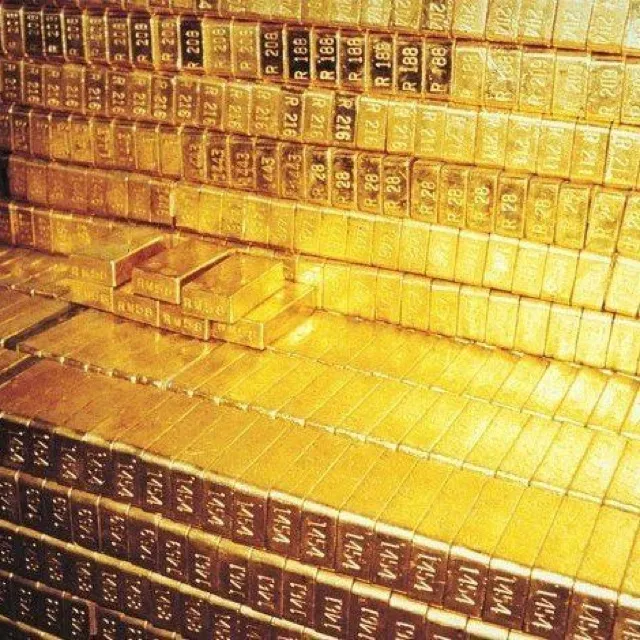
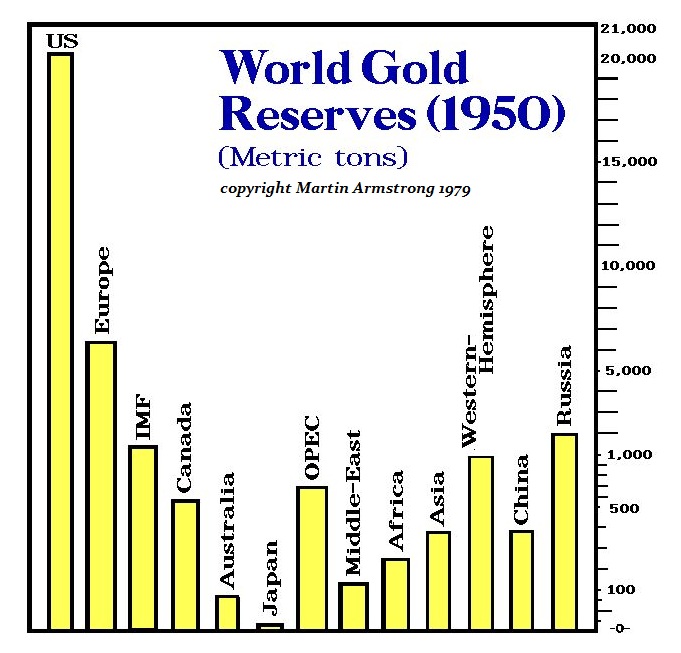
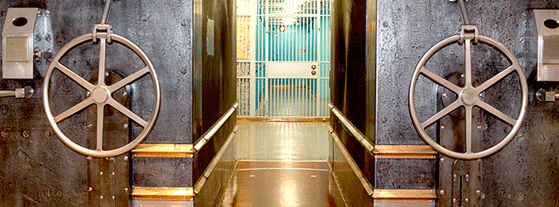
There has been ongoing speculation about America’s holdings of foreign gold reserves. Elon Musk’s request to audit Fort Knox pushed the issue into the headlines once more. Now, the new incoming German government is discussing pulling their gold reserves from the New York Fed due to a lack of transparency and the public is asking—where is the gold?
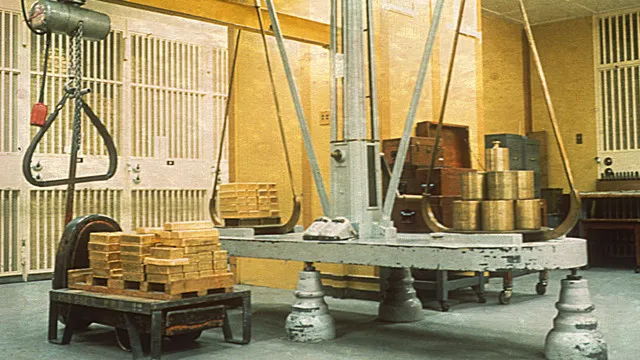
I personally toured the New York Fed many years ago, and while there is gold there, I cannot verify the quantity or quality; no one has ever accomplished such a feat. The last full audit of US gold reserves occurred in 1953 under President Eisenhower. Auditors from the US Treasury and Mint verified domestic and limited foreign-held gold at the New York Fed and Fort Knox. Third-party auditors were not permitted, but there were US Congressional observers. Treasury Secretary George M. Humphrey and Mint Director William H. Brett were in charge of overseeing this audit.
Now, the government declared the audit to be a “full” inspection. However, only 3 of the 22 compartments at Fort Knox were examined, accounting for only 13.6% of gold holdings. Around 88,000 bars (34.4M oz) were meticulously counted, and auditors weighed around 9,000 bars (130 tons). Only 26 gold bars, selected at random, were drilled to confirm purity. Auditors confirmed that US gold certificates matched physical holdings at the New York Fed, but due to limited sampling and a lack of transparency, suspicions rose. “We have no reason to believe other melts would differ [from assay results],” the joint commission stated.
The gold examined was mainly domestic. Germany’s holdings, for example, were not part of the audit. Public confidence in the US government was on the decline at this period amid Cold War secrecy. Around the same time of the audit, the CIA admitted it to Operation Ajax—a covert operation to overthrow Iranian Prime Minister Mohammad Mossadegh and install Shah Mohammad Reza Pahlavi. This was the first time that the US government openly admitted to orchestrating a coup and installing a leader in a foreign nation. How could the public and/or foreign nations trust the US under these conditions?
(Sources: Treasury 1953 Report, Sound Money Defense League, FRASER).
The GAO/Treasury conducted the next audit in 1974, reviewing 21% of gold holdings at Fort Knox. This occurred in the post-Bretton Woods period after Nixon abandoned the gold standard. Again, third-party auditors were not permitted to attend, and this time, auditors did not weigh bars. Some called the September 1974 examination a “show audit” and a publicity stunt as only 1 of the 13 vaults was examined. The “real” audit occurred the following month by a joint GAO-Treasury committee, but as mentioned, only 91,404 bars of 367,500 were examined. Random samples were tested for purity, but there was no assaying or weighing.
Continuing audits were ongoing, and the US government pledged to inspect 10% of its gold holdings annually from 1975 to 1983. As of 1985, the government stated it had audited 89% of its gold holdings, but only through seal verifications and limited sampling. Again, only the US government had access to these vaults.
The matter was ultimately laid to rest until 2012, when US politicians like Ron Paul and foreign governments demanded another audit. Germany was threatening to relocate their US holdings at the time due to a lack of transparency, and had been increasingly calling for an audit in the decades leading up to 2012. To appease doubters, the Treasury OIG conducted another limited audit.
The 2012-2013 NY Fed Audit scope included 34,201 US-owned gold bars (418 tons). Less than 1% (367 bars) were tested for purity. Auditors did not weigh the gold, nor did they conduct a full inventory. All compartments were to remain sealed unless they had reason to suspect tampering. Again, no independent assayers were admitted. Worse, foreign holdings were not inspected. Germany’s gold, for example, was not reviewed but they maintained trust in the US government despite some backlash.
Fast-forward to 2025: DOGE is uncovering government waste and mismanagement and has set its sights on Fort Knox. The US Treasury declared any audit a breach of national security. A true audit of Fort Knox, not including the NY Fed, would take 18-24 months and require 44,000 hours. Foreign governments now have a seemingly plausible reason to point their finger at the US and call “FOUL PLAY!”
Here’s the thing–no nation completely audits its gold holdings. The UAE, for example, implemented mandatory annual audits but only examined 10-20% of its holdings. There is limited transparency as their audits are classified, but they do permit third-party audits and follow London Bullion Market Association (LBMA) standards. Switzerland also follows LBMA standards and conducts regular audits, but auditors only check seals as there is no physical count. Switzerland is far more transparent about its auditing process, but again, they are only looking at a small percentage of overall holdings and not weighing or physically assessing the gold. Any nation could point the finger at another and question the validity of its stockpile.
As for US gold holdings, there have not been any official sales. If anything is missing, then that means it was stolen. However, the media is honing in on the US without understanding that no foreign nation conducts a full audit of their gold holdings. It all comes down to trust in the government, not only the current administration but every administration that has come to pass.
Posted originally on Apr 8, 2025 by Martin Armstrong
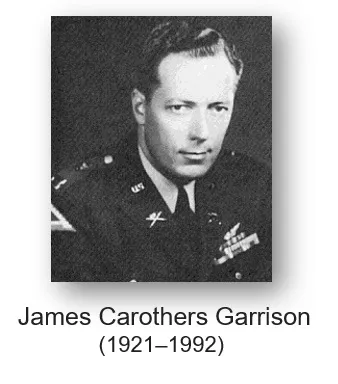
James Garrison served in the U.S. Army Air Forces during World War II, joining the year before the Japanese attack on Pearl Harbor. Jim Garrison’s military career trained him as a pilot and was assigned to the 8th Air Force in Europe. He flew reconnaissance missions over Nazi-occupied territories, contributing to intelligence-gathering efforts. His role involved photographing enemy positions and assessing bomb damage. By the end of the war, he attained the rank of lieutenant and was honorably discharged.
After WWII, Garrison joined the Louisiana National Guard while pursuing his legal education at Tulane Law School (graduated 1949). He remained in the National Guard throughout the 1950s, rising to the rank of lieutenant colonel. He retired from military service in 1957 to focus on his legal and political career. After the war, he obtained a law degree from Tulane University Law School in 1949. He then worked for the Federal Bureau of Investigation (FBI) for two years, stationed with the Seattle office.
His military experience informed his leadership style, but did not directly overlap with his later role as District Attorney of New Orleans (1962–1973). Garrison is better known for his controversial investigation into President John F. Kennedy’s assassination, which overshadowed his military contributions. Garrison’s military career demonstrated a commitment to service, though it remains a lesser-known aspect of his life than his legal and political endeavors.
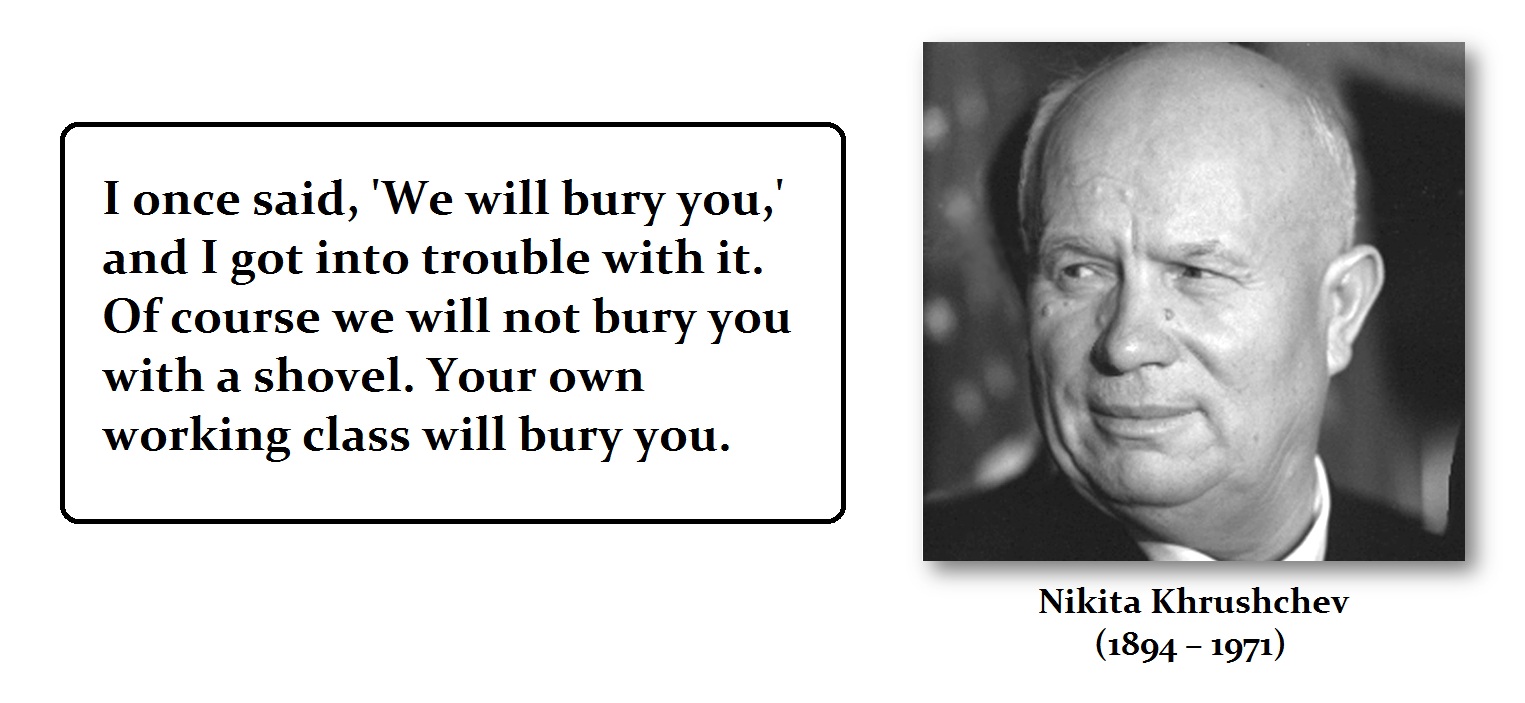
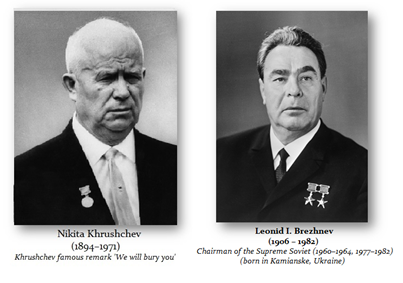
Jim Garrison stepped into the middle of the Neocons’ nest of corruption. During the 1960s, they were scheming to get us to (1) invade Cuba, and (2) invade Vietnam. In both cases, they assumed the Russians were behind both and with all of their conspiracy theories that Russia was trying to destroy the United States, thanks to Kruschev’s boast We will bury you, which launched their attempt to seize control of the United States’ foreign policy.
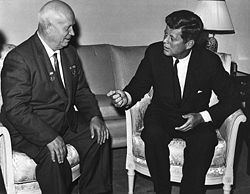
President Kennedy violated the NEOCON FIRST RULE – NEVER TALK TO A RUSSIAN!. Kennedy and Khrushchev first met at the Vienna Summit in June 1961. Before meeting face to face, their contact began when Khrushchev sent Kennedy a message on November 9, 1960, congratulating him on his presidential election victory and stating his hope that “relations between [the US and USSR] would again follow the line along which they were developing in Franklin Roosevelt’s time.”
There were some Russians who were anti-Khruschev and risked their lives to inform the US about his plans for Cuba and what became known as the Cuban Missile Crisis of 1962. What the Neocons ignored was that there was a coup in Russia to overthrow Khruschev. They hated all Russians, no matter what.
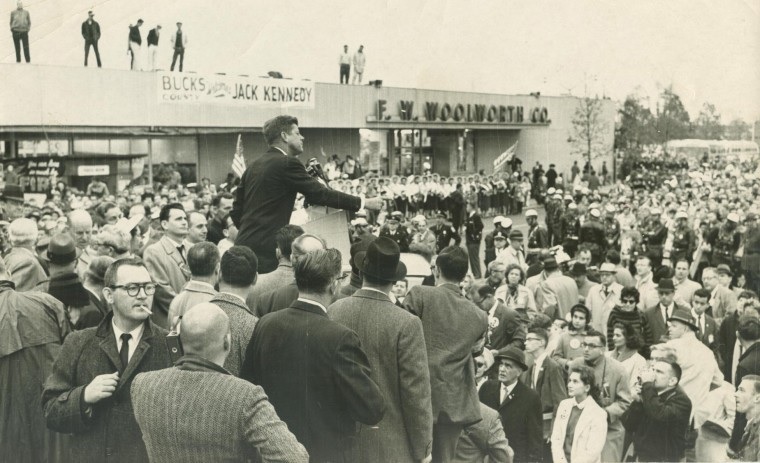
I was just 10 years old when my father took me to Willingborough, New Jersey, during the 1960 campaign to listen to JFK. I shook his hand, but unlike Bill Clinton, that did not make me want to become president. I remember the hatred of those days. First, it was that the Pope was going to run the United States because he was Catholic. Then later, I remember people calling him a traitor for meeting with Khruschev.
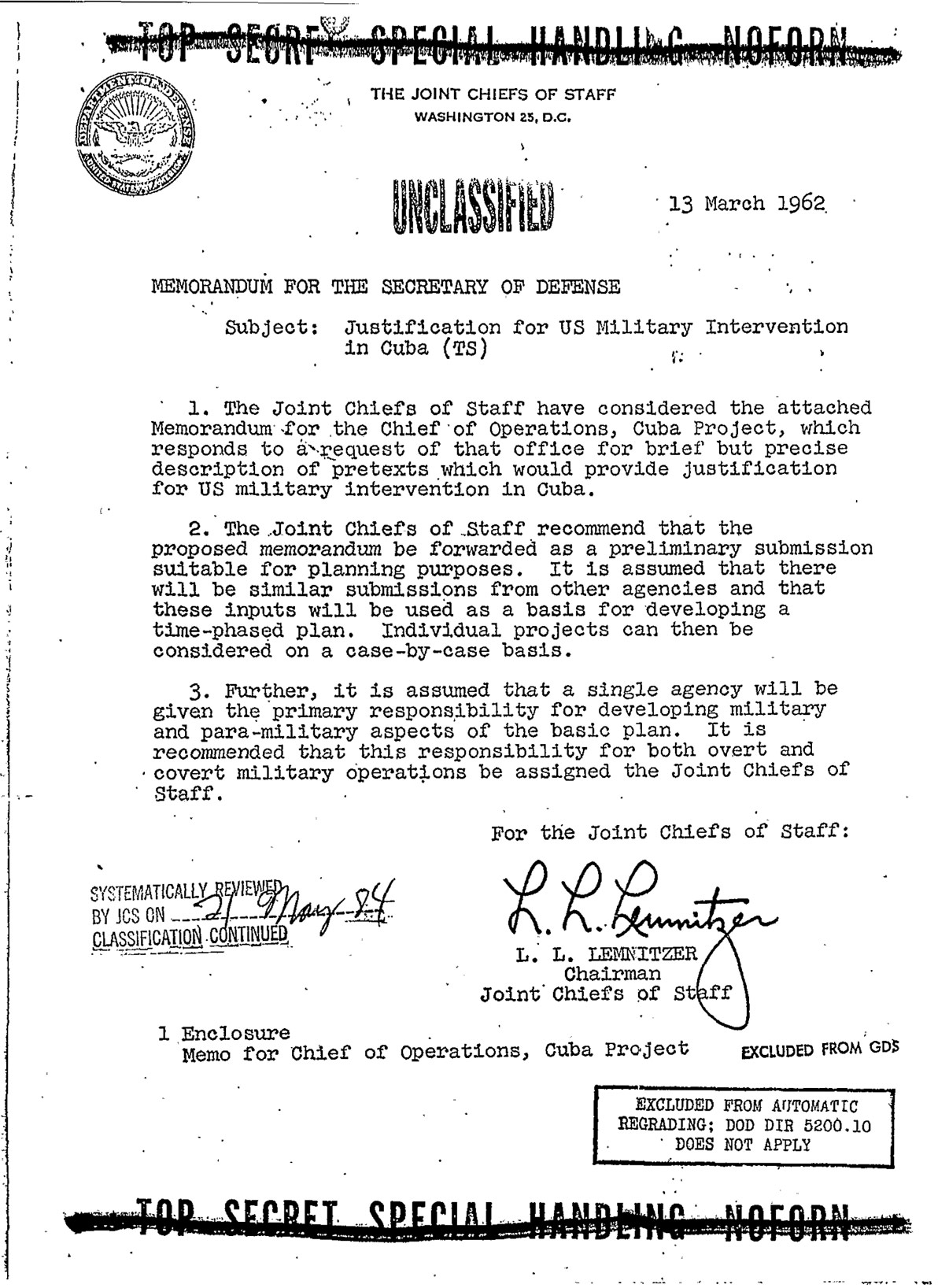
Then the CIA proposed on March 13th, 1962, to kill Americans to create a false flag to blame Cuba to justify an invasion. This was Operation Northwoods. JFK concluded that these Neocons were deranged, evil, and had no problem killing people to create war. He wanted to terminate the CIA. The CIA was pulling off covert operations that were never authorized. Established in 1961 by President John F. Kennedy to unite several foreign assistance organizations and programs under one agency, statute law places USAID under “the direct authority and policy guidance of the Secretary of State.”
The goal of this agency was to counter Soviet Union influence during the Cold War and to advance U.S. soft power through socioeconomic development. USAID was subsequently established by the executive order of President John F. Kennedy, who sought to unite several existing foreign assistance organizations and programs under one agency. Anyone dealing with Washington has always heard that this was a mega slush fund. It started with the CIA, but the Democrats used it to promote their Marxist agenda. Kruschev was right, our enemy would come from within. Despite Marxism failing every time, the Democrats still preach the class warfare hatred of Karl Marx.
Video Player
00:00
00:23
Then, on June 10th, 1963, after the Cuban Missile Crisis, Kennedy made what has been called his Peace Speech. That seemed to have been the turning point when I would hear people talking, calling him a traitor. Then, about 5 months later, the Neocons assassinated JFK. John F. Kennedy, the 35th president of the United States, was assassinated while riding in a presidential motorcade through Dealey Plaza in Dallas, Texas, on November 22nd, 1963
Beginning in March 1964, Supreme Soviet presidium chairman and thus nominal head of state Leonid Brezhnev began plotting Khrushchev’s removal with his colleagues. Brezhnev had initially considered having Khrushchev arrested for treason. Cooler heads prevailed, and it was decided that persuading members of the Central Committee to support the ousting of Khrushchev was the better choice to avoid civil war. Khrushchev was absent from Moscow between January and September 1964, allowing the dissent to fester inside Moscow.
Garrison said in response to an NBC program that was highly critical of his pursuit of the alleged Kennedy assassination conspirators in New Orleans. On July 15, 1967, NBC allowed Garrison to give that response on the air.
Oliver Stone’s famous film, JFK, followed the prosecution of Jim Garrison and the tremendous effort to cover up the assassination of Kennedy and the immense effort to exonerate the CIA and maintain that Oswald was a lone shooter. Oliver Stone did a second film, a documentary, JFK Revisited.
The day after Kennedy was assassinated, Johnson had a meeting about going to war in Vietnam, all because the Neocons assumed that Russia was behind that. Robert McNamara, before he died, apologized, saying that they were wrong – it was just a civil war, and Russia was not involved.
Some say there is an unanswered question about the following timeline:
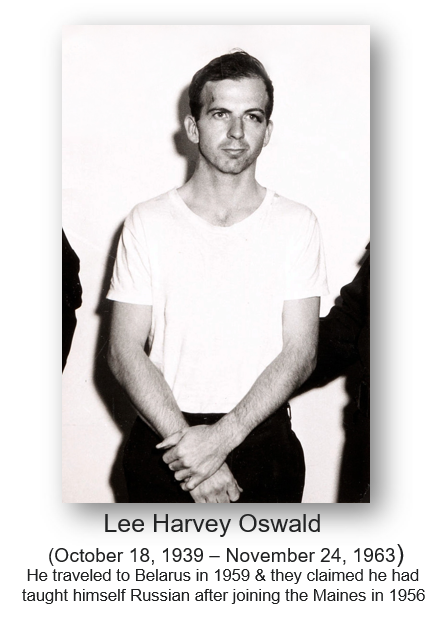
On March 1, 1967, Garrison arrested and charged New Orleans businessman Clay Lavergne Shaw with conspiring to assassinate President Kennedy, with the help of Lee Harvey Oswald, David Ferrie, and others.
On July 15, 1967, NBC allowed Garrison to give his response to NBC’s critical program about him.
On January 29, 1969, Shaw was brought to trial in Orleans Parish Criminal Court.
On March 1, 1969, a jury took less than an hour to find Shaw not guilty.
The question is, when did NBC obtain the evidence that Oswald could not have shot Kennedy, because NBC has a photo showing Oswald on the street at the time shots rang out? If that evidence was in the hands of NBC before July 15, 1967, then NBC let Garrison perform a dog and pony show when he gave his response to NBC’s “highly critical” program about him on air on July 15, 1967. If NBC obtained the evidence after July 15, 1967, but before January 29, 1969, it withheld crucial evidence from a criminal trial and thereby acquired every bad attribute, badge, and brand that anyone who withholds evidence must bear forever – obstruction of justice involving the assassination of a president.
After JFK’s assassination, Marina cooperated with authorities, including the Warren Commission. She testified that Lee owned a rifle resembling the murder weapon and acknowledged his pro-Castro sentiments and erratic behavior. Her testimony contributed to the Commission’s conclusion that Oswald acted alone.
Expressed Doubts Over Time:
In subsequent years, Marina began to express doubts. She questioned whether Lee could have acted alone and suggested the possibility of a conspiracy. In her 1978 book “Marina and Lee” and interviews, she speculated about external influences or a setup, though she did not outright deny his involvement.
Later Statements:
By the 1990s and 2000s, Marina continued to voice skepticism about the official narrative, emphasizing gaps in evidence and the plausibility of a broader plot. However, she stopped short of definitively exonerating Lee, often maintaining ambiguity about his exact role.
–
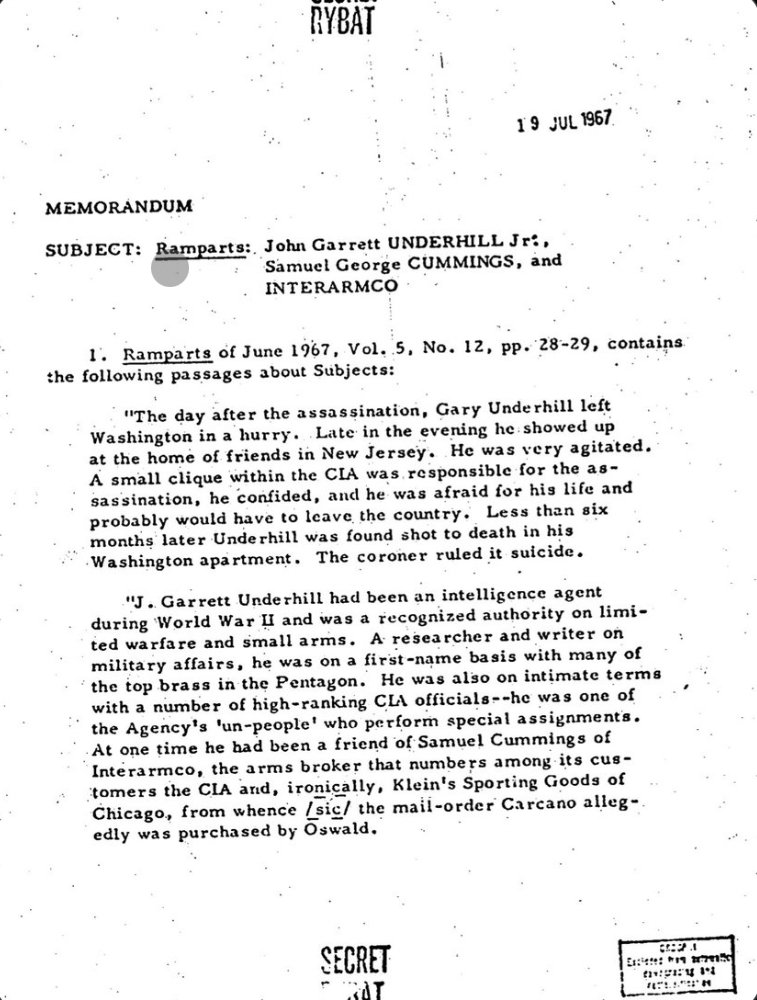
One document that the CIA has been hiding is the Gary Underwood document that states plainly that the CIA ASSASSINATED Kennedy. The reason this is important is that the Neocons are still running the show, lie about everything, and are in complete control of Europe, and are moving to achieve their ultimate goal – the total destruction of Russia, which is not fulfilling Ukraine’s ethnic cleansing of all Russians.
For example, Stone’s 1991 film “JFK” faced harsh pushback from historians for its suggestions that Kennedy’s death was the result of high-level conspiracies. Here, Oliver Stone appears after the most recent testimony before Anna Paulina Luna’s commission.
Conclusion:
Marina Oswald never categorically denied Lee’s involvement but evolved from initial cooperation with the official investigation to expressing persistent doubts about the lone-gunman theory. Her later remarks leaned toward skepticism, hinting at conspiracy possibilities without entirely absolving her husband.
World War III is unfolding before our eyes because the Neocons have been protected since the JFK assassination!
Posted originally on Apr 8, 2025 by Martin Armstrong
Some believe that Donald Trump is deliberately attempting to cause a sharp downturn in equities to force a flight into treasuries. If so, the Federal Reserve would have more of a reason to slash interest rates—Trump’s longstanding desire. Trump has stated that the markets are undergoing an “operation” of sorts, but I would not underestimate his long-term plan here.
Trump openly states that he wants companies to move manufacturing to the US to avoid tariffs. This will also promote domestic trade as companies will seek to avoid levies. US farmers will be incentivized to sell domestically, which could lower the price of groceries much to the pleasure of the American public.
The idea that a decline in the stock market could actually cause a flight into treasuries sounds counterintuitive on the surface, but when you understand how capital flows and confidence operate globally, it makes perfect sense. Capital moves globally and always seeks the safest place to park. Unexperienced and retail traders tend to panic at larger downturns and sell off.
Everything comes down to CONFIDENCE. A downturn in equities could cause a kneejerk reaction into treasuries because people still trust that the government will make good on their payments. Big institutional money began fleeing the public sector for the private sector years ago. What we have seen since the implementation of Trump’s tariffs is a new demand for treasuries.
The 10-year treasury yield dropped from 4.25% in late March 2025 to 4.01% by April 1, while the two-year fell to 3.68%. Billions have fled into the bond market since these tariffs were announced. JPMorgan, for example, said that there is now a 60% risk of a recession and is shifting toward the bond market.
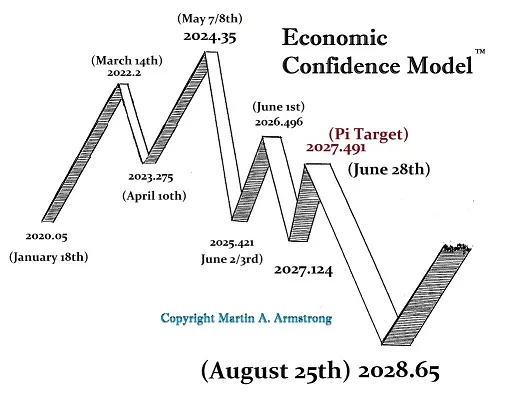
Lowering treasury rates will make homes more affordable by decreasing mortgage rates. Individual nations were fleeing US treasuries, creating a massive risk for an eventual default. Suddenly, at least temporarily, the stock market no longer seems like a safe place to park money. The Trump Administration first showed the world that it was cutting spending and attempting to reduce the deficit. A downturn in rallies DOES NOT guarantee a rally in the bond market, but we are witnessing a short-term flow into treasuries. However, the computer has warned that 2028 will mark a major turning point in confidence where any remaining confidence in government vanishes. For now, we may enjoy a temporary decline in treasury yields due to these tariffs.
Posted originally on Apr 8, 2025 by Martin Armstrong
PART II
QUESTION: Is he breaking the London metals dealers’ hold to suppress the gold price?
ANSWER: I am tired hearing the same constant bullshit about gold is suppress intentionally by dealers and that is why it is not $10,000. I have traded against these people for years. Here is a clip from the Forecast with Barclay, who used to work for me years ago, talking about how he checked me out before taking the job with Goldman Sachs.
Every manipulation that these dealers ever pull off was to the upside – not to suppress gold. They sell 10x more when people think gold is rising, not declining. This BS claim was explained that they were suppressing gold to help the government keep inflation in check. This is total BS!!!!!
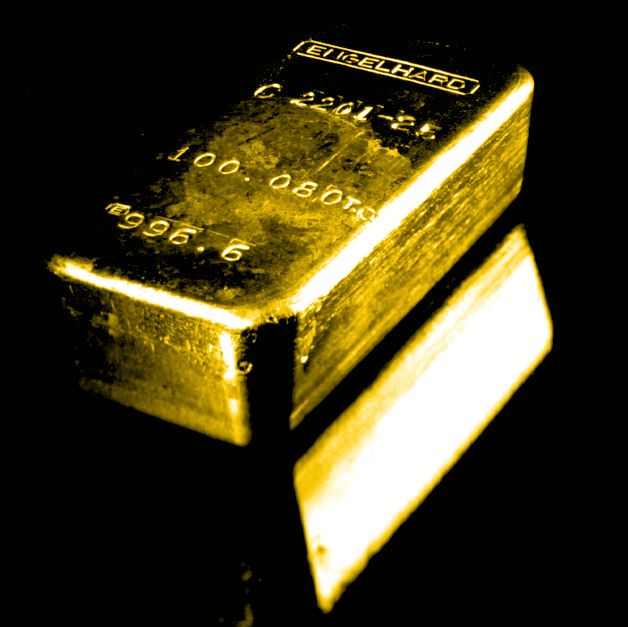
Back in the 1970s when I was one of the largest market-makers in gold, I was buying the scrap gold from stores in the country that people were selling to back then and refining it at Engelhard into 100-ounce bars for delivery into COMEX. PhiBro was who you would call to sell to Engelhard, locking in the prices. PhiBro made so much money that they bought Solomon Brothers, the bond house on Wall Street, and took the manipulation tactics to Wall Street, and then that blew up. That is when Warren Buffett stepped in to save the company, and that is how he got pulled into silver manipulation scams of the day.
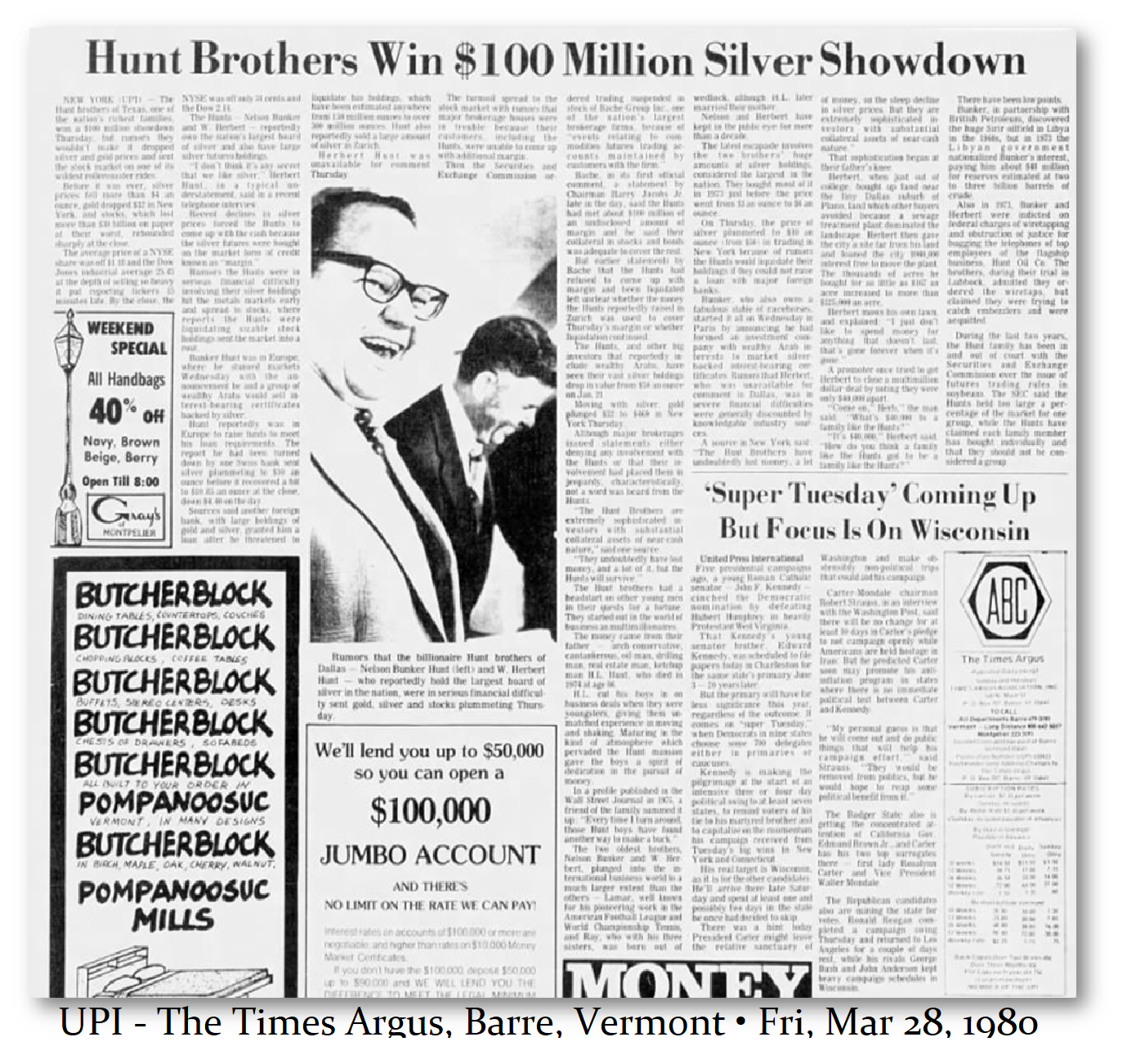
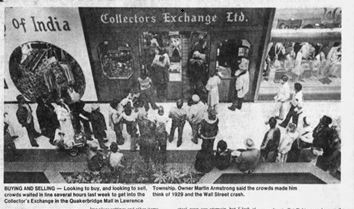
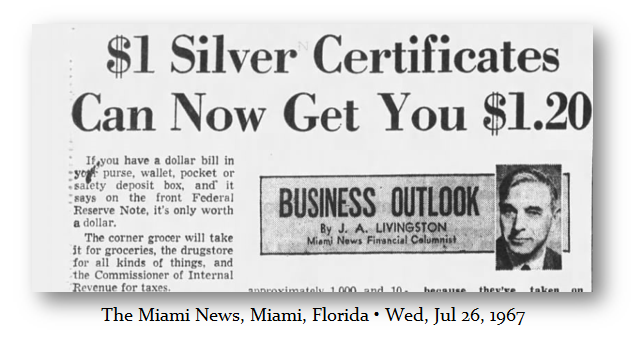
Nelson was one of my customers. In the early days, we bought silver certificates and redeemed them at the Treasury for 1,000-ounce bars. They generally had a permanent marker applied, often with two numbers, 102.6 and 120. The first implied it was 102.3 oz., and the second may have been the number of silver certificates it represented. Nelson was buying them when silver was $1.29. The U.S. Treasury primarily used 1,000-troy-ounce silver bars for the redemption of silver certificates. These bars were standardized for commercial and governmental use, aligning with industry practices for efficient storage and handling.
Historical Context: During the redemption period (late 1800s–1968), the Treasury managed large silver stockpiles, often stored in bulk. The 1,000-ounce size was practical for large-scale transactions and storage.
Commercial Standards: The 1,000-troy-ounce bar was (and remains) a common “good delivery” standard in precious metals markets, ensuring consistency in domestic and international trade.
Legislation and Practices: Acts like the Pittman Act (1918) and the Silver Purchase Act (1934) involved melting silver coins or purchasing bullion, likely using standardized bar sizes. The Treasury’s silver reserves, including those backing certificates, were held in forms compatible with industrial and monetary needs.
Thus, 1,000-troy-ounce bars were almost certainly the standard, though smaller denominations (e.g., coins) were also available for individual redemptions.
A funny story, I had $1 million credit line by the time I was 21 with the bank. It was funny because you did not have to deal with age or things like that. I had a business with employees and inventory, as well as sales. They granted you credit based on those things. They would assume I was older and just say, “You look good for your age.” I would just reply: “Thank you.”
I went to my local bank and wanted to borrow $2 million to buy silver. I told them I had a client, Nelson, who was going to take silver up dramatically. I may have even said $50 – I don’t recall. I told the bank they could hold the silver, which I thought made sense. I was turned down, and my banker called me in and explained that I should have just said it was for inventory, and I would have been approved. It was illegal for them to lend for speculation. For years, he told people that if he had bought silver himself, he could have retired by 1980.
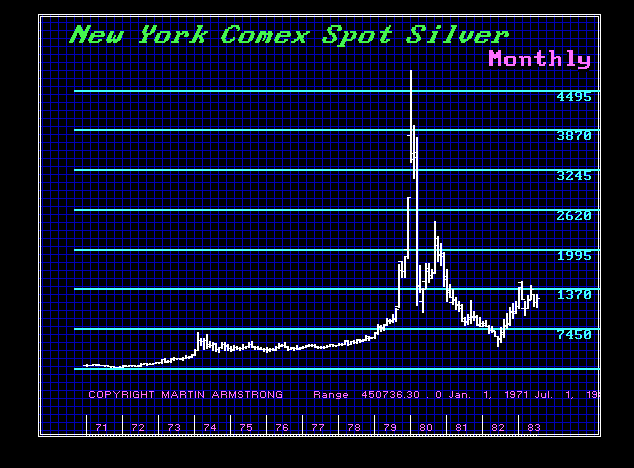
By February 1979, Hunt’s name was being thrown around all over the place, and they were saying silver was going to $100. That lured people in to buy, and they took silver up to test the $50 between February 1979 and January 1980. All the manipulations I have witnessed in the metals have been to lure people to buy, not sell, and suppress the prices. That is just stupid. Do they not make money by suppressing silver or gold to help the government? Come on.
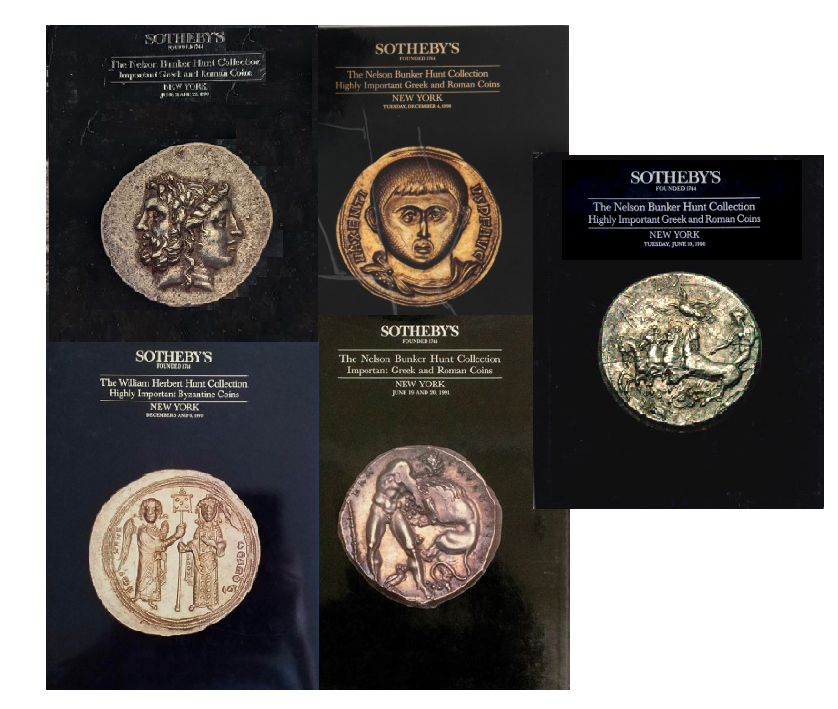
Nelson was also an avid ancient coin collector. Sotheby’s sold his collection, and it remains a significant sale often referred to. His collection ranked up there with J.P. Morgan and King Faruk.
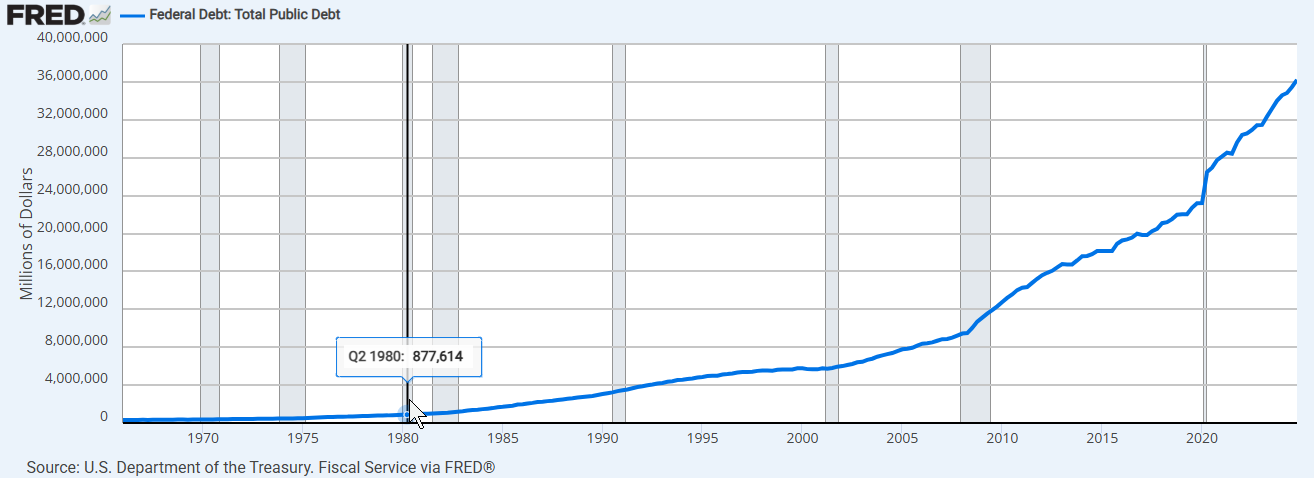
I have said countless times, gold rises NOT with inflation, but with geopolitical issues. Here was the National Debt Q2 1980 at $877.614bn. As of Q2 2024, it stood at $36,218bn. The debt has risen 40.29% since 1980. Gold hit $875 on January 21, 1980, in the cash market. If gold rose because of inflation or the debt level, then it should be $35,260 per ounce. The gold dealer could buy all of Wall Street with that price.
These people who make up these excuses are unbelievable. Gold pays no interest, which is why they lease it out. Otherwise, it is a dead asset that brings in no income. It is a hedge against the government in times of uncertainty—that’s it. It is not a hedge against inflation or the size of the debt. That has been a great sales pitch, but that is it.
Posted originally on Apr 7, 2025 by Martin Armstrong
QUESTION: Mr. Armstrong, you have said that we have lost manufacturing because of taxes rather than tariffs. I believe you also said that a trade deficit is not a bad thing under your capital flow analysis. Can you please explain this? The press seems to say the opposite, but they are political fake news.
Thank you
GG
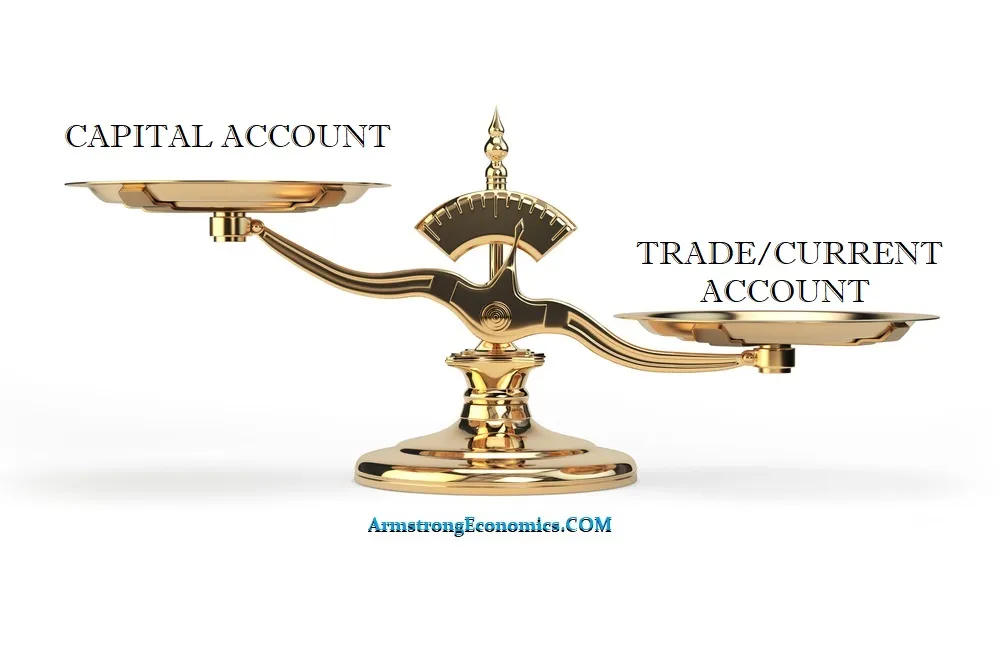
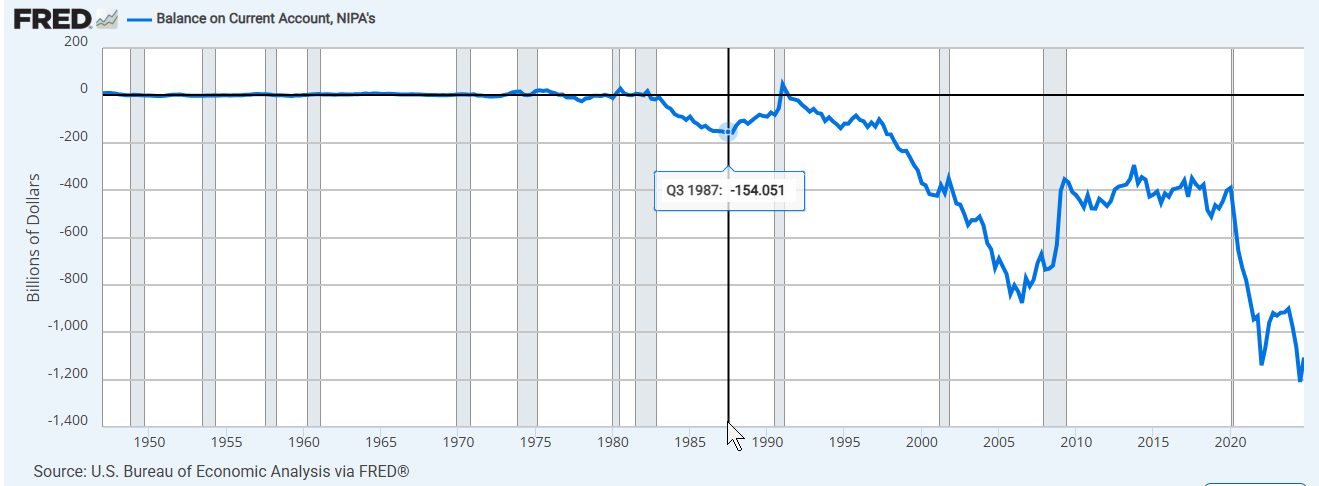
ANSWER: There are two account balances: the capital account and the trade/current account. Just because we have a trade deficit does not mean that it is negative for the economy. That is offset by the capital account, which is money coming in that is (1) foreign capital investing in the USA, from treasuries, shares, to real estate, and (2) US companies bringing capital home. Under Ronald Reagan, we had a rising trade deficit, but the economy was booming.
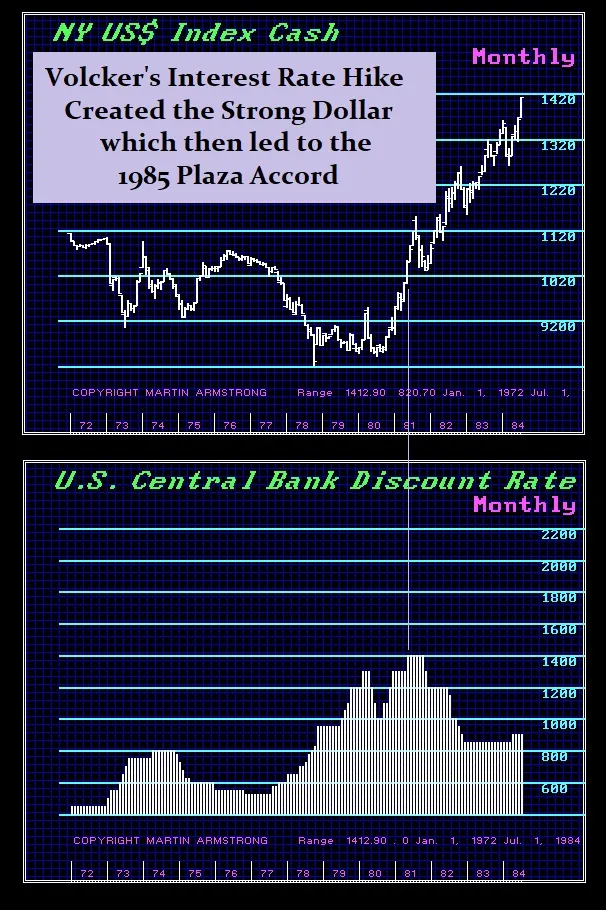
Volcker’s insane interest rates attracted foreign capital, causing the dollar to rise dramatically and sending even the British pound to nearly par in 1985. As the dollar rose, that brought down inflation, but it attracted foreign capital inflows. Interest expenditures flow through the current account when they flow outside the USA. That had nothing to do with goods or even services. It was interest payments on the debt.
The corporate tax rate in Michigan is a flat rate of 6% on federal taxable income (with certain adjustments) for C-corporations under the Corporate Income Tax (CIT), which replaced the Michigan Business Tax in 2011. The City of Detroit imposes a corporate income tax on businesses operating within its jurisdiction, a 2% tax on net income for corporations, and Michigan’s state corporate income tax rate of 6%.
If you look at where the US manufacturing hubs were, the local and state income taxes on top of federal taxes were the primary cause for manufacturing fleeing the USA. Add the fact that the Supreme Court ruled that because the federal income tax did not expressly exempt overseas income, that stupid decision meant Americans were subject to worldwide income on every level. I left New Jersey because if I held a conference in Hong Kong, I had to pay New Jersey 10% on top of the Feds for what? We held a conference in Philadelphia, and never again would I ever hold one there, for then I had to pay Philadelphia taxes, although I did not live or work there.
The Democrats make it sound like these corporations are greedy, and they go offshore because they get to pay $10 an hour instead of $20. That is the LEAST of the problem. It is always the taxes. You need accountants, and then lawyers, all to make sure to have crossed every “t” and dotted every “i” and all of these expenses are far more than anything you pay an employee. Now the latest is auditing you to see if you have “contract” employees instead of employees, since you do not take out taxes and match taxes on a contract employee. I just went through that audit, and it cost me $25,000 IN LEGAL AND ACCOUNTING FEES to prove I did not owe anything.
When the government looks in the mirror, it sees itself as all-powerful. It has no idea about humanity. It’s always about them and never the people. Just look at all the states where manufacturing used to be. They left, and it was not because they were paying someone else cheaper wages. The Democrats have blamed the “rich” and corporations for the damage that they have done to society, all for their corruption and greed.
The current account of the United States is a critical component of its balance of payments, reflecting the nation’s economic interactions with the rest of the world. It comprises four main elements. As you look at this list, you will see what I am talking about that this is by no means simply goods and services. All dividends, interest, and profits from multinational corporations that flow out to foreign investors. Thus, selling US Treasuries to foreigners expands the “trade” deficit as interest is paid. Since China has 10% of the US national debt and interest expenditures of $1 trillion, in theory, we send them $100 billion in interest. Tariffs are not going to reduce that, but they could result in selling domestic assets and returning that investment home, which would then go through the Capital Account, reducing the Trade/Current Account Deficit. The Press and even most Congressmen do not understand this.
1. Trade in Goods and Services (Net Exports)
Goods:
Exports: Physical products sold abroad (e.g., machinery, aircraft, agricultural goods).
Imports: Physical products purchased from other countries (e.g., consumer electronics, oil, automobiles).
The U.S. typically runs a trade deficit in goods due to high imports.
Services:
Exports: Financial, educational, tourism, and intellectual property services provided globally.
Imports: Services purchased from abroad (e.g., foreign travel, software licensing).
The U.S. often has a surplus in services, partly offsetting the goods deficit.
2. Primary Income (Net Income from Abroad)
Investment Income:
Earnings from U.S.-owned foreign assets (e.g., dividends, interest, profits from multinational corporations).
Payments to foreign owners of U.S. assets (e.g., interest on Treasury bonds held by foreign governments).
Compensation of Employees:
Wages paid to foreign workers in the U.S. (outflow).
Wages earned by U.S. residents working abroad (inflow).
3. Secondary Income (Net Current Transfers)
Government Transfers:
Foreign aid, grants, and donations (e.g., U.S. financial assistance to other countries).
Private Transfers:
Remittances sent by foreign workers in the U.S. to their home countries (outflow).
Gifts or inheritances received from abroad (inflow).
Current Account Balance
The sum of these components determines whether the U.S. has a surplus or deficit:
Deficit: The U.S. has run a persistent current account deficit, driven by:
A large goods trade deficit (imports > exports).
Outflows from secondary income (e.g., foreign aid, remittances).
Partial offsets come from services surpluses and primary income (e.g., returns on U.S. overseas investments).
Key Implications
Reflects the U.S. role as a net borrower globally, financing consumption and investment through foreign capital inflows.
Highlights structural economic factors, such as reliance on imports and the dollar’s role as a reserve currency, and exporting dividends and interest on US investments.
Posted originally on Apr 7, 2025 by Martin Armstrong
QUESTION: Mr. Armstrong, you have said that we have lost manufacturing because of taxes rather than tariffs. I believe you also said that a trade deficit is not a bad thing under your capital flow analysis. Can you please explain this? The press seems to say the opposite, but they are political fake news.
Thank you
GG
ANSWER: There are two account balances: the capital account and the trade/current account. Just because we have a trade deficit does not mean that it is negative for the economy. That is offset by the capital account, which is money coming in that is (1) foreign capital investing in the USA, from treasuries, shares, to real estate, and (2) US companies bringing capital home. Under Ronald Reagan, we had a rising trade deficit, but the economy was booming.
Volcker’s insane interest rates attracted foreign capital, causing the dollar to rise dramatically and sending even the British pound to nearly par in 1985. As the dollar rose, that brought down inflation, but it attracted foreign capital inflows. Interest expenditures flow through the current account when they flow outside the USA. That had nothing to do with goods or even services. It was interest payments on the debt.
The corporate tax rate in Michigan is a flat rate of 6% on federal taxable income (with certain adjustments) for C-corporations under the Corporate Income Tax (CIT), which replaced the Michigan Business Tax in 2011. The City of Detroit imposes a corporate income tax on businesses operating within its jurisdiction, a 2% tax on net income for corporations, and Michigan’s state corporate income tax rate of 6%.
If you look at where the US manufacturing hubs were, the local and state income taxes on top of federal taxes were the primary cause for manufacturing fleeing the USA. Add the fact that the Supreme Court ruled that because the federal income tax did not expressly exempt overseas income, that stupid decision meant Americans were subject to worldwide income on every level. I left New Jersey because if I held a conference in Hong Kong, I had to pay New Jersey 10% on top of the Feds for what? We held a conference in Philadelphia, and never again would I ever hold one there, for then I had to pay Philadelphia taxes, although I did not live or work there.
The Democrats make it sound like these corporations are greedy, and they go offshore because they get to pay $10 an hour instead of $20. That is the LEAST of the problem. It is always the taxes. You need accountants, and then lawyers, all to make sure to have crossed every “t” and dotted every “i” and all of these expenses are far more than anything you pay an employee. Now the latest is auditing you to see if you have “contract” employees instead of employees, since you do not take out taxes and match taxes on a contract employee. I just went through that audit, and it cost me $25,000 IN LEGAL AND ACCOUNTING FEES to prove I did not owe anything.
When the government looks in the mirror, it sees itself as all-powerful. It has no idea about humanity. It’s always about them and never the people. Just look at all the states where manufacturing used to be. They left, and it was not because they were paying someone else cheaper wages. The Democrats have blamed the “rich” and corporations for the damage that they have done to society, all for their corruption and greed.
The current account of the United States is a critical component of its balance of payments, reflecting the nation’s economic interactions with the rest of the world. It comprises four main elements. As you look at this list, you will see what I am talking about that this is by no means simply goods and services. All dividends, interest, and profits from multinational corporations that flow out to foreign investors. Thus, selling US Treasuries to foreigners expands the “trade” deficit as interest is paid. Since China has 10% of the US national debt and interest expenditures of $1 trillion, in theory, we send them $100 billion in interest. Tariffs are not going to reduce that, but they could result in selling domestic assets and returning that investment home, which would then go through the Capital Account, reducing the Trade/Current Account Deficit. The Press and even most Congressmen do not understand this.
1. Trade in Goods and Services (Net Exports)
Goods:
Exports: Physical products sold abroad (e.g., machinery, aircraft, agricultural goods).
Imports: Physical products purchased from other countries (e.g., consumer electronics, oil, automobiles).
The U.S. typically runs a trade deficit in goods due to high imports.
Services:
Exports: Financial, educational, tourism, and intellectual property services provided globally.
Imports: Services purchased from abroad (e.g., foreign travel, software licensing).
The U.S. often has a surplus in services, partly offsetting the goods deficit.
2. Primary Income (Net Income from Abroad)
Investment Income:
Earnings from U.S.-owned foreign assets (e.g., dividends, interest, profits from multinational corporations).
Payments to foreign owners of U.S. assets (e.g., interest on Treasury bonds held by foreign governments).
Compensation of Employees:
Wages paid to foreign workers in the U.S. (outflow).
Wages earned by U.S. residents working abroad (inflow).
3. Secondary Income (Net Current Transfers)
Government Transfers:
Foreign aid, grants, and donations (e.g., U.S. financial assistance to other countries).
Private Transfers:
Remittances sent by foreign workers in the U.S. to their home countries (outflow).
Gifts or inheritances received from abroad (inflow).
Current Account Balance
The sum of these components determines whether the U.S. has a surplus or deficit:
Deficit: The U.S. has run a persistent current account deficit, driven by:
A large goods trade deficit (imports > exports).
Outflows from secondary income (e.g., foreign aid, remittances).
Partial offsets come from services surpluses and primary income (e.g., returns on U.S. overseas investments).
Key Implications
Reflects the U.S. role as a net borrower globally, financing consumption and investment through foreign capital inflows.
Highlights structural economic factors, such as reliance on imports and the dollar’s role as a reserve currency, and exporting dividends and interest on US investments.
I have created this site to help people have fun in the kitchen. I write about enjoying life both in and out of my kitchen. Life is short! Make the most of it and enjoy!
This is a library of News Events not reported by the Main Stream Media documenting & connecting the dots on How the Obama Marxist Liberal agenda is destroying America








 Centinel2012