Economic Growth is the only way out of the mess we are in!


Is Income Growth for the Bottom 90% Prosperity or Inflation?

Can an Economy Grow Without Inflation?


It is commonly taught that we need a stable increase in prices in order for our economy to grow.  We are told, after all, gold does not expand quick enough to accommodate rapid economic gains.  But is it possible for an economy to grow without inflation?  Not only that, can an an economy grow when prices are actually deflating?

This common inflation argument seems to ignore the greatest economic expansion in the history of the world – the industrial revolution.  During the late 1800’s the American economy was booming.  The living standard of the average man increased faster than any time frame compared to today.  While I agree that no one wants to go back and forgo all the advances that have come since, it is irresponsible to ignore the shoulders on which we now stand.

I have heard from multiple intelligent people that they just don’t believe me.  They say that our economy could not have grown quicker during the industrial revolution than any time since, and are commonly under the impression that poverty increased during the Gilded Age.  But if you are to compare apples to apples, the industrial revolution experienced more growth than any time frame.  The middle class was created during late 19th century.  In 1800 the average American was a farmer, destined to a short life of poverty.  By 1900 that had all changed.

Please refer to the graph below.  We take into account 3 different – 25 year time frames in American history: 1878 – 1903, 1946 – 1971, and 1987 – 2012.  If the time following the second world war was actually a larger expansion in the economy and living standards of citizens, you would expect a larger increase in both life expectancy and average income per person.

Economic Expansions over 25 Year Periods

According to the information found at GapMinder, it is very clear that the time preceding the Federal Reserve was actually a larger economic expansion in every measurable way (these numbers are inflation adjusted).  When you take a look at the information on that site, it is clear the average income and life expectancy is greater today than in 1903, which is why no one would want to go back to that time (straw-man argument).  The point is, if we were to see the same economic expansion during the late 20th century as we had during the late 19th century, we would all be living much longer with a much larger income per capita today.

It is also important to note that we do not feel GDP as a good indicator of economic growth, especially since it includes government spending.  But even using the government’s GDP numbers, the fact still remains.  The only thing that would change this chart is if you included World War 2, since the massive government programs exploded GDP.  But it is obvious that when food is being rationed, the living standards are not increasing for the average person.

Let us not ignore the third part of this graph, the value of the dollar.  After the Civil War ended and we no longer printed greenbacks, our country relied on a hard money standard without any central bank.  We experienced some boom and busts (though I attribute that to legalized fractional reserve theft), but by any standard they were not as long nor as severe as the recessions experienced since.

No matter the source, you will find $1 held in 1878 would buy you far more goods in 1903.  This means the value of the dollar INCREASED and we experienced a DEFLATION of prices.  This goes against all economic theory you have been likely been taught.  While our economy did not expand nearly as quickly, the two other 25 year periods experienced roughly 50% devaluation of the dollar (or 50% inflation of prices).  This is using the government’s own CPI numbers, and many would consider that we actually experienced far more price increases during the 1987 – 2012 time frame (due to the manipulation of the CPI calculation).

History is not on the side of modern day Keynesian economists.  Yes life is better now, society is more accepting of different behaviors and ethnicities, but that cannot ignore the growth we experienced and the shoulders on which we now stand.

Martin Armstrong – Sovereign Debt Collapse Coming Later In 2015


If Martin Armstrong says 2015 is the year I would not bet against him!

Adding Up the Swiss Franc Fallout


It’s looking more and more like 2015/16 will see a 2007/08 style adjustment but this time its likely to be even worse.

How the Yuan-Dollar Currency Peg Ends


This is exactly what is happening and one of the problems with pegged or fixed exchange rates; they work for a while and then the system collapses and we are at that point now.

One World Reserve Currency


Electronic-Money

QUESTION:

Martin,

I must take issue to the answer you gave on Jan 19th to the crypto currency and one world currency question. Mainly the first sentence. You said “ A one world currency seems to be the only POLITICAL solution”. I see that you highlighted the world political. Can you please explain your reasoning for this? My problem with a one world currency is, who would be in control of that currency the IMF? No thanks. This would be the most disastrous outcome in my opinion. (not saying that it won’t happen) Concentrated power is always a bad idea. I believe if they (the powers that be) pull this off we will be one step closer to a one world SOCIALIST government. If a one world currency is the only POLITICAL solution what would, in your opinion be the FREE MARKET SOLUTION?

BM

ANSWER: An agreed upon one-world RESERVE currency would perhaps be a basket. I too am concerned who would be in control. I can say that the IMF is posturing already for that position. There will be the installation of corruption if the the IMF takes control. This is not my personal CHOICE. This is not about my OPINION, it is simply what is unfolding. I am certainly no fan of the IMF.

Nevertheless, the Free Markets would still prevail for each country’s currency would then float against the reserve. This would be the political solution for the major countries could then agree. The problem when one nation’s currency becomes the default world reserve currency (Babylon, Athens, Rome, Britain, Spain, France, USA, etc..), their domestic policy objectives become forced upon the world.

Just as the USA is scared to death of deflation as in the Great Depression and immediately stimulates, the Germans are obsessed with the hyperinflation of the 1920s and keep subjecting themselves and the rest of Europe to austerity (deflation) even at the expense of 60%+ unemployment. Both fight the FREE MARKETS to their own self-destruction. You can die from extreme cold as well as heat. The answer lies in between – never at the extremes of either philosophy.

We are headed into the vortex of fiscal mismanagement. The outcome will be the solution of creating a one-world currency.

The American Dream Goes Bust, KB Home Wrecked, Other Homebuilders Follow


KB Home, one of the largest homebuilders, reported earnings on Tuesday. It was all hunky-dory. Shares rose 3.6% in premarket trading. But then, at 11:30 AM ET came the conference call. And what these folks said about the housing market wrecked KBH. The carnage spread to other homebuilders and torpedoed a big-fat rally in the broader market.

So what the heck is going on in this glorious housing market of ours?

Since the implosion of the housing bubble, we the people bailed out Fannie Mae and Freddie Mac. We had home-buyer tax credits from state and federal governments. We got HAMP, HARP, mortgage write-downs, and banks that were delaying foreclosures to pump up prices. We got the Fed’s ZIRP, QE-1, QE-2, “Operation Twist,” and QE-3, during which the Fed purchased mortgage-backed securities, in addition to Treasuries,  to repress long-term interest rates, including mortgage rates, to goose home prices. We got multi-billion dollar fines and settlements from TBTF banks who never admitted any wrongdoing. We got private equity funds pouring the Fed’s free money into the housing market, buying up hundreds of thousands of single-family homes to rent them out and drive up their prices.

After all these trillions and taxpayer guarantees and no-cost capital for Wall Street, you’d think the housing market would be in great shape with first-time buyers, the bedrock of a sound housing market, flooding the scene to buy homes at affordable prices, borrow like mad to equip them with furniture and appliances, and push the economy to the next level.

Instead, home prices have jumped – in some hot areas, such as San Francisco, far above the crazy levels of the prior housing bubble. Homes have become unaffordable for many people. Sales are languishing. And everything is off kilter.

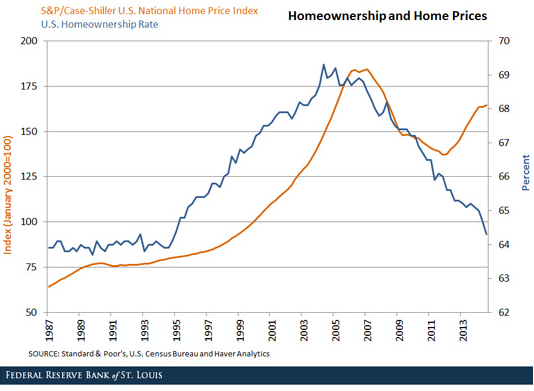
But one thing these heroic efforts did accomplish: they managed to decouple the relationship between homeownership rates and home prices. Ever since the post-war boom, there had been one constant: higher homeownership rates led to higher prices. The principle held during the Financial Crisis when homeownership rates and prices fell in sync. Then, as the heroic efforts to heal the housing market kicked in, home prices began to soar, and homeownership? It dropped relentlessly.

“The first national housing boom in the postwar era that has not been supported by an increased demand for owner-occupied housing,” that’s what a report by the St. Louis Fed called it.

In this chart from the report, homeownership rate (blue line) peaked in 2005 at 69%, “accompanied by a steep increase in home prices,” namely the housing bubble, as depicted by the CaseShiller home price index (orange line).

US-homeownership-v-home-price_StLouisFed

The biggest decline in homeownership was among households headed by individuals age 35 and under, hence “first-time buyers,” the report explained, concluding that it’s now “possible to have housing booms driven entirely by investors.” And the chart depicts how America has changed from a nation of homeowners chasing the “American Dream” to a nation where Wall Street is the biggest landlord.

This is the environment homebuilders are facing.

So KB Home reported that revenues for the fourth quarter, ended November 30, increased 29% from a year ago to $796 million, due to two factors: deliveries increased 9%; and the average selling price soared 17% to $351,500. Orders and backlog were up as well. Net profit jumped to $852.8 million, a feat accomplished via a tax benefit of $824.2 million. Without the tax benefit, the profit was $28.6 million, up a smidgen from a year ago. Those numbers lit a fire under the shares, and they rallied premarket and in early trading before they lost steam.

At 11:30 AM came the conference call.

CEO Jeff Mezger said that during the prior earnings call, he’d still expected “a slow yet steady recovery” of the housing market, and that gross profit margins would improve sequentially going forward. But the opposite happened. There was a “softening in demand” and “increased pricing pressure” while costs of labor and materials were rising (transcript, Seeking Alpha).

CFO Jeff Kaminski added that the average selling price had increased 18 quarters in a row on a year-over-year basis, but for Q1 he projected it to drop 7.5% to $325,000.

This is the toxic mix that hit them: They delivered fewer homes than “previously expected.” Given “tighter market conditions,” they had to cut prices and throw in more sales incentives. And “cost pressures” were building up in labor and materials.

So adjusted gross margin edged down to 18.7%. It would continue to be lower “for some time,” Mezger said. Year-over-year, Q1 gross margin will “drop significantly,” before ticking up during the rest of the year, but it won’t reach the “goal of 20% in 2015 as we have hoped.”

There was one more thing: California.

The company booked inventory impairment charges of $34 million. Of that, $23 million was for some land in the Coachella Valley area, near Palm Springs in Southern California. The remaining $11 million were for other areas in inland California and also in Arizona. While coastal California is booming, with the Bay Area being “as good as it’s ever been,” the inland areas – the Inland Empire in Southern California and the Central Valley – were “quite a bit softer than they have been.” And so they had to pile on sales incentives and slash prices in “the magnitude of 8% or 10%,” he said. “It hit pretty hard out there.”

And it’s “possible” that there would be “additional impairments in the future,” he said.

Then there’s Orange County, a wealthy enclave. It “softened a little,” he said. He blamed the “Chinese buyer.” Real estate agents were steering them to resale homes because they were a better deal, after new home prices had ballooned so much. And as Chinese demand wanes, “it ripples inland, and the further inland you go the more the ripple is felt….”

KBH had traded in the green for part of the morning, while the Dow was up over 200 points. But word of what was in the script must have leaked out, and KBH soon turned red. The conference call started at 11:30 AM ET. At 11:36 AM, as Mezger was reading off the script, KBH began to plunge in a nearly straight line then zigzagged down further to lose 16% for the day, and 44% for the last eight months.

Other homebuilders, after rallying, got hammered too. DR Horton dropped 4.8%, Lennar 1.7%, PulteGroup 2.5%, and the iShares US Home Construction 2.5%. The Dow began losing its grip at about 10 AM and dove over 400 points peak-to-trough, then bounced off and settled 27 points in the hole.

Broader home sales have been terrible. The bitter irony of the Fed’s handiwork. Read… Last Time Inflated Home Prices Strangled Sales Like This, the Housing Market Crashed 

Capitalism – Socialism – Communism


Armstrong Economics
Posted on January 10, 2015 by Martin Armstrong

CAPITALISM

The business cycle is critical to understand. The difference between Capitalism and Socialism is simple. Capitalism is where you are free to decide what you do with your money, and Socialism is where government orders you what to do with their money, which you earn. The difference between Communism and Socialism is clever. The former “owns” everything and the latter you own it but they tax it and if you cannot pay the tax they take it.

Socialism/Communists try desperately to paint capitalism as the benefit of the greedy rich. People see the bankers as manipulating government but this is not inherent in capitalism, that is the corruption that infects all republics. A republic ALWAYS devolves into an oligarchy, which is not freedom and is not capitalism. Russia moved from communism to oligarchy and that is why it did not really boom as did China, which moved to capitalism.

For capitalism to work historically, it must embrace freedom and that can ONLY be accomplished by a true democratic system. Once you have career politicians who are elected perpetually, that opens the door to oligarchy. If China has a political class of professional politicians who do not need money to get reelected, then this defeats the oligarchy evolution for they do not require money to maintain power.

The elections of 53BC in the Roman Republic saw interest rates double because corrupt politicians had borrowed so much money for bribing votes. This is the oligarchy tendency that destroyed the Roman Republic.

McDonald’s Replacing Cashiers with Touch-Screen Tablets – Another Idiocracy Prophecy Come True!


When wages get too high or work rules to restrictive the answer is automation and the result is no jobs!

Putin Kills “South Stream” Pipeline, Will Build New Massive Pipeline To Turkey Instead


Nothing in this post is good for either the EU or America.