Posted originally on CTH on March 25, 2026 | Sundance
The rebranded Lyndon LaRouche PAC has another good outline on the new strategic alliances assembled by President Trump as the ongoing conflict with Iran continues.
Susan Kokinda reviews how the United Kingdom and Europe have been sidelined as President Trump directly negotiates with key stakeholders in the middle east and Asia. Kokinda correctly notes the messaging from Russia indicates a strategic awareness that old systems are fracturing and the potential for new strategic alliances is rising.
“Susan Kokinda argues President Trump has opened a new diplomatic space to de-escalate the Iran conflict by working through a regional roster—Saudi Arabia, Egypt, Turkey, Pakistan, Gulf States, and back channels into Iran—while the U.K., EU, and NATO are absent and increasingly irrelevant. Citing reporting that ministers met in Riyadh and that Egypt, Turkey, and Oman carried messages, she says this “Board of Peace” architecture is isolating Iran and weakening its proxies, pointing to Lebanon’s move against Hezbollah, the Palestinian Authority’s condemnation of Iran, and Hamas considering disarmament. Kokinda links Europe’s exclusion to self-inflicted energy weakness from Green and anti-Russia policies, noting rushed LNG moves and a delayed Russian oil ban vote. She concludes Ukraine’s outlook darkens as Europe and Britain lack leverage, highlighting Zelenskyy’s scramble for support in London and Washington.” WATCH:
Posted originally on Mar 12, 2026 by Martin Armstrong |
Saudi Arabia is doing precisely what governments do when they understand that the world is no longer stable: buying protection, influence, and time. Washington likes to pretend that Riyadh is suddenly a loyal ally because it is investing in the United States, helping Ukraine, and quietly aligning against Iran. Saudi Arabia is not acting out of friendship. It is acting out of self-interest, and that is exactly how nations survive when the world moves into a war cycle.
The money alone tells you this is not a symbolic relationship. The White House said in November that Saudi Arabia’s investment commitment into U.S. infrastructure, technology, and industry had risen to nearly $1 trillion, up from the $600 billion first announced in May 2025. At the same time, Treasury and the Saudi finance ministry signed frameworks on financial and economic partnership and capital-markets collaboration. Washington also packaged this together with civil nuclear cooperation, critical minerals, AI, and defense deals, including future F-35 deliveries and an agreement for Saudi Arabia to purchase nearly 300 American tanks. Riyadh is tying itself to the American industrial base, the American financial system, and American defense production because that is how you secure leverage in Washington.
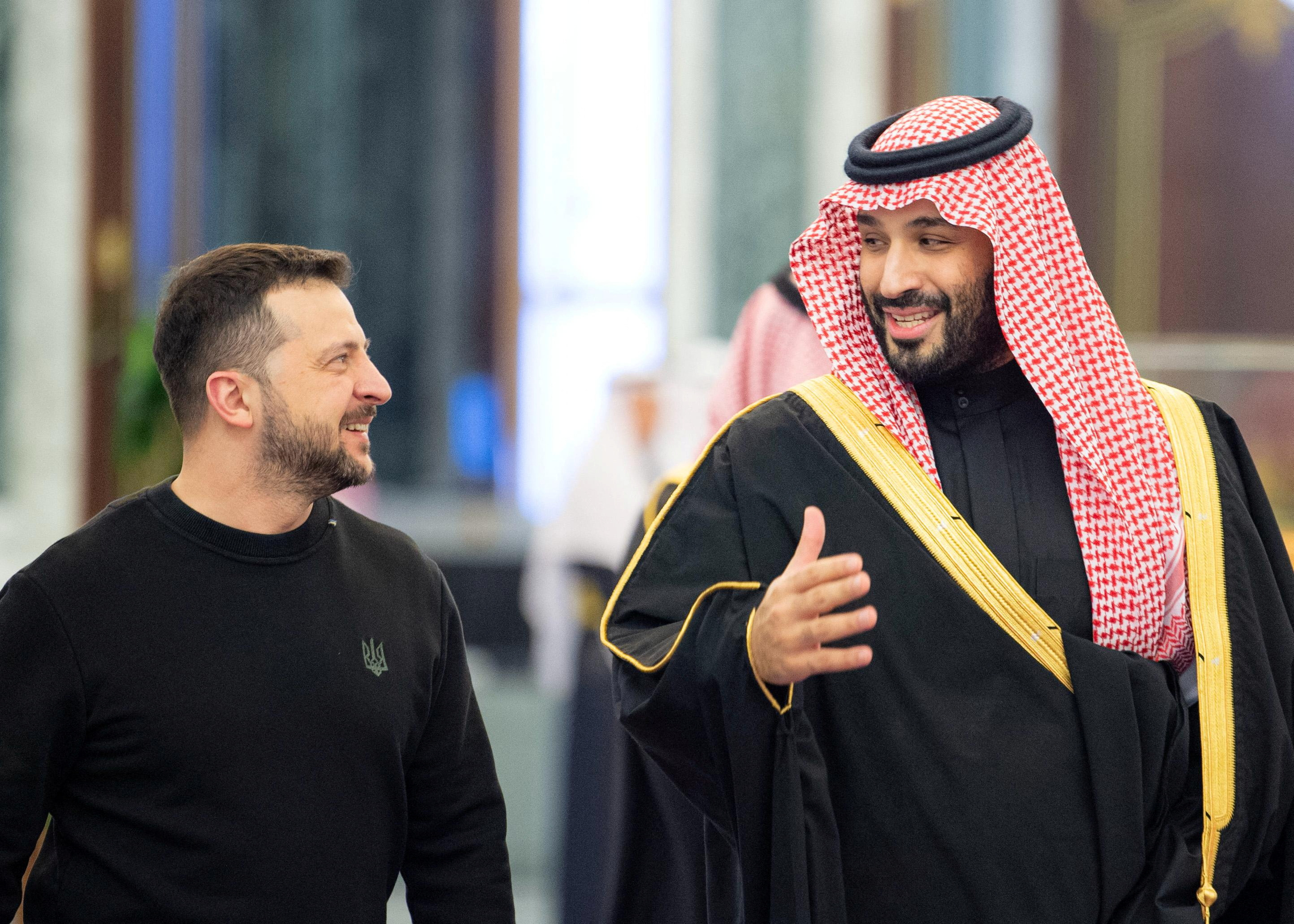
At the same time, Saudi Arabia is now moving on the Ukrainian side in a way that would have been unthinkable a few years ago. According to the Kyiv Independent, a Saudi arms company has signed a deal to buy Ukrainian-made interceptor missiles, and Ukrainian industry sources said Riyadh and Kyiv were negotiating a separate “huge deal” for arms that could be finalized this week. Zelensky also said he had offered Crown Prince Mohammed bin Salman Ukrainian help in intercepting Iranian Shahed drones, arguing that no country has more practical experience against them than Ukraine. Saudi Arabia is looking at the Gulf and seeing the same Iranian drone threat Ukraine has been dealing with for years. Riyadh is shopping for battlefield-tested systems because it believes the drone era is now on its doorstep. The one caveat is that the weapons-deal reporting rests on anonymous defense-industry sources, so the broad direction is clear even if the final size of the package is not yet publicly verified.
This also explains why Saudi Arabia is helping the United States against Iran while still trying to avoid being publicly dragged into a regional inferno. Reuters reported that after Iranian missile and drone strikes hit Gulf states hosting U.S. bases, including an attack targeting the U.S. embassy in Riyadh, the Saudi cabinet said it would take all necessary measures to defend its security and protect its territory, citizens, and residents. That is the language of a country that understands neutrality has limits. Saudi Arabia wants to contain Iran, and make sure Washington keeps treating the kingdom as indispensable.
The International Energy Agency says the Strait of Hormuz carried an average of 20 million barrels per day of crude oil and oil products in 2025, roughly 25% of the world’s seaborne oil trade. Of that, Saudi Arabia alone accounted for about 6.23 million barrels per day transiting Hormuz in 2025. Yes, Saudi Arabia has the East-West pipeline to Yanbu on the Red Sea, and the IEA estimates that only Saudi Arabia and the UAE have operational crude pipelines that can meaningfully bypass the Strait, with a combined 3.5 to 5.5 million barrels per day of alternative capacity. But that is the key point: the bypass capacity is limited compared with the scale of what normally moves through Hormuz. Riyadh can reroute some oil, but it cannot magically make the chokepoint disappear.
Saudi Arabia strengthens its position as the world's oil central bank.
Aramco announces East-West pipeline enables export rerouting up to ~7mb/d capacity. “We ramped up production through the East-West pipeline, which has a capacity up to 7 mb/d. Approximately 2 mb/d will be… pic.twitter.com/Gbha1eZyiL
That is why oil is the real story here. Reuters reported that OPEC+ agreed on March 1 to raise output by 206,000 barrels per day for April, even as war with Iran disrupted Gulf shipments, and that Saudi Arabia had already been increasing production and exports by around 500,000 barrels per day in preparation for U.S. strikes. Yet the IEA also notes that the world’s spare crude production capacity was running at just over 4 million barrels per day in late 2025 and that this spare capacity is primarily held by Saudi Arabia. In other words, Saudi Arabia remains the swing producer, but the market is now being reminded that swing capacity is useless if export routes are threatened. Spare barrels in the ground do not calm a market when the shipping lanes are in question.
Aramco’s own numbers show why Saudi Arabia is still the central energy power in the region. The company reported adjusted net income of $104.7 billion for full-year 2025, operating cash flow of $136.2 billion, free cash flow of $85.4 billion, and capital investment of $52.2 billion in 2025, with 2026 capital spending guidance of $50 billion to $55 billion. That is not a weak state oil company limping along. That is a cash machine financing the kingdom’s geopolitical flexibility. But even Aramco has warned about the economic consequences if this war drags on, and reports today indicate the company is racing to redirect exports via Yanbu, which can handle around 5 million barrels per day versus the roughly 7 million barrels per day Saudi Arabia normally exports.
Saudi Arabia understands something Washington still refuses to admit. This is not a transitory war, and these are not transitory prices. Saudi Arabia is investing in the United States because capital always runs to the power center it believes can still protect it. It is buying Ukrainian anti-drone technology because the Iranian threat is no longer theoretical. It is helping the United States against Iran because if Tehran can intimidate the Gulf monarchies, the entire regional balance of power changes. And it is guarding its oil with extreme caution because oil is not merely revenue for Saudi Arabia. Oil is the kingdom’s strategic sovereignty.
Posted originally on CTH on November 20, 2025 | Sundance
President Donald Trump and Saudi Arabia Crown Prince Mohammed bin Salman attended a U.S-Saudi investment forum and delivered remarks to the assembled business audience.
Posted originally on CTH on November 18, 2025 | Sundance
Mohammed Bin Salman (MbS) is a forward thinking change agent for Saudi Arabia and the region. As a key strategic ally Crown Prince Mohammed Bin Salman and President Donald Trump have a strong personal and geopolitical relationship.
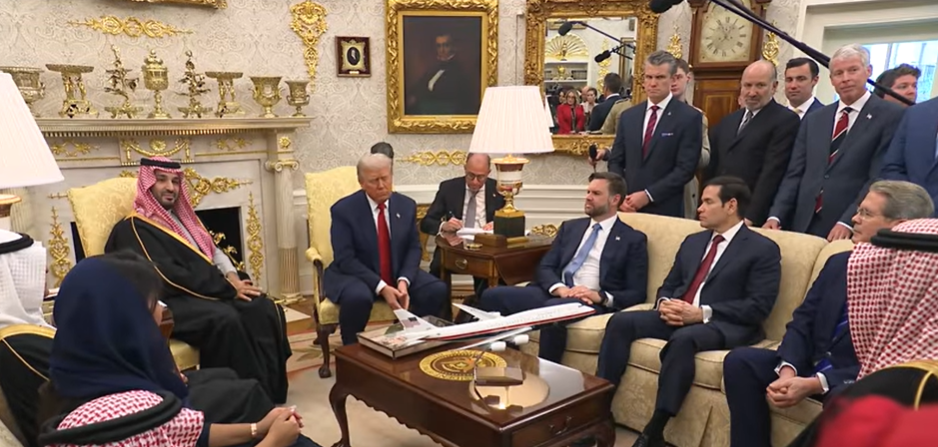
MbS and President Trump hold a bilateral discussion in the White House and open the conversation to the press pool. MbS is a key participant in the peace deal between Israel and Hamas within Gaza. WATCH (video added):
Posted originally on CTH on November 18, 2025 | Sundance
President Donald Trump welcomes Crown Prince Mohammed Bin Salman to the White House, with an arrival ceremony to represent the relationship the two leaders represent. WATCH:
Posted originally on CTH on November 2, 2025 | Sundance
Director of National Intelligence Tulsi Gabbard addressed the International Institute for Strategic Studies (IISS) Manama Dialogue, in Manama, Bahrain. The transcript of her prepared remarks is below – The Q&A Session is not transcribed.
It should be remembered that Bahrain was the second nation to erupt following the 2009 Cairo, Egypt speech of then President Barack Obama. Tunisia was the first, Egypt was the third. The government of Bahrain barely survived the Islamist Spring and later formed a coalition with Egypt, Saudi Arabia and the UAE against the extremists within the Muslim Brotherhood then supported by Qatar.
DNI Gabbard speaks to the changed geopolitical environment in the era of U.S. President Donald Trump; the elimination of seemingly endless conflict driven by old guard establishment entities and influence agents around the world. The Director highlights her personal journey toward supporting President Trump and the America First agenda that seeks genuine friendship and national partnerships based on mutually beneficial transactions.
[TRANSCRIPT] – “Thank you, distinguished guests, excellencies, friends, and fellow peacemakers. It’s a privilege to join all of you here this evening. Your Highness, thank you very much for your kind hospitality and welcoming us in hosting this important event. To IISS and your team, thank you for yet again putting on a phenomenal dialogue. It’s an honor to be able to address you here in the Kingdom of Bahrain at this pivotal time in global history.
As we gather here, we’re reminded that true security, true stability, and peace cannot be forged in isolation, but in the common collection of peacemakers working towards that common purpose. Today, I want to speak plainly for myself as a veteran and a soldier who has seen firsthand the high cost of war. As someone who serves under President Trump’s leadership, I have experienced the promise of peace. His vision is about delivering real wins, not just for America, but for our collective cause of peace and prosperity, and doing so through a very principled realism, rooted in shared goals, interests, and values.
The old Washington way of thinking is something we hope is in the rear-view mirror and something that has held us back for too long. For decades, our foreign policy has been trapped in a counterproductive and endless cycle of regime change or nation-building. It was a one-size-fits-all approach of toppling regimes, trying to impose our system of governance on others, intervening in conflicts that were barely understood, and walking away with more enemies than allies. The result: trillions spent, countless lives lost, and in many cases, a creation of greater security threats, the rise of Islamist terrorist groups like ISIS.”
“We’ve heard President Trump and Vice President Vance speak just last week about their hope that the Abraham Accords will continue to grow and expand to allow for a true lasting regional stability and peace. This is what President Trump’s America First policy looks like in action, building peace through diplomacy, with an understanding that there cannot be prosperity without peace. President Trump de-escalated tensions on the Korean peninsula through direct talks. During his first term in office, he opened lines of communication with North Korea that had been frozen for generations. He did what no other president had been willing to do: engage directly to speak about peace. He restored American leadership abroad. He brokered economic normalization between Serbia and Kosovo, promoting stability and peace in the Balkan region.
And now just nine months into his second term, President Trump’s America First agenda is supercharging these efforts and securing peace on a scale that we haven’t seen in decades. He secured ceasefires between India and Pakistan, Israel and Iran, a peace agreement between Rwanda and the DRC, a peace deal between Armenia and Azerbaijan, Cambodia and Thailand, and averted conflict between Egypt and Ethiopia over the Grand Ethiopian Renaissance Dam. As was mentioned previously and is very much in focus for so many of us, he negotiated the release of all living hostages from Hamas. While fragile, a historic ceasefire and peace plan is moving forward. It is doing so with integral support from many of our partners here in this room.
So, what ties all of this together? A simple and revolutionary idea: Pursue joint interests. Find those win-win solutions where they align and recognize that yes, we will have differences, and we will work through them.
President Trump understands that not everyone shares our exact values or our system of governance, and that’s okay. What’s most important is finding where our shared common ground exists and building those partnerships and progressing on those common grounds. Things like energy independence that stabilizes global markets, things like countering terrorism, something that continues to grow in different parts of the world, strengthening trade partnerships to boost economic growth and innovation. These are the components, the glue of enduring partnerships and friendships. So, America First is not about isolating ourselves. As President Trump has shown, it’s about engaging in direct diplomacy, being willing to have conversations that others are not willing to have and finding that path forward where our mutual sovereign interests are aligned.
And that’s really why we’re all gathered here today in Manama. We can commit to this path ourselves and put it into action with Bahrain’s own leadership. Year after year, hosting these critical dialogues shows us the way forward, convening nations from around the globe, amplifying shared stakes and strengthening partnerships and lines of communications that allow us to resolve our differences and deliver results for our respective people.
Under President Trump, the United States is your partner in executing this vision as a deal maker who is committed to peace. And together we look forward to continuing this path towards peace, to ending wars that have defined too many generations, unlocking prosperity for millions, and helping support the future of a Middle East where security is a dividend of cooperation, not a cost of conflict.
Thank you very much. God bless you. God bless the pursuit of peace.”
[END TRANSCRIPT] Question and Answer Session Follows.
Posted originally on Sep 10, 2025 by Martin Armstrong |
The new Home Secretary of the United Kingdom is yet another reminder that the UK is a Muslim nation. Shabana Mahmood, a Pakistani woman, is now responsible for England and Wales’s internal affairs, including immigration, national security, and counter-terrorism measures. The issue is not that she is Muslim; rather, the issue is that open border policies have overwritten the history of the UK and permanently altered society.
This is not a one-off as all Muslims are taking office in all major political positions across the UK. The mayor of London, the mayor of Leeds, the mayor of Birmingham, the mayor of Sheffield, the mayor of Oxford– Luton, Oldham, Rochdale, Blackburn, Rotherham, and others—are all Muslim.
Around 46% of young people under 29 years of age in Britain are Muslim, compared to 29% of the general population. Muhammad has been the most popular baby name in the nation for several years. The 2021 England and Wales Census marked the first time that less than half of the population (46.2%; 27.5 million people) identified as Christian. Pew Research Center believes that Muslim women will have more children than Christian women by 2035, and Islam could become the most followed religion in the world. There is nothing inherently wrong with the religion of course, but it is understandable that people want to maintain their own nation’s traditions, religion, and morals.
Around 78% of the Muslim refugees in the UK do not work among the women, and 63% of male migrants also rely on government aid. About 8 in 10 Muslim refugees in the UK now receive free government housing. Asylum seekers are entitled to FREE healthcare from the National Health Service (NHS). “You may be able to get housing and money to support you and your family while you’re waiting to find out if you’ll be given asylum,” the National Asylum Support Service (NASS) promotes on its website. The NASS will pay for housing and free education for all migrants, even those who have been DENIED asylum.
The Labor Party under Starmer has agreed to increase government spending on migrants by 30% this year. Schools across the UK are required to provide Halal-only lunches to accommodate the rapidly growing Muslim population. According to the Halal Times, “The Halal certification process involves a cut to the jugular vein, carotid artery, and windpipe, with the animal being alive and healthy at the time of slaughter. Blood must be fully drained from the carcass, and a Muslim must recite a dedication known as Tamiya or shahada during the slaughtering process.”
There were 1.6 million Muslims living in the UK in 2001. That figure rose to 4 million by 2024, and Muslims now account for 6.7% of England’s population and 2.2% of the population in Wales and Scotland. Repopulation theory is more of a tactic than a theory. Hence, leaders like Starmer are encouraging this massive demographic shift. As it stands, first-generation migrants will compose 25% of the UK’s population by 2035, according to the Centre for Migration Control, and the UK’s overall population will surge to 73 million. It may seem far off, but that is only a decade from now. All Build Back Better nations will be utterly unrecognizable thanks to repopulation tactics.
I have created this site to help people have fun in the kitchen. I write about enjoying life both in and out of my kitchen. Life is short! Make the most of it and enjoy!
This is a library of News Events not reported by the Main Stream Media documenting & connecting the dots on How the Obama Marxist Liberal agenda is destroying America






 Centinel2012
