Posted originally on the CTh on January 14, 2023 | Sundance
Their names will not make national headlines, and generally everyone has moved on, but to their families and friends Ilonka Knes and James Hurst mattered. As CTH readers may remember, in the aftermath of Hurricane Ian we shared that many missing people would be found in the months after the storm, and unfortunately many more will likely never be found.
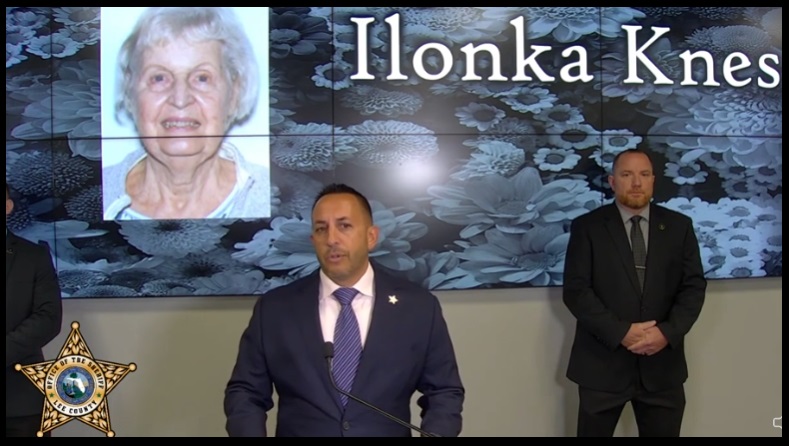
The body of Mrs Ilonka Knes (82) was found in the mangroves and back bay salt marsh near Fort Myers Beach and has been positively identified. The body of her husband Robert was found in the days immediately following Hurricane Ian.
Additionally, the sailboat “Good Girl” was found submerged with human remains believed to be the body of James ‘Denny’ Hurst (73).
Mrs. Knes and Mr Hurst bring the total number of Hurricane Ian victims in Lee County, Florida, to seventy-five. Mr. Hurst was the final “official” missing person on the local list; however, there are many more yet unaccounted that were not from this immediate area. The physical devastation is widespread, but the emotional toll on the families and friends of the missing has been beyond imagining. Tonight, two more families have answers.
(FLORIDA) – During Thursday’s news conference, Lee County Sheriff Carmine Marceno released new information regarding the area’s recovery.
“Most of us have gotten back to a sense of the new normal. For some, still missing their loved ones, every day since the storm has been difficult,” said Marceno.
The sheriff said his agency originally attempted a well-being check at what was left at the home of Ilonka and Robert Knes in the aftermath of the storm.
The body of Robert Knes was found shortly after Ian struck, but there were no signs of his wife during the days and weeks following the disaster.
Marceno said it wasn’t until mid-January that a debris removal crew found remains in a dense patch of mangroves, that later tested positive, through the use of dental records, to be that of Ilonka. (more)
The power and duration of Hurricane Ian killed more people than Hurricane Andrew and the storm that hit Southwest Florida last September is now recorded as the deadliest storm in the past 87 years.
If you live anywhere along the coastline of the United States, inland to about 50 miles, please remember to always take these storms seriously.
After this storm, and having been through four previous direct impacts, including Homestead AFB (Andrew), I would say this…. If there is even a remote chance you would ever encounter this type of a hurricane event, EVACUATE. Do not try and hunker down if there is a looming possibility of having to rely on a structure to withstand 150+ mph wind for a full day. Just leave. With all of my preparations in place, and all of the knowledge I possess in storm survival, I would never attempt it again.
It is more than three months since Hurricane Ian hit Southwest Florida and beyond the chaos and debris that still remains visible almost everywhere, they are still recovering bodies. Please take hurricane preparations seriously.
Posted originally on the conservative tree house on October 31, 2022 | sundance
In a previous update I noted the scale of debris cleanup ongoing as an outcome of Hurricane Ian. Several people made inquiries wanting to better understand the overall magnitude. So, I took some pictures today to share.
According to one of the debris contractor officials I incidentally bumped into, he shared how the debris cleanup was bid to the municipal regions using an actuarial formula from prior disaster recovery. It’s a pretty interesting, albeit heartbreaking, formula and overall process to understand.
After a geographic region is identified, an interim helicopter flight by specifically trained experts in the industry of debris removal is conducted. The general statistics applied to the contracts are for seven years’ worth of normal debris in the municipal region.
Meaning whatever tonnage is normally accumulated in municipal trash pickup over a year (garbage and recycling), that tonnage number is then multiplied by seven, and that’s the amount of debris anticipated during the initial hurricane debris removal. Seven years’ worth of ‘trash’.
More pictures below to help understand.
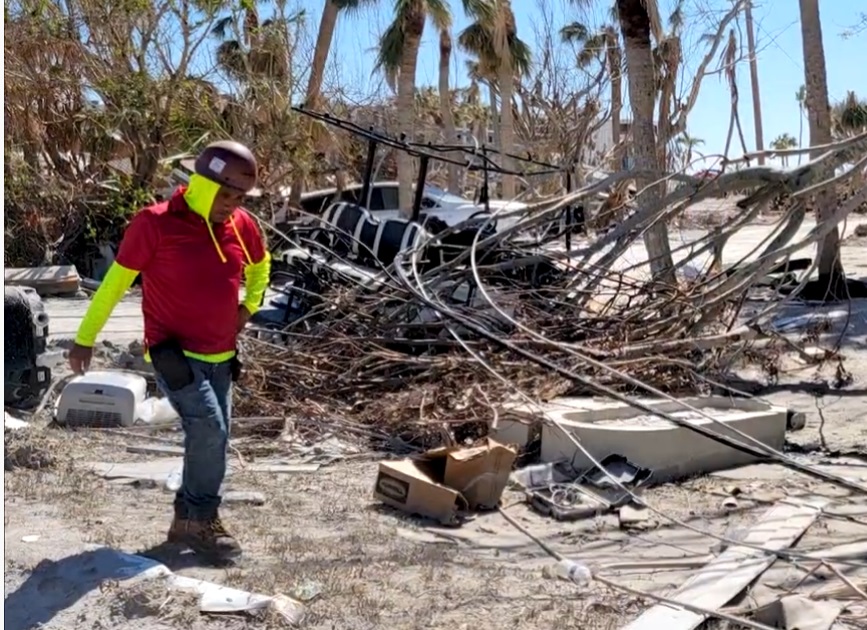
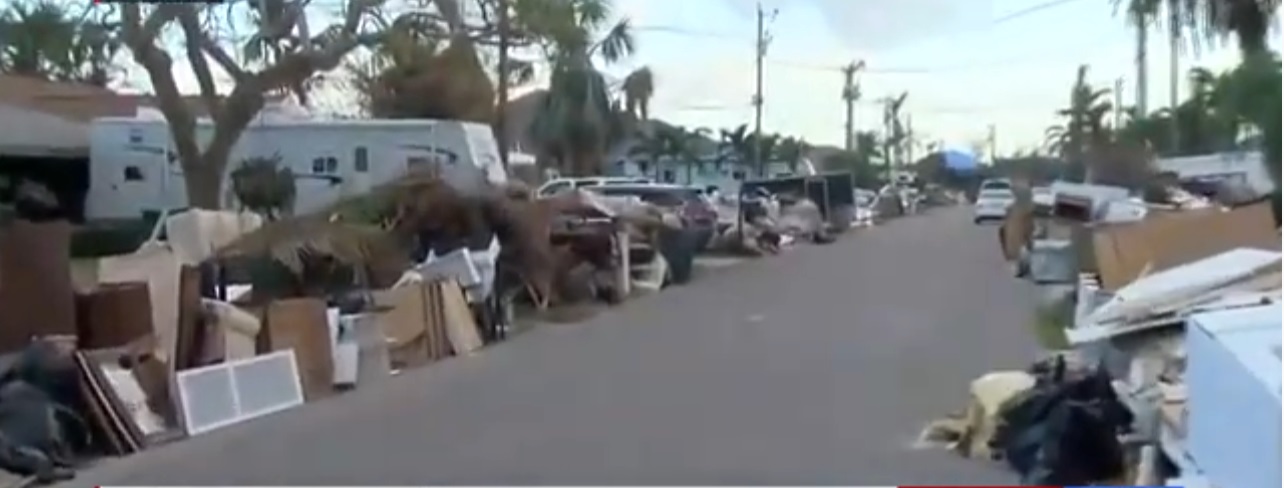
♦DEBRIS – The scale of physical debris is jaw dropping. FEMA reimburses local municipalities for the first 30 days of debris removal effort and costs. The 30-day limit is intended as a financial incentive to kick municipalities into fast action. This incentive is not a bad concept. Factually, it’s one of the better FEMA legislative standards because it forces local government to act quickly. However, the scale of what they are trying to do is just intense.
The various municipal governments in the severe impact zones appear to have a strategy to use the 30-day window to just collect as much as possible in interim geographic locations. Large empty lots (example below) are being utilized as fast dumps for massive piles of debris in this 30-day window. A claw truck can make a dozen fast runs (per day) locally to these interim dump sites, as opposed to driving long distances to landfills 30 to 50 miles away.
One of these 10-acre dump sites is less than a mile from me. I do not know how many of these exist; however, to see a full ten acres piled high with 10 to 20′ of debris gives me a sense of the scale of damage in this one small area within a region that must have hundreds of these interim sites. I have been to a dozen post-hurricane recovery areas and never seen debris like this.
Everything from destroyed construction material, to home furnishings, beds, appliances, parts of boats, roof parts, toys, patio furniture, pieces of cars, clothing, you name it, it’s all there. All now defined under the term “debris.” However, each piece of debris representing the former life of a family impacted by this storm. The trucks just keep coming, day and night 24/7. [Logistics tower for one 10-acre collection site pictured below]
In the bigger picture, when you think about what is represented, it’s a sullen site to bear witness to… Any person of reasonable Christian disposition would just cry. They have fenced off these interim dumping sites, and they have erected lights and temporary crane towers to seemingly assist the logistics of what goes where, but my God the scale of it is humbling. This is just one site utilized for an area of what seems to be approximately 5 square miles. Expand that scale to hundreds of similar 10-acre sites. Yeah, tears.
Eventually I assume these interim sites will be cleared one truckload at a time to the inner state landfills and recycle facilities. That phase will likely take years.
That’s a small snapshot.
Multiple those images times several thousand streets and similar areas.
Now you know what things look like.
Now you also know why Starfish Kid stays focused on the two feet in front of him…
…. If you look up for too long, the whispers of despair will try to get you.
Posted originally on the conservative tree house on October 29, 2022 | Sundance
The ‘context’ of Ian was shared previously {Go Deep}. Here we outline things to consider if you are prepping for a hurricane impact and/or deciding whether to stay in your home or evacuate. Standard hurricane preparations should always be followed. Protect your family, secure your property and belongings, and prepare for the aftermath.
What you do before the hurricane hits is going to determine where you are in the recovery phase.
Additionally, and this should be emphasized and discussed within your family, if you cannot be self-sufficient in the aftermath – for any reason, then you should evacuate.
Self-sufficiency in this context requires being able to cope for up to several weeks:
(1) potentially without power; (2) potentially without potable running water (3) potentially without internet service; (4) potentially without communication outside the region; and (5) with limited municipal and private sector assistance. If you decide you cannot deal with these outcomes, you should evacuate.
Additionally, as a family or individual, you should also honestly evaluate:
(1) your physical abilities; (2) your emotional and psychological ability to withstand extreme pressures; and (3) your comfort in losing daily routines, familiar schedules and often overlooked things you might take for granted. Post hurricane recovery is fraught with stress, frustration and unforeseeable challenges.
I saw a video presented by a structural engineer who was sharing his experience with Hurricane Ian. I am going to use his video for a few references because even with professional credentials, some of the common mistakes people make are highlighted in his experience. Keep in mind his video is taken about 30 miles inland from where the majority impact area (coastal region) is located.
The video below was shot from the soft side (western side) of the storm, and if we were to scale the difference between his experience and a person who was located in/around Fort Myers Beach, Sanibel, Pine Island or Cape Coral, he would be around a “5” on a ten-point impact scale.
Meaning the severity of conditions 30 miles southeast of him was twice as severe as his inland experience.
Key Points – At the 21: 35 moment (prompted), notice how his #2 vehicle is parked outside. Also, at the 22:00 minute moment, notice what he is describing and showing with his garage door and how his #1 vehicle (a pickup truck) is positioned inside the garage. WATCH:
.
♦ This is exactly what I was talking about in hurricane preparation when discussing the garage door. If that videographer was located 30 miles southeast, and/or his house was positioned facing West, instead of North, his garage door would have failed. If you lose the garage door, YOU COULD LOSE YOUR ROOF.
You can always tell those people who have been through direct hurricane impacts by how they parked their cars. I have never included this in the hurricane advice before so it’s worth a mention. If you lose your Florida garage door you will more than likely lose your roof. That’s just the reality of having a massive opening in your structure to 150 mph winds that will lift the trusses.
If you have two vehicles, put one vehicle inside the garage with the front bumper against the door to help stop the flex (do this carefully). Put the other vehicle outside blocking the garage door facing down the driveway or facing parallel to the garage. The goal is to use the aero dynamics of the car to push the wind away from the door and provide protection.
Purchase a cheap car cover to protect the outside vehicle and/or use old blankets (cable ties, bungee cords) to stop the outside vehicle from getting sandblasted and destroyed. Place double folded corrugated cardboard in front of the radiator to protect it from storm debris.
Additionally, if you live in a flood zone, or if you are concerned about storm surge, the day before impact take your #1 car to the nearest airport or hotel with a parking garage and park in the upper levels. Take an uber back home if you don’t have a friend or partner to help you. This way you know you will have one workable vehicle, just in case.
♦ Another lesson from Ian, if you drive an electric vehicle and sustain saltwater intrusion (of any level) your car is not safe. Saltwater makes the vehicle batteries extremely dangerous, and they could spark or catch fire. Multiple homes survived Hurricane Ian only to have the electric car catch fire in the garage and burn the house to the ground. Hurricane rain is saltwater rain. The fire department was begging people to put their ev’s outside and not to plug them in. Dozens of ev’s also erupted in flames while driving down the streets after the storm.
Back to the video above…
♦ Notice at 24:30 of the video this professional structural engineer is standing and physically supporting his glass patio doors, with his wife, trying to keep them from breaking in due to wind and pressure changes. DO NOT DO THIS ! That is beyond dangerous. Any small item of debris (even a small twig or branch) could hit that window and shatter it, turning flying glass into instant flying blades.
Put 3/4-inch plywood or steel bolted hurricane shutters over all your windows and doors. Period. This is not an option. My steel bolted hurricane shutters were hit with debris so hard – whatever it was physically dented the steel. Every window and door need to be covered and protected, especially glass patio doors (even if tempered). Do not think you can stand there and protect glass doors. It’s beyond dangerous.
♦ Hardening your home is a matter of careful thought and physical work. However, every opening into your structure must be protected, leaving yourself with one small exit opportunity just in case. Hopefully you have a bolted door with no glass windows you can use as an emergency exit. If not, select a small window and leave only enough room uncovered for you to get out in case of emergency or structural collapse.
Beyond the ordinary supplies like drinking water, batteries, flashlights, battery or hand-crank radio, generators, gasoline, etc. Evaluate the scale of what you have against the likelihood of weeks without power or water. A few pro tips below:
♦ Put three 30-gallon trash cans in the shower and fill them with water before the storm. This will give you 90 gallons of water for cooking and personal hygiene. You will also need water to manually flush your toilets. Bottled water is great for drinking, hydrating and toothbrushing, but you will need much more potable water if the municipal supply is compromised or broken.
♦ A standard 6,500-to-8,500-watt generator will run for approximately 8 hours on five gallons of gasoline. Do not run it all the time. Turn it on, chill the fridge, make coffee, use the microwave or charge stuff, then turn it off. Do this in 4-hour shifts and the fridge will be ok and your gasoline will last longer. Gasoline is a scarce and rare commodity in the aftermath of a hurricane. Gas stations don’t work without power. Check the oil in the generator every few days. Also, have a can of quick start or butane available in case the generator starts acting up.
♦ Extension cords. If you are purchasing them buy at least one 100 to 150′ extension cord with a triple ponytail. This way you can use one cord into a central location to charge up your electronic devices. Establish a central recharging station for phones, pads, laptops, and rechargeable stuff.
♦ Purchase a box of “contractor garbage bags” and just keep them in the garage. These are large, thick, industrial trash bags that fit 40-gallon drums. They can be used for trash, or even cut open for tarps in the aftermath of a storm. These thick mil contractor bags have multiple uses following a hurricane.
♦ Do all of your laundry before the hurricane hits. You will likely not have the ability again for a few weeks.
♦ Cook a week’s worth of meals in advance of the hurricane. Store in fridge so you can microwave for a meal. Eating a constant diet of sandwiches gets old after the first week. Dinty Moore canned beef stew and or Chef-boy-ardee raviolis can make a nice break…. anything, except another sandwich.
♦ Have bleach for use in disinfecting stuff before and after a hurricane. Also have antibiotics and antiseptics for use. Hygiene and not getting simple infections after a hurricane is critical and often forgotten. Again, this is where the extra potable water becomes important. Simple cuts and scrapes become big deals when clean potable water is not regularly available. Keep your scrapes and abrasions clean and use antiseptic creams immediately.
♦ Do not forget sunscreen and things to relieve muscle aches and pains. Hurricane recovery involves physical effort. You will be sore and/or exposed to the elements. Remember, it’s all about self-sufficiency because the normal services are not available. A well-equipped first aid kit is a must have.
♦ Buy a small camping stove. Nothing big or expensive, just something you can cook on outside in case of emergency. It will be a luxury when you are 2+ weeks without power and all the stores and restaurants are closed for miles.
♦ Those small flashlights that you can strap around your head that take a few AAA batteries? Yup, GOLD. Those types of handsfree flashlights are lifesavers inside and outside when you need to see your way around. Nighttime is especially dark without electricity in the entire town. Doing stuff like filling a generator with gasoline in the middle of the night is much easier with one of those head strap flashlights. Strongly advise getting a few, they’re inexpensive too.
♦ Cash. You will need it. Without power anything you may need to purchase will require cash, especially gasoline. Additionally, anyone you hire to help or support your immediate efforts will need to be paid. Cash is critical. How much, depends on your individual situation, but your cash burn rate will likely go into the thousands in the first few days. Also keep in mind, you may or may not be able to work and without internet access even getting funds into place could be challenging.
♦ Hardware. A box of self-tapping sheet metal screws (short and long) is important, along with a box or two of various wood screws or Tyvex screws. A battery drill or screw gun is another necessity. Check all of this stuff during hurricane prep.
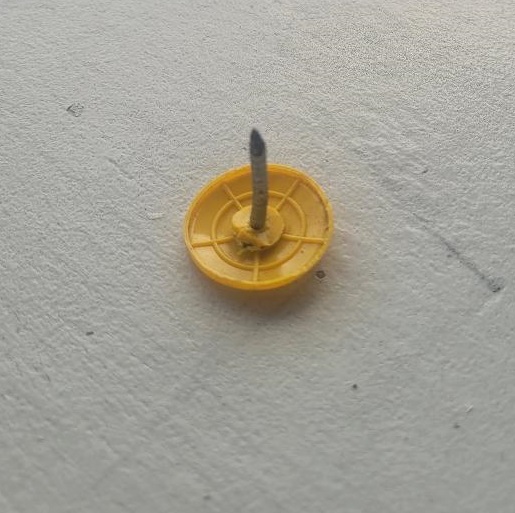
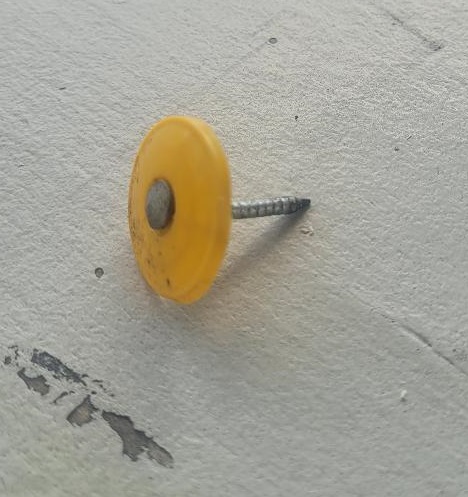
♦ ADD. I forget my #1 personal nemesis in the aftermath (pictured below):
Roofing nails. The pesky roofing nails. Thousands of em’, all over. Those buggers are everywhere, and they will go through a flip-flop, sneaker sole or car tire perfectly. Most of them are black (not yellow) like the ones above. Some of them have square of flat tops to help them stand up just perfect to find your tires.
I happen to believe roofing nails are actually tire magnets with some sort of automatic triggering system to jump in front of your car at the worst possible moments. On the positive side, I think my neighborhood is safe because my tires have picked up every one of em’. LOL and Grrrr…
More later…. but I hope this is useful. [Lie to me, even if it ain’t. lol.]
Posted originally on the conservative tree house on October 29, 2022 | Sundance
Many CTH readers know I have been involved in hurricane prep and recovery as a longtime member of a civilian emergency response team. I have physically been through four direct hurricane impacts and responded to recovery efforts in more than fifteen locations, often staying for days or weeks after the initial event.
Through the years I have advised readers on best practices for events before, during and after the storm. In this outline my goal is to take the experience from Hurricane Ian and overlay what worked and what doesn’t work from a perspective of the worst-case scenario.
Hurricane Ian was a worst-case scenario.
Let me be clear from the outset, I am not advising anyone to put greater weight on my opinion or ignore local emergency officials or professionals in/around the disaster areas. What I am going to provide below is my own experience after decades of this stuff, against the backdrop of Ian, and just provide information that you may wish to consider if you are ever faced with a similar situation.
Hurricane preparation can be overlaid against other types of disaster preparation, there are some commonalities. However, for the sake of those who live on/around the U.S. coastal areas where hurricanes have traditionally made impact, the specifics of preparation for this type of storm are more pertinent. I’m going to skip over the basic hurricane preparation and get into more obscure and granular details, actual stuff that matters, that many may not be familiar with.
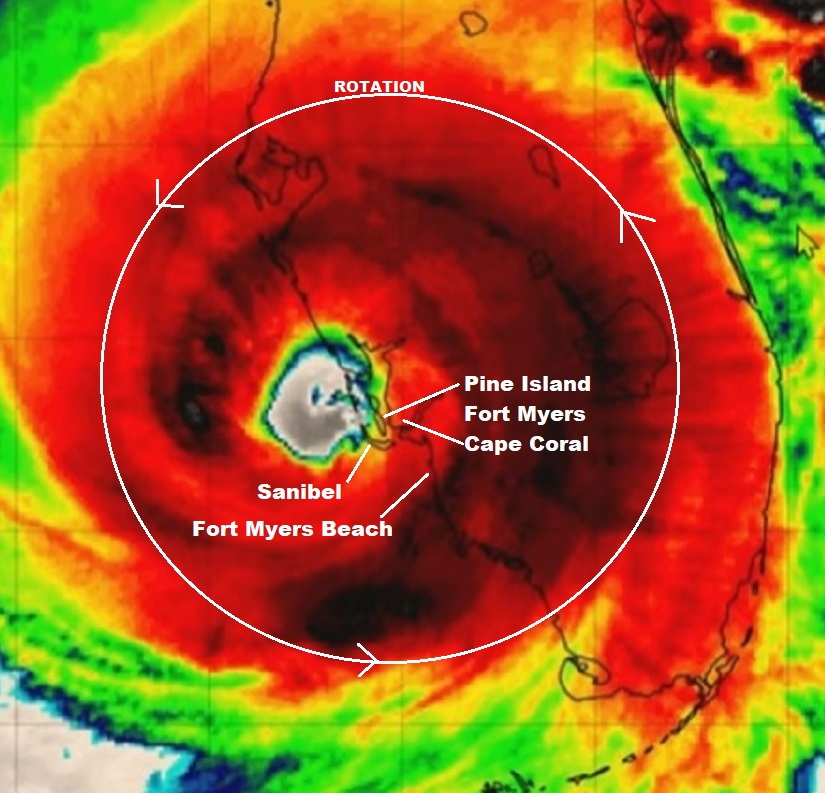
Let me start by sharing a graphic that you may overlay with the information you may have already seen from national media coverage. The graphic below shows Hurricane Ian in relation to Southwest Florida and points to locations that you may have seen on the news. The context of understanding Ian is going to be critical when contemplating preparation, so it must be emphasized.
This satellite image was likely taken around 4 to 7 pm on the evening of September 28, 2022, approximately three hours after Hurricane Ian officially made landfall at Bokeelia, a small community on the Northern end of Pine Island. All of my discussion below is from the ‘major impact zone’.
The satellite image above was taken during daylight after five or six hours of hurricane force winds (150+ mph) had already been impacting the SWFL coast.
For the areas of greatest impact, the event began roughly around 1:00pm and lasted until around 9:00pm. Ignore the red and dark area (rainfall) and instead focus on the green/blue ring around the eye, that is the “eye wall”, or what we call the “buzzsaw“.
From the perspective of the Fort Myers Beach, Cape Coral, Pine Island and Sanibel area, the first round of severe winds came from East to West around lunchtime on 9/28.
By 2pm the entire SWFL coastal region was without power. The easterly wind lasted about 2 hours, then as hurricane Ian meandered off the coast (retaining fuel) in a generally north-northeast direction, the winds shifted coming from the South. This is when the buzzsaw really started destroying buildings and infrastructure.
Ian was only moving in a forward direction around 5 to 8mph. That 150 mph buzzsaw (eyewall) is about 40 miles wide. Only half of the buzzsaw (the eastern side) was over land. The western side was providing hot water fuel the entire time. That buzzsaw was over the SWFL coastline for more than 8 hours.
Sanibel Lighthouse, Before and After
At approximately 5pm the most severe part of the storm surge started coming into the SWFL coast as the South and West winds began pushing massive amounts of water from the Gulf of Mexico onto the coast.
You have likely seen video from Fort Myers Beach as these moments were happening. The storm surge continued growing in scale for several hours. Combined with the wind, this storm surge is what erased most of the structures on Fort Myers Beach, Sanibel, Captiva, Upper Captiva Island, Saint James City, Pine Island, Matlacha and Bokeelia.
The 5 to 9pm timeframe is also when most of the flooding and storm surge damage took place in South Fort Myers and Cape Coral. Even after the buzzsaw cleared the area (9pm), the winds from the West at the bottom of the storm kept the water level high.
The water exit (back into the Gulf of Mexico) did not begin until the tidal shift after midnight. Due to the slow movement of the storm the total time of the storm surge impact was a jaw-dropping 8 to 10 hours. Many people drowned.
The old axiom remained mostly true, “hunker down from wind, but run from water.”
Now, I say “mostly true“, because to be brutally honest -due to the unique nature of Ian- if you are going to be inside that killer buzzsaw for 8 hours, hunkering down is really not a safe option. Fortunately, Ian was a rare system in terms of its slow-moving nature, even after hitting land. Most hurricane impact events are less than 3 hours in duration. Ian was dangerously unique.
To give scale to the size of the buzzsaw, again we are talking about the most dangerous part of any hurricane – the eyewall itself, this next image shows a comparison between the eyewall of Hurricane Charley in 2004 and the eyewall of Hurricane Ian in 2022.
That is the eye of Charley overlaid inside the eye of Ian in almost the same location. You can see how much bigger the buzzsaw was for Ian as opposed to Charley.
Both Hurricane Charley (’04) and Hurricane Ian (’22) came ashore in generally the same place. Charley made official landfall at Upper Captiva Island and Ian at Bokeelia. The distance between both landfall locations is only about 4 miles apart as the crow flies.
Both storms were Cat-4 landfall events. However, Charley was much smaller, had a smaller buzzsaw and moved quickly around 20 mph. Ian was big, had a much bigger buzzsaw and moved slowly around 5pmh.
The duration of Charley was around 2 to 3 hrs. The duration of Ian was around 8 to 9 hrs. Ian was bigger and just moved slower. Inside this distinction you discover why, despite their almost identical regional proximity, the damage from Ian was much more severe. Topography was changed.
I am focusing a lot of time on this similarity aspect because you cannot take a previous storm reference as a context for your ability to survive the next storm. They are all different, even when they hit the same place.
While more SWFL people evacuated for Hurricane Ian, and that is a profoundly good thing, the memory of getting through Hurricane Charley likely made many people think they could just prep, hunker down and get through it. The “I got this” reference of surviving through Charley may have led to people dying, because Ian wasn’t Charley…. not even close.
Having said that, I personally over prepare for these events. This time it was critical.
You have likely seen video from the hurricane area during the event. You have likely seen video from areas in/around the impact zone.
However, let me tell you something you have not seen…..
…. you have not seen any video of what was happening inside that eyewall. You have not seen any video of the buzzsaw at work.
Why? Because anyone who would attempt to step outside a structure into that buzzsaw would not survive. Any CCTV equipment, camera or video recording attached to a structure inside that coastal buzzsaw was almost certainly destroyed.
A physical human body does not step into 150 MPH winds and return.
This is a fury of nature, a battle where the odds are against you, that you may or may not be aware you are contemplating when you are choosing to stay or evacuate. It’s not the hurricane per se’, it’s that much smaller killer buzzsaw – the eyewall- that you are rolling the dice, never to see.
When it comes to the eyewall, the truest measure of the “cone of uncertainty“, the difference between scared out of your mind and almost certain death, is literally a matter of a few miles,…. and there ain’t no changing your mind once it starts.
Posted originally on the conservative tree house on October 24, 2022 | Sundance
I’ve been sharing some of the challenges with site admins; at their suggestion here’s the latest from the impact zone.
First things first. To establish the context, what made Ian completely different from all other hurricane recovery responses I have been involved in comes down to two issues: strength of the storm (155+ mph winds), and more importantly the duration of the event (8+ hours of peak destruction).
In normal hurricane impacts the worst affected areas generally experience 3 to 4 hours of chaos. Hurricane Ian was unique in that it was only moving 8 to 10 mph and that made the storm damage completely different. Structures that survived the first half, completely failed during the second half of the storm.
Almost nothing survived unscathed after 8 to 9 hours of that strength of storm sitting, almost stationary, in one place; nor was anything ever designed to withstand that duration of storm with winds from the South, then East, then West as Ian meandered inland from the gulf toward the north northeast.
After this storm, and having been through four previous direct impacts, including Homestead AFB, I would say this…. If there is even a remote chance you would ever encounter this type of a hurricane event, EVACUATE. Do not try and hunker down if there is a looming possibility of having to rely on a structure to withstand 150+ mph wind for a full day. Just leave. With all of my preparations in place, and all of the knowledge I possess in storm survival, I would never attempt that again.
That said, I will put a better word image together at a later date to share, along with specific recommendations learned as an outcome of this event. In the interim, just accept my most strenuous advice. If this specific type of storm was ever predicted to come near you, GET OUT.
♦CURRENT STATUS – Electricity and water restoration efforts continue as we near the one-month anniversary 10/28. Thankfully, both services have been restored for me personally, and I carry deep empathy -and my most sincere prayers- for those still waiting.
Regarding stable -if any- internet service, it remains elusive for everyone.
The biggest impacts upon the outer islands of Fort Myers Beach, Sanibel, Captiva and Pine Island/Matlacha are still in first stage recovery efforts. Completely new civil infrastructure is being built in these areas.
♦DEBRIS – The scale of physical debris is jaw dropping. FEMA reimburses local municipalities for the first 30 days of debris removal effort and costs. The 30-day limit is intended as a financial incentive to kick municipalities into fast action. This incentive is not a bad concept. Factually, it’s one of the better FEMA legislative standards because it forces local government to act quickly. However, the scale of what they are trying to do is just intense.
The various municipal governments in the severe impact zones appear to have a strategy to use the 30-day window to just collect as much as possible in interim geographic locations. Large empty lots are being utilized as fast dumps for massive piles of debris in this 30-day window. A claw truck can make a dozen fast runs (per day) locally to these interim dump sites, as opposed to driving long distances to landfills 30 to 50 miles away.
One of these 10-acre dump sites is less than a mile from me. I do not know how many of these exist; however, to see a full ten acres piled high with 10 to 20′ of debris gives me a sense of the scale of damage in this one small area within a region that must have hundreds of these interim sites. I have been to a dozen post-hurricane recovery areas and never seen debris like this.
Everything from destroyed construction material, to home furnishings, beds, appliances, parts of boats, roof parts, toys, patio furniture, pieces of cars, clothing, you name it, it’s all there. All now defined under the term “debris.” However, each piece of debris representing the former life of a family impacted by this storm. The trucks just keep coming, day and night 24/7.
In the bigger picture, when you think about what is represented, it’s a sullen site to bear witness to… Any person of reasonable Christian disposition would just cry. They have fenced off these interim dumping sites, and they have erected lights and temporary crane towers to seemingly assist the logistics of what goes where, but my God the scale of it is humbling. This is just one site utilized for an area of what seems to be approximately 5 square miles. Expand that scale to hundreds of similar 10-acre sites. Yeah, tears.
Eventually I assume these interim sites will be cleared one truckload at a time to the inner state landfills and recycle facilities. That phase will likely take years.
~ An ordinary neighborhood street awaiting pickup ~
♦PEOPLE – Thousands of people have been displaced. To give a context for the longer-term issue let me tell you a few stories.
In the past several weeks I have visited a number of businesses like Home Depot (hardware etc) and industrial repair shops. These places are packed with working-class people attempting to patch life back together. My best guess is you could put between 10,000 and 50,000 skilled construction workers and general laborers into the impact zone, and they would have continuous work for a year or more.
That said, businesses are failing because just as many people have given up and quit as the number that are trying to rebuild.
Most of the service workers involved in the hotel, restaurant and tourist industry on/near the SWFL beaches are out of work. The physical buildings are gone or heavily damaged and closed. Those ordinarily invisible workers are just picking up what may have remained and leaving; because they have no work, and everyone needs a paycheck. Consider this vulnerable population #1.
Additionally, thousands of people who work regular jobs, including retail and hospitality, have been wiped out or heavily impacted at a personal level. Whether it be due to direct loss of their homes, housing rentals, vehicles or belongings, or just stress amid the rubble, they too are leaving. Without those workers businesses are unable to operate and are modifying operations or folding completely.
This subsequent worker shortage puts more pressure on the small to medium businesses and employees that remain….. In turn that creates longer shifts and even more stress on the remaining employees. The result is a cascading impact upon every business from supermarkets to McDonalds, to convenience stores, to garages and mechanics, to just about everything including hospitals and elder care facilities.
♦SELF SUFFICIENCY – If you cannot fix it yourself, life is even more difficult.
An odd aspect I note is the destruction on garages, light industrial facilities and auto repair shops. Numerous places are closed for repairs as the exterior big garage bay doors (doors on the physical buildings of these places) failed, creating damage internally to the facility and equipment. If you need a vehicle lift or specialized light to medium industrial equipment repair, you have to travel inland, quite a considerable distance, looking for an open location.
Open hotels for 50+ miles are full of relief and recovery workers and still hundreds more rooms or temporary housing are/is needed for those who travelled to help. I talked with one six-man recovery crew who are housed at a hotel in Tampa and drive to Pine Island. That’s a minimum 4 to 5-hour round trip. Drive 2 hours, work 10, drive 2 hours back, eat/sleep, repeat.
Out of state recovery crews (for just about anything you can imagine) are generally doing two to four-week stints, then they are replaced -take a week off- then return. SWFL locals take every opportunity to thank them, but no one knows how long this level of assistance will remain available.
It sounds like I’m painting a pretty bleak picture, but that’s the reality of recovery life in an impact zone like this. It’s also why I don’t like writing about it. However, amid all of the stress and chaos there are incredible people who will give the shirt off their back to a stranger. Focusing on this aspect is what fuels the soul daily.
Exiting a 7-11 I ran into Dionne, his wife and 3 kids, including a 6-month-old.
Dionne originally from Indiana, like a bazillion other working-class folks, had a flat tire (roofing nail) and was desperate to get to WalMart for baby formula and diapers. As he explained the situation, I gave him my keys and said, “just go, I’ve got the tire.” By the time he came back both problems were solved. Dionne had the stuff for the baby, and a bunch of strangers – who were also just passersby overhearing the problem – stopped everything, chipped in and the tire was repaired and replaced.
Hurricane Ian certainly brought a mess, but the storm also brought buckets of ordinary opportunities to meet random strangers – reminding us constantly at our spiritual core there are overwhelming numbers of fundamentally good people that non-crisis life would have us miss.
I am intensely thankful for those moments a loving God is providing. Without Ian those moments may not exist, and each of them is an opportunity for an affirmation.
Now, to be sure, there are self-centered affluent knuckleheads in post hurricane life; but I can also tell you something with a spiritual certainty…
…..Those knuckleheads don’t shop at 7-11’s near me.
The damages from the hurricane are still being evaluated, but preliminary estimates state that Ian caused Florida’s agriculture industry to lose up to $1.56 billion. Around five million acres of farmland were destroyed by the hurricane, 60% of which was grazing land for cattle. An additional 500,000 acres were affected but not destroyed. Florida produces around $8 billion in agricultural goods per year, so this is a significant blow to the industry.
The Sunshine State was already experiencing hardships prior to Hurricane Ian, with some estimates saying the industry would decline by a third this year due to temperatures and disease.
“The impact on Florida’s affected commodities cannot be understated, especially the heartbreaking damage to Florida citrus, an industry already facing significant challenges,” state Agriculture Commissioner Nikki Fried declared. Orange juice alone is expected to cause a $304 million loss. The US Department of Agriculture said that orange production was already 32% down YoY, marking the smallest harvest in eight decades.
Up to $393 million may be lost from destroyed vegetable crops, while horticultural crops may experience a $297 million decline. Cattle is expected to decline by over $220 million.
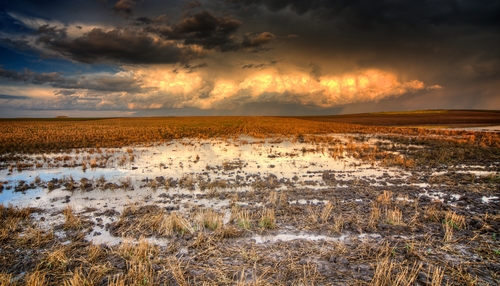
The true damage cannot be assessed until the fields dry up. None of these figures account for inflation. Natural disasters will only contribute to rising food prices and shortages.
Posted originally on the conservative tree house on October 20, 2022 | Sundance
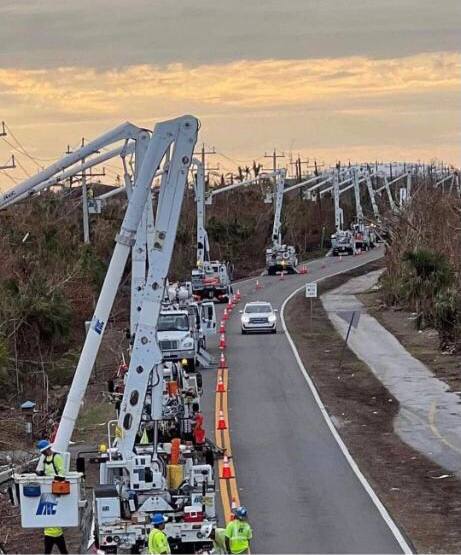
Sometimes the knights in shining armor appear as crews’ wearing jeans, overalls and steel toed boots.
It doesn’t take an emergency beacon to activate them, just a need… and they come. Purposefully, without condition, ready to move, activate and respond. They throw the gear bags, kiss the ladies & babies, and head out. The rest is figured out upon arrival.
Superior Construction, came from Jacksonville, Ajax Paving from Fort Myers, Honc from the Cape and trucks with subs from just about everywhere. There’s both a unity and similarity that flows when callouses are clasped and the melding of purpose comes together. Few words are needed, because it’s a task centered outlook, let’s git r’ done – no quit.
I asked Richard to put this together. {Direct Ruble Link} The drone video is from FAI photography. The song is by Lucy Thomas. The message, well, given all of the critics who say America’s best days are behind, perhaps they need to pause a little bit and remind themselves what we are capable of. Enjoy:
.
What has been accomplished in two weeks of 24/7 reconstruction is nothing short of remarkable. Then again, this is the Christian America we know well. The truckers, pullers, spreaders, drivers, welders, machinists, heavy equipment operators, tugboat operators, barge haulers, diggers, pumpers, tradesmen, all of them, just people.
Damn good people at that.
People who represent what makes our nation unique. The invisible, salty, mostly scruffy and beautifully comfortable about it, yet critical network of blue-collar crews that keeps it all operating. God, how I cherish them so.
At the core of our American purpose is a decency and unity. Critics don’t like to talk about it, but American workers are fundamentally good. When something seems impossible, for blue-collar Americans ‘impossible‘ is just another starting point, if you get out of the way. Don’t lose sight of that.
No other nation on earth was ever conceived on the principle of allowing people to manifest their own destiny, while keeping government out of their lives. The vision, the premise and the purpose, was to allow you the freedom to determine your place in life; and even, at any time, change that determination and strike off in an entirely new direction.
Our labor and aspirations would not be pre-determined by caste, tier, creed or social status; but rather by our personal vision for our own future. The right of self-determination.
This election is a time to reflect on the value of work; the great personal benefit of endeavors achieved; the pride in accomplishment -regardless of scale- amid this thing we call life; and all of these considerations have absolutely nothing, not-one-thing, to do with the money we assemble in the process.
What is the current value of a former seed that became a tree nurtured toward its continued maturity over decades? What was that seed worth at the time it was planted? We can only see the value in hindsight many years later. What value lay in the blood at Fort McHenry?
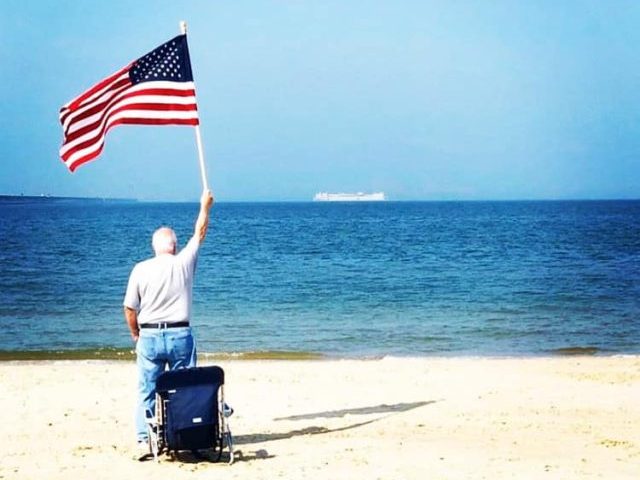
The job, per se’, was simple. Hold the flagpole in place. Keep that representative flag held high, no matter the cost. And yet, that cost, my God THAT COST, could it ever be quantified appropriately? A simple yet consequential task that expressed the fullest measure of devotion to the underlying premise, freedom. America!
Several years ago, Florida Power and Light won the prestigious international Edward Demming Award for excellence in multi-platform engineering, efficiency, superiority and total quality in the process of energy management.
However, the scruffy rednecks did not blow every PhD intellectual out of the water with slide rules, CAD programs, articulated and quantified quality improvement processes and engineering acumen. They did it with hard hats and dirty fingernails.
Because they lost the award, the jaw-agape Japanese spent 6 months visiting and reviewing FPL and later published a 1,000-page study essentially saying FPL “wasn’t really good, they were just lucky.” You see, the reviewers couldn’t actually quantify the reason why the Florida-based energy company was so successful. In response the FPL field leadership laughed, took out magic markers and wrote on the back of their hard hats: “WE’RE NOT GOOD, WE’RE RUCKY.”
A few years later, every single Kuwaiti oil field was blown up by Saddam Hussein. Global analysts and think-tanks proclaimed it would take 5 years to cap them all off and restart the Kuwait oil pumping industry. Well, the Kuwaiti’s and Saudi’s called Texans, who had them all capped and back in working order in 6 months.
We are a nation that knows how to get shit done.
A few more years pass, and the Northern Chile mine workers were trapped two miles underground. The eyes of the world began to tear as the word spread. Most began to whisper no one could save them. Who did they call for help? A bunch of hick miners from USA coal country who went down there, worked on the fly, engineered the rescue equipment on site, and saved every one of them.
Yup, that’s our America. Ingenuity born from freedom.
Across the pond a half-breed Islamic whack job, armed with an AK-47 and a goal to meet his virgins, began opening fire on a train in France. The scruffneck Americans on board didn’t run to the nearest safe room and hide themselves amid baguettes and brie. They said, “let’s go”, and beat the stuffing out of that little nut with a death wish.
Legion d’Honneur or not, that’s us. That’s just how we roll.
Lady Liberty can stroll along the Champs-Elysées with a swagger befitting Mae West because without her arrival, they’d be speaking German in the Louvre. Yet, for the better part of the past decade, a group of intellectual leftists have been teaching our children that it’s better to be sitting around a campfire eating sustainable algae cakes and picking parasites off each other; because ‘save the planet’, or something similarly minded. It would appear, they hate the outcomes and inequities from freedom.
So, we get to today, and right now those who wish to “fundamentally change” our nation are waging a full-frontal assault against our constitutional republic. The bombardment seems overwhelming.
Leftist city and state leaders have abandoned rule of law in favor of supporting a mob effort to destroy our sense of national unity. Political activists, left-wing ideologues under the guise of democrats, and a host of media allies are conducting information warfare on behalf of their objective. Big tech social media companies are attempting to remove the voices of those who are fighting back.
There is a great deal of purposefully driven anxiety and fear amid our nation as this multi-faceted internal war takes place. However, there is a primary element to this effort that each person can shield themselves from, and act to counter. We are, yet again, in Fort McHenry.
Do not let your sense of self succumb to this assault. Do not let them win the battle for your peace of mind.
It might, heck, -check that- it does seem overwhelming at times. But that is the nature of this collectivist strategy. That is the purpose of this bombardment. We must hold strong and push back against their lies and manipulations. If you look closely at their attack, it is weak and much of it is psychological bait. Do not fall into the trap of despair.
When we share the message, “live your best life”, it is not without purpose. Every moment that we allow the onslaught to deter us from living our dreams, is a moment those who oppose our nation view as us taking a knee. Do not allow this effort to succeed.
You might ask yourself how I can, one person, a flea looking into a furnace, retain an optimistic disposition while all around me seems chaotic and mad.
That’s the point; it ‘seems’ chaotic and mad because it has been created to appear that way. There are more of us than them; they just control the systems that allow us to connect, share messages and recognize the scale of our assembly. We cannot comply our way out of tyranny.
Every second that you live your life with thankfulness for the abundance within it; every moment that we CHOOSE to engage with fellowship; every day that we accept guidance from God – however you define him to be; and every moment we cherish this time to be a beacon of optimism; is a moment that we withstand that barrage and hold the flag in place. It is a genuinely patriotic position not to succumb to the attack.
If you allow yourself to be drawn into crisis and despair, you allow them to win. If your center of normal is based around this overwhelming onslaught, you will eventually concede liberty in favor of peace. Once we stop living in liberty, we no longer have peace.
It is time to hold that flagpole again. To remember the reason the seed was planted. To cherish the tree of liberty.
We must withstand this onslaught, any onslaught, and rally to the origin of our true national spirit. We must rally to a standard of Americanism and accept this is not that. In essence, we must individually take a stand. Purposefully, deliberately and with forethought, we must engage those around us to get rid of this sense of foreboding.
This approach is how we win the larger battle. Again, it seems simple, but keeping that flag standing tall requires the heart of a lion and dirty fingernails.
All around us, in every tribe and region, there are people who need you to show them the strength that you have. Strength of spirit. Strength of fellowship that you will not relent from expressing. Lead your children, your children’s children, and the children of community with an unwavering and steadfast example.
No matter what noise is shouting from the loudspeakers we must withstand it; you must withstand it. We must make eye contact and remain joyful.
We cannot allow despair to be the status quo; and we cannot allow a generation to experience a world without joy.
Our nation needs more people like you, right now. Don’t wait… engage life. Resolve to get optimistic however you need to do it. Then let that part of you shine right now. This is how we fight.
Hold up that flag; give the starter smile. Rally to the standard you create and spread fellowship again. God knows we need it.
When I hear President Donald Trump say, “Let’s Make America Great Again”, I also hear the familiar echo “cowboy up” people.
Git ‘r done.
It’s high time we stop being embarrassed about our exceptional American nature, and start being proud of it again.
Because when it matters most, when it really counts, when it’s really needed, there’s a whole bunch of people all around this world of ours that are mighty happy when swagger walks in to solve their problems.
Yeah, let us recommit to “Make America unapologetically Great Again”.
Posted originally on the conservative tree house on October 19, 2022 | Sundance
Did you know that during hurricanes asphalt roofing shingles act like flying blades? More on that momentarily….
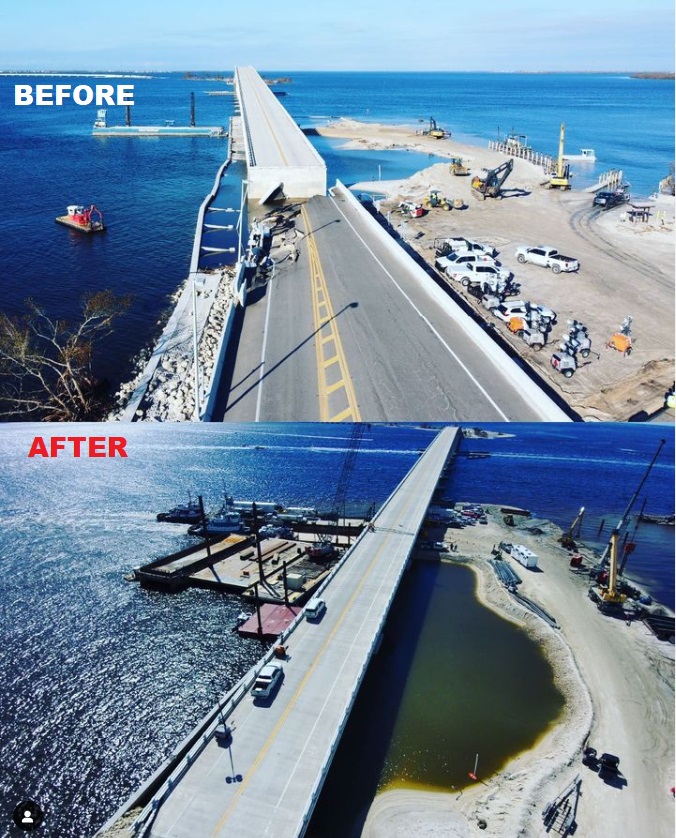
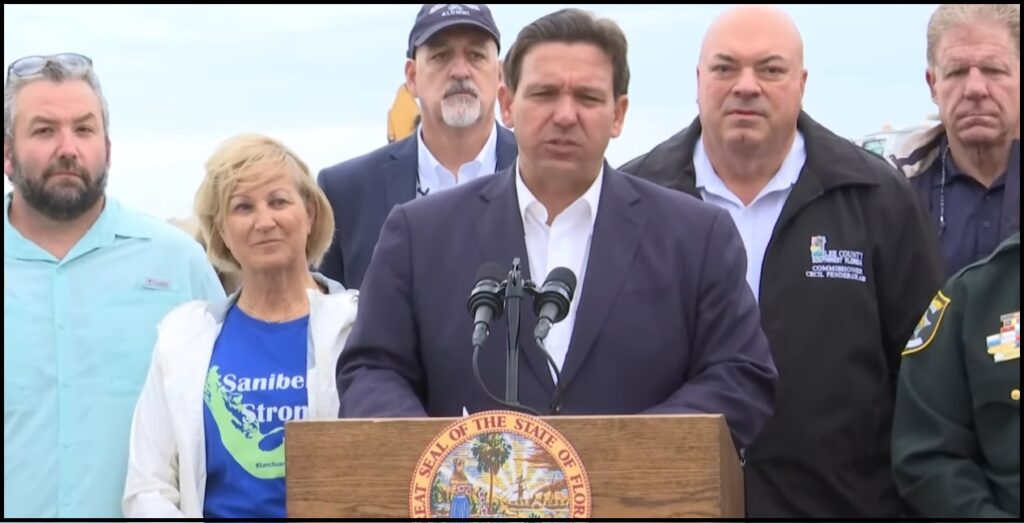
Today Florida Governor Ron DeSantis was in the Punta Rassa area of South Fort Myers to celebrate a remarkable accomplishment. The Sanibel bridges and causeway are open to civilian traffic. {Direct Rumble Link}
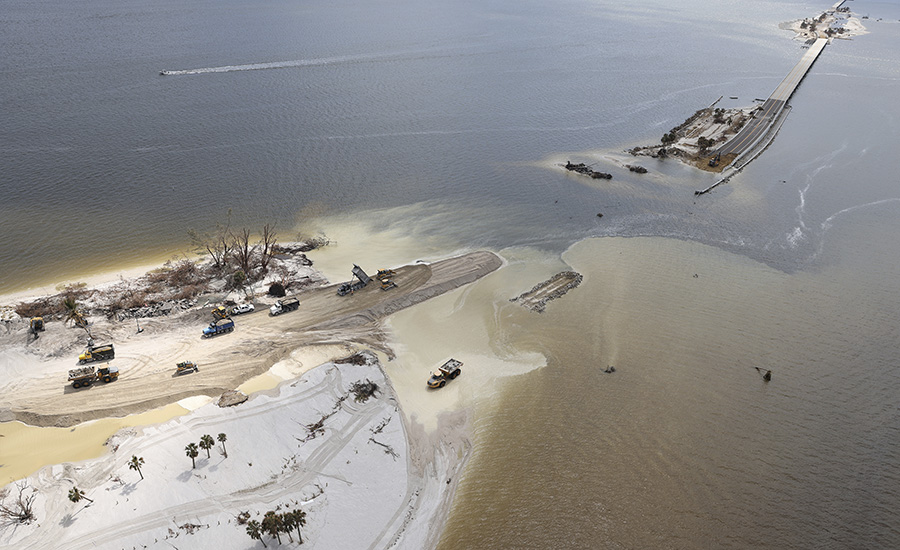
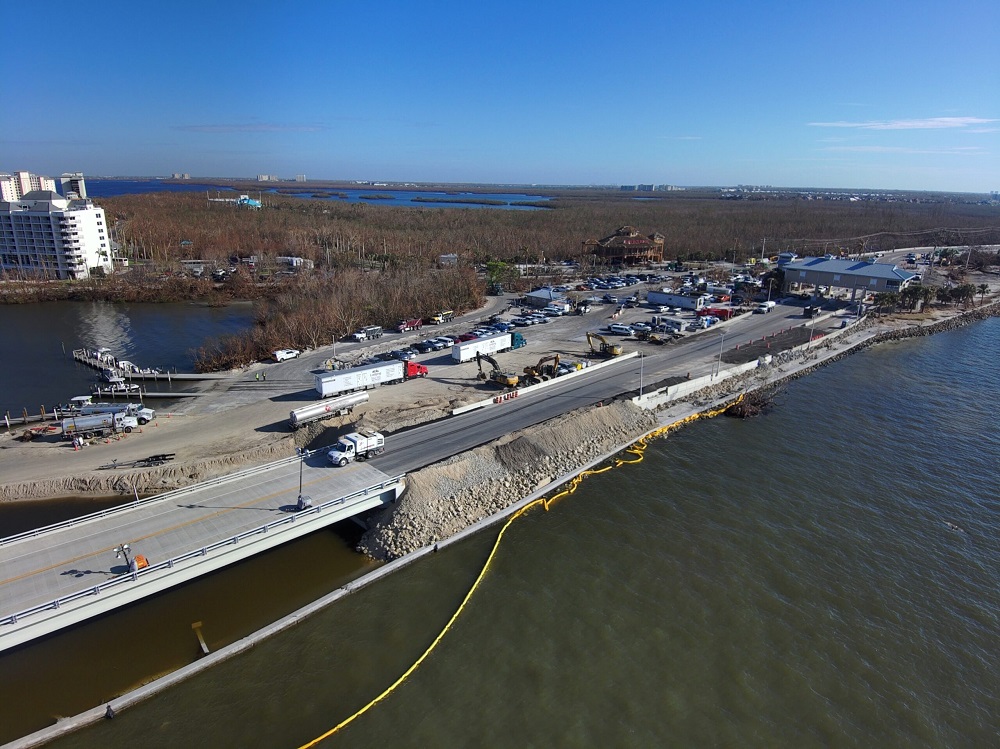
The massive, albeit temporary, repairs to the three spans and spoil islands have been completed three weeks after Hurricane Ian wiped them out. A genuinely remarkable feat of engineering and git’ r done roughneck effort. Truly an incredible accomplishment. To check out the scale of it see PICTURES HERE.
TALLAHASSEE, Fla. — Today, Governor Ron DeSantis announced that emergency repairs to the Sanibel Causeway have been completed in 15 days, more than a week ahead of schedule. As of this morning, access to Sanibel Island has been restored for residents, reconnecting Sanibel Island to the mainland. WATCH:
“The work that has been done to restore vehicle access to Sanibel Island has been historic,” said Governor Ron DeSantis. “Cutting through bureaucratic red tape and delivering on our promise to get Sanibel Island up and running has been a top priority. By restoring access over the causeway, repair crews, first responders, emergency vehicles, business owners and residents will be better able to expedite recovery from this storm.”
“I am grateful for our dedicated team members who quite literally built a road in the Gulf in 15 days,” said FDOT Secretary Jared W. Perdue, P.E. “While the bridges were largely undamaged by the storm, portions of the causeway which connect bridge structures together were washed away by Hurricane Ian, leaving the bridges unconnected to the mainland or the island.
A project like this, under normal circumstances, could take months. However, FDOT, along with our law enforcement partners at the Florida Highway Patrol, Lee County and Florida Department of Emergency Management made use of strategic and innovative techniques to rebuild the causeways quickly. Under Governor DeSantis’ leadership, and thanks to the hard work of hundreds of FDOT employees and contractors, we were able to relink Sanibel Island to the mainland.”
On October 4, Governor DeSantis directed FDOT to prioritize repairs to the Sanibel Causeway with an estimated completion date by the end of October. On October 11, the Governor announced that due to steady progress on repairs to the causeway, a one-time convoy of more than 350 vehicles for utility restoration would be able to safely cross the bridge onto Sanibel Island.
Damage from Hurricane Ian prevented vehicles from being able to cross the 3-mile-long bridge, delaying the delivery of needed services and supplies to the hard-hit Sanibel community. Crews worked around the clock to restore drivable access for the over 6,000 residents of Sanibel Island. With the completion of the temporary emergency repairs to the Sanibel Causeway, FDOT will now work with Lee County on plans for permanent repairs on the causeway.
FDOT, in partnership with Lee County, has completed emergency repairs to several other damaged bridges in the Lee County area, including repairs to the Pine Island Bridge in less than three days in addition to Big Carlos Pass, Big Hickory, Little Carlos Pass, and New Pass Bridges.
Access to Sanibel Island via the Sanibel Causeway will be managed by Lee County. For more information, please visit www.leegov.com or follow Lee County on Facebook at www.facebook.com/leecountyflbocc.
Governor Ron DeSantis has done a great job, and those who wash with Lava soap and degreaser are inspiringly awesome. Check Out This Video:
On the home front a few expected and unexpected challenges remain.
First, my apologies for not being able to post more content at CTH. Electricity and water service have been restored, but internet service is still a considerable challenge. Most of the current CTH articles are written from weak hotspots or travel to temporary business centers which have been established for use.
It is a wee bit challenging, not just for my efforts here but much more so for businesses in SWFL that rely on stable internet to process business transactions. Remember the pre-hurricane advice about having cash and not relying on electricity and internet?… Yeah, in some areas that aspect is still an ongoing issue.
Then there’s the goofy stuff. Just about everyone who was fortunate enough to have a stable structure remaining, has some form of a tarp roof. It’s like living in a tent, but a house, with plywood. Think about Bagram AFB with cinder block walls… lol… Hey, it’s home. Permanent installation roofers will be busy here for years; however, on a positive note our insurance adjuster (cool guy) said they were expecting 200,000+ claims, and so far only had 30,000. So, perhaps the major structural issues are more isolated.
On a directly related note, did you know that asphalt shingles are like flying razor blades in hurricanes? Ask me how I know this, and I will show you a shingle about 6 inches squared that sliced through the front grill of the truck and we found embedded in the radiator today. She was overheating, and now I know why. Crazy stuff.
Also, any gearheads out there with good advice on the best quality long-term patches for tires let me know. Roofing nails are hobbling everyone (also raises hand), tire shops look like the entrance to Trump rallies….
….which also look like the line for internet service appointments.
Apparently, whoever at Comcast/Xfinity came up with the script, “to report your internet outage, please go on-line to http://www.”, didn’t quite think through the process.
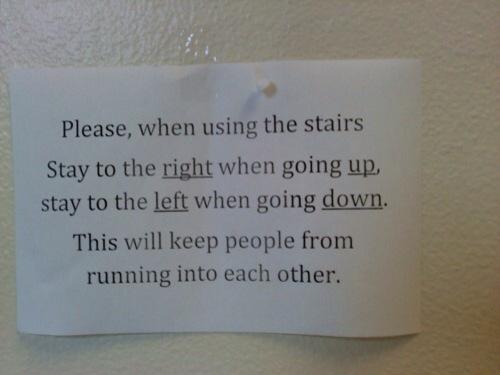
It reminds me of that sign I saw on the stairs years ago that I just had to take a picture of (see above). Hey, we need to laugh because the alternative isn’t healthy.
Back to the hurricane tip part. You can always tell those people who have been through hurricanes before by how they parked their cars. I have never included this in the hurricane advice before so it’s worth a mention.
Regarding hurricane damage, if you lose your Florida garage door you will more than likely lose your roof. That’s just the reality of having a massive opening in your structure to 150 mph winds that will lift the trusses.
First tip, if you have two vehicles, put one vehicle inside the garage with the front bumper against the door to help stop the flex (do this carefully). Put the other vehicle outside blocking the garage door facing down the driveway. Use the aero dynamics of the car to push the wind up away from the door.
Second tip, if you live in a flood zone, or if you are concerned about storm surge, the day before impact take your #1 car to the nearest airport or hotel with a parking garage and park in the upper levels. Take an uber back home if you don’t have a friend or partner to help you. This way you know you will have one workable vehicle, just in case.
I’m going to compile a list of oddball prepper stuff after learning even more from this event, and I will share it.
Stay strong; keep a good thought and be thankful. Again, the alternative provides no value.
Love to all,
~ Sundance
Lord, I cherish the lessons in patience, but please remove the blue circle of misery from my computer screen.
Posted originally on the conservative tree house on October 16, 2022
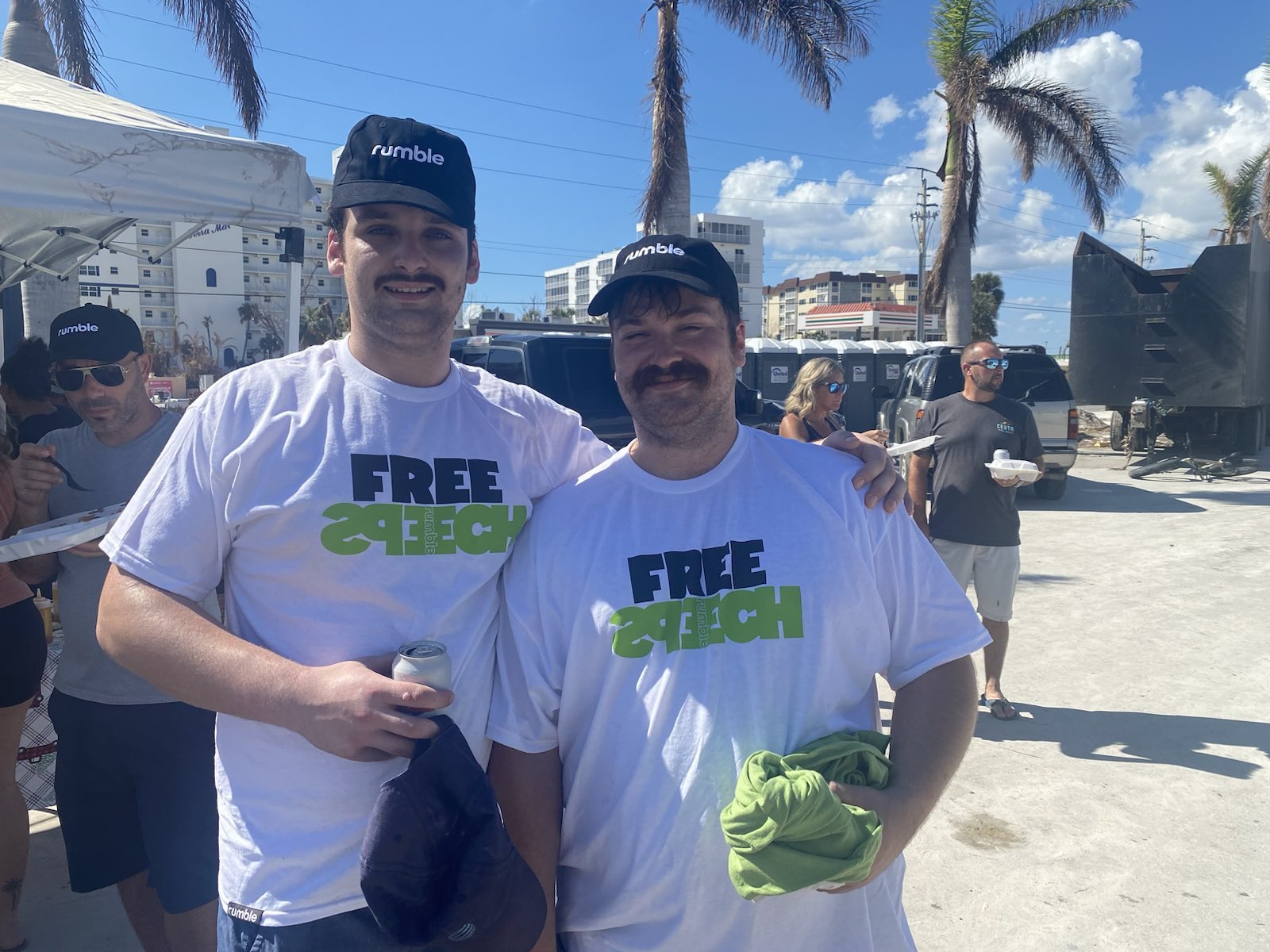
Rumble CEO @Chris Pavlovski and Rumble Video Creator @SteveWilldoit stepped up in a major way to help survivors of Hurricane Ian today by sending a convoy of 12 travel trailers and generators into Southwest Florida to support a dozen displaced families. This is a blessed contribution to the recovery effort.
The convoy traveled to Fort Myers where they will be transferred to a dozen families who have lost their homes, providing a temporary housing solution that is much needed. Just an awesome job by the Rumble Video company and a content creator for the platform.
Thousands of people are displaced from their homes in Fort Myers, Cape Coral, Pine Island, Fort Myers Beach and Sanibel Island. There isn’t an empty hotel room within 100 miles of Lee County as families struggle to find housing.
There are tents set up in parking lots in the South Fort Myers area as temporary shelters for those unable to find alternative housing. This type of private sector support is very much needed and appreciated. Rumble is headquartered in Longboat Key Florida, and CEO Chris Pavlovski extends his belief in civic stewardship with generous support for those families most severely impacted by the recent storm. Awesome Job. #FloridaStrong
Video of the convoy arriving, below:
UPDATE 1: A convoy of RV’s and generators are heading to Fort Myers as we speak, led by @stevewilldoit and joined by the Rumble team.
Posted on the conservative tree house on October 15, 2022 | sundance
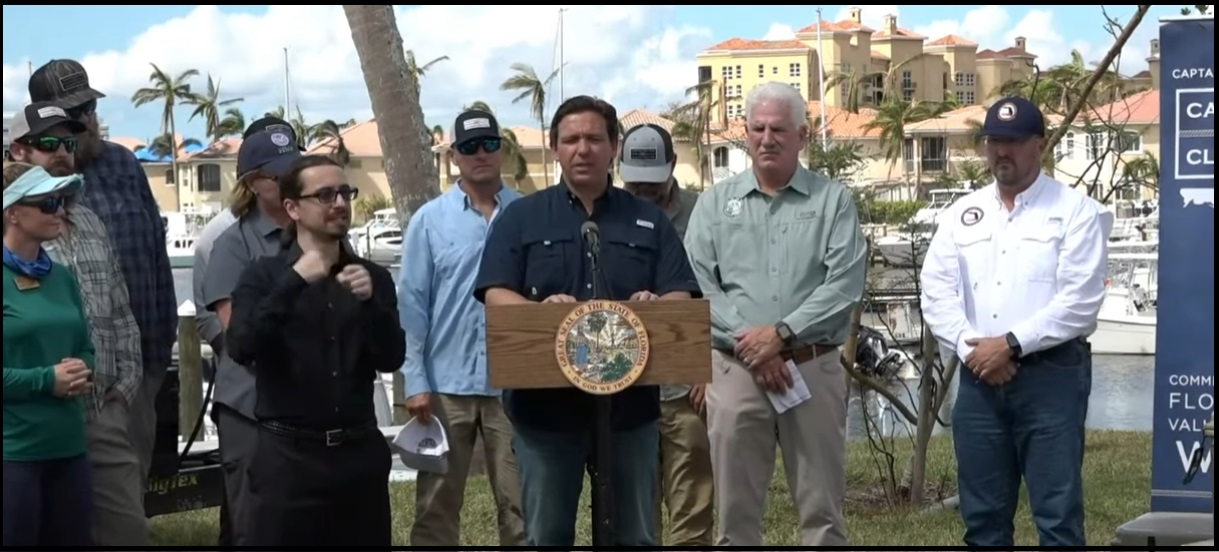
Florida Governor Ron DeSantis has spent the past several days in/around the western impact zone of Hurricane Ian, the areas hardest hit.
Restoration and recovery work continues overcoming serious obstacles with infrastructure destruction particularly around Fort Myers Beach, Sanibel Island, Captiva Island, Cape Coral, Pine Island and up toward the Boca Grande pass. These western coastal areas were impacted by sustained 150+ MPH winds for multiple hours as slow-moving Ian crept inland; hence the scale of the destruction.
The power infrastructure is slowly returning to Fort Myers Beach, however, most of the properties are a total loss and/or so heavily damaged power restoration to the structure is unsafe. The work on Sanibel Island is reconstructing the physical power transit system, which will take a long time. According to state officials, approximately 80% of the mainline power grid on Pine Island is now rebuilt; however, many homes are heavily damaged (like FMB) so lines to structures will take longer.
Governor Ron DeSantis gives an update from Burnt Store Marina, which is located between Cape Coral and Punta Gorda on the west. WATCH:
.
Governor Ron DeSantis also announced an official request to The Dept of Commerce and NOAA to declare a federal fisheries disaster which would provide relief to families and businesses impacted by the loss of economic activity in the fishery sector.
I have created this site to help people have fun in the kitchen. I write about enjoying life both in and out of my kitchen. Life is short! Make the most of it and enjoy!
This is a library of News Events not reported by the Main Stream Media documenting & connecting the dots on How the Obama Marxist Liberal agenda is destroying America













 Centinel2012