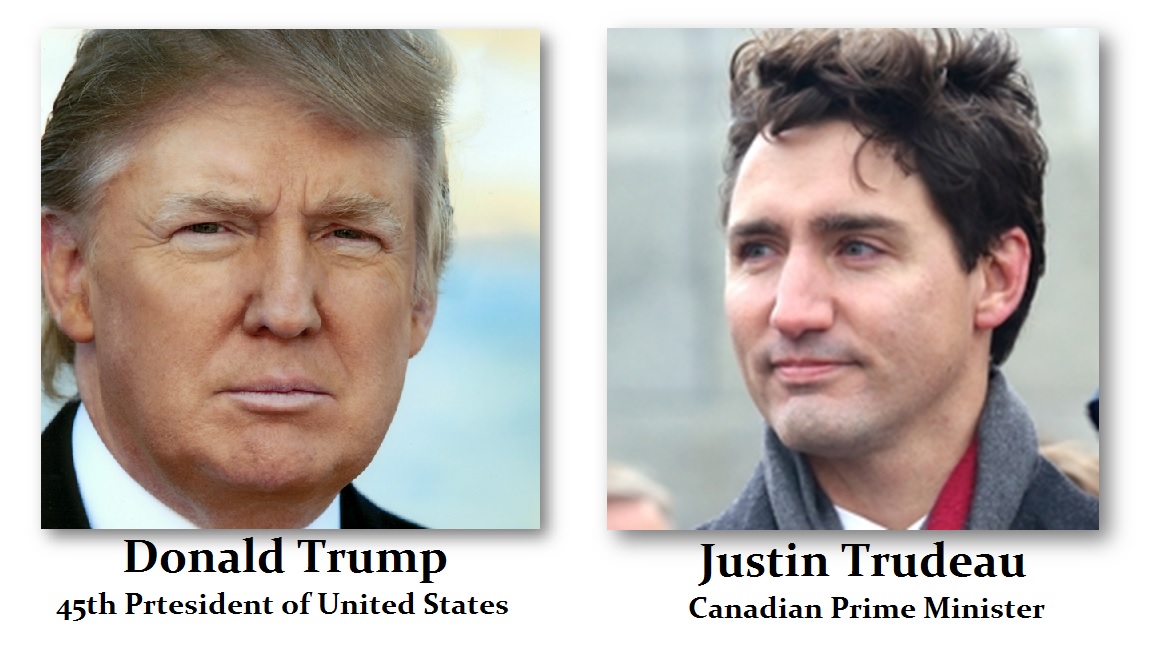
COMMENT: I live in Alberta, Canada and for years as a sign maker I had to order materials from the United States. I can assure you that the problems you mention are no different than the problems we encounter when buying American products: tariffs; customs duties etc. and as well paying in $US which really hikes our prices. We also sold promotional items, many which we ordered from the States. What a nightmare! I am now retired and I could go to the States to buy shoes, but why would I? We have shoes here, as a matter of fact, a lot of our friends are now only buying Canadian products, especially since President Trump has made so many negative remarks about us. I actually thought he was doing great things for the USA, but these digs against Canada are not helping anything.
DC
REPLY: Trump’s comment about scuffing up shoe is really ridiculous. The currency exchange defeats and benefit. This whole thing about blurring the distinction between tariffs and customs duties is a global problem. I was flying from Australia to Tokyo and I had to stop in Hawaii. I argued with the customs officer that I was going to Tokyo and then to New York so I should pay the customs duty one time on final entry. He was nasty and said either I paid there or they confiscated my bags. With no choice, I paid. Of course, when I landed in New York and told them I paid the duty in Hawaii, he could care less. They then made me pay it a second time.
This entire issue of trade is a total mess. Trump, in my opinion, does not understand trade and what really is going on. It is becoming outright extortion. If you eliminate the tariffs, they will still demand customs fees. We really need a complete reset. He should simply state that tariffs should end across the board except on defense and food.
Tonight President Trump is holding a MAGA rally in Duluth, Minnesota. The visit is a contrast between former Decepticon governor Gov. Tim Pawlenty, who criticized the MAGA policy, and his primary opponent Jeff Johnson who backs the president.
The rally in Duluth is also for Pete Stauber, a Republican congressional candidate running in the traditionally Democratic 8th District. Home of the state’s famed Iron Range, Minnesota is important ground for MAGA policy as a place where new tariffs on foreign steel will deliver economic benefits. The GOP primary is set for Aug. 14.
President Trump is scheduled to deliver remarks to the audience at 7:30pm EDT:
Earlier today, in response to current issues surrounding human trafficking arrivals at the U.S. – Mexico border, President Trump signed an executive order (full text below) addressing family separation.
.
By the authority vested in me as President by the Constitution and the laws of the United States of America, including the Immigration and Nationality Act (INA), 8 U.S.C. 1101 “et seq”, it is hereby ordered as follows:
[Text] ♦ Section 1. Policy. It is the policy of this Administration to rigorously enforce our immigration laws. Under our laws, the only legal way for an alien to enter this country is at a designated port of entry at an appropriate time. When an alien enters or attempts to enter the country anywhere else, that alien has committed at least the crime of improper entry and is subject to a fine or imprisonment under section 1325(a) of title 8, United States Code.
This Administration will initiate proceedings to enforce this and other criminal provisions of the INA until and unless Congress directs otherwise. It is also the policy of this Administration to maintain family unity, including by detaining alien families together where appropriate and consistent with law and available resources. It is unfortunate that Congress’s failure to act and court orders have put the Administration in the position of separating alien families to effectively enforce the law.
♦ Section 2. Definitions. For purposes of this order, the following definitions apply:
(a) “Alien family” means
(i) any person not a citizen or national of the United States who has not been admitted into, or is not authorized to enter or remain in, the United States, who entered this country with an alien child or alien children at or between designated ports of entry and who was detained; and
(ii) that person’s alien child or alien children.
(b) “Alien child” means any person not a citizen or national of the United States who
(i) has not been admitted into, or is not authorized to enter or remain in, the United States;
(ii) is under the age of 18; and
(iii) has a legal parent-child relationship to an alien who entered the United States with the alien child at or between designated ports of entry and who was detained.
♦ Section 3. Temporary Detention Policy for Families Entering this Country Illegally.
(a) The Secretary of Homeland Security (Secretary), shall, to the extent permitted by law and subject to the availability of appropriations, maintain custody of alien families during the pendency of any criminal improper entry or immigration proceedings involving their members.
(b) The Secretary shall not, however, detain an alien family together when there is a concern that detention of an alien child with the child’s alien parent would pose a risk to the child’s welfare.
(c) The Secretary of Defense shall take all legally available measures to provide to the Secretary, upon request, any existing facilities available for the housing and care of alien families, and shall construct such facilities if necessary and consistent with law. The Secretary, to the extent permitted by law, shall be responsible for reimbursement for the use of these facilities.
(d) Heads of executive departments and agencies shall, to the extent consistent with law, make available to the Secretary, for the housing and care of alien families pending court proceedings for improper entry, any facilities that are appropriate for such purposes. The Secretary, to the extent permitted by law, shall be responsible for reimbursement for the use of these facilities.
(e) The Attorney General shall promptly file a request with the U.S. District Court for the Central District of California to modify the Settlement Agreement in “Flores v. Sessions”, CV 85-4544 (“”Flores” settlement”), in a manner that would permit the Secretary, under present resource constraints, to detain alien families together throughout the pendency of criminal proceedings for improper entry or any removal or other immigration proceedings.
♦ Section 4. Prioritization of Immigration Proceedings Involving Alien Families. The Attorney General shall, to the extent practicable, prioritize the adjudication of cases involving detained families.
♦Section 5. General Provisions.
(a) Nothing in this order shall be construed to impair or otherwise affect:
(i) the authority granted by law to an executive department or agency, or the head thereof; or
(ii) the functions of the Director of the Office of Management and Budget relating to budgetary, administrative, or legislative proposals.
(b) This order shall be implemented in a manner consistent with applicable law and subject to the availability of appropriations.
(c) This order is not intended to, and does not, create any right or benefit, substantive or procedural, enforceable at law or in equity by any party against the United States, its departments, agencies, or entities, its officers, employees, or agents, or any other person.
Earlier today President Trump met with members of the republican deception caucus in the cabinet room. The Decepticon Caucus are funded by the U.S. Chamber of Commerce, and their President Tom Donohue. Within the discussion the Decepticons fight for open-ended immigration and trade deals to benefit Wall Street and the multinationals.
.
[Transcript] Cabinet Room – 11:44 A.M. EDT – THE PRESIDENT: Well, thank you very much, everybody. I’ll be leaving for Minnesota today. We have two stops; one a very big one, and it will be a lot of fun. I know a lot of you are going with us, so that will be interesting.
We’re meeting right now on immigration. And we are very strong at the border, we’re very strong on security. We want security for our country. The Republicans want security and insist on security for our country, and we will have that. At the same time, we have compassion. We want to keep families together; it’s very important. I’ll be signing something in a little while that’s going to do that. And the people in this room want to do that, and they’re working on various pieces of legislation to get it done. But I’ll be doing something that’s somewhat preemptive but ultimately will be matched by legislation, I’m sure.
We’re having a lot of problems with Democrats. They dont want to vote for anything. They don’t care about lack of security. They really would like to have open borders, where anybody in the world can just flow in, including from the Middle East. From — anybody, anywhere, they can just flow into our country. Tremendous problems with that. Tremendous crime caused by that. We’re just not going to do it.
I do want to say that because we’re all so busy, and I just mentioned to the congressmen and the senators in the room, that we are going to cancel and postpone tomorrow’s Congressional Picnic. We have a Congressional Picnic tomorrow. And I was just walking over to the Oval Office and I said, you know, it doesnt feel right to have a picnic for Congress when we’re working on — doing something very important. We have many things that are important. We’re talking about trade. We’re talking about many, many things. But it didnt feel exactly right to me.
So we will be officially postponing the Congressional Picnic for tomorrow. We’ll make it another time when things are going extremely well. And they are going, for the country, extremely well.
We have record-setting numbers in every way economically, but we want to solve this immigration problem, which is going on for 40 years, more. It’s been going on forever. And we want to see if we can solve it. So we are cancelling or postponing the Congressional Picnic tomorrow.
Would anybody in the room have any question or a statement that you’d like to make while the press is here? Anybody? Anybody?
SENATOR SULLIVAN: I’ll say one, Mr. President. On the issue of immigration, trade, and investment, these are all areas where Congress has a lot of authority under the Constitution, and you have authority; the executive branch has authority under the Constitution. And I think that’s why meetings like this are really important, bringing the leadership on both sides together because of important issues.
So appreciate the opportunity to let you see our views, hear our views on these issues, where we share authority on important matters. Thank you.
THE PRESIDENT: And we all very much have the same views. We want to keep family together; at the same time, we have to be strong on the border. Otherwise, you’ll have millions of people coming up — not thousands, like we have now; you’ll have millions of people flowing up and just overtaking the country. And we’re not letting that happen.
So we have to be very strong on the border, but, at the same time, we want to be very compassionate.
Yes. Lamar.
REPRESENTATIVE SMITH: Mr. President, thanks for having us. I think what Dan said was good. We really have — on the issues, on trade, on immigration — we have a partnership under the Constitution. We have some authority; the President has some authority. We need to work together.
I was thinking this morning, when we look at President Nixon’s portrait in the White House, we think that he did the unexpected and he went to China, because he could do that; he was in a position to do it. And President Reagan did the unexpected. He went to the Berlin Wall and Moscow.
And when we were here a year ago, I think I suggested to you that immigration, which has bedeviled us for 40 years, as you’ve said — I believe you can — you’re the President who can help us solve the immigration problem with your leadership. You may be able to do for immigration what Nixon did for China and Reagan did for the Soviet Union. And a lot of us would like to work with you on that.
THE PRESIDENT: Thank you, Lamar, very much.
We need the Democrats’ support, because we need their votes. It’s very simple. You know, people say we have a majority. Well, we have a one majority in the Senate. We need 60. Unfortunately, we don’t go with the majority; we go with 60. Someday, somebody will explain why, but that’s the way it is. We have — we need 60 votes; we have 51 votes at the most. So we need Democrat votes in order to do it, otherwise you can’t do it.
Tom, you were going to say something? Tom Cotton.
SENATOR COTTON: I think it’s very important that we protect our border. We cannot allow a child to be a “get out of jail free” card and a “get into the U.S. free” ticket.
But at the same time, as you’ve said, as we’ve all said, we’d like to keep families together, keep them together at the border for the orderly and timely processing of the adults immigration claim. If it’s a lawful, legitimate claim, we can admit the family into the country. If not, they’ll have to go back to their home country.
I’m glad you’re looking for a solution for that. I know that we, in Congress, are working on legislation that will allow our hardworking Border Patrol agents to keep families together at the border while we process their claims in a timely fashion.
THE PRESIDENT: You’re right. And you bring up something that I have to say. Our Border Patrol agents and our ICE agents have done one great job. ICE is throwing — we’re throwing, by the thousands, MS-13. They come into the country. We’re liberating towns on Long Island and other places. We’re throwing them out by the thousands. But we need laws that don’t allow them to come back in.
Mac, you’ve been very involved in this issue. Do you have anything to say?
REPRESENTATIVE THORNBERRY: Well, Mr. President, there are a number of issues that we’re going to be able to discuss today that touch on our country’s national security. And certainly, controlling who and what comes across our border is an element of national security, as we do the compassionate thing with families.
And I look forward to working with you to further strengthen our military. Together, we have turned around a declining situation. But that’s also part of what we need to do together. In fact, to Lamar’s point about we both have responsibilities, we can do more together.
THE PRESIDENT: I will say, with all of the numbers that you see, if we weren’t strong on the border, you’d have hundreds of thousands of people pouring through the border. They’d just be pouring through, and the country would not be the country anymore.
Lindsey?
SENATOR GRAHAM: We’ve got a big massive mess that’s been going on for decades, and we’re all going to fix it one day, I hope. But we got a specific problem that puts the country in a dilemma. Here’s your dilemma and was President Obama’s dilemma, and our dilemma: If a family shows up at the border and we let the family go into the country, and say please come back for your hearing, about 80 percent of the time the adults never show up for the hearing. I think most Americans feel like that is bad; it will create a third wave of illegal immigration.
I want to be fair to people who came here under the old system, but I don’t want to create incentives to create a third wave.
The other choice is, is if you detain the parents who broke the law, under the Flores decision you have to break the family up. So there’s a 1997 Supreme Court case that we’ve got to deal with.
So I would urge my Democratic friends to see if we can find a way to keep families together, have a legislative fix of the Flores decision, and argue about the other things later.
Because right now, Mr. President, you’re in a real bind. If you detain the adults, the law requires the children to be separated. If you let the adults into the country, they’d never show up. It seems to me that we want to keep the family together and have the parents show up for their day in court.
To Senator Schumer: I know there’s a lot we don’t agree on, but surely to goodness we can fix this court decision, because the country is in a bad spot, not just you.
THE PRESIDENT: Well, Lindsey, the dilemma is that if you’re weak — if you’re weak, which people would like you to be — if you’re really, really pathetically weak, the country is going to be overrun with millions of people. And if you’re strong, then you don’t have any heart. That’s a tough dilemma. Perhaps I’d rather be strong, but that’s a tough dilemma.
SENATOR JOHNSON: Mr. President —
THE PRESIDENT: Yes, go ahead, Ron.
SENATOR JOHNSON: In our community, homeland security, we’ve held 30 hearings on border security. And you know how much I like data. And, you know, Senator Graham mentioned the fact that we have these incentives. There’s nothing compassionate, by the way, of enticing people to take a very dangerous journey on a train they call “the beast,” or through the desert. We’ve seen the pictures of dead — desiccated bodies in the desert. There’s nothing compassionate about that.
But here’s what’s happened since 2012, since DACA. Just to talk about unaccompanied children: Prior to that, somewhere between 3,000 or 4,000 unaccompanied children from Central America came into this country. Then DACA was instituted in 2012, and that problem skyrocketed. The numbers on it — about 225,000 unaccompanied children, just from Central America; about almost half a million family members. So we’ve got another 750,000 individuals — very sympathetic — that we’re just incentivizing for coming. And we have to stop those incentives.
Our goal of our policy should be to reduce the flow of people incentivized to come to this country, and that’s what strong enforcement actually does.
THE PRESIDENT: So just so everybody knows, this deal was just about done. We had a deal signed. President Obama signed DACA. When he signed it, he said, I’m really not allowed to sign this, and I’m going to sign it anyway. But he actually said, I’m not allowed to sign this, never going to hold up. And they got a judge who held it up, and they got another one who held it up. Then we had a couple that turned it down, and it’s going to be a Supreme Court issue.
But before it was held up, everyone assumed that the DACA would not be held up. But we had a deal with the Democrats. It was a deal that everybody agreed to. It was $25 billion. We were going to build a wall. We would take care of many, many different things, including loopholes. And it was all done, except when this judge ruled in favor of DACA, meaning that it could continue until we get to the Supreme Court, all of a sudden, they weren’t there anymore. And that’s what happened, and that’s why we’re in this mess — because we had a couple of court decisions, which is going to force an issue to the Supreme Court that shouldn’t be forced to the Supreme Court.
Yes, John.
SENATOR HOEVEN: Thanks for inviting up on these important issues, and for having this important discussion certainly on immigration, but also on trade. And the context that I want to make sure we talk about is, we’ve made incredible progress on tax relief, we’ve made tremendous progress on regulatory relief, and it’s reflected in our economy. Now, if we can do the same thing on trade, think what that means for our country in terms of economic growth, in terms of jobs, in terms of getting wages moving higher, and the impact that has for all Americans.
So we have to look at in that context. When we talk about trade, it’s on top of tax relief, regulatory relief. And now, if we can get the right policies in place on trade, think what that means for our country.
THE PRESIDENT: Well, were doing very well on trade, I will say. We’ve been really hurt as a country on trade, for many years. Despite bad trade deals, we’re doing very well. And now we’re making very good trade deals. Well, you’ll be seeing that. They’ll be announced pretty rapidly. We already have a couple that are made. But we’re making great trade deals.
And honestly, we need people coming into our country. You know, we have a lot of companies coming into our country: Chrysler just announced. We have Foxconn is going up to Wisconsin, as you know, and a great company. They make the Apple iPhones and laptops and — unbelievable company. We need people. We need people that work for these companies because they’re coming in at a number that nobody ever thought possible.
So we want people to come into our country, but I think I can speak for everybody at the table: We want them to come in based on merit. We want great people that will be great for our country. And we want them to come in based on merit. We’re going to need those people because we have so many companies coming to the country.
John, you were going to say something?
SENATOR CORNYN: Mr. President, to your point, America is the most generous country in the world when it comes to legal immigration. And I think we ought to draw a very clear line between legal immigration that benefits our country —
THE PRESIDENT: Right, absolutely.
SENATOR CORNYN: — and illegal immigration, which is a threat to public safety.
I just wanted to make the one point. I agree with what Tom Cotton and others have said, what you’ve said, about being able to enforce the law and keep families together. It’s not a mutually exclusive choice. We can do both. And I’m confident we will achieve that goal.
But I just want to point out that, coming from a border state, like Mac and I do, the border — the illegality along the border is a complex problem because it is — as somebody pointed out, it’s “commodity agnostic.” In other words, they said it’s people, it’s drugs, it’s weapons. And you talk about an opioid crisis in the United States — it’s not just prescription drugs; it’s heroin that comes from Mexico.
THE PRESIDENT: Right.
SENATOR CORNYN: So this is a very complex situation. We need law and order along the border. Everybody agrees with that. We need to be compassionate in the way we handle these families. But it’s important to remember that larger context, because the cartels and the criminal organizations that benefit from this, they’re just making a lot of money and keeping this situation very dangerous for everybody involved.
THE PRESIDENT: And, John, in many ways, they’re using the children and always — they’re using the children as a ticket to getting into the country.
SENATOR CORNYN: Absolutely.
THE PRESIDENT: And we have to remember that. You know, there’s a number of the 12,000 children; 2,000 are with the parents, and 10,000 came up with some really horrible people, in some cases. You have the coyotes, you have the traffickers — the human traffickers — not only drug traffickers, but you have the human traffickers. And they use these children as passports to get into the country. So we have to work on that, too. It’s a very complex issue.
It has been going on — you shouldn’t feel guilty, because it’s been going on for many, many years. Many, many decades. But we’re going to solve that, along with a lot of other problems that we’ve already solved. We’re doing well at solving problems.
You know, when I became President, we had North Korea; we had the Iran deal, which was no good; we had lots of problems with trade and bad trade deals. There are a lot of things that we’ve solved and we’re solving that, in theory, I shouldn’t have had to solve. These are things that should have been solved for a long time. Even on trade.
We should have never allowed our past leaders — should have never allowed China to get to a point where there’s a $500 billion trade deficit with the United States. When they went up, we should have gone up. We should have gone up together — not where you allowed one to get so far ahead. And that includes the European Union and it includes many others. Shouldn’t have happened.
So we came at a time where there were plenty of problems to solve, and one of the big problems is immigration. And I hope that within not too long a distance — and I mean beyond just one problem of immigration. You can mention the word “comprehensive,” or you dont have to use it. A lot of politicians don’t like the word “comprehensive immigration reform.” But I really think we have an opportunity to redo the whole immigration picture, and that’s what I’m looking to do, ultimately. But right now, we want to fix this problem and I think we’ll be able to do that.
Does anybody else — David, do you want to say something?
SENATOR PERDUE: Well, Mr. President, the last year and a half has shown an absolute turnaround in this economy. I mean, we were faced with eight years of 1.9 percent economic growth. We focused on, as John said, regulation, energy, taxes. This year, we’ve put a Dodd-Frank bill — a bipartisan bill, and we freed up a couple trillion dollars.
And what this administration has done is freed up $6 trillion to go back into the economy. This is real jobs — 3.5 million new jobs, 870 regulations reversed. This economy is moving. The rest of world is paying attention.
NATO has doubled their investment in terms of their military spending. We have a new free trade agreement with Korea. We’re heading in the right direction. I just hope that we can focus on the priorities right now, within this trade equation, to get equal access. It’s not right and Alibaba can do cloud computing in the U.S., and Google can’t do cloud computing in China. And that’s what this is all about.
We’ve reduced global poverty by two-thirds in the last 40 years, while poverty in the United States has remained flat. That’s not right. And this is moving to change that.
THE PRESIDENT: Yes. Jim?
SENATOR INHOFE: I appreciate the fact that you call attention to what’s really happening now with the economy, due to two things: the tax bill and the regulations. You know, we’re killing people with the regulations. But what hasn’t been said around this table, and I’m surprised, the biggest accomplishment from your administration is what you’ve done with the military.
You succeeded a President who had a policy that said you can’t do anything with sequestration, with the military, unless you do it with the non-defense. And we changed that. We had to vote for a lousy budget bill to do it, but nonetheless, it is changed. We’ve broken parity, and we’re now rebuilding our military.
THE PRESIDENT: It’s true. The military is really incredible. We’re ordering new planes, new ships — all jobs too. You know, jobs, I would say, in this case is a far second. But we’re going to have a military like we’ve never had before, and it’s great. $700 billion approved and $716 [billion]. And in that budget, $6 billion for opioid. That’s an important thing, too.
So a lot of progress is being made.
Mike, did you have something to say? Mike Pence?
THE VICE PRESIDENT: Yes. Thank you, Mr. President. And I just — I know I speak for the President when I express the gratitude of this administration for the support of the members of the Senate and the House that are gathered around here. You’ve delivered for the American people on national security and rebuilding our military; on tax cuts and regulatory reform, restoring our economy.
But what the President reiterated again yesterday, and he has said every day from when he sought this office, is we have a crisis of illegal immigration. And as the President made clear, we don’t want families to be separated. We don’t want children taken away from parents. But right now, under the law — and we sit with these lawmakers — we only have two choices before us: Number one is, don’t prosecute people who come into our country illegally, or prosecute them and then, under court cases and the law, they have to be separated from their children.
What I want to be clear about is we’re calling on these lawmakers, Mr. President, not just to solve this problem in a way that affirms our commitment to law and order and compassion, which we can do. And there are proposals in the Senate and proposals in the House to do that. But the President’s vision, articulated in his State of the Union address, was let’s solve the whole problem. Let’s build a wall, let’s close the loopholes, let’s solve the problem for 1.8 million people that were brought into this country through no fault of their own, and let’s deal with law and order and compassion with this issue of family separation at our borders.
And I would say, with great respect to the members of Congress, as the House considers legislation tomorrow and the Senate is considering legislation, the President has postponed the Congressional Picnic — we’re calling on Congress to act. Let’s roll our sleeves up, let’s work the whole problem. Let’s end this crisis of illegal immigration.
THE PRESIDENT: Thank you very much. Does anybody else have anything to say? Because I think we’re pretty much — yes, Adam.
REPRESENTATIVE KINZINGER: Mr. President, thank you. And just from the House perspective, I want to say — and as a still-currently serving Guard member — you’re my Commander-in-Chief — there has been a marked difference in the security and the good feelings in the military. They understand that we’re investing in them again, even though we’re asking them to do a lot.
And secondly, security plays a big role. So that includes border security. And the bill that we’re going to bring up, and hopefully pass in the House this week, fully funds the border and takes care of all these issues. And I hope the House can pass it. And I wish Democrats would join us, because frankly, it’s a lot of stuff in there that they like, too. It’s an 80 percent issue. Unfortunately, I think they like the politics of this a little better.
And I also want to say, we really wish you didn’t take Secretary Pompeo from the House, because he did a great job. (Laughter.) He’s doing a great job.
THE PRESIDENT: He’s doing a great job. He is doing a great job. Thank you, Adam, very much. Appreciate it.
Anybody over here? Yes.
REPRESENTATIVE CHENEY: Thank you, Mr. President. I want to echo particularly what Chairman Thornberry and Senator Inhofe said in terms of the change that we’ve seen — and Adam as well — the change we’ve seen in terms of resources for the military. We got to make sure we don’t have another CR for the military.
THE PRESIDENT: Right.
REPRESENTATIVE CHENEY: And we are working hard in the House. We’re hopeful we’re going to pass defense appropriations bill next week in the House. And we need to make sure that that gets taken up and passed in the Senate, and that we don’t give you another omnibus-type bill —
THE PRESIDENT: Please. Please, that would be very nice.
REPRESENTATIVE CHENEY: — that we get a straight defense appropriations bill passed and taken up. And that will be critically important to continue the work you’ve done to rebuild the military.
THE PRESIDENT: Thank you, Liz. And say hello to your father, please.
REPRESENTATIVE CHENEY: Thank you.
THE PRESIDENT: Great guy.
PARTICIPANT: Can you tell Adam to shave — (laughter.)
THE PRESIDENT: He looks good. Handsome guy.
So thank you all very much. We appreciate it.
Q Mr. President, are you supporting (inaudible) to keep families together? (Inaudible) executive order?
THE PRESIDENT: We are. We’re looking to keep families together. It’s very important.
Q Are you signing an executive order?
THE PRESIDENT: We’re going to be signing an executive order. We’re going to also count on Congress, obviously. But we are signing an executive order in a little while. We’re going to keep families together, but we still have to maintain toughness, or our country will be overrun by people, by crime, by all of the things that we don’t stand for, that we don’t want.
So I’m going to be signing an executive order in a little while before I go to Minnesota. But at the same time, I think you have to understand: We’re keeping families together, but we have to keep our borders strong. We will be overrun with crime and with people that should not be in our country.
Q Will you accept a standalone bill addressing the family separation issue?
THE PRESIDENT: We’re going to see what happens.
Q Mr. President, did the images of those young children at the border change your mind on this?
THE PRESIDENT: Yes. They affect everybody. Those images affect everybody. But I have to say that you have double standards. You have people that want absolute security and safety, and you have people that do look at the children. And then you have people like me, and I think most of the people in this room, that want both. We want the heart, but we also want strong borders, and we want no crime.
We don’t want crime in this country. We don’t want people coming in. We don’t want people coming in from the Middle East through our border, using children to get through the lines. We don’t want that. We’re doing too good a job to allow that to happen. So we’re not going to allow that to happen.
Thank you very much. Thank you.
Q (Inaudible.)
THE PRESIDENT: Nothing. This has been going on for — when you say what took long — this has been going on for 50 years, longer. This has been going on under President Obama, under President Bush. This has been going on for many, many years. We’re going to see if we can solve it. This is not something that happened just now.
You look at the images from 2014. I was watching this morning, and they were showing images from 2014. They blow away what we’re looking at today. And that was not during this; that was during the Obama administration. I saw images that were horrible. And you know the ones I’m talking about because I’m sure you all saw them too.
We are going to see if we can solve the immigration problem like we’ve solved so many other problems. And I think we’ll get it done.
Thank you very much.
Q (Inaudible.)
THE PRESIDENT: North Korea is doing great. North Korea is doing great. North Korea is doing great.
Q (Inaudible) for North Korea?
THE PRESIDENT: No, no, no. North Korea itself is doing really well.
White House Trade Policy Adviser Peter Navarro discusses the release of the White House Trade and Manufacturing Policy report (full pdf below) on China.
.
Today, the White House Office of Trade & Manufacturing Policy (OTMP) released a report outlining how China’s policies threaten the economic and national security of the United States.
OTMP studied how China seeks to capture, through its “Made in China 2025” plan, the emerging high-technology industries that will drive future economic growth. China is targeting industries ranging from artificial intelligence, aerospace, and augmented and virtual reality to high-speed rail and shipping and new energy vehicles. Many of these “Made in China 2025” industries have important defense applications.
OTMP outlines how China aggressively seeks to acquire American technology and intellectual property through multiple vectors including: physical and cyber theft, forced technology transfers, evading United States export controls, export restraints on raw materials, and investments in more than 600 high-technology assets in the United States worth close to $20 billion.
CTH has tracked this issue so closely through the years it often feels futile for another reminder. However, with the insufferable political games surfacing, yet again, over the issue of illegal immigrants and children – perhaps it is worth another visit.
Understanding The Big Racket.
Massive illegal immigration is supported by both sides of the professional political machine. There are few issues more unifying for the K-Street purchased voices of DC politicians than keeping the borders open and the influx of illegal aliens as high as possible. The U.S. Chamber of Commerce pays politicians to keep this system in place.
All Democrats and most Republicans support mass immigration. Almost no DC politicians want to take action on any policy or legislation that stops the influx. There are billions at stake. None of the GOP leadership want to actually stop illegal immigration; it’s a lucrative business. Almost all of the CONservative groups and politicians lie about it.
The religious right is also part of the problem. In the past 15 years illegal immigration and refugee settlement has been financially beneficial for them. The prior actions of Ted Cruz, Glenn Beck et al show they are as committed to facilitating illegal immigration as Nancy Pelosi, Chuck Schumer, Paul Ryan, Mitch McConnell, Jeff Flake, Ben Sasse, Kevin McCarthy, Lisa Murkowski and the rest of the Decepticons.
Washington DC and the activist media, are infested with illegal immigration supporters; the issue is at the heart of the UniParty. Follow the money. It’s the Acorn model:
There is no greater disconnect from ordinary Americans on any singular issue than the policy positions of Democrats and Republicans in Washington DC surrounding immigration. President Donald Trump is confronting their unified interests.
All political opposition to the Trump administration on this issue is structured, planned and coordinated. The issue is a valuable tool for the professional political class to sow chaos amid politicians.
The resulting crisis is useful for them; therefore they fuel the crisis.
Southwest Key has been given $310,000,000, in taxpayer funds so far in 2018. And that’s just one company, in one part of a year. Prior CTH research showed this specific “Private Company” nets 98.76% of earnings from government grants (link).
Today … [Houston Mayor Sylvester] Turner said he met with officials from Austin-based Southwest Key Programs, the contractor that operates some of the child shelters, to ask them to reconsider their plans. A spokeswoman for Southwest Key didn’t immediately reply to an email seeking comment.
“And so there comes a point in time we draw a line and for me, the line is with these children,” said Turner during a news conference Tuesday. (link)
“The thought that they are going to be putting such little kids in an institutional setting? I mean it is hard for me to even wrap my mind around it,” said Kay Bellor, vice president for programs at Lutheran Immigration and Refugee Service, which provides foster care and other child welfare services to migrant children. “Toddlers are being detained.” (link)
“Faith Based Immigration Services” is a code-speak for legalized human smuggling.
Human smuggling is big business. If you dig in to the IRS 990 forms you’ll see a lot of, well, “generous” wage/benefit perks. Golf, florists, cafe’s, mysterious leases, land purchases, third party mortgages, $$$ Spouses on the payroll, etc.
So when you’ve got each individual immigration business making multi-hundreds of millions; and politicians getting kick-backs (lobbyists); and bribes to Mexican government officials; and payments to smugglers; who do you think actually wants the business to stop?
The “faith-based” crew (Ted Cruz, Glenn Beck, etc.) don’t want it to stop, because facilitating illegal alien import is now the financial bread and butter amid groups in their base of support. The man/woman in the pew might not know; but the corporation minister, preacher or priest (inside the process) surely does.
The Wall Street, big GOPe, U.S. Chamber of Commerce crew doesn’t want it to stop because they benefit from it (cheap labor), and the taxpayers -not them- are the ones funding it.
Sad thing is, it’s you and me that are paying the South American human smugglers through U.S. taxpayer funds. Laundered through the immigration business bagmen at U.S. Conference of Catholic Bishops, and/or, U.S. Catholic Charities, or Southwest Key Programs Inc; or Baptist Child and Family Services Emergency Management Division (BCFS-EMD), just to name a few.
These immigration groups, get *MASSIVE* HHS grants and then pay-off the DC politicians and human smugglers, including MS13. Billions of dollars are spent, and the business has exploded in the past six years.
It’s a vicious cycle. Trafficked children are more valuable than adults because the organizations involved get more funding for a child than an adult. Each illegal alien child is worth about $56,000 in grant money. The system is full of fraud.
From our prior research approximately 65% of the money they get is spent on executive pay and benefits, opaque administrative payrolls, bribes, kick-backs to DC politicians and payoffs to the South American smugglers who bring them more immigrants.
As best it can be determined, approximately 35% ($19,000) is spent on the alien/immigrant child; maybe. It gets sketchy deep in their accounting.
All of those advocates gnashing their teeth and crying on television have no idea just who is controlling this process; and immigration idiots like Ted Cruz are only adding more fuel, more money, to the bottom line:
President Trump is not only threatening to secure the border, he’s threatening a Washington DC-based business model that makes money for a lot of interests. The operation also has side benefits for the participants; child sexploitation, child labor, and yes, much worse (you can imagine).
Trump has been attacking Canada once again on trade. He blasted the North American Free Trade Agreement, saying the U.S. can no longer afford to be the “stupid country.” He pointed out that Canada imposes such onerous tariffs on U.S. products, such as shoes, that people are forced to “scuff ’em up” in order to “smuggle” them home. Trump has pointed out that Canada is seemingly confusing tariffs with duties.
I can attest to this problem. When we try to send materials to Canada for a conference, shipments are held-up, delayed, and they want all sorts of explanations even for materials that are handed out with no cost. It has become a real problem just trying to often ship anything outside the country. To get around this, we are having to try to find someone to manufacture mugs, pens, notebooks in the host country. It has become hopeless trying to just send cases of mugs that are handed out for free at our conferences.
Indeed, countries are sneaking in huge duties for sending anything into their country in place of tariffs.
Citigroup has issued a press release back in March stating that it will penalize banking clients who engage in gun sales even though they comply with federal, state, and local laws. Citigroup’s new policy tells businesses what kind of firearms and accessories they can stock in their stores, and who they can sell them to. This sort of bank interference in commerce and discrimination is actually illegal in itself. Under the FDIC rules, a bank may NOT under any circumstances discriminate against any business or person without just cause.
Under FDIC rules, it is “[u]nlawful discriminatory practices range from the overt to the very subtle. The motivations behind such practices range from prejudice to simple ignorance of the law. Violations generally fall into two categories: technical and substantive. Within the category of technical violations, some may be procedural, such as not having the Equal Housing Lender poster on display. However, technical violations, especially of a repetitive nature, can be indicators that possible substantive violations may also exist. Substantive violations involve actual discrimination on a prohibited basis, either disparate treatment or disparate impact.”
In this case, Citigroup is clearly engaging in political discrimination which goes all the way to violate the Second Amendment of the Constitution. It is not up to Citigroup to rewrite the Constitution or the prevailing laws. They are in effect violating the very foundation of a democratic structure and moving into a position of a corporate rough dictatorship. They can easily just as well discriminate and say everyone who sells condoms or birth control pills they will refuse to lend to because they believe that there should be no birth control. Or they could refuse to lend money to anyone who is a Muslim claiming they might be connected to some terrorist act.
This policy of Citigroup is flat outright illegal. Of course, the federal court in New York City rules in favor of banks. Any suit must be brought outside of New York where a violation takes place.
Any policy displaying a conscious orientation to reality (common sense) that extracts the U.S. from the insufferable fallacies of U.N. ‘councils’ means another winnamin is in order.
WASHINGTON/UNITED NATIONS (Reuters) – The United States withdrew from a “hypocritical and self-serving” United Nations Human Rights Council on Tuesday over what it called chronic bias against Israel and a lack of reform. (more)
Secretary Pompeo and U.S. Permanent Representative to the United Nations Nikki Haley deliver remarks to the press on the UN Human Rights Council, at the Department of State:
[Transcript] SECRETARY POMPEO: Good afternoon. The Trump administration is committed to protecting and promoting the God-given dignity and freedom of every human being. Every individual has rights that are inherent and inviolable. They are given by God, and not by government. Because of that, no government must take them away.
For decades, the United States has led global efforts to promote human rights, often through multilateral institutions. While we have seen improvements in certain human rights situations, for far too long we have waited while that progress comes too slowly or in some cases never comes. Too many commitments have gone unfulfilled.
President Trump wants to move the ball forward. From day one, he has called out institutions or countries who say one thing and do another. And that’s precisely the problem at the Human Rights Council. As President Trump said at the UN General Assembly: “It is a massive source of embarrassment to the United Nations that some governments with egregious human rights records sit on the Human Rights Council.”
We have no doubt that there was once a noble vision for this council. But today, we need to be honest – the Human Rights Council is a poor defender of human rights.
Worse than that, the Human Rights Council has become an exercise in shameless hypocrisy – with many of the world’s worst human rights abuses going ignored, and some of the world’s most serious offenders sitting on the council itself.
The only thing worse than a council that does almost nothing to protect human rights is a council that covers for human rights abuses and is therefore an obstacle to progress and an impediment to change. The Human Rights Council enables abuses by absolving wrongdoers through silence and falsely condemning those who have committed no offense. A mere look around the world today demonstrates that the council has failed in its stated objectives.
Its membership includes authoritarian governments with unambiguous and abhorrent human rights records, such as China, Cuba, and Venezuela.
There is no fair or competitive election process, and countries have colluded with one another to undermine the current method of selecting members.
And the council’s continued and well-documented bias against Israel is unconscionable. Since its creation, the council has adopted more resolutions condemning Israel than against the rest of the world combined.
The United States has no opposition in principle to multilateral bodies working to protect human rights. We desire to work with our allies and partners on this critical objective that reflects America’s commitment to freedom.
But when organizations undermine our national interests and our allies, we will not be complicit. When they seek to infringe on our national sovereignty, we will not be silent.
The United States – which leads the world in humanitarian assistance, and whose service members have sacrificed life and limb to free millions from oppression and tyranny – will not take lectures form hypocritical bodies and institution as Americans selflessly give their blood and treasure to help the defenseless.
Ambassador Haley has spent more than a year trying to reform the Human Rights Council.
She is the right leader to drive our efforts in this regard at the United Nations. Her efforts in this regard have been tireless.
She has asserted American leadership on everything from the Assad regime’s chemical weapons use, to the pressure campaign against North Korea, and the Iran-backed provocations in the Middle East.
Ambassador Haley has been fearless and a consistent voice on behalf of our ally Israel. And she has a sincere passion to protect the security, dignity, and the freedom of human beings around the world – all while putting American interests first. She has been a fierce defender of human rights around the world.
I will now turn it over to Ambassador Haley for her announcement on how the United States will move forward with respect to the UN Human Rights Council.
♦AMBASSADOR HALEY: Thank you. Good afternoon. I want to thank Secretary Pompeo for his friendship and his partnership and his leadership as we move forward on these issues.
One year ago, I traveled to the United Nations Human Rights Council in Geneva. On that occasion, I outlined the U.S. priorities for advancing human rights and I declared our intent to remain a part of the Human Rights Council if essential reforms were achieved. These reforms were needed in order to make the council a serious advocate for human rights. For too long, the Human Rights Council has been a protector of human rights abusers and a cesspool of political bias.
Regrettably, it is now clear that our call for reform was not heeded. Human rights abusers continue to serve on and be elected to the council. The world’s most inhumane regimes continue to escape scrutiny, and the council continues politicizing and scapegoating of countries with positive human rights records in an attempt to distract from the abusers in their ranks.
Therefore, as we said we would do a year ago if we did not see any progress, the United States is officially withdrawing from the UN Human Rights Council. In doing so, I want to make it crystal clear that this step is not a retreat from human rights commitments; on the contrary, we take this step because our commitment does not allow us to remain a part of a hypocritical and self-serving organization that makes a mockery of human rights.
We did not make this decision lightly. When this administration began 17 months ago, we were well aware of the enormous flaws in the Human Rights Council. We could have withdrawn immediately. We did not do that.
Instead, we made a good-faith effort to resolve the problems. We met with ambassadors of over a dozen countries in Geneva. Last September, in President Trump’s speech before the UN General Assembly, he called for member-states to support Human Rights Council reform. During High-Level Week last year, we led a session on Human Rights Council reform cohosted by the British and Dutch foreign ministers and more than 40 other countries.
Our efforts continued all through this year in New York, where my team met with more than 125 member-states and circulated draft texts. Almost every country we met with agrees with us in principle and behind closed doors that the Human Rights Council needs major, dramatic, systemic changes, yet no other country has had the courage to join our fight.
Meanwhile, the situation on the council has gotten worse, not better. One of our central goals was to prevent the world’s worst human rights abusers from gaining Human Rights Council membership. What happened? In the past year, the Democratic Republic of Congo was elected as a member. The DRC is widely known to have one of the worst human rights records in the world. Even as it was being elected to membership in the Human Rights Council, mass graves continued to be discovered in the Congo.
Another of our goals was to stop the council from protecting the world’s worst human rights abusers. What happened? The council would not even have a meeting on the human rights conditions in Venezuela. Why? Because Venezuela is a member of the Human Rights Council, as is Cuba, as is China.
Similarly, the council failed to respond in December and January when the Iranian regime killed and arrested hundreds of citizens simply for expressing their views.
When a so-called Human Rights Council cannot bring itself to address the massive abuses in Venezuela and Iran, and it welcomes the Democratic Republic of Congo as a new member, the council ceases to be worthy of its name. Such a council, in fact, damages the cause of human rights.
And then, of course, there is the matter of the chronic bias against Israel. Last year, the United States made it clear that we would not accept the continued existence of agenda item seven, which singles out Israel in a way that no other country is singled out. Earlier this year, as it has in previous years, the Human Rights Council passed five resolutions against Israel – more than the number passed against North Korea, Iran, and Syria combined. This disproportionate focus and unending hostility towards Israel is clear proof that the council is motivated by political bias, not by human rights.
For all these reasons, the United States spent the past year engaged in a sincere effort to reform the Human Rights Council. It is worth examining why our efforts didn’t succeed. At its core, there are two reasons. First, there are many unfree countries that simply do not want the council to be effective. A credible human rights council poses a real threat to them, so they opposed the steps that would create it.
Look at the council membership and you see an appalling disrespect for the most basic human rights. These countries strongly resist any effort to expose their abusive practices. In fact, that’s why many of them run for a seat on the Human Rights Council in the first place: to protect themselves from scrutiny. When we made it clear we would strongly pursue council reform, these countries came out of the woodwork to oppose it. Russia, China, Cuba, and Egypt all attempted to undermine our reform efforts this past year.
The second reason our reforms didn’t succeed is in some ways even more frustrating. There are several countries on the Human Rights Council who do share our values. Many of them strongly urged us to remain engaged in the council. They are embarrassed by the obsessive mistreatment of Israel. They share our alarm with the hypocrisy of countries like Cuba, Venezuela, Democratic Republic of Congo, and others serving on the council.
Ultimately, however, many of these likeminded countries were unwilling to seriously challenge the status quo. We gave them opportunity after opportunity and many months of consultations, and yet they would not take a stand unless it was behind closed doors. Some even admittedly were fine with the blatant flaws of the council as long as they could pursue their own narrow agenda within the current structure.
We didn’t agree with such a moral compromise when the previous UN Human Rights Commission was disbanded in 2006, and we don’t agree with it now. Many of these countries argued that the United States should stay on the Human Rights Council because American participation is the last shred of credibility that the council has. But that is precisely why we must leave. If the Human Rights Council is going to attack countries that uphold human rights and shield countries that abuse human rights, then America should not provide it with any credibility. Instead, we will continue to lead on human rights outside the misnamed Human Rights Council.
Last year, during the United States presidency of the Security Council, we initiated the first ever Security Council session dedicated to the connection between human rights and peace and security. Despite protests and prohibitions, we did organize an event on Venezuela outside the Human Rights Council chambers in Geneva. And this past January, we did have a Security Council session on Iranian human rights in New York.
I have traveled to the – to UN refugee and internally displaced persons camps in Ethiopia, Congo, Turkey, and Jordan, and met with the victims of atrocities in those troubled regions. We have used America’s voice and vote to defend human rights at the UN every day, and we will continue to do so. Even as we end our membership in the Human Rights Council, we will keep trying to strengthen the entire framework of the UN engagement on human rights issues, and we will continue to strongly advocate for reform of the Human Rights Council. Should it become reformed, we would be happy to rejoin it.
America has a proud legacy as a champion of human rights, a proud legacy as the world’s largest provider of humanitarian aid, and a proud legacy of liberating oppressed people and defeating tyranny throughout the world. While we do not seek to impose the American system on anyone else, we do support the rights of all people to have freedoms bestowed on them by their creator. That is why we are withdrawing from the UN Human Rights Council, an organization that is not worthy of its name.
Thank you.
QUESTION: Ambassador, is the timing related to the criticism of the border policy?
QUESTION: Do you believe that the criticism is justified?
I have created this site to help people have fun in the kitchen. I write about enjoying life both in and out of my kitchen. Life is short! Make the most of it and enjoy!
This is a library of News Events not reported by the Main Stream Media documenting & connecting the dots on How the Obama Marxist Liberal agenda is destroying America