S&P CoreLogic Case-Shiller Index Marks New High


Armstrong Economics Blog/Real Estate Re-Posted Apr 18, 2022 by Martin Armstrong

Home prices were up 19.2% in January according to the S&P CoreLogic Case-Shiller index. It is extremely difficult for Millennials and Gen Z to enter the housing market, as homes today cost 75% more than they did in 1987 – and that’s just when the index first began tracking prices. The agency addressed the problem the youth are facing:

“While the re-acceleration of home price gains may be concerning and likely discouraging for first-time and younger buyers, it is nevertheless unsurprising considering the dire inventory of for-sale homes, which continues to decline and continually record new lows. Additionally, with mortgage rates jumping to three-year highs, existing homeowners now have little incentive to sell and buy a new, more expensive home with a higher mortgage rate. As a result, homebuyers that remain in the market are once again faced with a very competitive buying environment.”

The pandemic, coupled with extremely low rates, spurred this buying frenzy. Cumulatively, home prices across the US rocketed 31% since March 2020. Although rates are rising and mortgages hit nearly 5% last week, there is no indication of demand declining significantly. The age of remote work has allowed people earning New York-level salaries to relocate to areas with lower tax rates and less crime. It has become a new form of gentrification in the age of corona.

Home prices are soaring everywhere as the supply cannot meet the demand. Some areas have far surpassed 19.2% increases. The 10-city composite is 33% higher than during the peak in 2006, and the 20-city composite rose an astounding 40%. America is looking at a housing crisis if inflation does not wane and risks a generation becoming reliant on rentals and more likely to delay having families.

Hours After Arrest South Carolina Mall Shooter Released on Bail, allowed to Go Home and Work


Posted originally on the conservative tree house on April 17, 2022 | sundance 

Earlier today, 22-year-old Jewayne Price was arrested in connection with yesterday’s mass shooting at a busy mall in Columbia, South Carolina. Jewayne Price is accused of shooting nine people leaving 14 people at the mall injured. The victims are ages 15 to 73.

Price was arrested after he was originally questioned as one of three gang related suspects identified as persons of interest in Saturday’s shooting at Columbiana Centre, a busy shopping mall in the state’s capital. A few hours after his arrest, Jewayne Price was released on 25,000 bail.

SOUTH CAROLINA – The suspect in a South Carolina mall shooting in which nine people were wounded has been released under house arrest and ordered to wear an ankle monitor after a judge set a $25,000 surety bond.

The suspect, Jewayne Price, is also barred from contacting any of the victims, Columbia police said on Twitter. Price will be allowed to travel from his home to work while he is under house arrest.  Neither Price nor his attorney could immediately be reached for comment. (read more)

Elon Musk Could Takeover Twitter


Armstrong Economics Blog/BigTech Re-Posted Apr 17, 2022 by Martin Armstrong

Media Admits It is Their “Job” To Control What People Think


Armstrong Economics Blog/Press Re-Posted Apr 17, 2022 by Martin Armstrong

Latest Durham Filing Indicates Special Counsel Thesis of Sussmann Prosecution – FBI Was Duped While CIA Tried to Save Country From Clinton Schemes


Posted originally on the conservative tree house on April 16, 2022 | Sundance 

CTH begins every outline of the ongoing Durham investigation with the following disclaimer:  How is John Durham going to reveal everything that is possible about the deep state Trump targeting operation, and simultaneously handle the involvement of Robert Mueller, Andrew Weissmann and the Special Counsel team who were specifically appointed to cover it up?

Thanks to a more detailed filing by John Durham last night {pdf here, h/t Techno}, we can now see the guardrails, rules and general direction the prosecution is taking.

In essence, the underlying Trump-Russia conspiracy theory material from the Clinton campaign, via Rodney Joffe to Michael Sussmann, was fabricated – likely for a dual purpose:

(A) to coverup and make excuses for the stunningly embarrassing, potentially unlawful and politically terrible April 2016 DNC email leaks, which showed the DNC Club internally working to secure the nomination for Hillary Clinton, while trying to destroy her primary opponent, Bernie Sanders.

and

(B) to create the political Russia narrative against Trump, to be deployed later in the general election.

Within the general direction Durham is following, the FBI was duped by a purposeful and manipulative intent from the Clinton campaign.  Meanwhile, the CIA [Agency-2] did not buy into the technological evidence saying it was not “technically plausible” and was “user created and not machine/tool generated.”  

For a complete breakdown of the legal filings and what they mean on a detailed level –

Read Techno Fog Substack Here.

The prosecutorial approach by John Durham positions all of the corruption outside the institutions of government, thereby protecting them.

The bad guys, the corrupt lawbreakers, are the people directly connected to the Clinton Campaign and all of the political and legal agents in/around the Clinton political machine.

As the prosecutorial narrative is unfolding, the institutions of government were victims to the horrible, terrible activity by the Clinton outsiders.

Pay no attention to the aligned politics and weaponization of the White House, DOJ, DOJ-NSD, FBI main, FBI-CoIntel, CIA, Senate Intelligence Committee, or memberships therein.  The entire apparatus of the most robust, capable, excellent and diligent intelligence apparatus in the history of all mankind, along with all the oversight mechanisms that exist to support that apparatus, was duped by Hillary Clinton’s team.

That’s John Durham’s investigative thesis, and the court filings show he’s sticking to it.

Secret Orders Targeting People’s Emails, Text Messages & Phone Calls Illegally


Armstrong Economics Blog/Gov’t Incompetence Re-Posted Apr 16, 2022 by Martin Armstrong

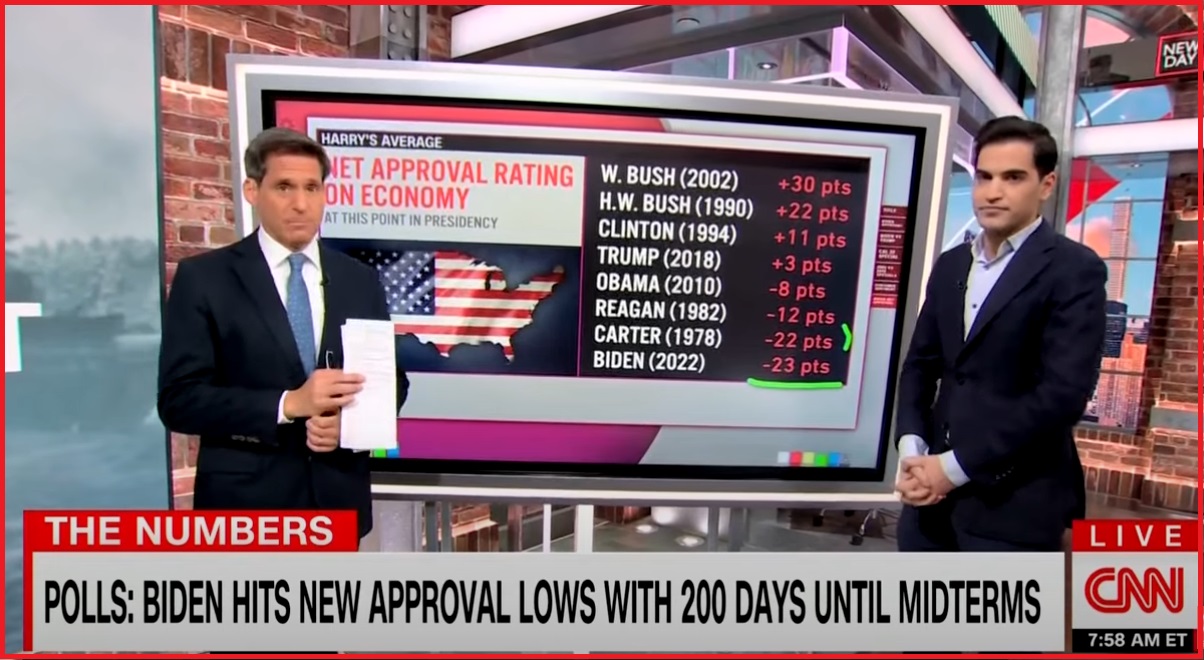
Oh SNAP, CNN Reports Biden Polling the Worst Ever Recorded in Presidential Polling History, Even Lower Than Jimmy Carter in 1978


Posted originally on the conservative tree house on April 15, 2022 | Sundance 

Jumpin’ ju-ju bones, this is rather remarkable.  Two video segments from CNN today highlight just how horrible things are for Democrats this mid-term election year.  No amount of J6 leverage is going to offset the way Americans feel about Joe Biden.

Delivering a summary of the last four most recent and consecutive polls, even CNN had to report that President Joe Biden’s approval is the lowest ever for any president at this point in any presidency.  According to the CNN presentation, Joe Biden is “in a lot of trouble,” as outlined during a segment on CNN’s “New Day” with Brianna Keilar and John Berman.  WATCH:

The second segment is even worse news than the first.  In the second segment they take a look at all modern presidential polling and discover that Joe Biden has a lower approval rating than even Jimmy Carter in 1978.

.

.

Florida Republican Legislature Unify in Support for DeSantis Redistricting Map


Posted originally on the conservative tree house on April 14, 2022 | Sundance 

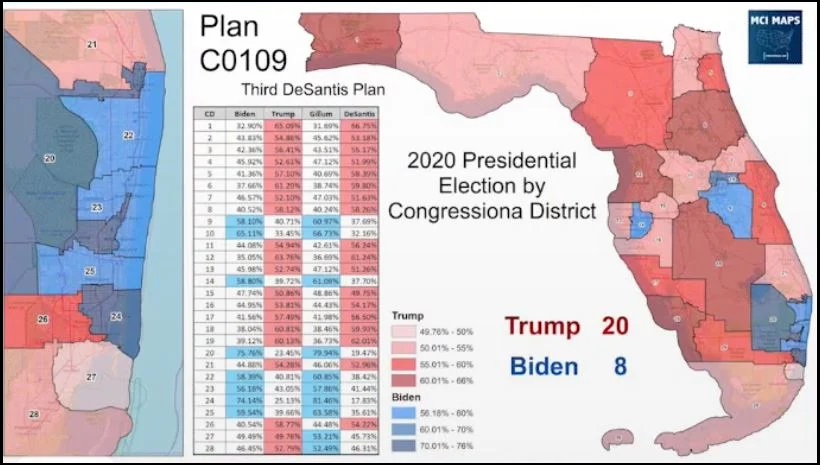
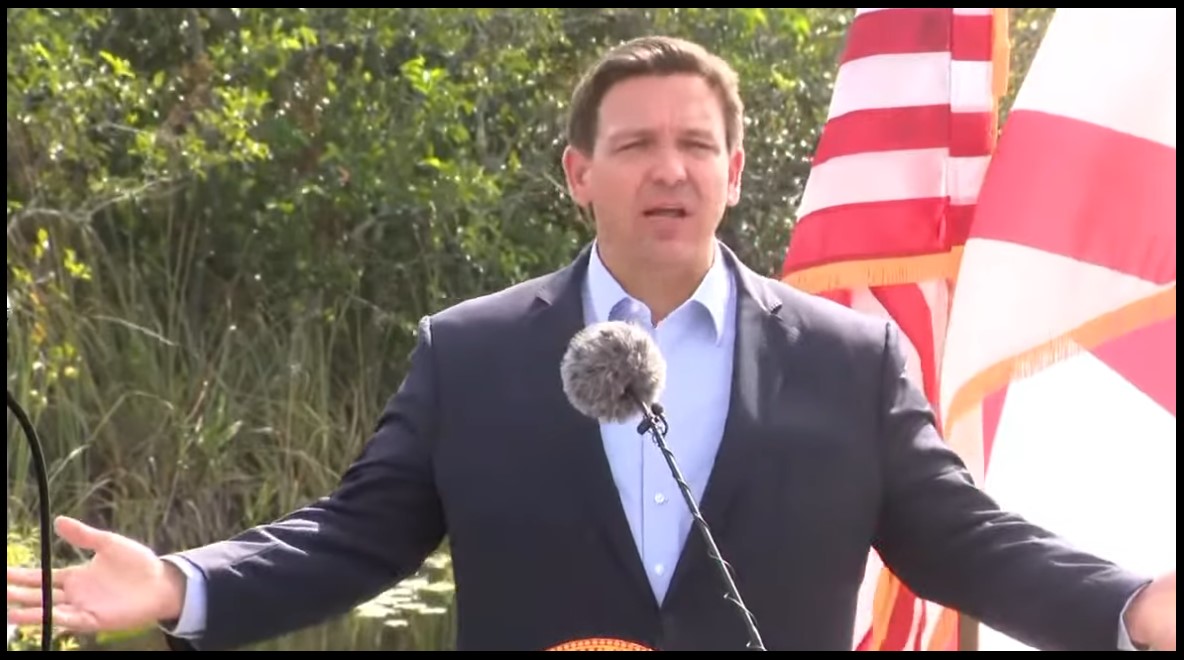
Late last month Florida Governor Ron DeSantis vetoed a legislative redistricting proposal for the state’s new expanded districts.  Florida is gaining a congressional seat as an outcome of the last census and a rapid growth in population.

The concern DeSantis expressed last month was not with the state house or state senate districts, but rather with the new congressional district mapping. {Background} Attorneys for the governor’s office and state saw a conflict between the legislative map and the constitutional provisions for district assignment.  The Governor’s office wrote a new map eliminating the gerrymandering which ultimately, based on the 2020 election outcome, would appear to give 20 districts to Republican areas and 8 districts to Democrat areas

Of course, the professional activists within the Democrat apparatus are apoplectic. “If this map is enacted, Florida will be sued.,” tweeted Marc Elias, a Democratic Party elections lawyer.  However, the Republican state legislature has indicated their full support in advance of a special session to affirm the new redistricting map.

FLORIDA – A Republican-favorable congressional redistricting plan that Gov. Ron DeSantis’ office released Wednesday landed quick support from the leader of the Senate’s reapportionment efforts.

Democrats, meanwhile, said the once-a-decade redistricting process has gone “extreme partisan” and threatened legal challenges.

State lawmakers will return to Tallahassee next week for a special session after DeSantis vetoed a congressional map passed during this year’s regular session. Senate Reapportionment Chairman Ray Rodrigues, R-Estero, found the plan released Wednesday by the governor’s office more than acceptable.

“After thoroughly reviewing the governor’s submission and a discussion with our legal counsel, I have determined that the governor’s map reflects standards the Senate can support,” Rodrigues wrote in a memo to senators. (read more)

The map appears solid from my perspective and based on sound -easily defensible- districting that represents the people within the state.  There are no weird contortions and strange boundaries in an effort to shape the congressional outcome.  The population boundaries are pretty straightforward.

I think the apoplexy from the moonbat wing of the Democrat machine is because (a) they know the map will easily pass legal scrutiny, and (b) Democrats are losing support within the state of Florida with each passing day.

The Democrat party nuttery is not going over well with most Floridians.  Latinos have abandoned the DNC social agenda in record numbers, and the overlay of the Biden inflation economy is a problem that looms too heavy.  The Florida 2022 vote will be a rebuke of Democrats on a scale that will likely be historic.

Ever since Governor DeSantis finally dealt with the Broward County vote manipulation and regional fraud, the Democrats have been losing.  Democrats in Florida are a sad and angry bunch, with no one except the deep blue media to console them.

Elon Musk Makes a Massive Proposal, Offers to Purchase Twitter for $41 Billion With Plan to Take Company Private


Posted originally on the conservative tree house on April 14, 2022 | sundance

April 14, 2022 | sundance | 553 Comments

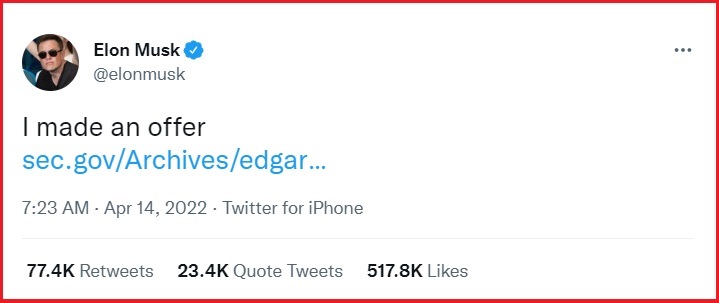
The richest man in the world, Tesla CEO Elon Musk, made an offer to purchase the Twitter platform for a price of $41 billion.  The offer represents a value of 38% more than the current evaluation.  [SEC FILING HERE]  The offer is filed with the US Securities and Exchange Commission proposing a full takeover for $54.20 per share in cash.

Within the filing Elon Musk states his intentions:

“I invested in Twitter as I believe in its potential to be the platform for free speech around the globe, and I believe free speech is a societal imperative for a functioning democracy.  However, since making my investment I now realize the company will neither thrive nor serve this societal imperative in its current form. Twitter needs to be transformed as a private company.

As a result, I am offering to buy 100% of Twitter for $54.20 per share in cash, a 54% premium over the day before I began investing in Twitter and a 38% premium over the day before my investment was publicly announced. My offer is my best and final offer and if it is not accepted, I would need to reconsider my position as a shareholder. Twitter has extraordinary potential.  I will unlock it. (SEC LINK)

What Elon Musk appears to be doing is perhaps the biggest story that few understand.

I share this perspective having spent thousands of hours in the past several years deep in the weeds of tech operating systems, communication platforms, and the issue of simultaneous users.   What Twitter represents, and what Musk is attempting, is not what most would think.

In the big picture of tech platforms, Twitter, as an operating model, is a massive high-user commenting system.

Twitter is not a platform built around a website; Twitter is a platform for comments and discussion that operates in the sphere of social media.  As a consequence, the technology and data processing required to operate the platform does not have an economy of scale.

There is no business model where Twitter is financially viable to operate…. UNLESS the tech architecture under the platform was subsidized.

In my opinion, there is only one technological system and entity that could possibly underwrite the cost of Twitter to operate.  That entity is the United States Government, and here’s why.

Unlike websites and other social media, Twitter is unique in that it only represents a platform for user engagement and discussion.  There is no content other than commentary, discussion and the sharing of information – such as linking to other information, pictures, graphics, videos url links etc.

In essence, Twitter is like the commenting system on the CTH website.  It is the global commenting system for users to share information and debate.  It is, in some ways, like the public square of global discussion.   However, the key point is that user engagement on the platform creates a massive amount of data demand.

Within the systems of technology for public (user engagement) commenting, there is no economy of scale.  Each added user represents an increased cost to the operation of the platform, because each user engagement demands database performance to respond to the simultaneous users on the platform.  The term “simultaneous users” is critical to understand because that drives the cost.

According to the Wall Street Journal, Twitter has approximately 217 million registered daily users, and their goal is to expand to 315 million users by the end of 2023.   Let me explain why things are not what they seem.

When people, users, operate on a tech platform using the engagement features, writing comments, hitting likes, posting images, links etc, the user is sending a data request to the platforms servers.  The servers must then respond allowing all simultaneous users to see the change triggered by the single user.

Example: when you hit the “like” button feature on an engagement system, the response (like increasing by one) must not only be visible to you, but must also be visible to those simultaneously looking at the action you took.   If 100,000 simultaneous users are looking at the same thing, the database must deliver the response to 100,000 people.  As a result, the number of simultaneous users on a user engagement platform drives massive performance costs.  In the example above, a single action by one person requires the server to respond to 100,000 simultaneous users with the updated data.

As a consequence, when a commenting platform increases in users, the cost not only increases because of that one user, the cost increases because the servers need to respond to all the simultaneous users.   Using CTH as an example, 10,000 to 15,000 simultaneous commenting system users, engaging with the servers, costs around $4,500/mo.

This is why most websites, even big media websites, do not have proprietary user engagement, i.e. commenting systems.  Instead, most websites use third party providers like Disqus who run the commenting systems on their own servers.  Their commenting systems are plugged in to the website; that defers the cost from the website operator, and the third party can function as a business by selling ads and controlling the user experience.  [It also sucks because user privacy is non existent]

The key to understanding the Twitter dynamic is to see the difference between, (a) running a website, where it doesn’t really matter how many people come to look at the content (low server costs), and (b) running a user engagement system, where the costs to accommodate the data processing -which increase exponentially with a higher number of simultaneous users- are extremely expensive.   Twitter’s entire platform is based on the latter.

There is no economy of scale in any simultaneous user engagement system.  Every added user costs exponentially more in data-processing demand, because every user needs a response, and every simultaneous user (follower) requires the same simultaneous response.  A Twitter user with 100 followers (simultaneously logged in) that takes an action – costs less than a Twitter user with 100,000 followers (simultaneously logged in), that takes an action.

If you understand the cost increases in the data demand for simultaneous users, you can see the business model for Twitter is non-existent.

Bottom line, more users means it costs Twitter more money to operate.  The business model is backwards from traditional business.  More customers = higher costs, because each customer brings more simultaneous users….. which means exponentially more data performance is needed.

User engagement features on Twitter are significant, because that’s all Twitter does.  Not only can users write comments, graphics, memes, videos, but they can also like comments, retweet comments, subtweet comments, bookmark comments, and participate in DM systems.  That is a massive amount of server/data performance demand, and when you consider simultaneous users, it’s almost unimaginable in scale.  That cost and capacity is also the reason why Twitter does not have an edit function.

With 217 million users, you could expect 50 million simultaneous users on Twitter during peak operating times.  My back of the envelope calculations, which are really just estimations based on known industry costs for data performance and functions per second, would put the data cost to operate Twitter around at least $1 billion per month (minimum).  In 2021, Twitter generated $5.1 billion in revenue, according to the Wall Street Journal.

There is no business model, even with paying subscribers, for Twitter to exist.  As the business grows, the costs increase, and the costs to subscribers would grow.  So, what is going on?

The only way Twitter, with 217 million users, could exist as a viable platform is if they had access to tech systems of incredible scale and performance, and those systems were essentially free or very cheap.  The only entity that could possibly provide that level of capacity and scale is the United States Government – combined with a bottomless bank account.

If my hunch is correct, Elon Musk is poised to expose the well-kept secret that most social media platforms are operating on U.S. government tech infrastructure and indirect subsidy.  Let that sink in.

The U.S. technology system, the assembled massive system of connected databases and server networks, is the operating infrastructure that offsets the cost of Twitter to run their own servers and database.  The backbone of Twitter is the United States government.

There is simply no way the Fourth Branch of Government, the U.S. intelligence system writ large, is going to permit that discovery.


CNBC Forced to Tell the Horrible, Terrible, Bad, Bad Results of Their Biden Performance Poll


Posted originally on the conservative tree house on April 13, 2022 | Sundance

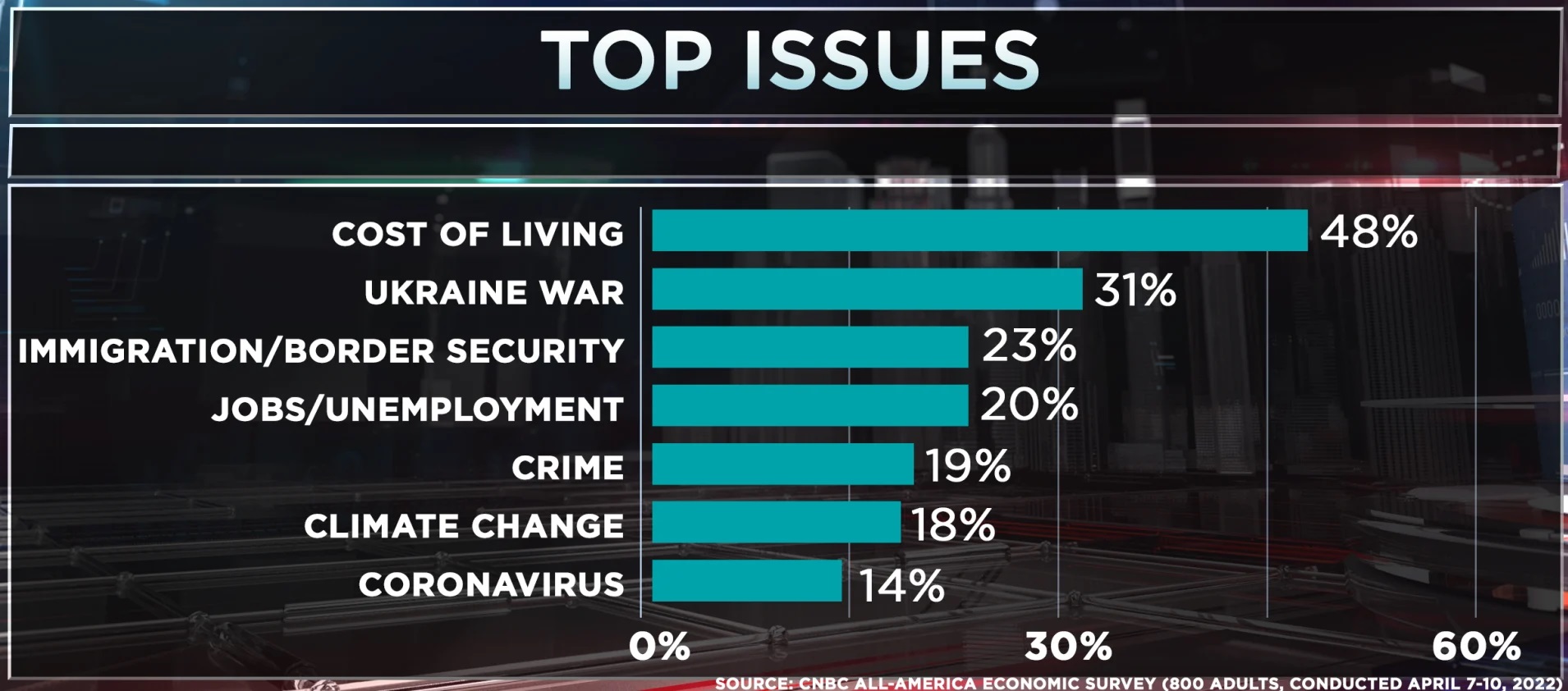
CNBC commissioned a poll by Hart research and associates, a friendly outfit for the left.  Unfortunately, that means CNBC then needed to tell everyone what the results were [Full Poll pdf Here].  That task fell to CNBC’s Steve Liesman; an appropriate name given the task at hand.

The irony doubles when you remember this was the same CNBC pundit who refused to accept the horrible economic data that began surfacing last fall.  There was even a public broadcast where Liesman said the BLS statistics had to be wrong, because the results were so horrible.  A few months later, and here he is explaining how the country now feels about Joe Biden.   WATCH:

(CNBC) – […] The pessimism is clearly dragging on Americans’ opinions of President Joe Biden. In fact, nothing looks to be working in the Biden presidency from the public’s viewpoint.

The president’s approval rating sank to a new low of just 38%, with 53% disapproving. Biden’s -15% net approval rating is measurably worse than his -9% approval in the CNBC December survey. What’s more, his approval rating on the economy dropped for a fourth straight survey to just 35%, with 60% disapproving, putting the president a deep 25 points underwater. (article link)