The Rich v Oligarchs


QUESTION: Hello Martin, You have said ‘the rich get richer by investing’; and as well, you’ve said ‘governments are always corrupted’. What history shows (and many of us have learned) is that ‘big money’ is especially adept at manipulating government for its own advantage. Currently, we call this ‘regulatory capture’. (This includes ‘judicial’ capture). The revolving door between corporate and government executive offices is obvious and historical. So I suggest that ‘the rich get richer by investing in corruption’ and suborning every possible corner of the body politic.

You have also said ‘ human nature never changes’. I could dispute that selectively from a religious point of view, but generally, I concur. However, since ‘big money’ understands human nature this is why it bankrolls/sponsors all manner of destructive lusty covetousness among the peoples of the world, (especially including borrowing to speculate) enabling it by easy credit-debt, using force of law, under threat of ‘assassination’, in one form or another, to collect.

You’ve also noted that Moses said “thou shalt not covet” your neighbor’s assets, though, particularly in relation to the principle of ‘socialism/Marxism’. However Moses also renounced, in the name of God, the practice of usury among people of the land, that is, in the body politic.

Also, you’ve mentioned the Mosaic law of the generational debt jubilee for all other kinds of debt in kind. Martin, to my mind, the first way of covetously accumulating capital is through pure force, theft and plunder by conquest, (yet wars must be ‘bankrolled’ too). In times of relative peace the debt-equity swap appears to be the fundamental and intentional principle of accumulation of capital, and, thus, ‘the business cycle’, the inner machinations of which are controlled, as much as possible, by lenders and their ‘legal’ contractual leverage. (Recall, for example, the Jewish ‘Shetar laws’ introduced into England after the conquest by William the Conqueror).

These things being said, and given the prospect of the ‘bankruptcy’ of the current political/economic ‘system’, I am particularly interested if you have any comment upon the super-priority of derivative contracts in business bankruptcy, not to mention, bail-in provisions of bank ‘reconciliation’, as established in various statutes. (Your recent posting of ‘1984 is Here’, and Orwell’s illumination of ‘oligarchical collectivism’ is apropos in exposing the historical link between financial/corporate oligarchy and ‘socialism’, the plantation mentality of mercantilism, etc..

It seems to me the ‘private wave’ is not necessarily something to be looking forward to, either, actually.) Many regards for your work, and thanks for holding fast to a humane heart. FCB, a Socrates subscriber. (By the way, the date of Jesus’ birth has been remarkably addressed in E.L. Martin’s 1991 work “The Star that Astonished the World”)

FB

ANSWER: I think sometimes I am not always specific in what I say because in my mind I have drawn a distinction that I have not articulated in words. As Einstein said, he thought in concepts, not words. That is a very true statement that has been largely ignored by most programmers who try to mimic the brain with neural networks. That is why IBM’s Watson was unable to find cures. As a programmer, I should know better. You really have to break down every single step in an action to be able to code it. How do you move your arm? It begins with a thought which then moves all the various elements for you to raise your hand up in a classroom.

That confession aside, when I speak of the “rich” who do not make money from wages but investments, I am not referring to the corporate organizations that are not single individuals but are honestly bureaucratic private replicas of government. I have attended board meetings of some of the largest public corporations in the world. I find them to be the same in structure as governments. I was called into a major auto company to resolve a $1 billion loss in hedging. They then referred me to a parent company that held stock in their corporation, for they had the same trade. The parent company had made hedging decisions at the board level and because they lost money by second-guessing their hedging decisions, they passed a resolution that once they took a hedging position, they would let it expire. By the end of the fiscal year, the two were merged to hide the $1 billion loss in the parent company.

There is a substantial difference between an individual who runs a small business and a major public corporation which has become bureaucratic. That is why Apple first removed Steve Jobs because he did not comply with bureaucratic procedures. When they then lost all creativity, they begged him to return.

Insofar as “human nature never changes,” once again I am not speaking of an individual but collectively as a society. We each have our own cycle in this journey for knowledge. If we are not complete fools who blame everyone else for their own mistakes (like Hillary), then we mature and learn from our mistakes. As children, parents inevitably warn their child not to place their finger in the flame of a candle. We all still do because we simply must experience that pain before we understand the power of fire and what it does.

I have also explained that there are no degrees you can get in trading. We all must be self-taught. The very concept of supply and demand was born in the mind of John Law (1671-1729). Since he was charged with murder for killing another man in a fair dual that was declared illegal, everyone else took advantage and plagiarized his discovery including Adam Smith. John Law gave birth to the concept of supply and demand because he was a trader on the floor of the first exchange in Amsterdam. There are some things you will NEVER discover unless you actually are involved in the experience.
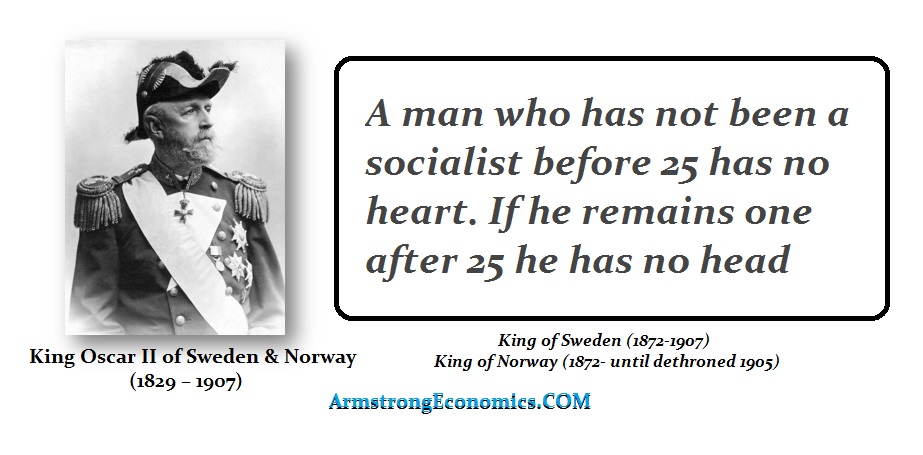
Therefore, my statement that “human nature never changes” does not refer to an individual, for most intelligent people do not believe what they may have believed when they were a teenager. Mark Twain’s famous quote is spot-on: “When I was a boy of 14, my father was so ignorant I could hardly stand to have the old man around. But when I got to be 21, I was astonished at how much the old man had learned in seven years.” There is even the quote of King Oscar II on how we are all socialists before 25 and become realists after 25 when we have to pay taxes.
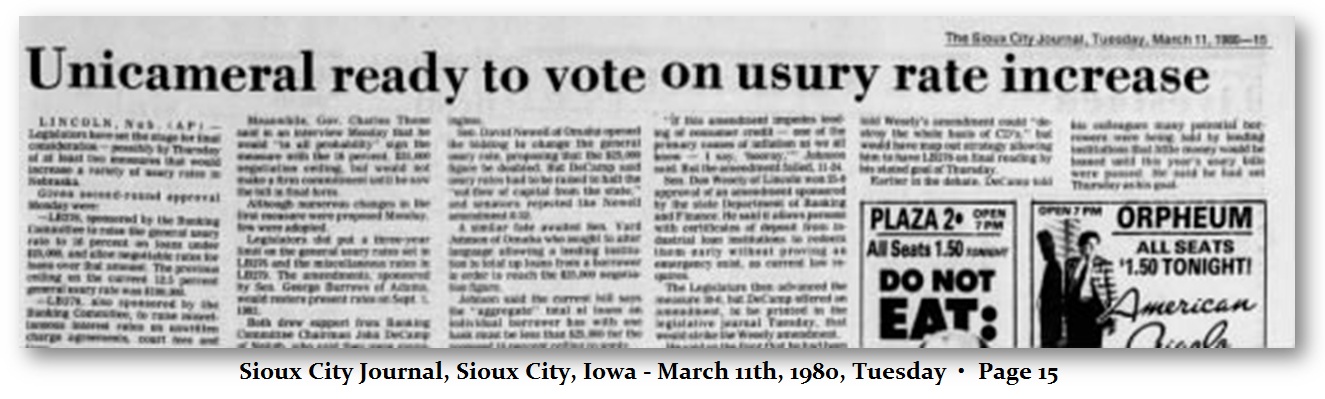
You also mention that Moses renounced, in the name of God, as well the practice of usury. I have stated that we had usury laws up until Paul Volcker wanted to raise interest rates using Keynesian Economics to enable him to raise the discount rate to 14% in March 1981. Congress was eliminating usury laws by March 31, 1980. In order to fight inflation using Keynesianism, they never restored usury rates and thus they transferred a huge amount of wealth to bankers as they were now able to charge 20% on credit cards with no problem.
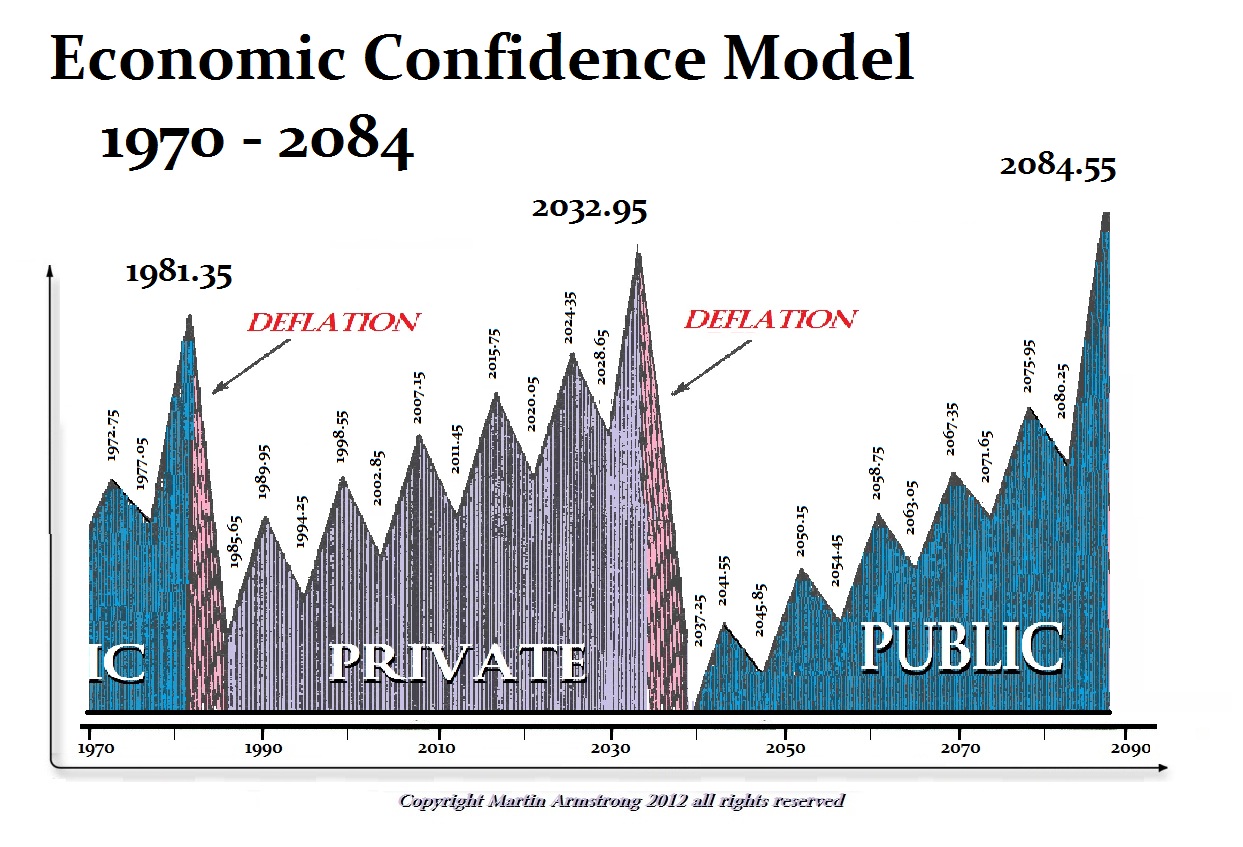
Private waves are inherently more volatile but the usury laws were all abandoned going into the peak of the Public Wave as the government was fighting for control. The government becomes much more aggressive and totalitarian during a Private Wave as they are losing power. But as they lose power, they ultimately turn against the very oligarchs who fed them to rise from the outset. The next financial crisis may not see Goldman Sachs walking on water. Politicians will turn against their benefactors to survive. This is typical during the final stages of the last 8.6-year wave within a Private Wave formation
Cycle v Free Will


QUESTION: Dear Mr. Armstrong,
You have said that everything has its own cycle and that somehow everything is connected to pi. To me this seems to fit nicely within a deterministic framework. Hence I am curious what your thoughts are on the subject of free will. Could you please elaborate?
Regards, E

ANSWER: We all have our individual free will. Society in a collective state produces the business cycle. As we move through life, we mature and change our thinking based upon experience. This is why there are always Democrats and Republicans. There are some who understand the business cycle and move with it, and others who act in a herd instinct. There is a difference between the individual and the collective cycle which we can call the business cycle.

Armstrong Ted Talk


Armstrong Interview Paris, France


Me verses Socrates


One of the more fascinating things is when people try to challenge me as an analyst and pretend it is a personal confrontation to try to prove me wrong personally. I have stated many times, whenever I have had a personal opinion that has been counter to Socrates, it is me who has always been wrong. As humans, we simply do not always see everything. We miss things taking place around the world or maybe too focused on one personal perspective.

Socrates writes over 1,000 reports e4ach day covering global stocks, bonds, commodities, real estate, and interest rates. These are ALL entirely written by the computer – NOT me. There is no human interaction. This is entirely Socrates. I find it so funny when people try to say of Armstrong will be wrong or whatever for they fail to understand this is the next evolution in the analysis. The greatest error in all analysis is human bias and the failure to see things from an objectives viewpoint.


Here is a Demo of Socrates so you can see – this is not me writing all of these reports.

How Empires Die


This is a special report which includes for the first time “The Dark Age Cycle” which looks into how do empires die. Sometimes they just collapse, yet at other times, civilization also collapses and moves into a Dark Age. This report distinguishes all the historical changes which have taken place and the rise and fall of Empires, Nations, and City-States. This dives into the monetary system and how it was reconstructed in order to ascertain the cycles that are so important to understand.

This report dives into global contagions and illustrates that while people have suddenly seen the economy as global today, it has always been that way. This analysis covers modern financial panics in addition to ancient and draws the analysis and common themes that undermine society. It would be nice if we learned as a society from past mistakes as most of us do on a personal level. Every parent warns their child not to touch the flame of a candle. No matter how often we are warned, everyone still was compelled to see for ourselves.

Society lacks that evolution from experience. Hence, collectively we keep sticking our finger into flame expecting somehow a different result. Worse yet, with every financial crisis, nobody ever asks has this taken place before? Was there a solution that previously worked?

Perhaps this is just why history must repeat. We can only learn from our past mistakes on a personal individual level. Society collectively seems incapable of ever retaining such knowledge. Thus, those of us who can see the trend is compelled to watch others repeat the same mistakes over and over again.

The Economic Confidence Model & the Shift in Trend


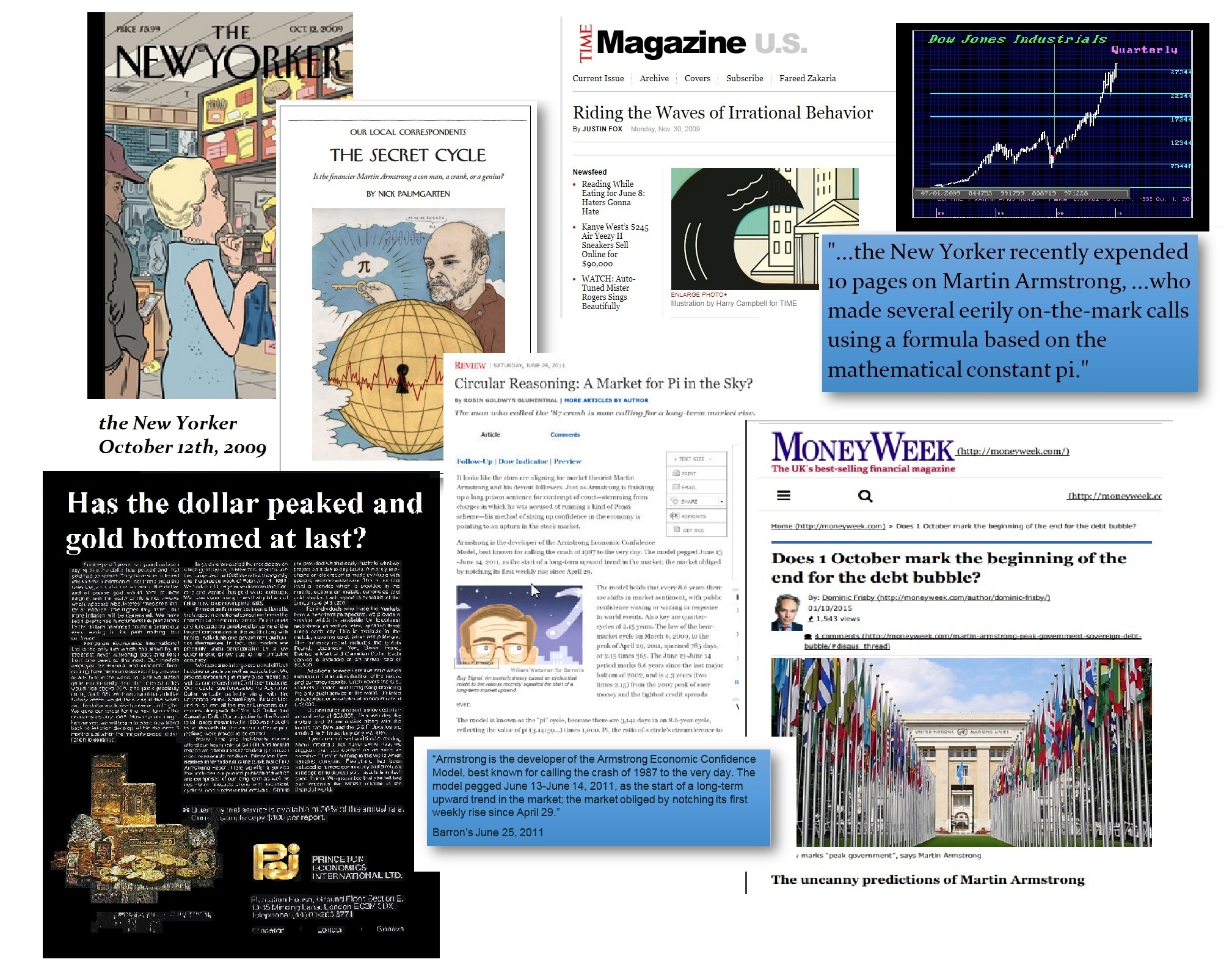
While we took the back cover of the Economist for 3 weeks during July 1985 to announce the beginning of the Private Wave stating that the dollar had peaked, the ECM has been remarked on around the world for its turning points. Money Week even got the forecast right that October 1st, 2015 would market the debt bubble in Europe. It was accelerated by the introduction of negative interest rates by the ECB and, of course, the very day of the Russian troops entering Syria and Merkel’s opening of the flood gates which unleashed the massive immigration into Europe which has been the very cause of BREXIT and the rising tensions amount member states.

This shift in trend is going to be profound for the pressure within the world economy has restarted and with a fervor. This has marked not just the very day of the Impeachment with Trump and BREXIT, but we are watching international capital flows intensify once again driving the US yield curve back toward an inverted position which has nothing to do with the recession. The confrontation that the Democrats have taken against Trump is really the total destruction of government and we can easily see what 2032 will be all about. There is no going back. With Bernie Sanders winning New Hampshire and the left rising within the Democratic Party, they knew well that they stand ZERO chance of beating Trump. Their strategy was to try to remove him to influence the 2020 election themselves doing the very thing they accused Trump about. The Democrats are desperate and the moderates fear their party is moving toward Marxism and thus the conspiracy builds to draft Hillary in hopes that the primaries will remain in chaos. With hindsight, we will look back upon this date as the day democracy truly died.

Meanwhile, the finances in Europe are beyond comprehension. The Euro has been in a free-fall despite the biased media all running headline that it is Britain who made the wrong decision. They are desperately trying to distract the people from the fall in the Euro and the capital flight which has been creating the drive into the US treasuries. On top of that, the REPO crisis has expanded as fear over European banks continues to escalate. So welcome to the new wave that began January 18, 2020.

Some people will ALWAYSdesperately try to paint the ECM as wrong or attack me personally when they cannot argue with the forecasts. This is simply the dark side of human nature which will always fight against the light. They are of the same character who killed people for arguing the world was round and not flat. They burned Bruno alive and rejoiced in his pain.

Why these types of people will always try to prevent any advancement in understanding anything is truly astonishing. It is hard to comprehend why they refuse to ever listen. What do they have to gain other than refusing to believe something?

There always must be a dark v light confrontation for that is the very essence of what makes the cycle function. So when they cannot challenge the message, they turn to hatred of the messenger.

Cyclical Waves of Innovation


QUESTION: Good Day, have you ever checked for cyclicity in scientific discovery and/or invention? if so, does your computer suggest anything about the next physics or mathematical breakthrough and what technological development might come of that?

thank you for all you do.

EAL

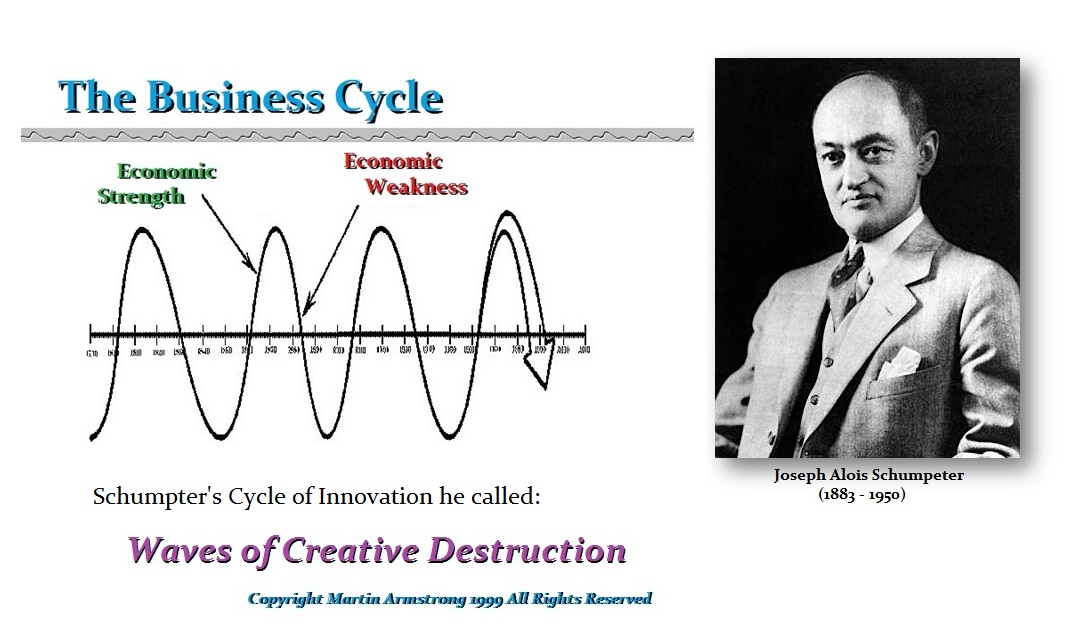
ANSWER: Yes, it appears to be a cycle of 51.6 years. Schumpeter called them waves of innovation that result in waves of creative destruction. Each wave of new innovation destroys the last. Cars wiped out horse & buggies. The internet is wiping out local stores, and technology has introduced streaming that has wiped out VCRs and DVDs.

Angkor Wat & Its Decline and Fall


QUESTION: Angkor Wat was abandoned and the whole society seems to have vanished. I saw somewhere that this was due to climate change and the drying up of their canal system. Is this something that shows in Socrates?

Best regards

MU (Sweden)

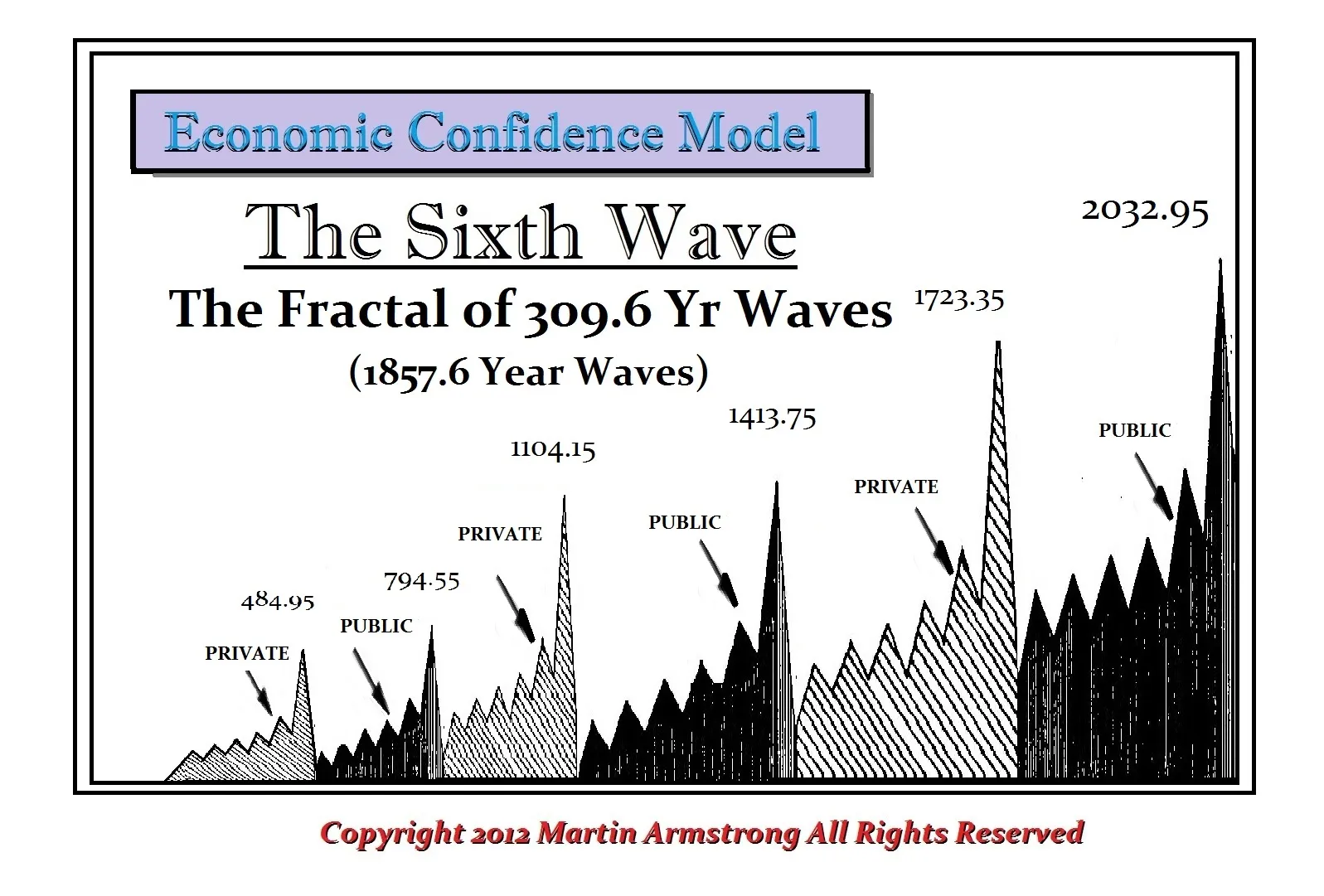
ANSWER: The fall of Angkor Wat was attributed to climate and abuse, but that is just wrong. The real story about the Angkor civilization primarily involves religion and the shift from a Private to a Public Wave marking its collapse. The Angkor civilization was established in 802 AD, which interestingly came at the beginning of the third wave in the current group of 309.6-year intervals. That wave group will ultimately peak in 2032, bringing major change to the world economy, which may even involve religion as well.

The Angkor civilization’s heartland and capital city was on the banks of the Tonle Sap Lake in northwest Cambodia. The Angkorian state was founded and grew during a period of favorable climate with abundant rainfall. This much is true as with most civilizations during warming periods. At its height, Angkorian rulers probably controlled a large portion of mainland Southeast Asia.

The Angkor civilization peaked the early 1100s, completing one wave of 309.6-years in 1104 AD. This was when the construction began on the Angkor Wat temple site. But we must look closely here for religion also came into play. The temple was constructed as a re-creation of the Hindu universe. There were five sandstone towers that rose above the four temple enclosures. This represented the peaks of Mount Meru, the center of the universe. The temple complex is surrounded by a very large moat which symbolizes the Sea of Milk from which “amrita,” an elixir of immortality, was created.

The peak in the culture took place around 1104 in conjunction with the peaks of the Economic Confidence Model. That is when there was a shift in culture. Indeed, by the end of the 13th century, numerous changes were taking place. The last Sanskrit inscription dates to 1295. The last inscription in Khmer, the language of Cambodia, appears a few decades later in 1327. As the ECM shifted from a Private to a Public wave, not only did society become more regimented, but the religion began to change as well. There was a shift from Hinduism, which was the theme of the Temple, to the region-wide adoption of Theravada Buddhism.

Buddhism and Hinduism agree on karma, dharma, moksha, and reincarnation. They are different in that Buddhism rejects the priests of Hinduism, the formal rituals, and the caste system. Buddha urged people to seek enlightenment through meditation. Therefore, this religious shift brought the caste system to an end. The Private Wave represented the rise in individualism and the anti-government sentiment we see even today. The priests of Hinduism were overthrown, which interestingly corresponded with the shift in the ECM.

This religious shift had a profound disruption on the culture and included political changes. No longer was there state-sponsored stone temples nor was there a royal bureaucracy. This was all rejected and overthrown. Everything shifted to community-based Buddhist pagodas that were now constructed from wood. Part of this religious shift to Buddhism took place simultaneously with an increase in maritime trade with China. This shift in the economic structure combined with the religious shift from Hinduism to Buddhism meant that the entire facade of Angkor Wat was no longer religiously acceptable.

With trading shifting to maritime, the capital was relocated further south, near the modern capital of Phnom Penh. With international trade becoming more important, moving the capital to the south allowed rulers to expand their economic powers. Clearly, the abandonment of Angkor Wat was primarily due to religion and the expansion of international trade.

Insofar as climate is concerned, claims that global warming destroyed the city are not valid. The Paleoclimate research in the region clearly reveals that there was a region-wide environmental change in climate because climate is always changing. There was a series of decades-long droughts, but these were also interspersed with heavy monsoons. The impact of this in agriculture no doubt sparked the development of international trade.

Other claims that the Thai invaded and sacked the city of Angkor Wat by the 15th century. The capital had already been moved which meant that Angkor Wat was easy prey and no longer economically important in Cambodia.

Therefore, the shift that truly undermined Angkor Wat was the one which saw Buddhism rise, making the entire complex an antiquated religious place that was no longer respecte

Real Estate – Cycles – Real Value


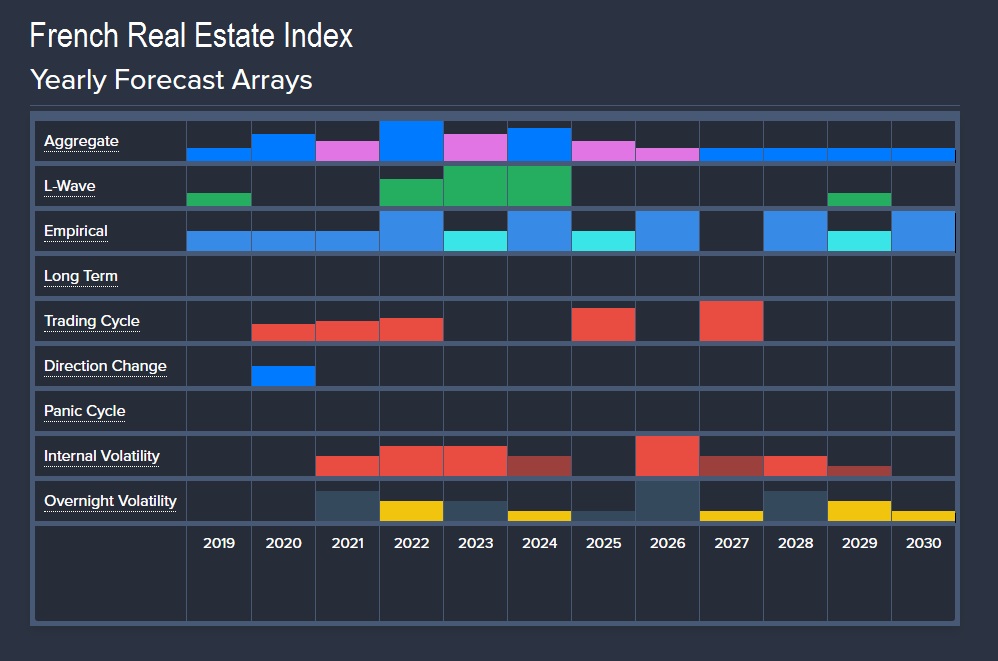
QUESTION: Your real estate model which peaked in 2007 was the broad crazy speculative market you explained in the low end of the market. Then there was a rally back into 2015 which you said would be mainly in Europe and the high end of the market. I am in France and there an uptick in some prices. But I can see, as you taught us, this appears to coincide with the decline in the euro. What actually comes after all of this? I subscribe to the Pro version and you have all the real estate index there covering around the world. Can you provide an update?

Thank you so much

HR

ANSWER: The 2007 high was the low-end of the market which became the bubble. That led to the massive decline in real estate where it became a bad word. I had a friend who bought a house at a public auction. The owner had bought it for $7 million at the peak in 2007. My friend bought the property in 2017 for $2.3 million.

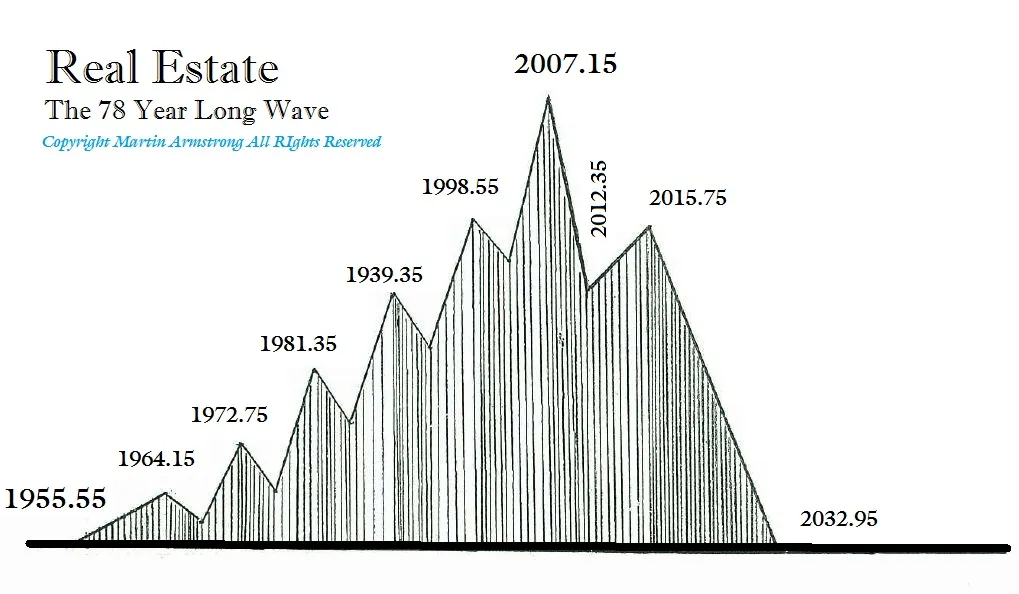
Real estate is very hard to forecast because you have the broad market, the low, middle, and high ends of the market. Then you have niche areas that boom in the face of others doing nothing. The 2007 high is the peak in “real” terms. There are many homes in the low to middle-end that are still 30% to 50% below the bubble high in 2007.

The 2015.75 rally was more of the high-end and this was driven by international capital flows. Thus, it was primarily intensely felt in the main centers where international capital moved such as Vancouver, New York, Miami, Los Angeles, etc. You did not see major price advances in smaller regions of no interest to international capital.

Then you have the tax migrations. People are moving from the high tax states to the no or low taxed states in the USA. I had looked at buying a house for my family in Florida, and I had to do the Singapore conference in 2017. I said I would put in a bid upon my return. The house just went on the market. When I returned in a couple of weeks, it had sold. Then the house next door went up for sale and I had to do the Rome conference. I was going to put in a bid and by the time I returned, that had sold. Other areas in the high-taxed states can’t sell. So there are a lot of different outcomes depending on where you are looking.

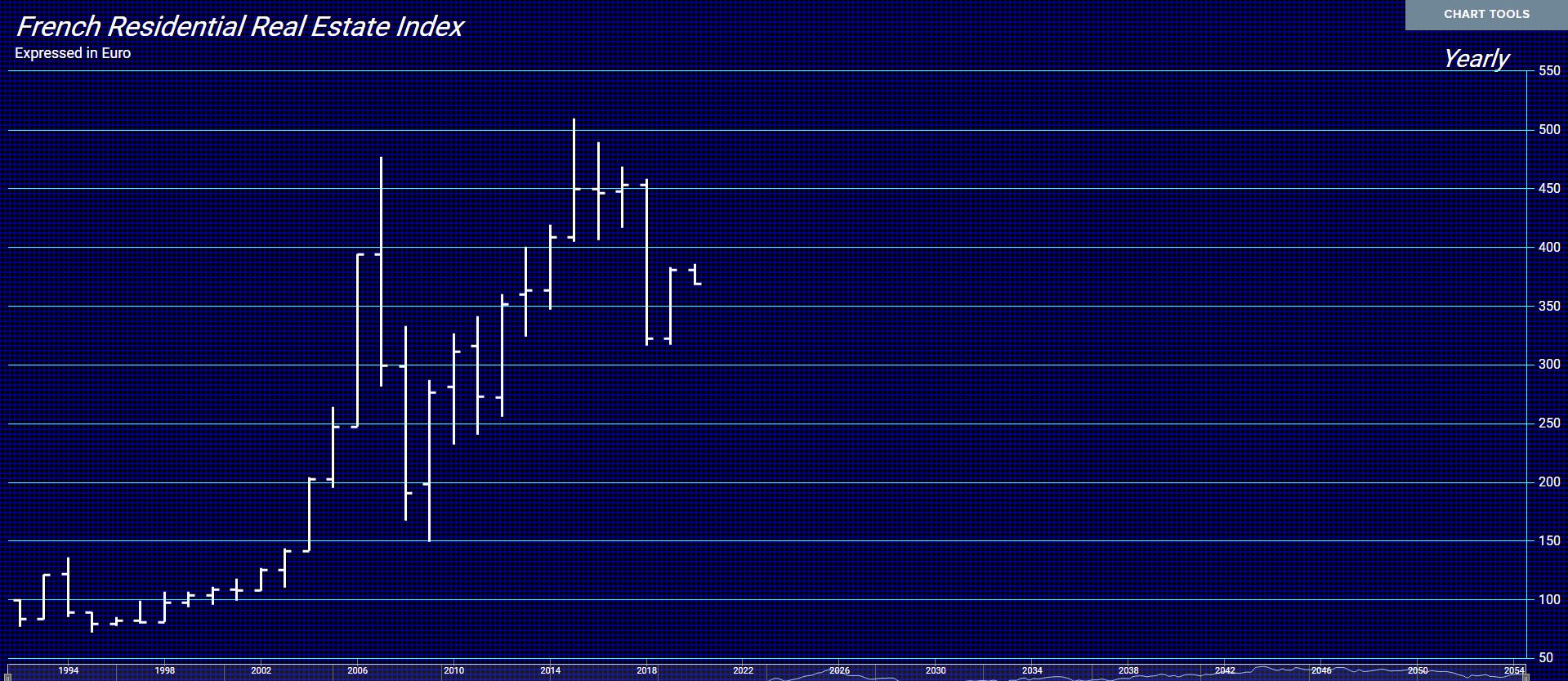
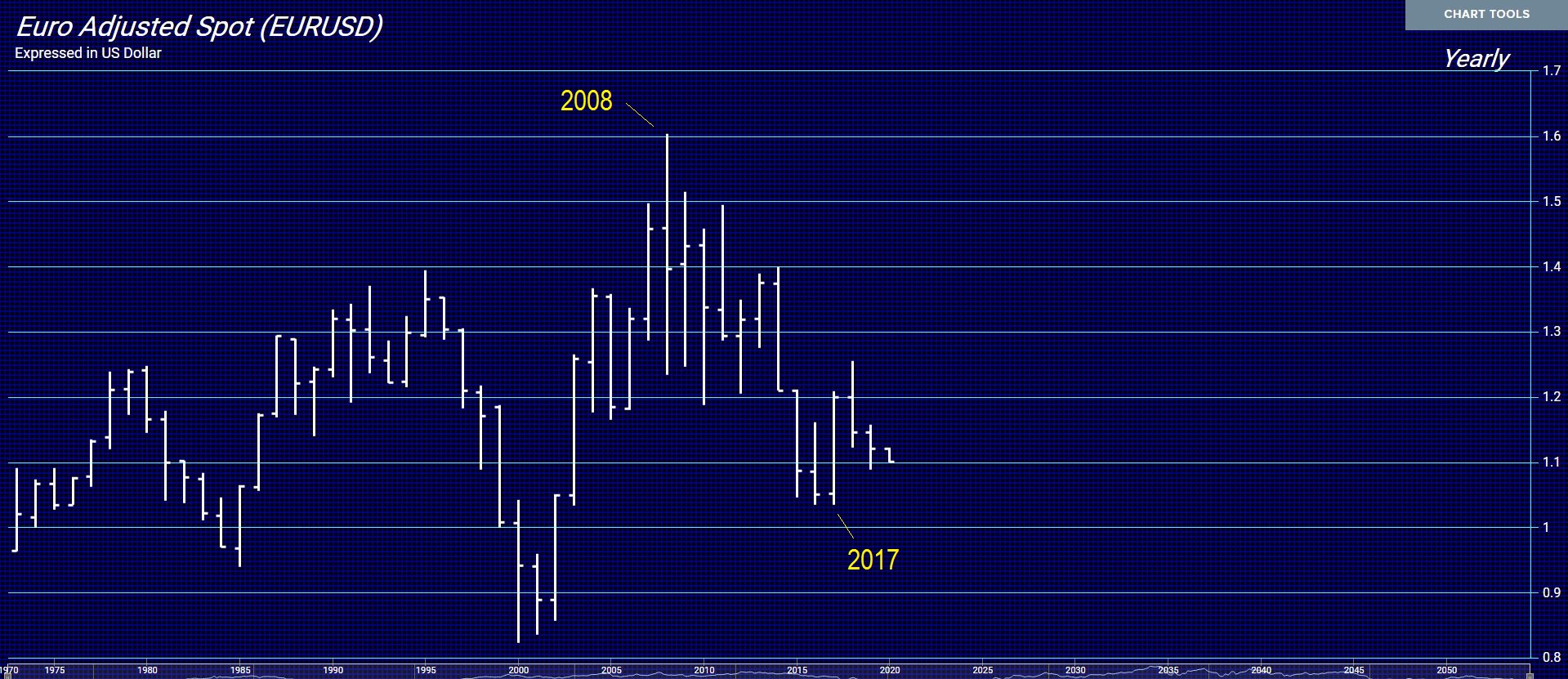
You are correct, the record high in the French real estate market remains 2015. There was a three-year low in 2018, then a bounce. This is true of all the results of the decline in the euro which bottomed initially in 2017. You have to look at this from an international “real value” perspective. What a house sold for going into 2015 when the euro was on average $1.30 compared to the international value when the euro was $1.03 is a substantial difference.


You can always just buy the property and then hedge the interest rates and currency. We all need a place to live. In terms of “real value” in real estate, that should begin to rise again after 2032. Going into that period, real estate will rise in nominal terms on a very varied basis depending upon the attitude of the local government. In the USA, for example, do not expect property in Illinois to ever reach the value it was even in 2015 no less 2007. Local municipalities are going broke and they will become very abusive in taxation. This is when people just start to walk away from the property, as was the case with the fall of Rome.