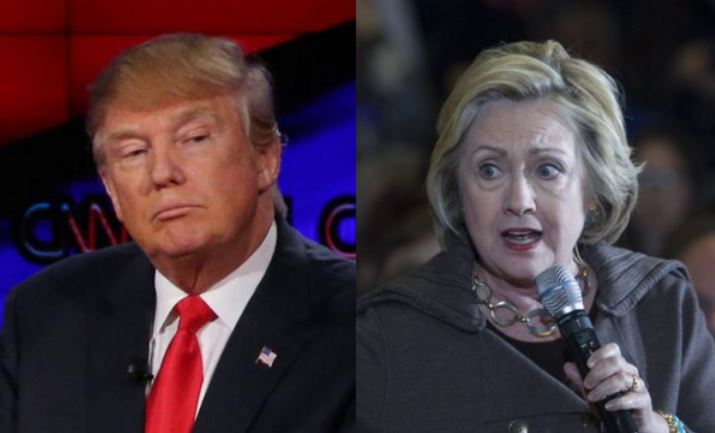
KOMMONSENTSJANE – NO EXPLANATION NEEDED.


No Words Needed

kommonsentsjane's avatarkommonsentsjane

No explanation needed::

kommonsentsjanesanta

View original post

FOTM made the List of 200 secret-Russian-agents websites! =^..^=


I’m disappointed I didn’t make the list 😦

Recount Unlikely to Change the Outcome


clinton-stein

Hillary’s people have come out joining Stein as long as she puts up the wasted money. “Now that a recount is underway, we believe we have an obligation to the more than 64 million Americans who cast ballots for Hillary Clinton to participate in ongoing proceedings to ensure that an accurate vote count will be reported,”  Marc Erik Elias said on behalf of her campaign.

Here is the real bottom-line. They would need to overturn Michigan, Pennsylvania, and Wisconsin to change the outcome. Anything less than that would not alter the outcome. While Trump won in Pennsylvania and Wisconsin, he holds a slim lead in Michigan, where a Republican presidential candidate hadn’t won since 1988, has a lead of 10,704 votes. That is far more than any recount has ever been enacted or changed the outcome. More than ten thousand is probably enough of a cushion to prevail. Trump has 290 votes to Clinton’s 232, and even if Michigan went to Clinton she still would trail, 290-248. Pennsylvania and Florida, require the vote difference between the two candidates to be less than one-half of 1 percentage point. Wisconsin and Pennsylvania conduct post-election audits, Michigan and many other states do not. In Michigan, a recount is triggered automatically if the margin is less than 2,000 votes. None of those states qualify for a recount on the numbers. There is nothing but Stein raising money claiming she will make a petition that would not change the outcome without all three states being overturned.

Clinton now leads Trump with 2 million votes in the popular count, but a close look reveals that this is made up of just California where she had 3.7 million more votes than Trump. This is a key factor for California is typically a left-wing state with the highest level of taxation in the country. Many top celebrities have residents outside of California to beat taxes while espousing they would leave the USA if Trump won.

Trump leads by little more than 22,000 votes in Wisconsin and 70,638 votes in Pennsylvania. Any recount must be completed by the Dec. 13 federal deadline. With this much of a lead in Wisconsin and Pennsylvania, there is no chance of overturning the election. This calls into question if Stein is simply doing this to raise money. Clinton is not chipping in and just getting a free-ride. She obviously looked at the numbers and can see this is a joke especially when Wisconsin and Pennsylvania automatically conduct post-election audits. Asking for a recount is more fraud than anything else.

I warned that this election was not over that easily. The press will continue to attack Trump for anything and everything. They are hell-bent upon destroying the fabric of the nation and will not let this go. They will be responsible for the civil unrest and ultimately the breakup of the United States. The divide is simply too great this time around. California should separate and take their socialists with them – please.

Why The Electoral College is December 13th – not 19th


Trump-Hillary

There is a statute that governs the appointment of electoral college “electors” that will come into play if anyone tries to upset the election. While the College is to vote on December 19th, 2016, the actual deadline is 6 days prior or December 13th, 2016. Moreover, if there were an attempt to vote for Hillary despite the fact that the election is based upon state rights since this is the “UNITED STATES” and not one sovereign federal state, this becomes very critical. Even if Hillary won the popular vote, that cannot legally manner.

Let’s say 25 million aliens became citizens in New York City and they all voted for one candidate. To allow that to decide the election and not state by state, destroys the very fabric of what the “united states” was all about converting it to a single federal state. The popular vote cannot be allowed to overrule the states or you will find that the less populous states can be subjugated by the majority. They would no longer have any voice in a democratic process. Therefore, this would violate equal protection of the law right to the very heart of the design of the USA. If the electoral college anointed Hillary, this would be grounds for separatist movements and I would have to support that because it would be a fundamental restructuring on the nation ending the “united” states and federalizing the nation.

The statue that will come into play makes this six day rule very clear. If this is not complied with, we will see this in the Supreme Court.

3 U.S. Code § 5 – Determination of controversy as to appointment of electors

If any State shall have provided, by laws enacted prior to the day fixed for the appointment of the electors, for its final determination of any controversy or contest concerning the appointment of all or any of the electors of such State, by judicial or other methods or procedures, and such determination shall have been made at least six days before the time fixed for the meeting of the electors, such determination made pursuant to such law so existing on said day, and made at least six days prior to said time of meeting of the electors, shall be conclusive, and shall govern in the counting of the electoral votes as provided in the Constitution, and as hereinafter regulated, so far as the ascertainment of the electors appointed by such State is concerned.
(June 25, 1948, ch. 644, 62 Stat. 673.)

College Students Demand Police Investigate “Suck It Up, Pussies” Post-It Note As Hate Crime


Tyler Durden's picture

Today we learn of yet another campus full of disaffected Hillary snowflakes who were triggered by a post-it note suggesting that they should stop whining about the election and just “suck it up, pussies.”  This latest example comes to us from Edgewood College in the ultra-liberal bastion of Madison, Wisconsin via Campus Reform.

Apparently the simple post-it note was determined to be a “hate crime” by the college’s “diversity offices” and students with knowledge of the incident were encouraged to contact campus police.  To our complete shock, a message from Edgewood’s Vice President for Student Development pinned the blame for the “hate crime” on Trump, saying that it is part of a growing trend of “covert micro-aggressions and overt macro-aggressions” that have “taken on new fervor in higher education since our national election.”

  “Over the past week, there have been increasing reports of hateful acts on college and university campuses across the country.  Covert micro-aggressions and overt macro-aggressions appear to have taken on new fervor in higher education since our national election.  The frequency, boldness, and severity with which hateful acts have been occurring has, for many, signaled a new era of intolerance, fear, and mistrust in higher education.”

“A great deal of fear, sadness, and anger among students, faculty, and staff resulted, especially for those that gather in the .  The message was hateful and harmful toward members of our community. It violated every value that this institution considers to be at its core.”

Here is the full letter sent to Edgewood students:

Post iT


In conclusion, we would simply say:

Suck It Up

Who Pays What Taxes In The US


Tyler Durden's picture

Every presidential election brings with it a renewed debate on taxes: should tax rates be increased or decreased (which in turn forces economists to break out their textbooks to brush up on their Laffer curve definitions)? Traditionally, the question eventually boils down to one thing: what should the tax treatment of the “rich” be: should the wealthy pay more or less in taxes?

Why the particular focus on the rich? The answer is simple: while those American who declare $500,000 and above in income represent less than 1% of total tax returns, they account for a quarter of taxable income and – more importantly – are responsible for 37% of government revenues collected through individual income taxes.

And with approximately $1.55 trillion in individual income tax expected to be collected in 2016, this means that less than 1% of US taxpayers will be responsible for more than a third, or roughly $575 billion in government revenue, nearly double what corporate income taxes ($300 billion) are expected to bring in.

To any readers surprised by this, here are further details from the St Louis Fed’s Fernando Martin and his recent note “A Closer Look at Federal Taxes

* * *

The first table provides a snapshot of revenues collected by the U.S. federal government for fiscal year 2016. Total revenue was $3.3 trillion, or roughly 18 percent of gross domestic product (GDP). Almost half of this revenue comes from individual income taxes. About one-third comes from payroll taxes, which are collected to fund Social Security, Medicare, and other social insurance benefits. Only 9 percent of total revenue comes from corporate income taxes, while another 9 percent comes from various sources (e.g., excise taxes, estate and gift taxes, and custom duties). These proportions have been stable in recent years.

Given the prominent role individual income taxes play in financing the federal government, this essay inspects these taxes in more detail. The second table breaks down individual income taxes by adjusted gross income brackets and four categories. The first three are relative to total filings: the share of returns; the share of taxable income generated (note that about one-third of returns report zero taxable income); and the share of tax revenue collected. The final category is the implied average tax rate. The data are for fiscal year 2014, the latest available for tax revenue by income levels. Notably, the data do not distinguish between single or joint (filed with a spouse) tax returns.

The differences in individual income tax collection at the extremes of the income distribution are striking. Filers earning less than $50,000 annually account for nearly two-thirds of all tax returns but contribute 7 percent of total revenue. Around half of the filers in this group report zero taxable income4; for those with taxable income, the average income tax rate is 12 percent.5 In contrast, filers making at least $1 million annually account for 0.3 percent of all tax returns and contribute 27 percent of total revenue. Their average tax rate—31 percent—is almost triple that of filers in the lowest income bracket.

Due to the progressive nature of the U.S. income tax code, average tax rates increase up the income ladder. Each income group’s contribution to total revenue, however, depends not only on their tax rate but also on the number of filers in the group and how much income they generate. For example, tax filers earning between $100,000 and $199,999 annually face an average income tax rate of 17 percent but contribute 22 percent of revenue, very close to the proportion contributed by those earning $1 million or more. The reason is that there are many more filers in the former group (12 percent versus 0.3 percent), who together generate about one-quarter of total taxable income (versus 17 percent for the highest earners).

These properties of the income distribution have profound implications for the likely effects of tax reform. For example, tax cuts for the middle class, even minor ones, would imply big declines in revenue; and collecting significantly more revenue from the rich would necessitate large tax hikes.

To illustrate this point, consider a simple back-of-the-envelope calculation. Suppose the desire is to cover the deficit by increasing the tax rates of the top income earners. The current deficit estimate for fiscal year 2016 is $590 billion. Income taxes collected from filers earning $500,000 or more annually (the top 1 percent) add up to roughly the same amount as the deficit. The tax rate of this group would need to double to collect enough revenue from the group to cover the deficit. Specifically, their average tax rate would need to increase from 30 percent to around 60 percent. A tax increase of this magnitude, however, might decrease the incentives for high-income earners to work as hard and encourage them to seek new ways to shield their income. Hence, in practice, the tax rate may need to be raised further and even then might not be enough to raise all the additional revenue.

Individual income taxes only partially reveal how the burden of federal taxation is distributed among different income groups. For low-income earners, payroll taxes constitute a significant portion of tax liabilities. The current Social Security and Medicaid withholding rates are 6.20 percent and 1.45 percent, respectively (in addition, employers must also match these contributions). Thus, the average tax rate faced by an individual making less than $50,000 annually and reporting positive taxable income is 12 percent in income taxes plus 7.65 percent; that is, almost 20 percent of income. Since wages contribute less to total income for higher-income earners, payroll taxes play a less significant role at the top. In other words, payroll taxes are regressive. Note, however, that the benefits they provide are progressive, as-high income earners rely more heavily on other sources of funding for retirement and healthcare (e.g., a 401(k) retirement plan).