A Serious Proposal for a different method of funding government operations suitable for a technology based economy


money wave

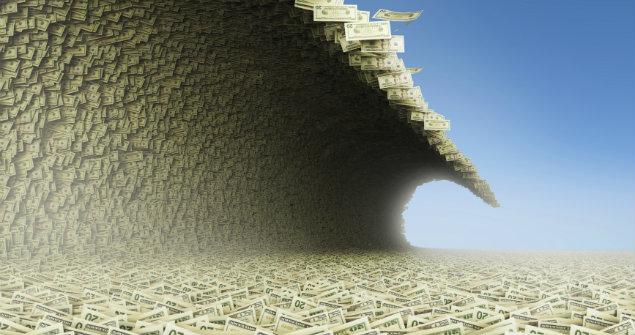
The Federal government never has enough money and over the past decade they have created enough money, Dollars, that there is a title wave of them about to hit us; we need a different system that the politicians can’t subvert. This short post is a way to achieve that.

The following figures are taken directly from the following government reports: Bureau of Economic Analysis (BEA) monthly report of the GDP of the United States; Monthly Treasury Statement; the Bureau of Labor Statistics (BLS) monthly employment situation; The Monthly Statement of the Public Debt of the United States and the Department of Defense (DOD) Active Duty Military Strength Report. The Monthly Treasury Statement data is reformatted to calendar year format the government fiscal year format which runs from October to September so we can compare apples to apples.

First the Facts for 2014:

#1 The federal government currently spends almost $4.0 trillion a year ($3.885 trillion) of which some is derived from taxes & fees ($3.096 Trillion) and some is borrowed ($789.5 Billion). More on this subject later since the official GDP figures are different; so we use $3.2 Trillion here instead of the actual $3.9 Trillion, to be consistent with BEA numbers (explained later).

#2 There are some 151,012,000 people working for a living including ALL categories (the BLS does not count farm, self-employed and the military). This figure is the average for the calendar year 2014.

#3 If we assume there are 2,000 hours worked per year per person that equates to 302 billion hours worked per year. This is the only assumption used here and since many workers are part time this maybe an overstated number. Whether it is or not doesn’t matter to the discussion of the concept. It would only matter if implemented.

# 4 Therefore, if we divide the $3.2 Trillion spent by the Federal government by the 302 billion hours worked by all the citizens, that gives a ratio of $10.56 of federal spending per hour worked.

Now here is the concept:

The idea is based on an economic principle that my advanced econ professor taught me my senior year at Ohio University which is, basically just a form of a thought experiment. The principle is that if we make a change and the result of the change shows a result that is the same as before the change, then there was no real change in the output only a change in how we got there. The assumption then is that it makes no difference which method is used.

What follows is for federal spending only, state and local could also be added to this but that is too complex for this brief overview. This does include ALL revenue going to the federal government no matter the reason or program including social security.

#1 We eliminate ALL personal federal taxes and fees and ALL business taxes and fees as well which then reduces the governments’ income to zero (all borrowing is also eliminated).

#2 Simultaneously we reduce individual pay rates by the exact amount of the taxes they pay. For example if you were making $25.00 per hour but only taking home $20.00 per hour the change we make would be that you would now be making $20.00 per hour but paying no taxes so your take home would be the same as before $20.00 per hour (no change).

#3 Businesses would be required to reduce prices such that their income would be unchanged in a similar manner. So the net economic effect on the economy from this change (initially) would be zero since private and corporate spending would be exactly the same (no change).

#4 To compensate for this loss of revenue the federal government would be allowed to create fiat money (no real change from what they do now) at the rate of $10.56 per hour worked by the citizens.  And since there would still be 302 billion hours worked by the citizens (no change) they could spend $3.2 trillion dollars (no change).

$5 The result is that there is still the exact same amount of money in the economy in both the current system and the new system. All we did is change the method of how it got from the worker to the government.

You can see we have made major changes but nothing has really changed, we just changed the method of how we got from there to here. So therefore we are in accordance with the economic principle we started this section with being true.

I think you can see the benefits to this kind of system and, of course the devil is always in the details; however I believe I have considered most of them and they are not major obstacles. I do agree that this would take a lot of re-education to the public but I think it could be sold especially after 2017.
The major benefits are:

#1 The federal government can only spend more money when there are more people working more hours. That is an incentive to promote growth not dependency.

#2 No one has to worry about paying federal taxes so all purchasing and investment decisions are based on economics not tax avoidance. This makes for a much more efficient economy.

#3 The federal budget is always in balance. No need to borrow money and this also forces international trade to be in balance since the government doesn’t need to borrow from foreigners.

#4 Lower prices for products produced here would make the US more competitive and since the take home income is the same internal growth would be immediate.

#5 We end up with a labor based currency which is a improvement over what we have which is debt based. It also takes gold out of the equation except possibly for international trade since the current system we have of pegged rates does not work. However, that is a different subject for other papers.

#6 There are no downsides other than some federal agencies would no longer be required, such as the IRS and the FED. So actually the federal government would need less money.

The Equations:

The equations shown after this discussion are used in national income accounting to calculate Gross National Product (GDP). To show how this works we present an example using the real numbers for 2014. Again this is a simple macro model and the details are much more complicated then what is shown here. However, that doesn’t matter since the principle is valid and all the details can be worked out.

Note the BEA does not count borrowed money and transfer payments are not shown as growth. The BEA’s G also includes state and local spending much of which is transfer payments from the federal government. This means that the BEA figures for “government” used to calculate the GDP are not the same as shown by the United States Treasury for federal spending and borrowing. We will use the BEA figure of $3.2 Trillion instead of the actual $3.9 trillion pulled from the economy by the federal government for 2014 in this exercise.

GDP = Y = C + I + G + (X – M)

GDP = Y = $17.7 = $12.1 + $2.9 +$3.2 + ($2.4 – $2.9)

Where C (consumption net of taxes CN) can be defined as gross income (Cg) less federal taxes (TF) or CN= CG – TF

Where I (investment net of Federal borrowing or IN) can be defined as gross investment (IG) less federal borrowing (BF) or IN = IG – BF

Where G (government) can then be defined as government taxes (TF) + government borrowing (BF)

X is exports

M is Imports

Y = CN + IN+ G + (X – M) or

Y = CN + IN + TF+ BF + (X – M)


After the proposed change

CG = CN

IG = IN

G = Hours worked (HW) * $10.56

GDP = Y = CN + IN + G + (X – M)

GDP = Y = CN + IN + 10.56 * Hw + (X – M)

GDP = Y = CN + IN + (10.56 * .302) + (X – M)

GDP = $17.7 = $12.1 + $2.9 +$3.2 + ($2.4 – $2.9)

Obviously nothing has changed since in either the old method or the new method The GDP = $17.7 trillion. Properly packaged, presented and sold by someone would solve many of our problems and doesn’t hurt either conservative or liberal principles.

Notes and Comments:

Federal Spending is very different from what is generally shown or known, for example: The Monthly Treasury Report for 2014 (adjusted to a calendar year) Shows the Federal Government spent $3.585 Trillion dollars derived from $3.096 Trillion from taxes and fees and $667 billion from borrowing. However the National Debt during the same period went up by $789 Billion so there was additional cash needed for changes in payables and obligations and capital projects of $122 Billion. Therefore the federal government actually spent/used $3.885 Trillion in 2014 or 21.95% of the GDP.

Also as previously mentioned transfer payments to the states and cities i.e. block grants do not show as being Federal spending in GDP analysis. That is unfortunate since the federal government has strings attached which give them control of the money and that will get much worse after 2016 when the full force of the Affordable Health Care Act goes into effect.

The purpose of the quick review of my idea is to show that economically and monetarily this system works. It works because economics is about people and what motivates them. In one sense Karl Marx was right labor is the ultimate source of value, he was wrong in how to use that principle and that wrongness has lead to much suffering in the world as we tried to absorb his idealist thoughts (socialism) into the real world.

This proposed system is a method of merging both Adam Smith and Karl Marx while rejecting John Maynard Keynes completely.
A Question of Money – Interest – Bankers


Dow-Bonds

QUESTION: 

Mr Armstrong, interesting article today, the story of the store of value (at least long term) has always confused me. One can look at saving accounts also as an asset as it yields the interest payment and one relinquishes the access to the money. No difference to bonds.

But your article causes some questions: as you stated before the FED buying bonds does not increase real money supply, so what caused the decline of purchasing power of money in the asset class of equities? Is it that the manipulating of interest rates distorted the actual confidence and time preference in the economy which can be measured by the velocity?

You posted earlier that the velocity has declined. People do not want to invest but save which is not an option for big money as it doesn’t yield any or very little return. Hence enterprises buy back shares and smart money has no other option.

Interest rate hike by the FED, eventually increasing retail participation, a cooling world economy, sovereign debt crisis and the flight to the Dollar. The outcome of your computer, a rise in US stock markets including a possible phase transition, seems comprehensible.

The only thing what leaves me with amazement is what do they really intend? I don’t believe that the families who run the banking system, operating for centuries in money business, do not understand that. I can only assume that for being protected by government the banking cartel buys the governments time and keep financing the deficits.

Best regards,

G

INTR-CCON

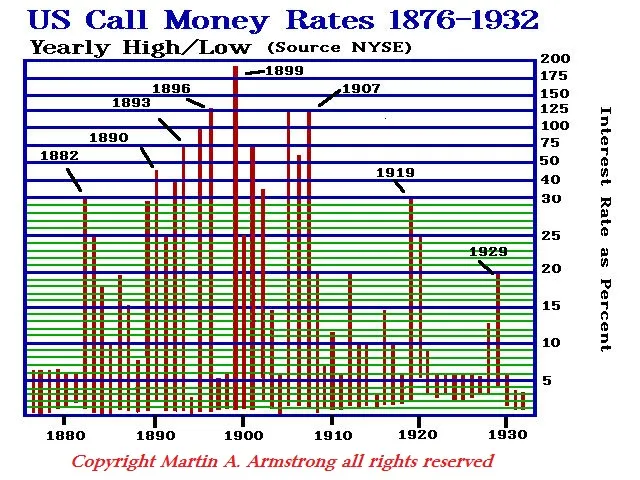
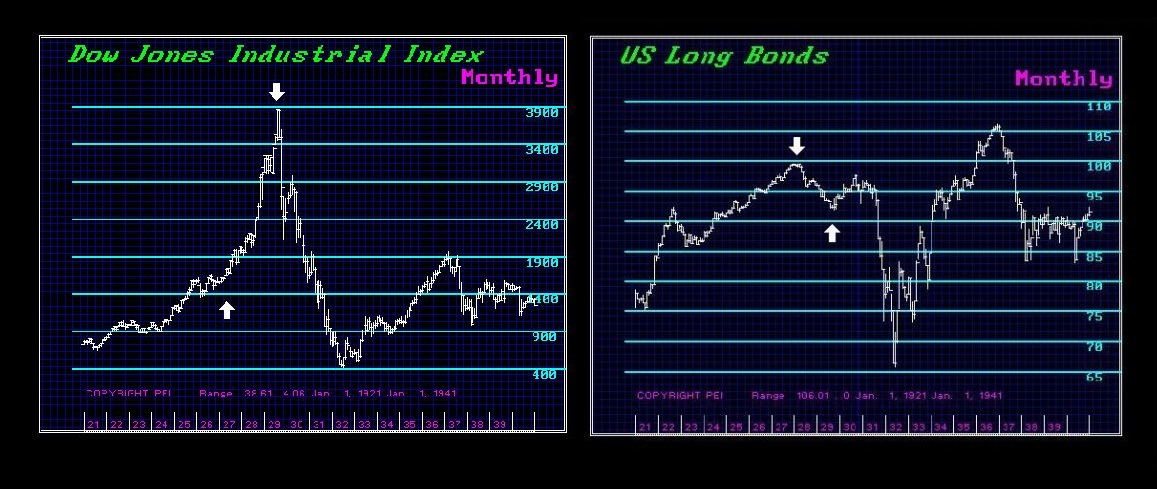
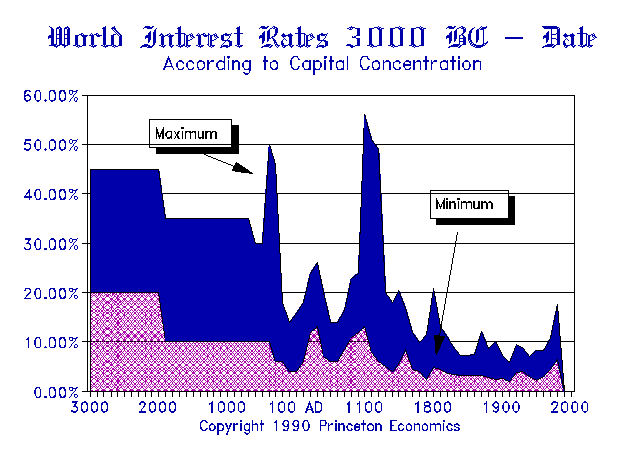
ANSWER: The problem in so many areas is that we can focus on one issue, but the answer is a complexity of variables. The history of interest rates has been provided on this site. Interest rates in a developed economy reflect the “option” value on the expected decline in purchasing power of money. If I expect it to decline by 5%, then I expect a profit and say want 8%. You in turn will pay the 8% only if you think you also can make a profit above 8% perhaps 10%+.

In an UNDEVELOPED economy, we transpose the depreciation risk of money with risk in general. Lacking any developed economy, one will lend only based upon the risk of getting repaid. Therefore, without a legal system, the risk is either the person or the political climate. When we look at the history of interest rates, I demonstrated that the rate of interest even within the Roman Empire increased the further you moved away from Rome. Hence, the lowest interest rates are in the dollar and they rise in other countries based upon perceived political risk. Greece’s interest rates are significantly higher than those in Germany. This is a reflection of political risk, not simple the future inflation rate in the Euro.

The Fed did not increase the money supply with QE easing and we have see that 9 months of QE in Europe has also failed to create inflation. What happened to the whole theory of the quantity of money impacting inflation? The problem lies in the definition. When US government debt was illegal to borrow against using it as collateral, then issuing debt DID NOT increase the money supply. When that was changed and you can post TBills as collateral to trade, then there is no longer a difference between debt and money.

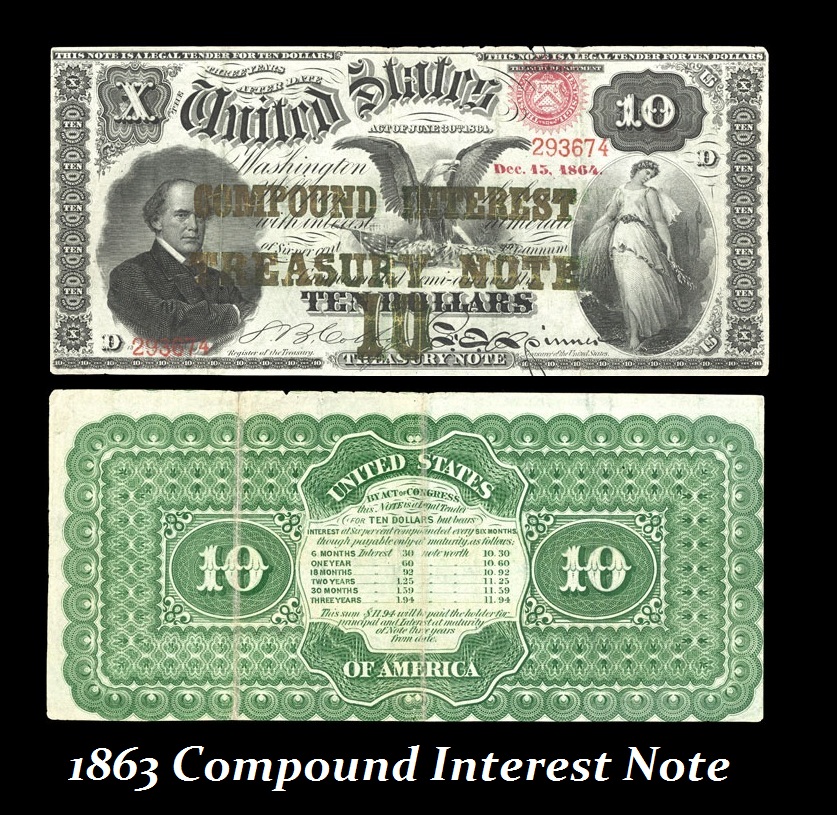
1864$10CompoundInt (2)

The US government did not issue paper money after the Revolution until the Civil War. To encourage people to accept it (CONFIDENCE), it paid interest. In reality, this was a form of circulating bond. The term “greenback” referred to the issues that did not pay interest and were not purportedly backed by silver or gold. You turned it over and it was just green ink with no promises.

Fed-Excess Reserves

So the Fed buying in bonds did not increase the money supply and it failed to create inflation as expected BECAUSE it merely swapped bonds (money paying interest) with non-interest paying money (electronic entries). The bankers then complained so the Fed created the Excess Reserve Facility, where banks have nearly $3 trillion in cash. The SF Fed argues Milton Friedman said they should pay interest on reserves. That was only on the required reserves. The creation of the Excess Reserves totally negated the entire idea of stimulating the economy for the banks never lent the money out. It became a giant swap of bonds for cash deposits at the Fed which it then had to pay 0.25% interest.

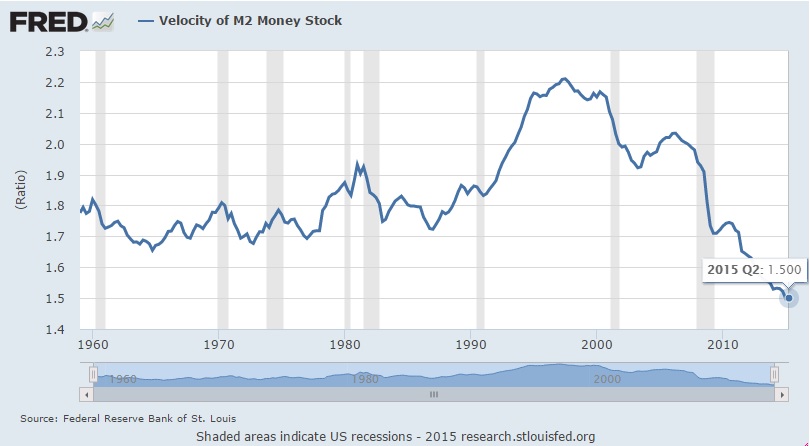
Velocity-Q2-2015

So now turning to the VELOCITY of money, a decline here demonstrates that people are HOARDING cash (rising in purchasing power as assets decline), as well as banks (Excess Reserves). We have companies buying back their own stock further shrinking the supply of equities also fueling the deflationary spiral. The Excess Reserves at the Fed show just how much banks are hoarding cash.

Therefore, we can see the deflationary trend and the contraction right here. The US share market has been at the high-end of trading, but it did not breakout beyond our second target which was the 18500 on the Dow. The market indeed doubled as we warned coming out of the hold in the 6,000 level passing 12,000, which is the MINIMUM requirement to start a Phase Transition. We nearly tripled by the 2015.75 target beating our minimum doubling requirement, but this was still not a Phase Transition. Why? Retail participation has been at record lows in stocks. This is a bubble in government debt and why we are at 5000 year lows in interest rates.

Now top the conspiracy. “The only thing what leaves me with amazement is what do they really intend? I don’t believe that the families who run the banking system, operating for centuries in money business, do not understand that. I can only assume that for being protected by government the banking cartel buys the governments time and keep financing the deficits.”

Medici - Tommaso Portinari Fall of Bank

Moth-2-FlameBanking establishments are some of the WORSE investors throughout history. They always go bust and it is government that devours them every single time. Yes, the government has been protecting the bankers for they have also been fueling the debt assisting governments to borrow. Therein lies their own demise. EVERY major banking house have been destroyed by this very same flirtation with power. They are like moths attracted to the flame of a candle, hoping to dance by the light never realizing their wings may get burned.

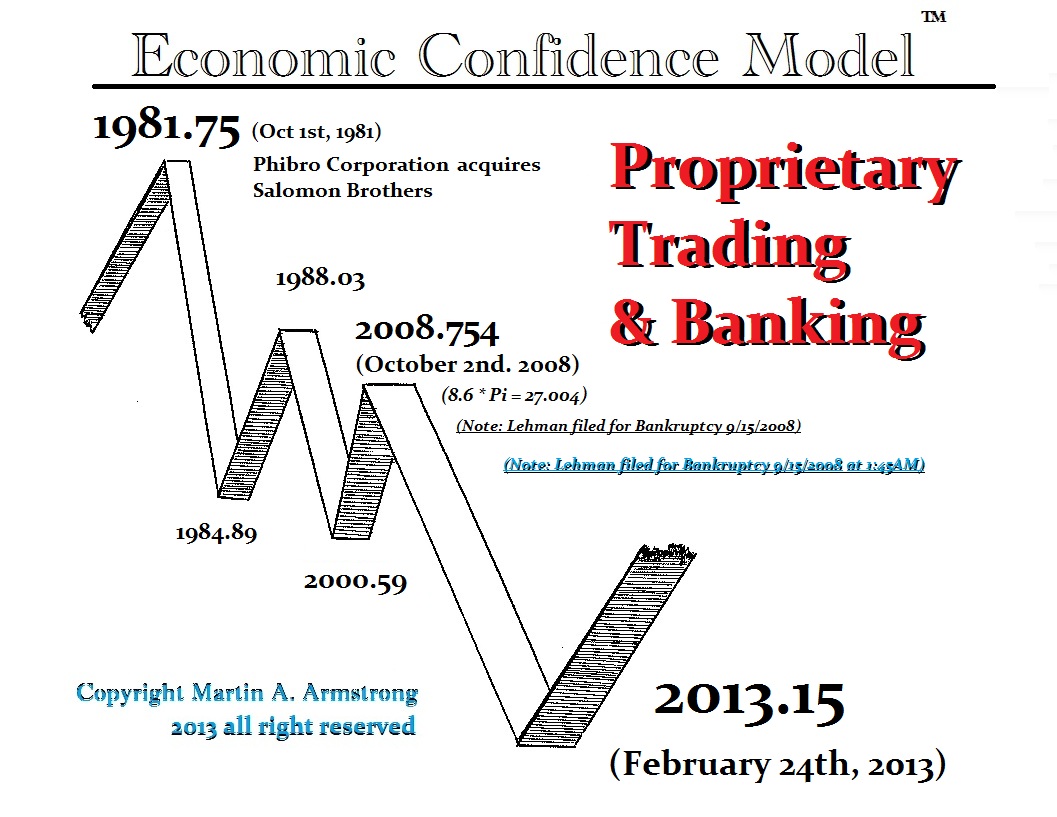
ECM-Banking-Proprietary-Trading


The cycle has change. The wheel of fortune has completed its revolution. Governments are turning against the banks and looking to electronic currency. The days of rumored banking conspiracies is coming to an end as it always has. The banks will be a giant short. When the Sovereign Debt defaults become a contagion, the banks will not be supported by government.

Money: What Is It? What is Interest? What is the Wealth of a Nation?


Merkel-Lagards

Angela Merkel and IMF chief Christine Lagarde can laugh it up as Europe burns down. The whole crisis stems from antiquated ideas that center on what money actually is. If you do not grasp what the true function which money actually provides within the economy, then you will be unable to get anything else right either. This entire idea of austerity is the crazy notion that money somehow should be a store of value. This is up there on the list of myths with those who also argue that markets decline because of shorts rather than comprehending that eventually longs do also sell.

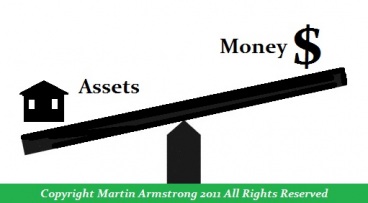
Money-Assets

Money is the OPPOSITE of assets and has always been historically. This is incredible important to understand far more than you may realize. If you want money to retain its purchasing power/value, you are creating a false image of how the economy functions. For Germany to be politically obsessed with the days of hyperinflation and constantly attempt to impose austerity, they are adopting the anti-asset position and that is the source of deflation.

Interest is actually supposed to be a measure of expected inflation and is essentially dealing in options. Whatever the rate of interest, the lender is expecting that the money will buy the same amount of assets upon repayment plus some profit in excess of the interest rate. Bankers want the same purchasing value back upon repayment plus their profit which is the entire purpose of lending money. Yet historically, the boom and bust cycle is the rise and fall in the purchasing power of money as measured in terms of assets. That is what is rising and falling – the purchasing power. When the purchasing power of money declines and assets rise, we call this a BULL MARKET. When the purchasing power of money falls, we call this a BEAR MARKET.

CALLMONY-MA

I have written many times that there is no magic level in interest rates that will cause the stock market to fall. As a market rises (BULL MARKET), interest rate MUST rise for that is the option on money and its future purchasing power upon return. Thus, it has NEVER BEEN the direction of interest rates that determines the direction of assets, for they are historically linked and must be. Only a fool, indoctrinated by Marxist-Keynesianism, cannot grasp that the economy cannot be manipulated by interest rates. This is why doing empirical studies of these two factors on a correlation model reveals simply that the stock market HAS NEVER peaked with the same level of interest rates twice in history. The level of interest rates is indistinguishable from a option premium on the future expectation of that particular asset.

bank-robberThe Federal Reserve keeps talking about the “normalization” of interest rates. They will not come out and explain what I am doing right now because it would expose that the emperor is naked. The Fed sees that negative interest rates proposed by the legendary banking advocate Larry Summers who may have been an agent from Hell sent to Earth to wipe out the economy, are highly destructive and amount to a tax on money. Negative interest rates can only be totally destructive to all asset classes and furthers deflation to the extreme. People then would hoard money outside of banks to avoid the tax and this leads government on their quest to eliminate physical money and embrace the age of electronic money. That changes the entire game and embraces economic totalitarianism.

Gold-Fluctuated

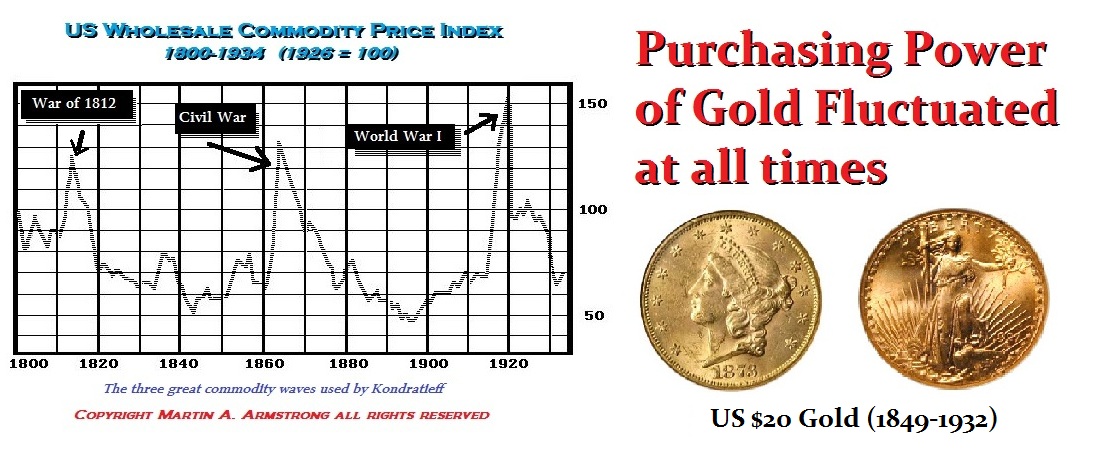
These people are fundamentally destroying everything because they are clueless about what is really money. Both China and Japan rose from the ashes without gold, proving that the wealth of a nation is not its gold reserves, but the total productive capacity of its people. Returning to a gold standard will not provide some magical check and balance where assets still rise in value yet gold/money would retain its purchasing power. They are totally lost in the rambling of their own mind. When gold was used as money, it rose and fell just as anything else that has ever been money proving it does not matter what you use for money, the same result will always emerge – money is on the opposite side of money. If you cannot grasp this fundamental realization, then you are doomed to screwing up the economy and society big time.

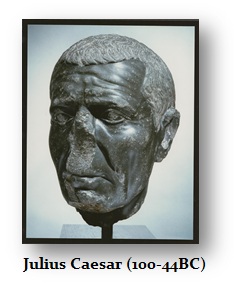
Caesar-5The only politician throughout history who truly understood this fact of life was Julius Caesar. To solve the debt crisis, he realized that the value of money rose above what it once had purchased and the price of assets reflected in terms of money had declined. He realized that say when a banker lent you money to buy a home say $100,000, and the market crashes, a $100,000 can perhaps buy two houses. The banker then reaps a huge profit demanding full repayment. Caesar’s solution? He appointed a board to revalue all assets to the point when the debt was entered. He then attributed all previous interest payment to reduce that capital borrowing and therein settled all accounts. He revitalized the economy and ended the debt crisis.

Money is merely a reflection of its purchasing power. It has NEVER been historically a store of wealth and cannot possibly be under any circumstances where assets rise in terms expressed in money. For assets to rise in terms of money, that means money must decline in purchasing power. This is rather simple to understand. Money is simply a medium of exchange that fluctuates in purchasing power rising and falling based upon human activity. We are lost in understanding the future because we cannot understand the past and the role of money no less debt and interest rates, which are merely an option on the future expectation of the purchasing power of money.

The wealth of a nation is the total productivity of its people. If I have gold and want you to fix my house, I give you the gold for your labor. Thus, your wealth is your labor, and the gold is merely a medium of exchange. So it does not matter whatever the medium of exchange might be. You will give your labor provided you know someone else will accept the medium of exchange from you in purchasing something else. It is the labor of the people and their productive capacity that creates the wealth of any nation. Germany rose from the ashes in Europe to be the strongest economy without gold all on the back of the total productive capacity of its people. The same is true for Japan and for China. Where corruption prevailed as in Russia and they relied upon selling a commodity rather than the productive capacity of its people, then its economy has not soared as did China, Japan,  or Germany. This also explains the third world status of South America and Africa. When a country exploits is natural resources to gain wealth rather than educating its people, its long-term viability will diminish with the reduction in the supply of its natural resources or in the case of oil, against rising cheaper alternatives. We do not get this fundamental principle correct, we will destroy our economies with excessive taxation, which in turn, reduces the total productive capacity of its people.

Germany & France Still Demand Repayment


Hollande-Merkel

German Chancellor Angela Merkel and her French counterpart Francois Hollande have called on Greece to make “serious” proposals. There is no such thing as debt forgiveness, as the German’s received in 1953. Merkel sold the euro under the pretense that there would be no bailout for southern Europe; any money lent must be repaid. So it does not matter that the underlying structure cannot support that expectation. Her personal career now depends upon that event, no matter how unreasonable.

Greek PM Alexis Tsipras is due to address a summit of Eurozone leaders on Tuesday. However, he is ignoring his own mandate: end austerity. He continues to try to negotiate with the EU when it is clear that the same line of thinking that created the crisis will not provide a solution. This entire Euro Crisis will spread between now and October; things are going to get worse before they get better. So do not expect the euro or the markets to understand this instantly. They do not yet comprehend the depth of this crisis.

The evil that is the Federal Reserve


In 1963 Milton Friedman and Anna Jacobson Schwartz published “A Monetary History of the United States 1867-1960″ which should be mandatory reading for any serious work in macro economics especially relating to monetary policy. In Chapter 7 and running for 120 pages is a description of the period 1929-1933 which he calls The Great Contraction. After reading this Chapter of this book of 859 pages there can be no doubt in any rational mind that the FED “caused” the economic collapse that we call The Great Depression.
There is little doubt that the FED also caused the 2008 collapse in the financial markets when the Housing bubble that they created burst. They are now working on a sovereign debt bubble that will be even worse than any that have occurred in the past. The FED needs to be eliminated.

john1282's avatarJunkScience.com

James Longstreet ‘splains what I keep pointing out.

I consider some of the mouthpieces for the Fed to be despicable for what they condone be done to people with pensions and fixed incomes.

I could start with my familiar targets on the right, Larry Kudlow, Bob McTeer. They run cover and blow smoke for a gang of thieves working for the plutocracy, the players in the Stocks and Bonds game.

Here are some of my previous critiques:

http://junkscience.com/?s=mcteer+federal+reserve

To the terrible disadvantage of the citizens who aren’t players.

http://www.americanthinker.com/blog/2015/05/federal_reserve_implies_indirect_tax_on_savings.html

View original post

Economic Growth is the only way out of the mess we are in!


Is Income Growth for the Bottom 90% Prosperity or Inflation?

Can an Economy Grow Without Inflation?


It is commonly taught that we need a stable increase in prices in order for our economy to grow.  We are told, after all, gold does not expand quick enough to accommodate rapid economic gains.  But is it possible for an economy to grow without inflation?  Not only that, can an an economy grow when prices are actually deflating?

This common inflation argument seems to ignore the greatest economic expansion in the history of the world – the industrial revolution.  During the late 1800’s the American economy was booming.  The living standard of the average man increased faster than any time frame compared to today.  While I agree that no one wants to go back and forgo all the advances that have come since, it is irresponsible to ignore the shoulders on which we now stand.

I have heard from multiple intelligent people that they just don’t believe me.  They say that our economy could not have grown quicker during the industrial revolution than any time since, and are commonly under the impression that poverty increased during the Gilded Age.  But if you are to compare apples to apples, the industrial revolution experienced more growth than any time frame.  The middle class was created during late 19th century.  In 1800 the average American was a farmer, destined to a short life of poverty.  By 1900 that had all changed.

Please refer to the graph below.  We take into account 3 different – 25 year time frames in American history: 1878 – 1903, 1946 – 1971, and 1987 – 2012.  If the time following the second world war was actually a larger expansion in the economy and living standards of citizens, you would expect a larger increase in both life expectancy and average income per person.

Economic Expansions over 25 Year Periods

According to the information found at GapMinder, it is very clear that the time preceding the Federal Reserve was actually a larger economic expansion in every measurable way (these numbers are inflation adjusted).  When you take a look at the information on that site, it is clear the average income and life expectancy is greater today than in 1903, which is why no one would want to go back to that time (straw-man argument).  The point is, if we were to see the same economic expansion during the late 20th century as we had during the late 19th century, we would all be living much longer with a much larger income per capita today.

It is also important to note that we do not feel GDP as a good indicator of economic growth, especially since it includes government spending.  But even using the government’s GDP numbers, the fact still remains.  The only thing that would change this chart is if you included World War 2, since the massive government programs exploded GDP.  But it is obvious that when food is being rationed, the living standards are not increasing for the average person.

Let us not ignore the third part of this graph, the value of the dollar.  After the Civil War ended and we no longer printed greenbacks, our country relied on a hard money standard without any central bank.  We experienced some boom and busts (though I attribute that to legalized fractional reserve theft), but by any standard they were not as long nor as severe as the recessions experienced since.

No matter the source, you will find $1 held in 1878 would buy you far more goods in 1903.  This means the value of the dollar INCREASED and we experienced a DEFLATION of prices.  This goes against all economic theory you have been likely been taught.  While our economy did not expand nearly as quickly, the two other 25 year periods experienced roughly 50% devaluation of the dollar (or 50% inflation of prices).  This is using the government’s own CPI numbers, and many would consider that we actually experienced far more price increases during the 1987 – 2012 time frame (due to the manipulation of the CPI calculation).

History is not on the side of modern day Keynesian economists.  Yes life is better now, society is more accepting of different behaviors and ethnicities, but that cannot ignore the growth we experienced and the shoulders on which we now stand.

Martin Armstrong – Sovereign Debt Collapse Coming Later In 2015


If Martin Armstrong says 2015 is the year I would not bet against him!

Adding Up the Swiss Franc Fallout


It’s looking more and more like 2015/16 will see a 2007/08 style adjustment but this time its likely to be even worse.

How the Yuan-Dollar Currency Peg Ends


This is exactly what is happening and one of the problems with pegged or fixed exchange rates; they work for a while and then the system collapses and we are at that point now.