Industrial Production Drops, Misses By Most Since January


This lack of “real” growth not the funneling of money into the market is the underlining problem we have have in out country. And that stems from so much of our production being exported to China, India and Indonesia. Most would blame business but that would not be completely fair as they had no choice as we the citizens demanded cheap goods at the same time we demanded high wages. It doesn’t seem to me that the two are compatible unless the government controls the input.  Sadly they did not as the surplus money went into funding the Treasure but buying T-bills and buy doing so the politicians had more money to play with and give us free stuff.  That works only as long as the exporters allow it to happen — right now they are telling us they no longer want to do this and are changing the international system of exchange.  That is going to be very very bad for us.

For the 3rd month in a row, Industrial Production missed expectations as hopes and dreams of follow through in Q2 remain dashed on the shores of hard data. IP rose 0.2% (missing the 0.3% expectation) and May’s jump was downwardly revised to 0.5%. What is stunning is that Industrial Production has slowed its gains from the polar-vortex Q1 into a much more economically frigid Q2. Capacity Utilization also missed expectations. Perhaps most worrying is the manufacturing industry’s mere 0.1% gain in June – the slowest increase since January.

Industrial Production missed for 3rd month in a row…


As Manufacturing tumbled…

Charts: Bloomberg


*  *  *

Does this look like a Q2 recovery bounce that is strong and supportive of 3% GDP growth?

The Almighty Dollar Is In Peril As The Global ‘De-Dollarization’ Trend Accelerates


Watch this closely over the next few months — this is the Achilles Heel of world commerce

Impact of IMF SDRs for Commercial Trade


Watch this closely over the next few months — this is the Achilles Heel of world commerce

This is a bit technical but VERY TRUE and the bottom line is we are very close to another collapse much like in October 2008


The Implosion Is Near: Signs Of The Bubble’s Last Days

Re-Post from Stockman’s Corner by David Stockman • July 14, 2014

The charts on his site to not transfer so go there to get the entire story.

The Implosion Is Near: Signs Of The Bubble’s Last Days

The central banks of the world are massively and insouciantly pursuing financial instability. That’s the inherent result of the 68 straight months of zero money market rates that have been forced into the global financial system by the Fed and its confederates at the BOJ, ECB and BOE. ZIRP fuels endless carry trades and the harvesting of every manner of profit spread between negligible “funding” costs and positive yields and returns on a wide spectrum of risk assets.

Moreover, this central bank sponsored regime of ZIRP and money market pegging contains a built-in accelerator. As carry trade speculators drive asset prices steadily higher and fixed income spreads steadily thinner—- fear and short interest is driven out of the casino, making buying on the dips ever more profitable and less risky. Indeed, the explicit promise by central banks that the money market rate will remain frozen for the duration and that ample warning of any change in rate policy will be “transparently” announced is the single worst policy imaginable from the point of view of financial stability. It means that the speculator’s worst nightmare—–suddenly going “upside down” due to a sharp spike in funding costs—-is eliminated by central bank writ.

Stated differently, ZIRP systematically dismantles the market’s natural stability mechanisms. One natural deterrent to excessive financial gambling, for example, is the cost of hedging a speculator’s portfolio of “risk assets” against a broad market plunge. In an honest market environment, hedging costs consume a high share of profits, thereby sharply limiting risk appetites and the amount of capital attracted to speculative trading.

By contrast, an extended regime of ZIRP, coupled with the central banks’ perceived “put” under risk assets, drives the cost of “downside insurance” to negligible levels because S&P 500 put writers are emboldened and subsidized to pick up nickels (i.e. options premium) in front of a benign central bank steamroller. This ultra-cheap downside insurance, in turn, attracts ever larger inflows of speculative capital to the casino.

This corrosive game has been underway ever since the Greenspan Fed panicked on Black Monday in October 1987 and flooded the stock market with liquidity. It is now such an endemic feature of Wall Street that it is falsely assumed to be the normal order of things. But, then, would anyone have been picking up nickels in front of the Volcker steamroller?

This dynamic is evident in the chart of the S&P 500 since the March 2009 bottom. The dips have gotten shallower and shallower as ZIRP and other pro-risk central bank policies have eroded the market’s natural defenses against excessive speculation. As of mid-2014, therefore, it can be fairly said that fear and short interest have been extinguished almost entirely. The Wall Street casino has thus become a one-way market that coils dangerously upward, divorced completely from the fundamentals of earnings and cash flow and real world economic conditions and prospects.

The inverse side of this coin is disappearance of volatility in the equity markets. As shown below, the current readings are at all-time lows, even below bottoms reached on the eve of the 2008 financial crisis. Needless to say, this dangerous condition does not appear by happenstance: its is the inexorable and systematic result of ZIRP and the associated tools of monetary central planning.

But all of this is ignored by the central banks because their Keynesian economic plumbing models contain a fatal flaw. These models purport to capture capitalism at work, but they contain no balance sheets and hardly any proxy for the financial markets which are at the heart of modern capitalist economies. As a result, central banks pursue ZIRP in order to inflate the plumbing system of the macro-economy with more “demand”—and hence more jobs, income, investment and GDP—-while ignoring the systematic destruction of financial stability that results from these very same policies.

As a consequence, Keynesian central bankers are bubble-blind. Whereas they monitor immense amounts of “in-coming” high-frequency macro-economic data that is trivial and “noisy” in the extreme, they ignore entirely “in-coming” financial market data that points to monumental troubles just ahead.

At the present time, for example, 40% of all syndicated loans are being taken down by sub-investment grade issuers. This is materially higher than the 2007 peak, and is accompanied by an even more virulent outbreak of “cov-lite” credit terms. Indeed, upwards of 60% of these junk loans have no protection against debt layering and cash stripping by equity holders—-notwithstanding their nominal “senior” status in the credit structure. The obvious implication, of course, is that the Fed “easy money” is being massively diverted into leveraged gambling and rent stripping by the LBO houses. Three times since 1988 this kind of financial deformation has led to a thundering bust in the junk credit market. Why would monetary central planners, who allegedly watch their so-called “dashboards” like a flock of hawks, think the outcome would be any different this time?

40pc of syndicated loans are to sub-investment grade borrowers

The monetary politburo remains unperturbed, of course, because they are not monitoring the composition and quality of credit. Their models simply stipulate that aggregate business loan growth will lead to more spending on capital assets and operational expansion including hiring. That assumption is manifestly wrong, however, because it is plainly evident that most of the massive expansion of business credit since the last peak has gone into financial engineering—-stock buybacks, LBO’s and cash M&A deals—-not expansion of productive business assets. Indeed, total non-financial business credit outstanding has risen from $11 trillion in December 2007 to $13.8 trillion at present, or by 25%, yet real business investment in plants and equipment is still $70 billion or 5% below its pre-crisis peak.

And that is “gross” spending for plant and equipment as recorded in the “I” term of the GDP accounts. The far more relevant measure with respect to economic health and future growth capacity is “net business investment” after accounting for depreciation and amortization allowances. That is, after accounting for the consumption of capital that occurred in the production of current period GDP. As shown below, that figure in real terms is 20% below the peak achieved two cycles back in the late 1990s.

In short, the combination of faltering investment in real plant and equipment juxtaposed to peak levels of leveraged loan finance should be a warning sign of growing financial instability. Instead, the central bankers bray that valuation multiples are not out of line and financial institution leverage is reasonably well-contained.

The “valuations are normal” line proffered by Yellen and her band of money printers, however, is simply an adaptation of the Wall Street hockey sticks based on projected earnings ex-items. That is to say, the kind of “earnings” estimates that omitted on average 23% of actual P&L charges over the course the 2007-2010 boom and bust cycle owing to non-recurring write-downs of goodwill, plants, leases and restructuring costs, among countless other real expenses—all of which ultimately consume corporate cash and capital. As I demonstrated in “The Great Deformation”, cumulative S&P 500 “earnings less items” over that four-year period amounted to $2.42 trillion compared to GAAP reported earnings—-that is, the kind that you don’t go to jail for reporting to the SEC—of only $1.87 trillion.

Consequently, the Fed fails to see the in-coming data on financial instability because it isn’t looking for it, and is simply tossing out Wall Street sell-side propaganda as a sop. The disappearance of volatility in the S&P 500 chart shown at the beginning, for example, is nearly an identical replica of the run-up to the 2007 stock market peak. Yet the appearance of a proven warning sign of a bubble top has been resolutely ignored.

The fact is, PE multiples are far above “normal” based on GAAP earnings in historical context. During the LTM period ending in Q1 2014, S&P 500 earnings amounted to $100 per share after adjustment for a recent change in pension accounting that is not reflected in the historical data. Accordingly, even the big cap “broad” market is trading at 19.6X reported earnings—a level achieved historically only at points when the stock market was on the verge an implosion.

Moreover, today’s $100 per share of earnings are highly artificial owing to massive share buybacks funded by cheap debt and by deep repression of interest carry costs. The S&P 500 companies carry upwards of $3 trillion in debt, but were interest rates to normalize— earnings per share would drop by upwards of $10. Likewise, profit margins are at an all-time high, indicating that the inevitable “mean-regression” will chop significant additional amounts out of currently reported profits.

In other words, at a point which is month #61 of the current business cycle, and thereby already beyond than the average cycle since 1950, why would any one in their right mind say a market is not bubbly when it’s trading at nearly 20X reported earnings. Indeed, in a world where interest rate and profit rate normalization must inevitably come, the capitalization rate for current earnings should be well below normal—-not extended into the nosebleed section of historical results.

And this applies to almost any other measure of valuation in risk asset markets. The Russell 2000, for example, still stands at the absurd height of 85X reported earnings. The cyclically adjusted S&P stands at 24X, or six turns higher than its half century average. The Tobin’s Q measure is also far more stretched than in 2007.

Likewise, emerging markets have piled on $2 trillion in foreign currency debt since 2008. This makes them far more significant in the global financial scheme than they were in 2008 or even at the time of the East Asia crisis of the late 1990s. And that is not even considering the massive house of cards in China, where credit market debt has soared from $1 trillion at the turn of the century to $25 trillion today.

At the end of the day, the Fed and its fellow traveling central banks have systematically dismantled the natural stability mechanisms of financial markets. Accordingly, financial markets have now become dangerous casinos in which speculative bubbles are guaranteed to build to dangerous extremes as the central bank driven financial inflation gathers force. That’s where we are now. Again.

ObamaCare: The Perfect New-Keynesian Policy Prescription? | Health Policy Blog | NCPA.org


This is the very heart of the “FALSE” belief of those follow Keynesian Economics, which in essence is that any savings is bad since it takes away from spending and therefore causes unemployment.

Forum for Healthcare Freedom's avatarForum for Healthcare Freedom

DEPaul Krugman is apparently so entranced by the magic that he believes that forcing firms to replace capital, even if it makes them poorer, “can stimulate spending and raise employment” and “the broken windows fallacy ceases to be a fallacy.” In this alternate universe, hurricanes Katrina and Sandy could do more for U.S. economic growth than the development of the petroleum industry, the refinement of the internal combustion engine, the development of the electric power industry, or the development and use of the semiconductor transistor.

Professor Cochrane writes that macroeconomists looking at new ways to explain the slow growth disaster are considering the uncertainty introduced by arbitrary policy changes, large distorting taxes, intrusive regulations, and the “unintended disincentives of social programs.”If these new approaches are correct, and one’s goal is to inflict maximum economic damage on Americans, ObamaCare is a smashing success. It affects the whole population, generates huge uncertainty…

View original post 55 more words

The Suicide of Communism: The Case for Patience


One of the best write ups on this subject I have ever read!

Re-Post from Gary North’s Specific Answers – July 05, 2014

At the age of 72, I look back at my life, and I ask a question: “What was the most significant event of my lifetime?”

I go back and forth between two events, but in fact they were the same event. The first was the decision of Deng Xiaoping in 1979 to begin to remove economic controls over agriculture in China. That led to the greatest period of economic growth over the largest area in the history of man.

The second was the collapse of the Communist Party of the Soviet Union in late August 1991. This was followed by the decision of the Soviet government to shut down the Soviet Union in the final week of 1991. This was the largest empire in history geographically. The Russian component spanned 11 time zones. Through its satellite nations, it extended into Western Europe. It had been in operation for over 70 years. It had the most extensive system of control over thought and activities of any large society in the history of man. Yet, in one week, without any bloodshed, the leaders of the USSR simply abandoned it. Nothing like this had ever happened before.

Those of us who lived through it could barely appreciate the magnitude of it. That is because it was bloodless. There was almost no warning. The West had been involved in a great competition between the two systems from 1946 until 1991. Then, without warning, that competition ended. It caught Russians by surprise. It caught Westerners by surprise.

Communist China and Communist Russia were loosely connected by ideology. Each system was far more rigorous than anything in the West. The West was committed to a vague faith in democracy as a political system, but with all kinds of economic opinions and religious opinions tolerated or promoted. The Communists were very different. They had a consistent ideology. It involved a specific view of God, man, law, causation, and the future. There was no toleration of supernatural religion. There was no official toleration of capitalism, although the black market was always allowed to exist, because without the black market, both systems would have completely collapsed. There was a name for it in the USSR: “blat.” There was also a phrase: “Blat is higher than Stalin.” Yet for all of the centralization, for all of the tyranny, and for all of the interference with civil liberties, both systems ended. They did not end with a bang. They ended with a whimper.

There was no collapse. The Chinese economy began to boom almost immediately in 1980. The Russian economy did go through some withdrawal pains, and these lasted for about 10 years. But it has recovered remarkably. Today, Russia is the dashboard camcorder capital of the world. When we watch YouTube videos of spectacular car crashes, a large percentage of them took place in Russia.

MISES PREDICTED THIS

All of this was predictable in general. More to the point, all of it had been predicted. It was predicted in 1920 by Ludwig von Mises, in an essay: Economic Calculation in the Socialist Commonwealth. In 1922, he extended that essay into a comprehensive treatise, Socialism. Mises made it clear that it would not be possible for any socialist commonwealth to implement its theory of socialism. If any government attempted this, the economy would end in chaos and economic breakdown. Without capital markets, and without the private ownership of the means of production, it is not possible to find out what anything is worth or what anything costs. Without a price system, there is nothing but economic blindness.

The socialists did their best to ignore this essay for the next 70 years, but in the end, it was obvious: Mises was right. The socialist multimillionaire economist Robert Heilbroner finally admitted it in an article in The New Yorker in September 1990. He literally said it: “Mises was right.”

What we have here is a combination of general theory and events in history. From the standpoint of general economic theory, the breakdown of both the Soviet Union and Red China was inevitable. In the case of China, there was no collapse, because the economy was so poverty-stricken in 1979 that the reform instituted by Deng Xiaoping could not possibly have collapsed it. In the case of the Soviet Union, which was a far more advanced economy, and which had been copying Western prices for half a century, just as Mises said socialist planners would have to do, the transition was more painful economically. But it was a major recession, not a collapse.

In Ernest Hemmingway’s novel, The Sun Also Rises (1926), we read this:

“How did you go bankrupt?” Bill asked.”Two ways,” Mike said. “Gradually and then suddenly.”

That was what happened in the Soviet Union. It was bankrupt morally and spiritually from the October Revolution of 1917. But it took 74 years for the implications of that bankruptcy to play out.

STEP BY STEP

If I ever write a history of the decline and fall the Soviet Union, I will start with Georgy Malenkov, who replaced Stalin in 1953. He is the archetype, and he is virtually unknown in the West today. He held the reins of power briefly, but he was replaced by Khrushchev in early 1955. He disappeared. He was not killed. The Soviet leaders had learned their lesson under Stalin. They knew that their reign would not last forever, and they all wanted a life insurance policy. So, they let him live. He died in 1988. The weakening of central power began in 1955.

The next event was Khrushchev’s supposedly secret speech to the Soviet leadership, which he delivered in 1956. He attacked Stalin’s cult of personality. Everyone in the room knew that he had been Stalin’s henchman, a mass murderer in the Ukraine. That speech, when translated and distributed the West, led to the defections of Communist Party members all over the West.

A dozen years later, the Soviet invasion of Czechoslovakia led to another wave of defections in the West. But this did not seem to affect the stability of the Soviet Union. There was no sign of weakness.

In August 1978, after 33 days as Pope, Pope John Paul I died. In October, he was replaced by John Paul II. This completely unpredictable turn of events soon led to a confrontation in Poland between the existing Communist hierarchy and the moral authority possessed by John Paul II. He had come to adulthood under the Nazis, and then served as a priest under the Communists after 1945. He had been trained by an anti-Communist cardinal who understood the limits of power, and who understood how to beat the system. The Pope knew the weaknesses of the Communist Party in Poland. His visit in June of 1979 helped create the moral basis of Polish resistance, which escalated in 1980.

In 1979, the Soviet Union rolled tanks down the highway that the American government had paid for in 1966. The Soviets were trying to prop up a puppet ruler in Kabul, and they soon found themselves in the quagmire for the next decade. They could not get out and save face. But they could not win.

In 1980, a pair of events took place which undermined the legitimacy of Communism as nothing else had before. They were both associated with the Olympics. The Olympics were held in Moscow, which were boycotted by the United States in the name of upholding the independence of Afghanistan.

From around the world, Westerners came to see the sports events. They came with their suits, their watches, their fine shoes, and their confidence. Every Soviet leader saw them. Every Soviet leader knew at that time, beyond a shadow of a doubt, that they would never be able to equal the wealth of the West. For all their power, for all their special privileges, for all their access to special department stores where a few Western goods could be purchased, they realized that they were second-class citizens economically. The leadership never recovered.

In Poland, the peculiar event of the discovery in July of meat in cans labeled “fish” led to a series of strikes. The meat was about to be sent to Moscow for Westerners who were attending the Olympics. A strike took place in the railway yard where the meat was discovered, and within weeks, the Solidarity movement was founded. From that point on, Poland began to move out of the Soviet orbit.

In 1980, Ronald Reagan was elected. He was an anti-Communist. He seemed youthful. Shortly after his election, there was an assassination attempt, but he survived. From that point on, he was in control. He broke the PATCO strike. The Soviet leaders wanted to know whether he had the gumption to stand up to the union, and he did. He smashed it. Then there were the television broadcasts of Reagan at the ranch, riding horseback, putting up fences. These were not staged events. This was what he really liked to do. The aging bureaucrats in Moscow were reminded constantly that they were not long for this world.

Then came the deaths in short succession of Brezhnev (1982), Andropov (1984), and Chernenko (1985). Gorbachev came into power. He began to reform the economy by allowing more decentralization. He began to free up public discussions in the press. In other words, he allowed more free market activities, and he allowed more freedom of speech. Yet the economy was in ruins, and it kept getting worse.

Then there was the fearful anniversary: 1988. This was the 1000th anniversary of the founding the Russian Orthodox Church. It had not been stamped out.

By that time, Gorbachev was touring the Western governments, begging for financial support. He did not get it.

In 1989, the Soviet Union pulled out of Afghanistan. It was a visible testimony to the inability of the Soviet military to maintain control in a nation on its border.

In 1991, its client state Iraq lost to the United States. Its military hardware was simply no match for Western technology. Its planes were shot out of the sky before they even detected the presence of an American fighter jet. Its tanks were blown up in the desert. That was in February. By the last week of December, the Communist Party and the Soviet Union were no more.

These events could not have been predicted individually, but the overall development had been predicted by Mises in 1920. The West was able to avoid a military confrontation directly with the Soviet Union, and the clock continued to tick. The West did not perceive how accurate Mises had been. But the scenario played out just as he said it would. The socialist economies of Red China and the Soviet Union were unable to compete with the West. The classic statement of this was made by Richard Grenier, who described the Soviet Union in three words: “Bangladesh with missiles.”

PAUL SAMUELSON: USEFUL IDIOT

The premier university economist in the second half of the 20th century, Paul Samuelson, wrote in the 1989 edition of his best-selling textbook, Economics, that the Soviet Union was proof of the efficiency of central planning. Mark Skousen has traced Samuelson’s comments on the USSR in the various editions.

In very early editions, Samuelson expressed skepticism of socialist central planning: “Our mixed free enterprise system … with all its faults, has given the world a century of progress such as an actual socialized order–might find it impossible to equal” (1:604; 4:782). But with the fifth edition (1961), although expressing some skepticism statistics, he stated that economists “seem to agree that her recent growth rates have been considerably greater than ours as a percentage per year,” though less than West Germany, Japan, Italy and France. (5:829). The fifth through eleventh editions showed a graph indicating the gap between the United States and the USSR narrowing and possibly even disappearing (for example, 5:830). The twelfth edition replaced the graph with a table declaring that between 1928 and 1983, the Soviet Union had grown at a remarkable 4.9 percent annual growth rate, higher than did the United States, the United Kingdom, or even Germany and Japan (12:776). By the thirteenth edition (1989), Samuelson and Nordhaus declared, “the Soviet economy is proof that, contrary to what many skeptics had earlier believed, a socialist command economy can function and even thrive” (13:837).

Samuelson’s reputation did not suffer, but by 1989, he had proven himself to be a useful idiot — to use Lenin’s phrase. From 1961 on, he had been completely taken in by fake Soviet statistics. Naum Jasny had been warning for years that the statistics were bogus, but Samuelson ignored this warning. He was given a free pass by academia, which had assigned his textbook to hapless students ever since 1948. They had been taken in by him, beginning in the 1961 edition, as surely as he had been taken in by the USSR, and they chose not to admit it.

In 1968, my first book appeared: a book on Karl Marx and Communism. I keep the 1988 reprint online for free downloading: Marx’s Religion of Revolution. In an appendix on soviet economic planning, I cited Jasny’s insights. The Soviet Union achieved statistical expansion by suppressing its people on a scale never seen in modern history. It looted them. It was this ruthless suppression of rights and a massive confiscation of private property that allowed the USSR look as though it was growing. I could see that Jasny was right. I was just a grad student, but I could see it. Samuelson denied it until the whole experiment went belly-up over two decades later. Yet the academic world took Samuelson seriously. It still does.

The most respected economist in the second half of the twentieth century was utterly snookered by a bunch of Soviet statisticians who feared reassignment in Siberia for not goosing the statistics. The premier Keynesian economist could not see through this charade. Keynesian economics blinds bright men. They refused to believe Mises, 1920 to 1991, so they were forced to believe hack statisticians who feared for their lives. They never fessed up — Heilbroner excepted. In retrospect, they were a bunch of suckers with Ph.D. degrees — men who could not perceive reality. Hans Christian Anderson wrote a tale about them: the emperor’s new clothes. Mises was the kid who announced in 1920 that the emperor was naked. For the next 50 years, he was shunned by academia for his lack of etiquette.

The intellectual heirs of those who did the shunning are still in charge.

Be patient. They are the blind leading the blind into the ditch.

Try to avoid the ditch.

CONCLUSION

What are the lessons of all this? First, there is a science of economics. Mises understood this. His critics did not. His critics were legion. But his assessment in 1920, three years after the October Revolution, proved to be accurate in Red China and the USSR.

Second, the inevitable economic failures of socialist societies gave the West time. There was no nuclear conflagration. By holding to peace, the West won. But because the West never believed Mises, it lacked confidence in its task. There were men in high places who said the two systems would merge. The systems did not merge. One of them simply folded up shop and disappeared. The other adopted Western policies of central bank financing, mercantilism, and Keynesian bubble inflation. It is crony capitalism on a massive scale. Its bubbles will pop. Be patient.

Communism lost. The West gave it time. Time proved Mises correct.

Keynesianism has not yet lost. Give it time.

There need not be a social collapse or an economic collapse in order to make possible a transition to a non-Keynesian economy. It is possible for the system to go belly-up at the top, yet not bring down the social order. We have seen this twice since 1979.

The United States government will go bust at some point. It will default. It will break its promises. At that point, the voters will get a lesson in economics and civics.

It is our task to prepare the educational materials required to make the case for liberty when Washington’s checks bounce.

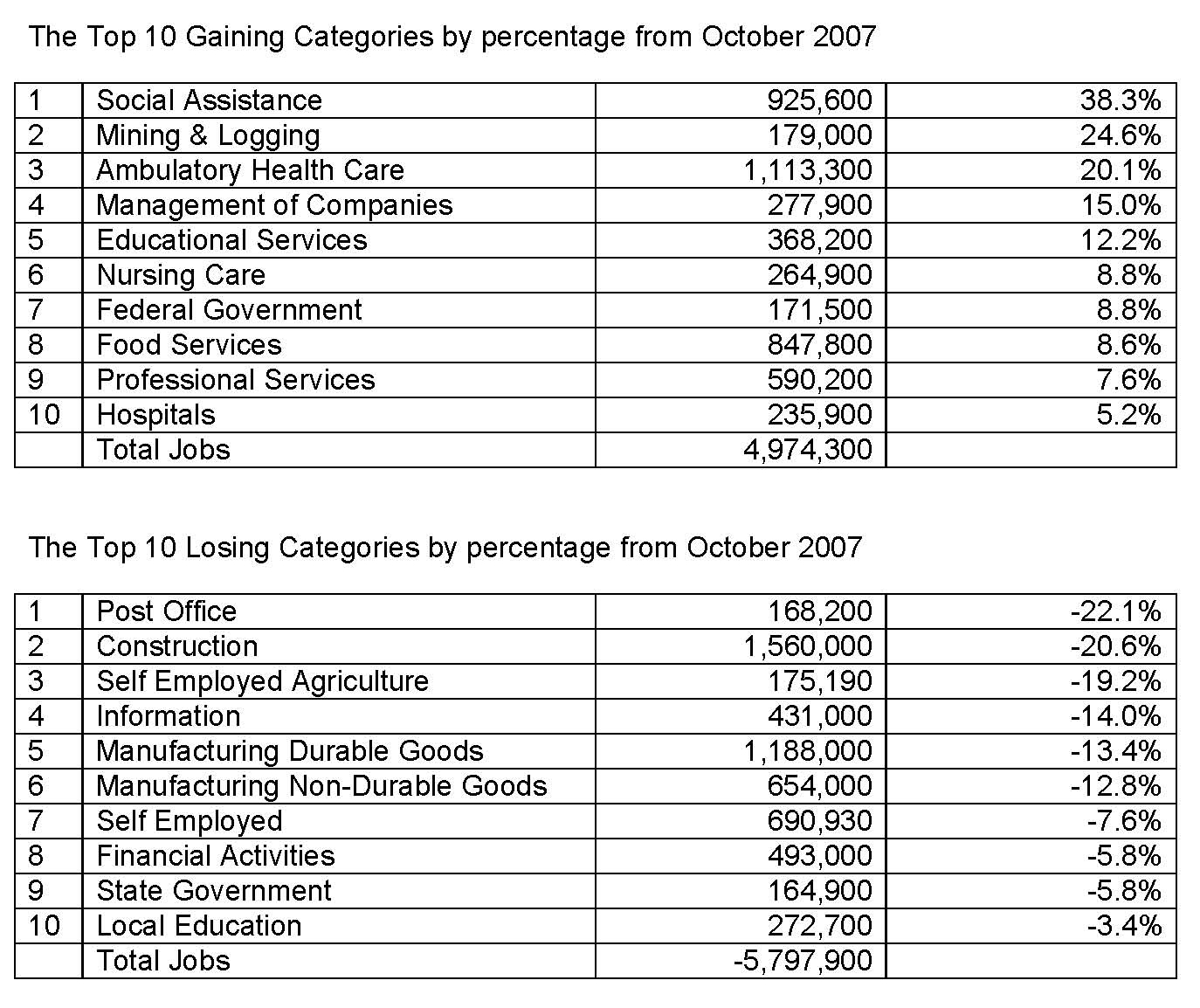
The Real Job’s Report for June 2014


How many jobs were created since 2007 not last month

Based on the BLS July 3, 2014 Release USDL-14-1243 we have the following analysis using the numbers shown in Table B-1 and A-8. Then we use a DOD monthly report for Active duty military to add to the other two of 1.36 million soldiers. By doing this we get a more complete picture of those that are getting pay for some form of work and are therefore not on public assistance or retired. For reference that report claims that 288,000 jobs were created in June.

The first thing that came out when we look at what has happened since the high point of the previous growth period in October 2007 was that we are still short 394,630 jobs from then making this the slowest recovery on record. But there were categories of gains and categories of loss’s so what are they?

JOBS June 2014

The total gains and losses for all the other categories give a net gain of 428,990 which when combined with the two table’s leaves us with a net loss of jobs since October 2007 of -394,630. But we also see that close to half of the gaining categories are low paying jobs and that most all the losing categories were good paying jobs. It would therefore appear that not only are there fewer jobs but there has been a shift out of traditional middle class jobs to lower paying personal service jobs in food service nursing homes and the like. Without seeing the income distributions that is speculation but the categories speak for themselves.

The only real winners in the past 7 years appear to be the upper middle class and the upper class as those categories of government workers, financial advisers, legal and doctors have increased.

The end of the current Fed Sovereign Debt Bubble is in sight


Currency changes are now in place

Re-Post from Power Line from Steven Hayward — with my comments.

Further to yesterday’s note on “Behind the Levitation” about the Federal Reserve’s easy money policy, Ron Greiss of The Chart Store kindly sent along these four graphs that display the astronomical expansion of the Fed’s balance sheet in the aftermath of the crash of 2008.  These make for sober viewing indeed.  Hard to see how this ends well. Click on Charts to enlarge.

If the current move away from the US Dollar as the only reserve currency gains steam this bubble will explode even if the FED continues to tapper off; the damage has already been done and can’t be undone.


Fed 1 copy

Fed 2 copy

Fed 3 copyRon Greiss notes that correlation does not equal causation, but still:

Fed 4 copy


The Collapse of the US Economic System


NO JOBS

The Great Recession actually started in November 2007 as that was the month that jobs in the US started to decline from their peak in the previous month October. The collapse in the financial markets started 12 months later in October 2008 just prior to the presidential election. This analysis is intended to show what was in place at the peak October 2007 compared to today May 2014. In this analysis we will use only official government data; however it will be adjusted to reflect TOTAL Employment not just what the Bureau of Labor Statistics (BLS) shows each month with their employment status report. They don’t report the farmers, the self-employed and the military; although those numbers are available, so we just add them to the BLS numbers to get a truer picture of “all” the people earning a living.

All these numbers can be found on the BLS website the most current is USDL-14-0987

For the peak October 2007, the population of the country was 301,811,120 and the BLS showed in their Table B-1 that there were 138,361,400 working comprising 50.04% of the populations in the following three major Categories:

Goods Producing            22,266,000     7.38%
Services                         93,767,500    31.07%
Government                   22,327,900     7.40%
TOTAL BLS                     138,361,400   45.84%

Next we add in the jobs the BLS doesn’t count.

Self Employed                  9,060,900     3.00%
Agriculture                       2,218,100       .73%
Military                             1,418,200       .47%
TOTAL                             12,697,200      4.20%

GRAND TOTAL               151,058,600     50.04%

For May 2014 53 months since the end of the recession the population of the country was 318,138,408 and the BLS showed in their Table B-1 that there were 138,462,300 working comprising 47.22% of the populations in the following three major Categories:

Goods Producing            19,009,000      5.98%
Services                          97,583,900    30.67%
Government                   21,869,400      6.87%
TOTAL                           138,462,300     43.52%

Next we add in the jobs the BLS doesn’t count.

Self Employed                  8,375,000      2.63%
Agriculture                       2,011,000        .63%
Military                             1,400,900        .44%
TOTAL                             11,786,900       3.70%

GRAND TOTAL               150,249,200     47.22%

The difference between the two periods is, by the BLS numbers, that we now have 100,900 more jobs than October 2007 which is good; however if we add back in the agriculture, self-employed and the military we are still short 809,440 jobs. This means there are 809,440 fewer people without a paycheck today than in November 2007. Also note that there are more people in the government than in the goods producing sectors in 2007 and and a lot more in 2014, that just doesn’t seem right.

Making this situation significantly worse are two other factors; the first being that the population has grown by 16,327,288 so that means that there are 16,327,288 more people to be support by 800,000 fewer workers. The second being that since the highest paying jobs for the middle class, in the good producing sectors, are down 3,257,000 jobs from October 2007 and the self employed are down another 685,900 for a total of 3,942,900 fewer middle class jobs. Offsetting this is an increase of 4,043,800 jobs (100,900 jobs more) but they are mostly in the lower paying job categories like food services and temporary help

So the bottom line is fewer people working and those that are working are bring home less money. The shift of a large portion of the manufacturing sector to China and India over the past dozen years has decimated the American middle class and swelled the rolls of those dependent of the federal government for various forms of transfer payments from food stamps to disability payments.

NO ECONOMIC OR POLITICAL SYSTEM CAN SUSTAIN THIS TRANSFORMATION BEING IMPOSED ON THE CITIZENS FROM THE PROGRESSIVE POLITICAL WINGS OF BOTH MAJOR PARTIES. THINGS WILL EITHER CHANGE OR THE AMERICAN SYSTEM WILL COLLAPSE.


A Public System for Economic Development


How to create growth

Background

This was written in 2008. Until only a few decades ago economic development in the sense that it is viewed today did not exist. New developments happened by personal salesmanship and hard work. Everything changed after the federally funded “Manhattan project” showed what directed research could do. Then shortly thereafter when Silicon Valley was created in California as a result of mostly federally directed research for computational power for the military and space markets precedence was set. Now every city in the country would like to have a success like that in their town but how?

The focus over the past several decades has been on entrepreneurs and venture capital with emphases on the venture capital thinking that that was the key, to have seed, angel and traditional venture money available. That approach only partially works for the funds managers looking for a return, which they must, go where the perceived opportunities are which is not necessarily where the “local” community is. The local community is being defined here as where the fund is located.

But actually, if you think about it, the focus on money and trying to find the next hot deal is an exact backwards approach for a region or city. The key is not in making the venture money available for the money will come to the deals that are good. The key is creating a concentration of creative people and entrepreneurs.

The logic here is that no one knows what the next hot deal will be but the entrepreneur that has it. In fact, no one foresaw the benefit to any of the major development trends until after they happened. Further there is no way to know which entrepreneur will be successful and when they will first get an idea that’s good. Therefore for any locality, such as Cleveland, that wants to create growth the most cost efficient method to get real economic development would be to attract a large numbers of entrepreneurs. For if enough of them could be concentrated in a location their very numbers would almost guarantee a big hit at some point in time. This is a shotgun approach and when there is no hard target in sight a shotgun is better than a rifle.

To bring entrepreneurs to a location in the numbers required to guarantee a major hit would mean a number of thing are required and money is not one of them. Money is the most mobile of the requirements for success and will come to the ideas. What is needed is to focus on the innovation process and set up a process to facilitate all the steps. There areas can easily be identified and there are a place to live, a place to invent and a place to get help.

A place to live:

Create an economic empowerment zone by tearing down the worst ward in any inner city and build a village of middle class homes at say $150,000 each for the home. Say 500 to 1,000 homes so we would need maybe $250,000,000 for the project which can be done with bonds. These homes are loaned to anyone who submits a valid business idea to a review committee and they are allowed to live there free for 10 years. They get a reduction in the $150,000 home commitment that they make of $5,000 for every job created in the city. At the end of 10 years or sooner they get brought out. The home is then cleaned up and given to the next entrepreneur. There is a lot more to this but we’ll skip for brevity.

A place to invent:

Most inventors are hampered by a lack of resources. So the next step is to create a place they can go were all the tools for making and doing things exist. Let’s call it a craft center for lack of a better term. A place that has research facilities, a small machine shop a computer lab with appropriate software and all the other things that you might need to develop or build something. Ideally this craft center would be in the center of the entrepreneur’s village. That keeps travel time to a minimum which facilitates that innovation. Like in the previous discussion there is a lot that goes with this but those are only details. An educated guess would be $50,000,000 to build the center again well within the reach of local bonds.

A place to get help:

The third thing needed is knowledge and education; so how about a 2 year, a 4 year and a master’s degree in entrepreneurship for the curriculum in a special school or college within a university. In each case the requirement for graduation would be a business plan. What would be taught would be how to find markets how to manage and how to plan. A combination of a business and technology program so to speak. But since some of the areas where growth could be expected are very technical and science oriented some method of traditional education would be also be required. Combining an engineering degree with the entrepreneur’s school so all the non engineering courses required for a traditional engineering degree would be supplied by the entrepreneur’s courses.

Student loans could be given out with the entrepreneur either paying in cash, as normal, or given a credit of $5,000 for each job created. Again many details but we’ll skip those for now. Hard to estimate the costs but lets say a thousand students so it would probably be under $100,000,000 to put 1,000 students through 4 years. If those 1,000 students each created only 25 to 35 jobs, on average, that is 30,000 jobs per year after the first 4 years of the program.

Discussion:

Every location in the country, or the world for that matter would like to foster economic development within its geographic area of responsibility. Governments, States, Counties and Cities have all set up programs to try and find a way to promote economic growth, especially technology based growth with all kinds of “programs,” “grants” and “tax breaks.” Not many of these programs have worked as well as they were hoped to, and in my opinion there are several major reasons why promoting this kind of growth is very difficult. These are: one, true “New Ideas” typically don’t come from organizations they come from unknown inventors or entrepreneurs; two, these inventors (word used to mean both inventor and entrepreneur) normally don’t have “experience” or “money;” three, many of the traditional methods of help result in the inventors losing most of the value of what they came up with; four, because of politics with the use of “public money” most of these programs end up being very conservative; five, even with these programs there is no one source shop to go to.

Many, if not most, of the core issues for the inventor center on finding money for doing the designs, building prototypes and getting patent protection without losing their idea. Writing business plans and securing seed and/or start up money are also high on the list of needs as well. Getting through these hurtles is extremely hard for most inventors and many good ideas never get made because of this. So is there a way to help these inventors and promote technology based growth. I think there is.

At the State or better at the County level within a state a special kind of community could be established with public money that did the following.

A. Have a place to live for the entrepreneur and his/her family. This would consist of homes build for the city or county where they were located, preferably located near a major university. In the community would be created an environment that would facilitate inventing. That means as many of the daily needs of the community as possible would be located here. The logic being that you want the inventor to spend as little time as possible doing things that aren’t inventing.

B. In the center of this community would be a facility that would contain: a number of good computers and appropriate software (both business and technical), related support equipment like desks, phones, file cabinets, copiers and fax machines, a complete machine shop, a model making shop to include stereo lithography, and an electrical and electronics lab. This listing is only meant to show breath not every aspect. In essence this facility would have everything that an inventor would need to take his or her idea from concept to working model.

C. Have a small staff of support people such as technicians, attorneys, engineers, programmers, accountants, business people and machine operators knowledgeable in all aspects of making things. These people would be there for advice and could come from the nearby college and/or from retired business executives. Existing organizations like SCORE would fit in here perfectly. Obviously there would need to be some admin people as well to keep the place running.

D. Have the support of local business that had previously agreed to help or mentor those using the facility.

E. Have ongoing contacts with the seed and venture capital community and even hold investment conferences during the year where inventors could present their case or ideas to interested parties.

In other words this would be a comprehensive facility where and inventor could get access to design and make almost anything be it hardware or software in nature. And it would be a place that took no ownership in the idea its sole purpose would be to facilitate the inventor and give him or her a place to work.

To gain access to this facility an inventor would need to write up his/her idea and submit it to a review committee. The main purpose of the review would be to make sure the idea was within the scope of the facility to handle and that it had some economic potential if it could be produced. This would not have to be a formal presentation and its purpose would not be not to judge whether the idea would work or whether the inventor had the ability to make it. The secondary purpose would be to see if the inventor had the will to make things happen. Based on a positive review of the idea presented the inventor would be allowed to use the assets of the facility to design and build their idea. However this is not an open ended deal and part of the review would be to tell the inventor for how long they had the use of the facility. It is assumed some form of scheduling would be required and the facility should be open 24/7 to accommodate people that are holding jobs. They would have to do the work and the “state” would provide the tools to do so. The inventor would not be given any money only the means to design and build their idea. The technical and business staff would be there for guidance and support but not for doing the work. However if the inventor needed help in an area and wanted to pay for help it could be provided at minimal cost to them.

To an inventor buying all the equipment needed to build something would be cost prohibited and to try and find a range of local companies that would even do it for them would be very hard as most companies are looking for production work not one or a kind projects with unestablished companies or inventors where they may not get paid for what they did.

To the state buying all the equipment needed to establish a facility of this kind is not out of the question but finding new ideas are. Public employees are not risk takers and so most publicly funded programs end up being to make small improvements to existing ideas. The state here provides the expensive physical plant and since it is a conservative use of funds the public is not seeing their money being given away.

Since local and state money was part of the funds used to build the facility the inventor would agree to start their venture in the immediate locality if at all possible and within the state in any case. That is not too much to ask for the use of the facility and is really the only string attached.

Analysis:

Using Cleveland as an example since it has gone from the top to the bottom in less than 80 years we can see what works and what doesn’t work. Cleveland in the last half of the 19th century and the first part of the 20th century was a center of innovation. That innovation created growth. Cleveland in the ’00’s is for all practical purposes brain dead and is now ranked as the second poorest city in the country.

If nothing changes than nothing changes and in Cleveland if it doesn’t work the first second or third time just keep trying till it does. Sadly no matter how many times we study the problem and try it has never worked and so we are where we are. We’ve been trying the same formulas for several generations and so the people have figured out that the politicians and community leaders don’t have a clue so they voted with their feet, their gone. Even the PD figured that out in the editorials they have done over the past several years. Much good it did as no one is reading them but then maybe the flaw in the PD work is they assumed Clevelanders can actually read.

A solution that has worked well in other areas of the country, where similar but not as bad problems existed, was to combine all the affected communities into one large city. Again the PD has recommended that for Cleveland but I guess we would all rather disappear as a community rather than fix the problem. Too many politicians involved to actually make this possible. For think about it there would be a lot of mayors and council people out of a job if this was enacted. So since that will never happen here this entrepreneur’s village maybe something that could be done.

Recommendation:

The underlying logic here is to find a way to attract entrepreneurs here not the money as for the jobs it’s the people not the funds that is the key to turning Cleveland or any city around. So, using this White paper as background any of the local colleges could do an economic analysis of this idea to include pro forma economic projects of implementing these recommendations. The study would cost little and given the critical condition of the city what is there to loose?