Counter Attack – New Intelligence Authorization Act Seeks to Curb Power of DNI


Posted originally on CTH on July 20, 2025 | Sundance

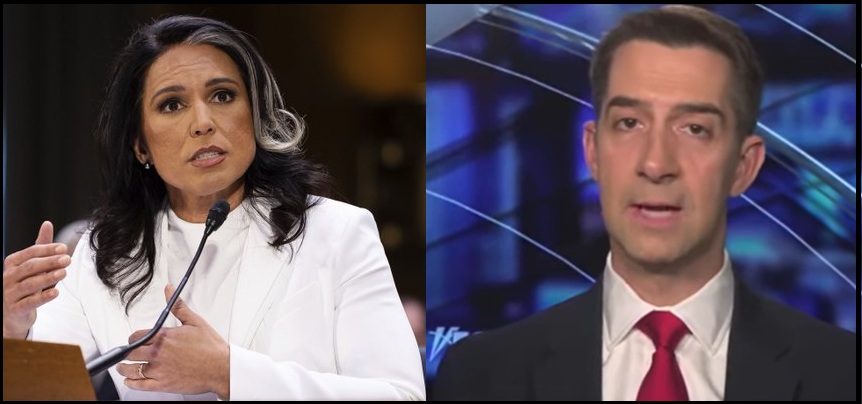
The response from Chairman Tom Cotton and the Senate Select Committee on Intelligence to the action of DNI Tulsi Gabbard was predictable.

The SSCI has now framed the Intelligence Authorization Act for Fiscal Year 2026 [LINK] to modify the “responsibilities and authorities of the Director of National Intelligence.” [Section 402]
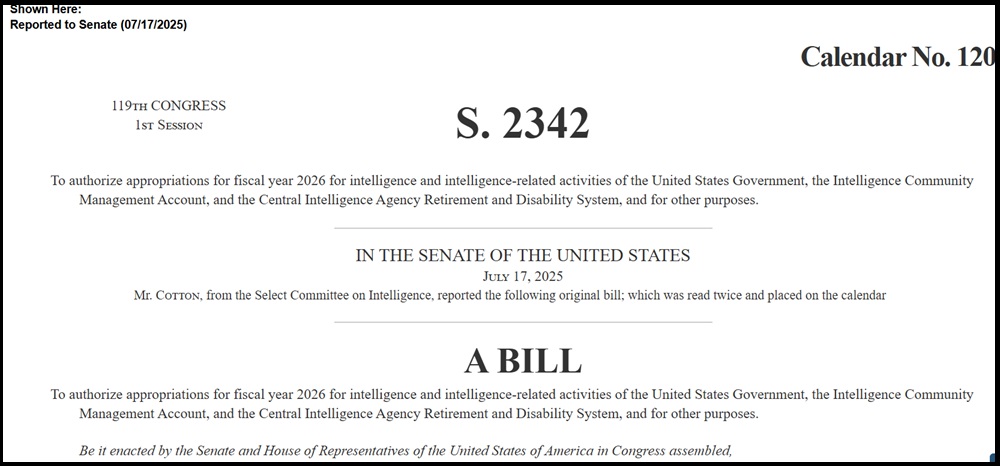
[SOURCE – Sec 402 LINK]

We knew this was coming.  The Intelligence Community does not like rogue actors amid their ranks, especially if those people have cross-silo access.  The silo system is designed to protect the Deep State.  Any entity who can cross reference the inserted information becomes a risk to the enterprise.

Senator Cotton cannot directly oppose Tulsi Gabbard without exposing himself.  Thus someone, not the SSCI, writes the legislative changes to the Intelligence Community rules and procedures and Tom Cotton simply advances them.  That’s the way DC operates.
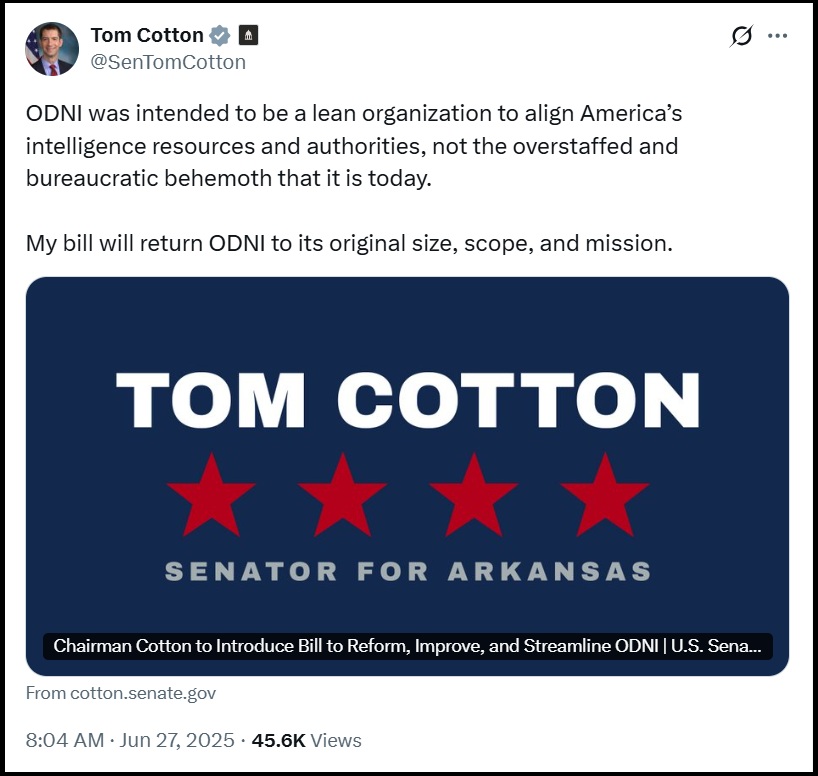
[TWEET LINK]

Additionally, Chairman Cotton does not want the DNI to investigate or generate its own intelligence.  Cotton demands the ODNI just accept and regurgitate the intelligence Tulsi Gabbard would be given by the other agencies; no independent review of analysis permitted.  All of these actions push the Intelligence Community power center back into the CIA and away from the prying eyes of the DNI.  That’s the SSCI motive.

WASHINGTON DC – A top Republican senator is proposing a sweeping overhaul of the Office of the Director of National Intelligence, slashing the workforce of an organization that has expanded since it was created in the wake of the Sept. 11 attacks.

Under a bill by Sen. Tom Cotton of Arkansas, the chair of the Intelligence Committee, the ODNI’s staff of about 1,600 would be capped at 650, according to a senior Senate aide familiar with the proposed legislation.

ODNI’s workforce was about 2,000 in January, but National Intelligence Director Tulsi Gabbard has already overseen a reduction of about 20% as part of the Trump administration’s drive to shrink the federal workforce. The reduction in the staff Gabbard oversees could weaken her role in the intelligence bureaucracy.

[…] The attacks of Sept. 11, 2001, exposed a failure to share information across spy agencies with catastrophic results. As a result, Congress established the ODNI to oversee all of the country’s 18 intelligence services, including the CIA, and manage bureaucratic turf wars from a complex outside Washington, D.C.

What started as a relatively small office under the national intelligence director in 2005 has expanded over the last 20 years to include in-house analysis teams and centers focused on counterterrorism and counterintelligence. Cotton has described the ODNI as a bloated bureaucracy that should return to its original mission of coordinating the work of other spy agencies instead of producing its own reports and duplicating other agencies’ efforts.

“Congress in no way wanted yet another unruly bureaucracy layered on top of an already bureaucratic intelligence community,” Cotton said at Gabbard’s confirmation hearing in late January. “Unfortunately, 20 years later, that’s exactly what the ODNI has become.”

Gabbard herself expressed support for downsizing the ODNI’s workforce at the hearing, saying she would work with Cotton and other lawmakers to eliminate “redundancies and bloating.” (read more)

In the lead up to the election I outlined what the DNI could do with untapped power already given to the office.  DNI Tulsi Gabbard has been following a path close to that outline.  Now, we see Washington DC responding to that affirmed power structure and actively working to neuter the DNI.  A very predictable outcome.

The only intelligence silo more corrupt than the CIA is the Senate Select Committee on Intelligence that oversees it.

What Are They Hiding?


Posted originally on Rumble on Bright Bart News Network on: July 19, 2025

Cortes: “This Who Has Been Canonized By Corporate Media Is Starting To Show Political Weakness.”


Posted originally on Rumble By Bannon’s War Room on: July 19, 2025, at 1:00 pm EST

Episode 4640: Former VOA Employee Indicted for Threatening The Life Of MTG


Posted originally on Rumble By Bannon’s War Room on: July 17, 2025, at 2:00 pm EST

War Room Battleground EP 810: One Year Ago Today The Release Of Peter Navarro


Posted originally on Rumble By Bannon’s War Room on: July 17, 2025, at 9:00 pm EST

NAVARRO’S NEW BOOK: ‘I Went To Prison, So You Won’t Have To’


Posted originally on Rumble By Bannon’s War Room on: July 17, 2025, at 2:00 pm EST

NAVARRO On Weaponization Of Our Justice System: ‘I Went To Prison Because Of The Democrats’


Posted originally on Rumble By Bannon’s War Room on: July 17, 2025, at 2:00 pm EST

Jones: “The Deep State Declared War On The American People, It’s Time To Finish Them Off For Good.”


Posted originally on Rumble By Bannon’s War Room on: July 17, 2025, at 2:00 pm EST

LOOMER: Man Behind Mar-A-Lago Raid Is STILL EMPLOYED As White House Dir. Of Records Management


Posted originally on Rumble By Bannon’s War Room on: July 17, 2025, at 1:00 pm EST

60% of Canadians Face Rising Mortgage Payments by 2026


Posted originally on Jul 18, 2025 by Martin Armstrong 

Housing

Canadians with a mortgage renewal in the near future are facing trouble ahead. The Bank of Canada released a new report detailing that around 60% of outstanding mortgages are set to renew in 2025 or 2026, and those homeowners are highly likely to see a rise in monthly payments.

Most borrowers went into a five-year, fixed-rate mortgage when rates were significantly lower. The average monthly mortgage payment for those renewing in 2025 is expected to rise by 10% compared to December 2024. Those set to renew in 2026 should anticipate a 6% monthly increase in comparison to the same time period. However, this is all dependent upon the type of product purchased. The central bank noted that those who selected a variable rate payment may actually see a decline of between 5% to 7%. Those with a five-year, fixed-rate payment could see an increase of up to 15% to 20%. Of the 60% of mortgage holders facing renewals, around 75% of those facing increases hold a five-year, fixed-rate mortgage.

Five-year, fixed-rate mortgages account for 40% of all outstanding mortgages in the nation. The central bank’s report notes that 20% of these holders with mortgages renewing in 2026 will experience an increase.

The variable rate surpassed its peak years ago, but the renewal rates vary drastically. At the top, 10% of those renewing in 2026 could experience an increase of over 40%, while at the bottom, around 25% may see a decrease of at least 7%. Principal payments made since origination is one of the primary factors. Those who chose or had the ability to increase monthly payments to cover principal and interest are less likely to experience a dramatic price increase at renewal compared to those in negative amortization. These loans face rising interest that is added to the principal when the monthly payment is unable to meet the initial interest.

Around 80% of those with variable loans who renewed prior to March 2022 have repaid beyond their contract, leading to only 5% of that group holding a higher principal balance in February 2025 compared to the previous renewal or origination.

The central bank has deemed that this will not cause severe stress to the Canadian economy. Yet, the central bank is counting on borrowers having a higher income at renewal.

“Overall, we do not expect upcoming mortgage renewals to lead to a severe worsening of financial stress for affected borrowers, holding everything else constant. Indeed, most borrowers will likely have higher income at renewal and should face interest rates below what they were stress-tested for. That said, some borrowers with higher payments at renewal will face challenges. Many of them will need to change their spending to manage higher mortgage payments. And some may struggle to meet their other financial obligations.”

This is an optimistic analysis that relies on the economy strengthening at a time when the indicators are not there. Households cannot necessarily absorb these rate hikes, as we are looking at around 60% of renewals experiencing an uptick in monthly payments. The models show rising tension across Canadian banks and mortgage-backed assets into Q1 2026. This is not about a bubble bursting. It’s about a slow, structural compression.