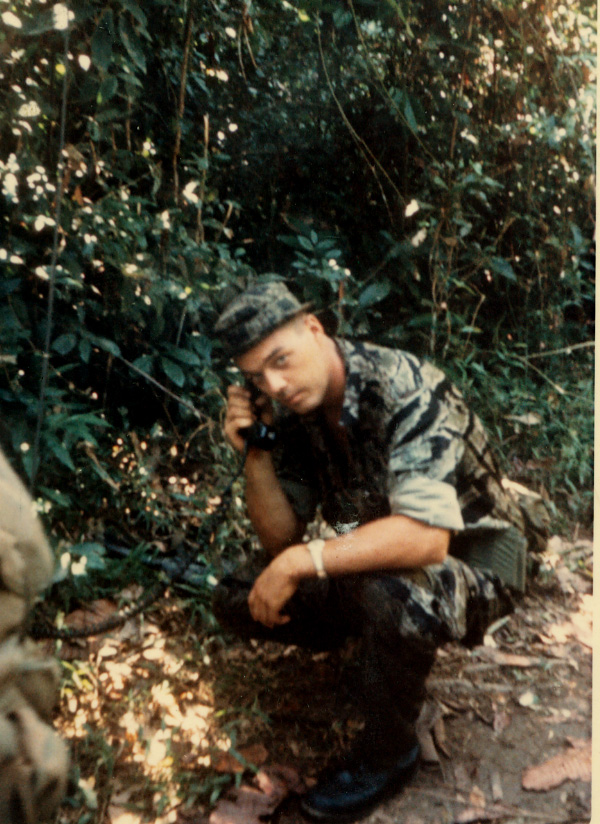
This is a book I started writing in in 1965 and made adjustments to up until recently as new information was uncovered. The company that published it is no longer in existence, and no hard copies are available. Attached in a fee down load PDF file. The picture below is of me on break during a patrol in late October 1967 to do a BDA after an Arc Light B 52 flight near the Cambodian border between Bu Dop A-341 and a sister SF camp Noc Ninh A-331 West of us.
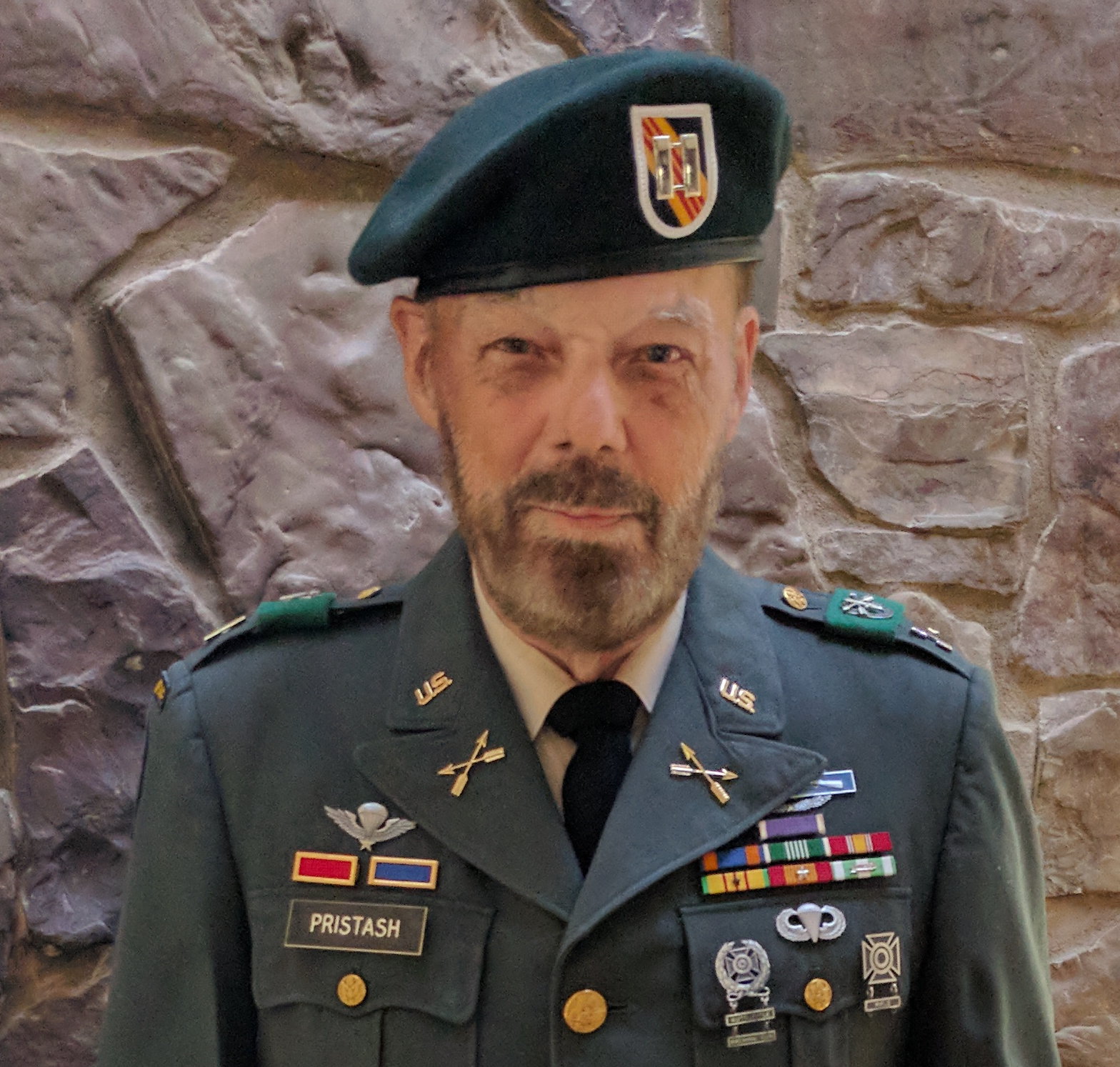
From an interview with Cleveland.com in January 20, 2019. A Former Green Beret officer talks about his service, and being serverly wounded in Vietnam.
Introductionto Vietnam
The Vietnam Conflict forced the United States Army to reevaluate much of what it had internalized throughout the first half of the 20th Century. The Army faced challenges in everything from adapting to the large scale use of helicopters in airmobile warfare to dealing with relentless and penetrating media coverage. The divisions at home, both within the American people and their government, added to the difficulties the Army faced in Vietnam. Perhaps the most trying element of Vietnam for the Army was the need to combat a guerrilla force that often operated on little more than rice and determination and was able to blend in with the populace with ease and speed. This was a far cry from the waves of North Korean and Chinese troops American soldiers were pitted against a decade earlier in Korea, or the conventional enemies faced in both world wars.
For the first time in anyone’s recent memory, the conventional U.S. Army was fighting for the allegiance of a people, not to destroy an army on a battlefield. The Army simply was not trained for this, and its leadership did not grasp how to succeed in this type of fight. Interestingly enough, for a small force in the Army, this was the mission. The Special Forces (SF) were designed to fight exactly this type of war, and they got the chance in Southeast Asia as the manpower behind the Civilian Irregular Defense Group (CIDG) program. From its fledgling stage under Central Intelligence Agency (CIA) control to its quick transfer to Military Assistance Command, Vietnam (MACV), to its final phase under South Vietnamese control, the program expanded and the mission gradually changed. Operation Switchback, the FULRO rebellions, and the introduction of conventional units in 1965 were three important aspects of the program’s history that effected the mission and dynamics of the program and the parties involved. Despite some significant drawbacks in the effectiveness of the program that resulted from its ever-changing nature, the U.S. Army Special Forces was extremely successful in conducting unconventional warfare by employing the Montagnard people to combat the guerrilla threat posed by the Viet Cong as part of the Civilian Irregular Defense Group program.
Background
The CIA, intent on pacifying the rural areas of Vietnam, especially those occupied by Montagnard tribesmen, decided to begin the CIDG experiment at Buon Enao, Dar Lac Province, in October of 1961. Using small SF teams, the mission in these early days was simply “to organize, train and develop Montagnard village defense forces and deploy them in village defense.”[1] The idea was that by doing so, the SF would earn the allegiance of the Montagnard people who would then use their training and arms to deny the region’s resources to the Viet Cong. There are many tribes of Montagnards, the French term for “mountain people;” these include the Rhade, Jarai, Bahnar, Koho, Mnong, and Stieng. The Rhade tribe, which primarily populated the area, was the first tribe to experience the program as they were the most technologically advanced and populous Montagnards in the Central Highlands.[2] Different from ethnic Vietnamese, Montagnards originally came from China, Laos, and Cambodia. They brought their own customs and practices, and over time a fierce animosity developed between the independence minded Montagnards and the Vietnamese population.
In order to understand the nature of this divide, one must first further understand the Montagnard people. At the time of the Vietnam War, they made up nearly the entire population of the Central Highlands. They practiced their own religions, spoke separate dialects, and were culturally a completely different entity than the ethnic Vietnamese. They were a people who survived by hunting wild animals and farming, even employing primitive techniques including slash-and-burn farming. Central to their religious philosophy is animism, not Buddhism or Catholicism. Because of their exclusion from Vietnamese society, they preserved their ancient ways and remained an object of derision for the Vietnamese.
The CIA realized that the Montagnards were rudderless in the conflict because of the animosity directed towards the Montagnards by Vietnamese from both North and South. Along with this recognition came opportunity for the Agency. Committed to carrying on their lives in peace rather than achieving any specific political ideology, the tribal people were unlikely to side with either Diem’s government or the communist forces.[3] However, they had very limited experience with the Americans at this point. The CIA realized that by providing the Montagnards with medical, financial, and material aid they would foster loyalty and hopefully gain the their allegiance. The Civilian Irregular Defense Group program was the result of these efforts to achieve the anti-communist goals of the Americans and South Vietnamese and to benefit the Montagnards themselves.
Scholars in search of a pristine example of how to conduct unconventional warfare need not look further than the CIDG program. Unconventional warfare is defined as
…a broad spectrum of military and paramilitary operations, predominantly conducted through, with, or by indigenous or surrogate forces organized, trained, equipped, supported, and directed in varying degrees by an external source. UW includes, but is not limited to, guerrilla warfare (GW), sabotage, subversion, intelligence activities, and unconventional assisted recovery (UAR).[4]
The CIDG program initially thrived as it effectively carried out its original unconventional warfare mission of training, organizing and equipping the Montagnards to defend their villages in a guerrilla war against the Viet Cong. Shortly after its creation, between 1962 and 1963, MACV gained control from the CIA, which in many ways changed the nature of the program. In terms of organization, the CIA, MACV, and in the end the government of South Vietnam (GVN), were responsible for oversight of the program. On the ground, the American SF were technically advisors to the South Vietnamese Special Forces, or Luc Luong Dac Biet (LLDB), who provided the officers for the Montagnard units—creating obvious problems given their hatred of each other. Other ethnic groups that would experience the program later included Chinese Nungs, Cao Dai, and Cambodians. Over the post-transformation years, the mission of CIDG camps evolved as well. As with any military operation, there were successes and failures.
The existence of LLDB teams within the CIDG camps created more problems than it was likely worth. Unfortunately, the GVN would never have allowed the camps to exist without their LLDB teams there. Successful conduct of unconventional warfare requires the loyalty of the indigenous force, in this case primarily the Montagnards. However, their allegiance was given to the Americans, not the LLDB in their camps. This worked to a point, but in the long run it created no Montagnard loyalty to the GVN.
The Montagnard loyalty to the Americans was not just the result of the aid and respect the Americans gave them. According to Dr. Gerald Hickey, many Montagnards believed the Americans were there to give them independence.[5] However, because the Special Forces of the CIDG program were technically advisers to the LLDB who commanded the camps (at least on paper), an interesting paradox existed. The South Vietnamese military was not immune from widespread corruption so characteristic of the Saigon government; many officers either bought their positions or received them via political appointment. The LLDB were the face of the GVN to the Montagnard people. To successfully show a better example than the Viet Cong, the Special Forces would have to present both themselves and the GVN as being free of corruption.
CSM (R) Reginald T. Manning of team A-323 explained one example of how the SF were creative in combating the Vietnamese corruption. CIDG strikers in his camp were paid by weapons serial numbers because they did not have any form of ID cards. Furthermore, there were far more weapons than people. One scheme the LLDB would pull was to force the CIDG to go through the pay line multiple times using different weapons. The CIDG troops would give each monthly allotment to one of their LLDB officers. After three or four trips through the line the LLDB would allow the CIDG to keep one of these payments, using the other payments to line their pockets.[6] To solve this problem, the Americans would hold a “command muster with assigned weapon formation” and then gather all extra weapons hidden around the camp before they could go through the pay line.[7] It was creativity like that shown by CSM Manning’s team that helped to undermine both LLDB corruption and thus VC intimidation. The Americans, in doing their best to stop corruption and show the Montagnards how a clean system worked, increased loyalty. Had the GVN troops not been corrupt, it is likely there would have been less cause for anyone to support the communist guerrillas. Unfortunately, loyalty to the Americans was not the ultimate goal. History shows that the war outlasted American involvement, and the failures of the GVN continued until its final capitulation in 1975.
The timing was right in the early days of the CIDG program. The National Liberation Front, or Viet Cong, had just united and received permission from Hanoi to begin extensive guerrilla operations. Thus, they were in the process of trying to exert a great deal of influence in the Montagnard areas. Elsewhere, the communist movement in South Vietnam was proving to be formidable and devoted to its cause. The Viet Cong controlled a great deal of what would become IV Corps, the southern Mekong Delta region that included the Seven Mountains region and the famed U Minh Forest.
Yet in many ways the Viet Cong failed to achieve true support of the people—by their own hand via the brutal practices they employed. Indeed, it was conventional North Vietnamese Army (NVA) forces that ultimately defeated South Vietnam, uniting North and South into one communist nation. The Allies knew that they needed to offer a better alternative than the VC offered in order to win in Vietnam. The CIDG program was one manifestation of this notion.
In order to win the war, the Allies needed to undermine, collapse, and replace guerrilla influence with government influence and control. This required eliminating Viet Cong bases of supply, manpower, and movement; what the CIDG forces were designed to do. However, the CIDG program could not completely stop the flow of men and materiel into South Vietnam, even if it could retain the loyalty of many Montagnard tribes. After the Tet Offensive of 1968, the Viet Cong had little strength left. The rest of the war was primarily fought by conventional forces from North Vietnam. Thus overall success in the war did not hinge solely upon CIDG success, although it certainly was an important and necessary part of the unconventional fight.
Many inaccuracies have been promulgated with regards to the history of the CIDG program. Generalizations made about the program’s strengths and weaknesses are often used to portray the CIDG effort as a whole. Interviews with veterans of the program indicate that no two camps were alike. The program was too widespread and diverse after the first year to paint in one way, as some historians attempt for simplicity’s sake.
Some scholars of Special Forces history have done an admirable job of chronicling the history of the CIDG program, as well as providing thorough analysis. Perhaps the most important book on the subject is COL (R) Francis J. Kelly’s U.S. Army Special Forces 1961-1971. It does a remarkable job of highlighting the history of the CIDG program and does not shy away from its failures as well as its strengths. In some other writings on the subject, the reader is left with a one-sided idea about the success and history of the program. The idea of this paper is to take what Kelly and others have done and synthesize it with the interviews and stories of veterans to provide a broad analysis of the CIDG program, with the primary focus being on the years between inception and Vietnamization.
1961-1963: The CIA’s Darling
The Special Forces went to Southeast Asia eight years before the first major deployment of conventional troops in 1965. They began advising South Vietnamese troops in 1957, and gradually their presence as advisers in the region was expanded with programs like Operation White Star in Laos until the major expansion that came with the CIDG program occurred. By 1961, the numbers were still extremely small, and they operated without many of the conveniences that would later save many lives, including extensive air, artillery, infantry, and logistical support.[8]
The CIDG program began in October 1961 when William Colby of the CIA and SF medic SFC Paul Campbell opened the dialogue with Rhade leaders at Buon Enao, Dar Lac Province. Offering them weapons and training for their support, the two sides discussed the proposition for two weeks before securing an agreement.[9] Half of team A-213 from C Company, 1st SF Group first arrived at Buon Enao during the week of 21 November 1961. The team members were 1LT Arritola, SFC Fisher, SFC Bowles, SGT Gabriel, SGT Shorten, and SFC England. Dave Nuttle was the CIA case officer who coordinated the early manifestations of the program.[10]
Things happened quickly after the two weeks of discussions, and the incoming team soon saw positive results. When A-213 arrived, the villagers had already begun building defenses such as a bamboo fence. The team spent the next month helping them strengthen such defenses, organizing them into a unit, and beginning training on weapons and how to conduct jungle warfare.[11] Things were going quite well at first, as indicated by the fact that in mid-December “the Buon Enao villagers, armed with crossbows and spears, publicly pledged that no Viet Cong would enter their village or receive assistance of any kind.”[12]
In late December, 1961, CPT Ronald A. Shackleton, commander of Detachment A-113 of the 1st Special Forces Group at Okinawa, arrived in Vietnam to replace 1LT Arritola’s team. Half of his team accompanied him: Team Sergeant John Slover, Sergeant Manfried Baier (medic), Charles Lindewald and John Clark (weapons), Al Warok (demolitions/engineer), and Lester Walkley and Bill Beltch (communications).[13] Arriving at the village of Buon Enao in Dar Lac province the next morning, the team quickly established rapport with the Rhade.
Shackleton soon raised a full-time “strike force” of paid soldiers gathered from local hamlets. The strike force was responsible for protecting Buon Enao from the Viet Cong by patrolling the area and serving as a local reaction force in the event that a village came under attack. They were better trained, more aggressive fighters than the average village defenders. While the Strike Force was being raised, the other villagers were armed, trained in village defense, organized, and given assistance with health care and agriculture.[14] The leaders of neighboring hamlets and villages were intrigued by the program that offered so many benefits, and soon approached the men of A-113 to help them as well. Thus, after the success of the program in Buon Enao, it expanded outward spreading the blanket of security as local Montagnard leaders’ interest grew.
The village defenders were trained to ward off small scale assaults with their limited small arms training, bolster defenses by emplacing punji stakes, emplace bunkers and early warnings systems, and finally to call for help on the radio they were given in the event an assault was more than they could handle. The team built trust by holding sick calls and performing other civic action projects geared towards improving daily Montagnard life. These were small steps intended simply to provide basic defensive and medical assistance in return for the Montagnards to resist Communist influence.
The CIA saw the success and decided to act in order to expand the program. By April of 1962 forty villages were actively participating.[15] The idea was working, the “oil spot of security was continuing to spread,” and the Viet Cong were losing ground as the Americans won Montagnard allegiance.[16] In May of 1962, a CIA status report detailed the progress of the program. In the Buon Enao village complex alone, forty-five hamlets were equipped and organized, 1,346 personnel were trained, 1,217 weapons issued, and 105 village medical assistants were trained by American Special Forces.[17]
These numbers indicate the rapid growth of the program in Dar Lac province. The Viet Cong took notice and decided to test some of the recently fortified villages. They attacked Buon Tong Sing and Buon Hra Ea Hning in force and were on the brink of victory when the Rhade defenders held and repelled the attacks.[18] However, it was not all victories and success stories. Just three months after Captain Shackleton began the project, the villages Buon Cu Bing and Buon Tong Dok fell to the VC without any resistance on 19 and 20 May.[19] Throughout 1962, as these examples show, the program’s expansion brought about increasing resistance from the Viet Cong. The fact that such remote lands were being exploited by the SF, LLDB, and Montagnards certainly distressed the communist guerillas.
The expansion camps from Buon Enao felt the increasing pressure, and struggled to meet it with the somewhat lackluster support they received. 1LT Carl Regan was the executive officer of team A-223, which built one of the first four expansion camps from Buon Enao, at the village of Buon Tah Mo. His description of the program in the early days provides a sense of how disorganized things could be under CIA control. When he showed up in Saigon, the CIA officer who briefed him simply slapped a map, placing his hand in the general area of Buon Enao, and told him to “go somewhere up in here.”[20] They started in July 1962 by finding the village of Buon Tah Mo, providing Montagnards with two weeks of training, helping them construct a fence, and giving them an AM radio. Between late August and early September, his team and the other eight teams in Dar Lac each decided to train a company of Strike Force Montagnards.[21]
Regan explained the manifestations of the aforementioned logistical difficulties his team faced during this period of expansion. Air America, the CIA’s covert air wing, periodically dropped the men ammunition, World War II weapons, piasters (Vietnamese currency), and occasionally some C rations. They were expected to use the money provided to buy the necessary medicine to run the dispensaries for the Montagnards and themselves, a difficult position when isolated in the Central Highlands of Vietnam in the early 1960s. The main drawback to CIA control of the CIDG program is evident here: poor logistical support. At times, the CIA wasn’t completely aware of a team’s exact location.[22] However, this was not necessarily a bad thing for the men serving on these A detachments. The high level of autonomy the CIA afforded allowed flexibility in the way they operated. This flexibility was vital to the Special Forces’ mission of unconventional, guerilla warfare, and it helped them thrive by fostering the necessary creativity that strict oversight might have prevented.
It was not long before the program grew to unexpected levels. The CIA requested sixteen more SF teams in short order and by the end of 1962 there were 38,000 irregulars from over two hundred villages in the program.[23] This rapid growth highlighted the program’s startling success. It was no longer a small scale experiment in a new method of counterinsurgency. In the summer of 1962, camps were built quite far from the original village of Buon Enao, moving close to the western borders of South Vietnam. The attention the CIDG program received as a result of its early success and expansion was not limited to the ranks of Special Forces or CIA personnel, and it would cause a transformation that some think degraded the operation.
Operation Switchback, FULRO, and Beyond
One widely accepted theory about this time in the CIDG program was that everything was defensive in nature. However, aggressive patrolling occurred to the extent that this seems somewhat inaccurate. Sergeant First Class Michael Di Rocco, at Van Canh from 1962-1963, even described this period as a time in which the Special Forces were on loan to the CIA to build a mercenary army.[24] SFC Di Rocco underscored the importance of the early CIDG program by stating that “If it had not been for the US Army Special Forces, the Saigon government would have lost the Central Highlands early on. The Viet Cong would have cut the country in half.”[25] Village defenders alone could not have achieved this. Leigh Wade explained that the defensive nature of the program of under the CIA led to a major drawback. Where the VC were stronger, a strictly defensive posture was “suicidal.”[26] In areas where the VC was better organized and equipped, the SF teams needed to take the strike forces on the offensive, because “the best defense is a good offense.”[27] Because of this, the SF and CIDG strike forces began to assume more aggressive postures as early as 1962.
Di Rocco also felt that logistics were poor under the CIA. Di Rocco’s team worked with the Bhanar and Chum tribes, which he described as “incredibly loyal and honest.”[28] In 1962, the Americans ate what the Montagnards ate, hunting wild boars and mixing everything with rice. This both underscores the lack of a good supply system under the CIA and serves as an example of how the SF showed respect for Montagnard culture and built comradeship. He concurred with Mr. Regan that the CIA had virtually no accountability of money or weapons, and would simply drop sandbags full of piasters and leave the teams to fend for themselves. The upside to this was that it helped build bridges of trust between the Montagnards and their American allies. By living the life of the Montagnards, participating in their rituals, sharing their hardships, and serving their interests, the Special Forces gained a great deal of loyalty from the mountain people, both by necessity and design.
At the same time that they were forming these bonds, enemy activity continued to increase in the area. The CIDG camps did not always have the resources or the conventional capabilities to take on the massing communist forces. The unwillingness of the regular South Vietnamese units to aid in taking the fight to the enemy partially caused what Di Rocco termed “a desperation move.”[29] This, the CIA’s desire to disengage from military action publicly after the Bay of Pigs disaster, [30] the massive growth of the CIDG program, and the need for better border surveillance and interdiction led to Operation Switchback.
Switchback precipitated many changes in the program. In June of 1962, in accordance with National Security Action Memorandum # 57, General W.B. Rosson instructed the Defense Department to transfer control of the program from the CIA to MACV in Operation Switchback over the course of one year.[31] Originally designed as a simple means for village defense, pacification, and civic action, as Wade noted, the program grew under MACV into a more conventional force dedicated to offensive operations including border surveillance and the interdiction of enemy lines of communication. What MACV failed to understand is that the huge amount of success the CIDG program enjoyed in the beginning stemmed from the fact that the Montagnards were allowed to carry on their normal lives in peace and safety, with only a few full-time strike force soldiers who were well compensated for their efforts. Thus MACV bred disaffection by using CIDG soldiers for conventional, offensive operations in places far from their home villages and hamlets. As mentioned earlier, however, the offensive posture some camps began to assume was also a result of the need for protection. This indicates that Switchback’s role in changing the mission and location of many camps seems partly a manifestation of the inevitable.
Many camps closer to the coast and the Central Highlands were closed or turned over to LLDB control. This was done so that the A detachments could build these border surveillance and interdiction camps closer to the Cambodian and Laotian borders.[32] Begun in the summer of 1962, this is considered one of the most serious problems the CIDG program developed. With the change in control and the key changes in the mission of CIDG troops and their Special Forces advisers, the program’s nature was no longer focused on village defense. One indication of how far the program was from its original intent was that some CIDG troops earned the moniker “VC hunters.”[33] While one would be hard-pressed to find anyone of the opinion that Switchback was not important, most veterans view the changes with mixed feelings: there were benefits as well as drawbacks.
Throughout 1963 the changes were implemented. Team A-726 experienced the downsides of Operation Switchback at Camp Nam Dong in 1964. Commanded by CPT Roger Donlon, with 1LT Julian M. Olejniczak serving as executive officer, the team’s mission was border surveillance, security, and civic action. For example, they built a road so the farmers could take goods from their fields to the nearest market with ease. At the camp were several hundred CIDG troops taken from all over the Central Highlands, the LLDB contingent, about forty Nungs of Chinese descent (mercenaries hired to provide added protection for some of the SF teams), and the A detachment.
Their experiences in early July 1964 illustrate one of the main problems that came about with Switchback: VC infiltration. Because his CIDG soldiers were from various locales, Mr. Olejniczak estimates that “one-third of our CIDG strike force soldiers were Viet Cong.”[34] There was a lack of loyalty to the specific area, making the Strike Force more susceptible to Viet Cong infiltration. Quality control was difficult with the rapid expansion. With the mix of CIDG troops, VC agents could work unnoticed in the camps. Before he restricted access to the inner compound where his A detachment and their ultra loyal Nungs lived and worked, CIDG laborers were often caught pacing the distances between the compound’s buildings in order to plot indirect fire coordinates for the enemy.[35] While the VC began infiltration of CIDG forces as early as 1962 at Plei Mrong, the changes Switchback brought about greatly increased each camps susceptibility to infiltration.[36]
Tensions had been building for several days, and sure enough shortly after midnight, in the early hours of 6 July, mortars began to fall on the inner-perimeter of Nam Dong. A full scale offensive by roughly nine hundred VC was underway.[37] In the middle of the battle, the Americans discovered their LLDB intelligence chief attempting to open the rear gate of the compound for the enemy. Many of the CIDG of Company 122 who were loyal to the Americans were silently killed by their turncoat comrades before the attack began. Such a high level of Communist infiltration was unmatched at the time. It was a preview of things to come, as Nam Dong was one of the first camps to be moved out to the border and be comprised of non-local forces. Evidence also suggests that this was one of the first times main force NVA troops did battle in South Vietnam, something that would only increase with time and “foreshadowed the fury of the struggle that would be known as the Vietnam War.”[38] For their efforts in holding the camp throughout the ferocious onslaught, A-726 became one of the most decorated United States Army units in history. CPT Donlon earned the Congressional Medal of Honor, SGTs Alamo and Huston were both awarded Distinguished Service Crosses posthumously, and the rest of the team earned either Silver or Bronze Stars with “V” devices.
In the years after Switchback, the number of camps increased and they were used as bases for offensive operations with more frequency. The events of the attack on Lang Vei illustrate a different drawback of Switchback than the attack on Nam Dong showed. Here, VC infiltration was not the main problem. Rather, the misuse of CIDG strikers and SF personnel that came about with the changed mission caused havoc. As one of the border surveillance camps, Lang Vei was located four miles west of Khe Sahn, just south of the demilitarized zone (DMZ) separating North and South Vietnam, and one mile from the Laotian border.[39] Hacked out of dense jungle in steep, mountainous terrain, Lang Vei was manned by twenty-four SF personnel and roughly four hundred Montagnards. In the early morning hours of 7 February, 1968, after a three days of signs of imminent attack, the edgy men of Lang Vei saw the first trip flares go off.[40] Over the course of the eighteen hour battle, the North Vietnamese Army (NVA) used armor for the first time, attacking with between forty and fifty armored personnel carriers and Soviet PT-76 amphibious tanks. Each tank had a 76mm main gun carrying forty rounds and one antiaircraft machine gun.[41] The NVA turned these assets point blank onto the Lang Vei’s defenses. At the end of the battle, the valiant American and Montagnard survivors barely escaped. Out of four hundred indigenous troops, two hundred were killed or missing and seventy-five were wounded. Of the twenty-four Americans, ten were killed or missing and eleven wounded. The camp lay in ruins, occupied by the NVA, and Khe Sahn was left extremely vulnerable.[42]
Lang Vei was not a good place for a CIDG camp. Isolated, the indigenous troops were not from the area and were unfamiliar with the terrain. By placing shaky troops commanded by only twenty-four Americans in such a vulnerable location, MACV demonstrated both its full confidence in the CIDG soldiers and its lack of understanding of how to effectively deploy the forces. Not only were they poorly supplied, their defenses were at eighty percent as they were still transitioning to their new camp.[43] Had MACV wanted to have a blocking force on the border, a battalion of Marines from nearby Khe Sahn would have likely proved more effective for the conventional role the CIDG were expected to play.
There was also, however, a major improvement to the effectiveness of the CIDG program after Switchback occurred. MACV was able to provide an abundance of supplies directly, whereas the CIA would simply airdrop bundles of Vietnamese currency. The weapons the CIA provided were older models, often foreign ones dating to World War II. With the logistical support of MACV behind the CIDG program, there was far more money, equipment, and manpower available. Carl Regan feels that, as a result of the increased availability of medicines, food, and other necessities, Operation Switchback was not as harmful as most believe. His opinion is that the Montagnard’s Front Unifie de Lutte des Race Opprimees (FULRO) uprisings in 1964 and 1965 were just as important to the evolution of the CIDG program as Operation Switchback.[44]
The first uprising began in September 1964 with three thousand Montagnard soldiers in the Special Forces camps of Buon Sar Pa, Bu Prang, Ban Don, Buon Mi Ga, and Buon Brieng. The Montagnards were revolting against the Special Forces’ Vietnamese counterparts, not specifically the Americans. FULRO’s basic demands included economic aid (directly to the Montagnards, not through the Vietnamese), military assistance, and representation in Saigon for all the Montagnard people by a single elected person.[45] They sought to circumvent the corruption that existed in the Vietnamese ranks, which often left the Montagnards with far less monthly pay than they were supposed to receive.
Dr. Gerald C. Hickey played an integral role in resolving the crisis. He went to Vietnam in 1956 to finish his Ph.D. in Anthropology, and ended up staying nearly through the entire war.[46] His vast experience gave him an understanding of American, Vietnamese, and Montagnard culture that was virtually unmatched. For this he was known and trusted as someone who could help negotiate when the FULRO rebellion broke out. On Sunday morning, 20 September 1964, General William Westmoreland, Ambassador Maxwell Taylor, and George Tanham of the RAND Corporation (for which Dr. Hickey worked at the time), asked Hickey to go to Ban Me Thout to help solve the problem arising in the Highlands.[47]
With FULRO flags flying over several Montagnard camps, many Vietnamese held hostage, and a far greater number dead, the Vietnamese leadership acted quickly by poising reaction forces to fire on the rebel controlled camps. Word leaked that some were blaming the Americans for arming the FULRO in the first place years earlier. All of this combined with the fact that for a short time American Special Forces were even held hostage made for an extremely tense situation.[48] On the night of 21 September, Hickey jotted some notes on how he would solve the issue. In a meeting with Vietnamese leaders on 24 September, Hickey showed the leaders his plan. It consisted of choosing negations with FULRO over violence, creating programs to meet the rebels’ needs, and calling a congress of Vietnamese and FULRO leaders in Pleiku. The proposal was accepted and then approved by the FULRO leadership. The rebels surrendered their arms, although up to two thousand FULRO rebels fled into nearby Cambodia.[49]
The rebellion would eventually change the atmosphere of the CIDG program considerably. At first, the resolution gave hope that eased the tensions between the CIDG strikers and their Vietnamese counterparts (albeit only slightly). Much was promised, and when not delivered there was another FULRO revolt in December 1965. It was over in one day, and slowly the new Saigon Government under Air Force General Ky (who took over from Kanh just before the second FULRO uprising) began to help the Montagnards. He established a Directorate-General for Development of Ethnic Minorities, gave FULRO representation in the national assembly, and began to negotiate with the FULRO exiles in Cambodia for their safe return.[50] Finally, and most important in terms of the CIDG program, Montagnards were now eligible to become company-level officers in CIDG units. Before, LLDB officers held all leadership within striker companies, an arrangement that did considerable damage to unit cohesion.
The first FULRO uprising was significant because it highlighted the unrest that existed between the Montagnards and the LLDB. The problems had clearly been ignored for too long. However, the second rebellion had a more lasting impact, as its more than token resolution “appeared to diminish Montagnard unrest.”[51] This could not have occurred at a better time, given the difficulties that the CIDG camps would face with the increasing influx of conventional American forces and emphasis on fighting in a more conventional, offensive manner.
The conventional American buildup that began in 1965 caused a continuation of that which began with Switchback. As more units arrived, the Special Forces could concentrate their efforts on border surveillance to a greater extant. Shelby Stanton explains what happened as a trade-off. The airmobile infantry forces and their artillery assets contributed greatly to the security of CIDG camps.[52] Also, the arrival of engineers, Seabees, and more construction equipment helped bolster camp defenses. In exchange for the much needed support, the CIDG forces spent more time on the borders gathering intelligence for main units and were able to patrol further then ever before.[53] As a result, the extent to which they played an offensive role increased greatly.
Although it was not what they were trained for, the skills of the SF personnel in training their CIDG forces allowed many successes in their offensive role. Commanded by CPT Ola Mize, who won the Congressional Medal of Honor in the Korean War, Detachment A-223 at Buon Ea Yang was tasked to help open Highway 21 to Ban Me Thout in March of 1966.[54] It was conducting convoy security operations, patrols, and construction security—hardly the original village defense role the CIDG programs were founded to play. On 18 March, a CIDG ambush patrol killed a Viet Cong company commander and found several valuable documents on his corpse directing four VC companies to establish a training base in the area. The SF planned an offensive operation, Le Hai 21, to attack the training base. At first, the VC were able to beat them back. With the aid of airstrikes and artillery, they kicked the VC out of their base camp by nightfall.
They found evidence at the camp of a VC battalion command post ten miles from the sight and they combined with CIDG companies A-234, A-236, and A-219 from nearby camps in preparation to attack. With the successful employment of surprise and firepower, the combined forces defeated an entire VC company. Again, capitalizing on intelligence gathered from the fights, Mize set up a company sized ambush on one of the roads near Camp Buon Ea Yang. On 30 March, the ambush decimated a VC battalion. It was a fierce firefight in which both sides showed immense discipline. In the end, American and CIDG firepower overwhelmed the counterattacking VC.[55]
CPT Ola Mize’s ability to act quickly and decisively on intelligence allowed him to demonstrate the effectiveness and adaptability of CIDG forces. Detachment A-223 was well supported with other reserves, close air support, and indirect fire. They demonstrated that they could successfully go on the offensive if resources were made available. The inherent problem with MACV’s absorption of the CIDG program was that all too often the teams and their indigenous counterparts were left out to dry and used to serve purposes far more suited to a line infantry company such as the fall of Lang Vei demonstrated. Their initial success rewarded them with missions demanding different skills than those of village defenders and small strike forces. To support this notion, John Nagl quoted General William DePuy as stating “‘[Army leadership] wanted to take anything that worked well with ten men…and expand it to ten thousand men right away,’” effectively “gutting” the CIDG’s capabilities.[56]
Nevertheless, the program continued to grow as it was needed to perform tasks that the conventional forces could not. The 5th SFG fielded 285 CIDG companies and eighty-two A detachments in over 100 places by 1967.[57] Furthermore, by this time there were twenty-eight border surveillance camps. This growth would continue until the Tet Offensive of 1968, which proved to be the beginning of the end of the SF CIDG program. Tet marked an important shift in the Vietnam Conflict; the guerrilla war was now a “full scale conventional contest,” leaving little room for the CIDG forces which “were neither designed nor rationally expected to prevent regular divisions from crossing the frontier.”[58]
The heavy toll the fighting had taken on the men of the Special Forces resulted in the need to begin Vietnamization of the CIDG program. In effect, many of the camps in the interior of South Vietnam were turned over to the LLDB after Tet. By 1969, there were only six border camps remaining under SF control: Ben Het, Bu Prang, Duc Co, Duc Lap, Dak Pek, and Dak Seang.[59] The last thirty-eight SF camps continued to struggle against the North Vietnamese infiltration until General Abrams, the MACV commander, ordered the CIDG program to close on 26 June 1970. For the rest of the year, the final Vietnamization took place and all remaining camps were converted to ARVN ranger battalions. The CIDG program was no more as of 31 December 1970.[60]
Conclusion
Unconventional warfare is a means to fight a guerrilla war by controlling and influencing the general populace. In the tribal areas, the Special Forces mostly retained influence and loyalty over the Montagnard people. In order to achieve American objectives, the United States military had to keep South Vietnam from falling to Communism. There were six major players in this conflict: the South Vietnamese government, the South Vietnamese people, the North Vietnamese, the Viet Cong, the Montagnards, and the Americans. The Americans were battling to defeat the Communist forces in South Vietnam, contain those in North Vietnam, keep the Montagnards and the South Vietnamese friendly enough to defeat their common enemy, and get the general population of South Vietnam on the side of the South Vietnamese government.
The CIDG program was, in its own right, a triumphant achievement for the U.S. Army Special Forces. The skill of the Special Forces at conducting unconventional warfare secured Montagnard loyalty to American aims, even though it meant living and fighting with South Vietnamese government troops. The lack of resources that forced the transfer of many camps to GVN control so that SF and strikers could monitor the border and conduct offensive missions reversed some of the progress made early on. Despite these setbacks, the CIDG program was effective before, during, and after Switchback.
The fact that the program met its own goals but failed to achieve the national objective is an important point for consideration when contemplating its success. The bravery and dedication of the CIDG, both American and Montagnard, merits credit. Captain Donlon spoke of success in battle in simple terms: “Going above and beyond all comes down to loving the guy next to you.”[61] The love and respect that prevailed between the Montagnards and their American advisers transcended the final defeat in the Vietnam Conflict. Both groups benefited from their association. For the first time, outsiders showed respect and admiration for Montagnard culture. Now, the lucky ones are relocating to the United States. Unfortunately, the persecution of those who remain in Vietnam today continues under the Communist government.
The Special Forces cemented its role in the army against a great deal of ill will during this period. They were able to adapt to the many different roles Army leadership expected them to play, no matter how unfeasible it often was. The sacrifices made by the SF in Vietnam were great. On those isolated plots of land in those remote regions of Vietnam, the program was a success—regardless of how backwards the methods and aims of any of the other players in the conflict were, and irrespective of the war’s final conclusion.
Works Cited:
5th Special Forces Group (Airborne), Extract from Enclosure 17, Section II of Operational
“U.S. Post Attacked by Tanks.” Washington Post. 07 February, 1968.
Waddell, Ricky. The Army and Peacetime Low Intensity Conflict¸1961-1963. Ann Arbor, MI:
UMI Dissertation Services, 1998.
Wade, Leigh. Tan Phu: Special Forces Team A-23 in Combat. New York: Ivy Books, 1997.
Westmoreland, GEN (R) William. A Soldier Reports. Garden City, NY: Doubleday &
Company, Inc., 1976.
Special thanks to the many members of the Special Forces Association who kindly volunteered to help me in this endeavor. This work would not have been possible without all of you.
[1] Billy Bowles, email to W.P. Grace, 01 May 2006.
[2] Shelby Stanton, Green Berets At War: U.S. Army Special Forces in Southeast Asia 1956-1975 (Novato, CA: Presidio Press, 1985), 41.
[3] Charles M. Simpson, Inside the Green Berets: The First Thirty Years (Novato, CA: Presidio Press, 1983), 98.
[4] United States Army Field Manual 3-05.201, Special Forces Unconventional Warfare Operations (Fort Bragg, NC: John F. Kennedy Special Warfare Center and School, 2003), 1-1.
[5] Dr. Gerald C. Hickey, telephone interview by author, 04 April 2006.
[6] CSM (R) Reginald T. Manning, email to author, 05 April 2006.
[7] CSM (R) Reginald T. Manning, email to author, 05 April 2006.
[8] Leigh Wade, Tan Phu: Special Forces Team A-23 in Combat (New York: Ivy Books, 1997), vi.
[9] COL (R) Francis J. Kelly, U.S. Army Special Forces 1961-1971 (Washington, D.C.: Department of the Army, 1973), 24-25.
[10] Carl Regan, telephone interview by author, 06 March 2006.
[11] Billy Bowles, email to W.P. Grace, 01 May 2006.
[14] LTC John A. Nagl, Counterinsurgency Lessons from Malaya and Vietnam: Learning to Eat Soup with a Knife (Westport, CT: Praeger Publishers, 2002), 128.
[28] Michael Di Rocco, telephone interview by author, on 08 March 2006.
[29] Michael Di Rocco, Fire Your FPLs (Rockledge, FL: Guttenberg Press Publications, 1990), 145.
[30] Dr. Gerald C. Hickey, telephone interview by author, 04 April 2006.
[31] U.S. Army Military History Institute, Outline History of the 5th SF Gp (Abn) Participation in the CIDG Program 1961-1970 (Carlisle Barracks, PA: USAMH) Accessed 07 December 2005; available from http://ehistory.osu.edu/vietnam/pdf/sfcidg.pdf; Stanton, 51 which stated that “whenever a secret paramilitary operation became so large and overt that the military contribution, in terms of manpower and equipment, exceeded the resources contributed by the CIA, the operation should be turned over to the Department of Defense.”; Andrew F. Krepinevich, Jr. The Army and Vietnam (Baltimore: Johns Hopkins University Press, 1986), 72.
[32] Michael Carey, interview by author, 04 February 2006.
[33] John A. Cash, Seven Firefights (Washington, D.C.: Center of Military History, 1984), ch. 2.
[34] Julian Olejniczak, interview by author, 07 March 2006.
[35] Julian Olejniczak, interview by author, 07 March 2006.
[55] 5th Special Forces Group (Airborne), Extract from Enclosure 17, Section II of Operational Report on Lessons Learned for period Ending 30 April 1966, Headquarters, 5th Special Forces Group (Airborne), (Washington, D.C.: 5th SFGA, 1966). Accessed 5 December, 2005, available from http://www.carrscompendiums.com/ccSEA/Documents/AD0391694/AD0391694_I17.html.
By Glen Greenwald posted originally on Rumble on June 16, 7:33 pm EDT
The Greatness of Daniel Ellsberg, From Heroic Vietnam War Whistleblower to Fearless Free Press Activist. Plus: Activists Force a Science Journal to Retract a Trans Study | SYSTEM UPDATE #101
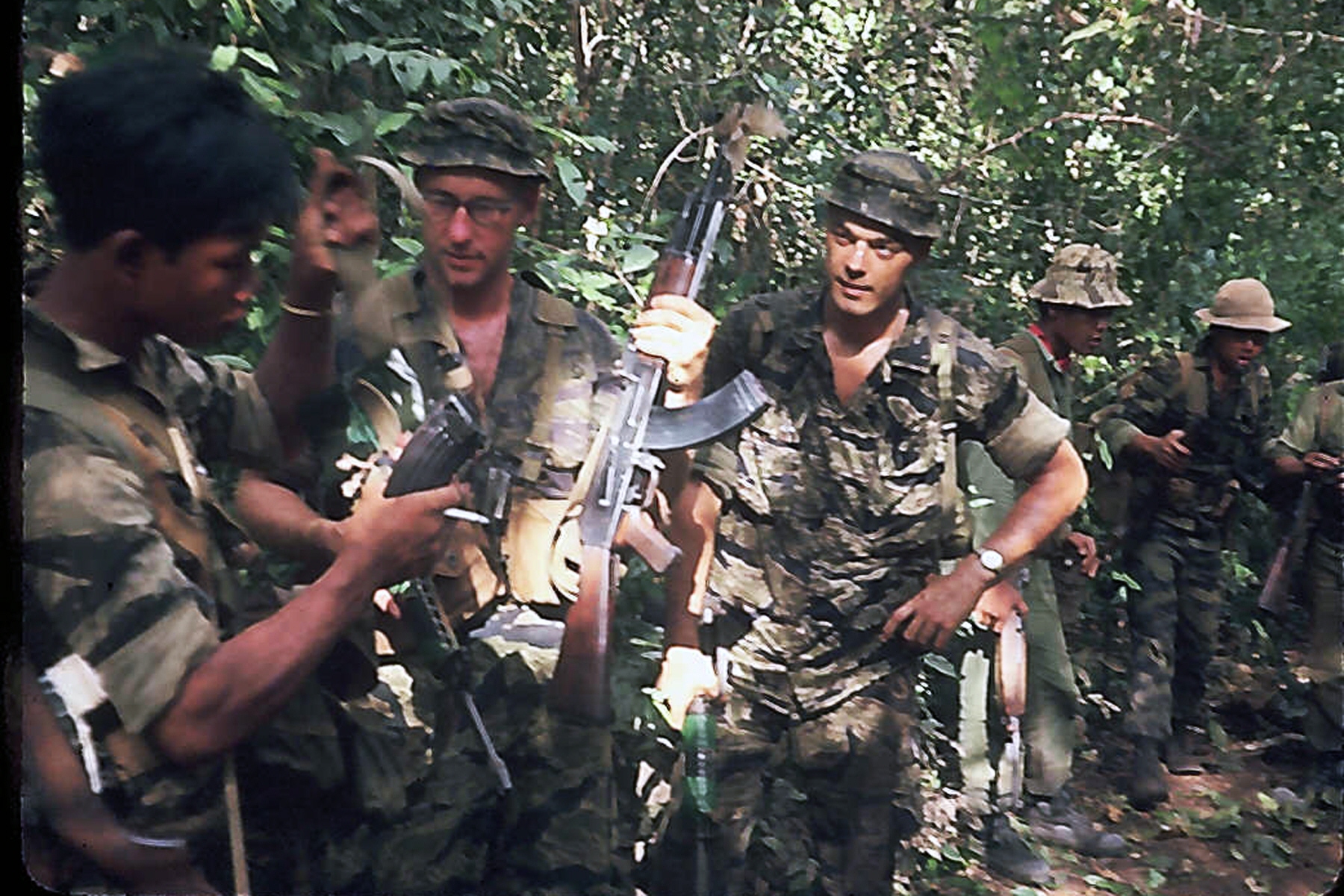
The following attached presentation was written to give to a local school a dozen years ago. It was meant to give a historical account of Indochina in general and the consequences of the Vietnam work in particular. This picture is me in the Jungle, Im the one on the right with my hand on my hip.
This is a book I started writing in in 1965 and made adjustments to up until recently as new information was uncovered. The company that published it is no longer in existence, and no hard copies are available. Attached in a fee down load PDF file. The picture below is of me on break during a patrol in late October 1967 to do a BDA after an Arc Light B 52 flight near the Cambodian border between Bu Dop A-341 and a sister SF camp Noc Ninh A-331 West of us.
I have created this site to help people have fun in the kitchen. I write about enjoying life both in and out of my kitchen. Life is short! Make the most of it and enjoy!
This is a library of News Events not reported by the Main Stream Media documenting & connecting the dots on How the Obama Marxist Liberal agenda is destroying America


 Centinel2012