The Suicide of Communism: The Case for Patience


One of the best write ups on this subject I have ever read!

Re-Post from Gary North’s Specific Answers – July 05, 2014

At the age of 72, I look back at my life, and I ask a question: “What was the most significant event of my lifetime?”

I go back and forth between two events, but in fact they were the same event. The first was the decision of Deng Xiaoping in 1979 to begin to remove economic controls over agriculture in China. That led to the greatest period of economic growth over the largest area in the history of man.

The second was the collapse of the Communist Party of the Soviet Union in late August 1991. This was followed by the decision of the Soviet government to shut down the Soviet Union in the final week of 1991. This was the largest empire in history geographically. The Russian component spanned 11 time zones. Through its satellite nations, it extended into Western Europe. It had been in operation for over 70 years. It had the most extensive system of control over thought and activities of any large society in the history of man. Yet, in one week, without any bloodshed, the leaders of the USSR simply abandoned it. Nothing like this had ever happened before.

Those of us who lived through it could barely appreciate the magnitude of it. That is because it was bloodless. There was almost no warning. The West had been involved in a great competition between the two systems from 1946 until 1991. Then, without warning, that competition ended. It caught Russians by surprise. It caught Westerners by surprise.

Communist China and Communist Russia were loosely connected by ideology. Each system was far more rigorous than anything in the West. The West was committed to a vague faith in democracy as a political system, but with all kinds of economic opinions and religious opinions tolerated or promoted. The Communists were very different. They had a consistent ideology. It involved a specific view of God, man, law, causation, and the future. There was no toleration of supernatural religion. There was no official toleration of capitalism, although the black market was always allowed to exist, because without the black market, both systems would have completely collapsed. There was a name for it in the USSR: “blat.” There was also a phrase: “Blat is higher than Stalin.” Yet for all of the centralization, for all of the tyranny, and for all of the interference with civil liberties, both systems ended. They did not end with a bang. They ended with a whimper.

There was no collapse. The Chinese economy began to boom almost immediately in 1980. The Russian economy did go through some withdrawal pains, and these lasted for about 10 years. But it has recovered remarkably. Today, Russia is the dashboard camcorder capital of the world. When we watch YouTube videos of spectacular car crashes, a large percentage of them took place in Russia.

MISES PREDICTED THIS

All of this was predictable in general. More to the point, all of it had been predicted. It was predicted in 1920 by Ludwig von Mises, in an essay: Economic Calculation in the Socialist Commonwealth. In 1922, he extended that essay into a comprehensive treatise, Socialism. Mises made it clear that it would not be possible for any socialist commonwealth to implement its theory of socialism. If any government attempted this, the economy would end in chaos and economic breakdown. Without capital markets, and without the private ownership of the means of production, it is not possible to find out what anything is worth or what anything costs. Without a price system, there is nothing but economic blindness.

The socialists did their best to ignore this essay for the next 70 years, but in the end, it was obvious: Mises was right. The socialist multimillionaire economist Robert Heilbroner finally admitted it in an article in The New Yorker in September 1990. He literally said it: “Mises was right.”

What we have here is a combination of general theory and events in history. From the standpoint of general economic theory, the breakdown of both the Soviet Union and Red China was inevitable. In the case of China, there was no collapse, because the economy was so poverty-stricken in 1979 that the reform instituted by Deng Xiaoping could not possibly have collapsed it. In the case of the Soviet Union, which was a far more advanced economy, and which had been copying Western prices for half a century, just as Mises said socialist planners would have to do, the transition was more painful economically. But it was a major recession, not a collapse.

In Ernest Hemmingway’s novel, The Sun Also Rises (1926), we read this:

“How did you go bankrupt?” Bill asked.”Two ways,” Mike said. “Gradually and then suddenly.”

That was what happened in the Soviet Union. It was bankrupt morally and spiritually from the October Revolution of 1917. But it took 74 years for the implications of that bankruptcy to play out.

STEP BY STEP

If I ever write a history of the decline and fall the Soviet Union, I will start with Georgy Malenkov, who replaced Stalin in 1953. He is the archetype, and he is virtually unknown in the West today. He held the reins of power briefly, but he was replaced by Khrushchev in early 1955. He disappeared. He was not killed. The Soviet leaders had learned their lesson under Stalin. They knew that their reign would not last forever, and they all wanted a life insurance policy. So, they let him live. He died in 1988. The weakening of central power began in 1955.

The next event was Khrushchev’s supposedly secret speech to the Soviet leadership, which he delivered in 1956. He attacked Stalin’s cult of personality. Everyone in the room knew that he had been Stalin’s henchman, a mass murderer in the Ukraine. That speech, when translated and distributed the West, led to the defections of Communist Party members all over the West.

A dozen years later, the Soviet invasion of Czechoslovakia led to another wave of defections in the West. But this did not seem to affect the stability of the Soviet Union. There was no sign of weakness.

In August 1978, after 33 days as Pope, Pope John Paul I died. In October, he was replaced by John Paul II. This completely unpredictable turn of events soon led to a confrontation in Poland between the existing Communist hierarchy and the moral authority possessed by John Paul II. He had come to adulthood under the Nazis, and then served as a priest under the Communists after 1945. He had been trained by an anti-Communist cardinal who understood the limits of power, and who understood how to beat the system. The Pope knew the weaknesses of the Communist Party in Poland. His visit in June of 1979 helped create the moral basis of Polish resistance, which escalated in 1980.

In 1979, the Soviet Union rolled tanks down the highway that the American government had paid for in 1966. The Soviets were trying to prop up a puppet ruler in Kabul, and they soon found themselves in the quagmire for the next decade. They could not get out and save face. But they could not win.

In 1980, a pair of events took place which undermined the legitimacy of Communism as nothing else had before. They were both associated with the Olympics. The Olympics were held in Moscow, which were boycotted by the United States in the name of upholding the independence of Afghanistan.

From around the world, Westerners came to see the sports events. They came with their suits, their watches, their fine shoes, and their confidence. Every Soviet leader saw them. Every Soviet leader knew at that time, beyond a shadow of a doubt, that they would never be able to equal the wealth of the West. For all their power, for all their special privileges, for all their access to special department stores where a few Western goods could be purchased, they realized that they were second-class citizens economically. The leadership never recovered.

In Poland, the peculiar event of the discovery in July of meat in cans labeled “fish” led to a series of strikes. The meat was about to be sent to Moscow for Westerners who were attending the Olympics. A strike took place in the railway yard where the meat was discovered, and within weeks, the Solidarity movement was founded. From that point on, Poland began to move out of the Soviet orbit.

In 1980, Ronald Reagan was elected. He was an anti-Communist. He seemed youthful. Shortly after his election, there was an assassination attempt, but he survived. From that point on, he was in control. He broke the PATCO strike. The Soviet leaders wanted to know whether he had the gumption to stand up to the union, and he did. He smashed it. Then there were the television broadcasts of Reagan at the ranch, riding horseback, putting up fences. These were not staged events. This was what he really liked to do. The aging bureaucrats in Moscow were reminded constantly that they were not long for this world.

Then came the deaths in short succession of Brezhnev (1982), Andropov (1984), and Chernenko (1985). Gorbachev came into power. He began to reform the economy by allowing more decentralization. He began to free up public discussions in the press. In other words, he allowed more free market activities, and he allowed more freedom of speech. Yet the economy was in ruins, and it kept getting worse.

Then there was the fearful anniversary: 1988. This was the 1000th anniversary of the founding the Russian Orthodox Church. It had not been stamped out.

By that time, Gorbachev was touring the Western governments, begging for financial support. He did not get it.

In 1989, the Soviet Union pulled out of Afghanistan. It was a visible testimony to the inability of the Soviet military to maintain control in a nation on its border.

In 1991, its client state Iraq lost to the United States. Its military hardware was simply no match for Western technology. Its planes were shot out of the sky before they even detected the presence of an American fighter jet. Its tanks were blown up in the desert. That was in February. By the last week of December, the Communist Party and the Soviet Union were no more.

These events could not have been predicted individually, but the overall development had been predicted by Mises in 1920. The West was able to avoid a military confrontation directly with the Soviet Union, and the clock continued to tick. The West did not perceive how accurate Mises had been. But the scenario played out just as he said it would. The socialist economies of Red China and the Soviet Union were unable to compete with the West. The classic statement of this was made by Richard Grenier, who described the Soviet Union in three words: “Bangladesh with missiles.”

PAUL SAMUELSON: USEFUL IDIOT

The premier university economist in the second half of the 20th century, Paul Samuelson, wrote in the 1989 edition of his best-selling textbook, Economics, that the Soviet Union was proof of the efficiency of central planning. Mark Skousen has traced Samuelson’s comments on the USSR in the various editions.

In very early editions, Samuelson expressed skepticism of socialist central planning: “Our mixed free enterprise system … with all its faults, has given the world a century of progress such as an actual socialized order–might find it impossible to equal” (1:604; 4:782). But with the fifth edition (1961), although expressing some skepticism statistics, he stated that economists “seem to agree that her recent growth rates have been considerably greater than ours as a percentage per year,” though less than West Germany, Japan, Italy and France. (5:829). The fifth through eleventh editions showed a graph indicating the gap between the United States and the USSR narrowing and possibly even disappearing (for example, 5:830). The twelfth edition replaced the graph with a table declaring that between 1928 and 1983, the Soviet Union had grown at a remarkable 4.9 percent annual growth rate, higher than did the United States, the United Kingdom, or even Germany and Japan (12:776). By the thirteenth edition (1989), Samuelson and Nordhaus declared, “the Soviet economy is proof that, contrary to what many skeptics had earlier believed, a socialist command economy can function and even thrive” (13:837).

Samuelson’s reputation did not suffer, but by 1989, he had proven himself to be a useful idiot — to use Lenin’s phrase. From 1961 on, he had been completely taken in by fake Soviet statistics. Naum Jasny had been warning for years that the statistics were bogus, but Samuelson ignored this warning. He was given a free pass by academia, which had assigned his textbook to hapless students ever since 1948. They had been taken in by him, beginning in the 1961 edition, as surely as he had been taken in by the USSR, and they chose not to admit it.

In 1968, my first book appeared: a book on Karl Marx and Communism. I keep the 1988 reprint online for free downloading: Marx’s Religion of Revolution. In an appendix on soviet economic planning, I cited Jasny’s insights. The Soviet Union achieved statistical expansion by suppressing its people on a scale never seen in modern history. It looted them. It was this ruthless suppression of rights and a massive confiscation of private property that allowed the USSR look as though it was growing. I could see that Jasny was right. I was just a grad student, but I could see it. Samuelson denied it until the whole experiment went belly-up over two decades later. Yet the academic world took Samuelson seriously. It still does.

The most respected economist in the second half of the twentieth century was utterly snookered by a bunch of Soviet statisticians who feared reassignment in Siberia for not goosing the statistics. The premier Keynesian economist could not see through this charade. Keynesian economics blinds bright men. They refused to believe Mises, 1920 to 1991, so they were forced to believe hack statisticians who feared for their lives. They never fessed up — Heilbroner excepted. In retrospect, they were a bunch of suckers with Ph.D. degrees — men who could not perceive reality. Hans Christian Anderson wrote a tale about them: the emperor’s new clothes. Mises was the kid who announced in 1920 that the emperor was naked. For the next 50 years, he was shunned by academia for his lack of etiquette.

The intellectual heirs of those who did the shunning are still in charge.

Be patient. They are the blind leading the blind into the ditch.

Try to avoid the ditch.

CONCLUSION

What are the lessons of all this? First, there is a science of economics. Mises understood this. His critics did not. His critics were legion. But his assessment in 1920, three years after the October Revolution, proved to be accurate in Red China and the USSR.

Second, the inevitable economic failures of socialist societies gave the West time. There was no nuclear conflagration. By holding to peace, the West won. But because the West never believed Mises, it lacked confidence in its task. There were men in high places who said the two systems would merge. The systems did not merge. One of them simply folded up shop and disappeared. The other adopted Western policies of central bank financing, mercantilism, and Keynesian bubble inflation. It is crony capitalism on a massive scale. Its bubbles will pop. Be patient.

Communism lost. The West gave it time. Time proved Mises correct.

Keynesianism has not yet lost. Give it time.

There need not be a social collapse or an economic collapse in order to make possible a transition to a non-Keynesian economy. It is possible for the system to go belly-up at the top, yet not bring down the social order. We have seen this twice since 1979.

The United States government will go bust at some point. It will default. It will break its promises. At that point, the voters will get a lesson in economics and civics.

It is our task to prepare the educational materials required to make the case for liberty when Washington’s checks bounce.
The Real Job’s Report for June 2014


How many jobs were created since 2007 not last month

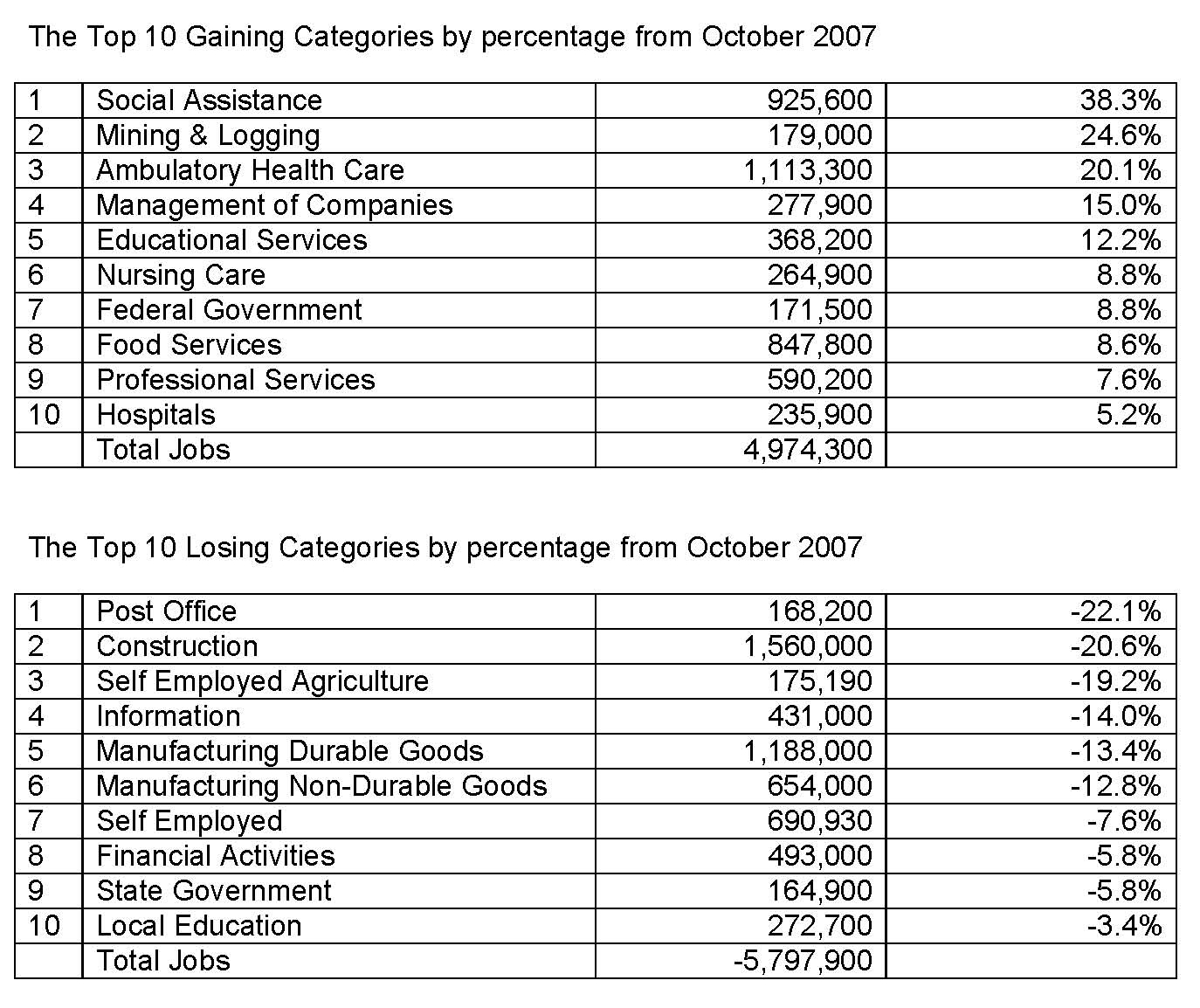
Based on the BLS July 3, 2014 Release USDL-14-1243 we have the following analysis using the numbers shown in Table B-1 and A-8. Then we use a DOD monthly report for Active duty military to add to the other two of 1.36 million soldiers. By doing this we get a more complete picture of those that are getting pay for some form of work and are therefore not on public assistance or retired. For reference that report claims that 288,000 jobs were created in June.

The first thing that came out when we look at what has happened since the high point of the previous growth period in October 2007 was that we are still short 394,630 jobs from then making this the slowest recovery on record. But there were categories of gains and categories of loss’s so what are they?

JOBS June 2014

The total gains and losses for all the other categories give a net gain of 428,990 which when combined with the two table’s leaves us with a net loss of jobs since October 2007 of -394,630. But we also see that close to half of the gaining categories are low paying jobs and that most all the losing categories were good paying jobs. It would therefore appear that not only are there fewer jobs but there has been a shift out of traditional middle class jobs to lower paying personal service jobs in food service nursing homes and the like. Without seeing the income distributions that is speculation but the categories speak for themselves.

The only real winners in the past 7 years appear to be the upper middle class and the upper class as those categories of government workers, financial advisers, legal and doctors have increased.

The end of the current Fed Sovereign Debt Bubble is in sight


Currency changes are now in place

Re-Post from Power Line from Steven Hayward — with my comments.

Further to yesterday’s note on “Behind the Levitation” about the Federal Reserve’s easy money policy, Ron Greiss of The Chart Store kindly sent along these four graphs that display the astronomical expansion of the Fed’s balance sheet in the aftermath of the crash of 2008.  These make for sober viewing indeed.  Hard to see how this ends well. Click on Charts to enlarge.

If the current move away from the US Dollar as the only reserve currency gains steam this bubble will explode even if the FED continues to tapper off; the damage has already been done and can’t be undone.


Fed 1 copy

Fed 2 copy

Fed 3 copyRon Greiss notes that correlation does not equal causation, but still:

Fed 4 copy


The Collapse of the US Economic System


NO JOBS

The Great Recession actually started in November 2007 as that was the month that jobs in the US started to decline from their peak in the previous month October. The collapse in the financial markets started 12 months later in October 2008 just prior to the presidential election. This analysis is intended to show what was in place at the peak October 2007 compared to today May 2014. In this analysis we will use only official government data; however it will be adjusted to reflect TOTAL Employment not just what the Bureau of Labor Statistics (BLS) shows each month with their employment status report. They don’t report the farmers, the self-employed and the military; although those numbers are available, so we just add them to the BLS numbers to get a truer picture of “all” the people earning a living.

All these numbers can be found on the BLS website the most current is USDL-14-0987

For the peak October 2007, the population of the country was 301,811,120 and the BLS showed in their Table B-1 that there were 138,361,400 working comprising 50.04% of the populations in the following three major Categories:

Goods Producing            22,266,000     7.38%
Services                         93,767,500    31.07%
Government                   22,327,900     7.40%
TOTAL BLS                     138,361,400   45.84%

Next we add in the jobs the BLS doesn’t count.

Self Employed                  9,060,900     3.00%
Agriculture                       2,218,100       .73%
Military                             1,418,200       .47%
TOTAL                             12,697,200      4.20%

GRAND TOTAL               151,058,600     50.04%

For May 2014 53 months since the end of the recession the population of the country was 318,138,408 and the BLS showed in their Table B-1 that there were 138,462,300 working comprising 47.22% of the populations in the following three major Categories:

Goods Producing            19,009,000      5.98%
Services                          97,583,900    30.67%
Government                   21,869,400      6.87%
TOTAL                           138,462,300     43.52%

Next we add in the jobs the BLS doesn’t count.

Self Employed                  8,375,000      2.63%
Agriculture                       2,011,000        .63%
Military                             1,400,900        .44%
TOTAL                             11,786,900       3.70%

GRAND TOTAL               150,249,200     47.22%

The difference between the two periods is, by the BLS numbers, that we now have 100,900 more jobs than October 2007 which is good; however if we add back in the agriculture, self-employed and the military we are still short 809,440 jobs. This means there are 809,440 fewer people without a paycheck today than in November 2007. Also note that there are more people in the government than in the goods producing sectors in 2007 and and a lot more in 2014, that just doesn’t seem right.

Making this situation significantly worse are two other factors; the first being that the population has grown by 16,327,288 so that means that there are 16,327,288 more people to be support by 800,000 fewer workers. The second being that since the highest paying jobs for the middle class, in the good producing sectors, are down 3,257,000 jobs from October 2007 and the self employed are down another 685,900 for a total of 3,942,900 fewer middle class jobs. Offsetting this is an increase of 4,043,800 jobs (100,900 jobs more) but they are mostly in the lower paying job categories like food services and temporary help

So the bottom line is fewer people working and those that are working are bring home less money. The shift of a large portion of the manufacturing sector to China and India over the past dozen years has decimated the American middle class and swelled the rolls of those dependent of the federal government for various forms of transfer payments from food stamps to disability payments.

NO ECONOMIC OR POLITICAL SYSTEM CAN SUSTAIN THIS TRANSFORMATION BEING IMPOSED ON THE CITIZENS FROM THE PROGRESSIVE POLITICAL WINGS OF BOTH MAJOR PARTIES. THINGS WILL EITHER CHANGE OR THE AMERICAN SYSTEM WILL COLLAPSE.


A Public System for Economic Development


How to create growth

Background

This was written in 2008. Until only a few decades ago economic development in the sense that it is viewed today did not exist. New developments happened by personal salesmanship and hard work. Everything changed after the federally funded “Manhattan project” showed what directed research could do. Then shortly thereafter when Silicon Valley was created in California as a result of mostly federally directed research for computational power for the military and space markets precedence was set. Now every city in the country would like to have a success like that in their town but how?

The focus over the past several decades has been on entrepreneurs and venture capital with emphases on the venture capital thinking that that was the key, to have seed, angel and traditional venture money available. That approach only partially works for the funds managers looking for a return, which they must, go where the perceived opportunities are which is not necessarily where the “local” community is. The local community is being defined here as where the fund is located.

But actually, if you think about it, the focus on money and trying to find the next hot deal is an exact backwards approach for a region or city. The key is not in making the venture money available for the money will come to the deals that are good. The key is creating a concentration of creative people and entrepreneurs.

The logic here is that no one knows what the next hot deal will be but the entrepreneur that has it. In fact, no one foresaw the benefit to any of the major development trends until after they happened. Further there is no way to know which entrepreneur will be successful and when they will first get an idea that’s good. Therefore for any locality, such as Cleveland, that wants to create growth the most cost efficient method to get real economic development would be to attract a large numbers of entrepreneurs. For if enough of them could be concentrated in a location their very numbers would almost guarantee a big hit at some point in time. This is a shotgun approach and when there is no hard target in sight a shotgun is better than a rifle.

To bring entrepreneurs to a location in the numbers required to guarantee a major hit would mean a number of thing are required and money is not one of them. Money is the most mobile of the requirements for success and will come to the ideas. What is needed is to focus on the innovation process and set up a process to facilitate all the steps. There areas can easily be identified and there are a place to live, a place to invent and a place to get help.

A place to live:

Create an economic empowerment zone by tearing down the worst ward in any inner city and build a village of middle class homes at say $150,000 each for the home. Say 500 to 1,000 homes so we would need maybe $250,000,000 for the project which can be done with bonds. These homes are loaned to anyone who submits a valid business idea to a review committee and they are allowed to live there free for 10 years. They get a reduction in the $150,000 home commitment that they make of $5,000 for every job created in the city. At the end of 10 years or sooner they get brought out. The home is then cleaned up and given to the next entrepreneur. There is a lot more to this but we’ll skip for brevity.

A place to invent:

Most inventors are hampered by a lack of resources. So the next step is to create a place they can go were all the tools for making and doing things exist. Let’s call it a craft center for lack of a better term. A place that has research facilities, a small machine shop a computer lab with appropriate software and all the other things that you might need to develop or build something. Ideally this craft center would be in the center of the entrepreneur’s village. That keeps travel time to a minimum which facilitates that innovation. Like in the previous discussion there is a lot that goes with this but those are only details. An educated guess would be $50,000,000 to build the center again well within the reach of local bonds.

A place to get help:

The third thing needed is knowledge and education; so how about a 2 year, a 4 year and a master’s degree in entrepreneurship for the curriculum in a special school or college within a university. In each case the requirement for graduation would be a business plan. What would be taught would be how to find markets how to manage and how to plan. A combination of a business and technology program so to speak. But since some of the areas where growth could be expected are very technical and science oriented some method of traditional education would be also be required. Combining an engineering degree with the entrepreneur’s school so all the non engineering courses required for a traditional engineering degree would be supplied by the entrepreneur’s courses.

Student loans could be given out with the entrepreneur either paying in cash, as normal, or given a credit of $5,000 for each job created. Again many details but we’ll skip those for now. Hard to estimate the costs but lets say a thousand students so it would probably be under $100,000,000 to put 1,000 students through 4 years. If those 1,000 students each created only 25 to 35 jobs, on average, that is 30,000 jobs per year after the first 4 years of the program.

Discussion:

Every location in the country, or the world for that matter would like to foster economic development within its geographic area of responsibility. Governments, States, Counties and Cities have all set up programs to try and find a way to promote economic growth, especially technology based growth with all kinds of “programs,” “grants” and “tax breaks.” Not many of these programs have worked as well as they were hoped to, and in my opinion there are several major reasons why promoting this kind of growth is very difficult. These are: one, true “New Ideas” typically don’t come from organizations they come from unknown inventors or entrepreneurs; two, these inventors (word used to mean both inventor and entrepreneur) normally don’t have “experience” or “money;” three, many of the traditional methods of help result in the inventors losing most of the value of what they came up with; four, because of politics with the use of “public money” most of these programs end up being very conservative; five, even with these programs there is no one source shop to go to.

Many, if not most, of the core issues for the inventor center on finding money for doing the designs, building prototypes and getting patent protection without losing their idea. Writing business plans and securing seed and/or start up money are also high on the list of needs as well. Getting through these hurtles is extremely hard for most inventors and many good ideas never get made because of this. So is there a way to help these inventors and promote technology based growth. I think there is.

At the State or better at the County level within a state a special kind of community could be established with public money that did the following.

A. Have a place to live for the entrepreneur and his/her family. This would consist of homes build for the city or county where they were located, preferably located near a major university. In the community would be created an environment that would facilitate inventing. That means as many of the daily needs of the community as possible would be located here. The logic being that you want the inventor to spend as little time as possible doing things that aren’t inventing.

B. In the center of this community would be a facility that would contain: a number of good computers and appropriate software (both business and technical), related support equipment like desks, phones, file cabinets, copiers and fax machines, a complete machine shop, a model making shop to include stereo lithography, and an electrical and electronics lab. This listing is only meant to show breath not every aspect. In essence this facility would have everything that an inventor would need to take his or her idea from concept to working model.

C. Have a small staff of support people such as technicians, attorneys, engineers, programmers, accountants, business people and machine operators knowledgeable in all aspects of making things. These people would be there for advice and could come from the nearby college and/or from retired business executives. Existing organizations like SCORE would fit in here perfectly. Obviously there would need to be some admin people as well to keep the place running.

D. Have the support of local business that had previously agreed to help or mentor those using the facility.

E. Have ongoing contacts with the seed and venture capital community and even hold investment conferences during the year where inventors could present their case or ideas to interested parties.

In other words this would be a comprehensive facility where and inventor could get access to design and make almost anything be it hardware or software in nature. And it would be a place that took no ownership in the idea its sole purpose would be to facilitate the inventor and give him or her a place to work.

To gain access to this facility an inventor would need to write up his/her idea and submit it to a review committee. The main purpose of the review would be to make sure the idea was within the scope of the facility to handle and that it had some economic potential if it could be produced. This would not have to be a formal presentation and its purpose would not be not to judge whether the idea would work or whether the inventor had the ability to make it. The secondary purpose would be to see if the inventor had the will to make things happen. Based on a positive review of the idea presented the inventor would be allowed to use the assets of the facility to design and build their idea. However this is not an open ended deal and part of the review would be to tell the inventor for how long they had the use of the facility. It is assumed some form of scheduling would be required and the facility should be open 24/7 to accommodate people that are holding jobs. They would have to do the work and the “state” would provide the tools to do so. The inventor would not be given any money only the means to design and build their idea. The technical and business staff would be there for guidance and support but not for doing the work. However if the inventor needed help in an area and wanted to pay for help it could be provided at minimal cost to them.

To an inventor buying all the equipment needed to build something would be cost prohibited and to try and find a range of local companies that would even do it for them would be very hard as most companies are looking for production work not one or a kind projects with unestablished companies or inventors where they may not get paid for what they did.

To the state buying all the equipment needed to establish a facility of this kind is not out of the question but finding new ideas are. Public employees are not risk takers and so most publicly funded programs end up being to make small improvements to existing ideas. The state here provides the expensive physical plant and since it is a conservative use of funds the public is not seeing their money being given away.

Since local and state money was part of the funds used to build the facility the inventor would agree to start their venture in the immediate locality if at all possible and within the state in any case. That is not too much to ask for the use of the facility and is really the only string attached.

Analysis:

Using Cleveland as an example since it has gone from the top to the bottom in less than 80 years we can see what works and what doesn’t work. Cleveland in the last half of the 19th century and the first part of the 20th century was a center of innovation. That innovation created growth. Cleveland in the ’00’s is for all practical purposes brain dead and is now ranked as the second poorest city in the country.

If nothing changes than nothing changes and in Cleveland if it doesn’t work the first second or third time just keep trying till it does. Sadly no matter how many times we study the problem and try it has never worked and so we are where we are. We’ve been trying the same formulas for several generations and so the people have figured out that the politicians and community leaders don’t have a clue so they voted with their feet, their gone. Even the PD figured that out in the editorials they have done over the past several years. Much good it did as no one is reading them but then maybe the flaw in the PD work is they assumed Clevelanders can actually read.

A solution that has worked well in other areas of the country, where similar but not as bad problems existed, was to combine all the affected communities into one large city. Again the PD has recommended that for Cleveland but I guess we would all rather disappear as a community rather than fix the problem. Too many politicians involved to actually make this possible. For think about it there would be a lot of mayors and council people out of a job if this was enacted. So since that will never happen here this entrepreneur’s village maybe something that could be done.

Recommendation:

The underlying logic here is to find a way to attract entrepreneurs here not the money as for the jobs it’s the people not the funds that is the key to turning Cleveland or any city around. So, using this White paper as background any of the local colleges could do an economic analysis of this idea to include pro forma economic projects of implementing these recommendations. The study would cost little and given the critical condition of the city what is there to loose?

Unintended Consequences


Politicians should never make technical decisions

It has been very popular for many intellectuals to adopt the view of Malthus that the planet’s resources are limited and that there are way to many people on the planet.  A good portion of the environmental movement is also based on these same views.  Unfortunately most of these “intellectuals” and “do gooders” are not knowledgeable in the science and engineering that relate to energy production and development. What we do know is that the generation and control of large amounts of cheap energy is critical to maintaining a high standard of living.  We also know that when the need for large families is eliminated that the people will have fewer children.

The solution therefore is to raise the standard of living which then results in fewer children being born.  How many people the planet will support is unknown for it depends on the technology we have and how much energy we can control.  If we assume that the politicians want the citizens to lead happy and productive lives (which is not certain) then we know the only way that can be done is through having cheap and abundant energy available.  This is the opposite of the current directions of those in positions of power mostly because they do not have the education, intelligence or the vision to see the real solutions.  Most of them operate on a zero sum game where it’s all about the distribution of the pie not the making the pie bigger.

What we do know is that if zealots are left unchecked and the environmentalists are zealots then they will destroy civilization.  For example, the banning of the incandescent light bulb in the United States starting with 100 watt incandescent lamps in January of 2012.  The replacement lamps for now appear to be mostly compact florescent lamps (CFL) which produce more light per watt of electricity. LED lamps are the same with slightly different numbers. This is being done for only one reason and that is to use less energy.  But is what is being said about less energy a true fact, well let’s find out.

A 100 watt incandescent lamp will produce when turned on 90 watts of heat and 10 watts of light. A 100 watt CFL replacement lamp will produce when turned on 50 watts of heat and 50 watts of light.  These numbers are not the actual numbers but they are reasonable estimates used for discussion purposes.  So we can say that for every five incandescent lamps we only need one CFL lamp.   So lets say we have 10 incandescent lamps and we replace them with 2 CFL’s that reduces the electric load from 1,000 watts (10 x 100) to 200 watts (2 X 100) and we save money.

Maybe, maybe not those 10 100 watt lamps that we replaced were helping to heat your home in the winter.  When they were replaced by the 2 100 watt CFL’s we removed 800 watts of heat which is where all the energy that the incandescent lamps used went.  They are hot to touch remember.  The difference between the two types 800 watts will need to be made up for by the furnace in the winter so depending on the rate one pays for power you could be spending more for the heating then you were saving from the electricity.

In general the addition cost of heating in the North could be higher then the savings if air conditioning is not used. And in some cases the higher cost of the lamps even with the offsetting longer life and with air could make this a bad investment.  In the south with little heating the CFL’s would save money especially with the reduced air conditioning load.  The point to this is that the savings will not be as advertised. And if it isn’t did it really make sense to shift 100% of lighting manufacturing to China along with all the jobs.

In Summary

National policy should be determined through independent private sector research and development, and outside the political system to include funding.

If Governmental is involved it should be used only to recommend general policy and never to actually provide any services.

Business should be responsible for all goods and services

Costs should be allocated as closely to the user as is practical

The American Dream


In danger of being eliminated

There is a current movement of social change that has been put into play by those politicians wishing to make changes that will give them more power.  There is no other way to say this for it is and has always been that those that rule are never happy with some power they always want more.  Machiavelli’s the Prince is probably the best book on that subject ever written. This need for absolute power is not related to left or right political views both of these artificial categorizations want the same things each for themselves and only with a different twist.  This has always been the case since recorded history begins and from that we can assume before that to the beginning of mans rain on earth.

This drive for power and wealth is a fundamental aspect of our very nature and it can result in both good and bad if not properly channeled.  The problem arises when we allow those with the desire for power to manipulate the education system and change the way our children are taught.  This is easy to do if the Citizens are not vigilant and we have been asleep for a half century now.

Political Correctness (PC), Multiculturalism, Class Warfare and the cradle to grave welfare state are  the tools that are being used and they have erased from our history the knowledge of all that allows us to be free, which is knowledge.  The promise that was instilled in the young was that with just a little more government and less private sector that all the people would be better off and have more.  We just need the government to make things fairer by asking those with more to share what they had with the rest of us.  What could possibly be wrong with that?

Much of what is being put in place in America now is being allowed because of the way the last two or three generation we taught. Few today much young than 50 would not be able to have even a basic discussion on limited government and big government and on central planning and free markets. This post is not and cannot be an economics text but never-the-less the basics must be understood if we are to discus government so based on the excellent book written my Mark Skousen The Big three in Economics Adam Smith, Karl Marx and John Maynard Keynes we will quickly introduce the reader to those three plus one others who has had a big impact on the way we view our world.

Skousen, a gifted writer, takes the reader through six phases of economic development starting with the man that started it all Adam Smith and ending with Milton Freidman (my interpretation of his work).  These six phases are the first six chapters in Skousen’s book:
One, Adam Smith declares an economic revolution in 1776
Two, From Smith to Marx: the rise and fall of Classical Economics
Three, Karl Marx leads a revolt against capitalism
Four, From Marx to Keynes: Scientific economics comes to age
Five, John Maynard Keynes: Capitalism faces its greatest challenge
Six, A turning point in twentieth century economics

The first period is the world’s first formal development of economics principles by Adam Smith where he declares that we will ALL be better off if we are free to produce and sell goods and services as we see fit. That competition in the market place will lower the prices and improve the products.  And that for this to work there must be honest transactions monitored by a fair and just legal system.  This can be boiled down to two principles being “natural liberty” and “laissez-faire.”

The second period is one where questions arise over Smith’s writings that result in the basic principles being questioned.  Smith did not develop equations and formulas his work was one of logical development based on empirical evidence.   Since this was the period of rapid industrialization in Europe and America there were dislocations that were occurring that appeared to disprove what Smith had developed in his work.

The third period was that of Karl Marx and his view that all production belonged to Labor and that land and capital should be placed in the collective for all to use.  Marx believed that the workers were being oppressed and that a new system would be developed based on the principles of Hegel’s Dialectic where a thesis caused an antithesis to develop and that lead to a synthesis (a new order).  Marx’s view was that his Communism was the new order.

The fourth period was where Smith’s views were proved correct by many others when mathematics resolved some of the problems that had developed in Smith’s principles which until now were verbal descriptions not mathematical formulations.  This period ended in the thirties with the great depression.

The Fifth period was dominated by Keynes and his theories of deficit spending, no or minimal private savings and government intervention in the market place.  Keynes developed his theories in response to the great depression that was causing much hardship in Europe and America except for Germany and Russia which had turned to a powerful central government albeit for different reasons.  This economic growth under a strong government gave credibility to Keynes views.

The Sixth period is that which we are now enduring.  Additional work especially by Milton Freidman shows that Keynes was not correct in his views — his work was distorted by the events of those times when he lived which lead him to make assumption that have now proved to be false.  Then there was the fall of the communist states and/or their embracing free market principles in portions of their economies has proved that Marx was wrong as well.  So with both Marx and Keynes both disproved Smith’s views of a free market and laissez-faire were now proved to be true once more.

Skousen’s book was published in 2007 before the housing bubble burst and we elected a very socialist President in 2008.  Those in Washington today believe in Keynes or at least in his big government e.g. like in China.  This view is false as over the past several decades congress has passed legislation here in the United States to the point that our market was free neither in its conduct nor in interference from the federal government.  We therefore find ourselves once again in a period where the politicians that have wrecked the economy are telling us that they need more power to fix the problems.  Since they are the very ones that created the problems this transference of power to them must be avoided at all costs.

Unfortunately, Economics is a complex subject and the politicians depend on that to keep the public misinformed.  Six books that go a long way to showing where the problems lie are now listed. But keep in mind that a full study of the issue would take much more then just these few books.

A Monetary History of the United States, 1867 – 1960 by Milton Friedman and Anna Jacobson Schwartz published in 1963. One section in the monumental book shows how the newly created FED caused the Great Depression.

Free to Choose, Milton & Rose Friedman first published in 1979. Milton and Rose Show how the welfare state cannot exist in the long run, indirectly it explains the collapse of the old Russian U.S.S.R. ten years after the book was published.

The Five Thousand Year Leap, by W. Cleon Skousen first published in 198, an excellent book on political philosophy written for those without a degree in this subject showing how things are not what we may think they are..

The Ruling Class, By Angelo M. Codevilla published in 2010, excellent contemporary book explaining the current push in American to set up a Ruling Class.

Reckless Endangerment by Gretchen Morgenson and Joshua Rosner published in 2011, Very well document analysis of the 2008 house bubble collapse and what caused it — and it was not the banks it was the US Congress aided and abetted by the FED.

Extortion, by Peter Schweizer published in 2013, an absolutely devastating description of the rampant corruption in the US Government.  The founding fathers are turning over in their graves right now and I would not be surprised to see them come back to get rid of the entire crop of obscenity that now resides in Washing DC.

There are a few other books that would help the argument but they get technically complicated and so the last two are enough I think.  The line of though developed here is that we started with a Constitutional Republic without universal suffrage and the purpose of that was to place “strong” limits on the federal government.  Those limits we needed because of the failing of human nature and that if they were not here a ruling class with arise and the republic would be gone.

This is done by legislation which gives us a large bureaucracy with has the power to write regulations, create rules, make fines for non compliance and set up permits for almost everything. All this is done for our benefit of course but every one of those things takes away a bit of our personal freedom and at some point, not far off now, the freedom is all gone.

Free Market or Central Planning?


No Justification for a Ruling Class

The justification for having or for creating a ‘ruling’ class be it secular (wealth) or an aristocracy (heredity), as it has been historically called is that this class of people are very intelligent (the best families) and well educated (only the best schools) so they should, by their very nature, be given the right to make the economic and political decisions for us.  They can do this because besides those qualifications they have the time and inclination since they come from wealthy families and have no need to work for pay like the rest of us do.  Aristotle, Socrates and Plato wrote about how to get these people the proper education and motivation so they would become good rulers; and much of political philosophy ever since has been devoted to this concept.  So we are lead to believe under these assumptions, proper education and motivation, that this group of people will do what is good for the country and the Citizens even if it is not in their best interest.  This is what is really believed, believe it or not.

That last part, in particular, is a bit much to believe as everyone always does what is in their own best interest but for now we’ll ignore that part and go to the heart of the argument which is that its their intelligence and education that make them so qualified to legislate and run the country.  Because we have the Constitution and there is technically no ruling class they, those that lust for power, are handicapped and they will try to establish themselves here by other means. Those are though legislation and regulations that will be enacted to control business to prevent those businesses from doing things that would not be good for the Citizens.  On the surface this sounds reasonable however the reality is that is will give them the control of those businesses and allow those in power to accumulate wealth as written about in Peter Schweizer’s 2013 book Extortion..

Implicit in this argument, that the government needs to protect the citizens, is the principle that the Citizens, being of lesser intelligence and not as well educated, do not know what is good for them. For example recent legislation in California that bans ‘Happy Meals’ because the parents are not smart enough to know that their kids can’t actually live only on ‘Happy Meals.’

Well let’s look at this and see if it makes any sense that a select group of people could run the country better then the Citizens could.  There are 435 Representatives in the House of Representatives and there are 100 Senators in the Senate for a total of 535 elected representatives.  Then we have the President and the Vice President and his appointed Cabinet of advisors numbering 15 for a total of 17.  Lastly we have the 9 U.S. Supreme Court justices.  Granted that these are not all elected positions but they can logically be said to be the ‘head’ of the Federal Government and the group that sets the policy of the country.  This group totals 561 people. We could add the Obama administration appointed Czars and their staff’s here if we knew who they all were, but we don’t so we’ll skip them in this analysis.

Now each in that group has a core around them let’s say a couple of dozen key staffers so 561 times 24 equals 13,464 people that are the ones running the country, could be a bit more could be a bit less but it’s a reasonable guess.  It is this group of super intelligent and well educated people that we are told should be running the country.  Today under this administration this group is comprised of mostly by progressives and they believe they will be able to make all the decisions for us and thereby we will all be better off.  For reference we will say this group of leaders has an average IQ of 150.

Now there does seem to be some logic here for we do want the best and the brightest right, but is the logic valid?

The country today, that this group of 13,464 is to manage, is in round numbers almost 320,000,000 citizens. But some of those are children and some are retired and in nursing homes so their economic activity is limited.  Let’s say that 68% of the population is economically active so that gives us ~217,000,000 citizens and they will have by definition an average IQ of 100.

Now we have the basis for the rulers and the number of subjects to be ruled. Let’s make this into a computer problem of solving an economic problem.  We can define that problem as how fast can we analyze a block of data, in this case the GDP of the country which is just under $16.0 trillion dollars (2009 dollars) today, 2013. We can then say that we need to process 16.0 trillion bits of information to give us a result.  But let’s break it down into a more reasonable number by dividing it by the number of days in a year, 365.25 days; to give us how much must be processed each day. And that would be $43.8 Billion bits of information per day that represent everything we do each day (actually the number is much greater but will use this for sake of discussion).

So now we have our problem which can be thought of as analyzing a distributed network of multiple computers and how fast can they solve a problem.

So we take our elite group of 13,464 top government officials and say they are 13,464 CPU’s running at 150 Hz (150 times a second) Then we take our 217,000,000 Citizens and say they are 217 million CPU’s running at 100 Hz (100 times a second).  The question is can the 13,464 CPU’s at 150 Hz process 43,800,000,000 bits of data faster then 217,000,000 CPU’s running at 100 Hz.  But let’s be fair and say that this elite group because of their education is faster by a factor of two.

That then gives us the government on the one end with the ability to process 43,800,000,000 data points divided by 4,039,200 (13,464 times 2 times 150 = 4,039,200) which is 10,844 seconds or 3.0 hours. Not bad!

On the other end we have the Citizens with the ability to process 43,800,000,000 data points divided by 21,700,000,000 (217,000,000 times 1 times 100 = 21,700,000,000) which is only 2.0 seconds which is 5,364 times faster and therefore is significantly better the first group.

Clearly the Citizens are significantly faster and therefore better at processing economics data.  Further the Citizens at their level are the ones directly involved in the transactions unlike the government which is removed from the actual transactions by several orders of magnitude.  That means that there are significant time delays and processing errors that can not be avoided so the government is working with “faulty” information and working on a solution to a problem that existed sometime in the “past.”  There is no way for this not to be true.

The planners find that the result of the previous plan was not what they expected so they make an adjustment in the new plan to correct, in the future, for something that was thought to have happened in the past.

To know why something didn’t happen as planed when there are hundreds of millions of transaction is not easy, actually it’s impossible.  For example lets say thin the master plan there was one place that called for 25,000 items X (they are small) to be made and shipped from location A to location B.  When the plan was implemented the truck on the way from A to B had an accident and they were all lost.  The planer sees months later that the output of B was not what was planned so he increases the quantity of X from 25,000 to 50,000 in the next cycle to make up for the loss.  This time they all get there but the plan for B still only calls for a need of 25,000 X and so they just put the difference in stock.  In engineering terms this is a positive feedback where the result of the action is that things get progressive worse.

In a free market system the market place gives both positive and negative feedback. The positive feed back increases the output and gets the planer a raise. The negative feedback allows the planer to find out what is really wrong and fix it or he loses his job when the firm closes down.

 In the United States over the past 20 years there was feedback on job loss going on in the economy as production left the country for China and India. The problem was the high cost of doing business here and it was not all labor. Washington elected officials ignored that and continued to pass laws that were not beneficial to business which resulted in positive feedback and the process accelerated.  The politicians did nothing because of all the money that was coming in to buy T-Bills which then gave them more play money to feed the Citizens that were loosing their jobs.

Back to the example, the planer keeps having A make 50,000 of X to get 25,000 of product at B until B is so full of X that they start giving away or throwing them out, absurd you say that would never happen.  Well this simple example combined with the lack of motivation of the workers in the old U.S.S.R. is exactly what led to their collapse. Further, since in collective systems all jobs are political jobs, there is no incentive to work efficiently.  Therefore there is a misallocation of resources inherent in this systems (meaning it can’t be removed) that makes these economies very un-competitive.   The only thing that kept the U.S.S.R. going as long at as it did was the motivation of a few of their motivated Citizens that worked hard because they knew it was right (to work).

It is clearly impossible for Central Planning run by a Ruling Class (which is what this is all about) to work better then a free market system with de centralized planning.  Further central planning will always make things worse not better since everything is a plan done by legislation and in most cases no one even knows what the plan is.  An actual case can be shown that some of us a bit older may remember.  In 1972 David Halberstam published a book titled The Best and The Brightest which was an account of how we got into the Vietnam War. Halberstam blamed it on the intellectuals and academics (The Best and the Brightest) in the Kennedy administration and after the assassination of Kennedy by the Johnson administration which kept them on. The book is a very interesting read and anyone who has read it would be horrified that anyone would think the government could do anything right.

de Tocqueville in his writing thought that it might be possible for an American Aristocracy or ruling class to form out of the formation of large businesses.   His thinking was that the owners of the businesses would be like the old land owners and they tenant farmers.  In this case the business owners would own the means of production instead of the land and the workers would have no place to go except to the factories to work.  Just like the tenant farmers that couldn’t leave, where were they going to go except to a different land owner?

de Tocqueville was not the only one to see this as Karl Marx certainly had this view and he wrote his Communist Manifesto only 8 years after Tocqueville finished his Volume II of Democracy in America.  It would be hard to believe that Marx’s did not read Tocqueville’s work since they were both in Paris from 1843 to 1845.


Currency Manipulation


The FED, IMF, China and the Wold Bank 

Going along with the Comparative Disadvantage theory that I have previously posted here we also have currency manipulation going on to help support that deceit.  The main player, and the one with the most to gain, in this game, is China; however they would not be able to play this game if it weren’t for the social welfare policies that America and Europe have been following since the end of WW II.  As the war was coming to an end the Allies held a conference in Benton Woods New Hampshire to establish the monetary system that would be used in the world after the war had ended.  By this time, July 1944, the Allies knew the end was near for the Axis powers and that there would need to be a way to manage the rebuilding.

The United States as the driving economic and military force for the allies and as the one country that was still intact was the only one capable of supplying the currency for rebuilding. The currency would be the U.S. dollar backed by gold. The chief features of the Bretton Woods system were an obligation for each country to adopt a monetary policy that maintained the exchange rate by tying its currency to the U.S. dollar and the ability of the International Monetary Fund (IMF) to bridge temporary imbalances of payments between the members.

From then on the dollar was therefore the Reserve Currency of world commerce and virtually all goods traded internationally were priced in dollars.  Then on August 15, 1971 President Nixon took the United States off the gold standard because of complications between the gold standard and the United States being the reserve currency and at that point the Dollar’s value was solely a determinant of the United States government.

Although that system worked reasonably well for a while there was a hole in the system that was used first by the Japanese and then more currently the Chinese.  For various technical reasons there was a way to manipulate the exchange rate between currencies to give a country a trade advantage with the United States.  Japan being a small country was only able to use this method for a short time and it was mostly played out by the late ‘80s.  However that manipulation was what allowed several Japanese companies to become the dominant players’ in a number of the world’s consumer markets.

The Chinese after Mao was gone and the U.S.S.R. (Russia) fell realized that since central planning didn’t work they were going to have to do something or the U.S.S.R.’s fait would soon be theirs.  I think they saw how the Japanese conducted their trade with the United States and they set up a similar system to be used by them.  This system, in time, allowed them to run up a huge trade deficient with the United States as described in the previous section.  Also in that section we saw how our politicians allowed that to get out of hand creating the situation we are now in.

The United States was not alone in the imbalances of government spending Europe was also a player only in a different manner.  Europe banded together forming the European Union (EU) in November 1993 probably has a result of the breakup of the USSR in December 1991 thereby eliminating them as a security military threat.  The Europeans thought that by forming this Union they could become an economic power house.  However that was not to be as they twenty years later.

Between 1995 and January 1999 the majority of the countries in the EU adopted the Euro as their official currency.  Why this was done I don’t know since every economist knows that you can’t have one currency and multiple fiscal policies being conducted by the member states.  Could the 50 American states each have their own state national bank that could set internal, to the United States, policies — well the answer is no the Dollar could not stand that for long and the Euro didn’t either.

Some countries like Greece went on a spending binge but they were not alone Spain, Portugal, Ireland to name just a few all conducted themselves recklessly and ended up forcing their internal banks to buy sovereign debt from them as well as other member states.  The monies generated were given to the various citizens groups such as the Unions and various social welfare benefits programs.  By the mid 00’s many of these former impendent countries had run up sovereign debt well in excess of their Gross National Product (GDP).

After the financial collapse in the fall of 2008 and the weak recovery in the next few years the problem with the EU debt became worse mainly, but not limited to, Greece as they got closer and closer to default.  Various austerity programs were tried but as of this writing no real solution has yet been found. Worse the Greek citizens’ not liking the austerity have begun to strike and riot in protest.  The EU is trying desperately to solve the Greek problem but since the Greeks are only the worst of the lot the EU governors may not be able to succeed.  The past reckless spending on social programs is exacting to great a cost.

Foolishly we elected many naive politicians in United States over the past 20 years and they embarked on a program to transform the American system into the European system, because we were told that our system was broken.  However the fact is that the European system is not working as advertised; or they would not be having all the problems that they have. This is of no consequence to these intellectuals’ politicians and they are going full steam ahead with their program for internal changes here.  The result of these new programs has been massive deficit spending averaging about $1.6 trillion per year for the last 40 months and by the end of the government FY, September 20, 2012, total federal deficit for the full 4 years will probably top $6.4 trillion.  We are averaging about $133.3 billion per month of deficit.

So we have both the Europeans and the Americans spending on give away programs like there is no tomorrow, and there probably isn’t, and the Chinese not liking this situation have embarked on a plan to take over the world financial system as a result.  This brings us to the description of what is going on now — under the table so to speak and this is the reason that the financial markets have been so erratic of late. Even though many in the financial markets do not see the big picture they do sense the undercurrent of instability and that causes the markets to move first one way and then another as rumors and facts point first one way and then another.

The result of what was just described is that there are three currency wars being waged as you read this. The European Union (EU) is fighting to prevent Greece from bringing down the EU (the latest deal is not enough). The second battle is being waged by the Federal Reserve (FED) in America to prevent a second recession.  The third is the war the Chinese are waging against both the EU and America over western devalued currencies. The signs can be seen in the movements in the commodities, stock, and the gold markets e.g. gold moving in the same direction as the Dow Jones Industrials (DJI) when they normally move opposite of each other.

The players in the game are the FED, the International Monetary Fund (IMF), the Bank of England (BOE), the European Central Bank (ECB), the Peoples Bank of China (PBC) and The Chinese State Administration of Foreign Exchange (SAFE).  Of course the political leaders in these countries are the puppet masters for these agencies. This list can be put into two groups the Western Countries, the WC, (America, England and the EU) and China.  The WC with their excessive entitlements spending and resulting debt needs to inflate their currencies to prevent collapse. China holds much of the WC debt and doesn’t want that. They seem to be in the driver’s seat but the vehicle is speeding down the road and the bridge just around the bend is out.

The Chinese think that they have found a way out of their dilemma; by manipulating their currency using the PBC and SAFE as their tools to achieve their goals. It works like this, when a Chinese company receives payment from the U.S. for goods supplied to a company there the dollar denominated payment goes first to the PBC and then from their it’s turned over to SAFE so SAFE ends up with the dollars. But the PBC gives the company that sold the material payment in Yuan in lieu of the dollars that were sent to them. However the Chinese not wanting to lose control make this a conversion at a fixed exchange rate set by the PBC.  The Chinese company gets paid and yet the Chinese government still has the dollars so in effect every dollar payment coming into China is doubled there; the company gets paid and the government holds the real money which it invests in the world outside China.

The wild card in this plan is that China does not allow many foreign made goods into their country because they need to create lots of jobs.  At least they have the creating jobs part right. So they buy things like gold mines, and other minerals and energy related mines and resources and — sovereign debt.  This is an economic system from the past but well discuss that later.

It’s now estimated that SAFE holds $3.2 trillion in foreign currency (almost half of that in U.S. Treasuries) and as previously stated China is worried about the WC countries resorting to inflation; as in the FED QE programs and the ECU write down of Greek debt. So they have gone, under the table, on a gold buying spree.  China probably has 2,000 tons of Gold now and is expected to take that to 5,000 tons in the next few years. Their plan is to make the Yuan a gold backed reserve currency. Unfortunately for both them and us the Chinese leadership being Marxist don’t understand the free markets and their real knowledge of world finance is limited and so this plan of theirs will backfire on them.

This currency battle can’t be hidden much longer. The trigger that brings this problem into the light could be a Greek full or partial default, a 2nd U.S. slowdown or recession, or the recent FED announcement that they plan to inflate the dollar by 33% over the next 20 years (2% a year).  Or it could be something else; the reason doesn’t really matter what matters are what actions, on the world stage, will be taken. If we aren’t prepared and make the right choices the results will likely be counter productive and those results will be very, very bad.

The problem we now have is that if the U.S. dollar fails the Chinese Yuan can’t replace it for two fundamental reasons. The first reason is that in any monetary system based on gold, A Gold Standard, the gold “must” be free to move between countries. The second reason is that in economics there is something called the Triffin dilemma which states that the country with the reserve currency, the U.S. right now, has to be a net importer of goods and services. By importing goods we supply dollars into the world market and this is how the world economy works. In essence we are exporting dollars and importing goods.

China will not let gold out of the country
China is a major exporter of goods

Therefore the Yuan can’t replace the dollar and the system that China is putting in is the very system that was in place in the eighteenth century prior to Adam Smiths Wealth of Nations being written — it was called the mercantile system.  This system tries to make all transaction favorable to one country and to horde gold at all costs.  Spain in its quest for gold created sever internal inflation that eventually destroyed their empire.  Smith proved conclusively with inductive logic that the mercantile system hurt trade and everyone was worse off and that it was one of the reasons that there were so many wars.

The pedal is to the medal, the bridge is out and it’s almost in sight.

Why Big Government Can’t Work


Friedman’s Spending Matrix

The very famous Nobel Laurite economist Milton Friedman explains a key aspect of social behavior in his 1980 book Free to Choose (Friedman’s wife, Rose, is a coauthor).  Friedman’s book should be mandatory reading in all our high schools and is a very highly recommend read for anyone with an interest in politics and economics.  Friedman’s writing style make this book an easy read. In Chapter 4 on page 116 of Free to Choose, Friedman presents a matrix which sums up the economic decision-making process, and this is critical to the understanding of the behavior of people with regards to how they spend and who they spend on.  The following is my interpretation of Milton’s economic matrix:

Friedman’s Spending Matrix

A

B

1

You use your money to buy something for yourself

You use your money to buy something for someone else

2

Someone else uses their money to buy something for you

Someone else uses your money to buy something for someone else

This simple matrix is really quite easy to understand.  The two columns labeled “A” and “B” and the two rows labeled “1” and “2” result in four possible situations:  A1, A2, B1, and B2.  These four possibilities are described in the next few paragraphs.

A1 In this situation, someone earns money, assigns a value to that effort, and then spends the money on something for him/herself.   The personally “assigned value” is used to make decisions about how the money earned will be spent.  The amount earned will determine one’s priorities and motivation for distribution of it e.g. the spending.  Maslow’s “hierarchy of needs” directly applies to these decisions — If one earns only a small amount, the money will be spent on the necessities of life; if one earns more, one can indulge in some “frivolous” spending. The bottom line is, however, that the person who earned the money will spend it to maximize his/her personal satisfaction (consciously or unconsciously in the best way he/she knows.  Only the person who actually performed the work to earn the money can place a “true” value on it that is proportional to the effort that went into earning it.  Further the “value” will be different for every person. This situation is the only one that optimizes the individual’s spending. The optimization of the individual’s transactions when summarized in the market place maximizes the economic transactions of the society. The maximization of monetary transaction in an economy must be steered into this category if the economy is expected to be viable.

B1 In this situation, someone uses the money that they have earned to buy something for someone else.  A good example of this kind of spending is the simple birthday present.  What you buy for the other person, however, may not be what he/she would have bought had they spent that amount of money on himself/herself.  In many, if not most all, situations, an individual simply cannot spend money for another individual to the highest satisfaction of that recipient.   Even husbands and wives or parents and children do not achieve total success in this arena (imagine how much worse people of less familiarity must fare!).  This situation does not optimize the individual’s spending. However, the spender does allocate their money used in accordance with the value they placed on it. We all known how many times a person return gifts to a store after getting them, so time and money was spent by the giver to get the gift and time and money was spend by the receiver retuning it. So by definition this process can not be as efficient as that of A1. The best method for giving gifts would be to give cash or a gift card.

A2   In this situation, someone else uses the money he/she has earned to buy something for you.   This, of course, is simply the reverse of B1.  We have probably all experienced receiving a gift that we did not use or like, no matter how much we may have appreciated the effort made by the giver. The old expression “it’s the thought that counts” probably comes from this very situation.  This situation, like B1, tends to be economically inefficient, and does not optimize the individual’s spending.  (By all this Friedman does not mean to imply, however, that one should stop giving gifts there are other factors besides economics to consider!) Since B1 and A2 are just the flip side of each other they could be combined.

B2   In this situation, someone else uses the money you have earned to buy something for someone else.  This is the problem situation, because there is absolutely no motivation to optimize spending.   This scenario is epitomized by government actions and spending no matter what the form of the government:  The government taxes you (you have no choice but to pay), and subsequently uses that money to buy something, or provide a service for, somebody else.  This process can never be accomplished efficiently, since neither the spender (the government bureaucrat) nor the recipient care about the “value” of the money spent.  It should be understood that it is the very process itself, and not the individual government employees, that causes the problem. There is no way to make government (of any kind) an efficient method of providing goods and services since the “value” link is completely broken. This is why Social Welfare, Communism and Redistribution of Wealth do not and cannot work in practice, no matter how hard one tries to make any of these policies work. But there is more as a layer of bureaucrats are required to handle the taxes and the distribution of the money; this process provides no economic benefit and so as these programs go the economy become less and less efficient. .

One of the objects of Friedman’s work was to show why the welfare start could not work for long in any society.   Both Marx and Keynes tried to justify large transfers to those at the bottom from those at the top.  Forgetting the wanting to do good issue by now after trying to do this so many times and always having it work out badly one would think that we would realize that Friedman was right.  His B2 situation shows the fundamental issue with the process that makes it impossible to work.  And Adam Smith in his book the Wealth of Nations comes to the same conclusions from a different perspective. Government by its very nature and purpose is not suited for legislating social believer and for sure never every actually running anything.

By contrast, private industry must provide services or goods on which individuals are willing to place personal value and spend money on.  Private industry must entice the buyer with “Value” to make the sale (positive feedback).  Firms or organizations that don’t provide real “Value” do not last long, for when their sales slow down they must immediately find and correct the problems (negative feedback) or they will either lose market share or go out of business.  This is true for both large and small companies there are no exceptions.

For example, Sears which was the premier consumer retailer for decades stopped providing “Value” to its customers and was dethroned by Wal-Mart who found a more efficient way to supply goods to the consumer.   The too big to fail belief of this current administration is not valid.  Bailing out companies of any kind or size only make the situation worse for it mitigates the consequences of making bad decisions.

The Friedman matrix thus proves that it is virtually impossible for any government no matter how formed to efficiently manage an economy.  Moreover, this logic is borne out by history, which has witnessed the absolute failure of all attempts at central planning or collectivism.   The collapse of the U.S.S.R. (Russia) in the late 80’s and early 90’s was a result of the inability of the Russian “Central Planners” to make good economic decisions and their economy collapsed as a black market developed that was by some accounts becoming the real economy of Russia. We should keep this in mind as the progressive politicians are right now duplicating the very system that brought the Russians down.  What these Politian’s’ don’t understand is that there is no way to make Central Planning work unless you have an absolute static economy with no innovation and growth, a hydraulic society as existed thousands of years ago especially in China and India. These were systems with strong Central Planning and static or unchanging social systems i.e. things were the same today as they were 10 years ago or 100 years ago or a 1000 years ago.

Only market-based systems can efficiently allocate resources.

Although it may be argued that social goals must sometimes take precedence over economic efficiency, Friedman disagrees with this statement explaining in his book that there are other ways to achieve social goals. Friedman did suggest that if the government had to do something that the best system would be a negative income tax that only gradually disappeared as income rose so there would be no disincentive to work and earn more, which is the core problem with most all social welfare programs as exist today.