War & Cycles


Posted originally on Jun 16, 2025 by Martin Armstrong 

MA War Cycle 2011 WEC

COMMENT: Mr. Armstrong, I attended your 2011 conference in Philadelphia. I was dragged there by a friend. You mentioned the war cycle resurfacing in 2014, and I didn’t believe it. I have read your criticism of Ukraine, and now Israel has not been trying to get Trump to attack Iran. You are correct, Zelensky is trying to get NATO to strike Russia first, claiming they are planning to invade the Baltic using a military drill in Belarus. Between the Neocons, Zelensky, and now Israel, all trying to get the US into war, any doubt I had about your models was ill-founded. You have paid with years of your life trying to help society. As is often said, no good deed goes unpunished.

friedman milton and rose

You have demonstrated that there is a cycle to everything. I was told you are not married because you never found your companion, like Milton Friedman, whom you envied, is what I heard. Perhaps you will one day find that person who understands and appreciates your calling in life.

Thank you for your courage and endurance.

WP

friedman Milton rose 2

ANSWER: Thank you for the cartoon of Milton and Rose. Milton had a very special relationship with Rose, who, by the way, was born in Ukraine when it was the Russian Empire before the USSR. They met in school and had the same interests – economics. I seriously doubt I would ever find such a person; it’s getting too late in life anyway.

2025_06_15_11_23_25_Zelenskyy_Russia_is_preparing_something_in_Belarus_under_guise_of_military_dril

I believe that Zelensky is such a piece of shit, he is beyond description. He is a traitor to Ukraine for he was pretending to be Christian and was a NeoNazi. He became Jewish ONLY after he became president to hide the fact that he was a NeoNazi.

Ukraine genoice jew nazi

The New York Times even published this piece about Ukrainian Nazis how they killed here a Jewish mother holding the hand of her child. They killed her, but threw the child in the grave because they did not waste bullets on children. They cut the babies out of pregnant women and sewed a live cat into the womb. What the Ukrainians were doing even horrified the German Nazis. the CIA protected the Ukrainian Nazis only because they hated Russians as well. That is where we are today with the press cheering every blow against Russia and refusing to look at the facts.

The Ukrainisn NeoNazi’s hated anyone who was NOT Ukrainian. They carried out genocide against Poles, Hungarians, and Russians as well as Jews. Like George Soros who pretend to be Christian to also hide from the Nazis, Zelensky was the same.

Here is Zelensky before becoming president, joking about confiscating the assets of Jews and Russians. He became a Jew only to hide his past.

Bidens Neocons

Biden’s Neocons were all Ukrainian Jews claiming that their families were persecuted by Russians. So all three supported Ukrainian NeoNazis all because they hated Russins.  Garland brought all sorts of charges against Trump, trying to prevent him from taking office because he was anti-war.

This ethnic hatred produced World War I when a Serbian assassinated the heir to the throne of Austria. This hatred will bring us into World War III. The hatred is surfacing everywhere. I do not see a way out – sorry.
The Economic Confidence Model & the Hidden Order Behind the Chaos


Posted originally on Jun 3, 2025 by Martin Armstrong |  


COMMENT: Marty, I have been with you since 1987. I have watched your Economic Confidence Model blow everyone out of the water, and your critics are just idiots who are either genuinely just stupid or they are paid by the “club” to try to prevent people from listening to you. Anyone who criticizes you is not trustworthy. The world should take notice of what you discovered. I saw your ECM predict the 1987 crash to the day. The Japanese Crash. The 1998 July 20th high in the markets. The 2002 low. There are so many events on the exact day that there can be no dispute that this is not your opinion, yet people try to ignore you, and others hate you. Now, May 15th was the exact day for the peach talks, and June 2nd was Russia’s Pearl Harbor. Everyone should send letters demanding that you get the Nobel Peace Prize for humanity’s sake.

L

ECM GIF Turning Points

REPLY: I understand what you are saying. Yes, I can see that a Nobel Prize might help focus attention on the reality of cycles. However, the Economic Confidence Model is something I bumped into, and I had assumed it would be an average. Never in my wildest imagination did I ever expect that such a model would work precisely to the day for countless geopolitical events, like 911, to the very day, and the same exact frequency picks the events here in May to June 2025.

I just do not know. Do I deserve a Nobel Prize for something I myself cannot entirely explain that exists when all the conventional thinking says that it can’t be? I am working diligently on my next book, the Economic Confidence Model. Perhaps then let the world judge. How many coincidences does it take to prove there is a hidden order lurking behind the appearance of random chaos?

The Theory of UNCERTAINTY


Posted originally on May 26, 2025 by Martin Armstrong 

Knight Frank

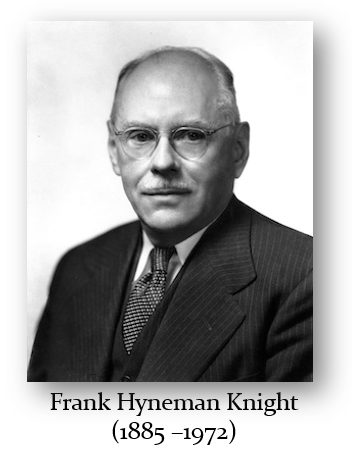
QUESTION: What is your view of Frank Knight’s view of risk versus uncertainty?

HL

ANSWER: Frank Knight, an influential economist and founder of the Chicago School from which Milton Friedman emerged. He is known for his work on risk and uncertainty, and he articulated a key distinction between the two concepts in his 1921 book “Risk, Uncertainty, and Profit”. The widely cited quote is:

“Uncertainty must be taken in a sense radically distinct from the familiar notion of Risk, from which it has never been properly separated. The term ‘risk,’ as loosely used in everyday speech and in economic discussion, really covers two things which, functionally at least, in their causal relations to the phenomena of economic organization, are categorically different.”

Knight argued that risk refers to situations where outcomes are unknown but probabilities can be calculated (e.g., gambling or insurance), making it measurable and manageable. On the other hand, uncertainty describes scenarios where probabilities cannot be determined due to a lack of historical data or predictable patterns (e.g., unprecedented market shifts). This distinction underpins his theory of profit, where entrepreneurs bear uncertainty (not mere risk) as a source of potential economic reward.

Uncertainty

This framework remains foundational in economics and decision-making theory, emphasizing the role of unquantifiable unknowns in shaping entrepreneurial behavior and market dynamics. I, being a trader rather than an academic, however, disagree insofar as nothing is truly UNCERTAIN. The problem with classical economists is that they have not explored ancient history, assuming the data is inconsistent or nonexistent. Then this view is compounded by the idea that the economy is random, and we can manage it, which was first presented by Karl Marx.

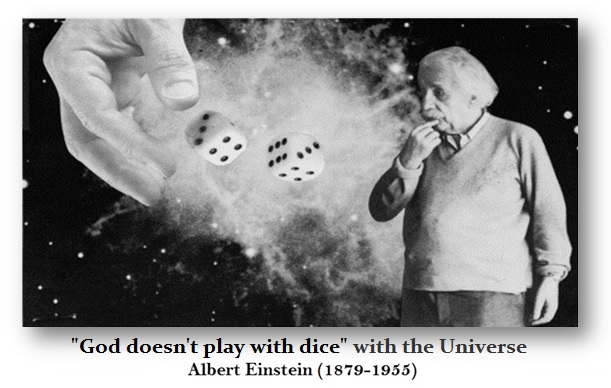
Einsteing dice

I have said many times that when I was in school, in economics class, they said it was random, and this government can smooth out the booms and busts under Keynesian Economics to prevent another Great Depression. Then I went to Physics class and was told that NOTHING is random. I concluded that someone was lying, and it was the economists. They refused to investigate the business cycle and presumed they could manage it.

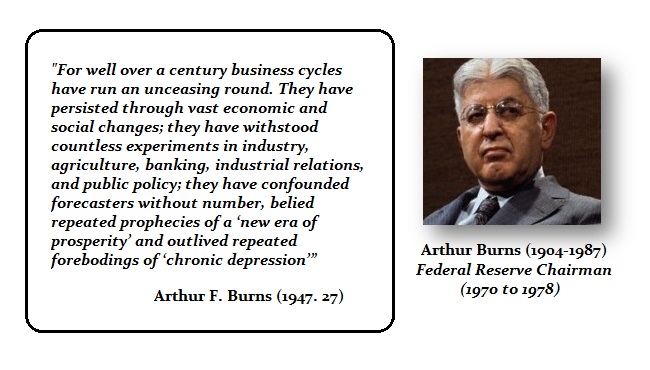
Burns Arthur

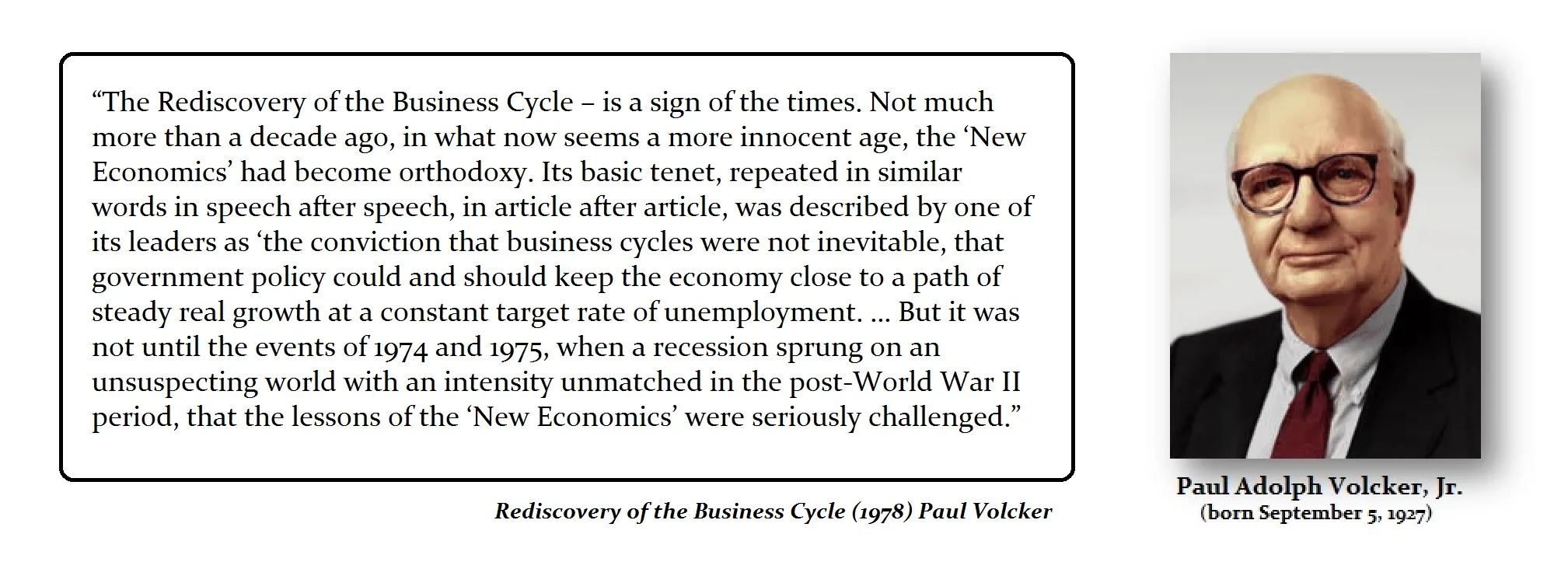
Anyone who had actual experience disagreed with the classic economists. Arthur Burns was the Fed Chairman when Bretton Woods broke. He concluded that the business cycle existed and always won. Then there was Paul Volcker, the next Fed Chairman. Paul also came to the same conclusion that the business cycle existed despite the classic economic theories.

Volcker Rediscovery

I had a conversation with Paul Vocker, who told me my Economic Confidence Model was correct and agreed that the business cycle was about 8 years. This flies in the face of classical economists.

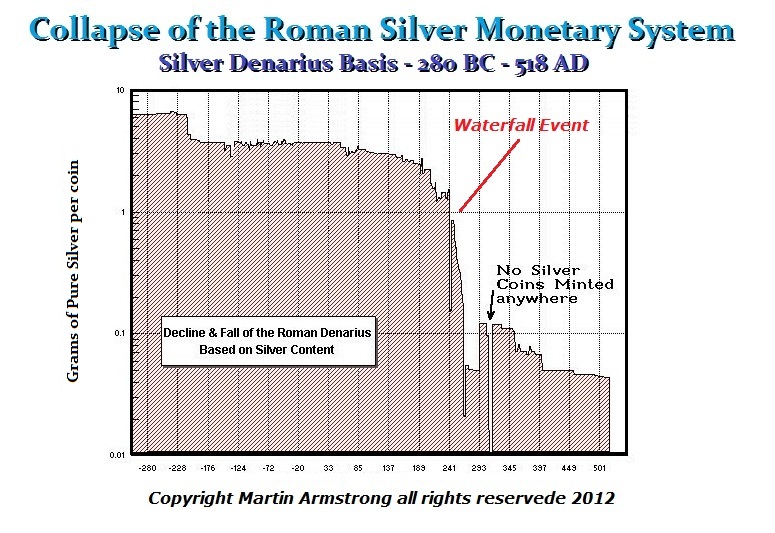
Roman decline silver content monetary system Armstrong Waterfall effect
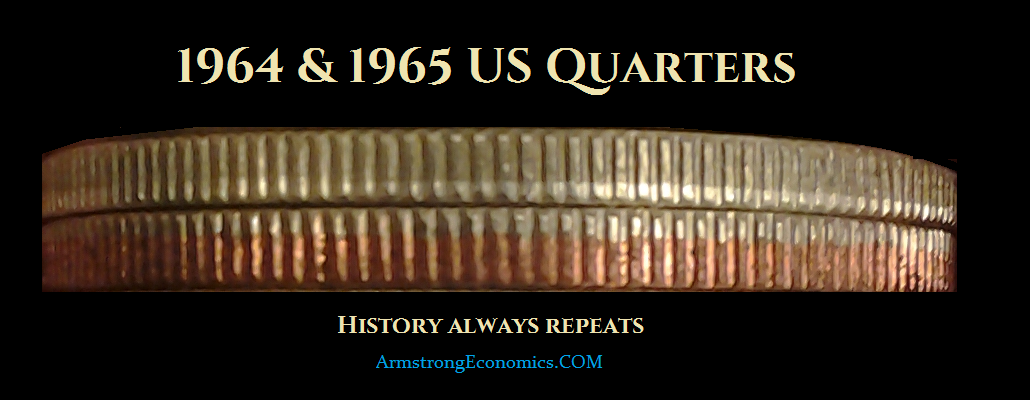
1964 1965 Quarters

I knew that Roman coins were attainable. I bought my first one for $10 in the 1960s. When they removed the silver from the coinage in 1865, I saw the connection to the very same event that marked the start of the Third Century Crisis.

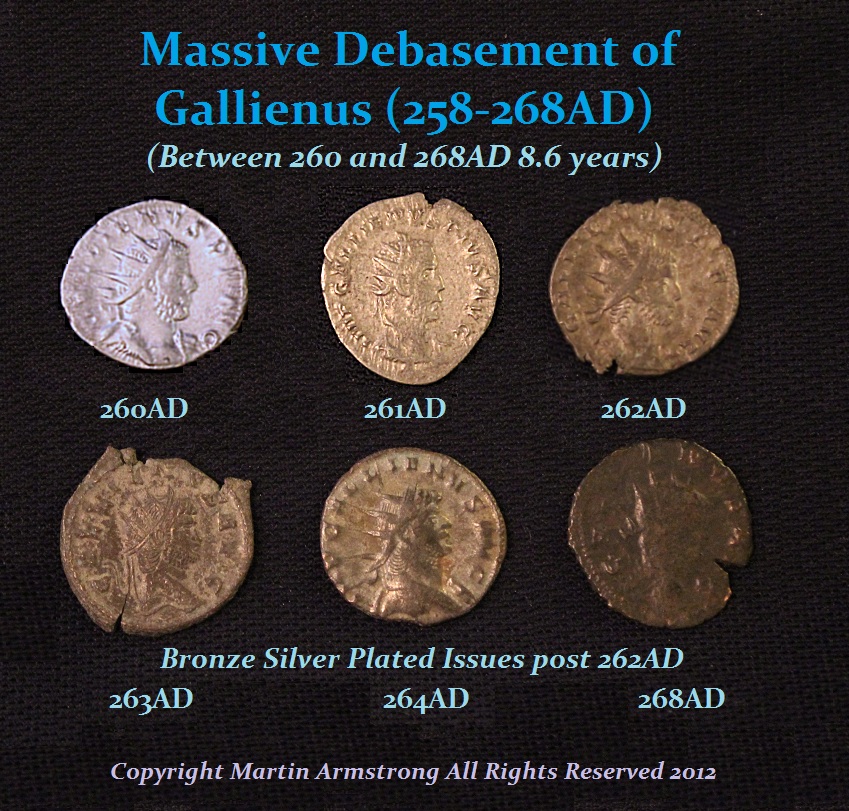
Debasement Gallienus

When I assembled the coinage to answer a gnawing question: How did Rome fall? Was it like a 747 coming in for a landing gradually, or was it abrupt? I discovered it fell from 50 %+ silver to 0.2% in just 8 years.

ECM GIF Turning Points

I discovered no such thing as random walks down the street. That is put out by people who cannot see the cycles before their eyes. Turn the economy down, and politics will always flip, no matter who is in power. The EU is fighting to stay alive, so they are interfering in elections to defeat anyone who is anti-EU. This will only blow up in their faces. The economy will always force a response, and human nature has never changed in 6,000 years. Whoever is in power will always respond similarly to the same old economic pressure.

Hammurabi Stella2

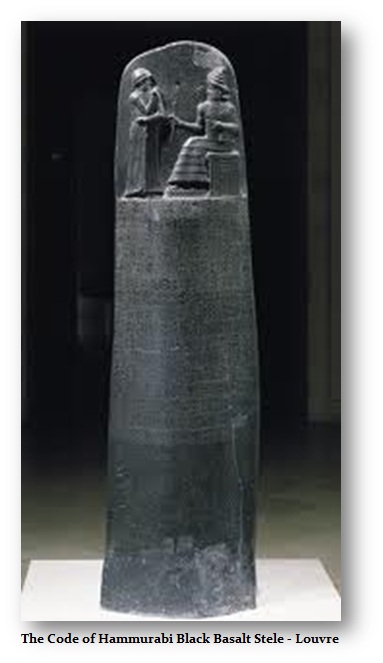
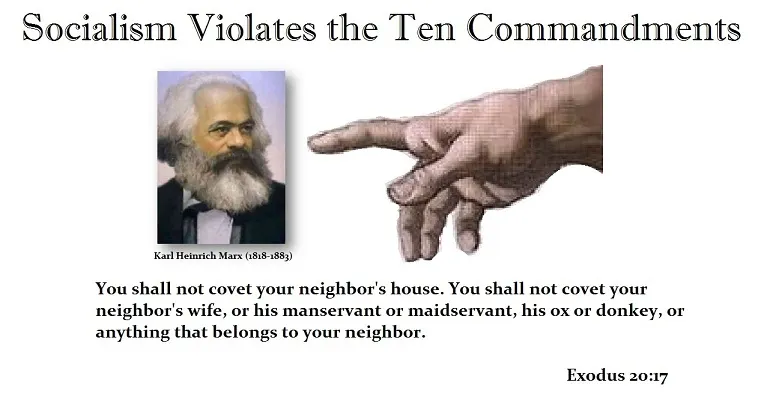
Read Hammurabi’s Legal Code. It is wage and price controls in response to an economic crisis. Even the Bible outlawed socialism. Attacking the rich and class warfare has been a problem since ancient times and it has always resulted in the collapse of such economies. Nothing has changed – ever. So, where is the UNCERTAINTY?

Marx ten commandments socialism

Interview: Have the World Economic Forum Elites Been Defeated?


Posted originally on May 17, 2025 by Martin Armstrong 

How to Save a Life – 2032


Posted originally on May 17, 2025 by Martin Armstrong 

I always liked this song. Some people see the world for what it is, and others are consumed by propaganda. Many of us have lost a friend to politics, war, or it was just their time. They may be unable to see, so they will never understand this song.

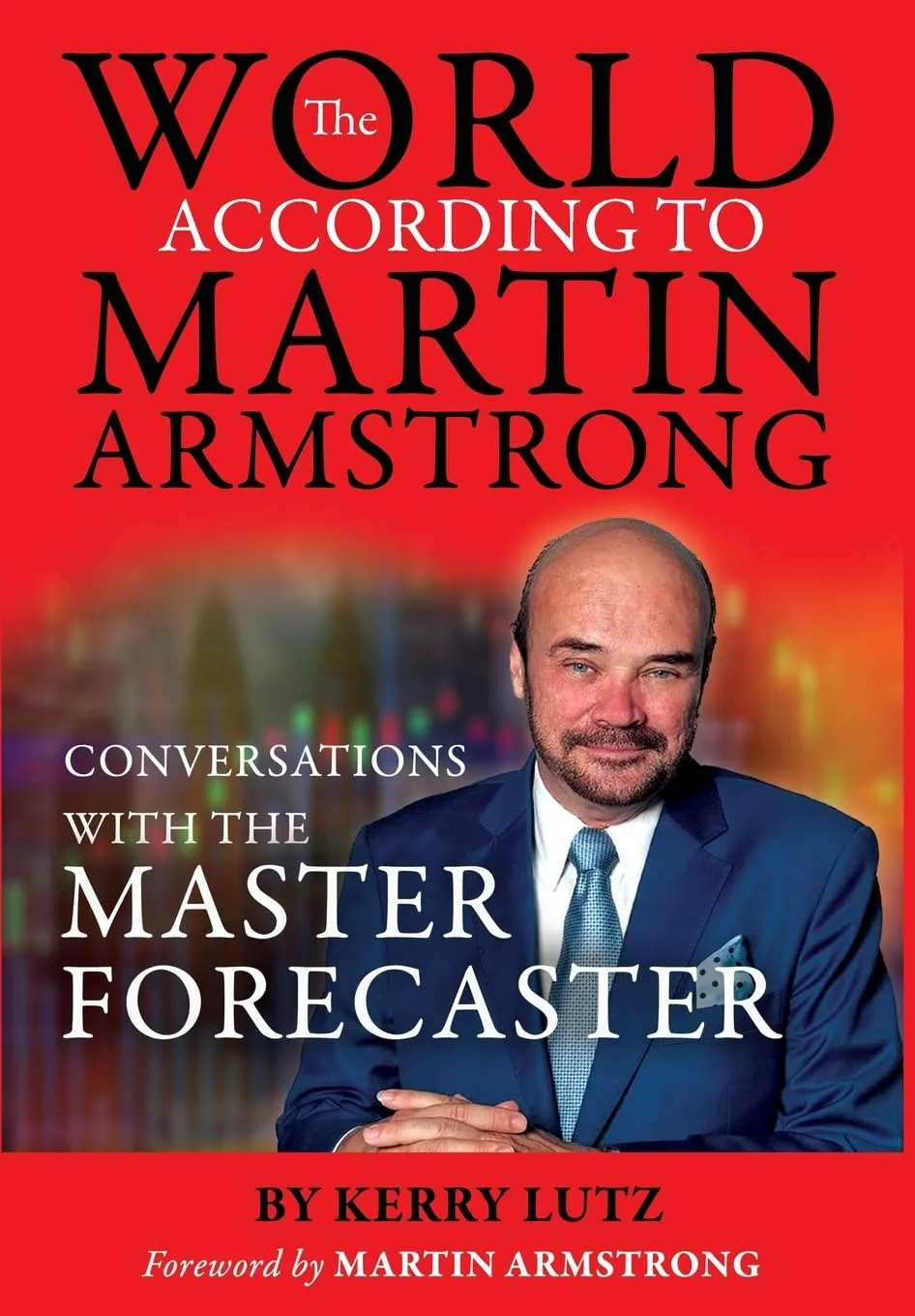
Book: Conversations with the Master Forecaster


Posted originally on May 16, 2025 by Martin Armstrong 

KerryLutzBook

Conversations with the Master Forecaster

This book is unlike anything you’ve read before. It’s not another theory — it’s a documented track record of how Martin saw what no one else did:

✅ Sovereign debt implosions
✅ War cycles and geopolitical shifts
✅ The coming collapse of trust in governments
✅ The timeline to 2032 — and what it means for you

Written by longtime interviewer Kerry Lutz, this book is based on over a decade of never-before-published insights, straight from Martin’s most powerful moments on air.

Whether you’re an investor, thinker, or someone simply seeking truth in an age of lies, this is your handbook for what’s next.

Now available on Amazon:
Click here to get the book
(Paperback, Hardcover, Kindle & Audiobook editions available)

Thank you for supporting the real truth in a world of curated nonsense.

More information:

A visionary economist. A controversial thinker. A man whose ideas challenge the status quo.

In The World According to Martin Armstrong, discover the extraordinary insights of a financial forecaster who predicted some of the most significant economic events of our time. Armstrong’s unique understanding of historical cycles, global finance, and political power offers a fresh perspective on the forces shaping our world.

From the intricate dance of sovereign debt to the rise and fall of empires, this book explores Armstrong’s groundbreaking Economic Confidence Model and its implications for the past, present, and future. Whether you’re a seasoned investor, a history buff, or someone seeking to make sense of today’s complex world, this book will challenge and inspire you.

Prepare to see the world through a new lens that connects the dots between history, economics, and human behavior in ways you’ve never imagined.

Interview: AI Predicts REAL Market Crash (Here’s When)


Posted originally on Aug 11, 2024 By Martin Armstrong |  

Revealing History


Armstrong Economics Blog/Ancient History Re-Posted Mar 31, 2021 by Martin Armstrong

COMMENT: I find it interesting how two people the general consensus has said were scoundrels, John Law and Julius Caesar, you have shown were actually people against the establishment. I read your Anatomy of a Debt Crisis and you have put together the contemporary historians where everyone else just seems to rely on the fake news of the day.

Thank you for digging up the facts.

HY

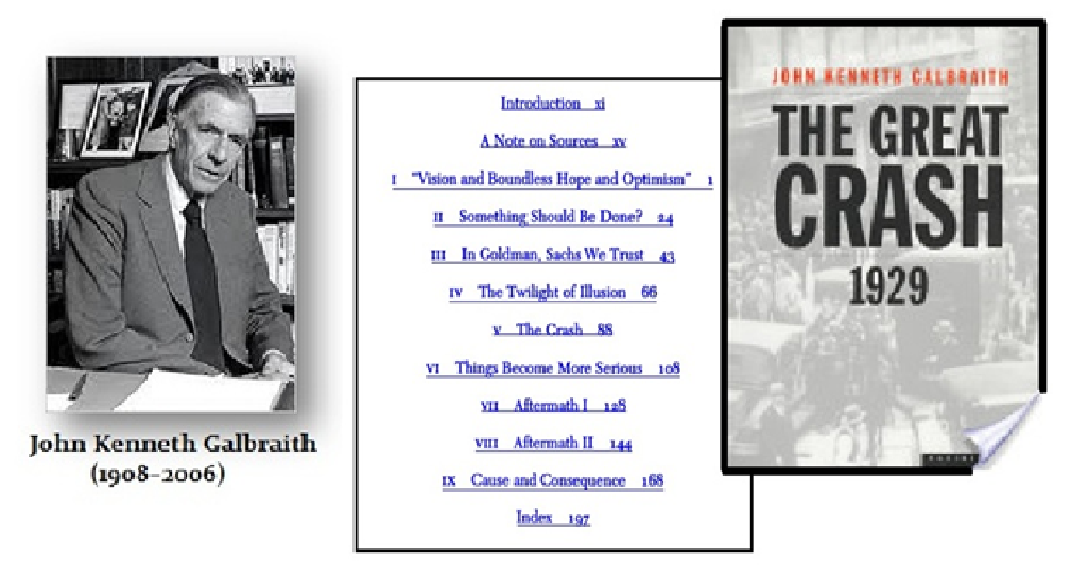
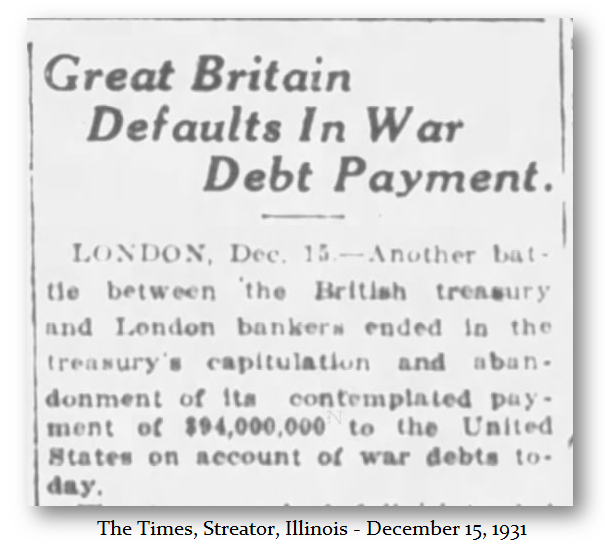
REPLY: When I was in high school, I had to read Galbraith’s “Great Crash.” Nowhere in his book did he ever mention defaults on national debts by any country. When I came across Herbert Hoover’s memoirs in an old book store in London, this was probably the second thing that changed my life, with the first being the movie  “The Toast of New York” about the Panic of 1869 when gold hit $162.50, which I had to watch in history class. I learned not to trust the history books, and the best way to find out the truth was always to return to the contemporary reports of history and/or the newspapers of the time.

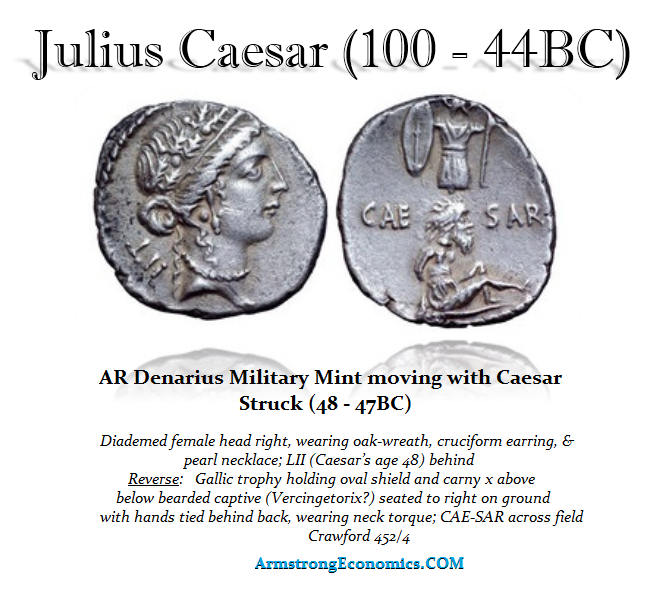
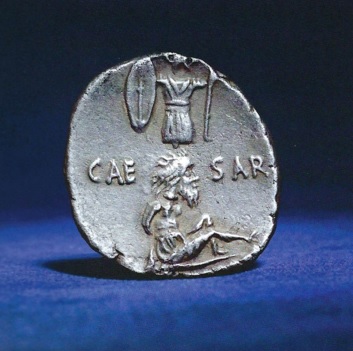
The coinage has been a major factor in identifying the history and accurately dating events. Here is an extremely rare coin of Julius Caesar. Note that there is no portrait of him. He is announcing his victory in Gaul. His Gallic campaign was initially a piecemeal affair, but within six years, he had expanded Roman rule over the whole of Gaul. Following years of relative success, mainly thanks to the disconnected nature of the tribes allowing him to take them on separately (divide and conquer), Caesar was faced with the chief of the Arverni tribe, Vercingetorix, who too late had built a confederation to stand against Caesar. In 52 BC, despite formidable resistance, Caesar finally defeated Vercingetorix at the Battle (or Siege) of Alesia. This illegal war which by Caesar’s own account had left a million dead, was instrumental in elevating him to a position of supreme power among the statesmen of the late Republic, making him incredibly wealthy through war booty and also making him dangerously popular with the plebs — the common people.

This coin was struck in the course of Caesar’s war against the Senatorial faction led by Pompey and later Metellus Scipio. Caesar’s triumphant coinage trumpets his military achievements and conquest in Gaul while reminding the bearer also of his claimed descent from Venus through Aeneas. Interestingly, behind the bust is how old he is IIL or 48 years old. The reverse figure tied below the trophy of arms is popularly believed to depict the defeated Vercingetorix. The figure is carefully rendered in detail of how the Gauls appeared unshaven often with tattoos in blue to frighten their opponents.

In order to consolidate his power when he returned, Caesar produced triumphant coinage to spread the news of his military capability. The reverse of this coin is popularly believed to depict Vercingetorix himself. In 48-47 BC, the defeated Gallic chieftain still languished in the Tullianum, the underground prison beneath the Comitium. He would be hauled out for Caesar’s triumph in 46 BC, then returned to his cell and strangled.

This example of Julius Caesar AR Denarius was struck by a military mint moving with Caesar to pay the troops on a regular basis between 48-47 BC.

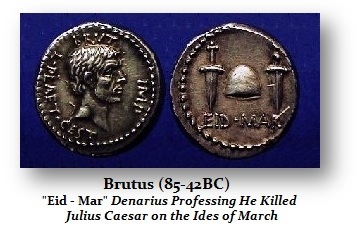
This is a Roman silver denarius struck by Brutus announcing he killed Caesar on the Ides of March 15, 44 BC (EID MAR). As you can see, the coinage can actually be used to confirm history to the year and sometimes to even the very day.

What is 2032?


Armstrong Economics Blog/ECM Re-Posted Mar 30, 2021 by Martin Armstrong

Many people have asked, “Why is 2032 going to be such a major change in the world’s political economy and society as a whole?”

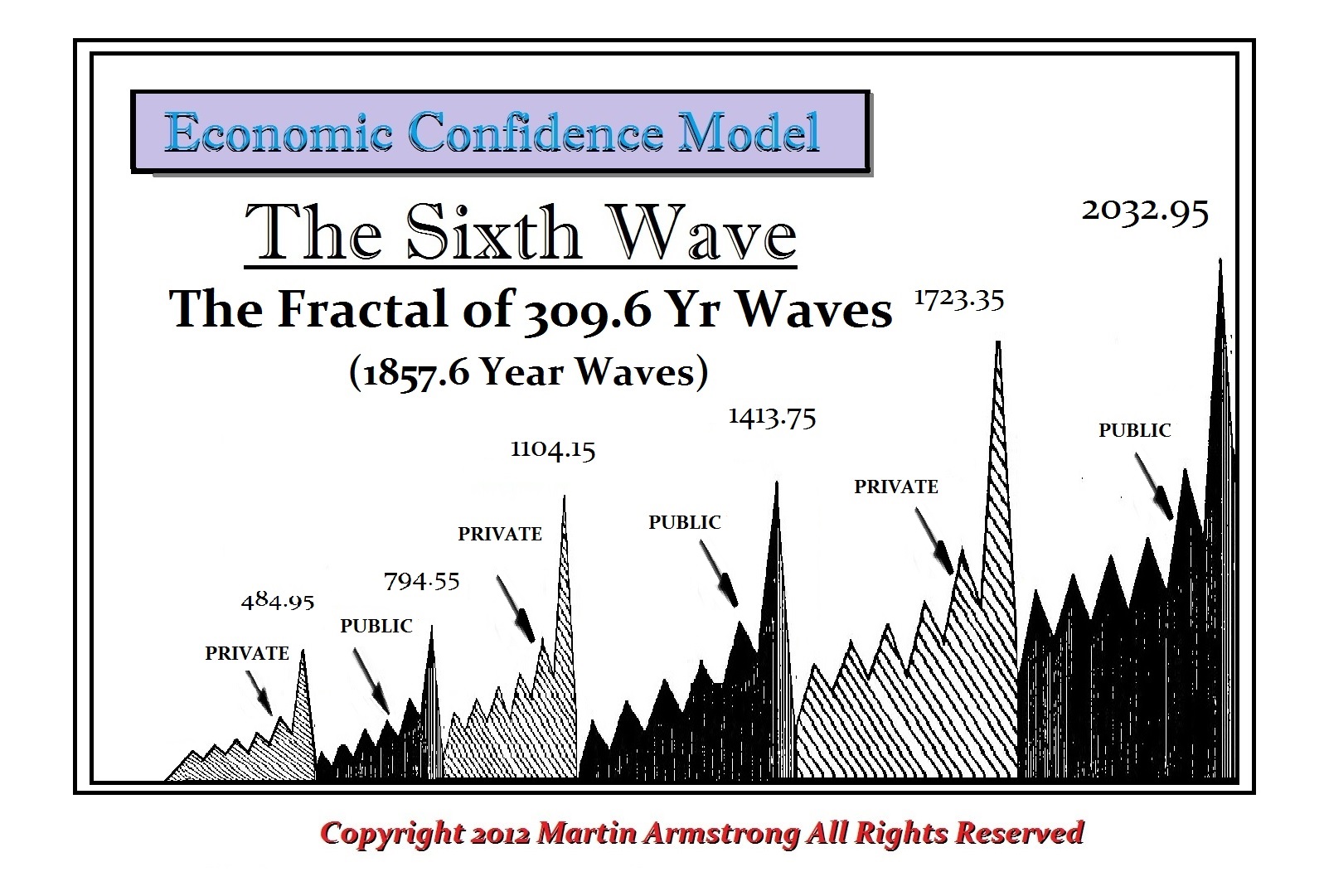
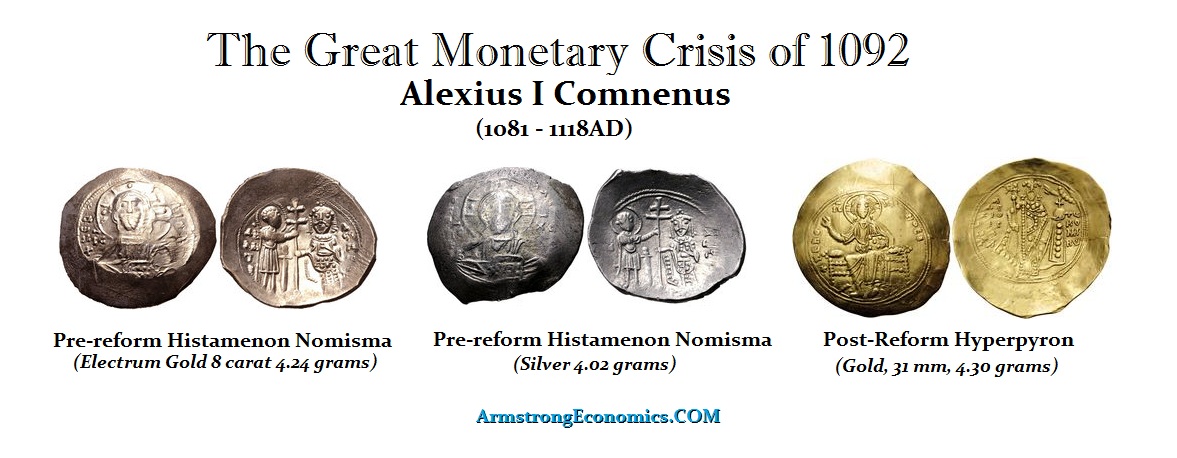
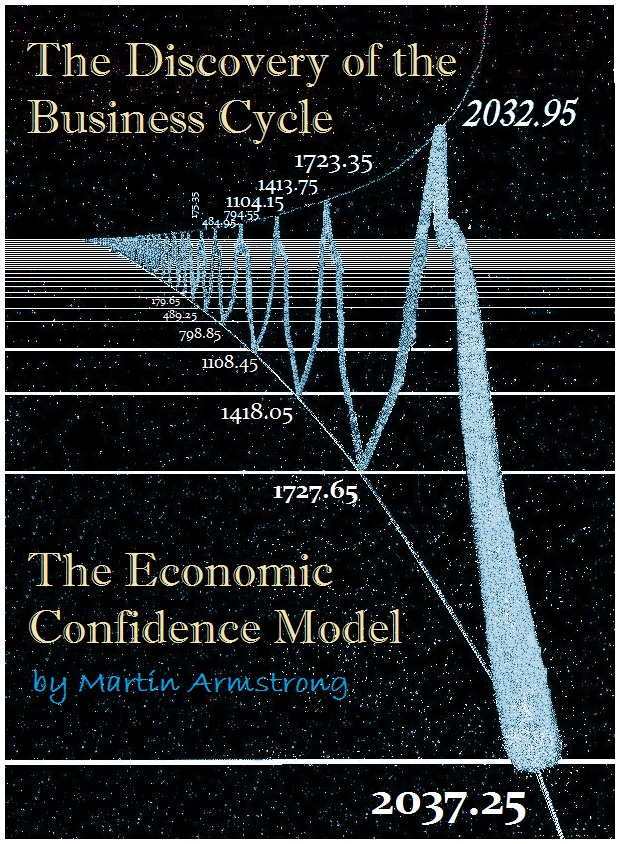
We are confronted by the end of the Sixth Wave come 2032, which will be a profound economic and political change. It appears these world leaders are pushing us toward fulfilling the vision of Kalus Schwab and his distorted view of how society functions. While the first wave marked the collapse of Rome, 794 marked the collapse of the Nara period in Japan as the capital then moved to Kyoto. That would last until 1185 AD when government was overthrown, marking the birth of the Shogun Period (military general authority). The Great Seljuk Turkish Empire had its origins, with its first capital in 1037. By 1092, the Seljuk Empire was at its greatest upon Malik Shah I’s death and had captured most of the Byzantine Empire, creating the Great Monetary Crisis of 1092 in Constantinople. Alexius I (1081-1118AD) of Byzantium saw his empire carved up.

It was 1075 when the Investiture Dispute began, where the Pope opposed kings appointing bishops to control. He had to threaten the ex-communication of kings, which only concluded in 1103. This was the start of the separation of church and state. In 1084, Emperor Henry IV deposed Pope Gregory VII and installed the first Anti-Pope Clement III who then crowned Henry Holy Roman Emperor. A revolution in 1094 resulted in Pope Urban II overthrowing the Anti-Pope and Henry lost power over Italy. But by 1111, Henry V captured the Pope, forced his settlement, and then crowned Henry V as Holy Roman Emperor. By 1112, the Church splits between Papal and Imperial supporters.

The Balkans had been overrun by the Patzinaks who were a nomadic people of the Turkic family. Their original home is unknown, but during the 8th and 9th centuries, they inhabited the region between the lower Volga and the Urals. They then laid siege to Constantinople itself in 1090 AD. They led Alexius to ask for help from Venice, which began the First Crusade (1096–1099) where they took Jerusalem. But the Venetians were more interested in plundering Constantinople. Thus, 1104 marked the peak in the Byzantine Empire and by the Latin rulers who seized Byzantium taking control 1204-1261 AD. It wasn’t until 1298 when the reign of Osman I, founder of the Ottoman Empire, began.

The financial crisis in France led to the default on loans to Italian bankers and the seizure of the Papacy itself moving it to Avignon in France known as the Avignon Papacy, also known as the Babylonian Captivity, which was period from 1309 to 1376. The French Anti-Pope seized the Knights Templars on Friday, October 13, 1307, to confiscate all their wealth and that of their clients. The Knights Templars had become the first real international banking system as they evolved following their founding around 1117/1118 AD, lasting for 22 waves of 8.6 years. This next wave also saw the Black Plague (1347-1351) wipe out 50% of the population, which then changed the economy by shifting it from serfdom in Europe to capitalism as wages began to take place because of the shortage of labor.

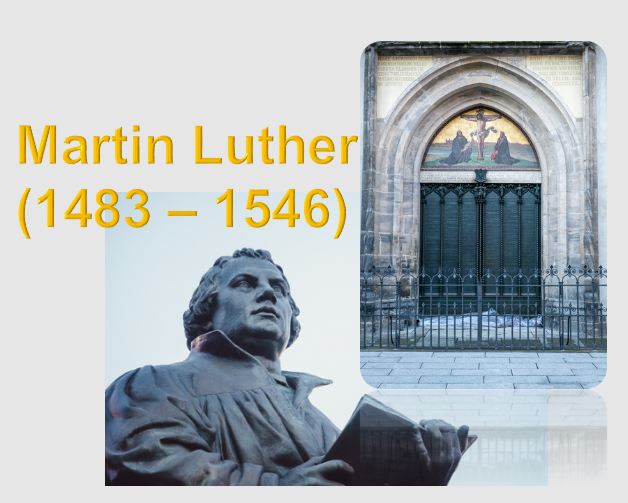
The next peak in the cycle 1413.75 marked the start of the religious revolution. In England, the Oldcastle Revolt was a Lollard uprising against both the Catholic Church and the English King Henry V. Oldcastle was influenced by Lollard cleric William Swynderby, who preached in Almeley during his youth. Lollardy was a politico-religious movement initiated by prominent theologian John Wycliffe during the 1370s. The Lollard beliefs dealt with their opposition to capital punishment, rejection of religious celibacy, and belief that members of the Clergy should be held accountable to civil laws. In addition, it was the rise of the iconoclasty, which took place in the Byzantine Empire, where they rejected ornamentation of churches, religious images, and pilgrimages. They objected to war, violence, and abortion. John Oldcastle led the revolt, and it took place on the night of 9/10 January 1414. The rebellion was absolutely crushed at the battle on St. Giles’s Fields. There was rising discontent in religion that manifested on October 31, 1517, when Martin Luther nailed his 95 Theses to the door of the Wittenberg Castle church in Germany.

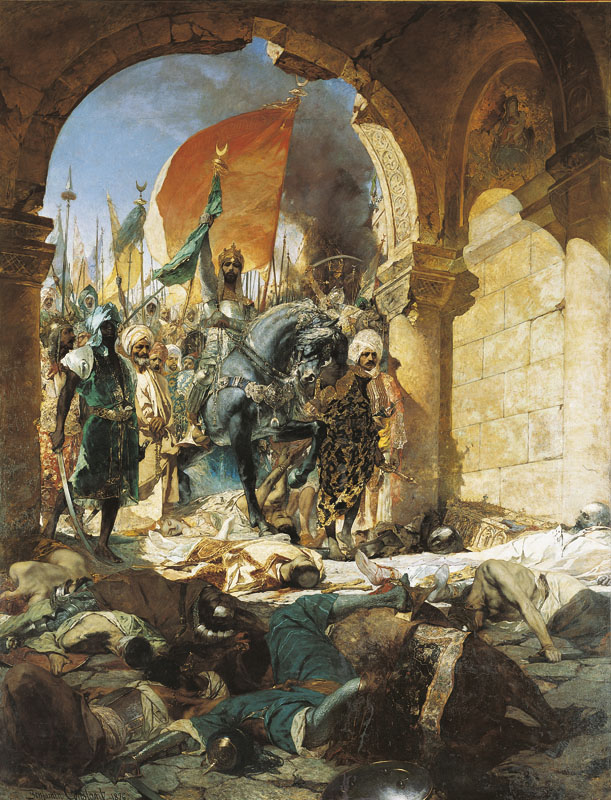
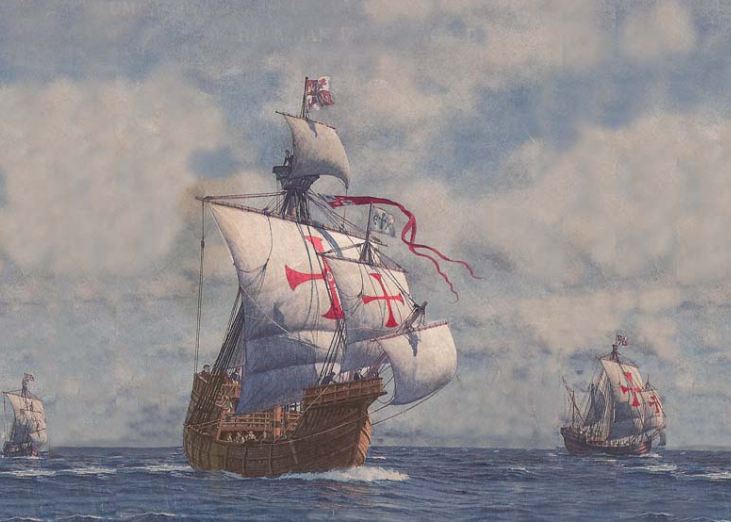
This next wave peaked in 1723.35, not merely saw the Protestant Reformation impact region, but with the fall of Constantinople in 1453, scholars fled to Europe and Russia, taking the wealth of knowledge with them. By 1492, Christopher Columbus convinced others that the world was round and not flat based upon maps that came from Constantinople. While it would slowly expand the knowledge in Europe, the Age of Enlightenment is formally classified as being between 1715-1789, which really became the foundation for the next wave into 2032.

But this wave was the beginning of the crisis with a monarchy. Columbus was backed by Spain, which then became the new financial capital of Europe. But the mismanagement by the monarchy led to Spain becoming a serial defaulter beginning in 1557, followed by 1570, 1575, 1596, 1607, and 1647, ending in a third world status by the end of this wave. King Philip V of Spain abdicated the throne in 1724 to go to a monastery.

In England, on October 17, 1722, the Habeas Corpus Act was suspended because of a Jacobite plot to take the thrown by a Catholic James III they called the Old Pretender, and Parliament prohibited journalists from reporting on political debates. From here on out, the tone for the next wave was set in motion. The rise against the monarchy. This was the wave of human rights and it moves into its culmination come 2032 with the rise against human rights and the attempt once more to suppress the people with the rise of authoritarianism. This is once more a major turning point, and we will face a dramatic change both economically and politically on a global scale.

The forthcoming “The Discovery of the Business Cycle” goes into the details of these waves throughout history with not merely political facts but also the rise and fall of the world’s monetary system.

The Greatest Female Trader of All Time?


Armstrong Economics Blog/Traders Re-Posted Mar 25, 2021 by Martin Armstrong

QUESTION: First I want to thank you for your guidance. You have helped me understand markets where I can see I was clueless before. You seem to be a contrarian. I take it that is why you say the majority must always be wrong. Have you learned this to be the best way to look at the world?

Thank you for shining a light in these dark times.

GR

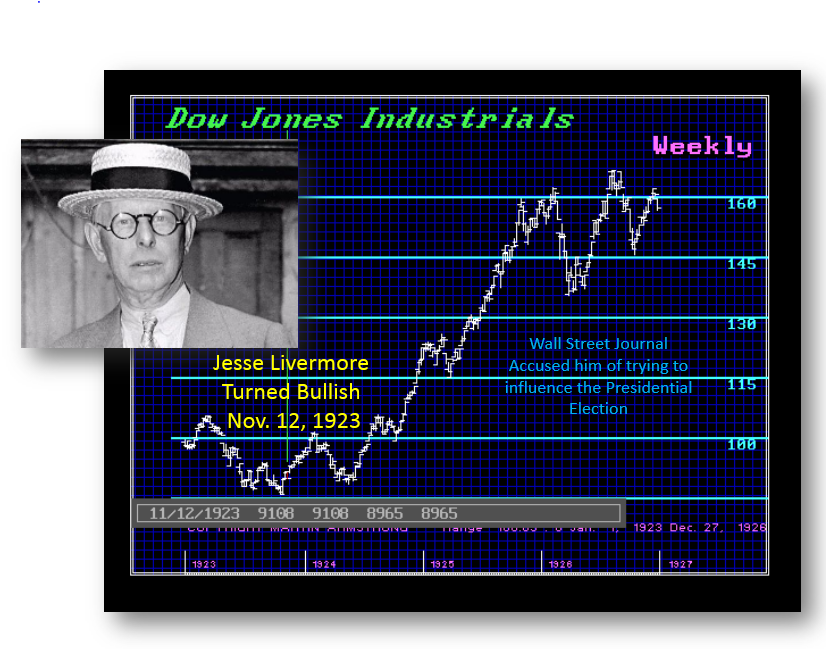
ANSWER: The greatest traders of all time have always been contrarians. They can see the patterns within patterns and how history repeats right before their eyes. Jesse Livermore (1877 – 1940) turned bullish in 1923. He could see the bull market coming. The Wall Street Journal accused him of turning bullish to influence the presidential elections. When they were proven wrong, they simply refused ever to quote Jesse ever again. Many have pointed out that Barrons had reported that our model was calling for new highs back in 2010 more as a joke. They have never reported ever again how it was correct. It appears that the media does not like it when they are wrong and will retaliate.

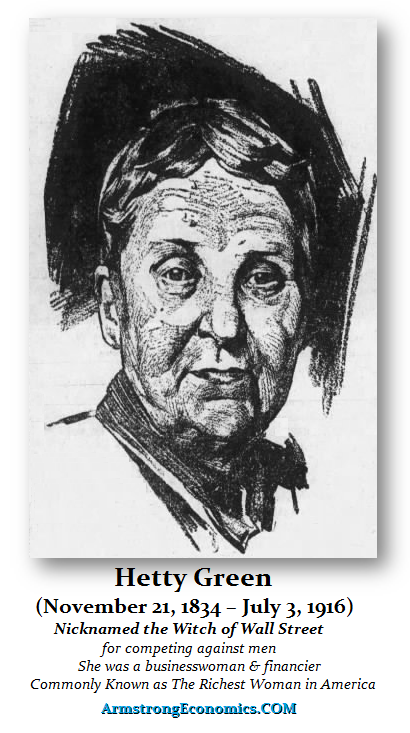
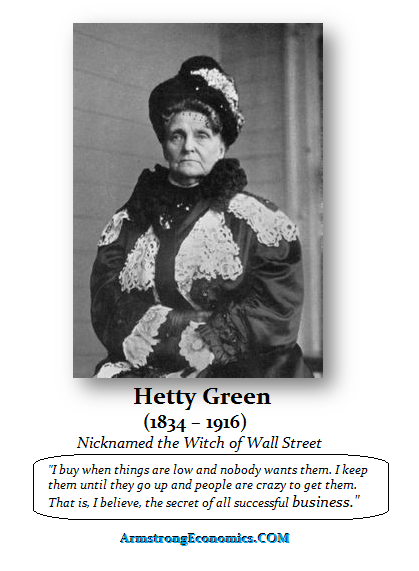
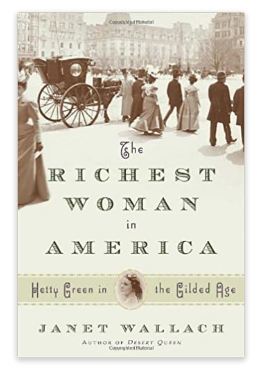
Hetty Green (1834-1916) was a woman in a man’s world. She became not just one of the wealthiest and most astute investors in American history, but she became the richest woman perhaps in the world. Hetty’ was known for her extreme frugality, which was exploited by her adversaries and made for good copy in the press. They dubbed her the “Witch of Wall Street” because she was such a good trader her wealth could outdo even the top ten Wall Street bankers in her day. She was in reality a woman in a man’s world, during the era of robber barons when deals were done in dark oak wooden rooms filled with cigar smoke clouds that you would think it was going to rain.

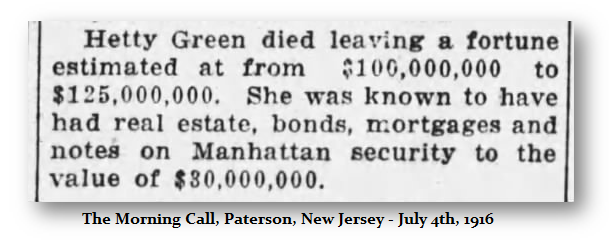
Her reputation as the “Witch of Wall Street” was undeserved and today they would call it sexist. Hetty was the first female billionaire in modern terms who would be worth $10 billion+ in 2021. When she died in 1916, she was worth between $100-$125 million when a dollar was really worth something. She actually despised many of the titans of industry and finance of the day for their predatory ways and profligate spending. She actually sympathized more with the average hardworking citizen, yet she followed in her father’s Quaker footsteps.

Hetty Green was the woman of the Gilded Age. Few men could compete with her mentally. Hetty was abandoned at birth by her mother and she was viewed as a female by her father. Against this backdrop, Hetty set out as a child to prove she was of substance and had value. She followed the simple rules of her wealthy Quaker father, and always was extremely frugal. She would accompany him to the counting houses, storehouses, commodity, and stockbrokers. She observed trading from an early age and clearly saw the patterns within patterns.

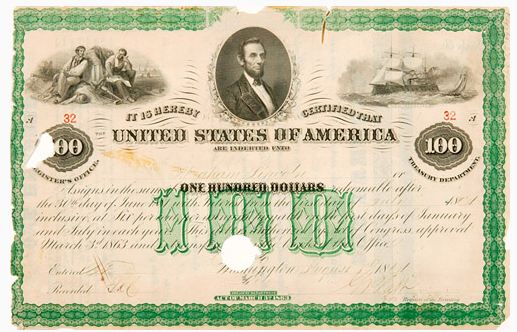
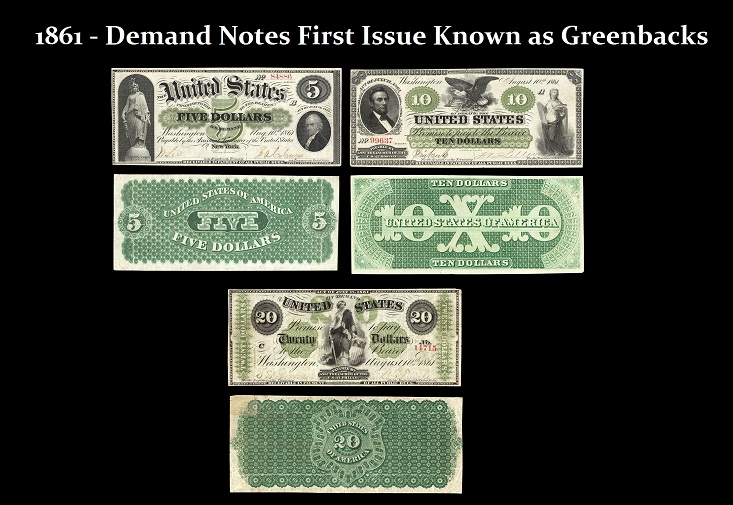
While she inherited money, she understood trading. Perhaps her greatest trade was buying greenback bonds during the Civil War and into the panic of 1869. Some painted it as she never lost faith in America’s potential, but from a practical standpoint, she could see that the North was the industrial hub against the South which was agricultural. Others claim she just ignored the herd mentality and took advantage of financial panics and crises.

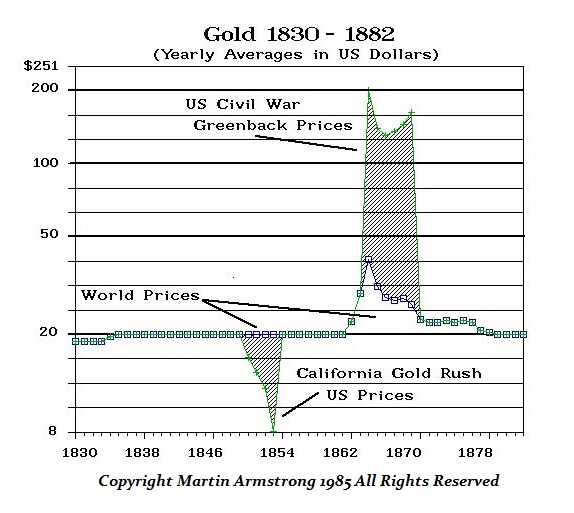
Indeed, during the civil war, Hatty bought federal bonds when the greenback would collapse against gold. In 1862, the greenback declined against gold until the end of the year when gold was trading at a 29% premium to the paper greenbacks. The following year, by spring of 1863, the greenback collapsed to $152 against $100 in gold. After the Gettysburg victory, the greenback bounced back to $131 to $100 in gold. Then came 1864 when General Grant was making very little headway against General Lee. When it looked bleak in 1864, that is when the Greenback collapsed to its lowest point reaching during July 1864 briefly to $258 greenbacks to $100 in gold.

The Greenback began to recover, dropping back to the $1509 level. Congress limited the total issue of greenbacks to $450 million, which helped to support their value. Then the Panic of 1869 hit, and Greenbacks fell again to $162.50. Hetty made a fortune buying the Greenbacks at the lows. Then in December 1878, Congress made the Greenbacks on par with gold. What bonds in Greenbacks she was buying, she gained not just the interest but also about doubled her money on this trade alone.

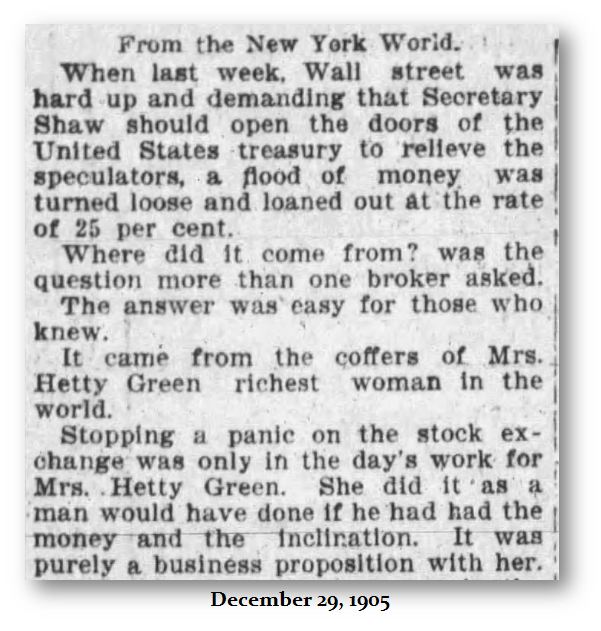
Therefore, Hetty bought railroads, real estate, and bonds. She could smell blood in the streets, as they say in financial markets, and she was there to buy it up. Men mocked her, and women scoffed at her frugal ways. Nevertheless, she had thick skin, and because she would buy in the panics and win, they called her the “Witch of Wall Street.” Yet, she even supplied the loans that kept the city of New York itself from going bankrupt. Even when the markets panicked, Hetty looked at the trend and had a nose for seeing the market. She would be there lending money at 25%.

Hetty is said to have relished a challenge. When her aunt died and did not leave Hetty the fortune she expected, she filed a groundbreaking lawsuit that still resonates in law schools and courts. When her husband defied her and sank her money on his own risky interests, she threw him out and, marching down to Wall Street, quickly making up the loss. Her independence, outspokenness, and disdain for the upper crust earned her a reputation for harshness that endured for decades.  Yet, those who knew her admired her warmth, her wisdom, and her wit.

When Hetty died, she did leave a fortune.

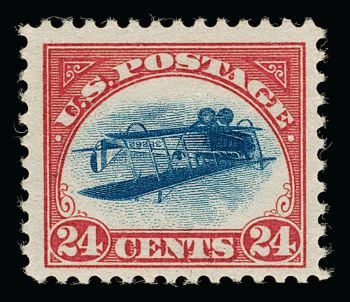
Her son, Edward Howland Robinson Green (1868-1936), was not so frugal. He was an avid collector and bought the famous sheet of 100 inverted air mail stamps in 1918, paying $20,000. The last example sold after a few years and brought in $1.3 million. He also had bought all five of the known 1913 Liberty Head nickels and as many as seven of the rare 1838-O half dollars. He also held dozens of high-grade 1796 quarters.