Amid breaking developments on multiple trade fronts which will likely see USMCA passage; and the potential for enhanced China tariffs on December 15th; Commerce Secretary Wilbur Ross appears with Maria Bartiromo to discuss the big picture.
Secretary Ross highlights the manipulation of USMCA ratification and timing by Pelosi to obfuscate the highly partisan political impeachment effort. Mid-2019 CTH noted this strategic plan was visible and probable.
Ross also discusses the specifics of China, the EU and Brexit as it relates to the global trade reset being carried out in a methodical manner by the Trump administration. The USMCA will be the first cornerstone domino in a chain of trade events that will fundamentally restructure the nature of all international trade and supply chains. Great Interview:
.
As we have discussed on these pages, the dynamic is severely consequential and the Wall Street multinationals are reacting to the daily details while Main Street gains strength. President Trump is dismantling global supply chains; focusing on bringing high-wage manufacturing industry back to the U.S; and driving a process of profound consequence through economic nationalism.
Titan Trump is winning the economic battle by: (a) repatriating wealth (trade policy); (b) blocking exfiltration (main street policy); (c) creating new and modern economic alliances based on reciprocity (bilateral deals); and (d) dismantling the post WWII Marshal plan of global trade and one-way tariffs (de-globalization).
The Democrats within the House of Representatives have decided to suspend House Impeachment Resolution [HR 660] without following their own rules that established a House Minority Hearing. Instead, House leadership have produced two partisan articles of impeachment for a full house vote.
Both articles are exceptionally weak; the Democrats are rushing to cut their losses:
♦Article One is “Abuse of power” – and structured on a false premise that President Trump “exercised the powers of his public office to obtain an improper personal benefit, while ignoring or injuring the national interest.”
♦Article Two is “Obstruction of Congress” – and structured on a ridiculous premise that President Trump “engaged in unprecedented, categorical, and indiscriminate defiance of the impeachment inquiry”, by challenging congressional subpoenas and seeking relief from the judicial branch.
Both articles are structurally deficient in the extreme. It will be interesting to see which House democrats could possibly vote for these articles, especially article two. There is a possibility some democrats will ignore Pelosi’s whip.
The weakness of the articles now actually appears to be a feature, not a flaw. The exercise of the “impeachment process” writ large was more of a political promise to the far-left constituents of the resistance movement itself. Structurally there is no strength to either article; they appear designed to fail in the Senate. Again, a feature not a flaw.
Nationally the democrat resistance voters are not too smart. What Pelosi, Schiff and Nadler are delivering for them is an impeachment in name only. The downstream consequences for this incredibly partisan political effort could be a massive backlash amid independent voters and centrist democrats.
Traditionally, impeachment is constitutionally designed to remove an elected official from office. However, in this modern example the process has been intentionally corrupted to disparage the President, not to remove him. In essence Pelosi has used the impeachment process as way to sooth the emotional needs of the far-left resistance.
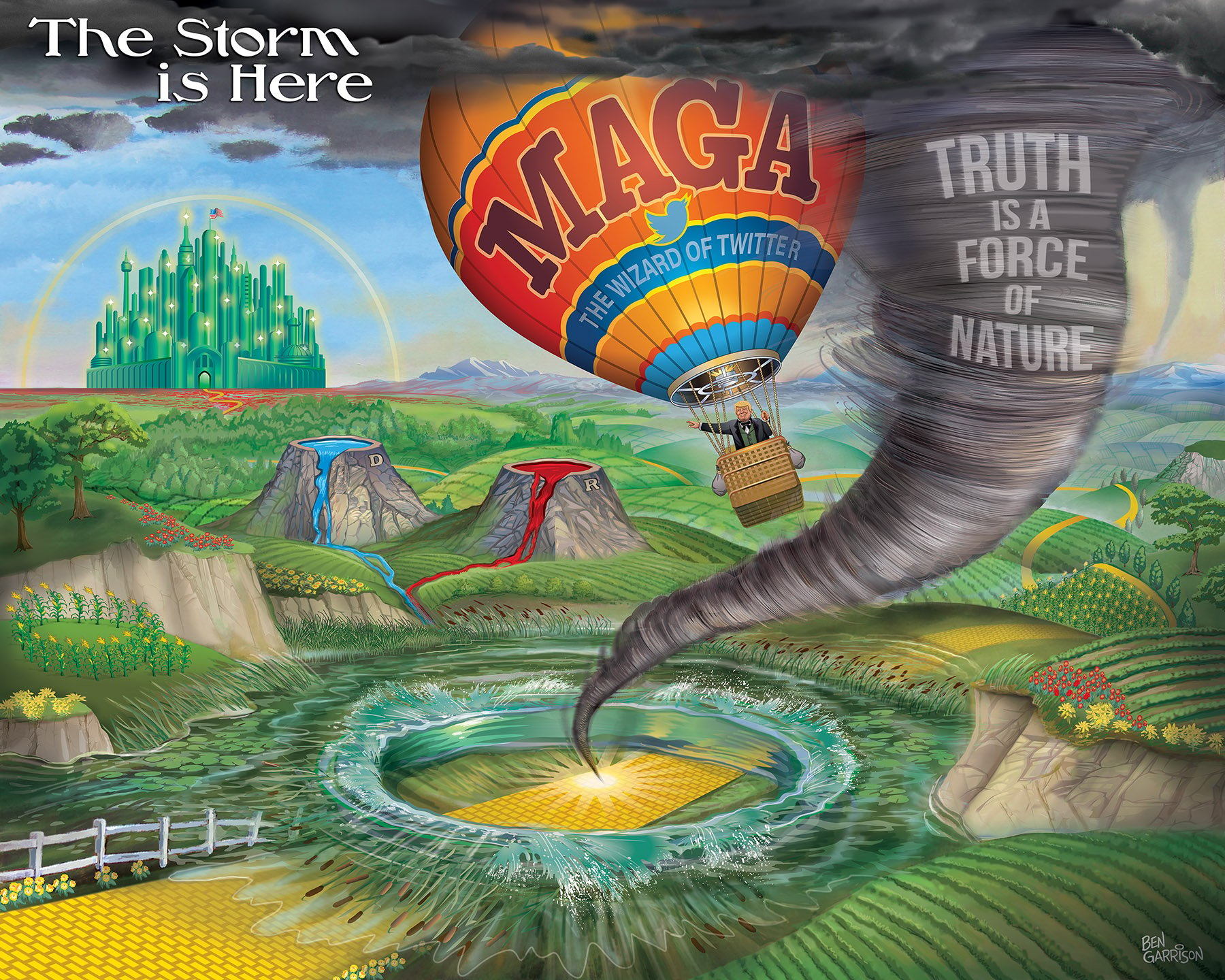
We the American people have been lied to and abused for decades. The swamp covered the Yellow Brick Road and ran deep and thick with graft and corruption. We were stuck in a bog of fake news and distractions by both parties. After eight years of Obama and eight years of Bush, the American people were looking for someone to just tell the truth and represent the will of the American people.
President Trump riding high and navigating the winds of an UNSTOPPABLE FORCE that will drain the swamp, created over decades of establishment politics that have muddied the waters and have smothered our dear Republic.
The Deep State Swamp fought Trump tooth and nail in a deadly battle for America’s soul.
And we, the people, are finally winning!
The Storm Is Here… it is now TIME to Drain the Swamp and its creatures and reveal the TRUTH that will set us all free and invoke #TheGreatAwakening all America has been waiting for.
Nothing can stop what is coming!
The storm will clear the swamp from the yellow brick road of prosperity and peace.
Justice will be served and the corrupt and evil will be punished.
Patriots of Red and Blue will unite here in the United States and around the world.
Think for yourself. Knowledge is power.
Being awake is the swamp’s greatest fear.
Follow The Yellow Brick Road and watch as the storm paves the way for Truth and Justice… it’s going to be a wild ride! TRUTH IS A FORCE OF NATURE! #TrustThePlan
Earlier today President Trump and Vice-President Pence hosted a family education roundtable at the White House. There were also questions from the media [Video and Transcript Below]
.
[Transcript] – THE PRESIDENT: Okay, thank you very much. The IG report just came out, and I was just briefed on it, and it’s a disgrace what’s happened with respect to the things that were done to our country. It should never again happen to another President. It is incredible. Far worse than I would have ever thought possible. And it’s — it’s an embarrassment to our country. It’s dishonest. It’s everything that a lot of people thought it would be, except far worse.
So I’m going to get some very detailed briefing — briefings. But they are — it’s a very sad — it’s a very sad day when I see that; a very sad day when a lot of people see that. They had no nothing. It was concocted. And you say what you want — that was a — probably something that’s never happened in the history of our country.
Pam Bondi, I think you were able to look at some of the report and can address a little bit of it very well, if you might say a few words. I’d like to ask Kellyanne; I know you looked at it also. Please.
MS. BONDI: Sure, President. You know, so many of us who are career law enforcement today are outraged. And I think the American people really should be terrified that this could happen to you when we’re supposed to live in a society of integrity and honesty.
And this happened to the President — not just to the President. You know, this should be a good day, but it’s not. It’s a horrible day for the country that this could had happen to the President of the United States, that they could fabricate, falsify e-mails, lie, and omit exculpatory evidence in order to continue this witch hunt against the President of the United States.
And this is just the tip of iceberg. Now we have the Durham investigation.
THE PRESIDENT: Thank you very much. Kellyanne, please?
MS. CONWAY: Mr. President, thank you. I was the campaign manager during that time, and I would ask a simple question: Why no defensive briefing? Why not contact the Trump campaign? Why not contact candidate Trump or Governor Pence, or Governor Christie, who at the time was arranging for the intelligence briefings for candidate Trump and was a public servant, a government official at that time, as Governor of New Jersey, with a full intelligence security clearance to receive that type of information.
So you can’t blame people for feeling that it was unfair and that the fix was in. And to think that perhaps people lied and spied and tried to subvert democracy just because they wanted someone else to win, or just because they have a different political point of view, that is not the way the world’s greatest democracy has been formed and can survive at a time such as this.
I will just repeat something that Attorney General Barr said today, Mr. President: that this was an intrusive investigation of the U.S. presidential campaign on the thinnest of suspicions. And that is chilling language for any of us who want our government to work for us and not against us.
I only wish they had have come and informed us, Mr. President, and we could have had the knowledge and the wherewithal to act at that time, and not put the taxpayers through two-plus protracted years of nonsense.
Thank you, sir.
THE PRESIDENT: Well, they fabricated evidence and they lied to the courts, and they did all sorts of things to have it go their way. And this was something that we can never allow to happen again.
The report, actually — and especially when you look into it, and the details of the report — are far worse than anything I would have even imagined. What they were doing and what they would have done if I didn’t make a certain move — a certain move that was a very important move because it would have been even worse, if that’s possible. And they might have been able to succeed.
This was an overthrow of government. This was an attempted overthrow. And a lot of people who were in on it, and they got caught. They got caught red-handed. And I look forward to the Durham report, which is coming out in the not-too-distant future. It’s got its own information, which is this information plus, plus, plus.
And it’s an incredible thing that happened, and we’re lucky we caught them. I think I’m going to put this down as one of our great achievements. Because what we found and what we saw never, ever should this happen again in our country.
With that, today we gather to discuss the urgent national priority that we’ve been working on so long and so hard: expanding education freedom through school choice so that every American child can get a great education.
We’re grateful to be joined by Vice President Mike Pence, Secretary Betsy DeVos, Senators Ted Cruz and Mike Lee, Representative Bradley Byrne, Florida Governor Ron DeSantis, Texas Lieutenant Governor Dan Patrick, Pennsylvania House Speaker Mike Turzai, Tennessee State Representative John DeBerry, and students, parents, and teachers from across the nation. Some wonderful, brilliant students are with us. And we’re going to be having a big session in a little while.
As President, I’m fighting every day for the forgotten American. We are looking [to] pass criminal justice reform. We got that done — criminal justice reform. They could have never done it without me. It was done by us. It wasn’t done by anybody else. They came to me. They’ve been trying to get it for many years. President Obama wouldn’t do it or couldn’t get it done. Maybe that means the same thing.
But I got criminal justice reform done, but the press doesn’t want to mention that we got it done. And we got it done soundly and good. And we had a lot of help, including from Mike Lee. Mike, that was something. When I heard Mike was in favor, I said, “Boy, he’s pretty conservative.” That’s pretty something. But it worked out. It’s working out very well. And it’s a big step, and we’re proud of it.
And I think when you look at the African American community in particular, they are the biggest beneficiaries of criminal justice reform. So we’re honored to have helped.
We passed the criminal justice reform and the legislation to target resources to distressed communities. Our economy is lifting up citizens of every background. You saw the new reports coming out on unemployment. They’re the best in the world — best we’ve ever had. The best this country has ever had. Historic records.
We have the lowest unemployment in the history of our country for African Americans, Asian Americans, Hispanic Americans. And, overall, we’re just about going to break the all-time record. We’re very close.
But now is the time to fight for the forgotten child, and that’s what we’re doing with respect to education. For decades, countless children have been trapped in failing government schools. In my administration, these children are forgotten no longer. Just like I said I was going to do it for different groups of people, and we did it.
We have the strongest economy probably in the history of our country. The numbers came out, as you saw on Friday, with a number of jobs that nobody believed possible: 200- — well over 200,000. They were thinking about 50. Some people thought it would be 50,000, 60,000. You saw how badly Canada did. We had 266,000. Canada had an unbelievable period and is going through something. And yet, we are right there. And the whole world is not doing well. And we’re doing phenomenally well. We’re doing better than — we’re the hottest economy in the world. We’re doing great.
And frankly, it’s hard to believe we could even do better. But if the world were doing better, we’d do better. That’s the way it’s set up.
We’ve made tremendous progress in the last three years — far greater than anyone thought possible. So we have the hottest economy in the world, by far. Nobody close. If you look at Europe, if you look at Asia — China is having a very hard time. We’re doing well with China in our trade deal. But they’re having a tremendously difficult time. The worst time they’ve had in at least 57 — it was 57 two weeks ago; now it’s much more than that — number of years. Fifty-seven years. And yet, we do record-breaking numbers. So that’s great.
We broke the stock market record — I believe it’s 132 times, during the course of less than three years as President. So that’s something.
And, by the way, you were great on television this weekend. I admired that very — you did a fantastic job. Everyone is talking about it in a very positive way, too. So, congratulations, Ted. He’s a hater. He’s definitely a hater. That came out loud and clear. Congratulations.
Lawmakers in 44 states, Washington, D.C., and Puerto Rico have empowered some parents to choose a better future for their children, for their child. But school choice waitlists are growing, and, sadly, not everyone wants to give these students the education and freedom that they deserve. They’re locked into a school system that’s terrible, and we’re working on that very hard. Betsy is working on it, full-time. About 30 hours a day, I guess, Betsy. Right? That’s what she does.
But school choice waitlists are growing, and that’s a — that’s a incredible factor. Everyone wants school choice. And we have certain groups that are very powerfully against that, but we’re breaking through very strongly.
This year, Pennsylvania Governor Tom Wolf denied 50,000 kids the promise of a better school. Florida Governor Ron DeSantis, on the other hand, got 14,000 Florida students off of the waitlists. Really great. The waitlists were just ridiculous, and still are. I mean, they’re still very long. That’s where they want to go, Ron, I guess. Right? So congratulations to Ron DeSantis of Florida.
We believe that every parent should have educational freedom for their children. Earlier this year, I asked Congress to pass a federal tax credit to support state-based scholarship programs so we can provide over 1 million more students with school choice. People want school choice. They want to have their child go to a school that they want to have the child go to. It’s very simple.
I look forward to hearing from each of you today. We’re going to be discussing a lot of things that have happened in the last couple of years. Some great successes. And we’re in the process of getting more. Education is a very tough subject because it’s been grounded. And whether it works or doesn’t work, the areas that don’t work — people seem to want to come at a certain — a certain group of people. And it’s a very powerful group of people. They want it to stay that way. We don’t want it to stay that way.
Worldwide, we’re probably ranked about 36th, and yet we spend more per pupil than anyone other country in the world — far more per pupil. And we should be at the top of the list, not mired down toward the middle and even worse than that.
So I’d like to ask Mike Pence to say a few words. And we’re going to go around the table, and we’ll have a discussion. Thank you.
Mike?
THE VICE PRESIDENT: Well, thank you, Mr. President. Thank you for your leadership on education. It was one of the very first conversations that we had when you considered me for the position that I now hold. And you expressed to me then, in the summer of 2016, your belief that it ought to be parents that choose where their children go to school.
I want to join you in thanking Governor DeSantis for his leadership, Lieutenant Governor Patrick, and the leadership represented by Senator Cruz, Senator Lee, and especially to be able to welcome the students, parents, and teachers who are here with us, at your invitation, to talk about how we advance your agenda.
As you mentioned, Mr. President, when I was governor of the state of Indiana, I was proud to be home — as Governor DeSantis is — to a state that’s been expanding educational choice for students for decades. And just like Governor DeSantis has done back when I was governor of the state of Indiana, we increased enrollment in our voucher program from 4,000 to 32,000. We actually expanded school choice for pre-K for several thousand disadvantaged children.
The American people deserve to know that this is a President who has been putting taxpayer resources to work to expand educational choice for disadvantaged families. We already expanded the [DEL: 521 :DEL] [529] college savings accounts to let parents use those resources for K-12 education.
And, Mr. President, participation in the D.C. voucher program, which has been a historic program that’s changed lives, changed our nation’s capital, is already up by more than 50 percent.
But today, we really look forward to hearing from the Secretary and all of those gathered here about your proposal for a $5 billion Education Freedom Scholarship program, as you said, which would, we believe, expand educational choice opportunities to more than a million students around America.
We really believe the key to success for any child is a good education. And we believe that parents are best equipped to choose what is the best education for their children.
So, Mr. President, again, thank you for your passion for educational choice. And I want to thank the Secretary. But, most especially, I want to thank the leaders and the parents and the students and the teachers that are gathered here for this important discussion.
THE PRESIDENT: All right, very Good. Thank you very much, Mike. Excellent job.
Mike Lee, would you like to say a few words —
SENATOR LEE: Sure, Mr. President. Sure.
THE PRESIDENT: — on your feelings on education?
SENATOR LEE: The Joint Economic Committee, which I chair, is releasing a report tomorrow on educational pluralism. Educational pluralism is a fancy word for a simple concept, which is that we ought to give more people more options in the area of K-through-12 public education, and do so rather than having a monopolistic system — one that dictates to parents, based on the neighborhood in which they live, where their child may and may not go to school.
We can do better, as a country, by giving parents more options. Families thrive when parents are given options as to where they should send their child to school.
Now, ordinarily, these are decisions that have to be made at the state and local level. Most K-through-12 public education is. There are a few areas at the margins where the federal government can make a difference. Sometimes it involves lifting federal restrictions, and that’s why I appreciate you having this meeting here today, Mr. President.
The fact that you’re willing to ask questions that haven’t been asked in a long time is going to open the door for more Americans to get out of poverty and to climb into the middle class. And that’s what our country is about, and that’s why I’m so glad that you’re supportive of school choice and educational pluralism.
THE PRESIDENT: Very good. Thank you, Mike, very much.
Ted?
SENATOR CRUZ: Mr. President, I want to thank you for your leadership on education, and, in particular, school choice. You’ve already signed into law the most significant federal school choice legislation that’s ever passed in the history of our country. And that was — the Vice President referred to it — that was expanding college 529 plans, so that parents can use them for K-through-12 education.
I introduced that amendment in the Senate. It was during the tax cut fight. It was 50-50 on the floor of the Senate. The Vice President came down at one in the morning to cast the tiebreaking vote on groundbreaking legislation that made a difference for 50 million kids.
THE PRESIDENT: That’s right.
SENATOR CRUZ: This next step — and I’ve been proud to vote with Secretary DeVos; Secretary DeVos is doing an amazing job. She is a courageous and principled Education Secretary. But I’ve been proud to work hand in hand with her on legislation that would provide $100 billion in federal tax credits over 10 years for K-through-12 education and for workforce development.
If and when we pass this, this will be the most significant federal civil rights victory of modern times. This is all about millions of kids — millions of inner-city kids, millions of African American kids, millions of Hispanic kids, trapped right now, desperate for hope — and giving them scholarships. And it is only the corrupt bureaucracy that is telling them “no.”
And you are fighting — the men and women around this table are fighting to give every one of those kids a shot at the American Dream.
This is also about adults, about union members, about men and women out of work giving them workforce development and apprenticeships so that they can get good, high-paying jobs and provide for their family. There is nothing on the domestic front that I believe will have a longer lasting legacy in your presidency than if and when we get this done together. So thank you for that.
THE PRESIDENT: Thank you. Great job, Ted. Thank you very much. Betsy?
SECRETARY DEVOS: Mr. President, we know that education freedom works. And so I’m grateful for your leadership on this issue. I’m also grateful to the other elected leadership here that is taking this issue on in the states, to the Vice President for his leadership in Indiana, and now with you.
I would love to hear from some of the students and the parents —
THE PRESIDENT: Good.
SECRETARY DEVOS: — who are here, and would suggest that we do that and start with Tera and Sam Myer.
THE PRESIDENT: That’s great. Please.
MS. MYERS: Thank you. Thank you so much, Secretary. Thank you, Mr. President and Mr. Vice President, and all of the elected officials for your support on education freedom.
Our family in particular, specifically with my son Samuel, we were able to have a big part in the passage of the Jon Peterson Special Needs Scholarship in the state of Ohio. It made a complete difference in the life of Samuel and our family. And not only that, but in a tremendous number of families in our state.
When Samuel was born, I was told not to have any high expectations for his life. And I said, “Well, that’s really something. He’s just an infant.” I waited to send him to school until his sister could attend with him. And when I got to school, they said, “There’s no need to be in rush. Why don’t you go home and take a six-and-a-half-hour break.” And, “We have all the way until he graduates to teach him how to read.” And I said, “That is completely unacceptable.”
I tried volunteering and trying to get things done. And finally, the fight was too big. And I went up and I said, “Why would you not want to do those things?” They said, “Maybe you should try somewhere else.” And so I did. I took that on as a personal challenge.
And there were options in the state of Ohio starting to emerge, but there weren’t any for children like Sam with special needs. And he was the forgotten child. And I thought, “Simply because of that need? You know what? He still has a purpose and a hope and a future in our community.”
And so Sam, being a very motivated individual, we took on that front as a family and we started lobbying at the state level and got the Jon Peterson Special Needs Scholarship passed. And Sam was one of the first individuals to take part in that.
THE PRESIDENT: Great, Sam.
MS. MYERS: And it’s amazing what was able to happen. We were able to take part in starting a program, a functional learning program in our community. And there are hundreds of students that have benefitted, and I just want to say thank you for helping with that fight.
Teachers are being held hostage, in my opinion, in the public system, by not being able to give the opportunities that they could give with the resources that are available simply because unions are grasping and holding on tight to those funds. And that was one of my main platforms when I was trying to get things passed for children like Sam, saying we should be allowed to make those choices — we, the parents. We know the children better than anyone else. And given that opportunity and those resources, we’ve been able to make a better education.
THE PRESIDENT: Good.
MS. MYERS: Sam, would you like to share a little bit about your experience?
MR. MYERS: So, President, thanks for the good school choice. And I am prepared to ask a questions about — I am Samuel Myers and I am 25 years old. School choice helped my dreams come true. And I have a job in my community. I volunteer and I do things with my friends and family because of the skills I learned, my school helped me learn that I was to fit in. I made many friends because they’re part of my community. My school and teachers helped me learn new skills and become the best I can be. I am thank for the school and my choice. And thanks for the President, and thank you for the (inaudible) to fight. So, thanks for you sharing my stories. Thank you so much, in my hearts.
THE PRESIDENT: Well, I’ll tell you what: That was beautifully done and beautifully said. (Applause.) Good job. Good job.
That was a fantastic job. Thank you very much, Samuel. Appreciate it.
MR. MYERS: Yeah. And you’re too. (Laughter.)
THE PRESIDENT: Thank you. That’s beautiful.
Ron DeSantis, you have done a fantastic job with Florida, and I know Rick was very much into it. And now you’ve taken over and what a job you’ve done. Could you give us a little clue how to get it done on a large basis — a very large basis?
GOVERNOR DESANTIS: Sure. And as a newly minted Florida resident, I think you’ll appreciate the — (laughter) — I think we are the number-one state for school choice. We have almost 120,000 students on scholarship programs for low-income families. We have a tax credit scholarship and then a new family empowerment scholarship that I was able to sign into law. And that is primarily single moms who are working hard, but they just don’t have the resources to be able to send their kids to the best fit. It is — 70 percent are African American and Hispanic who are in this. And the demand keeps growing because it’s work.
But we also have programs, a scholarship program — almost 30,000 students in Florida who are on McKay Scholarships, which are for students with disabilities. And then we have almost 12,000 students on — we call them Gardiner Scholarships; that’s for students with special needs, so things like autism.
We have 1,000 students on Hope Scholarships, which are scholarships that we created for students who are being bullied and are not being treated well in the school that their zoned for. They have an opportunity to get into a better environment.
And we have over 300,000 students in charter schools, which are public schools, but they’re just not run by the school district. They’re run by other operators.
And here’s an interesting stat. I just asked my education commissioner to give me something interesting coming up here. If you take all of those 300,000 students in Florida — and it’s 69 percent minority, 50-plus percent Title I — but if you take all of those charters and made that its own state for rankings on the nation’s report card — the NAEP scores — Florida charters would rank number five in the nation on the NAEP scores if they were its own state. So that’s pretty significant.
And then on our scholarship programs, particularly the need-based, if you’re on the program for four years or more, you’re 40 percent more likely to graduate from college than somebody who is similarly situated. And so the results have been good there.
But I think the thing that gets lost is the results have also been good for our school districts. So, for example, Miami-Dade County is the number-one performing large school district in the country. Seventy percent of the kids in Miami-Dade County do not go to the school that they were zoned for. And that’s a combination of private school choice, public charters. But they’ve also really embraced magnet programs and all these other things. So you have a big, diverse — all these languages being spoken. And yet the achievement has been better than other districts in the country.
And then the final thing I’ll say is: What school choice has done — and as a businessman, you’ll appreciate it — it’s given an opportunity for entrepreneurship. What we find happening is teachers, who are in particularly inner city, they’re public school teachers, and they go through this, and they’ve very experienced. And they say, “You know what? If I could make three or four changes, we could get better results. But I can’t because of the bureaucracy.” So they start their own private schools.
And because we have the scholarship program, they know that they can make it work — because, obviously, their market would not have enough income to be able to do it. So it’s allowed for these educational entrepreneurs to come and really do some great things in the state of Florida.
So I think, as a Florida resident, you should be proud of the stuff going on there, and obviously want to keep the momentum going.
THE PRESIDENT: And we’re also very proud: Florida had the best year, economically, it’s ever had in its history. And Okeechobee, as you know — a lot of money put into Okeechobee and the Okeechobee Dam and all other aspects of it. And that’s now on its way to being fixed, finally, after many, many decades of wanting to do it.
And we’ve also spent a lot of money on the Everglades, and they’ve done a fantastic job on the Everglades.
But you’ve had the best economic year you’ve ever had, so congratulations.
GOVERNOR DESANTIS: Thank you.
THE PRESIDENT: Thank you. Great job.
Walter? How about saying a few words?
MR. BLANKS: Absolutely. Well, first off, Mr. President and Mr. Vice President, thank you so much for having me here. Secretary DeVos, thank you for your leadership on this particular issue.
I always say that each and every one of you at this table fought for me before you even knew me, and you’re continuing to fight for millions of kids across the country. But we talk about the school-to-prison pipeline, and that is a very real thing, especially — I’m from Ohio. Growing up in Columbus, I saw it. I lived it.
While some of my friends were going to sleep to lullabies, I was going asleep to gunshots. And so my education was my way out of that. My family didn’t have a lot. They couldn’t really give me everything that I needed or wanted, but my education was my ticket out of that lifestyle. And so there were people that I grew up with that are either in prison now or six feet under, in the grave. And the only difference is: I had a way out. My education allowed me to get out of that situation, and it opened me up to so much more than what I could even understand at the time.
If you told fourth-grader Walter that he’d be sitting next to the President, speaking on a topic that he’s passionate about and that changed his life, he wouldn’t believe you. My parents, even to this day, would not have believed of the unlimited opportunity and potential that I have had because of my education journey.
And so that’s my story in a nutshell. But, Mr. President and Mr. Vice President, everyone around this table — Senator Cruz, Representative Byrne — leading this charge, thank you so much. To say that it means a lot is an understatement. This changed my life.
And for people in my neighborhood, it’s not — it’s not, you know, “maybe he’ll get a good education, maybe he won’t.” No. This is life or death. And because of the work that each and every one of you have done, I am here today. So I appreciate that. Thank you.
THE PRESIDENT: What a beautiful job.
MR. BLANKS: Thank you. Thank you.
THE PRESIDENT: Come here. Great job. Man, how good was that? Great job. (Applause.)
So, Briana, how about a few words?
MS. GILCHRIST: Sure. My name is Briana Gilchrist. And so thank you so much for having me here today, Mr. President and Mr. Vice President. Thank you, Secretary DeVos and everyone around the table, for all your advocacy and the work that you’ve done.
Similar to Walter, I would not be here had it not been for the people around this table doing the work that they do. I’m originally from north New Jersey. I’m the product of a charter school, and my charter school literally saved my life and my family.
I remember when my mom first told me that I was transferring from my regular district school to a charter school. I was very upset because I didn’t want to go to a school and wear a uniform, I did not want to wake up early, I didn’t want to do the extra work. I just wanted — you know, basically, to just go to school and have fun.
And when my mother put me into a school that was intentional in its approach with all of us, it wasn’t just about me going to school; it was a school that was created for the community, by the community, and to empower the community. And that school literally wrapped its arms around myself and my sisters. My sister went to a charter school, and now she’s in the Air Force. You know, we’re the first people in our family to graduate from college, which has literally changed our life.
And just to bring it a little full circle, one of my friends who was in — originally in charter school with me, who transferred out, she didn’t even make to her 24th birthday. She was swallowed up by her community, and not in a good way, because she didn’t have the community in her school to really be there for her.
And so I’m so thankful for my charter school and for all the people here who have done the work to allow more charter schools to open and more education scholarships to be open.
Thank you so much.
THE PRESIDENT: Great story. Thank you very much. Thank you. (Applause.)
Go ahead.
MR. SLADE-BOWERS: Oh, myself?
THE PRESIDENT: Sure.
MR. SLADE-BOWERS: Well, hello, everyone. My name is Myles Slade-Bowers. I am a current student at Bishop McDevitt High School — one of the best schools in my home state of Pennsylvania.
I would just like to take a moment to thank all the leaders within the Trump administration, and those such as Mike Turzai, for their continuous work in advancing tax-credit scholarship programs — like the one that allows me to attend my school — just with their work and their continued dedication and their devotion, you know.
School choice opens up doors that would otherwise be slammed shut. You know, just speaking as — a perspective, as a young African American male in a low-income neighborhood, you know, it’s more likely that I would be a dropout of high school or even in prison at this very moment than speaking before you all, like all of you at this moment, just, you know, discussing the importance of education freedom for all children, despite, you know, zip codes, despite backgrounds, despite race.
And, you know, I believe that, in conjunction with — you know, with school choice nationwide — you know, available for all people — and also, you know, decisive and intentional investments into education reform, that we will see, you know, true change in our nation; that it will be just more than just, you know, one moment in life where this — it worked out for a few years; that this could be a true pillar in change. It could be true — the true foundations and (inaudible).
And I believe that all American children deserve a fair chance at education equality. And I just want to really thank you for your time and allowing me to speak today. (Applause.)
THE PRESIDENT: Great job.
So what do you want to do? After education, what do you want to do?
MR. SLADE-BOWERS: After my education, I plan to attend Penn State, one of the premier colleges in our state. And I also — I want to pursue or study biology, and minor in microbiology and biochemistry and hopefully move on to med school and become a practicing psychiatrist.
THE PRESIDENT: Wow. That’s good. I could use you. (Laughter.) That’s true. That’s great. Great job.
MR. SLADE-BOWERS: Thank you.
THE PRESIDENT: Briana, what do you want to do?
MS. GILCHRIST: Well, I’m actually here, based in D.C. I work in education reform.
THE PRESIDENT: That’s great. And you love it, right?
MS. GILCHRIST: I love it. I love being able to advocate for students like myself.
THE PRESIDENT: That’s fantastic. Congratulations.
Samuel —
MR. MYERS: Yes.
THE PRESIDENT: What about you? What do you want to do? You’re out there now, and you’re doing well. What do you have planned?
MR. MYERS: My plan is — I was in here from White House before I got many things at a new skills. And I need a business coffee cart, and like helping the coffee for the people.
THE PRESIDENT: Very good. That’s great. That’s a great ambition. That’s fantastic.
MS. MYERS: He’s working on it. (Laughs.)
THE PRESIDENT: That’s good. Thanks, Samuel. Beautiful job. Thank you very much.
So, Walter, what do you have planned?
MR. BLANKS: I’m coming for the White House. (Laughter and applause.)
THE PRESIDENT: I can see that. (Inaudible.) Great job.
So, Denisha?
MS. MERRIWEATHER: Hi.
THE PRESIDENT: How are you?
MS. MERRIWEATHER: I’m doing good.
THE PRESIDENT: Go ahead.
MS. MERRIWEATHER: Yeah. Well, thank you for having me.
THE PRESIDENT: Thank you.
MS. MERRIWEATHER: And it’s been long since the joint address. So, I’m pleased to be here. And thanks for hearing our stories.
This is a very pressing issue. And I thank you for your assertive leadership and the need to ensure that more students have access to success like we have.
My name is Denisha Merriweather. And where I come from, I behold depleted buildings, lack of community resources, decadence, and poor public schools.
I failed the third grade twice, attending my Duval County public schools. I didn’t recei- — it wasn’t until I received the scholarship to attend a private school that my life really changed for the better.
Thanks to Education Freedom, I became the first in my family to receive a high school diploma and then a master’s degree. I now exercise school choice for my 17-year-old sister to ensure that she receives a high school diploma.
I want to personally thank my own Governor, DeSantis, for empowering more students in the state of Florida. Thank you.
This year, more students have clearly asked for more demand, with almost 18,000 low-income students wanting the new scholarship.
But the work is not done. I know that all of you here at the table will continue to fight so that every student has the opportunity to receive a great education.
Across this country, too many children are having adverse childhood experiences in school, and that’s just wrong. The proposed legislation can definitely help. All students deserve the freedom to choose. Action is required. Thank you so much for listening to our stories, and thank you for your action.
THE PRESIDENT: Great job. Great job. Thank you very much.
MS. MERRIWEATHER: Thank you. (Applause.)
THE PRESIDENT: And Bradley? How about — you’ve had a lot of experience in exactly what we’re talk- — you’ve seen it all different ways. What do you think?
REPRESENTATIVE BYRNE: Mr. President, I want to thank you for your courage because we’re all arrayed against some very powerful forces out there. To step out on this like you have, like the Secretary has, means a lot.
There are 85 sponsors for this piece of legislation in the House — myself and 84 others — and it’s growing, because we’re seeing your courage as an example to the rest of us to do the same thing. Now, why would we do that? We would do that if you come from a state like Alabama that’s new to school choice, unlike Florida. We’re just beginning to see it. The Secretary and I got to tour the first charter school in Alabama a year and a half ago. And we met students that this is their last chance. They were high school students. And if this didn’t work, they were done.
Our newest charter school in Alabama is in Sumter County — a very rural county. This is the first time, I’m told, that they’ve had integrated schools in that county in 30 years. Quality brought people together.
When I was on the state school board 25 years ago in Alabama, we came up with the “failing school” list, which I guess every state has. Every year, it’s the same schools. And if we lock those parents and their children into those same failing schools, year after year, we’re going to get terrible results. And the worst part of that, Mr. President, is that you brought all of these jobs back to America. Well, it doesn’t do these people any good if they don’t have the education and skills it takes to fills those jobs.
THE PRESIDENT: Right.
REPRESENTATIVE BYRNE: So to realize on your education dream, what’s your dream for the American economy — and we have to do this. So those 85 are just 85 of us today. But with the Secretary’s help, we’re going to continue to grow that. We’re going to get every Republican on this bill and start working on Democrats as well, because this issue shouldn’t be a Democrat issue or a Republican issue. It should be an American issue, because in America, we don’t take opportunity away from people, we give it to them. Thank you for your leadership on this.
THE PRESIDENT: Thank you very much, Bradley. Great job. Thank you. Betsy, go ahead, please.
SECRETARY DEVOS: Mr. President, I was just going to suggest that you may call on State Representative John DeBerry over here because —
THE PRESIDENT: Sure.
SECRETARY DEVOS: — I think he has some experience —
THE PRESIDENT: Absolutely.
SECRETARY DEVOS: — from the opposite perspective — party perspective.
THE PRESIDENT: (Inaudible.)
REPRESENTATIVE DEBERRY: Mr. President, Mr. Vice President, Secretary DeVos, I appreciate being here. And I appreciate the fact that you’re going to shepherd this thing through that we’ve been talking about so many years. And as we put a face on this, with these young folks sitting around the table who have already spoken, too often the kids get lost. They’re data, they’re statistics, they’re numbers. But they put a face on it.
I’ve heard many times — and we’ve talked about school choice over the years — that we’re going to cherry pick, and you’re going to get the best students and things of this sort. My answer has always been: Then, let’s put more cherries on the tree. (Laughter.)
The fact of the matter is, if we cherry-pick a young man who can prepare himself one day to come to the White House, or young men and women who can go to medical school, these kids would be left out because everybody cherry picks. Every medical school, every law school, every university, they go for the best and the brightest.
What we’ve got to do is make sure they are among the best and the brightest. And that’s why I support education choice. When the young man spoke about many of his colleagues, Mr. President, the schoolhouse, the jailhouse pipeline is wide open. Thank God for criminal justice reform that’s possibly going to help some of these folks. Hopefully, we can interdict with education to keep them from going.
And before I stop, my eldest daughter is an attorney. Passed the bar the first time. When she was in the second grade, she was going to a school — a neighborhood school that she was assigned to. She came home with a note on her jacket one day. And my wife — who is deceased now — but she was in the second grade, we went to the school. My wife said, “What’s this about?” The teacher said, “Your child can’t read.” And my wife said, “Well, that’s funny, she could read when I sent her to you.” (Laughter.)
And what we realized was, that school was not living up to what we expected for our child. I asked that my child be transferred from that class; they said no. I asked that she be transferred from that school; they said no. I went that same day — I got a second job, I put her in a private school, and we paid tuition, because she was my responsibility.
Parents want the right to make that choice for their children. They don’t want anybody else to make that choice for them. They pay taxes. Many of them are veterans. They pay for homes. They’ve worked hard. They just want to say, “I want my kid to go this school because I want them on a par with everybody else.”
I thank you so much again —
THE PRESIDENT: Thank you very much.
REPRESENTATIVE DEBERRY: — for what you’ve done. I hope you will continue until this gets passed.
THE PRESIDENT: Thank you very much. Appreciate it. Great job. Thank you. (Applause.)
MS. PRYOR: Thank you, Mr. President —
THE PRESIDENT: Thank you.
MS. PRYOR: — Mr. Vice President.
Distinguished roundtable attendees, I am Christina Pryor. I’m a native Washingtonian. I am a product of the District of Columbia public school system having graduated from the Teaching Profession’s Academy at Coolidge High School here in D.C.
I am the daughter of a retired DCPS educator and I am also a former educator who’s a parent to two wonderful boys, both of whom have earned need-based and merit-based scholarships. And they’ve been educated in DCPS and the private-school settings.
During his academic year — excuse me, during his academic career, our eldest son, Jeremy (ph), earned the Saint Ignatius Loyola Award, presented by then Attorney General, Mr. Eric Holder. Having graduated from college in May, he is now working in public relations. And after our youngest son’s school closed — his public charter school closed just this past year — our youngest son, Jaden (ph), is currently excelling in private school.
Through the years, I continued to see educators doing phenomenal work in the classroom. Whether it’s public private or otherwise, our children deserve to be educated in safe, loving, nurturing, and cultivating environments that are conducive to learning and growing and that produce results. But having access to excellent education is the key.
Education freedom means, to me, that as our children’s very first teachers, parents have the power and choice to set them up for a lifetime of success. Since every child is unique, there is no one cookie-cutter formula that works best for every person. The children — our children — certainly deserve access to any and all excellent educational experiences available. Scholarship opportunities certainly open these doors. And the keys to those doors should be accessible to all. Thank you for you your time.
THE PRESIDENT: Thank you. Great job. Thank you very much.
MS. PRYOR: Thank you, sir. (Applause.)
THE PRESIDENT: Dan, Lieutenant Governor of Texas and that is somebody that’s very much involved in education, and done a fantastic job. Please.
LIEUTENANT GOVERNOR PATRICK: Thank you, Mr. President. A lot of us have been on this road a long time — for home school, school choice, charter schools. And to have your bold leadership on this issue, with the Vice President’s, means a lot to us.
When I get weary in a fight, and the opposition is strong, all I have to do is be inspired by Myles and Walter and Sam.
THE PRESIDENT: Do you get weary? I don’t think you get weary. (Laughter.)
LIEUTENANT GOVERNOR PATRICK: Well, (inaudible).
THE PRESIDENT: I haven’t seen you weary. I’ve seen you in a lot of fights, but I’ve never seen you weary.
LIEUTENANT GOVERNOR PATRICK: But you never — you never quit, because what you realize, and these parents and these students realize: You cannot live the American Dream without a quality job, and you can’t have quality job without a quality education. And when you deny a child an education, you take their entire life away from them. They never have a chance to recover.
And has been said, when you cut that pipeline from the schoolhouse to the jail, that will be the biggest prison reform bill we have all ever passed. And we’ve joined you on that. As you know, we —
THE PRESIDENT: That’s right.
LIEUTENANT GOVERNOR PATRICK: — we have led on that in Texas. And in Texas, we have a robust charter program. We’ve — we build them as fast we can. We still have 150,000 parents it seems like always in line, because they want that opportunity. And it’s to say we don’t have some great quality public schools — we do — but not every school is an “A” school.
And every child and every parent deserves an “A” school. One of the things that Florida has done, and we’ve done in Texas, is we now grade every public school district and every public school A through F. We grade the schools like they grade our kids.
And as you know, Governor, this made — it’s just a tremendous difference in creating competition and awareness of parents saying, “Wait a minute, I thought my school was good, but it’s only a C. I don’t want my kid going to a ‘C’ school.”
So it is — it is the civil right issue of our time, as Brooke said. And thank you for being bold on this. You know, in Texas, we have 6 million kids. That’s more kids in school than 32 states have people. So we’re a big system. And we’re with you on this. And thank you for leadership.
THE PRESIDENT: Thank you very much. Thank you.
LIEUTENANT GOVERNOR PATRICK: The future of the country depends on our success on this.
THE PRESIDENT: It’s true. Thank you very much.
Anybody else would like to say something?
MS. FRIEDRICHS: I’d love to.
THE PRESIDENT: Please.
MS. FRIEDRICHS: Thank you, Mr. President, Mr. Vice President, and Secretary DeVos for your leadership on this very important issue. I’m Rebecca Friedrichs. Twenty-eight-year California public school teacher. I served as lead plaintiff in Friedrichs versus California Teachers Association, which led to freedom from forced unionism for all government employees in the United States. I’m also founder of For Kids and Country.
America’s great teachers support school choice because we believe in putting the children first. But self-serving unions infiltrated our profession, and they pour hundreds of millions of our dues’ money into defeating choice.
Unions claim to speak for teachers, but I’m here today to tell you they do not. The union I was forced to fund brought great damage to my own students, my profession, my own sons, and the ongoing harm to my niece Nicole.
Nicole has a seizure disorder, and even with special education support, she was earning Ds and Fs in public school and was severely depressed. We found an amazing charter school for Nicole, where the teachers and children were empowered. Nicole’s grades soared to As and Bs, and her self-worth skyrocketed too. But the status quo closed her high-performing school.
Now, Nicole is back to Ds and Fs, and she’ll once again tell me this Christmas that she’s dumb. And I’ll do all I can, again, to tell her that she’s brilliant and beautiful. But tragically, she won’t believe me because her report card and the unions get the final word.
Well, America’s great teachers have had enough. These abuses, and thousands more, are why we sued CTA and the NEA for freedom from forced unionism. The Obama administration and California leadership intervened against us. The unions labeled us the “spawns of Satan.”
But 10 courageous teachers stood in defense of children and our believed profession. We were poised to win, but Justice Scalia’s death led to a tragic deadlock in our case. But we blazed the trail for another case. And thanks to you, President Trump and your appointment of Justice Gorsuch, all teachers are now freed from forced unionism. Amazingly, we won on my birthday. (Laughter.)
But unions still have a stronghold. They’ve harshly bullied great teachers for decades. They’ve silenced our voices. And they are chasing many great teachers right out of the classroom.
So I am here today to give voice to great teachers. America’s great teachers believe that parents and teachers must be empowered to work together. All children should receive an outstanding education in a safe school of their family’s choice.
Unions masquerading as teachers will fight education freedom tooth and nail. You can count on it. But, Mr. President, America’s great teachers stand with you and Secretary DeVos for education freedom for every student. Thank you.
THE PRESIDENT: Great story. Thank you very much. Thank you. (Applause.) Please.
STATE SPEAKER TURZAI: Mr. President, thank you very much. I’m very honored. I’m the Speaker of the House in Pennsylvania.
THE PRESIDENT: Yes.
STATE SPEAKER TURZAI: And to you and to Secretary DeVos, thank you for leading on educational freedom. It’s interesting, a lot of times the other side likes to paint it as not enough public money going to public schools. I’m going to use Myles’s public school district in Pennsylvania, Harrisburg, our capital city.
We spend well over $20,000 per student in that particular school district; it’s over twice the national average. Yet the performance rates, despite the fact that that school district has been in receivership a number of times: 7.1 percent proficiency in algebra, 9.3 percent proficiency in biology, and 13.6 percent proficiency in English.
The mayor of Harrisburg, the state representative who represents the particular community — each of them sends their children to private schools. Why wouldn’t everybody have that opportunity if they wanted to have that decision?
We see the opportunity of school choice as being a way that one size does not fit all, and parents and grandparents and guardians can make those decisions, like Jocelyn, who’s Myles’s mom, made that decision.
We think that an infused educational improvement tax credit program — we put one on the governor’s desk with an escalator. We already have the program in place. We have continued to increase it. We’ve kind of leveraged opportunities to increase it. But we really went big. He vetoed it. It was a mistake. Fifteen thousand students on waitlists who are not able now to take advantage of these particular scholarships. We’re going to continue to pursue that endeavor.
But the proposal that you, the Secretary, and Senator Cruz is putting on the table, where you’re going to work hand in hand with the state tax-credit scholarships, is going to provide so many opportunities for so many students all across the United States. And we truly support your work. We’re going to continue to work strong in our state. And thank you for your leadership.
THE PRESIDENT: Thank you very much, Mike. And you’re doing a great job. And our state is doing a great job — one of our wonderful states. They’re doing a really well — the Commonwealth, as we say. And really good.
How are things going? How — economically? Records.
STATE SPEAKER TURZAI: Mr. President, the lowest unemployment rate in recorded time thanks to the great work you’re doing. And I will say, our Republican majorities in the State House and Senate have certainly been along a similar message as you and the Vice President. But without a doubt, you are bringing manufacturing opportunities and energy — growth opportunities and energy independence to the great state of Pennsylvania.
You were down in Beaver County, in the western part of the state.
THE PRESIDENT: Right.
STATE SPEAKER TURZAI: Sixty-five hundred skilled trades folks are building a petrochemical facilities on a brownfield site. And both national and state policy are moving in the right direction.
Our revenues, Mr. President, thanks to your tax cuts, your regulatory reform — our revenues on the state level, without increasing any taxes, like the governor wanted — without increasing any taxes, grew by 6.4 percent. We haven’t seen that kind of growth in a very long period of time. Without a doubt, your leadership is making that happen. Thank you very much.
THE PRESIDENT: Thank you very much. And you have more good news, because your steel industry, as you know, are doing very well.
STATE SPEAKER TURZAI: Yes. Correct. Yes.
THE PRESIDENT: Those are tariffs we taxed very heavily. We taxed the dumping of steel.
STATE SPEAKER TURZAI: Correct.
THE PRESIDENT: And the steel companies are doing incredibly well. They were finished.
STATE SPEAKER TURZAI: U.S. Steel just invested — or is about to invest a billion dollars —
THE PRESIDENT: Yeah.
STATE SPEAKER TURZAI: — because of your policies.
THE PRESIDENT: No, they were ready to close up — all of them — and now they’re doing great. It’s one of the really incredible, untold stories — the steel companies. And we need our steel companies — for defense, if nothing else. But we need our steel companies.
So you’ve had some very good news in Pennsylvania. Thank you, Mike, very much. I appreciate it.
STATE SPEAKER TURZAI: Thank you for having me.
THE PRESIDENT: So that’s the story. We’re working hard on education. Things are happening at a rapid rate like we haven’t seen before. And, Betsy, I want to thank you very much. Great job.
And we’ll get it done. I think this group will get it done. We have some fantastic representatives here, and you will — you’ll knock it out, Bradley. So good luck with everything, okay?
Thank you all very much. Thank you. Thank you. (Applause.)
Q Mr. President, what about USMCA? Do you have an update on USMCA?
THE PRESIDENT: I hear they’re doing very well on USMCA. I’m hearing very good things. I’m hearing from unions and others that it’s looking good. And I hope they put it up to a vote. And if they put it up to a vote, it’s going to pass. A lot of Democrats want to pass it too. And we look forward to that. But I’m hearing they’re doing very well.
It’s replacing probably the worst trade deal ever made, which was NAFTA. And this is one of the best trade deals ever made for our country.
And we have some other ones coming, too. We did Japan, we did South Korea, and some others that are very important. But this is a very big deal. That’s the biggest border in the world economically, believe it or not: our southern border. And our Canadian border does a lot of business. But the southern border, people don’t realize, the largest number — in terms of dollars, the biggest in the world by far. Not even close. And with Canada, very big.
So this is the USMCA, and I’m hearing a lot of strides have been made over the last 24 hours with unions and others. So thank you all very much.
Q Did you watch any of the hearings this morning, Mr. President? Did you watch any of the hearings this morning, Mr. President?
THE PRESIDENT: Yeah, I did. I watched a little bit. Very little. It’s a disgrace. It’s a disgrace to our country. It’s a hoax. And it should never, ever be allowed to happen again.
Amid the predictive discussions by those who have followed the three-year background of the potential DOJ & FBI FISA issues, there was one very specific aspect CTH was looking for: Would the IG report redact the dates of the Carter Page FISA application and renewals?
We got that answer today, and that answer, unfortunately, is yes:
Ask yourself what is the national security value in hiding those dates? Why does the DOJ need to hide them? Unfortunately the answer highlights an institutional decision.
On its face the dates seem like an overly granular question; perhaps even a small detail that few would notice. However, for CTH readers that little detail exposes so much.
In 2018 Main Justice made a very specific decision, a very specific lie, that once told would forever set them on a path – from which there is no return. It was during a time between July and December 2018 that CTH realized the DOJ had handcuffed themselves to a cover story; and that cover story foretold future conduct.
When Senate Intelligence Committee Vice-Chairman Mark Warner requested a copy of the FISA application back in early spring 2017, the Jeff Sessions’ DOJ produced a copy for review, date stamped by the FISC on March 17th, 2017. That copy was seeded with a false date of origination. The reason for the false date was the FBI leak taskforce initiated by Sessions. The false date was a leak trap.
Investigators provided the FISA application to SSCI Vice-Chairman Warner with a false date and then they looked to see if media reports of that FISA application would surface. If reports started surfacing, any report that used the false date would be attributable to the application given to the SSCI. The source of the leak would be identified.
That’s exactly what happened.
♦ On March 17th, 2017, the Senate Intelligence Committee took custody of the FISA application used against Carter Page. We know the FISA court delivered the read and return Top-Secret Classified application due to the clerk stamp of March 17, 2017.
The FISA application (original and first renewal) was delivered to Senate Security Director James Wolfe. Senator Mark Warner entered the basement SCIF shortly after 4:00pm on March 17, 2017, the day it was delivered (texts between Warner and Waldman):
Now, when SSCI Security Officer James Wolfe was indicted (unsealed June ’18), we could see the importance of the March 17th date again:
We could tell from the description within the Wolfe indictment FBI investigators are describing the FISA application. Additionally Wolfe exchanged 82 text messages with his reporter/girlfriend Ali Watkins. The FISA application is 83 pages with one blank page.
The logical conclusion was that Wolfe text Ali Watkins 82 pictures of the application.
FBI Investigators applied for, and received a search warrant for the phone records of journalist Ali Watkins through November 2017. Ms. Watkins was notified in February 2018, three months after Wolfe was questioned by FBI investigators in December 2017.
However, despite the overwhelming (public) circumstantial evidence that Wolfe leaked the FISA application, he was never charged with leaking classified information. Wolfe was only charged with lying three times to federal authorities, and he pled down to one count of lying to the FBI.
CTH made the case in mid 2018 that someone at the DOJ had influenced a decision not to charge Wolfe with the leaking of the FISA application; despite the FBI and DOJ having direct evidence of Wolfe leaking classified information.
The logical reason for the Rosenstein DOJ not to charge Wolfe with the FISA leak was because that charge would ensnare powerful Senators on the powerful committee. Worse still, in hindsight we now see how that committee was working to aide the purposes and intents of the corrupt DOJ and FBI officials as they built their impeachment agenda.
Remember, the SSCI has intelligence oversight of the DOJ, DOJ-NSD, FBI and all associated counterintelligence operations. Additionally, when the FBI was investigating Wolfe for leaking classified documents, according to their court filings they had to inform the committee of the risk Wolfe represented. Who did they have to inform?.. Chairman Richard Burr and Vice-Chair Mark Warner.
Think about it. Both gang-of-eight members (Warner/Burr), who happened -as a consequence of the jaw dropping implications- to be two SSCI members who were warned by the FBI that Wolfe was compromised…. and they, along with Feinstein in 2016, were the co-conspirators who used James Wolfe. The ramifications cannot be overstated.
Any criminal charges for leaking classified intelligence information against James Wolfe would likely result in a major scandal where the SSCI itself was outlined as participants in the weaponization of government for political intents. Thus, the perfect alignment of interests for a dropped charge and DC cover-up. REMEMBER:
If it wasn’t already transparently sketchy, in an act of serendipity and self-preservation, the accused Security Director James Wolfe evidenced the schemes when he threatened to subpoena members of the SSCI as part of his defense. [See Here]
[…] Attorneys for James A. Wolfe sent letters to all 15 senators on the committee, notifying them that their testimony may be sought as part of Mr. Wolfe’s defense, according to two people familiar with the matter.
[…] Mr. Wolfe’s defense lawyers are considering calling the senators as part of the proceedings for a variety of reasons, including as potential character witnesses and to rebut some of the allegations made by the government in the criminal complaint, these people say. (link)
Immediately after threatening to subpoena the SSCI (July 27, 2018), the DOJ (Rosenstein authorizing) cut a deal with Wolfe and dropped the charges down to a single charge of lying to investigators. However, someone in the FBI who was doing the investigative legwork wasn’t happy with that decision.
The overwhelming circumstantial evidence that Wolfe leaked the FISA application went from a strong suspicion, to damn certain (after the plea deal) when the DOJ included a sentencing motion in mid-December 2018.
On December 15th, 2018 the DOJ filed a response to the Wolfe defense teams’ own sentencing memo (full pdf), and within the DOJ response they included an exhibit (#13) written by the FBI [redacted] special agent in charge, which specifically says: “because of the knowndisclosure of classified information, the FISA application”… Thereby admitting, albeit post-plea agreement, that Wolfe did indeed leak the FISA:
Right there, in that FBI Special Agent description is the bombshell admission that James Wolfe leaked the Carter Page FISA application to journalist Ali Watkins at Buzzfeed.
We know the special agent who wrote exhibit #13 in the December filing was Special Agent Brian Dugan, Asst. Special Agent in Charge, Washington Field Office. The same investigator who originally signed the affidavit in the original indictment against Wolfe.
So with hindsight there was absolutely no doubt that James Wolfe leaked the 83-page Carter Page FISA application on March 17, 2017. Period. It’s all documented with circumstantial and direct evidence; including the admissions from the FBI agent in charge.
So, why was SSCI Security Director James Wolfe allowed to plea to a single count of lying to investigators? Because of the ramifications of Wolfe’s leak being directed by Senator Warner.
The DOJ covered-up the fact that Wolfe leaked the classified FISA application, and from that moment forward the DOJ was forever compromised by that corrupt decision.
During the 2016 and 2017 effort to weaponize the institutions of government against the outside candidacy of Donald Trump, the Senate Select Committee on Intelligence (SSCI) was a participating entity. Dianne Feinstein, Richard Burr, Mark Warner, Daniel Jones, and James Wolfe were all participants of varying degrees. {Go Deep}
And it gets worse… because the corrupt small group appears to have leveraged what they knew about this DOJ coverup as recently as two months ago:
[…] The Senate intelligence committee examined the allegations about Downer, Mifsud and Halper, as part of its bipartisan investigation into the intelligence community’s assessment that Russia was responsible for attacking the 2016 election, and found nothing to substantiate any wrongdoing, a committee aide said. (read full article)
Facing a great deal of public pressure, when the DOJ released a public version of the Carter Page FISA application (July 21, 2018) they had to use the same copy sent to the SSCI on March 17th, 2017, or their leak trap would be exposed; and subsequently the Wolfe non-prosecution would be at risk of exposure. The DOJ had to redact the dates because the leak trap FISA (dates) doesn’t match the original FISA application.
Once the DOJ made the March 17th, 2017, FISC copy the public copy they had to keep the dates redacted. Hence any further release of the FISA court needs to maintain that same date redacted standard.
Once the DOJ allowed James Wolfe to get away with leaking a highly classified FISA application, they committed themselves to always covering-up the fact the DOJ allowed James Wolfe to get away with leaking a classified FISA application.
Earlier this afternoon Senate Judiciary Committee Lindsey Graham held a press availability to discuss concerns with the Inspector General report. Senator Graham outlines three key FBI moments (for him) within the IG report, that highlight demonstrable and intentional misconduct.
January 2017 the FBI contacted the Steele Dossier sub-source and was informed the dossier was remarkably unreliable, out of context, and full of “bar talk”.
January 2017 the FBI lied. Telling the FISA Court the sub-source validated the dossier as evidence in order to get a renewal; a claim they repeated in April.
June 2017 the CIA told FBI Lawyer Kevin Clinesmith that Carter Page was working for them; and then Clinesmith changed that notification so he could submit the last renewal.
U.S. Attorney John Durham issued a statement contradicting a key and consequential conclusion of Inspector General Michael Horowitz, and reads in part:
…”last month we advised the Inspector General that we do not agreewith some of the report’s conclusions as to predication and how the FBI case was opened.”
The reason for this conflict, and immediate rebuke by Durham, is stunningly clear on Page ii of the executive summary as highlighted below. This is a very important element, and needs to be contemplated in its totality:
What inspector general Horowitz outlines in that key section is that: (A) he has reviewed everything, and talked to everyone (current and former) within the FBI; and (B) the ONLY evidence they FBI cited for the opening of Crossfire Hurricane is the singular conversation between George Papadopoulos and Australian Ambassador Alexander Downer and/or Downer’s asst. Erika Thompson.
That’s it. Nothing else.
There is no other predicate evidence from the FBI investigative unit other than a singular conversation between Alexander Downer/Erika Thompson and George Papadopoulos.
Nothing before that July 26, 2016, contact by Australian High Commissioner Alexander Downer relaying a conversation with Downer on May 10th, 2016, is cited by the FBI as having anything to do with opening Crossfire Hurricane (started on July 31st).
That conversation between Downer and Papadopoulos was George Papadopoulos relaying a rumor he heard from Joseph Mifsud is the totality of evidence used to initiate Crossfire Hurricane.
This investigative predicate is where Durham and Horowitz have a conflict. Horowitz says the predicate was justified, Durham says not-so-much.
So the totality of the variables to create a conflict is very small. Papadopoulos, Downer and Mifsud.
Durham says: “last month we advised the Inspector General that we do not agree with some of the report’s conclusions as to predication and how the FBI case was opened“. This is important because the difference between the inspector general and the U.S. attorney is that John Durham has interviewed Downer and Mifsud, and Horowitz has not.
Therefore for Durham to state the predication was not justified, has to come from his contact with Ambassador Downer or Joseph Mifsud.
However, stay with me, Alexander Downer is not really a variable in this dynamic. Assuming Downer is honest, and there’s nothing indicating inconsistency in the public comments he has made about this contact. Downer had a conversation on May 10th, weeks later he relayed what he felt was his best interpretation of that conversation on July 26th. There’s not a lot of variable in that sequence.
The variable in this small group dynamic is Joseph Mifsud, and the only variable within the Papadopoulos-Mifsud interplay is the background and purpose of Mifsud.
Horowitz has eliminated all predicate variables on his end by stating all FBI witnesses and all FBI documents agree the Downer contact with the FBI initiated the investigation. The only variable on the Durham end is…. yep, the background and purpose of Joseph Mifsud.
If Durham is disputing the validity of “predication and how the FBI case was opened”, then it’s the predicate behind Joseph Mifsud driving the dispute. This almost guarantees that Mifsud was *NOT* the Russian operative that current FBI and Intelligence Officials have stated he was or is.
We also asked those FBI officials involved in the decision to open Crossfire Hurricane whether the FBI received any other information, such as from members of the USIC, that the FBI relied upon to predicate Crossfire Hurricane. All of them told us that there was no such information and that predication for the case was based solely on the FFG information.169
We also asked Comey and McCabe about then CIA Director John Brennan’s statements reported in several news articles that he provided to the FBI intelligence on Russian contacts with U.S. persons that predicated or prompted the opening of Crossfire Hurricane. Comney told us that while Brennan shared intelligence on the overarching efforts by the Russian government to interfere in the 2016 U.S. elections, Brennan did not provide any information that predicated or prompted the FBI to open Crossfire Hurricane.
McCabe said that he did not recall Brennan providing the FBI with information before the FBI’s decision to open an investigation about any U .S person potentially cooperating with Russia in the efforts to interfere with the 2016 U.S. elections. Priestap and the Intel Section Chief also told us that Brennan did not provide the FBI any intelligence that predicated the opening of Crossfire Hurricane. We did not find information in FBI or Department electronic communications, emails, or other documents, or through witness testimony, indicating otherwise. [Page 59 IG Report pdf]
Chapter 3 of the IG report clearly outlines a presumption by all FBI officials that Joseph Mifsud was acting on behalf of the Russian government. Again, Horowitz eliminates more variables.
The only thing remaining is the conflict between Durham and Horowitz on this predicate issue; and eliminating all other possibilities for the strength of the disagreement expressed by Durham only one reasonable aspect remains to reconcile the disparity:
Joseph Mifsud wasn’t an FBI operative (not in the CHS database); but also Joseph Mifsud was not a Russian operative (hence predicate issue).
Someone else was running Mifsud on behalf of the background effort.
My hunch is CIA asset Stefan Halper was running/instructing Mifsud, thereby creating plausible deniability for the CIA and John Brennan. Whoever it was, Durham knows.
U.S. Attorney John Durham is currently doing a criminal investigation into how the intelligence community, CIA, ODNI and DOJ/FBI originated the investigation of candidate Donald Trump. U.S. Attorney Durham does not agree with the conclusions presented by Inspector General Horowitz:
“I have the utmost respect for the mission of the Office of Inspector General and the comprehensive work that went into the report prepared by Mr. Horowitz and his staff. However, our investigation is not limited to developing information from within component parts of the Justice Department.
Our investigation has included developing information from other persons and entities, both in the U.S. and outside of the U.S. Based on the evidence collected to date, and while our investigation is ongoing, last month we advised the Inspector General that we do not agree with some of the report’s conclusions as to predication and how the FBI case was opened.”(link)
I have created this site to help people have fun in the kitchen. I write about enjoying life both in and out of my kitchen. Life is short! Make the most of it and enjoy!
This is a library of News Events not reported by the Main Stream Media documenting & connecting the dots on How the Obama Marxist Liberal agenda is destroying America




 Centinel2012