Tropical Storm Idalia Likely to Become Hurricane Headed to Florida West Coast


Posted originally on the CTH on August 27, 2023 | Sundance 

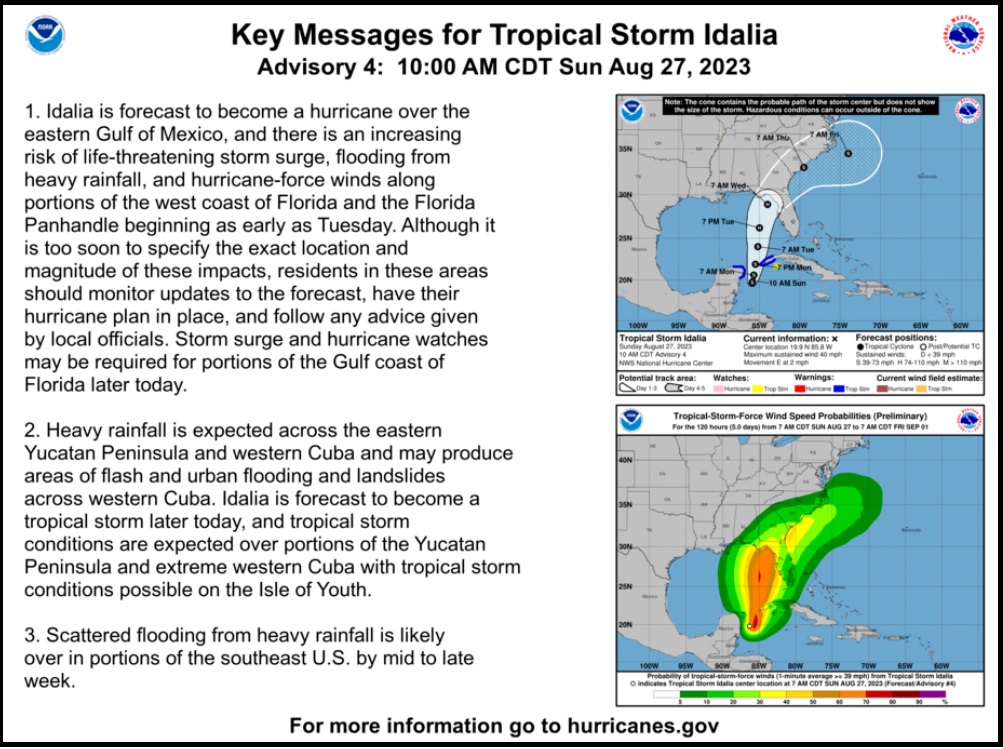
Information from the National Hurricane Center [DATA HERE] indicates currently slow-moving Tropical Storm Idalia will likely speed up quickly tomorrow and form a Hurricane in the Gulf of Mexico on Tuesday.  The current cone of uncertainty puts the Northern and Western portion of Florida at greatest risk.

At 100 PM CDT (1800 UTC), the center of Tropical Storm Idalia was located near latitude 20.0 North, longitude 85.8 West. Idalia is moving toward the north near 2 mph (4 km/h), and it is likely to meander near the Yucatan Channel through tonight. A faster motion toward the north is expected on Monday, bringing the system over the eastern Gulf of Mexico.

Maximum sustained winds remain near 40 mph (65 km/h) with higher gusts. Strengthening is forecast, and Idalia is expected to become a hurricane by Tuesday.
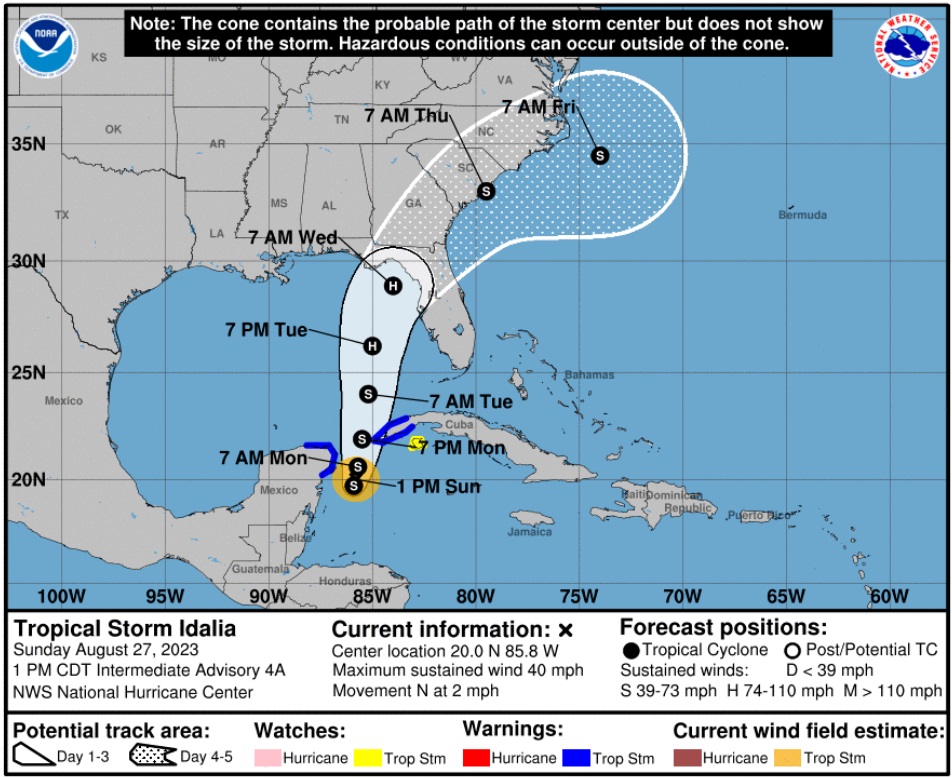
Idalia will come fast, most likely making landfall at a category 2 hurricane.  Those in the cone of uncertainty should pay attention, and people in the Tampa and St Pete region who have really lucked out in the past 30 years, should pay very close attention.

I hope you will understand why my proactive tips, advice and planning have modified since our experience with the September 2022 Hurricane, Ian. {Go Deep} Thankfully Idalia is not expected to be anything similar to Ian.  However, for those in the Tampa/St Pete area, do not be complacent.   This is a large metropolitan area with a similar demographic to the impact zone of Ian.
In my last set of proactive suggestions, {GO DEEP HERE} I focused first and foremost on something few discuss, mental capability.  Due to what I witnessed in Hurricane Ian with the people of the area, I am always going to put this into the analysis now to provide consideration that few understand.  I saw Ian literally break strong people down and create a PTSD demographic I have never experienced before.

What follows below are things to consider if you are prepping for a hurricane impact and/or deciding whether to stay in your home or evacuate.  Standard hurricane preparations should always be followed.  Protect your family, secure your property and belongings, and prepare for the aftermath.

What you do before the hurricane hits is going to determine where you are in the recovery phase.

Additionally, and this should be emphasized and discussed within your family, if you cannot be self-sufficient in the aftermath – for any reason, then you should evacuate.  Self-sufficiency in this context requires being able to cope for up to several weeks:

(1) potentially without power; (2) potentially without potable running water (3) potentially without internet service; (4) potentially without communication outside the region; and (5) with limited municipal and private sector assistance.   If you decide you cannot deal with these outcomes, you should evacuate.

Additionally, as a family or individual, you should also honestly evaluate:

(1) your physical abilities; (2) your emotional and psychological ability to withstand extreme pressures; and (3) your comfort in losing daily routines, familiar schedules and often overlooked things you might take for granted.

Post hurricane recovery is fraught with stress, frustration and unforeseeable challenges.  {GO DEEP}

For those in the cone of uncertainty, remember, planning and proactive measures taken now can significantly reduce stress in the days ahead.  Plan when to make the best decision on any evacuation (if needed). For now, consider Tuesday night the decision timeframe. As a general rule: take cover from wind – but evacuate away from water.

DAY ONE (Today)

  • Determine Your Risk
  • Make a Written Plan
  • Develop and Evacuation Plan
  • Inventory hurricane/storm supplies.

DAY TWO (Monday)

  • Get Storm Update
  • Assemble and Purchase Hurricane Supplies
  • Contact Insurance Company – Updates
  • Secure Important Papers.
  • Strengthen and Secure Your Home
  • Make Evacuation Decision for your Family.

DAY THREE (Tuesday)

  • Get Storm Update
  • Re-Evaluate your Supplies based on storm update.
  • Finish last minute preparation.
  • Assist Your Neighbors
  • If Needed – Evacuate Your Family

Communication is important.  Update your contact list. Stay in touch with family and friends, let them know your plans. Select a single point of contact for communication from you that all others can then contact for updates if needed.  Today/tomorrow are good days to organize your important papers, insurance forms, personal papers and place them in one ‘ready-to-go’ location.

Evaluate your personal hurricane and storm supplies; update and replace anything you might have used. Assess, modify and/or update any possible evacuation plans based on your location, and/or any changes to your family status.

Check your shutters and window coverings; test your generator; re-organize and familiarize yourself with all of your supplies and hardware. Check batteries in portable tools; locate tools you might need; walk your property to consider what you may need to do based on the storms path. All decisions are yours. You are in control.

Consider travel plans based on roads and traffic density. Being proactive now helps to keep any future stress level low. You are in control. If you have pets, additional plans may be needed.

One possible proactive measure is to make a list of hotels further inland that you would consider evacuating to.  Make that list today and follow updates of the storms’ progress.

Depending on information tomorrow you might call in advance and make a reservation; you can always cancel if not needed.  It is better to have a secondary evacuation place established in advance.  Being proactive reduces stress.  Even if you wait until much later to cancel, it is better to pay a cancellation fee (usually one night charge) than to not have a plan on where to go.   Trust me, it’s worth it.

Protect your family. Make the list of possibilities today, make the booking decision in the next 24 hrs.

Look over the National Hurricane Center resources for planning assistance.

If you do not handle stress well, leave.

If you cannot be self-sufficient in the aftermath, leave.

If you choose to stay pay super close attention to the exact path of the storm.  A few miles make a massive difference when you are dealing with the possibility of encountering the eyewall of a hurricane.

This is a fury of nature, a battle where the odds are against you, that you may or may not be aware you are contemplating when you are choosing to stay or evacuate.  It’s not the hurricane per se’, it’s that much smaller killer buzzsaw – the eyewall- that you are rolling the dice, never to see.

When it comes to the eyewall, the truest measure of the “cone of uncertainty“, the difference between scared out of your mind (victim) and a fight to avoid death (survivor), is literally a matter of a few miles. And there ain’t no changing your mind once it starts.

♦ Hardening your home is a matter of careful thought and physical work.  However, every opening into your structure must be protected, leaving yourself with one small exit opportunity just in case. Hopefully you have a bolted door with no glass windows you can use as an emergency exit.  If not, select a small window and leave only enough room uncovered for you to get out in case of emergency or structural collapse.

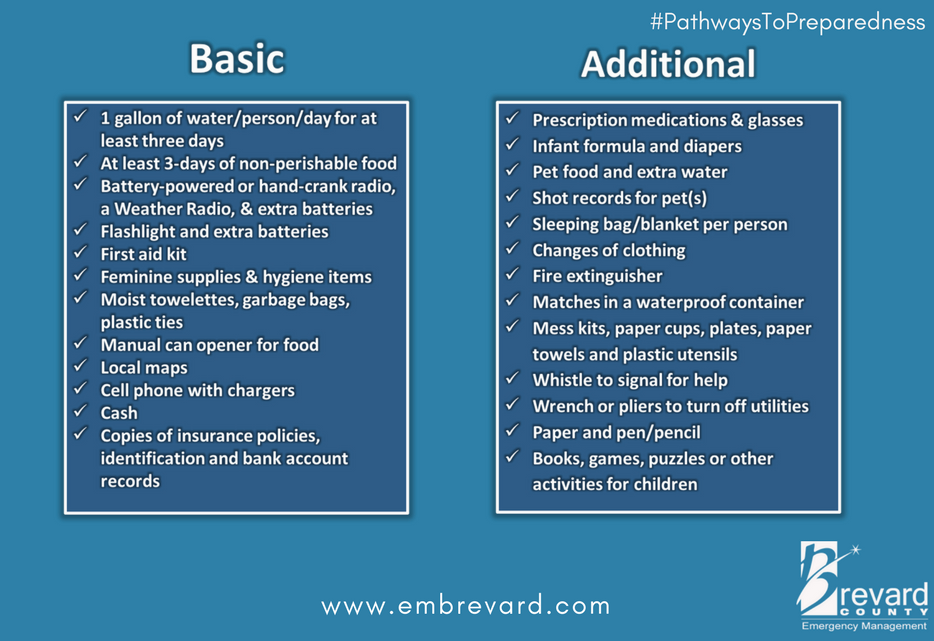
Beyond the ordinary supplies like drinking water, batteries, flashlights, battery or hand-crank radio, generators, gasoline, etc.  Evaluate the scale of what you have against the likelihood of weeks without power or water.   A few pro tips below:

♦ Put three 30-gallon trash cans in the shower and fill them with water before the storm.  This will give you 90 gallons of water for cooking and personal hygiene.  You will also need water to manually flush your toilets.  Bottled water is great for drinking, hydrating and toothbrushing, but you will need much more potable water if the municipal supply is compromised or broken.

♦ A standard 6,500-to-8,500-watt generator will run for approximately 8 hours on five gallons of gasoline.   Do not run it all the time.  Turn it on, chill the fridge, make coffee, use the microwave or charge stuff, then turn it off.  Do this in 4-hour shifts and the fridge will be ok and your gasoline will last longer.  Gasoline is a scarce and rare commodity in the aftermath of a hurricane.  Gas stations don’t work without power.  Check the oil in the generator every few days.  Also, have a can of quick start or butane available in case the generator starts acting up.

♦ Extension cords.  If you are purchasing them buy at least one 50 to 100′ extension cord with a triple ponytail.  This way you can use one cord into a central location to charge up your electronic devices.  Establish a central recharging station for phones, pads, laptops, and rechargeable stuff.

♦ Purchase a box of “contractor garbage bags” and just keep them in the garage.  These are large, thick, industrial trash bags that fit 40-gallon drums. They can be used for trash, or even cut open for tarps in the aftermath of a storm.  These thick mil contractor bags have multiple uses following a hurricane.

♦ Do all of your laundry before the hurricane hits.  You will likely not have the ability again for a few weeks.

♦ Cook a week’s worth of meals in advance of the hurricane. Store in fridge so you can microwave for a meal.  Eating a constant diet of sandwiches gets old after the first week.  Dinty Moore canned beef stew and or Chef-boy-ardee raviolis can make a nice break…. anything, except another sandwich.

♦ Have bleach for use in disinfecting stuff before and after a hurricane.  Also have antibiotics and antiseptics for use.  Hygiene and not getting simple infections after a hurricane is critical and often forgotten.  Again, this is where the extra potable water becomes important.  Simple cuts and scrapes become big deals when clean potable water is not regularly available.  Keep your scrapes and abrasions clean and use antiseptic creams immediately.

♦ Do not forget sunscreen and things to relieve muscle aches and pains.  Hurricane recovery involves physical effort.  You will be sore and/or exposed to the elements.  Remember, it’s all about self-sufficiency because the normal services are not available.  A well-equipped first aid kit is a must have.

♦ Buy a small camping stove.  Nothing big or expensive, just something you can cook on outside in case of emergency.  It will be a luxury when you are 2+ weeks without power and all the stores and restaurants are closed for miles.

♦ Those small flashlights that you can strap around your head that take a few AAA batteries?  Yup, GOLD.  Those types of handsfree flashlights are lifesavers inside and outside when you need to see your way around.  Nighttime is especially dark without electricity in the entire town.  Doing stuff like filling a generator with gasoline in the middle of the night is much easier with one of those head strap flashlights.  Strongly advise getting a few, they’re inexpensive too.

♦ Cash.  You will need it.  Without power anything you may need to purchase will require cash, especially gasoline.  Additionally, anyone you hire to help or support your immediate efforts will need to be paid.  Cash is critical.  How much, depends on your individual situation, but your cash burn rate will likely go into the thousands in the first few days.  Also keep in mind, you may or may not be able to work and without internet access even getting funds into place could be challenging.

♦ Hardware. A box of self-tapping sheet metal screws (short and long) is important, along with a box or two of various wood screws or Tyvex screws.  A battery drill or screw gun is another necessity.  Check all of this stuff during hurricane prep.
Reminder of Some Less Familiar Disaster and Hurricane Prep Tips


Posted originally on the CTH on August 21, 2023 | Sundance 

The next sixty days are peak hurricane and storm season for the Southeast coast.  While we all hope for a non-eventful next few months, several people have requested a repost of the lessons from Hurricane Ian.  I am duplicating that information for sharing and bookmarking in case you missed it last year.

[Current Tropical Status per NHC]

The ‘context’ of Ian was shared previously {Go Deep}.  What follows below are things to consider if you are prepping for a hurricane impact and/or deciding whether to stay in your home or evacuate.  Standard hurricane preparations should always be followed.  Protect your family, secure your property and belongings, and prepare for the aftermath.

What you do before the hurricane hits is going to determine where you are in the recovery phase.

Additionally, and this should be emphasized and discussed within your family, if you cannot be self-sufficient in the aftermath – for any reason, then you should evacuate.

Self-sufficiency in this context requires being able to cope for up to several weeks:

(1) potentially without power; (2) potentially without potable running water (3) potentially without internet service; (4) potentially without communication outside the region; and (5) with limited municipal and private sector assistance.   If you decide you cannot deal with these outcomes, you should evacuate.

Additionally, as a family or individual, you should also honestly evaluate:

(1) your physical abilities; (2) your emotional and psychological ability to withstand extreme pressures; and (3) your comfort in losing daily routines, familiar schedules and often overlooked things you might take for granted.

Post hurricane recovery is fraught with stress, frustration and unforeseeable challenges.

I saw a video presented by a structural engineer who was sharing his experience with Hurricane Ian.  I am going to use his video for a few references because even with professional credentials, some of the common mistakes people make are highlighted in his experience.  Keep in mind his video is taken about 30 miles inland from where the majority impact area (coastal region) is located.

The video below was shot from the soft side (western side) of the storm, and if we were to scale the difference between his experience and a person who was located in/around Fort Myers Beach, Sanibel, Pine Island or Cape Coral, he would be around a “5” on a ten-point impact scale.

Meaning the severity of conditions 30 miles southeast of him was twice as severe as his inland experience.

Key Points – At the 21: 35 moment (prompted), notice how his #2 vehicle is parked outside.  Also, at the 22:00 minute moment, notice what he is describing and showing with his garage door and how his #1 vehicle (a pickup truck) is positioned inside the garage. WATCH:

.

♦ This is exactly what I was talking about in hurricane preparation when discussing the garage door.  If that videographer was located 30 miles southeast, and/or his house was positioned facing West, instead of North, his garage door would have failed.  If you lose the garage door, YOU COULD LOSE YOUR ROOF.

You can always tell those people who have been through direct hurricane impacts by how they parked their cars.  I have never included this in the hurricane advice before so it’s worth a mention.  If you lose your Florida garage door you will more than likely lose your roof.  That’s just the reality of having a massive opening in your structure to 150 mph winds that will lift the trusses.

If you have two vehicles, put one vehicle inside the garage with the front bumper against the door to help stop the flex (do this carefully).  Put the other vehicle outside blocking the garage door facing down the driveway or facing parallel to the garage.  The goal is to use the aero dynamics of the car to push the wind away from the door and provide protection.

Purchase a cheap car cover to protect the outside vehicle and/or use old blankets (cable ties, bungee cords) to stop the outside vehicle from getting sandblasted and destroyed.  Place double folded corrugated cardboard in front of the radiator to protect it from storm debris.

Additionally, if you live in a flood zone, or if you are concerned about storm surge, the day before impact take your #1 car to the nearest airport or hotel with a parking garage and park in the upper levels.  Take an uber back home if you don’t have a friend or partner to help you.  This way you know you will have one workable vehicle, just in case.

♦ Another lesson from Ian, if you drive an electric vehicle and sustain saltwater intrusion (of any level) your car is not safe.  Saltwater makes the vehicle batteries extremely dangerous, and they could spark or catch fire.  Multiple homes survived Hurricane Ian only to have the electric car catch fire in the garage and burn the house to the ground.  Hurricane rain is saltwater rain.  The fire department was begging people to put their ev’s outside and not to plug them in.  Dozens of ev’s also erupted in flames while driving down the streets after the storm.

Back to the video above…

♦ Notice at 24:30 of the video this professional structural engineer is standing and physically supporting his glass patio doors, with his wife, trying to keep them from breaking in due to wind and pressure changes.  DO NOT DO THIS !   That is beyond dangerous.  Any small item of debris (even a small twig or branch) could hit that window and shatter it, turning flying glass into instant flying blades.

Put 3/4-inch plywood or steel bolted hurricane shutters over all your windows and doors.  Period.  This is not an option.  My steel bolted hurricane shutters were hit with debris so hard – whatever it was physically dented the steel.  Every window and door need to be covered and protected, especially glass patio doors (even if tempered). Do not think you can stand there and protect glass doors.  It’s beyond dangerous.

♦ Hardening your home is a matter of careful thought and physical work.  However, every opening into your structure must be protected, leaving yourself with one small exit opportunity just in case. Hopefully you have a bolted door with no glass windows you can use as an emergency exit.  If not, select a small window and leave only enough room uncovered for you to get out in case of emergency or structural collapse.

Beyond the ordinary supplies like drinking water, batteries, flashlights, battery or hand-crank radio, generators, gasoline, etc.  Evaluate the scale of what you have against the likelihood of weeks without power or water.   A few pro tips below:

♦ Put three 30-gallon trash cans in the shower and fill them with water before the storm.  This will give you 90 gallons of water for cooking and personal hygiene.  You will also need water to manually flush your toilets.  Bottled water is great for drinking, hydrating and toothbrushing, but you will need much more potable water if the municipal supply is compromised or broken.

♦ A standard 6,500-to-8,500-watt generator will run for approximately 8 hours on five gallons of gasoline.   Do not run it all the time.  Turn it on, chill the fridge, make coffee, use the microwave or charge stuff, then turn it off.  Do this in 4-hour shifts and the fridge will be ok and your gasoline will last longer.  Gasoline is a scarce and rare commodity in the aftermath of a hurricane.  Gas stations don’t work without power.  Check the oil in the generator every few days.  Also, have a can of quick start or butane available in case the generator starts acting up.

♦ Extension cords.  If you are purchasing them buy at least one 100 to 150′ extension cord with a triple ponytail.  This way you can use one cord into a central location to charge up your electronic devices.  Establish a central recharging station for phones, pads, laptops, and rechargeable stuff.

♦ Purchase a box of “contractor garbage bags” and just keep them in the garage.  These are large, thick, industrial trash bags that fit 40-gallon drums. They can be used for trash, or even cut open for tarps in the aftermath of a storm.  These thick mil contractor bags have multiple uses following a hurricane.

♦ Do all of your laundry before the hurricane hits.  You will likely not have the ability again for a few weeks.

♦ Cook a week’s worth of meals in advance of the hurricane. Store in fridge so you can microwave for a meal.  Eating a constant diet of sandwiches gets old after the first week.  Dinty Moore canned beef stew and or Chef-boy-ardee raviolis can make a nice break…. anything, except another sandwich.

♦ Have bleach for use in disinfecting stuff before and after a hurricane.  Also have antibiotics and antiseptics for use.  Hygiene and not getting simple infections after a hurricane is critical and often forgotten.  Again, this is where the extra potable water becomes important.  Simple cuts and scrapes become big deals when clean potable water is not regularly available.  Keep your scrapes and abrasions clean and use antiseptic creams immediately.

♦ Do not forget sunscreen and things to relieve muscle aches and pains.  Hurricane recovery involves physical effort.  You will be sore and/or exposed to the elements.  Remember, it’s all about self-sufficiency because the normal services are not available.  A well-equipped first aid kit is a must have.

♦ Buy a small camping stove.  Nothing big or expensive, just something you can cook on outside in case of emergency.  It will be a luxury when you are 2+ weeks without power and all the stores and restaurants are closed for miles.

♦ Those small flashlights that you can strap around your head that take a few AAA batteries?  Yup, GOLD.  Those types of handsfree flashlights are lifesavers inside and outside when you need to see your way around.  Nighttime is especially dark without electricity in the entire town.  Doing stuff like filling a generator with gasoline in the middle of the night is much easier with one of those head strap flashlights.  Strongly advise getting a few, they’re inexpensive too.

♦ Cash.  You will need it.  Without power anything you may need to purchase will require cash, especially gasoline.  Additionally, anyone you hire to help or support your immediate efforts will need to be paid.  Cash is critical.  How much, depends on your individual situation, but your cash burn rate will likely go into the thousands in the first few days.  Also keep in mind, you may or may not be able to work and without internet access even getting funds into place could be challenging.

♦ Hardware. A box of self-tapping sheet metal screws (short and long) is important, along with a box or two of various wood screws or Tyvex screws.  A battery drill or screw gun is another necessity.  Check all of this stuff during hurricane prep.
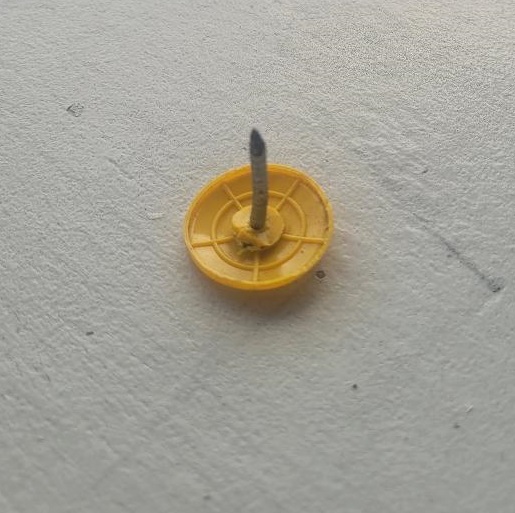
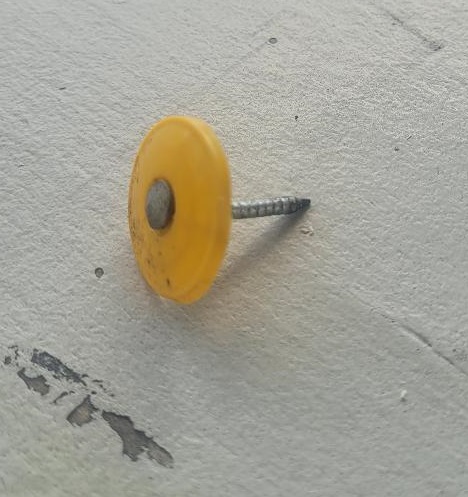
♦ ADD.  I forget my #1 personal nemesis in the aftermath (pictured below):

Roofing nails.  The pesky roofing nails.  Thousands of em’, all over. Those buggers are everywhere, and they will go through a flip-flop, sneaker sole or car tire perfectly. Most of them are black (not yellow) like the ones above.  Some of them have square of flat tops to help them stand up just perfect to find your tires.

I happen to believe roofing nails are actually tire magnets with some sort of automatic triggering system to jump in front of your car at the worst possible moments.  On the positive side, I think my neighborhood is safe because my tires have picked up every one of em’.  LOL and Grrrr…

I hope this is useful.  [Lie to me, even if it ain’t. lol.]

Love to all,

~ Sundance

Migration & War = Deadly Disease Cycle


Armstrong Economics Blog/Disease Re-Posted Jun 26, 2023 by Martin Armstrong

The border crisis that we have in the United States is part of the cycle of disease that our model has been projecting. In late May, Sarasota County, Florida, health officials confirmed that they had identified a case of locally transmitted malaria. Then a second confirmed case appeared on June 23 rd in Texas, discovered in Cameron County. There are several thousand cases of malaria in the USA each year, but these are contracted overseas – not locally. A mosquito contracts it by biting a person who has malaria and then it bites another person giving them malaria. There have been ABSOLUTELY ZERO domestic malaria cases in over 20 years.

The source of this disease is clearly the migrants that Biden has been letting in in hopes of granting them citizenship so they can vote for him in the 2024 election against working Americans. The other plan is to offer them citizenship by signing up for the military since our volunteer army is understaffed. Those reasons aside, this mass migration comes with zero health requirements but then an employer cannot hire someone who does not have a SS# to pay taxes. Hence, they are here for a free ride.

A simple review of history reveals that such massive waves of disease with drastic death rates have ALWAYS, and without exception, been mostly linked to war where soldiers are sent to fight in foreign lands and bring home with them a new plague and mass migrations.

BlackDeath-10

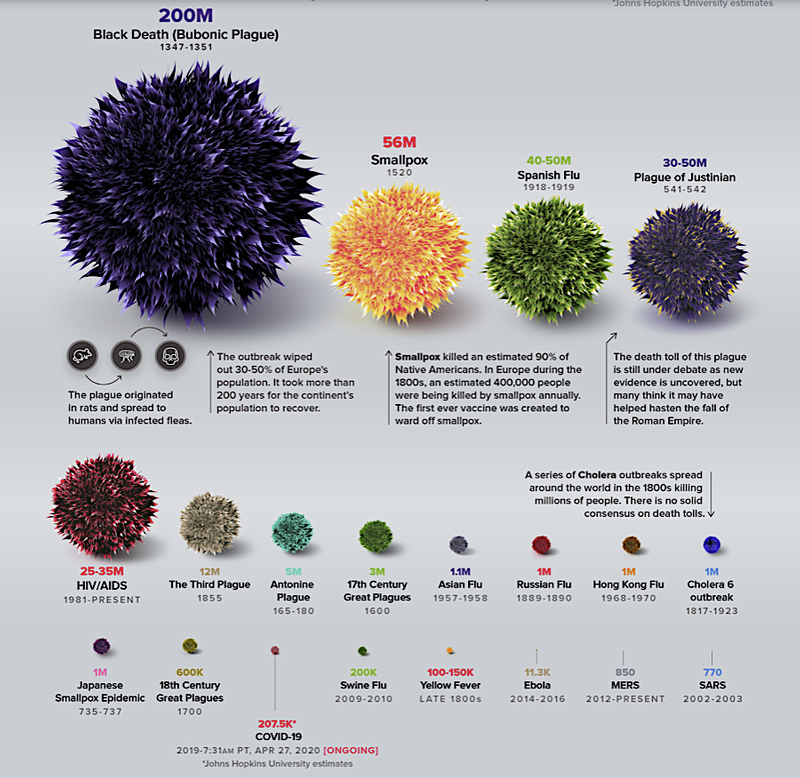
During the 14th century, rumors of a great plague in China and India killed most of their population. The plague made its way to Europe when the Kipchak forces besieged the Genoese trading post in Crimea – the disputed territory in Ukraine. The Kipchaks began to catapult plague-infested corpses over the walls and into the trading post. The disease spread quickly, and the Genoese abandoned the outpost. They sailed back to Europe, stopping in Sicily in 1347, taking back the Black Death. From there, it quickly engulfed all of Europe.

The Black Death occurred during Edward III’s reign (1327-1377), and contemporary accounts place the devastation between 30% and 50% of the population throughout Europe.  Human nature never changes throughout the centuries. Just as we saw during COVID how they pushed Pfizer’s vaccines and refused to acknowledge the side-effects that even killed many, they demonized the unvaccinated. The very same took place during the Black Death.

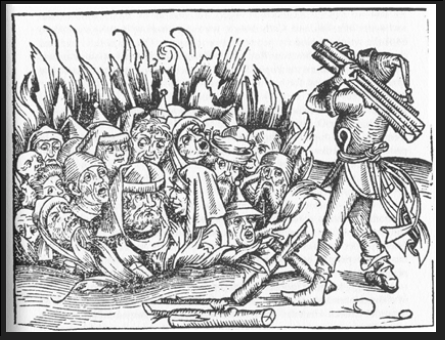
While it was the “unvaccinated” during COVID, they blamed the Jews during the Black  Death. Indeed, the Jewish population of Europe was turned into the spreader of the plague between 1347-1350. The Jews were accused of creating and spreading the plague (Cantor 2001; In the Wake of the Plague. Simon and Schuster, New York, NY.)

In Spain, Germany, and Italy, Jewish families were marked with distinctive clothing, isolated, and killed. Hitler was not the first to require distinctive clothing to identify the Jews. He got the idea from the Black Death. When the plague hit southern France in 1348, the hatred of the Jewish people was unleashed. Four Jewish citizens were dragged from their houses and burned at the stake on the mere accusation that they had poisoned the town’s water supply with plague.

The initial charges of spreading the plague in southern France led to an outbreak of accusations and an explosion of death where more than 2,000 Jews were burned alive in France and Germany (Tuchman 1978; A Distant Mirror: The Calamitous 14th Century. Ballantine Books, New York, NY.) With COVID, they were using the status of being unvaccinated as an anti-government rebel who would not comply.

Once the Jews became the scapegoats during the Black Death, that distinction remained for centuries. The Spanish King Ferdinand and Queen Isabella (1474-1504) initially tried to protect the Jewish population from the Spanish Inquisition about 100 years later because of their economic importance throughout the country as moneylenders. Nevertheless, there was no return to normal once society had been divided during the Black Death, even 100 years later. Thus, blaming the Jews continued, eventually leading to The Spanish Inquisition in 1478. This is what we need to fear that the division within society between the vaccinated and non-vaccinated will remain a strategy employed by our governments for decades to come. They were restricting travel to required vaccination because the unvaccinated were people who resisted tyranny. The Black Death divided society, as we have seen during COVID. We will see this rise again as we will also see lockdowns to protect the government now firmly in control of the Neocons.

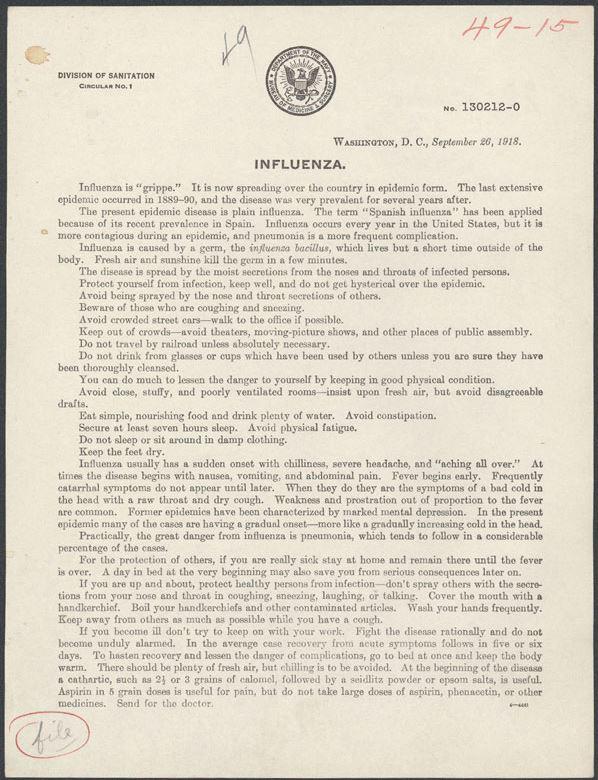
(Click on the image to enlarge)

The document above was issued by Washington, D.C., on September 26, 1918, in response to the Spanish flu. The document states that the virus circulates annually in the US but is “more contagious during an epidemic, and pneumonia is a more frequent complication.” It explicitly states: “do not get hysterical over the epidemic.” That is the opposite of what they did during COVID against all medical norms. The government in 1918 admitted the virus only lasted a short time outside the body and suggested that people avoid those sick or having sick persons directly sneeze or cough on them (seems very fair). Wash your hands, stay home if you are sick, sleep, and eat well. Fresh air helps. “Fight the disease rationally and do not become unduly alarmed.” We were told during the experimental COVID tyranny to lock down, do not go outside, and cash was now lethal. These were all manipulations to prepare us for authoritarian rule and the elimination of paper money.

Throughout history, both migrations and war spread disease. Our cyclical models correlate the two stunningly. The Antonine Plague, sometimes referred to as the Plague of Galen, erupted in 165 AD, at the height of Roman power throughout the Mediterranean world during the reign of Marcus Aurelius Antoninus (161-180AD). The first phase of the outbreak would last until 180AD affecting the entirety of the Roman Empire. The Antonine Plague of 165 to 180AD was the first known pandemic impacting the Roman Empire. It was most likely contracted by soldiers who were returning from campaigns in the Near East and spread throughout the empire.

That was the same correlation we found with the Black Death taken to Crimea by the invading forces from Asia. The Antonine Plague most likely took the life of Roman Emperor Lucius Verus. According to the Roman historian Cassius Dio, the disease broke out again nine years later, in 189 AD. That time he said, it caused up to 2,000 deaths per day in Rome itself. The total death count at the time ranged between 5 and 10 million. About 25% of those who contracted the plague died. This amounted to about 10% of the population being reduced.

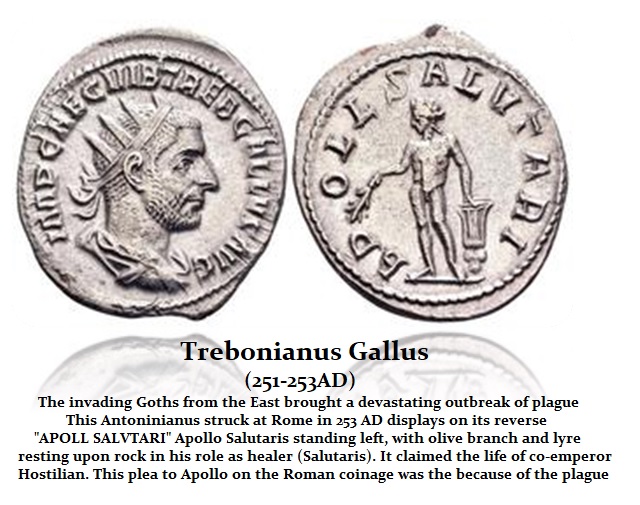
The next plague came in 251-266 AD and is known as the Plague of Cyprian, taking its name from St. Cyprian, the bishop of Carthage who witnessed and described the plague. Some historians have suggested that this plague also represents a useful starting point for understanding the beginning of the decline of the Roman Empire in the West and the underpinning of its ultimate fall. Once again, it was brought from Asia by invading armies. Emperor Trajan Decius (249-251AD) and his oldest son Herennius Etruscus (251AD) were killed in battle against the invading Goths. His youngest son, Hostilian (251 AD), died of the plague they brought with them to the Roman Empire.

This coin was issued by Trebonianus Gallus (251-253AD), appealing to Apollo Salutaris, who was believed to have been the god of healing to save the Empire. The Plague of Cyprian infected the Roman Empire from about 249 to 262 AD. It is not known precisely what it was. But from the description, it may have been smallpox, measles, or a viral hemorrhagic fever like Ebola. We know that this plague weakened Rome during the 3rd century, causing a widespread decline in the workforce. That resulted in food shortages and for lack of manpower to produce food for the Roman army. This contributed greatly to the collapse of the 3rd century and the price inflation in food as we are experiencing today.

The next disease cycle was during the reign of Byzantine Emperor Justinian I (527-565AD) and is thus known as the Plague of Justinian (541-542AD). This was the third major plague that struck during the 6th century. Research has been conducted on skeletons that have survived. It has been confirmed that DNA from Yersinia pestis—the same bacterium responsible for the Black Death. This plague also became a pandemic that spread throughout the Mediterranean region, yet it coincided with a Volcanic Winter, reducing the food supply. A mysterious cloud appeared over the Mediterranean basin, according to the historian Procopius of Caesarea (Procopius Caesarensis; c. 500-560 AD), who wrote:

“The sun gave forth its light without brightness, and it seemed exceedingly like the sun in eclipse, for the beams it shed were not clear.”

This was a volcanic cloud that blocked the sun setting in motion climate cooling for more than a decade. Crops failed, and there was widespread famine. This deadly combination of disease and climate change cooling set in motion a death spiral that swept through the Eastern Roman Empire killing 5,000 to 10,000 people per day in Constantinople.

War and migration have been the catalyst for disease. Why? The movement of populations from one region to another has historically spread disease. Even when the Europeans visited America, they brought diseases that killed many Indians. The National Institutes of Health estimated that 95 percent of the indigenous populations in the Americas were killed by infectious diseases during the years following European colonization, amounting to an estimated 20 million people. Likewise, Europeans who had sex with Indian women brought back to Europe Syphilis which did not previously exist in Europe.

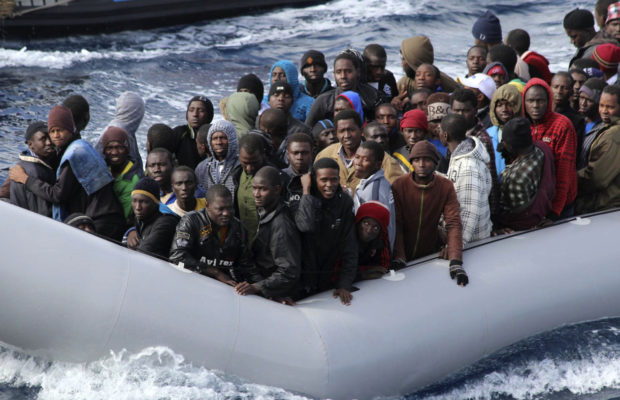
Migrants sit in a boat during a rescue operation by the Italian navy off the coast of Sicily on Nov. 28. Italy is looking to revamp the way it handles the hundreds of thousands of migrants who arrive annually.

The massive migrations both in Europe and the United States are also impacting the disease cycle. What is fascinating is that there were exactly 86 years between the Antonine Plague and the Plague of Cyprian. There were about 34 intervals of 8.6 years until the first signs of the major event of the Justinian Plague, but this was also impacted by climate change and the plunge in temperatures.

This disease cycle hits significantly in 2046.

Mississippi Death Toll Now 25 as Recovery Efforts Continue


Posted originally on the CTH on March 27, 2023 | Sundance

We loaded a CERT toolbox trailer yesterday that is heading to Mississippi to assist as recovery efforts get underway.  Samaritan’s Purse is now on the ground in two locations, Rolling Fork and Armory [Register to Volunteer Here]  Any Treepers in the impact zone check in and feel free to provide updates on the ground events that relate to your area.

(Via Fox News) – Help began pouring into one of the poorest regions of the U.S. after a deadly tornado tore a path of destruction for more than an hour across a long swath of Mississippi, even as furious new storms Sunday struck across the Deep South.

At least 25 people were killed and dozens of others were injured in Mississippi as the massive storm ripped through more than a half-dozen towns late Friday. A man was also killed in Alabama after his trailer home flipped over several times.

“Everything I can see is in some state of destruction,” said Jarrod Kunze, who drove to the hard-hit Mississippi town of Rolling Fork from his home in Alabama, ready to help “in whatever capacity I’m needed.”

[…] The storm hit so quickly that the sheriff’s department in Rolling Fork barely had time to set off sirens to warn the community of 2,000 residents, said Mayor Eldridge Walker.

“And by the time they initiated the siren, the storm had hit and it tore down the siren that’s located right over here,” Walker said, referring to an area just blocks from downtown.  The mayor said his town was devastated.

“Sharkey County, Mississippi, is one of the poorest counties in the state of Mississippi, but we’re still resilient,” he said. “We’ve got a long way to go, and we certainly thank everybody for their prayers and for anything they will do or can do for this community.”

[…] Following Biden’s declaration, federal funding will be available for recovery efforts in Mississippi’s Carroll, Humphreys, Monroe and Sharkey counties, including temporary housing, home repairs, loans covering uninsured property losses and other individual and business programs, the White House said in a statement.

The twister flattened entire blocks, obliterated houses, ripped a steeple off a church and toppled a municipal water tower.

Based on early data, the tornado received a preliminary EF-4 rating, the National Weather Service office in Jackson said in a tweet. An EF-4 tornado has top wind gusts between 166 mph and 200 mph.

In Rolling Fork, the tornado reduced homes to piles of rubble and flipped cars on their sides. Other parts of the Deep South were digging out from damage caused by other suspected twisters. (read more)

Samaritan’s Purse is setting up in the following locations:

ROLLING FORK/SILVER CITY
Lake Washington First Baptist Church
1068 Lake Washington Rd E
Glen Allan, MS 38744

AMORY
First Assembly of God Amory
521 Tschudi Road
Amory, MS 38821

[Details and information Here]

Dear God, please bring the residents and families of those in the Mississippi area to Your throne of comfort. The shock and pain is unimaginable as they anguish over the loss of their town, their homes, their sense of normalcy and possibly their loved ones.

Father of mercy and comfort wrap Your loving arms around them. Hold them close. Help them to breathe and overcome the choking knot of despair in their throat.  Raise them, strengthen them, provide assurance for them.  Help the victims to see forward.  Dear Lord please provide wisdom and strength to the leaders of every community.

Please God, provide strength for their continued faith in You through this horrific destruction. Lavish them with Your love and fill the void of loss in their hearts.

In Jesus’ powerful name, I believe and pray.


Amen.

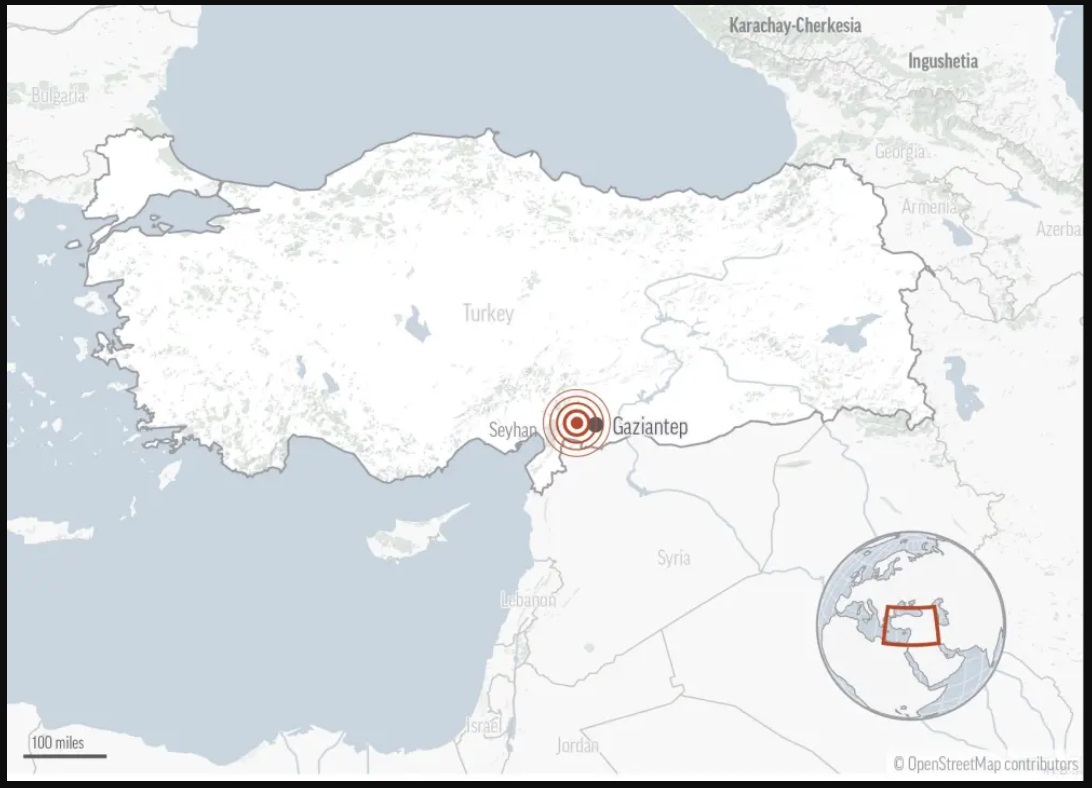
Horrific Death Toll Continues Rising from Earthquake in Turkey/Syria as Aftershocks Continue – So Far 5,600 Buildings Have Collapsed


Posted originally on the CTH on February 6, 2023 | Sundance

I did not have internet access for most of today, another long-term recovery issue.  However, now that I am seeing the footage of the earthquake in Southern Turkey and Northern Syria, my prayers are for all of those in the region.  The devastation is just incredible.

According to the Associated Press, 5,600 buildings have collapsed and several of them came down today during aftershocks amid search and rescue operations.  The current recorded death toll is over 4,300 people, with the World Health Organization (WHO) predicting the total loss of life could exceed 20,000.  This is just horrific.

The estimated 7.8 magnitude earthquake hit over an area of several major population centers. The Guardian reports, “the population of the ten provinces in southern Turkey affected by the earthquakes are home to 13.5 million people. So far, according to the Andalou agency, more than 5,600 buildings have collapsed.

It is just after 6am in Turkey, and we’re seeing stories of people rescued after a very long day and night, which means they survived not only the rubble’s collapse but the cold. There are many, many more who have not yet been found, with the WHO predicting the death toll could reach 20,000 in the coming days. For now, here are videos of a three-year-old toddler and a woman who were freed from collapsed buildings by rescuers.” (link)

(Via Reuters) […] The magnitude 7.8 quake brought down whole apartment blocks in Turkish cities and piled more devastation on millions of Syrians displaced by years of war. It struck before sunrise in harsh weather and was followed in the early afternoon by another large quake.

In Diyarbakir in southeast Turkey, a woman speaking next to the wreckage of the seven-storey block where she lived said: “We were shaken like a cradle. There were nine of us at home. Two sons of mine are still in the rubble, I’m waiting for them.”

She was nursing a broken arm and had injuries to her face.

“It was like the apocalypse,” said Abdul Salam al-Mahmoud, a Syrian in the northern town of Atareb. “It’s bitterly cold and there’s heavy rain, and people need saving.” (more)

All-powerful Father, as we see all of the destruction caused by this natural disaster, we mourn for all that has been lost and the fragility of this life.

Lord God of mercy, please comfort those who have lost somebody they love, and those who are yet still searching. Give them comfort and peace.

Heavenly Father, be a protective wing for those who have survived, but lost their home. Grant the men, women and children the needed fortitude and assistance they need to recover and rebuild.  Show me how best to pray for their needs and guide my prayer. 

Lord God of all creation, be strong with directed purpose for those whose job it is to search through the rubble for those lost.  Give them endurance and strength as they complete their responsibilities.

God of comfort and mercy, help us come together as one body in You during this time of tragedy.

You are the redeemer, the source of our strength and courage, please provide us with reassurance, humanity and faith. 

In Your holy and merciful name, we humbly kneel and pray. 

Amen.

Two More Bodies Recovered in Aftermath of Hurricane Ian


Posted originally on the CTh on January 14, 2023 | Sundance

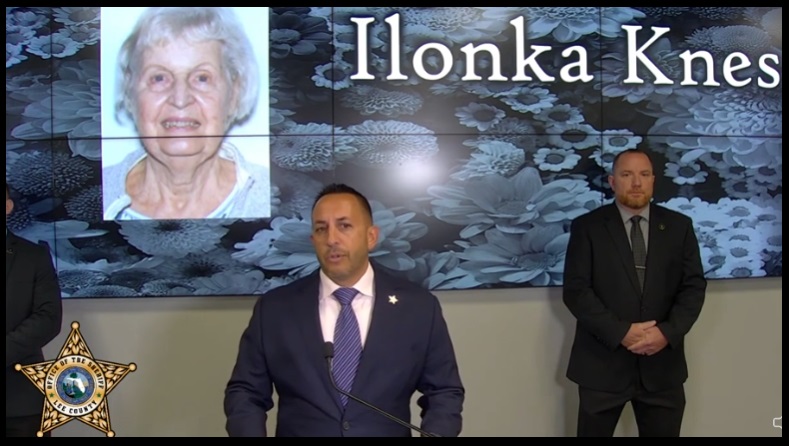
Their names will not make national headlines, and generally everyone has moved on, but to their families and friends Ilonka Knes and James Hurst mattered.  As CTH readers may remember, in the aftermath of Hurricane Ian we shared that many missing people would be found in the months after the storm, and unfortunately many more will likely never be found.

The body of Mrs Ilonka Knes (82) was found in the mangroves and back bay salt marsh near Fort Myers Beach and has been positively identified. The body of her husband Robert was found in the days immediately following Hurricane Ian.

Additionally, the sailboat “Good Girl” was found submerged with human remains believed to be the body of James ‘Denny’ Hurst (73).

Mrs. Knes and Mr Hurst bring the total number of Hurricane Ian victims in Lee County, Florida, to seventy-five.  Mr. Hurst was the final “official” missing person on the local list; however, there are many more yet unaccounted that were not from this immediate area.   The physical devastation is widespread, but the emotional toll on the families and friends of the missing has been beyond imagining.  Tonight, two more families have answers.

(FLORIDA) – During Thursday’s news conference, Lee County Sheriff Carmine Marceno released new information regarding the area’s recovery.

“Most of us have gotten back to a sense of the new normal. For some, still missing their loved ones, every day since the storm has been difficult,” said Marceno.

The sheriff said his agency originally attempted a well-being check at what was left at the home of Ilonka and Robert Knes in the aftermath of the storm.

The body of Robert Knes was found shortly after Ian struck, but there were no signs of his wife during the days and weeks following the disaster.

Marceno said it wasn’t until mid-January that a debris removal crew found remains in a dense patch of mangroves, that later tested positive, through the use of dental records, to be that of Ilonka. (more)

The power and duration of Hurricane Ian killed more people than Hurricane Andrew and the storm that hit Southwest Florida last September is now recorded as the deadliest storm in the past 87 years.

If you live anywhere along the coastline of the United States, inland to about 50 miles, please remember to always take these storms seriously.

After this storm, and having been through four previous direct impacts, including Homestead AFB (Andrew), I would say this….  If there is even a remote chance you would ever encounter this type of a hurricane event, EVACUATE.  Do not try and hunker down if there is a looming possibility of having to rely on a structure to withstand 150+ mph wind for a full day.  Just leave.  With all of my preparations in place, and all of the knowledge I possess in storm survival, I would never attempt it again.

It is more than three months since Hurricane Ian hit Southwest Florida and beyond the chaos and debris that still remains visible almost everywhere, they are still recovering bodies.  Please take hurricane preparations seriously.

Lessons from Ian – Part One

Lessons from Ian – Part Two

Severe Winter Storm Brings Cold, Snow and Proactive Warnings from White House


Posted originally on the conservative tree house on December 22, 2022 | Sundance 

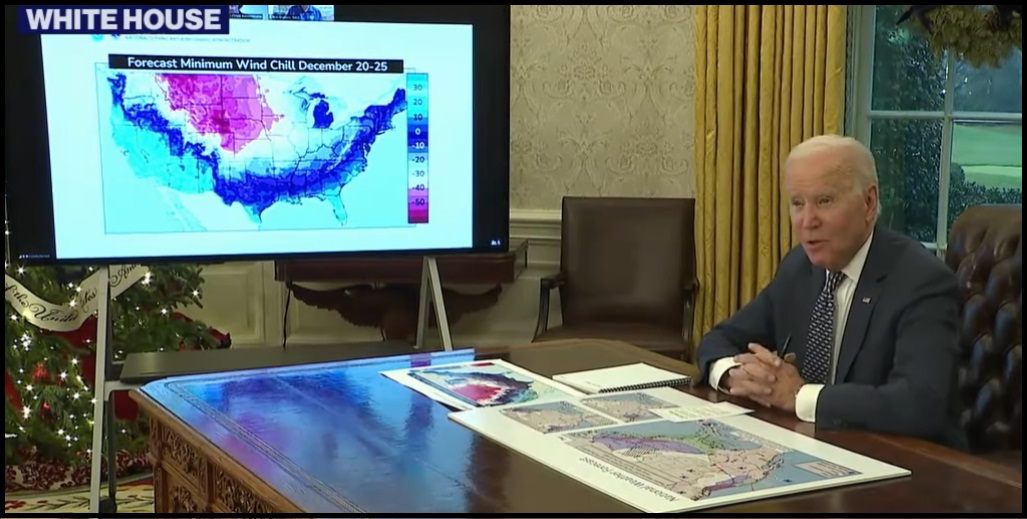
Extreme winter weather, such as subzero temperatures, wind chills and heavy snow, is impacting much of the U.S. this Christmas holiday weekend and is expected to heavily impact travel.  Major parts of the U.S. electricity grid are very vulnerable, particularly as a result of Biden energy policy, steering investment away from coal, oil and natural gas.

Places across the northern Rockies, northern Plains and upper Midwest are experiencing temperature drops by tens of degrees in minutes.  The extremely cold airmass is expected to hit at least 24 other states along the Gulf Coast and in the eastern U.S.  The National Weather Service has a Detailed Warning HERE.

The potential for severe consequences as an outcome of this winter storm has the political minders of Joe Biden worried.

.

(Via NWS) – A major and anomalous storm system is forecast to produce a multitude of weather hazards through early this weekend, as heavy snowfall, strong winds, and dangerously cold temperatures span from the northern Great Basin through the Plains, Upper Midwest, Great Lakes, and the northern/central Appalachians.

At the forefront of the impressive weather pattern is a dangerous and record-breaking cold air mass in the wake of a strong arctic cold front diving southward across the southern Plains today and eastward into the Ohio/Tennessee Valleys by tonight.

Behind the front, temperatures across the central High Plains have already plummeted 50 degrees F in just a few hours, with widespread subzero readings extending throughout much of the central/northern Plains and northern Rockies/Great Basin.

These temperatures combined with sustained winds of 20 to 30 mph and higher wind gusts of up to 60 mph will continue to lead to wind chills as low as minus 40 degrees across a large swath of the Intermountain West and northern/central Plains, with more localized areas of minus 50 to minus 70 possible through the end of the week. (read more)

I am reminded of Fort Wainwright, Alaska, in January of 1989, when a cold airmass settled on the state for weeks. It was so cold (-50°, -70° or worse) that airplanes could not achieve lift.  McGrath went from +29° to -42° during a work shift.  During a single work shift everyone’s truck tires were flat and frozen. LOL… Crazy stuff.

Joe Biden – “I’m going to, shortly, be briefed by — by both FEMA and the National Weather Service, and we’re going to start that briefing.
 
And — but in the meantime, please take this storm extremely seriously.  And I don’t know whether your bosses will let you, but if you all have travel plans, leave now.  Not — not a joke.  I’m tell- — sending my staff — my staff, if they have plans to leave on — tomorrow — late tonight or tomorrow, I’m telling them to leave now.  They can talk to me on the phone.  It’s not life and death.  But it will be if they don’t — if they don’t get out, they may not get out.
 
So, any rate, thank you all for coming in, and I’m going to do the briefing now.  Thank you.” (link)

The polar air will bring “extreme and prolonged freezing conditions for southern Mississippi and southeast Louisiana,” the National Weather Service (NWS) said in a special weather statement Sunday.

“We’re looking at much-below normal temperatures, potentially record-low temperatures leading up to the Christmas holiday,” said NWS meteorologist Zack Taylor. (link)

Armstrong Economics Blog/Nature Re-Posted Dec 20, 2022 by Martin Armstrong


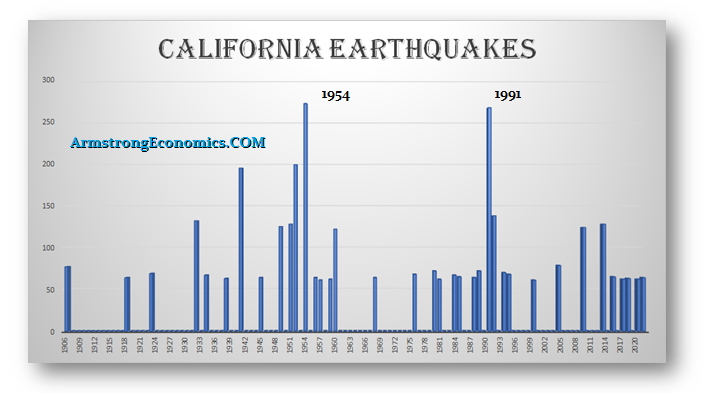
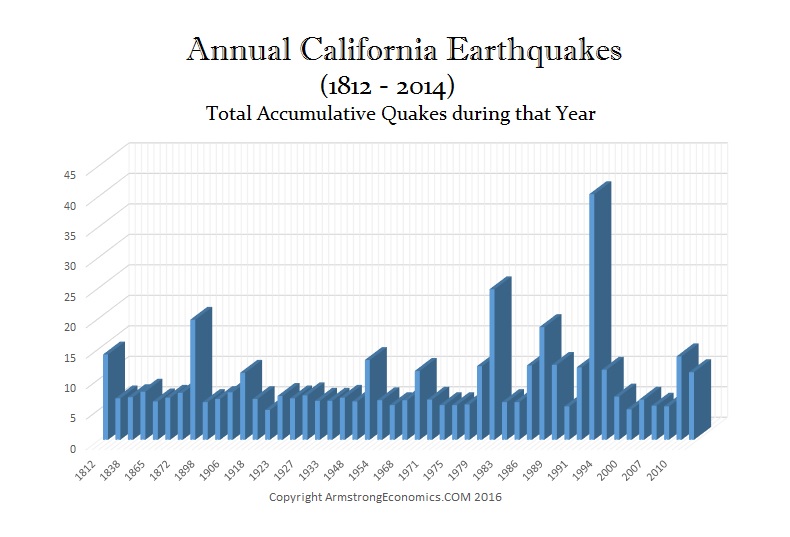
QUESTION: Marty, we had an earthquake here in Northern California today that seems to be following your forecast building into 2028. Can you update your earthquake chart?

Thank you

Jeff

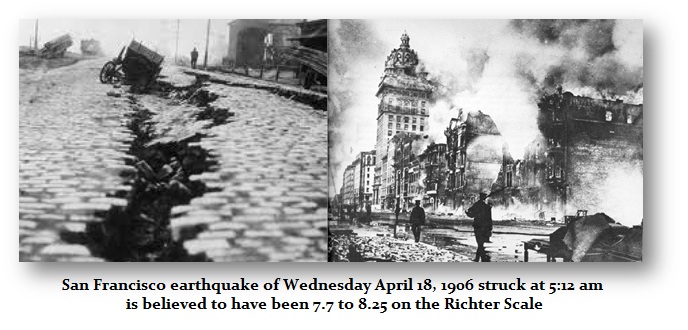
ANSWER: Here is the update. Socrates has already pulled that data down. Yes, the trend appears to be building into a serious cluster for 2028 which may exceed that of 1954. This chart is recording ONLY those quakes that are 6.0 or higher. There are numerous quakes in the 4 to 5 range. It was the 1906 Earthquake that set in motion the Panic of 1907 since the insurance companies were in NYC and the claims were in California. It was JP Morgan who stepped up to save the banks in NY and that became the model for how the Federal Reserve was created with 13 branches to manage the regional capital flows that resulted in the financial crisis in the aftermath of the 1906 San Francisco Earthquake which was a 7.7 on the Richter Scale.

This chart presents the total number of quakes regardless of the magnitude. Here we can see that 1992 was the year with the greatest number of quakes irrespective of magnitude. This is a different perspective entirely. The top chart is what I have called the cluster perspective where we only took into account 6.0 or higher. This illustrates that just like market activity, earthquakes build in intensity. They produce clusters of magnitude. The next serious period should still be 2028.

Volcano Eruptions On the Rise with Solar Minimum


Armstrong Economics Blog/Nature Re-Posted Dec 1, 2022 by Martin Armstrong

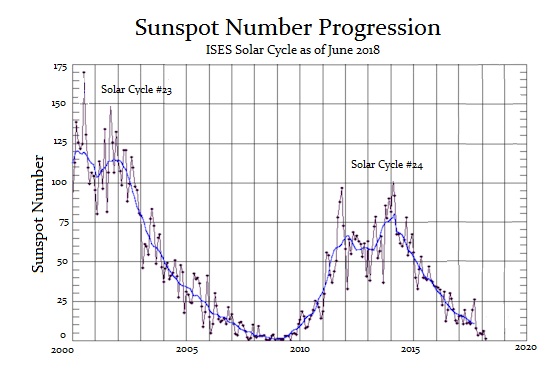
We are now in Solar Cycle 25 with peak sunspot activity expected in 2025. Solar Cycle 24 which ended in December 2019, was of average in length, at 11 years. However, it was the 4th-smallest intensity since regular record keeping began with Solar Cycle 1 in 1755. We’re now in Solar Cycle 25 and we are still in Solar Minimum conditions at this time. Solar Maximum is predicted to occur midway through this cycle which may come as soon as November 2024 but no later than March 2026, with this ideal peak reaching most likely by July 2025.

Right now, the solar wave is conforming more to our model than that of NASA. The Sun has become far more active than NASA has forecast or expected. NASA is beginning to worry that this Solar Cycle 25 could become the Strongest Cycle Since Records Began. Effectively, in terms of our model terminology, Solar Cycle 25 may be a Panic Cycle. In other words, we appear to be headed into the strongest cycle on record following the weakest cycle. That is high volatility in cycle terminology.

So what does this mean for Markets?

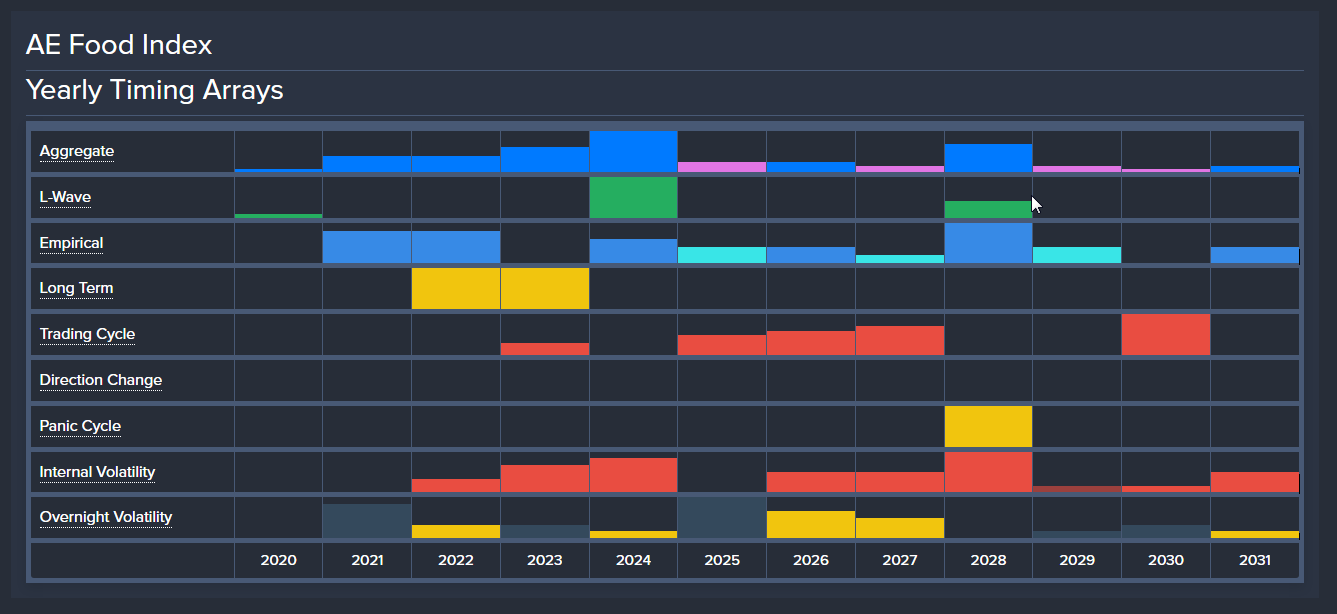
Since this Solar Minimum may continue into 2024, that appears to be a very major turning point on our global food index. Most of our models on markets are showing Panic Cycles in the 2027-2028 time period. That appears to be more war than nature.

I warned that Socrates, which monitors everything around the world, noticed a distinct correlation that more volcanos erupt during Solar Minimum. There have been many studies on the impact of UV and gamma radiation during solar changes and events. Gamma-rays are a form of electromagnetic radiation, as are radio waves, infrared radiation, ultraviolet radiation, X-rays, and microwaves. Gamma-rays can be used to treat cancer, and gamma-ray bursts are studied by astronomers.

I have also reported that our correlation models also show that solar minimums correspond to increased volcanic activity. Volcanic winters take place during solar minimums. It certainly seems that gamma-rays may be the reason volcanoes erupt more during these periods. This certainly also reduces food production and increases disease, presumably because of a rise in malnutrition. However, since gamma-rays are also used to treat cancer, there is at least a basis to warrant further investigation if the increase in gamma-rays during solar minimums impact certain susceptible people or those with particular DNA sequences.

1816 Year Without a Summer

We tend to ignore volcanos since they are not in our backyard. The deadly aspect of these volcanic eruptions is not the loudness of the boom, but how much ash it throws up into the atmosphere which then blocks the sun creating Volcanic Winter.

Go to the beach on a partly cloudy day. When a cloud blocks the sun it suddenly gets cool. This is common sense. As far as volcanoes blocking the sun, well all someone has to do is read: The Year Without Summer: 1816 and the Volcano That Darkened the World and Changed History

Tambora

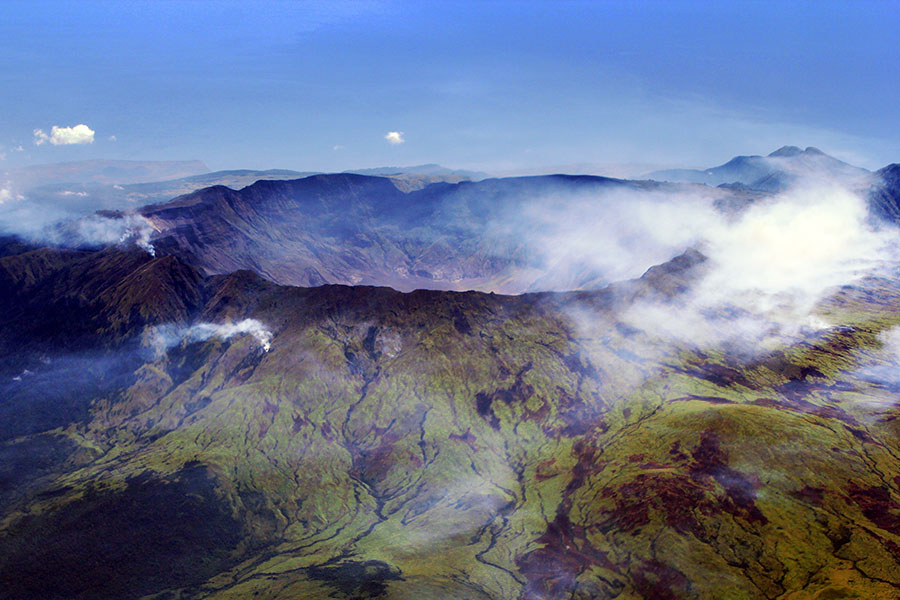
Mount Tambora (VEI 7) erupted  in 1816 and threw into the air so much ash that it snowed during the summer in New York City. It became known as 18-hundred-and-froze-to-death. This account from history tells the story that 1816 was a year when the sunlight could not penetrate the natural pollution from Tambora. As a result of a volcanic eruption at Mount Tambora in Indonesia, weather patterns were disrupted worldwide for months, allowing for excessive rain, frost, and snowfall through much of the Northeastern U.S. and Europe in the summer of 1816.

1817-Wheat-Y

The global cooling altered the natural weather and it resulted in a serious food shortage that set off a mass migration from New England to the Midwest within the USA as people were trying to find the sun. Some saw this as an omen and there was also a religious revival.

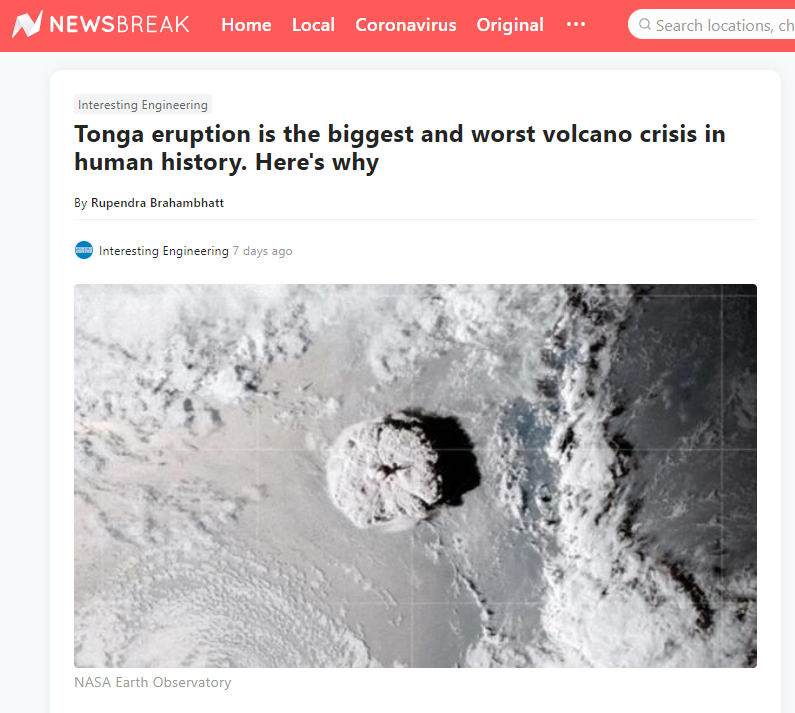
Almost one year has now passed since the Hunga-Tonga-Hunga-Ha’apai volcano erupted (VEI 5). Only now are we starting to realize that this eruption was the biggest volcanic event in human history. They have mapped the 22,000 km(2) area around the Tonga volcano. This has curiously taken place with the weakest solar minimum on record. More significantly, such a major explosion takes about one year before its true impact is understood worldwide.

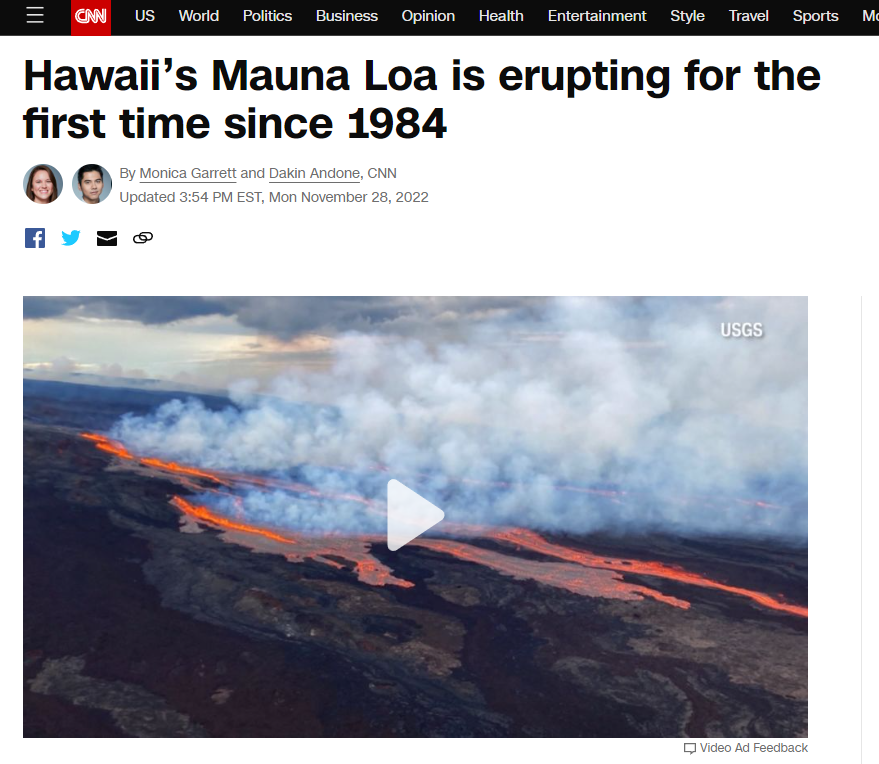
Mauna Loa, which is the largest volcano in the world covers half the island of Hawaii. It has erupted 33 times since 1843 making this an average cycle of 5.4 years. It tends not to be extremely violent as many others. Hawaii’s Mauna Loa has therefore erupted for the first time in decades but nearby, Kilauea is also erupting and both on the archipelago’s Big Island. Dual eruptions haven’t been seen since 1984.

The last eruption took place in 1984, making this prolonged quiet period the volcano’s longest in recorded history. More interesting, it is near Kilauea which erupted in 2018. The concern is not this volcano by itself. We are looking around the world at increased volcanic activity for the danger is a volcanic winter coming on top of these shortages manufactured by COVID restrictions.

There has been activity which has been detected in Alaska under what has been an 800-year dormant volcano near Sitka known as Mount Edgecumbe. This volcano was believed to have been extinct since it has not been active for at least 800 years. Earthquakes began earlier this year.

Just in August, in Indonesia, the Anak Krakatau Volcano erupted in Seven Explosions within Two Days. It unleashed 1500-Metre-High Scorching Ash.

The Ahyi Seamount is the largest submarine volcano which lies 449 feet deep in the Pacific Ocean below the Northern Mariana Islands, which are more than 3,700 miles west of Honolulu.

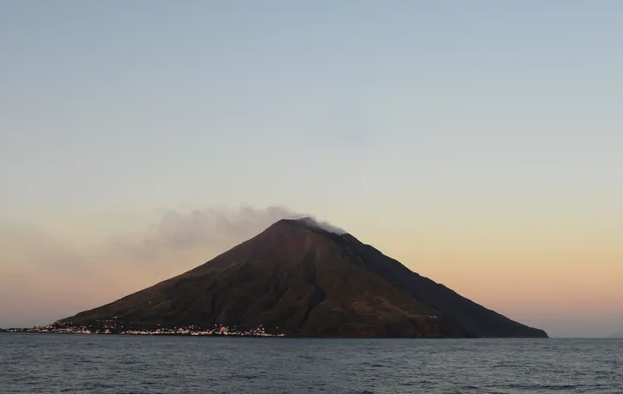
Meanwhile, over in Italy, the Stromboli volcano has also erupted also during October 2022. Several explosions inside of Italy’s Stromboli volcano sent enormous plumes of smoke into the sky and major streams of lava into the Tyrrhenian Sea over the weekend.

Over in Russia, its Shiveluch volcano has become active and now a powerful explosion is considered possible at any moment. It is one of the largest in the Russian far East volcanos recorded and it has had volcanic ash plume rising up to around 13000ft altitude.

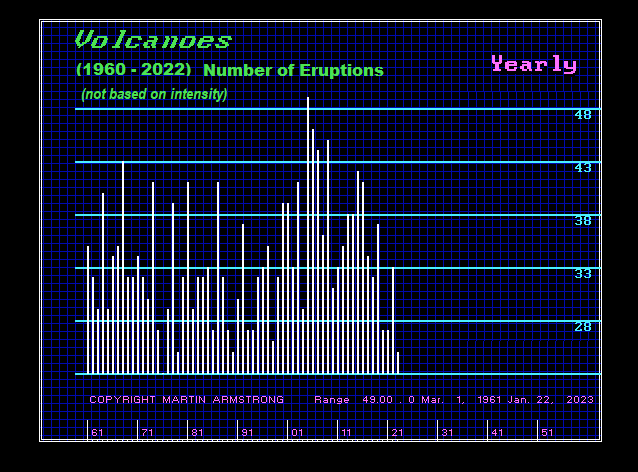
There were 5 eruptions last year around the world at 5 or higher on the Volcanic Explosivity Index (VEI). The first two eruptions here in 2022 were Bezymianny in Russia during May and Popocatépetl in Mexico during June. There was only one in 2020, but 5 during 2019. It appears we are witnessing a rise in global activity that is starting from a general major low in volcanic activity overall.

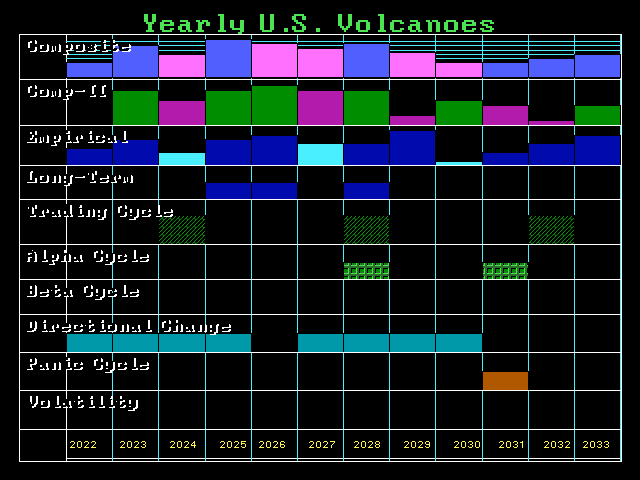
We have a string of Directional Changes between 2022 and 2025.  We may be looking at rising volcanic activity into 2025. We will run our models on intensity as well. The undersea Hunga Tonga-Hunga Ha’apai eruption of December 2021 into January 14-15, 2022 was a volcanic explosivity equivalent to VEI 5. It was an eruption of a magnitude greater than the 1991 eruption of Pinatubo in The Philippines. According to a news article, the main undersea international fiber-optic communication cable that had been severed in multiple places due to the eruption had been repaired by February 21, 2022, and internet connectivity was restored the following day.

The sheer magnitudes of this eruption tends to warn that we may in fact witness a very significant rise in both the frequency of eruptions as well as the magnitude into 2025. The  VEI describes the size of explosive volcanic eruptions based on magnitude and intensity. The numerical scale (from 0 to 8) is a logarithmic scale, and is therefore similar to the Richter and other magnitude scales for the size of earthquakes.

The largest eruption of magna took place at Yellowstone at Huckleberry Ridge about 2.1 million years ago. Our cycle models on Yellowstone have turned up and the “ideal” target would be in the year 2100. The difference between a VEI5 and VEI6 is a factor of 10 to 100.

Hurricane Nicole Expected to Impact Southeast, Southcentral Coast and Central Florida Overnight


Posted originally on the conservative tree house on November 9, 2022 | Sundance

Hurricane conditions are expected from Boca Raton to Flagler/Volusia County line along the coast in Florida tonight.  However, do not focus only on the center of the storm. Hurricane winds extend 25 miles from center, tropical storm winds 400+ miles from center, and massive rain are anticipated over central Florida with significant flooding north of Lake O.  Residents along coastal and inland waterways should be fully prepared for this storm.  Overnight conditions will deteriorate rapidly.

At 1000 PM EST (0300 UTC), the center of Hurricane Nicole was located near latitude 27.0 North, longitude 78.9 West. Nicole is moving toward the west-northwest near 13 mph (20 km/h). A turn toward the northwest is expected on Thursday, followed by a turn toward the north and north-northeast on Friday.

On the forecast track, the center of Nicole will move onshore the east coast of Florida within the hurricane warning area late tonight or early Thursday. Nicole’s center is then expected to move across central and northern Florida into southern Georgia Thursday and Thursday night, and into the Carolinas Friday.

Maximum sustained winds are near 75 mph (120 km/h) with higher gusts. Little change in strength is expected until Nicole makes landfall along the Florida east coast. Nicole is expected to weaken while moving across Florida and the southeastern United States Thursday through Friday, and it is likely to become a post-tropical cyclone by Friday afternoon. (more)

Many of us have spent the past 36 hrs preparing for this storm; however, my gut is telling me many are not ready for the potential flooding from Nicole.   Toolboxes and supplies are loaded, and relief/recovery supplies staged south of Lake-O are prepared to move north as needed.

Now, is when the southeast and southcentral east coast needs to hunker down in safe, secure and hardened structures away from the water.

Power is likely to be lost along the coastal and near coastal areas of Florida as well as central Florida north of Lake-O.  Stay inside during the storm passing and pay attention to local officials for instructions related to road closures and transit corridors.

East coast of Florida Treepers, if you find yourself in an emergency situation, feel free to reach out in the comment section or email directly.

Keep a good thought, all will be okay.

I know it is unnerving when these storms move in at night, but everything will be okay.  Nicole will hopefully pass through quickly, but the rain, ground saturation and potential for flooding may be problematic for several days.

Hurricanes can be frightening; downright scary.  There’s nothing quite like going through a few to reset your outlook on just how Mother Nature can deliver a cleansing cycle to an entire geographic region.   The sounds are scary. Try to stay calm despite the nervousness. Trees will bend and break; the sounds are dramatic.

If you are near the eyewall, there’s a specific sound when you are inside a hurricane that you can never forget.  It ain’t a howl, it’s a roar.  It is very unique sound in depth and weight.  Yes, within a hurricane wind has weight.  Stay clear of windows and doors, and within an interior room of the house or apartment if possible.

That scary roar sounds like it won’t ever quit…. it will… eventually; but at the time you are hunkering down, it doesn’t seem like it will ever end.

A hurricane wind, even a moderate one, is a constant and pure rage of wind that doesn’t ebb and flow like normal wind and storms. Hurricane wind is heavy, it starts, builds and stays; sometimes for hours.  Relentless, it just won’t let up.  And then, depending on Nicole’s irrelevant opinion toward your insignificant presence, it will stop.

Judging by the forward speed the hurricane force winds will likely last around 2 hours before she lets up.

Meanwhile, tomorrow you might walk outside and find yourself a stranger in your messed up neighborhood. It will all be cattywampus. Trees gone, signs gone, crap everywhere, if you don’t need to travel, DON’T.

I mean CRAP e.v.e.r.y.w.h.e.r.e. Stay away from powerlines.

Try to stay within your immediate neighborhood for the first 36-48 hours.  Keep the roadways and main arteries clear for recovery workers, power companies and relief trucks.

Remember, when it is safe to drive, if the power is out – every single intersection must be treated like a four-way stop…. and YOU ARE GOING TO HAVE TO PAY ATTENTION.  Even the major intersections.

You’ll need to override your brain tendency to use memory in transit.  You’ll need to pay close attention and watch for those who ain’t paying close attention.  Travel sparingly, it’s just safer.

Remember, this is important – YOU are the first responder for your neighborhood.  Don’t quit.  Recovery is a process.  Depending on the scale of the impact zone, the process can take days or weeks. Take care of your family first; then friends and neighborhood, and generally make a conscious decision to be a part of any needed solution.

Keep a good thought.  Who knows, we might even end up shaking hands.

It might suck a little bit, but it will be okay. Promise.

You got this!