A statement from Senate Judiciary Committee today outlines a letter received from the U.S. State Department highlighting security ramifications of the ongoing issues of former Secretary of State Hillary Clinton -and her staff- transmitting classified information over unsecured networks:
WASHINGTON – The U.S. State Department recently confirmed that former Secretary of State Hillary Clinton’s security clearance has been withdrawn at her request. Clearances for five other individuals whom Clinton designated as researchers have also been withdrawn, including close aide Cheryl Mills, according to the State Department’s update of its ongoing review of the mishandling of classified information related to the use of Clinton’s non-government email server.
Documents containing classified material have been sent to the Bureau of Diplomatic Security, and all valid security incidents have been added to the security file for some individuals. Department authorities are continuing to review tens of thousands of documents for classified content.
The update was provided to Senate Judiciary Committee Chairman Chuck Grassley and is being released for the first time following consultation with the State Department. The update follows a letter from the Department in May of 2017 confirming the Department’s review into any mishandling of classified information stemming from the use of Clinton’s non-government email server. That letter, which responded to an inquiry from Grassley, also outlined the review and adjudication process. (LINK)
This is an interesting panel segment. It is not often you get the primary source (Meadows) and the recipients (Carter, Solomon and Hannity) all in one panel segment. Representative Mark Meadows has been the primary source for information from within the joint committee oversight hearings to Sara Carter, John Solomon, Sean Hannity, Greg Jarrett and Catherine Herridge.
All of the panel participants concede that most of the declassified evidence against the soft-coup officials will not come out until after the mid-term election. Additionally, it appears to be generally accepted now that AG Jeff Sessions will be fired (allowed a graceful exit) in the lame-duck congressional period or soon after.
Very funny: “President Trump’s policies have re-jiggered the incentive system in the economy.” …Well, that’s a slightly different wording than CTH has used since 2016, but what Mr. Kudlow is highlighting is how POTUS has uncoupled the U.S. economic engine from Wall Street investment and re-coupled it to Main Street investment. [Go Deep]
Then comes the funniest pundit question ever…. “where is this disconnect coming from?”
Too funny. Long-term CTH readers likely joining me in laughing at the predictability of it all. [“Disconnect” January 2016] or [“Disconnect” July 2017]
2016 […] Understanding the distance between the real Main Street economic engine and the false Wall Street economic engine will help all of us to understand the scope of an upcoming economic lag; which, rather remarkably I would add, is a very interesting dynamic.
Think about these engines doing a turn about and beginning a rapid reverse. GDP can, and in my opinion, will, expand quickly. However, any interest rate hikes (monetary policy) intended to cool down that expansion -fearful of inflation- will take a long time to traverse the divide.
Additionally, inflation on durable goods will be insignificant – even as international trade agreements are renegotiated. Why? Simply because the originating nations of those products are going to go through the same type of economic detachment described above.
Those global manufacturing economies will first respond to any increases in export costs (tariffs etc.), by driving their own productivity higher as an initial offset, in the same manner American workers went through in the past two decades. The manufacturing enterprise and the financial sector remain focused on the pricing.
♦ Inflation on imported durable goods sold in America, while necessary, will ultimately be minimal during this initial period; and expand more significantly as time progresses and off-shored manufacturing finds less and less ways to be productive. Over time, durable good prices will increase – but it will come much later.
♦ Inflation on domestic consumable goods ‘may‘ indeed rise at a faster pace. However, it can be expected that U.S. wage rates will respond faster, naturally faster, than any monetary policy because inflation on fast-turn consumable goods become re-coupled to the ability of wage rates to afford them.
The fiscal policy impact lag, caused by the distance between federal monetary action and the domestic Main Street economy, will now work in our favor. That is, in favor of the middle-class.
Within the aforementioned distance between “X” and “Y”, a result of three decades traveled by two divergent economic engines, is our new economic dimension…
Earlier today President Trump met with Jim Brown and Kanye West in the Oval Office for a discussion about multiple issues involving social policy, mental health, endorsement deals, stop-and-frisk policies and support among African Americans for the president.
[Transcript] Oval Office – 12:32 P.M. EDT – THE PRESIDENT: Jon, you know Jim Brown? The greatest of all time.
Q It’s an honor, sir.
THE PRESIDENT: And what people don’t know, Kanye — everybody knows, right? Every — does the world know Kanye? Kanye, what people don’t know about Jim — they say — first of all, he’s the best football player. But they say he was an even better lacrosse player. Do you think so?
MR. BROWN: Never thought about it.
THE PRESIDENT: Huh?
MR. BROWN: Never thought about it.
THE PRESIDENT: I heard he was even — at Syracuse.
MR. BROWN: I love the game. Yes, I loved it. I loved all the sports.
THE PRESIDENT: Well, it’s great to have you, Jim. Great to have you.
MR. BROWN: It’s good to be here, Mr. President.
THE PRESIDENT: Kanye, it’s great to be with you.
MR. WEST: Great to be here.
THE PRESIDENT: And these are two friends of mine. And Kanye has been a friend of mine for a long time. And Jim is — Jim came out of nowhere, and he said, “I like what the President is doing.” A long time ago we met. Right? And I just appreciated it very much.
And, you know, if you look at the employment numbers, if you look at the median income, if you look at every single indicator, we’re keeping our promise, Jim. Thank you. And I want to thank you.
MR. BROWN: And I like North Korea.
THE PRESIDENT: I like North Korea too.
MR. BROWN: (Inaudible.)
THE PRESIDENT: Yeah. Yeah. Well, he’s — turned out to be good. Dialogue. We had a little dialogue. And Secretary of State just came back — Mike. He just came back from North Korea. We had very good meetings, and we’ll meet again. But we’re doing good. No more nuclear testing. No more missiles going up. No more nothing. And it’s — that was headed to war. That was headed to war.
MR. BROWN: Yeah. I mean, it was — to me, it seemed like that.
THE PRESIDENT: Yeah. It was so close. We spoke — I spoke to President Obama. I will tell you, that was headed to war. And now it’s going to be — I believe it’s going to work out very well.
MR. WEST: You stopped the war —
THE PRESIDENT: We really stopped the war. Saved millions of lives. You know, Seoul has 30 million people. You don’t realize how big. Thirty million people who are right near the border; 30 miles off the border. Millions of people would have been killed. And I will say, Chairman Kim has been really good. Really good. And we’ve made a lot of progress.
That’s nice that you say that, because that’s a big — that’s a big thing. These folks were covering — they were covering North Korea not — I think not very promisingly. And there were a lot of problems. President Obama said that was his biggest problem. And I don’t say anything is solved —
MR. WEST: You, day one, solved one of the biggest problems.
THE PRESIDENT: Yeah.
MR. WEST: We solved one of the biggest problems.
THE PRESIDENT: It was a big solving. And not solved yet, but I think we’re along — I think we’re on the way.
MR. BROWN: (Inaudible.)
THE PRESIDENT: No, no. It’s — we’re well on our way.
MR. BROWN: (Inaudible.)
THE PRESIDENT: In a short period of time, Jim. Very short period of time. You know, I left Singapore three months ago. And we’ve made a lot of progress. So it’s very good. Hey, look, that’s one of many things. But I appreciate everything with you.
I’ll tell you what — Kim was in. Mrs. Johnson, we got her out. She was very unfairly treated. And there are many other people like that, that —
MR. WEST: Yeah, we have Larry Hoover’s lawyer with us today. And it’s a prisoner that was focused on — he has six life sentences, and they have him next to the Unabomber doing 23 and 1. That means —
THE PRESIDENT: What did he do? Larry? What happened?
MR. MOORE: Why was he in?
THE PRESIDENT: Yes, tell me. Tell us.
MR. MOORE: Allegedly, it’s for conspiracy from prison — from state prison. You know, it’s alleged. But we do believe even if he did commit those crimes, the sentence was overly broad and too strict.
THE PRESIDENT: What was the sentence?
MR. MOORE: Six consecutive life sentences in the most secure prison in the world, also known as “a clean version of hell,” for basically an economic crime.
MR. WEST: What prison is that? Name the prison.
MR. MOORE: ADX supermax, in Florence, Colorado. They house the Unabomber, al Qaeda operatives, mass killers, Oklahoma City bomber, things of that nature.
THE PRESIDENT: How old is he? How old?
MR. MOORE: Sixty-eight.
THE PRESIDENT: Sixty-eight years old?
MR. MOORE: Yes, 68 years old.
MR. WEST: And really, the reason why they imprisoned him is because he started doing positive for the community. He started showing that he actually had power, that he wasn’t just one of a monolithic voice, but he could wrap people around.
So there’s theories that there’s infinite amounts of universe and there’s alternate universe. So it’s very important for me to get Hoover out, because in an alternate universe, I am him. And I have to go and get him free because he was doing positive inside of Chicago, just like how I’m moving back to Chicago and it’s not just about, you know, getting on stage and being an entertainer and having a monolithic voice that’s forced to be a specific party.
You know, people expect that if you’re black you have to be Democrat. I have a — I’ve had conversations that basically said that welfare is the reason why a lot of black people end up being Democrat. They say — you know, first of all, it’s a limited amount of jobs. So the fathers lose the jobs, and they say, “We’ll give you more money for having more kids in your home.” And then, we got rid of the mental health institutes in the ‘80s and the ‘90s, and the prison rates just shot up.
And now you have “Chiraq,” what people call “Chiraq” — which is actually — our murder rate is going down by 20 percent every year. I just talked to the superintendent; met with Michael Sacks; that’s Rahm’s right-hand man. So I think it’s the bravery that helps you beat this game called life.
You know, they tried to scare me to not wear this hat — my own friends. But this hat, it gives me — it gives me power, in a way. You know, my dad and my mom separated, so I didn’t have a lot of male energy in my home. And also, I’m married to a family that — (laughs) — you know, not a lot of male energy going on. It’s beautiful, though. But there’s times where, you know, there’s something about — you know, I love Hillary. I love everyone, right? But the campaign “I’m with her” just didn’t make me feel, as a guy, that didn’t get to see my dad all the time — like a guy that could play catch with his son. It was something about when I put this hat on, it made me feel like Superman. You made a Superman. That was my — that’s my favorite superhero. And you made a Superman cape.
For me, also as a guy that looks up to you, looks up to Ralph Lauren, looks up to American industry guys — non-political, no bullshit — put the beep on it, however you want to do it, five seconds delay — and just goes in and gets it done.
Right now, you gave me the heart to go to Adidas. Because at Adidas, when I went in, in 2015, we were a $14-billion company losing $2 billion a year. Now we have a $38-billion market cap. It’s called the “Yeezy effect.”
And I went to Casper. We had a meeting in Chicago. And I said, “You have to bring manufacturing onshore.” And not even shore; into the core. It’s not about the border; it’s the core of Adidas. And Chicago is the core of Middle America. And we have to make Middle America strong.
So I had the balls — because I have enough balls to put on this hat. I mean, this Adidas thing made be a billionaire. And I could have lost $200 million walking away from that deal. But even with that, I knew it was more important for me to take the chance of walking away from that deal than to have no fathers in Chicago with no homes. And when we do have prison reformation, for no — because it’s habilitation, not rehabilitation, because they didn’t have the abilities in the first place. We never had anyone that taught us. They didn’t teach us. Exactly — we had no one that “taught” us. Right?
So it’s more important than any specific deal — anything — that we bring jobs into America, and that we provide a transition with mental health and the Amer-I-Can education curriculum that Jim has worked on. Larry Hoover also has a curriculum that he’s worked on. We have Montessori curriculums that we worked on. WeWork has a beautiful curriculum. The Waldorf establishment has a curriculum. We have meditation. There’s a lot of things affecting our mental health that makes us do crazy things that puts us back into that trap door called the 13th Amendment.
I did say “abolish” with the hat on. Because why would you keep something around that’s a trap door? If you’re building a floor — the Constitution is the base of our industry, right? Of our country, of our company. Would you build a trap door that if you mess up and you — accidentally something happens, you fall and you end up next to the Unabomber? You end up — you got to remove all that trap door out of the relationship.
The four gentlemen that wrote the 13th Amendment — and I think the way the universe works, it’s perfect. We don’t have 13 floors, do we? You know, so the four — the four gentlemen that wrote the 13th Amendment didn’t look like the people they were amending. Also at that point, it was illegal for blacks to read — or African Americans to read. And so that meant if you actually read the Amendment, you would get locked up and turned into a slave.
Again — so what I think is, we don’t need sentences; we need pardons. We need to talk to people. I was diagnosed with bipolar disorder. I was connected with a neuropsychologist that works with the athletes in the NBA and the NFL. And he looked at my brain — it’s equal on three parts. I’m going to go ahead drop some bombs for you — 98 percentile IQ test. I had a 75 percentile of all human beings, but it was counting eight numbers backwards, (inaudible), so I’m going to work on that one. The other ones, 98 percent — Tesla, Freud.
So he said that I actually wasn’t bipolar; I had sleep deprivation, which could cause dementia 10 to 20 years from now, where I wouldn’t even remember my son’s name. So all this power that I got, and I’m taking my son to the Sox game and all that, I wouldn’t be able to remember his name from a misdiagnosage.
And what we need is, we can empower the pharmaceuticals and make more money. That’s one thing — I’ve never stepped into a situation where I didn’t make people more money. So we can empower pharmaceuticals, we can empower our industries, we can empower our factories. We can bring not only Adidas onshore, we can bring — Foxconn has set up a factory in, I think, Minnesota.
Oval Office
12:32 P.M. EDT
THE PRESIDENT: Jon, you know Jim Brown? The greatest of all time.
Q It’s an honor, sir.
THE PRESIDENT: And what people don’t know, Kanye — everybody knows, right? Every — does the world know Kanye? Kanye, what people don’t know about Jim — they say — first of all, he’s the best football player. But they say he was an even better lacrosse player. Do you think so?
MR. BROWN: Never thought about it.
THE PRESIDENT: Huh?
MR. BROWN: Never thought about it.
THE PRESIDENT: I heard he was even — at Syracuse.
MR. BROWN: I love the game. Yes, I loved it. I loved all the sports.
THE PRESIDENT: Well, it’s great to have you, Jim. Great to have you.
MR. BROWN: It’s good to be here, Mr. President.
THE PRESIDENT: Kanye, it’s great to be with you.
MR. WEST: Great to be here.
THE PRESIDENT: And these are two friends of mine. And Kanye has been a friend of mine for a long time. And Jim is — Jim came out of nowhere, and he said, “I like what the President is doing.” A long time ago we met. Right? And I just appreciated it very much.
And, you know, if you look at the employment numbers, if you look at the median income, if you look at every single indicator, we’re keeping our promise, Jim. Thank you. And I want to thank you.
MR. BROWN: And I like North Korea.
THE PRESIDENT: I like North Korea too.
MR. BROWN: (Inaudible.)
THE PRESIDENT: Yeah. Yeah. Well, he’s — turned out to be good. Dialogue. We had a little dialogue. And Secretary of State just came back — Mike. He just came back from North Korea. We had very good meetings, and we’ll meet again. But we’re doing good. No more nuclear testing. No more missiles going up. No more nothing. And it’s — that was headed to war. That was headed to war.
MR. BROWN: Yeah. I mean, it was — to me, it seemed like that.
THE PRESIDENT: Yeah. It was so close. We spoke — I spoke to President Obama. I will tell you, that was headed to war. And now it’s going to be — I believe it’s going to work out very well.
MR. WEST: You stopped the war —
THE PRESIDENT: We really stopped the war. Saved millions of lives. You know, Seoul has 30 million people. You don’t realize how big. Thirty million people who are right near the border; 30 miles off the border. Millions of people would have been killed. And I will say, Chairman Kim has been really good. Really good. And we’ve made a lot of progress.
That’s nice that you say that, because that’s a big — that’s a big thing. These folks were covering — they were covering North Korea not — I think not very promisingly. And there were a lot of problems. President Obama said that was his biggest problem. And I don’t say anything is solved —
MR. WEST: You, day one, solved one of the biggest problems.
THE PRESIDENT: Yeah.
MR. WEST: We solved one of the biggest problems.
THE PRESIDENT: It was a big solving. And not solved yet, but I think we’re along — I think we’re on the way.
MR. BROWN: (Inaudible.)
THE PRESIDENT: No, no. It’s — we’re well on our way.
MR. BROWN: (Inaudible.)
THE PRESIDENT: In a short period of time, Jim. Very short period of time. You know, I left Singapore three months ago. And we’ve made a lot of progress. So it’s very good. Hey, look, that’s one of many things. But I appreciate everything with you.
I’ll tell you what — Kim was in. Mrs. Johnson, we got her out. She was very unfairly treated. And there are many other people like that, that —
MR. WEST: Yeah, we have Larry Hoover’s lawyer with us today. And it’s a prisoner that was focused on — he has six life sentences, and they have him next to the Unabomber doing 23 and 1. That means —
THE PRESIDENT: What did he do? Larry? What happened?
MR. MOORE: Why was he in?
THE PRESIDENT: Yes, tell me. Tell us.
MR. MOORE: Allegedly, it’s for conspiracy from prison — from state prison. You know, it’s alleged. But we do believe even if he did commit those crimes, the sentence was overly broad and too strict.
THE PRESIDENT: What was the sentence?
MR. MOORE: Six consecutive life sentences in the most secure prison in the world, also known as “a clean version of hell,” for basically an economic crime.
MR. WEST: What prison is that? Name the prison.
MR. MOORE: ADX supermax, in Florence, Colorado. They house the Unabomber, al Qaeda operatives, mass killers, Oklahoma City bomber, things of that nature.
THE PRESIDENT: How old is he? How old?
MR. MOORE: Sixty-eight.
THE PRESIDENT: Sixty-eight years old?
MR. MOORE: Yes, 68 years old.
MR. WEST: And really, the reason why they imprisoned him is because he started doing positive for the community. He started showing that he actually had power, that he wasn’t just one of a monolithic voice, but he could wrap people around.
So there’s theories that there’s infinite amounts of universe and there’s alternate universe. So it’s very important for me to get Hoover out, because in an alternate universe, I am him. And I have to go and get him free because he was doing positive inside of Chicago, just like how I’m moving back to Chicago and it’s not just about, you know, getting on stage and being an entertainer and having a monolithic voice that’s forced to be a specific party.
You know, people expect that if you’re black you have to be Democrat. I have a — I’ve had conversations that basically said that welfare is the reason why a lot of black people end up being Democrat. They say — you know, first of all, it’s a limited amount of jobs. So the fathers lose the jobs, and they say, “We’ll give you more money for having more kids in your home.” And then, we got rid of the mental health institutes in the ‘80s and the ‘90s, and the prison rates just shot up.
And now you have “Chiraq,” what people call “Chiraq” — which is actually — our murder rate is going down by 20 percent every year. I just talked to the superintendent; met with Michael Sacks; that’s Rahm’s right-hand man. So I think it’s the bravery that helps you beat this game called life.
You know, they tried to scare me to not wear this hat — my own friends. But this hat, it gives me — it gives me power, in a way. You know, my dad and my mom separated, so I didn’t have a lot of male energy in my home. And also, I’m married to a family that — (laughs) — you know, not a lot of male energy going on. It’s beautiful, though. But there’s times where, you know, there’s something about — you know, I love Hillary. I love everyone, right? But the campaign “I’m with her” just didn’t make me feel, as a guy, that didn’t get to see my dad all the time — like a guy that could play catch with his son. It was something about when I put this hat on, it made me feel like Superman. You made a Superman. That was my — that’s my favorite superhero. And you made a Superman cape.
For me, also as a guy that looks up to you, looks up to Ralph Lauren, looks up to American industry guys — non-political, no bullshit — put the beep on it, however you want to do it, five seconds delay — and just goes in and gets it done.
Right now, you gave me the heart to go to Adidas. Because at Adidas, when I went in, in 2015, we were a $14-billion company losing $2 billion a year. Now we have a $38-billion market cap. It’s called the “Yeezy effect.”
And I went to Casper. We had a meeting in Chicago. And I said, “You have to bring manufacturing onshore.” And not even shore; into the core. It’s not about the border; it’s the core of Adidas. And Chicago is the core of Middle America. And we have to make Middle America strong.
So I had the balls — because I have enough balls to put on this hat. I mean, this Adidas thing made be a billionaire. And I could have lost $200 million walking away from that deal. But even with that, I knew it was more important for me to take the chance of walking away from that deal than to have no fathers in Chicago with no homes. And when we do have prison reformation, for no — because it’s habilitation, not rehabilitation, because they didn’t have the abilities in the first place. We never had anyone that taught us. They didn’t teach us. Exactly — we had no one that “taught” us. Right?
So it’s more important than any specific deal — anything — that we bring jobs into America, and that we provide a transition with mental health and the Amer-I-Can education curriculum that Jim has worked on. Larry Hoover also has a curriculum that he’s worked on. We have Montessori curriculums that we worked on. WeWork has a beautiful curriculum. The Waldorf establishment has a curriculum. We have meditation. There’s a lot of things affecting our mental health that makes us do crazy things that puts us back into that trap door called the 13th Amendment.
I did say “abolish” with the hat on. Because why would you keep something around that’s a trap door? If you’re building a floor — the Constitution is the base of our industry, right? Of our country, of our company. Would you build a trap door that if you mess up and you — accidentally something happens, you fall and you end up next to the Unabomber? You end up — you got to remove all that trap door out of the relationship.
The four gentlemen that wrote the 13th Amendment — and I think the way the universe works, it’s perfect. We don’t have 13 floors, do we? You know, so the four — the four gentlemen that wrote the 13th Amendment didn’t look like the people they were amending. Also at that point, it was illegal for blacks to read — or African Americans to read. And so that meant if you actually read the Amendment, you would get locked up and turned into a slave.
Again — so what I think is, we don’t need sentences; we need pardons. We need to talk to people. I was diagnosed with bipolar disorder. I was connected with a neuropsychologist that works with the athletes in the NBA and the NFL. And he looked at my brain — it’s equal on three parts. I’m going to go ahead drop some bombs for you — 98 percentile IQ test. I had a 75 percentile of all human beings, but it was counting eight numbers backwards, (inaudible), so I’m going to work on that one. The other ones, 98 percent — Tesla, Freud.
So he said that I actually wasn’t bipolar; I had sleep deprivation, which could cause dementia 10 to 20 years from now, where I wouldn’t even remember my son’s name. So all this power that I got, and I’m taking my son to the Sox game and all that, I wouldn’t be able to remember his name from a misdiagnosage.
And what we need is, we can empower the pharmaceuticals and make more money. That’s one thing — I’ve never stepped into a situation where I didn’t make people more money. So we can empower pharmaceuticals, we can empower our industries, we can empower our factories. We can bring not only Adidas onshore, we can bring — Foxconn has set up a factory in, I think, Minnesota.
But you know what I don’t like about — it’s not that I don’t like — what I need Saturday Night Live to improve on, or what I need the liberals to improve on is, if he don’t look good, we don’t look good. This is our President.
THE PRESIDENT: It’s true.
MR. WEST: He has to be the freshest, the flyest, the flyest planes, the best factories. And we have to make our core be in power. We have to bring jobs into America because our best export is entertainment and ideas. But when we make everything in China and not in America, then we’re cheating on our country and we’re putting people in positions to have to do illegal things to end up in a cheapest factory ever: the prison system.
THE PRESIDENT: I’ll tell you what — that was pretty impressive, folks. (Laughter.) You know, I hate to say this — Jim, do you want to say something? (Laughter.) What do you after that?
PARTICIPANT: You don’t mind if I —
THE PRESIDENT: You are — please, Jim. Please.
MR. BROWN: If he doesn’t look good, we don’t look good.
THE PRESIDENT: Great, right? Isn’t that a great statement?
MR. BROWN: Yes, it is.
THE PRESIDENT: And it’s so true.
MR. BROWN: Makes a lot of sense.
THE PRESIDENT: As a country. It’s — very — I’ve never seen Jim Brown impressed before. (Laughter.) He was impressed. That’s true. That statement is amazing, huh?
MR. BROWN: Yeah, yeah. It makes a lot of sense.
THE PRESIDENT: I want to say it’s great to have you guys here. And we’re going to go and we’re going to have some lunch.
That was quite something. That was quite something.
MR. WEST: It was from the soul. I just channeled it.
THE PRESIDENT: Yeah.
Q Can I just ask a quick question of Kanye?
THE PRESIDENT: Really very interesting.
Yes, yeah. Please.
Q So you had said, of President Bush, that he doesn’t care about black people. And you’ve heard some people say that about this President. What do you — how do you respond to that? What do you make of that?
MR. WEST: I think we need to care about all people. And I believe that when I went on to NBC, I was very emotional, and I was programmed to think from a victimized mentality. A welfare mentality.
I think that with blacks and African Americans, we really get caught up in the idea of racism over the idea of industry. We say if people don’t have land, they settle for brands. We want Polo-sporting Obama again. We want a brand more than we want land. Because we’ve haven’t known how it feels to actually have our own land and have ownership of our own blocks.
So when you don’t have ownership, then it’s all about how something looks. It’s about the patina; it’s not about the soul, it’s not about the core. So we focus more on, is somebody wearing something; is someone disrespecting so I got to shoot them. Or the idea of someone being racist.
You know, we talk about police murders, which we definitely have to discuss, and we have to bring nobility to the police officers and make — the police officers are just like us. But there’s this whole hate-building, right? And that’s a major thing about racial tension.
And we also, as black people, we have to take a responsibility for what we’re doing. We kill each other more than police officers. And that’s not saying that the police officer is not is not an issue, because they are in a place — a position of power. But sometimes they’re in a place of law enforcement. They need to be law-power. It’s force versus power. And when you — you shouldn’t have to force people to do that.
So a lot of times the police officer is sitting there, they’re being forced to do this and forced to do that block. And then they force somebody into something and force into something. We have to release the love throughout the entire country and give opportunities. A lot of times it’s just the overall lack of reparations that we, at any given point, we say, “Oh, this is racist. This is racist. This is racist. This is racist.”
So we don’t have reparations, but we have the 13th Amendment. We got to open up the whole conversation. So — and that’s a move. One of the moves that I love that liberals try to do — the liberal would try to control a black person through the concept of racism, because they know that we are very proud, emotional people. So when I said “I like Trump” to, like, someone that’s liberal, they’ll say, “Oh, but he’s racist.” You think racism could control me? Oh, that don’t stop me. That’s an invisible wall.
Q But you don’t think — you reject those who say he’s racist?
MR. WEST: On your question — and you had one question; we’re going to do it to another question.
Q (Laughs.) Okay.
MR. WEST: I answered your question. I don’t answer questions in simple soundbites. You are tasting a fine wine. It has multiple notes to it. (Laughter.) You better play 4D chess with me like it’s Minority Report. Because it ain’t that simple. It’s complex.
Q When would you like — I’m from the Chicago Sun Times, sir. I would like to know what you would like to ask President Trump to do for Chicago. You’re here to talk about crime in Chicago.
MR. WEST: The thing that the head of the police and Mike Sacks met with me last night at the Soho House about was we feel that “stop and frisk” does not help the relationships in the city. And everyone that knew I was coming here said, “Ask about stop and frisk.” That’s the number-one thing that we’re having this conversation about.
Another thing is opening up industries. And we’ve got to get some tax breaks too. Because we’re making — we got a Speedfactory in Atlanta, but the shoes are costing us $300, so it’s costing us too much to make things.
So we need some prototypes here so we can get people back working, so China can’t just beat us and Vietnam can’t beat us. You got Levi’s, the greatest jeans company in the world, making their jeans in Vietnam.
So we’re going to need to get a few breaks to be able to have some places in my hometown of Chicago, and 2.7 million to the 9 million surrounding suburbs where we can create some factories.
Now, I think it would be cool for them to be Trump factories, because he’s a master of industry. He’s a builder. And I think it would be cool to have Yeezy ideation centers, which would be a mix of education that empowers people and gives them modern information like — sometimes people say, “This kid has ADD. This kid has ADD.” He don’t have ADD. School is boring. It was boring. It’s not as exciting as this. We have to make it more exciting. We have to mix curriculums.
You play basketball while you’re doing math. You learn about music while you meditate in the morning. We have to instate mental health and art programs back into the city. So those are —
And also, Larry Hoover is an example of a man that was turning his life around, and as soon as he tried to turn his life around, they hit him with six life sentences. So I believe he’s — you say don’t tear down the statues? Larry Hoover is a living statue. He’s a beacon for us that needs to see his family; that needs to go out and represent. When you have a block leader on every single block, they can own the block as their own. That’s something I learned from Jim Brown, from “Amer-I-Can.”
We need to put curriculums for people who really came from the streets, not people who were just trying to set us up to go into a work system or prison system that applies to what people are really going through, which Jim Brown has created.
Q What about gun violence? With all the debate about the Second Amendment going on, how do you fix that?
MR. WEST: The problem is illegal guns. Illegal guns is the problem, not legal guns. We have the right to bear arms.
Q President Trump has said that he favors “stop and frisk.” Are guys going to be discussing that? Do you think you can change his mind?
MR. WEST: Yeah. We’re going to discuss that. I didn’t mean to put you on blast like that, bro, but —
THE PRESIDENT: No, no. It’s okay. (Laughter.)
MR. WEST: But this is definitely a —
THE PRESIDENT: Hey, I’m open-minded. I’m here. I am open-minded.
Q Mr. President, would you like him to speak at one of your rallies?
THE PRESIDENT: He can speak for me anytime he wants. He’s been a great guy. He’s a smart cookie. Smart. He gets it. These two guys — Jim Brown. He’s been doing this for a long time.
MR. BROWN: Yes, sir.
Q Is this a future presidential candidate?
THE PRESIDENT: Could very well be.
MR. WEST: Only after him. It’ll be 2024.
THE PRESIDENT: Could very well be. That’s good. I’m glad to hear that.
MR. WEST: We have a good — and the thing is, let’s stop worrying about the future. All we really have is today. We just have today. Over and over and over again, the eternal return. The hero’s journey. And Trump is on his hero’s journey right now. And he might not have expected to have a crazy motherfucker like Kanye West run up and support, but best believe we are going to make America great.
Now, the thing is my — another thing is black people have an issue with the word “again.” And I believe — my feeling from that is because I’m going to throw — I’m going to go all the way, (inaudible), because time is a myth. All we have is now. All we have is today.
So the word “again” — it doesn’t hurt us because the idea of racism and slavery, different things; it hurts us because we need to focus on who we are now, today, I believe.
So I actually brought some hats in that have a bit of a transition. I’m not trying to put you — (inaudible) in the spot a little bit. I made a hat that says “Make America Great.” Just that.
But I would love to see, at the Super Bowl, Trump wearing the “Make America Great” hat; Colin making — wearing the “Make America Great,” and showing that we can bend a bit on this side, we can bend a bit on this side, and we can learn how to be malleable in the infinite universe that we are and the loving beings that we are. That we don’t have to stick to our own traditions. And we aren’t a side. We are one unit. We are one country. We are one moment in history and time. We might have been here before, but right now we’re here together. And our greatest value that people have are other people. And we need to stop working on (inaudible). It’s like gang again.
THE PRESIDENT: Let me ask you this question. You’re in the Oval Office —
MR. WEST: Okay. (Laughs.)
THE PRESIDENT: How does it feel to be in the Oval Office?
MR. WEST: Oh, it is good energy in this.
THE PRESIDENT: Isn’t it good energy?
MR. WEST: It’s good energy.
THE PRESIDENT: It’s a great place. Jim, how do you feel?
MR. BROWN: I feel good. I truly feel good. And thank you, too.
THE PRESIDENT: You are so respected. And what Kanye is doing has been incredible. All over the world they’re talking about this. And I have to tell you, I had important meetings today with senators and with everything. Nobody cared. They wanted this meeting. This is the meeting. Is that right? I can say that to Jon.
Q We care about other stuff, too.
THE PRESIDENT: The others were good, right? But this is what they want.
MR. BROWN: (Inaudible) honor you would be here.
THE PRESIDENT: Well, it’s my honor, Jim. I want to tell you. I’ve been a fan of yours for a long time.
MR. BROWN: Well, thank you very much.
THE PRESIDENT: Long time. Nobody like you. Nobody like you. No athlete like you.
MR. BROWN: Well, you know why I’m here? I’m here to serve.
THE PRESIDENT: Yeah. That’s really nice, Jim.
MR. BROWN: I’m not here to ask of anything. (Inaudible.)
THE PRESIDENT: And you know, that’s always been the way Jim has been — for a long time. And he just wanted to help. And it’s something special.
Jennifer, did you have a question?
Q I guess — just you — what do you feel about stop and frisk? Are you going to, you know —
THE PRESIDENT: Well, we’re going to look at it.
Q — back-track on your comment (inaudible)?
THE PRESIDENT: I’m open to everything. Hey, look, I think it’s a shame what’s happening in Chicago.
Q And what else can be done in Chicago?
THE PRESIDENT: I’m in Chicago a lot, too. I have nice things in Chicago. You know that, right? And I hate to see what’s happening. They’re having numbers — the numbers of people being shot and killed and it’s — it’s not for this country. So they have to do something. And I am totally open. If we can do it a different way, Kanye, I’m totally open. I mean, we all agree they have to do something, that’s for sure.
Q Mr. President, is it a law enforcement issue? A legislation — a legislative issue?
THE PRESIDENT: Well, maybe it’s a combination of both. Yeah, I guess it is. But I think it’s probably a combination of both. And it’s also a respect issue. They respect this guy. They respect this guy. That’s a big thing. Right now, they’re not respecting, let’s say, your mayor, or let’s say your leadership in Chicago. But certainly it shouldn’t be happening. What’s going on there should not be happening.
Steve? Go ahead.
Q Sir, what do you want this meeting to lead to in terms of prison reform?
THE PRESIDENT: Honestly, from our standpoint, this was just set up to be a lunch of two people that I like. And I guess they like me. And we’re going to have lunch. We’re going to talk.
MR. WEST: You said — you said, I guess, you know I love you.
THE PRESIDENT: I know.
MR. WEST: Did I —
THE PRESIDENT: But I don’t want to take — I don’t want to put you in that spot, but —
MR. WEST: No, I’m standing in that spot. I love this guy right here. Let me give this guy a hug right here. (Laughter.) I love this guy right here.
THE PRESIDENT: That’s really nice. Come here. That’s really nice. And that’s from the heart. I didn’t want to put you in that position. (Laughter.) But that’s from the heart. Special guy.
These two are special people. Whether you like it, whether you don’t like it, they’re special people. And I appreciate it. Jim, Kanye, I appreciate it. So let’s go have some lunch.
It is reported today that Fusion-GPS co-founder, Glenn Simpson, will not agree to testify to congress and will invoke his fifth amendment privilege to avoid answering questions.
Chris Steele – Bruce Ohr – Glenn Simpson
This is interesting for several reasons. Recent evidence and testimony has conflicted with Simpson’s prior testimony. Specifically testimony from DOJ official Bruce Ohr who testified to meeting with Glenn Simpson and Christopher Steele in August 2016 prior to the FBI seeking a FISA application against Carter Page.
In prior testimony Simpson said he only met with Mr. Ohr sometime after Thanksgiving of 2016. Not coincidentally it is the FBI interview notes of Bruce Ohr that congress has requested to be declassified, and that DAG Rod Rosenstein wants to keep hidden.
Simpson hired Bruce Ohr’s wife Nellie Ohr, in late 2015 to work on the Trump opposition research project. That oppo research effort evolved into the Christopher Steele authored dossier after the DNC and Hillary Clinton hired Fusion-GPS in April of 2016.
One of the most likely reasons for Simpson to take the fifth amendment is his network of activity extends beyond the DOJ and FBI, and directly connects to the Obama White House during the election time-frame the dossier was being assembled. It does not seem coincidental the Obama administration recently began seeding the media with a story about why the White House was active in the ‘Trump Russia Collusion’ narrative.
The New York Magazine article dated October 10th (yesterday) is a clear signal that someone in/around the previous Obama administration team is seeking to create a plausible ‘by the book‘ excuse, for why the White House was engaged with the same elements constructing the Trump dossier. The timing is simply too transparent.
The NYMAG article outlines a secret meeting and secret strategy from the Obama White House to force candidate Donald Trump to accept a defeat in the 2016 election:
In October 2016, senior staff in the Obama White House discussed what they should do if Hillary Clinton won the November election and Donald Trump refused to accept the result as legitimate.
[…] The Obama White House plan, according to interviews with Rhodes and Jen Psaki, Obama’s communications director, called for congressional Republicans, former presidents, and former Cabinet-level officials including Colin Powell and Condoleezza Rice, to try and forestall a political crisis by validating the election result.
In the event that Trump tried to dispute a Clinton victory, they would affirm the result as well as the conclusions reached by the U.S. intelligence community that Russian interference in the election sought to favor Trump, and not Clinton. (read more)
Remember, despite the claims by DNI James Clapper and CIA Director John Brennan, in the final report NSA Director Admiral Mike Rogers disagreed with the premise the Russian election involvement was to help Trump. Specifically the Russian efforts went both ways including the organization of anti-Trump rallies at Trump Tower.
That NYMAG report, published yesterday, appears to be an attempt to make an excuse for why the White House was engaged with the participants in the Russia Collusion narrative.
However, in hindsight, the actions and motives by all of the participants in October 2016, become increasingly clear. As quoted by Hillary Clinton during the second debate, October 9th, 2016:
HILLARY CLINTON: “But, you know, let’s talk about what’s really going on here, Martha, because our intelligence community just came out and said in the last few days that the Kremlin, meaning Putin and the Russian government, are directing the attacks, the hacking on American accounts to influence our election.
And WikiLeaks is a part of that, as are other sites where the Russians hack information, we don’t even know if it’s accurate information, and then they put it out. We have never in the history of our country been in a situation where an adversary, a foreign power, is working so hard to influence the outcome of the election. And believe me, they’re not doing it to get me elected. They’re doing it to try and influence the election for Donald Trump.“
Again, in hindsight, the above highlighted part of Clinton’s statement during the second debate inherently implies her knowledge of the closed-door white house meeting. Clinton didn’t stop at saying Russia was trying to interfere in the election, she specifically framed the issue as Russia trying to help Trump win the election.
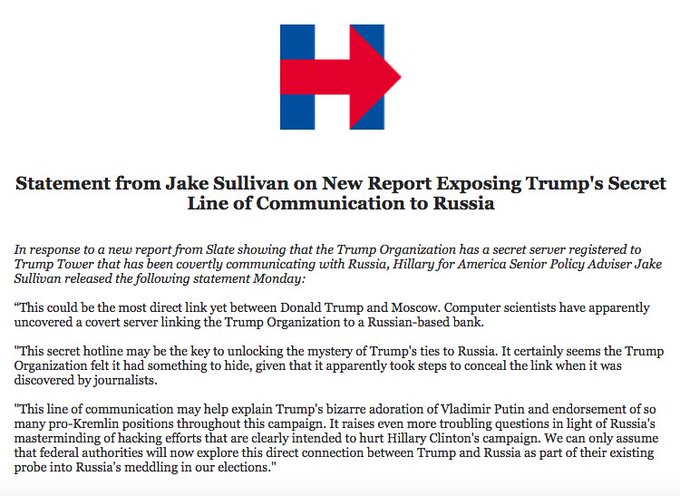
Computer scientists have apparently uncovered a covert server linking the Trump Organization to a Russian-based bank.
Back to Glenn Simpson…
It is entirely likely Glenn Simpson knows exactly who, from the White House, was involved in the efforts to support his anti-Trump work. Simpson’s wife, Mary Jacoby, visited the White House on April 19, 2016, the day after NSA Director Mike Rogers shut down contractor access to the NSA and FBI database on April 18, 2016.
The wife of Glenn Simpson (Fusion GPS), Mary B. Jacoby, with years of Russia-angled reporting –including Donald Trump– visits the White House in April 2016, at the same time as the DNC and Clinton hire Fusion GPS to conduct the opposition research on Donald Trump, surrounding Russia. [WH Log Link]
(The Hill) A lawyer for Glenn Simpson, co-founder of Fusion GPS, told the head of the House Judiciary Committee on Thursday that his client will “invoke his constitutional rights not to testify,” defying a GOP-issued subpoena seeking to compel him to give a closed-door deposition.
The lawyer, Joshua Levy, told Judiciary Chairman Bob Goodlatte (R-Va.) in an electronic letter that Simpson will not participate in this committee’s inquiry because it “is not designed to discover the truth.”
“Consistent with the September 27, 2018 letter we sent to you, Mr. Simpson, whose testimony is a matter of public record, will not be participating in a confidential deposition before this Committee,” lawyers for Simpson write, according to a copy of the letter obtained by The Hill.
“He will instead invoke his constitutional rights not to testify under the First and Fifth Amendments of the Constitution.” (read more)
Why should anyone be surprised and I’m sure FBI/DOJ lawyers told Simpson to take the fifth!@TheLastRefuge2
Fusion GPS co-founder will invoke ‘constitutional rights not to testify’: lawyers https://thehill.com/policy/national-security/411062-fusion-gps-co-founder-will-invoke-constitutional-rights-not-to?amp&__twitter_impression=true … via @thehill
The Democrat party intentionally made a choice to embrace socialism and far-left Marxist ideology in an effort to fuel their political goals. Tom Perez, current head of the DNC, has a life of activism and assembly for just these purposes. However, the predictable risk and consequence of that decision is really simple; a loss of control over the mob.
With four weeks left before the mid-term elections, the modern democrat mob is now so highly visible, and so filled with toxic/violence and rage, it has become a liability…. The only thing the media can do to assist their party is to downplay the mob and pretend it doesn’t exist; that’s the currently urgent narrative. Cue the audio visual:
The far-left is really the authentic democrat base under various names. Before there were Democrat Socialists it was the Antifa mob, Revolution Communism (RevCom), the Black lives Matter mob, the Dream Defenders mob, the Occupy Wall Street mob, Anarchists, the Weather Underground, the KKK, etc. ….it is all the same political leadership.
The President’s Interagency Task Force to Monitor and Combat Trafficking in Persons (PITF) is a group of 15 government agencies specifically focused on combating human trafficking. The Task Force is a Cabinet-level entity, consisting of 15 departments and agencies, working to prosecute traffickers and protect survivors.
.
[Transcript] Indian Treaty Room – 2:20 P.M. EDT – THE PRESIDENT: Thank you. Please. Thank you very much. Thank you. It’s a great honor. Thank you very much. Thank you to Ivanka for the wonderful introduction. She knows me well. And also, very importantly, on the tremendous work you’ve done on this on behalf of human trafficking victims and survivors all over the world. Very important subject.
And incredibly, with the age of the computer, it’s gotten worse and worse and worse every year. And we’re going to turn that around.
This is an urgent humanitarian issue. My administration is committed to leveraging every resource we have to confront this threat, to support the victims and survivors, and to hold traffickers accountable for their heinous crimes.
Before going any further today, I’d like to provide an update on Hurricane Michael, which made landfall along Florida’s great Panhandle. Incredible people in the Panhandle, and they went through a lot. Followed a really destructive path; then to Georgia and North and South Carolina.
Our prayers are with those who lost their lives and with their families. And our hearts are with the thousands who have sustained property damage — in many cases entirely wiped out — the many families who have been displaced and the businesses that have been affected by this devastating hurricane.
All residents should heed all local warnings and instructions. My administration is in constant contact with state and local authorities in Florida, Alabama, Georgia, South Carolina and North Carolina. FEMA and first responders are on the ground, and we have teams currently conducting search and rescue missions — by the way, the Coast Guard has been incredible; they’ve saved many lives — working to restore power and delivering needed supplies.
We will do everything in our power to help those in need. And we will not rest or waver until the job is done and the recovery is complete. The only thing we can say about Michael with certainty is that it was so fast, it went through like a bullet, but it was a devastating bullet. It was complete. It was winds about as big as we’ve ever seen in history. We’ve never had anything like this.
So I just want to thank everybody for working so hard and for FEMA, and first responders, and law enforcement. They have been incredible. Incredible. Thank you very much.
Today we’re gathered together for a truly important mission: ending the scourge of human trafficking.
Joining us are top officials from across our government who are deeply engaged in this effort. Also, Senator Rob Portman is with us someplace. Rob, thank you very much for coming.
I’d like to just introduce a few of the people that have worked so hard: Secretary of State Mike Pompeo. Secretary Nielsen. Secretary, thank you. Good job. I know you’re working very hard on this. Ryan Zinke. Ryan, thank you. Thank you. Alex Acosta. Thank you very much. Rod Rosenstein. Thank you, Rod. Alex Azar. Thank you very much. Great job you’re doing. Thank you, Alex. Elaine Chao. Thank you, Elaine. And Betsy DeVos. Thank you. Thank you very much.
Along with Ambassadors Nikki Haley — and what a job you’ve done. Thank you very much, Nikki. And you know how we feel. Bob Lighthizer. Thanks, Bob. Dan Coats. And Director Chris Wray. Thank you. Thank you. Thank you, Chris, very much. Appreciate it very much. You really — you’re making big difference and you’ll make an even bigger different because we’re making it a lot easier for you now. We’re going to give you what you need to get this done — as much as you can. It’s a tough one.
Thank you as well to Representative Ann Wagner who has been a great leader in the fight against human trafficking. Thank you, Ann, very much. Thank you very much.
Most importantly, I want to thank the courageous survivors of human trafficking for joining us today. From the beginning of my administration, I promised we would direct the full might and force of the United States government to combat the sinister crime of trafficking. And that is exactly what we are doing.
We’re working to aggressively target traffickers and to protect the victims of this inhumane abuse. In my first month in office, I signed an executive order directing federal law enforcement to prioritize dismantling the criminal organizations that engage in human trafficking. I later hosted survivors and experts here at the White House on numerous occasions for a conversation about how we can strengthen and improve our nation’s anti-trafficking efforts.
Since the time and since that moment — very first moment — we’ve really made tremendous strides. We’re challenging foreign regimes that facilitate this horrible evil of sex trafficking and forced labor. And we’re working to take down the criminal organizations that illegally traffic drugs and people across our border, exploiting them for their own gain. And we are pursuing criminal charges against those who perpetrate these monstrous acts and deeds.
Last year, my administration prosecuted a record number of traffickers. The Department of Health and Human Services National Human Trafficking Hotline received over 8,500 reports of potential trafficking last year. And our brave heroes at ICE have made over 1,600 human trafficking arrests. They do a great job.
I have signed several anti-trafficking bills into law, including a landmark law championed by Representative Wagner. And, Representative, where are you? Please. Fantastic job, Ann. Thank you very much. Really appreciate it. To help states and victims to fight online sex trafficking.
Under this law, victims can now bring civil suits against websites involved in sex trafficking — it’s so important — so you can bring civil suits against these websites, and states can bring criminal charges. These provisions complement existing laws that the Department of Justice used to seize and shut down Backpage.com, the Internet’s leading forum for traffickers, earlier this year. Good job, Rod. Really good job.
We also included tough forced-labor provisions in the new U.S.-Mexico-Canada Agreement — USMCA, as it’s known. Great agreement. And we are taking the lead to combat this crime internationally, having invested millions in the Global Fund to End Modern Slavery. If you can believe that title — it’s to end modern slavery.
This is just a brief overview of our government-wide effort to smash these criminal networks and to help victims rebuild their lives.
Every Cabinet member here today and every member of this presidential taskforce is fully engaged in the fight. It’s very important to every one of them.
Our country will not rest until we have put these vile organizations out of business, and rescued every last victim. And we will not stop until we have stamped out the menace of human trafficking once and for all.
Again, I want to thank everybody for the incredible job you’re doing, for your good work. So important. Thank you very much. Thank you. Thank you everybody. Thank you. (Applause.) Thank you. Thank you.
President Trump began opening remarks, prior to Senate Bill 3508, with discussion surrounding Hurricane Michael and the ongoing recovery efforts.
The Save Our Seas Act involves the administration confronting foreign nations who dump trash and debris into the oceans. All forward U.S. trade agreements will include passages forcing trade partners to control oceanic trash and debris.
.
[Oval Office Transcript] – 11:27 A.M. EDT – THE PRESIDENT: Okay. Thank you very much. I very much appreciate your being here. We have hurricane reports on Hurricane Michael. Unbelievably destructive, powerful.
The one good thing we can say — we were just discussing — is that it was the fastest hurricane anybody has seen. It just was speedy. If it wasn’t, there would be absolutely nothing left. It was incredibly powerful. You’ve seen the destruction.
It’s moving through Georgia now at a much lesser pace both in terms of speed and in terms of its power — 50, 60-mile-an-hour winds. But some of those winds reached almost 200 miles an hour, which is unheard of. People are saying it’s the third most powerful that they’ve seen hit our country anywhere.
We’ve done — I’ll tell you, FEMA has gotten rave reviews. The first responders, law enforcement — everybody has gotten rave reviews. I just spoke with Governor Scott. They’re very happy. Food is being now — following the hurricane — being now brought in. We have unbelievable large amounts of water and food and everything that people can want.
The electric companies have been terrific. They’re already working. The roads are being cleared out. Many trees are in the path of the electric companies.
The roads are being cleaned right now. They’re being — for the most part, they’re open enough to get the electric companies in. And a lot of electricity is already back on. Some of the off electricity is already back on. That’s in Florida. They’re following up in Georgia.
A lot of water will be in North and South Carolina, added to the horrible situation they had with Florence two weeks ago. But they’re incredible people and they know how to do it. They’ve done it before and they’ll do it again. But they know how to do it.
So we’ve had great reports in everything. The only — the big problem with this hurricane was the tremendous power. And fortunately, it was very fast. It went through Florida very, very quickly. It didn’t linger. It didn’t come back as we had in Texas, where it actually came back a second time and then a third time. It went out, filled up, came back. This one went very quickly. But it’s tremendous destruction in the areas where it — the path that it chose is incredible, the kind of destruction. We’ve not seen destruction like that in a long time.
But it’s — the rebuilding, I can actually say — the rebuilding process and the survivor-looking process, we hope we don’t have too much of that. The area most affected was, hopefully, 100 percent evacuated, but there’s always somebody that stays. And in this case, they would have been in big trouble.
But so far, the reports, as you know, are very good. So I want to thank you for that.
And I don’t know if you have any questions on the hurricane. Does anybody have any questions?
Q Do you have enough time to focus on the hurricane? You have a very busy day at the White House. Obviously, Kanye West is here and —
THE PRESIDENT: Yeah, I do. I have a very busy day today. We’re doing — as you know, we’re doing — having to do with copyright music. We’re doing, right now, the Save Our Seas Act of 2018, which is a very important thing. But I — and yesterday I had a tremendous rally in Pennsylvania, and we had thousands of people lined up. And I just couldn’t — you couldn’t tell those people — and they were there for a day and a half before.
And I couldn’t tell people that had been standing in line for a day and a half, wanting to get into the arena, that I’m not going. I went there. We had great control over what we were doing both on Air Force One, at the White House, and in Florida.
And I think you’re seeing we’re getting tremendous marks for the job that we did. And I wasn’t going to disappoint thousands and thousands of people who have been standing in line for, in some cases, a day and a half. I wasn’t going to do that.
But I think we’ve really, really done a job. This is a particularly busy day because we’re signing a number of bills. Very different kinds of bills. So you’ll be seeing me a little while later, I think with a couple of the senators standing behind me right now. And you’ll be seeing me and us in a little while.
And we’re having lunch with Jim Brown, one of the great football players of all time and a great guy, and Kanye West. He’s coming in — they’re coming in for lunch. And after that, we’re doing some additional interesting things.
But we have a busy day. But I always have a busy day.
And the economy is doing really well. Jobs are looking — we think jobs are going to be better than ever. And we think records are broken already, but we’re going to continue to break the records.
So let’s talk about the Save Our Seas Act, if we could. And again, thank you all for being here. I want to thank also the members of Congress that are with us. That’s Senator Dan Sullivan, who’s been absolutely terrific; worked along with Sheldon Whitehouse. And these two have been spearheading something that’s very important, and we want to thank you both.
Sheldon, thank you very much.
SENATOR WHITEHOUSE: Thank you, Mr. President.
THE PRESIDENT: Thank you very much. We appreciate it. Really do. I know you worked very hard on that.
SENATOR WHITEHOUSE: Worked well together.
THE PRESIDENT: And, Mr. Sullivan, thank you very much for being here. We appreciate it very much.
We have Secretary of Commerce Wilbur Ross who worked along with the senators, and Acting NOAA Administrator Admiral Tim Gallaudet. You’re here, and thank you for being here, Tim. Thank you very much. Great job you’re doing.
Every year, over 8 million tons of garbage is dumped into our beautiful oceans by many countries of the world. That includes China, that includes Japan, and that includes many, many countries.
This waste, trash, and debris harms not only marine life, but also fishermen, coastal economies along America’s vast stretches. The bad news is it floats toward us. I’ve seen pictures recently, and some of you have seen them, where there’s — a vast, tremendous, unthinkable amount of garbage is floating right into our coast, in particular along the West Coast.
And we’re charged with removing it, which is a very unfair situation. It comes from other countries very far away. It takes six months and a year to float over, but it gets here, and it’s a very unfair situation. It’s also unbelievably bad for the oceans.
Every year, over 8 million tons of garbage is dumped into our beautiful oceans. And when you think of that number — I mean, to think 8 million tons — and I would say it’s probably — Senators, I think it’s probably more than that, based on what I’ve seen and based on the kind of work that I’ve seen being done.
This dumping has happened for years and even for decades. Previous administrations did absolutely nothing to take on the foreign countries responsible. We’ve already notified most of them and we’ve notified them very strongly.
The Save Our Seas Act will help address this problem by extending the Marine Debris Program for five additional years. We also are strengthening that up to improve waste management overseas and clean up our nation’s water. We will boost the federal government’s response to ocean waste by authorizing the National Oceanic and Atmospheric Administration to declare severe marine debris events, which happen all the time. It’s incredible. It’s incredible when you look at it. People don’t realize it, but all the time we’re being inundated by debris from other countries.
This legislation will release funds to states for cleanup and for response efforts. And we will be responding and very strongly.
The legislation also encourages the executive branch to engage with those nations responsible for dumping garbage into our oceans. My administration is doing exactly that. For example, the new United States-Mexico-Canada Agreement is the first U.S. trade agreement ever to include commitments by the parties to cooperate to address land- and sea-based pollution and improve waste management.
And I can tell you that Dan and Sheldon were very insistent on trying to get that into the USMCA, the new agreement that we have with Canada and Mexico. And we’ll be putting it into other agreements also.
The United States has some of the most beautiful beaches and oceans in the world, and the coastlines are incredible. As President, I will continue to do everything I can to stop other nations from making our oceans into their landfills. That’s why I’m pleased — very pleased, I must say — to put my signature on this important legislation.
And again, I’d like to thank Dan and Sheldon, and all of the people — the Admiral and Wilbur — all of the people that worked so hard on this. This was a tough one, but it had great bipartisan support.
What was the final vote?
SENATOR SULLIVAN: It was unanimous consent in the Senate.
THE PRESIDENT: Unanimous.
SENATOR SULLIVAN: Yes, sir.
THE PRESIDENT: Bipartisan. Did you ever think, Jon, you’d hear that? Bipartisan.
Q It’s unusual to see Sheldon Whitehouse here.
THE PRESIDENT: Well, that’s pretty good. Can you imagine Trump and Whitehouse in the same area? It’s all right. Hey, I have a lot of respect.
SENATOR SULLIVAN: And what the President said about the administration — the Trump administration — doing a great job on this, it’s an underreported story but they are really taking the lead globally. And, Mr. President, we want to thank you for (inaudible) very bipartisan.
THE PRESIDENT: Well, I want to thank you, and I want to thank Sheldon. Thank you. Come here, Sheldon. See, we can shake hands.
SENATOR SULLIVAN: Thank you, Mr. President. Thank you very much.
THE PRESIDENT: Thank you, Wilbur. Thank you. Admiral, thank you.
All right. Let’s get this done properly here.
(The bill is signed.)
So with that, we’re all completed. And I just want to say it’s an honor. And hopefully that goes a long way for our oceans.
We’ve notified other countries that have been abusers. They abuse the ocean. We have notified them already about this. And they’re doing things. They tell us they’re doing things. And I think some cases at least they are. But they will be.
And I want to thank you very much.
SENATOR WHITEHOUSE: Thank you, Mr. President. The Philippines is up next, Mr. President.
THE PRESIDENT: Yes, that’s right.
SENATOR WHITEHOUSE: The Philippines is up next. They’re one of the worst three.
THE PRESIDENT: Well, that’s right. That’s going to be interesting.
SENATOR WHITEHOUSE: So, thank you.
THE PRESIDENT: So you’re working on that?
SENATOR WHITEHOUSE: We are.
THE PRESIDENT: That’s very good.
SENATOR WHITEHOUSE: With your trade team on the Philippine trade agreement. We’ll make sure this is part of that.
THE PRESIDENT: We’re okay with that. I understand. A lot comes from there.
Yes.
Q Mr. President, what exactly is the U.S. doing to investigate the missing Saudi journalist? You said there were U.S. investigators over there.
THE PRESIDENT: Yes, we’re looking at it.
Q Could you explain what exactly that means?
THE PRESIDENT: We’re looking at it very strongly. We’ll be having a report out soon. We’re working with Turkey, we’re working with Saudi Arabia. What happened is a terrible thing, assuming that happened. I mean, maybe we’ll be pleasantly surprised, but somehow I tend to doubt it. And we take it very seriously.
Q Does the U.S. have any kind of responsibility to warn him if (inaudible) were picked up?
THE PRESIDENT: Well, it’s not our country. It’s in Turkey, and it’s not a citizen, as I understand it. But a thing like that shouldn’t happen. It is a reporter with the Washington Post, and it’s — something like that should not be allowed to happen. Something like that should not happen. And we intend to get to the bottom of it.
Yes.
Q Mr. President, you have talked a little bit about the markets. The markets are down again, today. How long do you think this correction, which you said was coming anyway, is expected to last?
THE PRESIDENT: Well, we’re still up 40 percent for the period of time. So, I mean, the markets are way up over what they were. It’s a correction that I think is caused by the Federal Reserve with interest rates. The dollar has become very strong, which, frankly, people can debate whether or not they like a strong dollar or not.
The dollar is very strong, very powerful. And that causes a little difficulty with doing business, frankly. A strong dollar doesn’t necessarily mean all good, but we do have a very strong dollar. And we have interest rates going up at a clip that’s much faster than certainly a lot of people, including myself, would have anticipated.
I think the Fed is out of control. I think what they’re doing it wrong. Under the Obama administration, you had a lot of help because they had very little interest. You know, when you talk about economies, our economy is far better than that. But we have actually — we’re paying interest. And they weren’t. They were using funny money.
But I think the Fed is far too stringent, and they’re making a mistake and it’s not right.
And it’s — despite that, we’re doing very well but it’s not necessary, in my opinion. And I think I know about it better than they do. Believe me.
Q Would you consider firing the Fed Chairman? I mean, is his job secure?
THE PRESIDENT: No, I’m not going to fire him. I’m just disappointed at the clip. I think it’s far too fast. Far too rigid, far too fast.
Q Mr. President, after what happened with the Soyuz capsule today, are you at all worried that American astronauts have to rely on the Russians to get into space? Because you’ve been talking about Space Force.
THE PRESIDENT: No, I’m not worried. We have a tremendous space program going right now, in addition to which you’re going to have the Space Force. I think by next year we intend to have that. It’s already in this budget. And we’ll have our own everything. But no, I’m not at all. Not at all worried at all.
Q Will Jamal Khashoggi’s case affect the way you deal with MBS or other Saudi officials?
THE PRESIDENT: We’ll have to see what happens. A lot of work is being done on that, and we’re going to have to see what happens. I don’t like stopping massive amounts of money that’s being poured into our country on — I know they’re talking about different kinds of sanctions, but they’re spending $110 billion on military equipment and on things that create jobs, like jobs and others, for this country.
I don’t like the concept of stopping an investment of $110 billion into the United States. Because you know what they’re going to do? They’re going to take that money and spend it in Russia or China, or someplace else. So I think there are other ways. If it turns out to be as bad as it might be, there are certainly other ways of handling the situation.
But I will tell you, upfront, right now, and I’ll say it in front of senators: They’re spending $110 billion purchasing military equipment and other things. If we don’t sell it to them, they’ll say, “Well, thank you very much. We’ll buy it from Russia.” Or “Thank you very much. We’ll buy it from China.” That doesn’t help us — not when it comes to jobs and not when it comes to our companies losing out on that work.
But there are other things we can do. Let’s find out what the problem is first. Okay?
Q You mean sanctions in that case? You oppose sanctions against Saudi Arabia?
THE PRESIDENT: I oppose — I would not be in favor of stopping a country from spending $110 billion — which is an all-time record — and letting Russia have that money and letting China have that money. Because all they’re going to do is say, “That’s okay. We don’t have to buy it from Boeing. We don’t have to buy it from Lockheed. We don’t have to buy it from Raytheon and all these great companies. We’ll buy it from Russia. We’ll but it from China.”
So what good does that do us? There are other things we can do.
Q Well, do you think they should pay a price if it turns out that the Saudis are responsible?
THE PRESIDENT: Yeah. There’ll be something that has to take place. First, I want to find out what happened. And we’re looking. Again, this took place in Turkey. And to the best of our knowledge, Khashoggi is not a United States citizen. Is that right? Or is that —
Q Permanent resident.
THE PRESIDENT: He’s a permanent resident. Okay.
We don’t like it, Jon. We don’t like. And we don’t like even a little bit. But as to whether or not we should stop $110 billion from being spent in this country, knowing they have four or five alternatives, two very good alternatives — that would not be acceptable to me.
Okay. But we’re looking for the answer. And I think probably you’ll have an answer sooner than people think.
Thank you very much. I’ll see you in a little while.
Q We’ll see you with Kanye later? Are you going to —
THE PRESIDENT: Yeah. We’re going to have you come in for Kanye for just a couple of seconds, okay?
Q Okay, great.
THE PRESIDENT: He’ll be here and we’re going to do a little — you’ll have a little fun. Okay?
Everybody asks about Kanye. You know, we have Kanye West and Jim Brown coming in. And everybody wants to know about —
Q (Inaudible) Jim Brown too.
THE PRESIDENT: I like Jim Brown. That Jim Brown is some running back. Hey, do you think the NFL would be paying him a couple of dollars nowadays?
What people don’t know — he might have been — he was the greatest football player, perhaps. He may have been an even better lacrosse player. Did you know that? At Syracuse. He may have been an even better lacrosse player. And he’s a great guy. And he’s been with me for a long time. He’s been a big supporter.
Thank you all very much. You’ll come back in a little while.
H.R. 1551 The Music Modernization Act – closes loopholes in our digital royalty laws to ensure that songwriters, artists, producers, and providers receive fair payment for the licensing of music.
.
[White House ] 11:57 A.M. EDT – THE PRESIDENT: I know you’ve been waiting for this for a long time, you folks. Right? For a long time. Hi, Shelley. Hi, everybody. They’ve been working on this for years and years and years. And I guess certain entertainers have been taken advantage of — but no longer, because of Trump. Can you believe it? (Laughter.) Who would think? Who would think?
But I’m thrilled — I know so many of you. I mean, it’s just great. And I definitely know your music, and you’ve done a great job.
I’m thrilled to welcome all of you to the White House today and the signing of the Hatch–Goodlatte — you know Hatch and you know Goodlatte, don’t you? Terrific guys. I didn’t know you liked music that much, Orrin. (Laughter.) Huh? The Hatch-Goodlatte Music Modernization Act. This is a landmark bill — they’ve been looking for it for many, many years — to protect the intellectual property and creative genius of America’s incredible musicians.
Thank you to Secretary Wilbur Ross for being here and for working so hard to get this done. I especially want to thank one of the bill’s lead sponsors, an accomplished musician and songwriter in his own right — which I heard, but I haven’t heard his music. I’ll let you know when I hear his music. (Laughter.) The legendary Senator Orrin Hatch. It’s been 44 years. How long have you been in the Senate?
SENATOR HATCH: Forty-two.
THE PRESIDENT: Forty-two. Oh, I thought it was forty-four. Forty-two is nothing. That’s pretty good.
SENATOR HATCH: Feels like 44. (Laughter.)
THE PRESIDENT: Feels like 44. And he’s been my friend, and he’s been a great, great senator.
I also want to thank another friend of mine, Bob Goodlatte, for his tremendous leadership at the helm of the House Judiciary Committee. Very instrumental on this.
Let me also recognize and thank Senate Judiciary Committee Chairman Chuck Grassley. Everybody knows Chuck now. He’s become more famous in the last two weeks. What a job you did. Was that easy, Chuck, or tough?
SENATOR GRASSLEY: No, it was not easy. (Laughter.)
THE PRESIDENT: I thought you were going to say that. You made it look easier than it was. Chuck is an incredible man. As well as Senators Lamar Alexander, Shelley Moore Capito, Chris Coons, Sheldon Whitehouse, and Congressmen Darrell Issa, Doug Collins, and — Jerry Nadler was going to be here but he couldn’t make it. I don’t know what happened to him. I’m shocked. I’m shocked.
We’re also joined by truly amazing artists and people I’ve known for a long time — people everyone knows — including Kid Rock. Kid, thank you. Great job. Do you like this legislation or do you hate it?
MR. RITCHIE: Like it.
THE PRESIDENT: He’s been fighting for a long time.
I want to welcome Christian rock group MercyMe. Also joining me is — gee, so many of these people, I’ve been with them — are famed guitarist from the Doobie Brothers and Steely Dan, Jeff Baxter. Jeff, thank you very much. Mike Love, I’ve heard him many times. Many times. He’s — The Beach Boys. Where is Mike? Mike — come here, Mike. Boy, that’s something, huh? You like this, right?
MR. LOVE: I love it.
THE PRESIDENT: Good. Mike Love. Been a friend of mine. The Beach Boys are — look, what can you say about The Beach Boys? Great music.
We have some great country artists with us, including Craig Morgan and my good friend John Rich of Big and Rich. He happened to win “The Apprentice,” but we won’t even get into that. (Laughter.) I know him better than anybody. I’m the one — week after week, it was “John Rich, you’re going to make it.” I said “you’re fired” to everybody but John Rich, right? Huh?
MR. RICH: Yes, sir, thank you.
THE PRESIDENT: Great job. Great guy. Really good guy. And good under — he’s good under pressure, which is very nice.
We also have Rock and Roll Hall of Famer Sam Moore, who is having a big birthday. Sam and Dave. But having a big birthday today. Today is your birthday?
MR. MOORE: Today is my birthday.
THE PRESIDENT: Eighty-three?
MR. MOORE: Promise to keep your golf game going.
THE PRESIDENT: My golf game? He looks good. (Laughter.) Eighty-three. That means there’s a future for us. (Laughter.) That’s great, Sam. Great to have you here.
The legislation has wide support throughout the music industry, and I am very pleased that so many industry leaders, also over here — I won’t call all the names, but some real leaders of industry are here with us for the enactment of this critical legislation.
I see Neil Portnow, who, in the world of music, is big stuff. He’s the President and CEO of the Recording Academy, also known as the Grammys. Where is he? Thank you. Very good. Thank you for being here. I appreciate it very much. Thank you very much, Neil.
The Music Modernization Act closes loopholes in our digital royalty laws to ensure that songwriters, artists, producers, and providers receive fair payment for the licensing of music. I’ve been reading about this for many years. Never thought I’d be involved in it, but I got involved in it. They were treated very unfairly. They’re not going to be treated unfairly anymore. Streaming has made music more accessible than ever, yet our laws have not kept up with the pace of technology. As such, artists of all varieties and all career stages are losing out on revenue that they have rightly earned. And I guess especially from four or five, six years ago, and beyond.
This legislation will help ensure that artists from eras long ago, in addition to modern day, can retire in security, and that current and upcoming artists can make a living by creating amazing works that captivate their fans and entertain our nation — and the world. Because this is really the world we’re talking about.
This legislation creates a single licensing system for reasons of simplicity, for digital music providers, so that music is more quickly licensed and paid for. Ensures that American songwriters receive fair market value when their songs are streamed or purchased online. Sets a standard licensing rate for digital performances.
Why aren’t some of you guys performing for us today free? (Laughter.) We should have done that, senators. I’ll tell you. We should have gotten some — Shelley, we should have gotten a little free music out of this. (Laughter.) They could have — they could give us a great concert, this group.
Sets a standard licensing rate for digital performance and recordings, and applies that very same standard to music recorded before 1972. And creates a procedure for producers, engineers, and other participants in the recording and music industry to collect performance royalties.
This legislation passed both houses of Congress unanimously. How did you do that? (Laughter.) See? Bipartisan. Second one. We just did the Clean Oceans Act with Dan Sullivan and — he’s around. Dan? And with Sheldon Whitehouse. We just signed that. And that was — I think we had one negative vote, didn’t you? Did we have one?
SENATOR WHITEHOUSE: Unanimous.
THE PRESIDENT: Unanimous. So we just did two unanimous bills. Who says we can’t pass unanimous? Who said we don’t have bipartisan? It is bipartisan. But this legislation passed both houses unanimously.
Fair payment for intellectual property is essential to maintain America’s longstanding position as the world leader in music and entertainment. And when they say “world leader,” it’s world leader, by far. It’s not even close.
This legislation accomplishes that goal by updating our licensing laws to reflect the significant growth in streaming and digital music.
Today, we build on America’s rich cultural and musical legacy, which brings joy and meaning to countless millions and millions and millions of Americans, and beyond, frankly. And beyond.
So with that, I’m pleased to sign the Hatch-Goodlatte Music Modernization Act. It’s my honor. Hearing about it for so many years, and we’re finally getting it done. And these people are going to become even richer than they are, but that’s okay. (Laughter.) Because they really were — they were treated very unfairly. A lot of people got nothing. They’d do an incredible song and they’d end up getting nothing. They’d create some of the most incredible music, some great music, and they would not be able to benefit. And that sounded — always sounded very unfair. And that’s why you had a unanimous consent.
So thank you all for being here. It’s an honor. And I’ll go and sign the paper, and then you go on and do what you have to do. And, Kid, thank you very much, man. It’s great. (Applause.)
(The bill is signed.)
Got it. We’re done. (Applause.)
How about if I asked Bob Goodlatte and Orrin Hatch to say a couple of words. Do you mind? And what this means. And I’m also going to hand out the pen. Who should get the first pen?
PARTICIPANT: Sam! It’s his birthday.
THE PRESIDENT: Okay, let’s give it to Sam. (Applause.)
MR. MOORE: Why, thank you.
THE PRESIDENT: Sam, say a couple of words. Go ahead. You want to speak?
MR. MOORE: Thank you, everyone. I got to tell you, this is a historic moment. I’m so proud. When Mr. Bush was in, we couldn’t get it done. When we had Mr. Obama in, we couldn’t get it done. But we got it done with this man. (Laughter.)
Thank you so much. Thank you, everybody. (Applause.)
THE PRESIDENT: Mike Love.
MR. LOVE: Thank you, President Trump. Thank you so much for your support of music, historically. I remember you tried your best to help get Whitney Houston in some kind of shape.
THE PRESIDENT: It’s true.
MR. LOVE: And it was — yeah, I remember being at Mar-a-Lago with this guy right here. He had Ron Perlman come down. He had — he tried your best to help Whitney.
THE PRESIDENT: Right.
MR. LOVE: And she’s not the only one you’ve benefitted and tried. And people are going to say what they want, but you’ve always been a big supporter of some of the best music that America has ever made.
THE PRESIDENT: Thank you very much.
MR. LOVE: And you’re right when you say it’s beyond. We remember going to Czechoslovakia six months after the Russians invaded. And because of our music — because of America and the freedom that we represented, you know, we were, like, welcomed like heroes. All we were doing was playing our songs.
But it meant a lot to people all over the world. And so we appreciate you and Senator Hatch and Goodlatte. Darrell Issa, he’s been involved with the pre-’72 stuff, and that’s very near and dear to my heart. (Laughter.)
THE PRESIDENT: Darrell is a good man.
MR. LOVE: Yeah, he’s great. Thank you. Thank you, President Trump. (Applause.)
MR. RICH: Thank you. You know, I am really encouraged by today because we all know how divided our country is. We see it every single day. And to see that music is the one thing that can get unanimous consent in the Senate, in the House, in the state I live in in Tennessee — Marsha Blackburn has been pounding away at this for years. NSAI, pounding away at this for years.
And to see it come together and know that it affects all these artists and all these genres — the full political spectrum of artists are impacted. Kanye West, who you’re going to see. Kid Rock, Sam Moore, Taylor Swift, Big and Rich — you name it. Everybody is impacted by this.
So thank you very much for signing it. Thank you. (Applause.)
THE PRESIDENT: Thank you very much.
MR. RITCHIE: Uh oh, I got the mic. (Laughter.)
THE PRESIDENT: This could be good.
MR. RITCHIE: This could be good. No, but I think we should start with, you know, I’d just like to bring it up that there’s a whole lot of people in this country that do give you a lot of credit for everything you’ve been doing for this country.
THE PRESIDENT: Thank you.
MR. RITCHIE: That we know that some people don’t give it to you as much as maybe they should sometimes.
A big part of this bill that I’m a huge fan of is for the unsung songwriters out there. There’s so many who have written the songs that no one will ever see at any level. And everybody knows this business of music is a pretty dirty business. There’s a lot more that needs to be done here, and we need to go after the record companies next for things like free goods and things like that.
But this is a great start to protect songwriters, producers, engineers — the unsung heroes behind many of these songs that go out there. People like myself who are maybe more at the top of the food chain, it really doesn’t affect as much. But I know many people it does affect. So this is going to help out in a big, big way, and be a great start for, hopefully, a lot of more following in the future. So thank you again.
THE PRESIDENT: Thank you, Kid. (Applause.)
MR. BAXTER: You know, this is in the Constitution. This is in the Constitution. Patented language (inaudible). Congratulations.
THE PRESIDENT: That’s right. That’s right.
Please.
SENATOR HATCH: Well, Mr. President, once again, it’s — thank you.
MR. BAXTER: Songwriter. Absolutely. (Applause.)
SENATOR HATCH: Mr. President, I’m honored to be here with you, as always. And I’m honored to be with these great songwriters and musicians who really haven’t been able to receive all the recognition they deserve.
This is a very important bill. It’s going to renew the interest in music throughout the country and throughout the world. And we’ve had a lot of help from a lot of good people, including the senators and Congress people standing here. Bob Goodlatte carried this through the House, and I’m just very grateful to him. I’m grateful to all of you.
But, Mr. President, we’re grateful to you. You’re making a real hell of a difference in this country. It’s a good difference. And we all — you’re getting both sides to — (inaudible). (Applause.)
THE PRESIDENT: Please.
SENATOR GOODLATTE: Mr. President, you’re doing a lot of things to make America great again. And signing this bill is one of them. And it is something that has been needed for decades. This has been a situation where the music licensing system in this country hasn’t worked fairly. And I’m honored to have my name associated with it. I’m honored to have my name associated with Senator Hatch. But this is an effort of a lot of people all across this country, in the Congress and out of the Congress, over a long time.
So thank you for putting the finishing touch on it. It’s going to do a lot of good for a lot of great people.
THE PRESIDENT: Great job.
Lamar, do you want to say something?
SENATOR ALEXANDER: Thank you, Mr. President, for your leadership. There are tens of thousands of taxi drivers, waitresses, music teachers in Tennessee and across this country who are riding the bus out to their work and hoping they’ll write a big number-one hit one day. And what this means is that when they do, they’ll get paid, and they’ll get paid a fair market value.
So I’m grateful to the entire range of the music industry for coming together on what they agree on, putting aside what they don’t, and then working with this whole range of those of us in Congress who wanted to make this happen.
This is a great day, Mr. President. And thank you for your support and for calling attention to the music that, as John says, unifies our state and our country.
Everything is happening in a very predictable sequence. Few understand the MAGAnomic reset and what was predicted to happen in the space between disconnecting a Wall Street economic engine (globalism and multinationals) and restarting a Main Street economic engine (nationalism/America-First). In 2016 CTH explained where we would be today. With current Wall Street events, perhaps it is worthwhile remembering the CTH forecast.
President Trump’s MAGAnomic trade and foreign policy agenda is jaw-dropping in scale, scope and consequence. There are multiple simultaneous aspects to each policy objective; however, many have been visible for a long time – some even before the election victory in November ’16.
If we get too far in the weeds the larger picture is lost. CTH objective is to continue pointing focus toward the larger horizon, and then at specific inflection points to dive into the topic and explain how each moment is connected to the larger strategy.
Today we repost an earlier dive into how MAGAnomic policy interacts with multinational Wall Street, the stock market, the U.S. financial system and perhaps your personal financial value. Again, reference and source material is included at the end of the outline.
If you understand the basic elements behind the new dimension in American economics, you already understand how three decades of DC legislative and regulatory policy was structured to benefit Wall Street, Multinational corporate interests, and not Main Street USA. The intentional shift in economic policy is what created distance between two entirely divergent economic engines to the detriment of the American middle-class.
REMEMBER […] there had to be a point where the value of the second economy (Wall Street) surpassed the value of the first economy (Main Street).
Investments, and the bets therein, needed to expand outside of the USA. hence, globalist investing.
However, a second more consequential aspect happened simultaneously. The politicians became more valuable to the Wall Street team than the Main Street team; and Wall Street had deeper pockets because their economy was now larger.
As a consequence Wall Street started funding political candidates and asking for legislation that benefited their multinational interests.
When Main Street was purchasing the legislative influence the outcomes were -generally speaking- beneficial to Main Street, and by direct attachment those outcomes also benefited the average American inside the real economy.
When Wall Street began purchasing the legislative influence, the outcomes therein became beneficial to Wall Street. Those benefits are detached from improving the livelihoods of main street Americans because the benefits are “global”. Global financial interests, multinational investment interests -and corporations therein- became the primary filter through which the DC legislative outcomes were considered.
As an outcome of national financial policy blending commercial banking with institutional investment banking something happened on Wall Street that few understand. If we take the time to understand what happened we can understand why the Stock Market grew and what risks exist today as the financial policy is reversed to benefit Main Street.
Instead of attempting to put Glass-Stegal regulations back into massive banking systems, the Trump administration is creating a parallel financial system of less-regulated small commercial banks, credit unions and traditional lenders who can operate to the benefit of Main Street without the burdensome regulation of the mega-banks and multinationals. This really is one of the more brilliant solutions to work around a uniquely American economic problem.
♦ When U.S. banks were allowed to merge their investment divisions with their commercial banking operations (the removal of Glass Stegal) something changed on Wall Street.
Companies who are evaluated based on their financial results, profits and losses, remained in their traditional role as traded stocks on the U.S. Stock Market and were evaluated accordingly. However, over time investment instruments -which are secondary to actual company results- created a sub-set within Wall Street that detached from actual bottom line company results.
The resulting secondary financial market system was essentially ‘investment markets’. Both ordinary company stocks and the investment market stocks operate on the same stock exchanges. But the underlying valuation is tied to entirely different metrics.
Financial products were developed (as investment instruments) that are essentially wagers or bets on the outcomes of actual companies traded on Wall Street. Those bets/wagers form the hedge markets and are [essentially] people trading on expectations of performance. The “derivatives market” is the ‘betting system’.
♦Ford Motor Company (only chosen as a commonly known entity) has a stock valuation based on their actual company performance in the market of manufacturing and consumer purchasing of their product. However, there can be thousands of financial instruments wagering on the actual outcome of their performance.
There are two initial bets on these outcomes that form the basis for Hedge-fund activity. Bet ‘A’ that Ford hits a profit number, or bet ‘B’ that they don’t. There are financial instruments created to place each wager. [The wagers form the derivatives] But it doesn’t stop there.
Additionally, more financial products are created that bet on the outcomes of the A/B bets. A secondary financial product might find two sides betting on both A outcome and B outcome.
Party C bets the “A” bet is accurate, and party D bets against the A bet. Party E bets the “B” bet is accurate, and party F bets against the B. If it stopped there we would only have six total participants. But it doesn’t stop there, it goes on and on and on…
The outcome of the bets forms the basis for the tenuous investment markets. The important part to understand is that the investment funds are not necessarily attached to the original company stock, they are now attached to the outcome of bet(s). Hence an inherent disconnect is created.
Subsequently, if the actual stock doesn’t meet it’s expected P-n-L outcome (if the company actually doesn’t do well), and if the financial investment was betting against the outcome, the value of the investment actually goes up. The company performance and the investment bets on the outcome of that performance are two entirely different aspects of the stock market. [Hence two metrics.]
♦Understanding the disconnect between an actual company on the stock market, and the bets for and against that company stock, helps to understand what can happen when fiscal policy is geared toward the underlying company (Main Street MAGAnomics), and not toward the bets therein (Investment Class).
The U.S. stock markets’ overall value can increase with Main Street policy, and yet the investment class can simultaneously decrease in value even though the company(ies) in the stock market is/are doing better. This detachment is critical to understand because the ‘real economy’ is based on the company, the ‘paper economy’ is based on the financial investment instruments betting on the company.
Trillions can be lost in investment instruments, and yet the overall stock market -as valued by company operations/profits- can increase.
Here’s the critical part – Conversely, there are now classes of companies on the U.S. stock exchange that never make a dime in profit, yet the value of the company increases.
This dynamic is possible because the financial investment bets are not connected to the bottom line profit. (Examples include Tesla Motors, Amazon and a host of internet stocks like Facebook and Twitter.) It is this investment group of companies that stands to lose the most if/when the underlying system of betting on them stops or slows.
Specifically due to most recent U.S. fiscal policy, modern multinational banks, including all of the investment products therein, are more closely attached to this investment system on Wall Street. It stands to reason they are at greater risk of financial losses overall with a shift in economic policy.
That financial and economic risk is the basic reason behind Trump and Mnuchin putting a protective, secondary and parallel, banking system in place for Main Street.
Big multinational banks can suffer big losses from their investments, and yet the Main Street economy can continue growing, and have access to capital, uninterrupted.
Bottom Line: U.S. companies who have actual connection to a growing U.S. economy can succeed; based on the advantages of the new economic environment and MAGA policy, specifically in the areas of manufacturing, trade and the ancillary benefactors.
Meanwhile U.S. investment assets (multinational investment portfolios) that are disconnected from the actual results of those benefiting U.S. companies, and as a consequence also disconnected from the U.S. economic expansion, can simultaneously drop in value even though the U.S. economy is thriving.
I have created this site to help people have fun in the kitchen. I write about enjoying life both in and out of my kitchen. Life is short! Make the most of it and enjoy!
This is a library of News Events not reported by the Main Stream Media documenting & connecting the dots on How the Obama Marxist Liberal agenda is destroying America