June Minutes Report Decoded


Posted  originally on Jul 11, 2025 by Martin Armstrong 

Interest Rates Percent

The Minutes Report by the Federal Reserve indicates that the central bank is unlikely to cut rates at the next Federal Open Market Committee meeting on July 29-30. FOMC members unanimously maintained the borrowing range between 4.25%-4.5% where it has stood since December 2024. The central bank knows that it has limited power to control inflation through rate cuts, and stimulating demand is a moot point when the government is the largest borrower.

Instead of noting that the government simply borrows in perpetuity, Fed members focused on uncertainty surrounding tariffs and a potentially weakening labor market. Chairman Jerome Powell stated that cutting rates was a “closer call” as the 2% inflation target as been out of reach for several years. “With regard to the outlook for inflation, participants expected that inflation would continue to move toward 2 percent, although they noted that recent higher-than-expected readings on inflation, and the effects of potential changes in trade and immigration policy, suggested that the process could take longer than previously anticipated,” the FOMC minutes said. The last CPI reading was 2.7% with the PCE coming in at 2.4%.

The ongoing Trump v Powell feud is potentially spilling over into policy. Despite non-foreign-born citizens picking up over 2 million jobs as a direct result of deportation efforts, the Fed believes that the weakening labor market could be the result of deporting cheap labor. “Almost all participants judged that upside risks to the inflation outlook had increased. As reasons for this judgment, participants cited recent stronger-than-expected readings on inflation and the likely effects of potential changes in trade and immigration policy,” the minutes said. Unemployment fell to 4.1% with June posting an increase of 147,000 jobs.

The Fed is also blaming Trump’s tariff policies for inflation. “Ultimately, the cost of the tariff has to be paid, and some of it will fall on the end consumer,” the Fed Chair told reporters in June. “We do expect to see more of that over the course of the summer.”  Powell is confusing a one-time price adjustment with a monetary-driven inflationary wave that began in 2015 and soared after the pandemic. As previously noted, “almost all” participants saw trade policy as an upside risk to inflation. “Many participants noted that the eventual effect of tariffs on inflation could be more limited if trade deals are reached soon, if firms are able to quickly adjust their supply chains, or if firms can use other margins of adjustment to reduce their exposure to the effects of tariffs,” the Minutes stated.

A ”couple” of members stated rate cuts could happen at the next meeting, with Fed Governors Michelle Bowman and Christopher Waller going on record to say that they believe rate cuts are appropriate this month. “Several” officials said the overnight rate “may not be far” from target, believing a bit of adjustment could bring inflation to target. The “dot plot” of individual officials indicates a divide on the outlook of cuts.

The Minutes Report noted that two rate cuts could potentially happen in 2025, followed by additional cuts over the next few years. Powell has less than a year left in office, and the president is certain to appoint someone who will abide by his policy that he sees through the eyes of a borrower and not a lender.

The Better Investment — ETFs or Mutual Funds?


Posted originally on Jul 7, 2025 by Martin Armstrong 

ETF Tax

The primary difference between mutual funds and ETFs (exchange-traded funds) is that while an open-end mutual fund is priced once based on the market closing, ETFs, as well as closed-end mutual funds, trade all day. This actually goes back to the Panic of 1966 when mutual funds were open-ended but traded on the exchange and were bid up and down based on emotion rather than net asset value. The crash took place because mutual funds were, at times, selling well above net asset value.

If we look at the reforms post-1966, investors in mutual funds buy or sell them directly from the mutual fund companies themselves. That creates a different tax structure than an ETF in which purchases go to the market and the ETF is simply created by purchasing the underlying basket.

Mutual funds and most ETFs are governed by the Investment Company Act of 1940. Therefore, this legislation treats them like a pass-through company. When a mutual-fund investor wants to sell, the fund sells shares of appreciated stock to generate cash, which creates a taxable capital gain. Since most funds operate as simple pass-through vehicles, those tax liabilities from the gains accrue to all investors in the fund, including those who have not sold any holdings.

ETFs actually do avoid that type of tax issue. ETFs are not direct buyers or sellers of shares as a mutual fund. The ETF is created by a market maker with a special contract with the ETF provider. The investor has the newly created ETF share, which is created by purchasing all of the holdings in the underlying ETF. This basket of shares is given to the ETF issuer, thereby creating the ETF shares.

Because an ETF is not a direct buyer of the underlying shares as in a mutual fund, the ETF itself is not a buyer or seller. The basket of shares is swapped and is therefore an in-kind transaction; thus, there is no pass-through capital-gains tax bill. This is the tax advantage of an ETF over a mutual fund.

FREEMAN: “Gold-Backed Debit Cards Are Here, And The Movement Is Just Getting Started.”


Posted originally on Rumble By Bannon’s War Room on: June 19, 2025, at 1:00 pm EST

Japanese’s Sovereign Debt Crisis


Posted originally on Jun 5, 2025 by Martin Armstrong 

Japan_Debt_Crisis_2025 6 5 25
Japan_Debt_Crisis_2025 INDEX 6 5 25

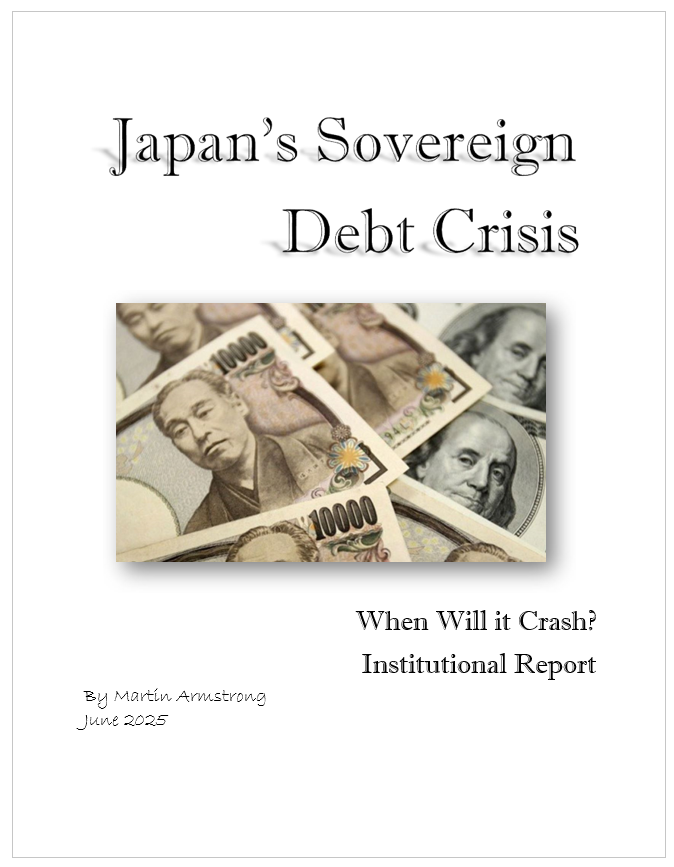
This is the first installment for our Institutional Clients concerning the two countries at the greatest risk of DEFAULT – Japan and Germany. We have provided the forecast for Japan’s default and explained in detail the internal battle between the Government, the Bank of Japan, and the Private Sector. This report exposes the truth about who holds what and the threat to instability as Japan also tries to cozy up close to NATO as a diversion for its fiscal mismanagement.

Investors have long fretted about the sustainability of Japan’s government debt as other nations, including Germany, are facing unsustainable fiscal mismanagement across the developed world. Japan has garnered the most attention due to its highest debt load relative to economic output and the heaviest debt-service burden. At the same time, the excuse has been that they are mostly self-funded, and as such, appearances are deceptive. Still, all Western nations are on a collision course with a sovereign debt crisis that will bring them all crashing down when the line at the door stops buying the new debt to roll over the old.

Japan’s fiscal mismanagement is not significantly worse than that of others. The pandemic, climate change, sluggish growth, and financial crises, accompanied by a lack of confidence, have led to an increase in government debt for many wealthy countries. At more than 250% of GDP, Japan’s gross debt stands out. Combined with sluggish growth and a shrinking population, many financiers and economists see it as an existential risk. The real question this report addresses is the real story behind the curtain, and when does this come to a head?

“Negotiators Are Able To Wipe Out The Debt.” Jillian Barberie On Done With Debt


Posted originally on Rumble By Bannon’s War Room on: June 3, 2025, at 2:00 pm EST

Silver Bars vs Coins


Posted originally on May 31, 2025 by Martin Armstrong 

SilverCoins

QUESTION: Marty,
There seems to be a growing trend with States approving gold and silver coins as acceptable payment methods. You have always said that it would be coins and not bars. However Florida now states that the silver must be 99% pure. How will this affect the pre 65 constitutional coins like dimes, quarters and half dollars generally referred to a junk silver? Junk silver coins will of course be worth more if the price of silver increases however it appears that one may not be able to use them for any daily transactions. Would one be better off selling their junk silver and converting it to silver rounds immediately? What does Socrates or Socrates Jr think on this topic as it is certainly a new wrinkle.
Thanks !
JimJ

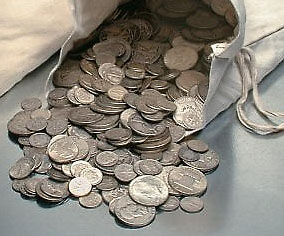
ANSWER: I understand the act, and it only illustrates my point that when it comes to a silver bar, 99% of the people out there would NEVER know the difference between that and a bar of Nickel. That’s what I said; I prefer the pre-1965 silver coins because the average person can easily identify the date. They are ALREADY legal tender. So they are not demonetizing the silver coins.

Roll of Silver Eagles

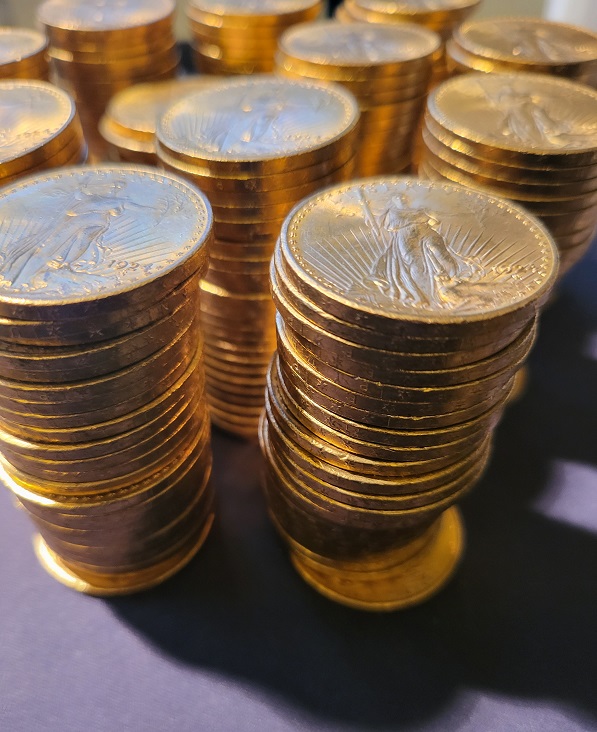
The Roll of 20 – 2025 $1 American Silver Eagles are 99.9% silver. However, they are denominated as $1. This may be more confusing to the average smuck on the street. Personally, I have bags of silver coins, and I have a hoard of $20 gold coins that came from a central bank, which found them tucked away in the basement vault. They are all uncirculated 1924 Saints. This was a private offering.

1924 Gold Hoard 3

Gold and Silver Now Legal Tender in Florida


Posted originally on May 30, 2025 by Martin Armstrong 

Florida Governor Ron DeSantis has declared gold and silver legal tender. HB 999 maintains that these precious metals may be used in payments if they meet specific purity standards. The bill goes into effect on July 1, 2026, but many are confused as to what this will entail.

As stated in the legislation: “Legal Tender; Revising the sales and use tax exemption for certain coin or currency; specifying that a person who claims the sales tax exemption bears the burden for determining whether the gold coin or silver coin meets a specified definition; providing a presumption regarding the purity requirements of gold coin and silver coin, etc.”

“We are the first large state to step up and to get this done,” DeSantis said. “And this is right out of the Constitution of the United States. So this legislation will authorize money services business like check cashers or PayPal to transmit and accept payment in gold and silver.” State Rep. Bill Bankson sponsored the bill with the goal to “eliminate the tax burden and make it a functional means of transaction between willing parties.”

To begin, Florida is not the first state to declare gold and/or silver legal tender. Utah passed the Utah Legal Tender Act of 2011, which declared coins of either metal legal tender. Oklahoma passed Senate Bill 862 in 2014, recognizing U.S.-minted gold and silver coins as legal tender and exempting them from taxation. Kansas and West Virginia have similar policies. Texas has recognized these coins as legal tender and enacted legislation to protect them from state seizure. Wyoming treats gold and silver as currency and has exempted it from sales tax. South Carolina and Louisiana have similar policies.

GoldCoins

Florida’s approach is a bit more structured. Gold coins must be at least 99.5% pure and silver coins at least 99.9% pure to qualify as legal tender. The weight and purity must be imprinted on the metal with the name or symbol of the mint refiner. Both will be exempt from sales tax. The state government may choose to accept silver and gold coins for payments on taxes, dues, charges, and debts. Yet, these transactions must be done electronically, and the coins will be held by a public depository while processing. A regulatory regime will be established to handle coinage, process insurance, record-keeping, licensing, and consumer disclosure agreements, which the Office of Financial Regulation will oversee.

Will Floridians see people using silver coins to check out at the grocery store? No. The law entails that payments in gold and silver coinage are entirely optional, and no person or business is required to accept them in payments. Merchants will not be required to attain knowledge on metal purity or have scales behind the cash register. The difference now is that businesses are allowed to accept them if they choose to do so. There are numerous tax benefits to choosing metal over cash.

If John Doe wants to purchase a boat from a dealership with gold, for example, the dealership must voluntarily accept the coinage but is in no way obligated to do so. Then the dealership has the burden of verifying the spot price of gold or silver rather than the state. However, if you go to a bank to cash a check, the bank will have the ability to offer clients payments in gold or silver coinage rather than cash. Another aspect to consider is that Florida will no longer add a sales tax on transactions in gold and silver, lowering the cost for businesses and consumers by around 6%.

This signals the ongoing loss of confidence in the federal government. States are rebelling against federal mismanagement and offering residents alternatives to move off the grid. People tend to hoard gold and spend paper. Gold and silver are not practical as daily commerce but are a symbolic store of wealth. We are entering a phase where sovereign debt will become toxic, and states will begin to prepare for the inevitable chaos coming from Washington.

Second US Commerce Dept Report – GDP Stagnant


originally on Posted May 30, 2025 by Martin Armstrong 

STAGFLATION

The US economy contracted by 0.2% from January through March of 2025. This is the second Q1 estimate provided by the US Commerce Department, with a third on the way on June 26.

Imports surged into the US during Q1 as corporations aimed to avoid incoming tariffs. The 42.6% uptick in imports marked the fastest pace of goods arriving in the US since Q3 2020. Business investment rose 24.4% in Q1, with business inventories adding 2.6 percentage points to overall GDP. Federal government spending fell by 4.6%, the largest drop in three years, but a deduction from overall GDP calculations.

Real consumer spending rose by 1.2%, albeit far less than the 4% posted during Q4 2024 and revised down from the first reading of 1.8%. Other reports indicate that Americans are spending far more on the essentials like utilities, health care, and housing. The Fed’s preferred inflation measure (PCE price index) rose 3.6%. Persistent inflation has led to cautious consumer behavior and a decline in demand for goods, contributing to the overall weakened reading for Q1.

Discretionary retail fell by 3% this quarter to 23% as consumers are less likely to purchase items like clothing, furniture, and electronics. Durable goods experienced a significant decline of 19%. The University of Michigan’s survey noted that decreased confidence has caused the demand for big-ticket items to decline. A lot of the demand we did see in Q1 was spending to offset anticipated tariffs. Autos, for example, rose by 11% YoY in March alone, and Q1 saw an overall 4.8% in auto purchases. That trend is not expected to continue as consumer sentiment is low.

April’s 2.3% CPI reading was the smallest annual increase since 2021, yet still above the 2% target set by the Fed years ago. The Fed isn’t fighting inflation. That phase is over. What they’re really fighting now is a collapse in confidence in the bond market, the dollar, and in the entire public sector. There will be no soft landing as once anticipated, as we are currently in a stage of stagflation.

Meanwhile, Fed Chair Jerome Powell met Trump at the White House on Thursday to declare that rate decisions would be based on “careful, objective, and non-political analysis.” “I’ve never asked for a meeting with any president, and I never will,” Powell said. “I wouldn’t do that. There’s never a reason for me to ask for a meeting. It’s always been the other way.” Trump invited Powell to the White House to encourage him to cut rates at the June meeting. The markets were pricing in a rate cut in June but now that does not seem as likely.

Trump fails to realize that the Fed is attempting to preserve confidence in the US, primarily in the debt market. We are witnessing cash deficits of over $1 trillion per quarter. Moody’s recently downgraded the US and no longer believes that Treasuries are a certain bet. The government is broke and the Fed must maintain the illusion of solvency.

LIVE: VP Vance Delivers Remarks at Bitcoin Conference…


Posted originally on Rumble on Bright Bart News Network on: May 28, at 1:50 pm EST

Ep. 3644a – Now We Know Why The Fed Was In A Holding Pattern, Economic Boomerang


Posted originally on Rumble By X 22 Report on: May 18, 2025 at 4:45 pm EST