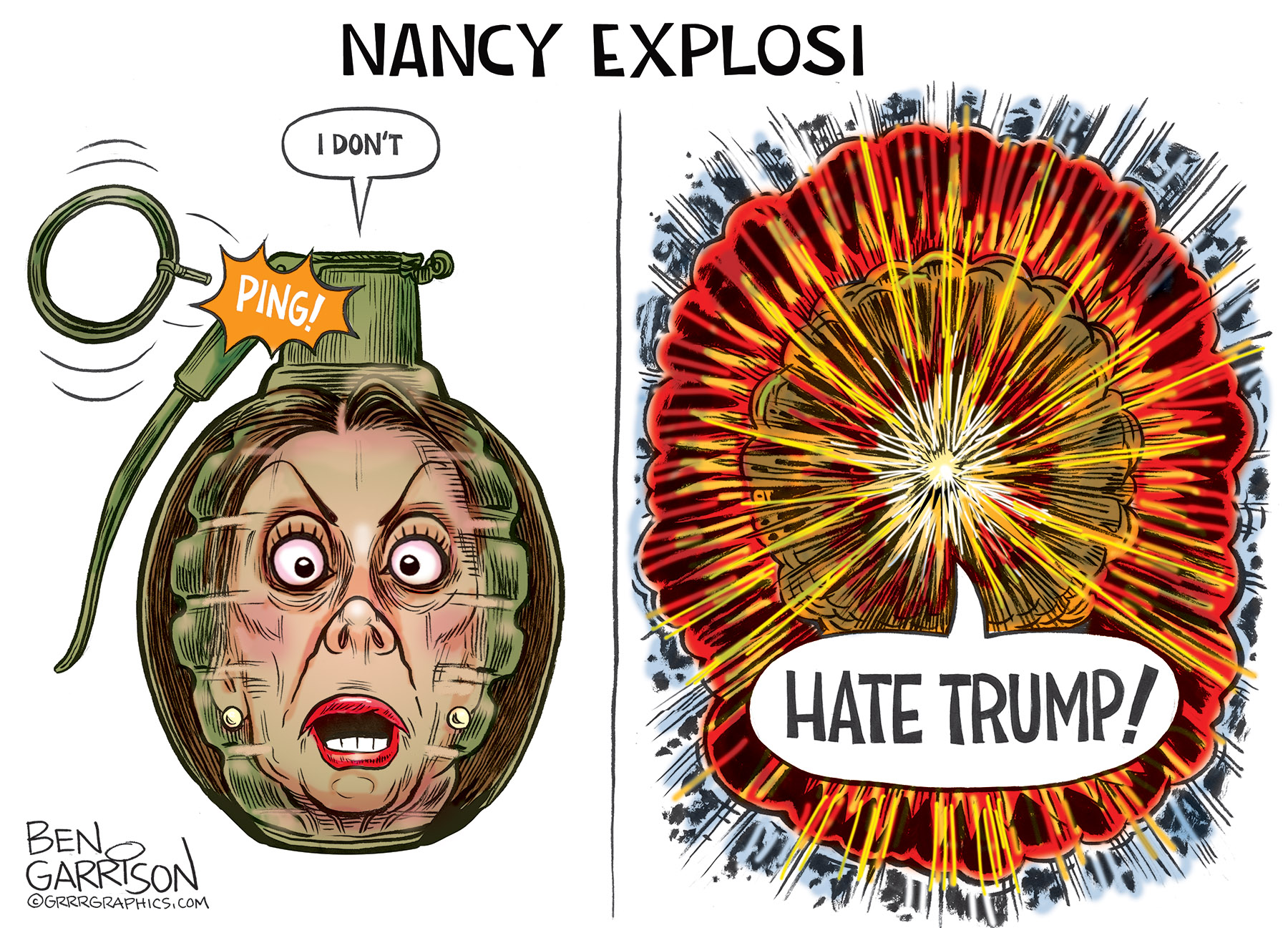
At a recent news conference, Nancy Pelosi was asked if she hated Trump. She blew up and acted angrily while claiming she was only protecting the Constitution. She added, “Our democracy is at stake.” What she really meant was, “Our Deep State is at stake.” Of course Nancy hates Trump. She can’t hide it.
Elaborating on this matter is our guest poster, “J” in Florida:
Question: Ms. Pelosi, do you hate Donald Trump?
Answer: What? What did you ask? Do I hate Donald Trump? I don’t hate anybody! How dare you accuse me of hating anyone! Yeah, I may have been trying to impeach that “orange bastard” and have him impeached at regular intervals for the past three years but that was just business. It’s like organized crime. We don’t hate the bastard. We just whack him because it’s the right thing to do and the necessary thing to do. But hate? No way. Yeah, maybe I hate you for posing that question and putting me on the spot, a pointed rebuke that my actions may be derived from animosity and insane rage and Trump Derangement Syndrome, but that’s not the case in this case. This is the case of the missing case. Even if I did hate Trump, do you really think I’d admit that to you?
Let me tell you something, little man. You aren’t as important as me. You don’t make as much money as me. You don’t have benefits equal to mine which has nothing to do with Congress exempting itself from the ACA, and therefore you can’t even begin to fathom the smallest inkling of what hate constitutes. You can’t fathom hate at my level. We may despise Trump, loath him, rage against him, find unrelenting fault with everything he does or attempts to do, but hate? No way. There are things I do hate and I’ll admit to that. I hate Trump’s policies. I hate his family. I hate the mere sight of his face on TV. I hate the comments that emanate from that mouth of his but there’s no way you can conclude from that that I hate Trump. I may detest him but you can’t interpret that as hate.
Hate. Spell it. H-A-T-E. That spells hate. You know things I do hate as House Speaker? I’ll tell you. I hate it when my car doesn’t start which causes me to be late for a meeting no one cares about. I hate stupid reporter questions about whether or not I hatesomething. I hate republicans, conservatives, traditionalists, the Tea Party types, rhinos, dumbass media who question me and my motives, who question me about hate, and everyone who remotely disagrees with me. I have a duty, an obligation, a commitment, and a responsibility to do what’s best to retain power and privilege.
Hate would be what I’d feel with Donald Trump being reelected to a second term. Now that might constitute hate. But hate now? Not me. Not here.
Don’t you ever ask me about hate again, you hear me? You sorry, slimy reporter! I detest you and your question but I don’t hate it. I’m just clarifying my thoughtsand feelings for the record. I hope this makes things clear as crystal.
Next question?
Visit our friends at The Patriot Post: America’s News Digest http://bit.ly/2OHfd9W —– The Bloomberg headline says “Trump Administration Moves to End Food Stamps for 750,000”, and that sounds bad during an election year. But as Scott Ott digs deeper into the story, he finds details that don’t make great anti-Trump clickbait. Bill Whittle Now with Scott Ott comes to you five times per week thanks to our Members, who enjoy backstage videos, a Member-written private blog, private messaging and a vigorous comments section. Produce these messages and find your people at https://BillWhtitle.com/register/ – Support us on Patreon: https://www.patreon.com/billwhittle – Listen to our shows on the go with your podcast app: http://bit.ly/BWN-Podcasts – Watch us now on Amazon’s Fire TV by downloading the Bill Whittle Network app. http://bit.ly/BWN-FireTV – Ask your Amazon smart device, “Alexa, play Bill Whittle Network on TuneIn radio.” – We’re on Bitchute too: http://bit.ly/BWN-Bitchute
President Trump responds to today’s deadline set by House Democrats for the White House to say whether it would participate in the impeachment proceedings:
Following a visit to Mexico by U.S. Attorney General Bill Barr, earlier today President Trump announced he was putting a “temporary hold” on the designation of Mexican drug cartels as terrorist organizations.
It looks like President Donald Trump has once again created a significant amount of leverage for Mexican President Lopez-Obrador to continue working with the Trump administration on a variety of security (border and immigration) and economic (USMCA) aspects.
(US DOJ) […] Attorney General Barr and Mexican Government counterparts discussed a broad range of issues including their shared commitment to protecting the security and safety of the citizens of both the United States and Mexico from transnational criminal organizations (TCOs) as well as how our countries work together to combat drug, human, and arms trafficking. They talked about the importance of targeting illicit financial networks and disrupting the illicit movement of cash, weapons, and drugs, combatting corruption, and strengthening cooperation on bringing members of TCOs to justice. (more)
Earlier today President Trump hosted a small business roundtable at the White House with various business owners to discuss the economy and the removal of regulatory hurdles. [Video and Transcript Below]
.
[Transcript] – THE PRESIDENT: Well, thank you very much, everyone. King Salman of Saudi Arabia, he just called to express his sincere condolences and give his sympathies to the families and friends of the warriors who were killed and wounded in the attack that took place just recently, just this morning, in Pensacola, Florida.
The King said that the Saudi people are greatly angered by the barbaric actions of the shooter and that this person, in no way, shape, or form represents the feelings of the Saudi people who love the American people so much.
So that was just given to me by the King of Saudi Arabia. And I can tell you, it’s a horrible thing that took place. And we’re getting to the bottom of it. All of the investigators are there now, and they’re studying it very closely. And a terrible thing. And our condolences go to the families and to everybody involved, including the wounded. We have some badly wounded people also. And we have to extend our condolences to them, and we’ll be working with them all very closely.
So I just wanted to let you know that was from King Salman.
And today, we’re here to talk to some of the very hardworking citizens who are benefitting from our historic record-setting campaign to eliminate job-killing regulations. I will tell you, the market is up 325 points today on great job numbers. The numbers have been phenomenal, actually. Some people said — so spot on, so good — that they’ve actually never seen anything like it. And it’s a long way from when people were rooting for a recession because they thought they could maybe win an election. But we don’t root for a recession; we root for success. And we’re having tremendous success.
I want to thank Vice President Mike Pence, who’s here, right here — Mike, thank you — as well as Secretary Gene Scalia, Secretary Elaine Chao, Acting OMB Director Russ Vought, and Acting Administrator Chris Pilkerton. Thank you all very much for being here. Appreciate it. Appreciate it very much.
It’s been an incredible period of time, economically, for our country. Probably the best ever. And we have the best unemployment numbers in over 54 years. We have the best numbers for African Americans. This came out today. Again, African American, Hispanic, Asian American — the best numbers we’ve ever had. Numbers for women are at a record number. We think that it will probably — if it keeps going like this — very shortly be totally historic. But they’re at numbers that nobody ever believed possible. Nobody would have believed it. Frankly, in the campaign, I would have never said it, but I felt we were going to do very well.
That’s despite the fact that we’re paying interest to people that have their money in the bank and other countries are not. So they have a great competitive advantage, and yet we’re, by far, far and away, the most successful economy anywhere in the world. We’re doing better than any other economy in the world. And, you know, we’ve created many trillions of dollars of wealth since the election. Other countries have lost many trillions of dollars.
We’re, by far, the largest economy in the world, and that was going to change. For many years, they were saying that was going to change, we were going to go to number two during this presidency. That was years ago. And I guess that — the wrong President got elected from the standpoint that there are a lot of people very unhappy about it. So they wish — they certainly think it was the wrong President; they would have rather had somebody else because they’re not number one. We’re number one. And we’re so far ahead that people can’t even believe it.
So we’ve had tremendous success. We’ve had it together. This has been a great group of Cabinet members. And the people in the administration have done a really good job.
It was just reported that we added another 266,000 jobs in November and we’ve also had very favorable numbers outside of the 266 [thousand], including some of the past numbers have been corrected in a very positive way also. So we have 266,000 jobs, plus we’ve created 7 million jobs, since my election. Unemployment is at the lowest rate, as I told you, in many years. And in many ways, I think we can probably, very soon, say “historically.”
A record 158 million Americans are now working. That’s the largest number in the history of our country. We’ve never had 158 million people working. And we should be breaking the 160 million magic mark fairly soon.
The stock market today, as you know, it’s up 325. We’ve hit another record high. I believe that’s 128 times — something like that — that we’ve broken the record, the all-time record for stock market highs. And think of that: about 128 times, and we’ve been here for less than three years. So it’s — and that, I can tell you, is a record.
2.5 million Americans have been lifted out of poverty. African American, Hispanic America, Asian American poverties — poverty levels, in the positive sense, have hit record lows. That’s something that nobody thought was going to be possible in a short period of time either. So they’ve all hit record lows.
Our regulatory reform efforts are delivering prosperity to forgotten men, women, and children of America. We are seeing a middle-class boom led by blue-collar jobs. And that’s one of the things that’s so great: The blue-collar workers — great workers of our country — they’re really benefitting tremendously from what we’ve done with the tax cuts and all of the other things that we’ve done.
And very big, I think, is the regulation cuts. Because even before we were able to get the tax cuts so successfully from Congress, we started cutting regulations immediately, and that had a big impact. And that’s why we went up so much between the election victory. So you’d say, really, from November 9th, the day after the election, up until January 20th, the Inauguration, the stock markets and jobs went — literally, went through the roof. And if the election were lost, it would have gone right through the floor. It would have been a disaster.
The soaring stock market is boosting pensions, 401(k)s, and college savings accounts at record levels. We’ve added $10 trillion in value to the economy, helping the small businesses that create two out of three new jobs. Nearly every single state has seen record numbers. Almost every state — I can tell you, every state I’ve been to in the last three months is having the best year they’ve ever had. And that’s because of the federal policy. And they’re very thankful. The governors are very thankful. The senators are very thankful. They’re all very thankful.
So things have happened that nobody thought would be possible. But, literally, every state I go to is setting a record for their state — individual states. And one of the states had just reported, and it’s because of our actions, not because of their actions, this I can tell you — because their actions are very negative. California is doing much better than anyone anticipated because of what we’ve done at the federal level. So, I’m very happy about that.
Next year, we will continue our bold deregulatory campaign. We’ll remove costly burdens to make cars safer and more affordable. I don’t know if you know what’s going on. We’re in a dispute with California. California, in order to save a tiny amount of fuel, of which we have plenty — and we have numbers that nobody would have believed possible. We’re the largest energy producer now in the world, and we’re an exporter of energy for the first in our history, really.
But we can make cars much less expensive, much better, much stronger, and about the same, from an environmental standpoint. Very close. But then, when you realize that many old cars will be taken off the road because they don’t want to get rid of them because they don’t want to buy the new cars because, frankly, they don’t work very well. That little — like this: You take that. (Points at a glass of water.) Sometimes, it’s about that much gasoline.
It’s a difference between $3,500, extra computers put on the engines, and all of the other things that you have to do. But the cars are much safer. Our cars are much safer. They’re much cheaper. They’re much better. And the reason they’re safer is because they can be heavier because, right now, the cars are made out of papier-mâché. (Laughter.) And ours are actually — we allow steel content. (Laughter.)
And so people are getting very excited about it. We have some good support with the auto companies. The only ones that don’t support are the car companies that want to be politically correct. But we’ll end up in some litigation with California. But just remember: Our cars are safer — and they are much safer, by the way — and they’re better. They operate better.
And, in every way, we think it’s going to be terrific. And we have a lot of support from the car industry. And you’re talking about a saving of $3,500 on average, per car. That’s a tremendous saving.
And one of the other things, from an environmental standpoint, many of the old gas guzzlers are — that are spewing out bad things are going to be coming off the road. Cars that are 10 years old and older, people will be going to the new cars because the pricing is better. And the net result of what happens environmentally is a very positive result because a lot of old cars are going to come off the road. And they won’t come off the road with the California standard, but they’ll come off the road with our standard. So you have a better car for less money, and it will be safer.
We’ll end the regulatory assault on franchise small businesses, which a lot of the people around the table want to do, because they’re very, very strongly affected. We’ll provide greater financial freedom and flexibility for U.S. truckers. The trucking industry has gotten — right, Elaine? — out of control. You might want to say a few words about that in a minute. But it’s gotten out of control.
And we’re doing other things. The lightbulb: They got rid of the lightbulb that people got used to. The new bulb is many times more expensive. And I hate to say it, it doesn’t make you look as good. Of course, being a vain person, that’s very important to me. (Laughter.) It’s like a — it gives you an orange look. I don’t want an orange look. (Laughter.) Has anyone noticed that? (Laughter.) So we’ll have to change those bulbs in at least a couple of rooms where I am in the White House. (Laughter.)
But we’re going back to the — it’s a double standard. We have a standard of the new bulbs, and we have the old bulbs. And they’re already making the old bulbs. Many people were complaining that the new bulbs were much, much more expensive. Many times, in some cases, more expensive. And the other thing, they’re considered a hazardous waste that, because it’s largely a gas technology, when the bulb is disposed of, you’re supposed to bring it to a hazardous waste site. I said, “How many people do that?” “No- — nobody does it.” And, you know, that’s a bad thing.
So you probably heard about it. You probably read about it. And you’ll be able to buy lightbulbs that actually are better lighting, in the opinion of many — and, I tell you, in my opinion — and for a lot less money. And so we’re doing that. But you’ll also be able — if you want, you can buy the other bulbs also. And I’ll tell you, even the bulb companies are very happy about that.
But together, we’re defending the American workers. We’re using common sense. We have a situation where we’re looking very strongly at sinks and showers and other elements of bathrooms where you turn the faucet on — in areas where there’s tremendous amounts of water, where the water rushes out to sea because you could never handle it — and you don’t get any water. You turn on the faucet; you don’t get any water. They take a shower and water comes dripping out. It’s dripping out — very quietly dripping out. People are flushing toilets 10 times, 15 times, as opposed to once. They end up using more water. So, EPA is looking at that very strongly, at my suggestion.
You go into a new building or a new house or a new home, and they have standards, “Oh, you don’t get water.” You can’t wash your hands, practically, there’s so little water comes out of the faucet. And the end result is you leave the faucet on and it takes you much longer to wash your hands. You end up using the same amount of water.
So we’re looking at, very seriously, at opening up the standard. And there may be some areas where we’ll go the other route — desert areas. But for the most part, you have many states where they have so much water that it comes down — it’s called rain — (laughter) — that they don’t know — they don’t know what to do with it.
So we’re going to be opening up that, I believe. And we’re looking at changing the standards very soon. And that’s a little bit like the lightbulb, where you get a bulb that’s better for much less money. We go back — but you have the other alternative. And you’ll keep the other alternative with sinks and showers, et cetera, too. But that’s been a big problem.
So a lot — a lot of the things we do are based on common sense. Somebody said, “Is that a conservative, is it a liberal thing? Is it — what is it? What are we doing?” I said, “It’s a commonsense thing.” In so many — so many of the things that we do, it’s based on common sense, like the car. The car will end up with that net tremendous saving, environmentally, when you think of all the cars, the old cars, that will come off the road. You’ll end up with a very — a better car. And you’ll end up — environmentally, it will be ultimately much better.
So, with that, I’d like to introduce Mike Pence, our great Vice President. And, Mike, you might want to saw a few words and, very importantly, go around the table with a couple other people you want to introduce.
THE VICE PRESIDENT: We will. Thank you, Mr. President. And it’s a great day in America, where we cleared the threshold of 7 million jobs created. And I assured all these business leaders and owners around the table earlier, Mr. President, that they have a President who understands that, while you — you’ve advanced tax cuts and tax reform at a historic level, unleashed American energy, fought to open markets, free and fair trade, and rolled back regulation at a historic level, that — that you, as someone who built a lifetime in a business and grew up in a family business, understand that it’s — it’s businesses that create those jobs.
And we really have a group around us that’s done an incredible job, being a part of that extraordinary economic boom that’s underway.
But I assured them that, for all that we’ve accomplished, it’s just what you consider to be a good start. And today, several of them have welcomed the opportunity to share their stories of what, particularly, cutting federal red tape has meant to their businesses and how we can continue to build the momentum in this economy through more regulatory reform.
I’m going to introduce all three of them first, and then they can just go at — at their timing and yours.
Barb Smith is the President of Journey Steel, which was founded 10 years ago and based in Cincinnati. Ryan Newby is Vice President of the Bank of Laverne in Laverne, Oklahoma. And Drew DeWalt is Co-Founder of Rhumbix, Incorporated — a field data capture company that’s revolutionizing aspects of the construction industry — and also a Navy veteran.
And I’ll also encourage you to hear from Dana Weber, whose family business was started 50 years ago by her dad. And she told me she’s worked there for 48 of those years, growing up, and is a part of a burgeoning and growing pipe business in this country that’s benefitted by the efforts that you’ve taken on steel.
THE PRESIDENT: Good. Yeah.
THE VICE PRESIDENT: So these are great job creators. And I’ve told all of them how grateful we were to have them here, for what they’re doing, and how anxious you are to hear how we can continue to build the momentum in this booming economy.
So, Barb.
THE PRESIDENT: Please. Yes.
MS. SMITH: So, thank you very much, Mr. President and Vice President, for giving me this incredible opportunity to be at this session. As said, my name is Barb Smith, and I’m the President of Journey Steel. Journey Steel is a self-performing steel fabrication and erection company. We’re headquartered in Cincinnati, Ohio.
My partner and I established Journey in 2009, built on passion, integrity, and dependability. We provide on-time, safety-driven, in-budget projects to our clients, while also impacting the community.
We have a year-round paid, pre-apprenticeship program that targets inner-city high school seniors. So upon their graduation, we get them started on their career in the construction industry.
My company is certified 8(a), WOSB, MBE, and, on a state level, EDGE and DBE, which — these programs are put in place to help small, minority-women-owned businesses to grow. However, some of the regulations that are in place really hinder that opportunity for us.
If I may share an analogy —
THE PRESIDENT: Yeah, go ahead.
MS. SMITH: I’m Dorothy. The ruby-red slippers are the certifications that I have. And the agencies point me on the yellow brick road. I’ve made a lot of friends along the way. They’ve been very supportive on my journey to the Emerald City. (Laughter.) But when I got to the Emerald City, those big doors closed in my face because of some of the regulations that told me to go back, jump through some wicked hoops —
THE PRESIDENT: Right.
MS. SMITH: — which I managed to do. Got back; the doors were then opened, only for me to find another set of regulations behind the curtain.
So my ask of this administration would be: Remove those regulations. Let us get to the man behind the curtain who knows the power and those ruby-red slippers that they’ve given us to open those doors for contracts so that we can truly unpack them.
THE PRESIDENT: Now, did you write those regulations down? Did you think they’re — I assume you think they’re unnecessary. Because some regulation is needed.
MS. SMITH: They’re not — I won’t say they’re unnecessary. Like I said, great people in the SBA. I’ll use that as part of it. Like I said, they are tremendous. They know their job.
THE PRESIDENT: Do you know the ones that Barb is talking about?
ACTING ADMINISTRATOR PILKERTON: I gave her my direct line and e-mail. So we’re going to talk about that afterwards.
MS. SMITH: Yes. And they’re just simple. With the regulations, with a new 8(a) firm, being small, minority-women-owned, some of the things that we need — the biggest thing we need is a mentor. And in order to get a mentor who has the past performances, who has the bonding capabilities, who knows how to work for the government, which is one of the biggest spins in the construction industry, as you know; you spend billions and billions of dollars.
But for the small, minority-women-owned business, who can’t get to that company that’s already been there, the regulations are in place where these agencies can’t give me a list, they can’t help me find that mentor. And even though I may knock on the door, I may not get to the right person.
So that’s just a simple regulation that hopefully would be able to be removed — because if we’re able to get to the right people, understand that, get the mentors in place that help us grow so that we can hire more people, change the economy, get more people to work, that would truly benefit — which is what these programs, I believe, was established for to begin with, is to help the minority, small businesses be able to access federal contracts.
THE PRESIDENT: Okay. Good. Thank you, Barb, very much. Thank you.
MS. SMITH: Thank you. Thank you.
THE VICE PRESIDENT: That’s great. That’s great.
Ryan.
MR. NEWBY: Mr. President, Mr. Vice President, thank you for the opportunity and your time today. I appreciate it very much. Ryan Newby, from Laverne, Oklahoma — northwest part of the state. I represent a small community bank in the Oklahoma Panhandle. And I say “small” — we’re $58 million in total assets, $26 million in loans.
A few points that I wanted to hit on was the reform and repeal of Dodd-Frank. We, like a lot of other banks in Oklahoma, got out of the mortgage-lending business due to the compliance red tape that we were having to deal with. Forty percent of the banks in Oklahoma got out the mortgage-lending business at that time.
And with your deregulation, we’ve been able to get back into that and serve our customers. We were sending them, you know, 40, 50 miles down the road to competition. So that’s been a big plus for banks like us.
A couple other points I’d like to make are — it probably don’t seem like big things to other people, but longer exam cycles for well-capitalized banks — you know, 18-month exam cycles, which helps cut down on compliance costs. We don’t have to deal with examiners as much; we can serve our customers. And also, the corporate tax rate being lowered from 34 percent to 21 percent saves us thousands of dollars a year to reinvest in our community and make more loans for our customers.
So, again, thank you —
THE PRESIDENT: Thank you, Ryan.
MR. NEWBY: — for everything you guys have been doing.
THE PRESIDENT: Good job you’re doing. I’ve heard some good things. Great. Thank you very much.
THE VICE PRESIDENT: That’s great.
Drew.
MR. DEWALT: Thank you. Mr. President, it’s an honor to be here today. My grandfather was a World War Two Navy veteran and spent the rest of his career running a small business — a construction company. And so I guess you could say I followed in his footsteps.
I’m also a Navy veteran. Got into construction afterwards. I actually developed into building large infrastructure projects and then started my own small business. It’s a technology company providing technologies for construction companies to operate more efficiently.
I really think, until we started our business, Rhumbix — my co-founder is actually a Navy veteran as well.
THE PRESIDENT: Great.
MR. DEWALT: So until we started our business, nobody had built technology and software solutions for the men and women actually building construction. You don’t get it built and somebody’s hands get put on it. So that’s what our business does to really drive efficiency in the construction industry.
And through this experience, I’ve gained a great appreciation for the construction industry — all the good that it does. But, as you well know, with all of your building completed, it’s a — it can get pretty complicated, costly, and inefficient. So I love the dereg- — deregulation approach we’re taking here.
As part of my business, I get to go to construction companies — boots on the ground — across the country. And I’ve seen the drag that over- — overdue-for-a-good-look regulation has on the industry.
That being said, none of the builders that I meet with and work with have ever seen the industry booming as much as it has right now. They have the largest work backlogs that they’ve ever had. And the only thing constraining the industry right now is finding enough people to do the work.
THE PRESIDENT: That’s right.
MR. DEWALT: So if we can — sidebar — drive more people and encourage more people to join the trades, which is a lucrative individual business and can prop up this part of the economy, that would be welcomed.
But there’s still more issues to be solved. You know, I think — I see a lot of companies doing federal contracting work that have added costs to their business — of specific software and overhead and head count just for compliance. No other economic result on the business, other than making sure you’re compliant or you’re going to get fined later.
THE PRESIDENT: Sure. It’s too much. I agree.
MR. DEWALT: And then I see good projects getting done, and they’re still not out of risk, because — I had a contractor tell me: About six months after a job being completed, they got sued for payroll noncompliance. They had to fly somebody from the U.S. to Australia to dig through the garage of a former employee for a legal box, looking for the right paperwork to verify so they didn’t get sued.
You’ve done enough building, I’m sure you’ve been in a similar situation. It’s crazy. These inefficiencies still exist, and I think there’s just such a good opportunity.
I think what I do on the technology front is important for taking an industry that’s trying to move forward, actually to take that next step. But I think the regulation piece, candidly, is a bigger opportunity — that everybody is championing around this table — so that you can actually look for opportunities to remove duplicative regulations from the federal, state, and local level that actually drive even more efficiency. Because it’s the second-largest industry in the nation, and if you can put more juice in the tank there, you can get even better results.
And I’d love to help anyway I can, but I appreciate you inviting me here today to share my story.
THE PRESIDENT: That’s great. Yeah, thank you very much. Good job. Good job you’re doing.
You know, we have a lot of things that we’re working on. One of them is — to build a road can take 22 years to get approvals. And we’ve got it way down now. We had — we have roads where they’ve been going for many, many — they’ve been going for decades. Elaine knows this better than anybody. And at the end of 20 years —
SECRETARY CHAO: I’m taking notes. (Laughter.)
THE PRESIDENT: Right? At the end of 20 years, you’re literally — you go for a vote, and you get turned down. So they’ve been trying to get an approval for 20 years, and then they get turned down, like 3-2 or something.
And we’ve got that process down to four and a half years. It’s going to be — I think it’s going to be two years. We’re going to try and get it down to almost one year. That doesn’t mean a road or a highway doesn’t get approved. But if they don’t get approved, it goes quickly, so they get rejected quickly.
MR. DEWALT: Right.
THE PRESIDENT: But they also, mostly, will get approved quickly.
And Elaine is doing a fantastic job in bringing that down. We’ve had so many — so many examples of roads that took 17, 18, 19 years to get approved. And by the time they get approved, they cost 50 times more and they have to do all sorts of turns to get out of certain areas, from an environmental standpoint, instead of being a straight and much safer road.
So we’ve been able to do that. And I think those people in the steel industry have been greatly helped by the tariffs, because the tariffs made the steel industry — it’s incredible what’s happening — the money that is being spent on steel today. I don’t think we would have had a steel industry. If I — if I didn’t get elected, you wouldn’t have a steel industry, because, ultimately, every steel mill was closing. They were dumping steel at a level that nobody has ever seen before. And they were dumping it in order to, really, destroy our steel industry so that we had to buy from them.
And now the steel industry — if you look at what’s going on, the industry is doing incredibly well. They’re building a lot of extensions. They’re building brand-new plants where they never — you know this, Russell — they never built a new plant. I mean, they hadn’t built one in years, and now they’re building new plants all over the country. They’re expanding existing plants all over the country. And the steel industry is doing great. And it will start doing even better with what we’re doing.
So it’s been very exciting, especially since the economy is now even stronger than at the beginning.
And I think what I’d like to do is ask Larry Kudlow — the great Larry Kudlow — to say a few words. The numbers came out today — the job numbers and —
THE VICE PRESIDENT: Mr. President?
THE PRESIDENT: Yes?
THE VICE PRESIDENT: If I may, just based on what you just said, Dana Weber is in the steel industry —
THE PRESIDENT: Okay. Let’s go. I hope you back me up.
THE VICE PRESIDENT: — and had a few things she wanted to share before —
THE PRESIDENT: I hope I get backed up here. (Laughter.)
MS. WEBER: I am absolutely going to back you up.
THE PRESIDENT: Good.
MS. WEBER: I’m going to tell you that — first of all, you’re the first President in the 40 years plus I’ve been in this business that’s actually stood up for manufacturing. And I want to say thank you.
The tariffs and the trade policies that you have, have made a huge difference for us and a big difference. We are investing at record levels — we have over the last three years. We are paying profit-sharing bonuses and wage increases at record levels over the last years. And we are having companies, customers come out of the woodwork that we didn’t even know existed — coming to us because — to inquire and to buy steel from us. We made specialty steel tubing.
So you have made a tremendous difference.
THE PRESIDENT: Great, Dana. That’s great.
MS. WEBER: And that’s on top of all the tax relief and the regulatory burdens that I just want to — as I said earlier, please keep doing what you’re doing for at least five more years. (Laughter.)
THE PRESIDENT: Good. We love the word, “at least,” — the words. (Laughter.) They like to hear that. Thank you, Dana.
No, it’s been a big difference in the steel indus- — and many industries. But the steel industry, in particular, was — we weren’t going to have a steel industry. And that’s so unacceptable, even from a defense standpoint. I mean, can you imagine if we have to — if we need — if we need steel and we have to go to another country to get steel? And that was what was happening. Everything was closing down — and very unfairly and done with purpose. I mean, these people were coming in with a purpose — a negative purpose.
So they’re not too happy, but our people are very happy. And the industry is doing fantastically well. It will soon be at numbers that will be almost like the old days and maybe like the old days.
Larry Kudlow, you also had good manufacturing numbers today. I noticed 50,000 jobs or something created over a short period of time. And the previous administration said — manufacturing — “you’d need the magic wand.” You know, we’ve all heard the statement. But they basically said it was a dead business, when in fact it’s one of the most important sets of jobs I think you can have anywhere.
Could you give a little discussion as to what took place today when they announced the numbers early in the morning?
Mr. KUDLOW: I would be happy to. Thank you, sir. By the way, you’re right; we’re still running over 500,000 new manufacturing jobs. So that’s a big plus.
Just a couple of quick ones: The report today was plus-266,000 jobs for the month of November, but the prior two months were revised higher by 41,000. So actually, today’s number is 307,000. After you and I spoke last night, I went back and crosschecked. And sure enough, this is the fourth-straight month of upward revisions from the prior period. And that’s a leading indicator of a strong economy.
A couple of other quickies on this: 3.5 percent unemployment rate; that’s near the 50-year low. Since you’ve been President, the average working family — right? — husband, wife, two kids — after inflation, after taxes, has gone up $5,000. That’s take-home pay — $5,000. The prior two administrations were basically flat.
And then, part of this worker boom — this American worker boom theme — so since you’ve been President, the production workers are increasing their wages at a 3.7 percent annual rate. Okay? Production workers: 3.7 percent annual increase. Their managers’ wages are rising 1.6.
So, the folks on the line — the folks wearing the blue collars or whatever, the folks getting their hands dirty — they are working so well, their wage gains are almost twice the gains of their own managers. You know what? I’ve never seen it before and, as you know, I’ve been around three or four centuries. (Laughter.)
THE PRESIDENT: Great job. You did great this morning, too.
MR. KUDLOW: Thank you.
THE PRESIDENT: A lot of shows, and really did fantastic. Well, they’re easy numbers really to work with, aren’t they? Those numbers were great.
MR. KUDLOW: It’s a sunny day, sir.
THE PRESIDENT: Yeah. No, it’s very good. Really, very good.
Elaine, maybe you want to discuss a little bit about transportation and, in particular, the highway and the building of the highways and the roads and everything that we’re working on so hard?
SECRETARY CHAO: Well, this is a President that really cares about the condition of our infrastructure. And we continue to want to work with the Congress on a bipartisan basis. You’ve always said that.
As a down payment to the President’s proposal — infrastructure — the Department spends about $70 billion every single year to address, to refurbish, rehabilitate bridges, roads, highways. And so we remain very focused on our goal, as the President has wanted. He has also asked us to look at the permitting process and how important that is to, I know, several of you around this table and others, of course, who are in this business.
So, he’s been a very strict taskmaster. He has asked that for every two new — every one new regulation, we’ve got to withdraw at least two. And I think the whole administration has done much better. Brooke mentioned that, for every one new regulation, about 7.5 — seven and a half regulations have been withdrawn. So, this is a tremendous, you know, lifting of the burden on people’s backs — small businesses in particular.
And I want also want to mention one other thing the President mentioned about the Safe Vehicle Act. You know, when we have — we all care about the environment, but when cars cost too much people, don’t trade in their cars. And when that happens and people keep older cars, that’s actually unsafe.
So our new fuel economy standard will be one of this administration’s biggest legacies, in terms of a deregulatory action. And it’s going to introduce and improve safety on top of that, because also cars that are too light are not safe.
So, Mr. President —
THE PRESIDENT: And you’re working on — yeah.
SECRETARY CHAO: — you’ve also led the way on that.
THE PRESIDENT: Thank you very much. And you’re working on air traffic control?
SECRETARY CHAO: Yes, sir.
THE PRESIDENT: And that’s something that, to me, is very important — because we have a system that’s obsolete. It’s ridiculous. It’s a ground-based system, which nobody can even imagine because that’s a 40-year-old system. They’ve spent billions and billions and billions of dollars over the years trying to upgrade it when you can buy a new system — brand-new, with the top of the line. There are basically four companies that are in that business. But you can buy a new system for less money than it costs to renovate little pieces of this old, obsolete system.
I’ve been in planes where the pilots don’t even want to use our system. They use another country’s system to land in New York City or to land in other parts of the country, like Oklahoma. (Laughter.) But they’ll use somebody else’s — they’ll use somebody else’s system. Air traffic control — it’s obsolete, and we’re working on a project where we make a deal to get a great system. And we’ll — hopefully, we can meet on that soon. Maybe with your people we’ll talk about it, okay?
SECRETARY CHAO: May I ask —
THE PRESIDENT: Yes, please.
SECRETARY CHAO: I have one more thing. The Vice President and you are both here. You have a tremendous interest in commercial space. And six years ago, the U.S. was way behind all other countries. In the last three — two and a half years, under your leadership and the Vice President’s leadership of the Space Council, America is once again number one in commercial space launches.
THE PRESIDENT: Yeah. Number one. Number one by far. So, we’ve done very well with space.
Gene Scalia, you’ve done a good job in that first short period of time. Right? Secretary of Labor. You want to just say what’s going on? I know you called me this morning to say how great the numbers are.
SECRETARY SCALIA: Yeah. I called you this morning. I’ve been in this job two months. I mean, it’s such a treat to be able to report these numbers —
THE PRESIDENT: What a job — what a job he’s done. (Laughter.)
SECRETARY SCALIA: Four hundred and twenty-two thousand jobs in the two months that I’ve been in the position. And I get to talk to the American people about these results.
And, you know, this is cause and effect, right? It’s cause and effect. The effect is unprecedented numbers. They’re spectacular. And wages. I mean, that’s so important. And wages at the lower level are going up more, as Larry was saying.
And the effect and the cause, we know what it is. Right? It’s what we’re here talking about. It’s the tax cuts. It’s the deregulation. And so it’s cause and effect.
And I bet you, if we went around the table, apart from wanting to deal with regulations, and keep at that — right? — apart from that, I bet that one of the biggest things on these folks’ minds right now is finding workers. That’s a challenge to small business. That’s how strong our economy is. When you talk to business people, one of the biggest worries they have is finding workers.
And so, we heard — Michael was talking a little about helping with reentry. Barb, you were talking about apprenticeships. Those are things that, Mr. President, you’re focusing on, and the Vice President, too. So we’re addressing that, but I mention it just to show how strong the economy is right now. And you know — and again, that’s the effect of the things that you’ve been causing through these policies.
THE PRESIDENT: Great job. Great job.
So thank you very much, everybody. Very successful period of time for our country. The most successful probably in the history of our country. We’ve never done anything like that. We’ve never had these unemployment numbers or employment numbers. And we’re very happy about it. A lot of hard work.
Thank you very much, everybody. Thank you.
Q Mr. President, what can you tell us about the shooter in the Pensacola incident?
THE PRESIDENT: Well, that’s all being studied now. We’ll have a full report on it very shortly.
Q Is this — could this be considered a terrorism act?
THE PRESIDENT: We’re not going to report on that yet, but we’ll be talking about it very soon. It could — we have a lot of great people looking at it and interviewing people in depth. And it’ll be a report, and the report will come out very soon.
Thank you all very much. Thank you.
Q How do you plan to respond to Jerry Nadler’s invitation? Jerry Nadler’s invitation?
THE PRESIDENT: Thank you very much.
Q What’s your thinking about the tariffs, Mr. President?
National Economic Council Director Larry Kudlow appears on Fox Business news to discuss the November jobs report, economic growth and the China trade discussions.
Kudlow highlights the primary point that President Trump has reestablished Main Street USA as the primary focus of policy. U.S. companies invested in the U.S. economy are doing exceptionally well and receiving the majority benefit. U.S. multinational companies who are invested overseas are not benefiting as much. Wall St -vs- Main Street.
.
Director Kudlow is correct, if the House can ratify the USMCA trade deal, North America will see a massive influx of investment.
In essence Titan Trump is winning the economic battle by: (a) repatriating wealth (trade policy); (b) blocking exfiltration (main street policy); (c) creating new and modern economic alliances based on reciprocity (bilateral deals); and (d) dismantling the post WWII Marshal plan of global trade and one-way tariffs (de-globalization).
The Bureau of Labor Statistics (BLS) has released the jobs number for November and the results are astoundingly excellent. November jobs gains 266,000; the year-over-year wage growth is 3.1% with non-supervisory wages growing double the rate of supervisory wages. The unemployment rate dropped slightly to 3.5 percent.
Additionally, September was revised up by 13,000 from +180,000 to +193,000, and the change for October was revised up by 28,000 from +128,000 to +156,000. With these revisions, employment gains in September and October combined were 41,000 more than previously reported. [Full BLS Report Here]
Also in November, 1.2 million persons were marginally attached to the labor force. This is a reduction of 432,000 from a year earlier. Those additional jobs are not counted in any labor report because those returning workers were previously not looking for employment; they came off the sidelines and entered the workforce. AMERICA IS WORKING AGAIN !
Shortly after 6pm this evening Supreme Court Justice Justice Ruth Bader Ginsburg put a prior 2nd Circuit ruling on hold until next Friday, December 13, at 5 p.m.
President Trump went to the Supreme Court after the House Financial Services and Intelligence Committees issued subpoenas to Deutsche Bank and Capital One seeking President Trump’s tax records. In his request to the court [Read Here] Trump asked SCOTUS to block the subpoenas on the ground they go beyond the committees’ powers.
Justice Ginsburg’s order tonight gives the justices time to rule on Trump’s request for a longer stay of the lower court’s decision while he files a petition for review. Ginsburg ordered the House of Representatives to file a response to Trump’s request by 11 a.m. on Wednesday, December 11.
At their private SCOTUS conference next week, the justices are scheduled to consider President Trump’s original petition for review of a lower-court ruling that would require him to turn over tax records to the SDNY who are seeking them as part of a grand-jury investigation. The SCOTUS decision today, placing a hold on a similar House effort, essentially allows the court to receive arguments relating to the second request for tax records and contemplate the merit of both.
The first request to the Supreme Court resulted in them issuing a ruling maintaining the block against House Democrats receiving President Trump’s tax returns. The one paragraph order [pdf here] essentially maintained the stay and requested the Trump administration to file a formal request for review by the court. The Trump filing today is a response to that SCOTUS request:
Attorney Ristvan previously provided a good encapsulation of the problems for the House that explains why President Trump could likely win the case:
House Oversight is one of three committees that 26USC§6103(f) requires the IRS to turn over individual returns “upon request”.
They requested (PDJT taxes for 6 years 2013-2018) long before Pelosi announced her impeachment inquiry, way before the House vote on same, to which Pelosi said Sunday, (paraphrased) “We haven’t decided to impeach. We are only inquiring about it.”
The ‘upon request’ is not as absolute as it seems. The request must still be predicated on a legitimate legislative purpose. SCOTUS has held (I skip the rulings, since previously commented on here many months ago) that there are only two valid purposes, both constrained to legislative powers expressly granted by A1§8.
1. An inquiry into making, repealing, or amending an A1§8 law.
2. Oversight of executive administration of an existing law.
With respect to (1), a legitimate legislative purpose would be reviewing real estate tax law for possible changes. BUT then, the request should have come from Ways and Means (Neal) where tax laws originate. AND, it should have included requests for tax returns from other big real estate developers also. Singling out only PDJT is a fatal defect to this purpose.
With respect to (2), after Nixon/Agnew the tax code was amended to require a special IRS audit of annual POTUS and VPOTUS returns, with the results held in the National Archive. Reviewing those special audits by IRS would be a proper Oversight and Reform legislative purpose, BUT ONLY for 2017-2018 after PDJT was inaugurated. The earlier 4 years demanded are a fatal defect to this purpose.
Both these valid points were raised by President Trump and were already on their way to SCOTUS. Now the committee is trying to ‘cure’ these fatal request defects by claiming the returns are necessary for impeachment. This raises four new issues where PDJT can also win.
1. Impeachment is not a legislative purpose within A1§8.
2. Articles of Impeachment have historically been the the province of Judiciary, NOT Oversight.
3. The demand was made BEFORE the impeachment inquiry unofficially started and cannot be retrospectively cured.
4. No tax ‘high crimes of misdemeanors’ have even been alleged. Impeachment fishing expeditions are unconstitutional.
IMO this case has the potential to set a major constitutional precedent about POTUS harassment via political impeachment. The constitutional convention minutes and Federalist #65 both make it clear why ‘maladministration’ (the original third test after treason and bribery, and which WOULD allow for political impeachment) was replaced by ‘High Crimes and Misdemeanors’. The phrase was borrowed from prior British law, has a specific set of meanings, and DOES NOT allow political impeachment. (link)
The quest for President Trump’s financial records is essentially a legislative fishing expedition in an attempt to gain opposition research for their Democrat candidate in the 2020 election.
The Supreme Court has not yet ruled on any ancillary case that touches upon the validity of the unilaterally declared House impeachment process. The Supreme Court has not ruled on any case that touches the impeachment “inquiry”.
The issue at stake is whether the legislative branch can penetrate the constitutional firewall which exists within the separation of powers.
If the House loses the Tax case in SCOTUS (likely), and/or either HJC case in appeals or SCOTUS it will mean there was no constitutional foundation for the “impeachment inquiry” upon which they have built their original legal arguments.
♦The first case is the House Oversight Committee effort to gain President Trumps’ tax returns as part of their impeachment ‘inquiry’ and oversight. That case is currently on-hold (10-day stay) in the Supreme Court. Written briefs soon, arguments perhaps in early December? Outcome pending. There is a very strong probability Pelosi will lose this case because Oversight doesn’t have jurisdiction and the case began back in February.
Ginsburg placed a hold on the order on Friday, according to Reuters. The 2nd District Court of Appeals issued a ruling on Tuesday ordering Deutsche Bank and Capital One to turn over financial documents on Trump, members of his family, and his business.
Justice Ruth Bader Ginsburg put the 2nd Circuit’s ruling on hold until next Friday, December 13, at 5 p.m. Ginsburg’s order gives the justices time to rule on Trump’s request for a longer stay of the lower court’s decision while he files a petition for review. Ginsburg ordered the House of Representatives to file a response to Trump’s request by 11 a.m. on Wednesday, December 11. (link)
Probability of loss to Pelosi 90%.
♦The second case is the House Judiciary Committee (HJC) effort to gain the grand jury information from the Mueller investigation. The decision by DC Judge Beryl Howell was stayed by a three member DC Appellate court. Oral arguments were November 12th, the decision is pending. [Depending on outcome, the case could will also go to SCOTUS]
[…] the appeals court in a brief order said it would not immediately release the documents “pending further order of the court.” The court also asked the House and the Justice Department for more briefings and set a Jan. 3 date for another hearing. (link)
Probability of SCOTUS 100%
♦The third case is the HJC effort to force the testimony of former White House legal counsel Don McGahn. Issue: subpoena validity. The HJC asked for an expedited ruling. Judge Ketanji Brown Jackson delivered her ruling November 25th.:
Federal District Court Judge Ketanji Brown Jackson said McGahn must appear before Congress but retains the ability to “invoke executive privilege where appropriate” during his appearance. The judge did not put her own ruling on hold, but the Trump administration will likely seek one to put the effect of her ruling on hold while it pursues an appeal. (link)
However, two days later Judge Brown-Jackson stayed her own ruling...
Judge Ketanji Brown Jackson, an Obama appointee on the district court in D.C., granted McGahn’s request for a temporary stay while she deliberates on whether to issue a lengthier one to allow him to appeal her decision.
The House Judiciary Committee, which had asked the court to enforce its subpoena for President Trump‘s former legal adviser, said it would not oppose a temporary stay. (read more)
Probability Appeal 100% – Probability SCOTUS 90%
Pelosi, Schiff, Nadler and Lawfare are now rushing toward a full House impeachment vote while simultaneously attempting to stall any judicial decision (Appeals or SCOTUS) that would undermine their manufactured impeachment authority.
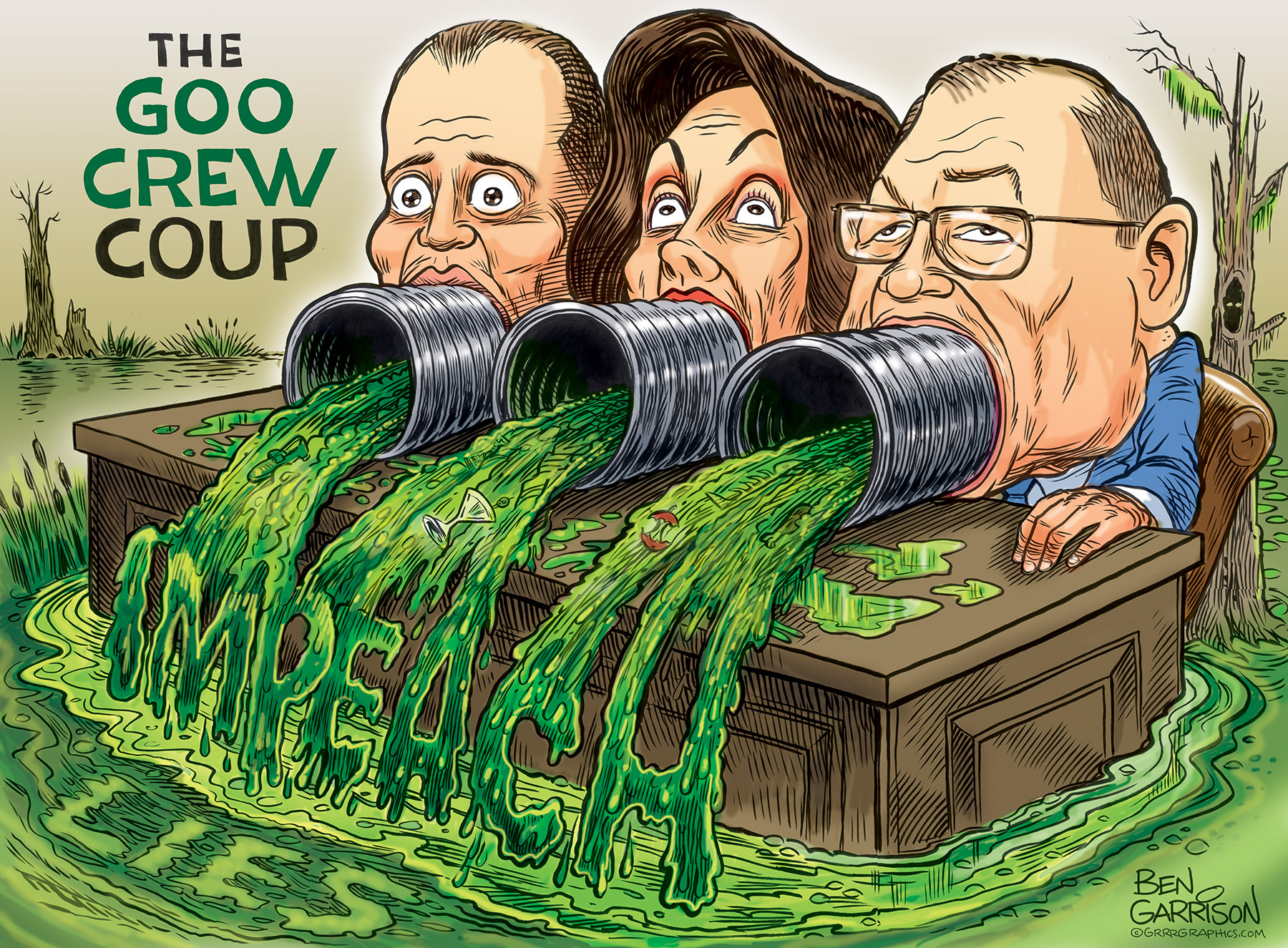
I’ve been watching the ongoing farce known as the impeachment hearings and I realized their Star Chamber circus was never going to end. The Democrats will continue to invent and spew slime toward Trump no matter what. They accuse the president of interfering with next year’s election, yet THEY are the ones who are trying to negate the will of the American people who lawfully put Trump into office–and they are already interfering with his reelection in 2020.
President Trump is not part of the Deep State. He was elected as an outsider—an America-first populist and he promised to drain the swamp and end the corruption. The swamp is fighting back. Everyone is onto their tiresome game, but that makes no difference. They all have severe cases of Trump Derangement Syndrome.
The Democrats have contempt for the will of the American people. The Deep State Swamp will never stop spewing slimy lies as they continue to make a mockery of the Constitution.
I have created this site to help people have fun in the kitchen. I write about enjoying life both in and out of my kitchen. Life is short! Make the most of it and enjoy!
This is a library of News Events not reported by the Main Stream Media documenting & connecting the dots on How the Obama Marxist Liberal agenda is destroying America



 Centinel2012