President Trump was asked Wednesday to remark on disparaging comments made about him by Justin from Canada during the diplomatic reception at No. 10 Downing Street on Tuesday evening.
President Trump responded: “Well, he’s two-faced;… and honestly he’s a nice guy, I find him to be a very nice guy, but the truth is I called him out on the fact that he’s not paying two percent and I guess he was not very happy about it.”
At 10:00am ET the House Judiciary Committee will hold an “impeachment groundwork” hearing with a panel of left-wing resistance academics scheduled to help democrats justify their urgent partisan efforts to remove President Trump from office.
HJC Chairman Jerry Nadler will be aided by contracted Lawfare attorney Norm Eisen for the effort. Chairman Nadler promised his peers he will be very aggressive toward any opposition questioning that seeks to undermine the predetermined enterprise. The academic panel is scheduled to begin testifying to Mr. Eisen at 10:00am ET
President Donald Trump and First Lady Melania Trump attend day two of the 70th Anniversary NATO Summit in London, England. The U.K. is five hours ahead of U.S. Eastern Time.
Day two includes: a general session for all members of the NATO alliance; a luncheon by President Trump to thank those NATO members fulfilling their two-percent pledge to their own security; bilat meetings with Angela Merkel, Mette Frederiksen and Giuseppe Conte; a press conference, and then departure.
♦3:25am ET / 8:25am Local – THE PRESIDENT departs Winfield House Landing Zone en route to the Grove Landing Zone, London, UK
♦3:40am ET / 8:40am Local – THE PRESIDENT arrives at the Grove Landing Zone, London, UK
♦3:50am ET / 8:50am Local – THE PRESIDENT departs the Grove Landing Zone en route to The Grove, London, UK
♦3:55am ET / 8:55am Local – THE PRESIDENT arrives at The Grove, London, UK
♦4:20am ET / 9:20am Local – THE PRESIDENT participates in an Official Welcome with the Secretary General of the North Atlantic Treaty Organization, Jens Stoltenberg, and the Prime Minister of the United Kingdom of Great Britain and Northern Ireland, Boris Johnson, London, UK
♦5:00am ET / 10:00am Local – THE PRESIDENT participates in a North Atlantic Treaty Organization Plenary Session, London, UK
♦7:30am ET / 12:30pm Local – THE PRESIDENT participates in a bilateral meeting with the Chancellor of the Federal Republic of Germany, Angela Merkel, London, UK
♦8:15am ET / 1:15pm Local – THE PRESIDENT participates in a working lunch with the NATO two-percent club, London, UK
♦9:00am ET / 2:00pm Local – THE PRESIDENT participates in a bilateral pull-aside with the Prime Minister of the Kingdom of Denmark, Mette Frederiksen, London, UK
♦9:45am ET / 2:45pm Local – THE PRESIDENT participates in a bilateral pull-aside with the Prime Minister of the Italian Republic, Giuseppe Conte, London, UK
♦10:30am ET / 3:30pm Local – THE PRESIDENT participates in a press conference, London, UK
~ NATO Summit Concludes ~
♦11:20am ET / 4:20pm Local – THE PRESIDENT and THE FIRST LADY depart The Grove en route to the Grove Landing Zone, London, UK
♦11:25am ET / 4:25pm Local – THE PRESIDENT and THE FIRST LADY arrive at the Grove Landing Zone, London, UK
♦11:35am ET / 4:35pm Local – THE PRESIDENT and THE FIRST LADY depart the Grove Landing Zone en route to London Stansted, London, UK
♦11:55am ET / 4:55pm Local – THE PRESIDENT and THE FIRST LADY arrive at London Stansted Airport, London, UK
♦12:05pm ET / 5:05pm Local – THE PRESIDENT and THE FIRST LADY depart London, UK, en route to Washington, D.C., London, UK
♦8:20pm ET – THE PRESIDENT and THE FIRST LADY arrive at Joint Base Andrews, Joint Base Andrews
♦8:30pm ET – THE PRESIDENT and THE FIRST LADY depart Joint Base Andrews en route to the White House, Joint Base Andrews
♦8:40pm ET – THE PRESIDENT and THE FIRST LADY arrive at the White House, South Lawn, Washington DC
The Democrat Progressives led by Pelosi and her donners have not got the end game of their battle with Trump in their sights. Their Joker Adam Schiff has now produced a 300 page document, The Trump-Ukraine Impeachment Inquiry Report that has been sent to the House Judiciary committee to start the process of impeaching Trump. There is no chance that Nadler will not turn that Schiff report in to articles of impeachment that will be voted on with around 224 votes +/- of support and sent to the Senate before the end of the year.
What is in the first paragraph, above, is of no surprise to most of those following this process. However, the prevailing view that the Senate will not find Trump guilty on all counts is false. I say this will some degree of certainty as I have been following what is going on politically since the end of the Bush administration. In particular in 2010 when the Tea party movement started and was immediately attacked by the progressive wings of both parties it became obvious that something was not right.
Over the next 6 years there appeared to be coordination between the two parties to stop any populist movement in the country. When Trump decided to run for president, both political parties made an effort to prevent him from winning the 2016 election. But it was a halfhearted movement as they saw Hillary wining was a sure thing. This view was based on two factors number one she was needed to completed the Obama goal of neutering the US and number two all the power brokers and the media were for her so how could she loose she was a Clinton?
She may have been a Clinton but she was not Bill and worse she was so full of herself that she wouldn’t even listen to his advice; which was very sound. The result was that she probably ran the most inept campaign for president ever; and thereby lost. With that all hell broke loose and it’s not over.
Now which switch gears and look at the Senate and the Republicans? The Republicans also have Progressives and their leader is Mitch McConnell. Now republican progressives are somewhat different then the Democrat progressives but the differences are not large. For example the McConnell faction is for open borders, Climate Change and government run Health Care. McConnell engineered the McCain vote that blocked the repeal of Obama Care and was all for the Immigration reform that was eventual stopped in 2014 with the defeat of Republican Eric Cantor in the House, by the Tea Party.
McConnell was also instrumental in getting Progressive Republicans into the Senate by running anti Tea Party ads and/or supping the Democrat candidate i.e. Doug Jones in Alabama. Then we have Mitt Romney in Utah and now Kelly Loeffler in Georgia just to site a few examples. Some of the rest are: John Cornyn, John Barrasso, Joni Ernst, Todd Young, John Thune, Mike Lee, Cory Gardner, Mike Crapo, Ben Sasse, Thom Tillis, Lamar Alexander, Roy Blunt, Susan Collins, Jerry Moran, Rob Portman, Rand Paul, Marco Rubio, Pat Toomey, Roger Wicker, Lisa Murkowski. And the biggest snake of them all Lindsey Graham.
McConnell has more than enough Trump haters in is collation such that he could convict Trump if the Senate gets the Articles of Impeachment. I suspect that McConnell with try to blackmail Trump to either back off on the border issue and the trade issues which the Republican money suppliers to not want. How open, in the public, this gets is a question and I hope Trump tells McConnell to stuff it.
For purposes of clarity the previously mentioned Republicans and most of the Democrats are in league with the bureaucrats and together with the State Department, the CIA the DNI the FBI and the NSA make up the Deep State.
The enemies of the people are legion but we have the numbers and so it should be made very clear in the next few weeks that if anything is done to remove Trump or make Trumps second term ineffective, by a close impeachment vote in the Senate, that in November of 2020 We will vote for Trump but no other Republican. I will vote Libertarian and if they impeach Trump he should run as a libertarian.
That would split the power for if we put in the House and Senate enough people that no one at a majority then we would have real power.
After a series of bilateral discussions and NATO meetings President Donald Trump and First Lady Melania Trump attended two diplomatic receptions in honor of the 70th anniversary of the NATO alliance.
President Trump and First Lady Melania arrive at Buckingham Palace for a reception hosted by Queen Elizabeth II:
More background video from Buckingham Palace reception:
.
After leaving Buckingham Palace the President and First Lady attended a second diplomatic reception at No. 10 Downing Street hosted by British Prime Minister Boris Johnson.
The republican leadership from the U.S. House of Representatives held a press conference today as a rebuttal to the democrat impeachment inquiry report. House Judiciary Committee ranking member Doug Collins joined GOP leadership to discuss the significant issues with the impeachment process. WATCH:
.
Everything We The People ever needed to know about media bias is completely visible at the end of the press conference. Few DC media attended. Apparently the republican rebuttal message is antithetical to the DC media objective.
Seconds after the presser concluded we witness the lack of media interest….
In the second bilateral NATO meeting of the day, U.S. President Donald Trump and Canadian Prime Minister Justin Trudeau hold a joint press availability.
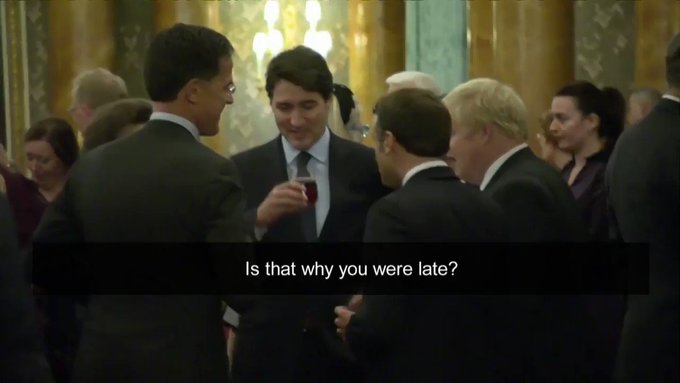
Unfortunately for U.S-Canada relations, at the conclusion of their bilat Trudeau went to a NATO reception at No. 10 Downing Street and was caught on mic disparaging President Trump with French President Emmanuel Macron. [Video and Transcript Below]
.
[Transcript] – PRESIDENT TRUMP: Well, thank you very much, everybody. A question was asked just a little while ago about supporting the people protesting in Iran and are going through a very tough period. And we do support them totally and have supported them from the beginning.
The question was asked: “Do we support them” — I thought — “financially?” And we haven’t supported them. I don’t know that we’ve ever been actually asked to support them, financially. And I — you know, if somebody asked, maybe we would. But we support them very, very seriously. The people that are protesting in Iran, they’re looking for their freedom, and we are fully in support of them.
So I wanted to — just in case anybody had any questions. We haven’t been asked to support them, financially, which I assume that’s what the question was. But just to make sure everybody understood it.
It’s an honor to be with a friend of mine who just had a great election victory. Congratulations.
PRIME MINISTER TRUDEAU: Thank you, Donald.
PRESIDENT TRUMP: And done a very good job. And we actually have a very good relationship and a good relationship, in terms of our countries.
We’re working on the USMCA. We’re trying to get Nancy Pelosi to put it up for a vote. You know, if it gets put up for a vote, it passes. But, so far, she hasn’t decided to do that. It’s up to her. It’s actually — a single individual has the — the Speaker of the House — it’s that person’s decision, and she’s the Speaker of the House.
And it’s a great deal for Mexico and for Canada and for the United States. And it’s a lot of jobs for everybody, and it replaces a deal that’s really a lousy deal, a bad deal, for — I can tell you — I can’t refer to you, but I would say, for the United States, that the deal that we have right now is terrible — NAFTA. Terrible. Been a terrible deal for the United States.
So we look forward to being able to vote on — take the vote on USMCA. It’s been there for a long time. And at some point, perhaps the President of Mexico — we have a wonderful man there, you know. He really is. He’s been a wonderful man. They’ll get tired and the Prime Minister will get tired and he’ll say, “Look, let’s forget this deal.” And I could understand it if you did. It’s been sitting in Congress now for six or seven months. And it’s a great deal for everybody.
So, hopefully, they can get it done and get it done fast. And it’s one of the few transactions, I think, where all three countries benefit, really, as a unit against the world, if you look at it. It really is a unit against the world. And that’s the way we looked at it right from the beginning. So we hope that’s the case.
Again, congratulations. We’re going to be talking about a number of subjects, including additional trade to that, and the military and the military presence. And it’s great being at NATO. We had some real success, I think, and some very successful talks having to do with NATO.
As you know, a lot of the countries have stepped up and they’re putting in at least 130 [billion] — probably the exact number is $131 billion — more. And that’s great. And they have commitments for $400 billion. So it really has become a force.
And as we’ve discussed in the past, there’s going to be great flexibility shown now with NATO. We can go to other parts of the world, not just one focus; it’s a lot of focuses. And we need a lot of focuses. We need a lot of focus.
We’ll be looking at other forms of terror. We’ll be looking at other countries. We’ll be looking at countries that are aggressive, and not just one particular part of this world.
So, I think NATO has become a very big factor over the last two or three years. You’ve been involved. I’ve been involved. And a lot of good things have happened. And it’s great to have you here. Thank you very much. Thank you. Congratulations.
PRIME MINISTER TRUDEAU: Thank you. It’s a real pleasure to be sitting down with President Trump. The relationship between Canada and the United States is incredibly strong. I don’t think it’s ever been stronger.
Our work together on the USMCA, as we move forward towards ratification, has been really tremendous. It’s been — it’s been a great process working with — between your team and our team, working with the Mexicans, as well.
We know that we’re here for NATO — the 70th anniversary, extremely important. The American strength in ensuring that people are stepping up, in terms of their military investments, is certainly something we’ve recognized in Canada. We’re increasing our defense investments by 70 percent over these 10 years because we know that making sure that everyone is there to step up and deliver is really important.
We have an enhanced forward battle group in Latvia. We’re leading the command mission in Baghdad. Canadians are a strong part of this Alliance, and we’ll continue to be.
But this is just a great opportunity for me to sit down with the President and talk about the many issues in which we align and we work together.
(Speaks in French.)
PRESIDENT TRUMP: That sounded very good. (Laughter.) Any questions, please?
Q Yeah. Mr. President, climate change is a top priority for the Prime Minister here, as well as for President Macron earlier. We’ve not heard you talk about it on this trip, and it doesn’t appear to be on your agenda. Are you thinking about that issue? And why is it not —
PRESIDENT TRUMP: I think about it all the time, Phil. And, honestly, climate change is very important to me. And, you know, I’ve done many environmental impact statements over my life. And I believe in — I believe very strongly in very, very crystal clear, clean water and clean air. That’s a big part of climate change.
I also see what’s happening with our oceans, where certain countries are dumping unlimited loads of things in it. They float — they tend to float toward the United States. I see that happening, and nobody has ever seen anything like it, and it’s gotten worse.
But, no, it’s very important to me also. But I want clean air and clean water. That would be number one and number two. Very important.
Yes.
Q Are you concerned about rising sea levels at all, sir?
PRESIDENT TRUMP: You know, I’m concerned about everything. But I’m also concerned about nuclear proliferation, which I think is a very important topic, and it’s a topic that we’re going to discuss today.
I’m — you know, the whole situation with nuclear, to me, is very, very important, as we’ve been discussing today at the various meetings that we’ve had. I think that’s something that has to be taken care of and it has to be dealt with very strongly.
Okay?
Q Mr. President, are you happy with Canadian defense spending as it is right now?
PRESIDENT TRUMP: Say it?
Q Are you happy with Canadian defense spending as it is right now?
PRESIDENT TRUMP: Well, they’re moving up, and they’re moving up substantially. And they’re starting to do very well, economically. And that has something to do with it. And, yeah, they’re getting up to a level that’s getting to be very acceptable. They have been under the 2 percent, obviously, but they’re moving up. We discuss it. I’m satisfied with it.
Q Do you plan to discuss Huawei, Mr. President?
PRESIDENT TRUMP: Excuse me?
Q Do you plan to discuss Huawei?
PRESIDENT TRUMP: We’ll discuss that. Yes, we’ll discuss that. We’ll be discussing that, yes.
Q What’s your message to the Prime Minister about Huawei and using it in the next generation of cell phone networks in Canada?
PRESIDENT TRUMP: Well, we find a security problem with it. And, you know — and Canada is going to make a decision at some point. But we find — I just speak for the United States, and we have ability to do a lot of things. We’ve actually advanced very far on 5G — much further than anyone really knows. Ajit Pai has headed it up, and he’s very good. And we have a lot of — a lot of action going on, with respect to 5G.
We’re not using Huawei. And we’re — we’re really — some of the — some of our great companies are getting much involved with 5G right now.
But, no, we find a tremendous security problem with respect to Huawei.
Q Mr. President, on the nuclear issue: Your comments a little earlier about Russia — the governments of Russia and China trying to come to the table on some sort of agreement on nuclear nonproliferation — your description of those conversations that you’ve had with those leaders doesn’t really mesh with what they’ve said publicly. I was hoping you might be able to elaborate when was the last time you —
PRESIDENT TRUMP: Is not what they said publicly?
Q Yeah. Can you talk about when —
PRESIDENT TRUMP: Well, look, we’ve had — we’ve had discussions and we’ve also had communications. And I can tell you, on behalf of both, they’d like to see something done with it.
Now, does that mean they’ll agree to do some- — I’m the one that terminated the agreement. And I terminated it because they were not living it — up to it. And we don’t want to be living up to an agreement and they don’t. And so it wasn’t fair. But it was also a very obsolete agreement. You know, it covered things that, frankly, didn’t matter anymore.
We are looking at doing a new agreement with Russia, and we’re looking at doing a new agreement with China. And maybe the three of us will do it together. And they do want to do it.
I can tell you that, with China, we were at a trade meeting, and the subject — I broached the subject, and they were very excited about it. No, they’d like to do it.
We may do it with Russia first and then go to China, or we may to it altogether. Or it may not happen. I mean, to be honest with you, maybe it won’t happen. But we are spending a lot of money on nuclear. And we have new nuclear and we have tremendous renovations of our older capability.
And I have to tell you, I see the kind of damage that we’re talking about and the kind of power that we have, and it’s a very — it would be a very sad day if we ever had to use it. It’s a very good thing if we could do something to stop making that, fixing that. We’ll see what happens.
Now, there are other countries. But, in terms of the world, we’re number one, by far. Russia is number two. And China would be number three. China is not — you know, China will be pretty even over a period of four or five years.
But it’s a tremendous expense for them and for us — for everybody. The destructive capability is really unacceptable.
So we’ll see if we can do something. I think Russia and I think China would like to do it very much.
Q President Trump, on NATO spending, you called member countries and the Allied countries in the past “delinquent” for not meeting the 2 percent standard. Where would you put Canada in that, as they’re not —
PRESIDENT TRUMP: Slightly delinquent, I’d say — Canada. But they’ll be okay. I have confidence. Just slightly delinquent. But, no, some are major delinquent. Some are — some are way below 1 percent, and that’s unacceptable.
And then, if something happens, we’re supposed to protect them, and it’s not really fair. And it never has been fair. And they’re paying up — we are talking to Germany tomorrow. And they’re — they are starting to come along. They have to. They have to. Otherwise, if they don’t want to, I’ll have to do something with respect to trade.
Q So Canada is okay for now?
PRESIDENT TRUMP: And with trade, I have all the cards. We’ve built a — we have built something in the last three years that’s been incredible. You’ve seen it. We’re up $21 trillion, and China is down about $32 trillion.
And as you know, for years, I’ve been hearing that it was “2019.” “In 2019, China’s going to become the largest economy.” Well, that didn’t happen. We’re much larger than China now, because we’ve gone up and they’ve gone down. And they’ve had their worst year in 56 or 57 years now. By far, they’ve had the worst year that they’ve had, that they know of. And — and we don’t want that, frankly. But what they were doing was wrong. And I think they’re going to stop it. And they want to — and they want to make a deal very badly.
Yes.
Q On that question, would you commit — if there’s a country that’s “delinquent,” as you put it, in paying for their defense spending, will you commit, as President of the United States, to defend them if they were attacked?
PRESIDENT TRUMP: Well, you know, I’m going to be discussing that today. And it’s a very interesting question, isn’t it? And, you know, it also depends on what your definition of “delinquent” is.
For instance, if you have a country that’s paying only 1 percent — and you have some that are paying less than 1 percent, and they shouldn’t be — you have some that are paying less than 1 percent, and they’re wealthy countries, on top of everything. Now we go to a new year, and they don’t pay. And now we go to yet another year, and they don’t play. Well, now, I ask you: Do they have to pay for the back years? Okay?
Now, so why is it that they owe us for this year, but every time a new year comes out, they don’t have to pay? It’s wrong. It’s not right.
So, I mean, you have — I could say that you could go back 25 years. I won’t do that with Canada, of course. But, no, but you could go back — you can go back, you know, right from the beginning, where they were short of whatever goal it was at the time. It’s 2 percent now. Two percent is very low. It should be 4 percent. Two percent is very low. But you have some that are well short of that. But they were short of it last year, the year before, the year before, the year before, right? So they’re short all these years. Well, in theory, you don’t just say, “That’s okay. You don’t have to have ever pay.” I mean, they really owe all that money from the past. That’s the way I look at it.
If Germany, as an example, is paying 1 percent and they’re supposed to be paying 2 percent — you’re talking about billions of dollars — well, that means that last year, the year before, the year before — all of those years, they would owe us money.
You’re talking about — really, you’re talking about trillions of dollars. Nobody has ever brought that up. They just keep talking about the present. So if they’re short one year, and then you go into the new year, they never talk about the year that they didn’t pay. But they actually, in theory, owe us that money. It’s not fair. It’s not fair.
Q Mr. President, just regarding China. When you met the Prime Minister in June, you talked about being — or trying to help with the two prisoners that are Canadians, that are in China.
PRESIDENT TRUMP: Yeah.
Q Have you made any —
PRESIDENT TRUMP: Well, I have. And I think we’ve made progress. And I had mentioned that to President Xi, as you know, because it was a big subject at the time. And I just hope they’re be treated well. But I put in a very, very strong word for those two prisoners.
PRIME MINISTER TRUDEAU: There’s still more to do.
PRESIDENT TRUMP: Now, I haven’t spoken to him recently, to be honest with you. I don’t think he likes me so much anymore, but that’s okay.
Q So, Mr. President, Canada does not meet the 2 percent standard. Should it have a plan to meet the 2 percent standard?
PRESIDENT TRUMP: Well, we’ll put them on a payment plan, you know? We’ll put Canada on a payment plan, right? I’m sure the Prime Minister would love that.
What are you at? What — what is your number?
PRIME MINISTER TRUDEAU: The number we talk about is a 70 percent increase over these past years, including — and for the coming years — including significant investments in our fighter jets, significant investments in our naval fleets. We are increasing significantly our defense spending from previous governments that cut it.
PRESIDENT TRUMP: Okay, where are you now, in terms of your number?
PRIME MINISTER TRUDEAU: We’re at 1.35
AIDE: (Inaudible.)
PRESIDENT TRUMP: 1.3.
AIDE: 1.4
PRIME MINISTER TRUDEAU: 1.4. And we’re continuing to move forward.
PRESIDENT TRUMP: They’ll get there. They’re getting there. They’ve — they’ve — they know it’s important to do that. And their economy is doing well. They’ll get there quickly, I think.
And look, it’s to their benefit.
PRIME MINISTER TRUDEAU: And the President knows well, as well, that Canada has been there for every NATO deployment. We have consistently stepped up, sent our troops into harm’s way. We’re leading in Iraq. We’re leading in NATO — in Latvia. We continue to step up, like — like most of our Allies. There are some countries that, even though they might reach the 2 percent, don’t step up nearly as much. And I think it’s important to look at what is actually being done.
And the United States and all NATO Allies know that Canada is a solid, reliable partner. We’ll continue to defend NATO and defend our interests.
PRESIDENT TRUMP: And we do have tremendous coordination with radar, with all of the different things that, you know — technologically, we have tremendous coordination between Canada and the United States. So, that’s good.
Yes.
Q Mr. President, to turn back to impeachment, you met with Clinton advisor Mark Penn last month. What did you learn from that meeting? And what advice are you getting on impeachment?
PRESIDENT TRUMP: We are winning so big. We had our biggest fundraising month ever. We’ve had — last quarter was unbelievable. I have my best poll numbers that I’ve ever had.
The impeachment hoax is going nowhere. The Republican Party has never been so unified as it is right now. I have never seen anything like it.
You know, I used to tell you — I said: The one thing — the Republicans are better politicians, they have better policies. But the Democrats do stick together.
The Democrats like open borders. They like sanctuary cities. They like a lot of things that are not good. But they do stick together. Well, the Republican Party, on this whole impeachment hoax has been like glue, because they know it’s a hoax. It’s a way of hurting the Republican Party — beyond me. It’s a way of trying to hurt the Republican Party and a lot of great people.
And the — the people aren’t standing for it. And a lot of these Democrats went back over the weekend and over the last week and a half — you know, they talk about how — how much of an emergency everything is and then they go away for two weeks. They went back to their districts and they are getting hammered in their districts. I mean, I see what’s going on, especially the Trump districts where I won by a lot. I have districts where I won by a lot. You people know it better than anybody.
And we had a lot of great elections recently. We had the two big victories in North Carolina, I told you before. We had — in Kentucky, we won everything other than the governorship. And the governor I brought up almost 19 points. He won by just — he lost by just a few votes. And Louisiana was a long shot. It was less than 1 percent. He came up 12 or 14 points — a lot.
We’ve — and we won everything else. And we won everything else — and, by the way, in Mississippi, we won the governorship. Very close race. And it was tied going in two days before. I went up, we made a speech. We had a rally, and he won by a lot. And we have a wonderful governor in Mississippi, and everybody else won. So, other than the two races. But they both — both candidates went up a lot.
We have never had the spirit that we’ve had. I really believe — I think I can honestly say I don’t think we’ve ever had the spirit that we have right now in the Republican Party. And the impeachment hoax is what’s done it. So, that’s the way it is.
But you people — you know what? Honestly, I think you people know that better than I do. Please.
Q Mr. President, the Dow is down more than 400 points right now, in part over the comments you made earlier in this room about the China trade deal extending past 2020.
PRESIDENT TRUMP: That’s okay. Well, it’s up — let me tell you, we took it up — it was about at 16,000 or 15,000, and now it’s almost at 30,000. It’s going to be at 30,000.
No, I have to tell you, if it’s not going to be a good deal, I’m not signing a deal. It’s peanuts compared to what — we have picked up record numbers in our stock markets. So, that’s okay. I mean, that’s the way I feel. I have to make the right deal. I’m not going to make a deal that’s not going to be great for our country. And it can’t be an even deal. If it’s an even deal, it’s no good, because China — other Presidents and leaders of our country have really let us down because they let China get away with — get away with something that should have never been allowed to happen. Billions and billions of dollars a year were lost in dealing with China, by — by foolish people, or by people that didn’t care or by people that didn’t know how.
We rebuilt China. And I give China great credit. And I don’t even blame China because our people should have done what they did. But what they’ve done is — we’ve lost $150 billion, then $200 billion, then $400 billion to China. They rebuilt China with the money that they took out of the United States. And that’s where they were and that’s where it is. And now we’re taking in billions of dollars in tariffs. And, by the way, they’re eating it. You know, remember, you used to tell me how it will cost us — they’re eating that money because they don’t want to lose their supply chains. And I don’t want them to lose their supply chains, but if it happens, it happens.
And that’s where it is. They want to make a deal, but I like the deal that we have, and the deal that we have could get even better. And I could do it all by myself. So we’ll see what happens. We’re at a critical stage.
They’ve called us today and they’ve called us yesterday. We’re having ongoing discussions. And we’ll see what happens.
But if the stock market goes up or down — I don’t watch the stock market. I watch jobs. Jobs are what I watch. I watch making the proper deal.
We’ve been taken advantage of, the United States, by China for so many years at numbers that if you were doing this, you wouldn’t have believed it. I came in, I looked at numbers for — I mean, ever since the founding of the China’s entrance into the World Trade Organization, the WTO, the numbers are astronomical that we’ve given to China, because of Presidents that didn’t know, didn’t care, or weren’t smart. So that’s over.
As to whether or not we make a deal: They want to make a deal. We’ll see what happens.
Q Mr. President, a point of clarification on your answer earlier where you talked about the “delinquent” countries and whether you would commit to defending them if they were attacked. In your answer, does that signal that you’re wavering about Article 5 of the NATO Charter?
PRESIDENT TRUMP: It doesn’t signal anything.
Q Is that something you’re contemplating?
PRESIDENT TRUMP: It’s just that when a country is delinquent — they don’t pay — and then something happens — now, usually, we look at it as a group, and I think I have to look at it as a group, Phil. So I would look at it as a group. But I think it’s very unfair when a country doesn’t pay. So, most likely, I’d do something with respect to trade. But that’s one of the things we’ll be discussing today.
I have to look at it as a group. You can’t say, “Well, gee, this country sitting right in the middle is delinquent” — they’re not paid — and something happens to that country. I think it’s an unlikely circumstance, but I would do something having to do with trade much more so than what you’re suggesting.
Q Back to impeachment — back to impeachment for a second. Is it your belief now that there will be a Senate trial, sir?
PRESIDENT TRUMP: I have no idea. I think they’re making a mistake if they do that, but that’s okay. If they do it, they do it. I think it’s a disgrace. I think the Democrats should be ashamed of themselves.
If you look at impeachment — and the word “impeachment” — here, there was nothing wrong. Nothing done wrong. It was a perfect conversation with a very nice gentleman, the President of Ukraine. The conversation was perfect. It was two conversations; they were both perfect. They were transcribed. They were both perfect. And this is what you’re going to impeach the President of the United States on?
The Republicans have never been stronger, never been more unified. The Democrats have gone crazy.
And you know what? They have to be careful, because when the shoe is on the other foot, and some day — hopefully in a very long, distant future — you’ll have a Democrat President and you’ll have a Republican House, and they’ll do the same thing, because somebody picked an orange out of a refrigerator and you don’t like it, so let’s go and impeach him.
It’s no good. That’s not the way our country is supposed to be run.
Q Mr. President, have you selected a new site for the G7 Summit next year?
PRESIDENT TRUMP: We really have. And I think it’s been more or less announced. We’re going to do it at Camp David. And we’ll be doing some very special things at Camp David. It’s nearby. It’s close. We’re going to give very good access to the press. You’ll have great access.
And we’ll have a little bit of a Washington, I think, deliverance. We’re going to have — but it will be Camp David, which is a place that people like.
Q (Inaudible) that your decision to leave Syria and leave the Kurds will affect NATO Allies (inaudible) —
PRESIDENT TRUMP: No, not only have we not left the Kurds, we’re working with the Kurds. We have a very good relationship with the Kurds. And we’ve taken the oil. I’ve taken the oil. We should have done it in other locations, frankly, where we were. I can name four of them right now. But we’ve taken the oil. And that oil is what — what they lived off of. And that was going to be taken away from them, but now our great soldiers are right around the oil. We’re — we’ve got the oil.
But if we didn’t have it, they wouldn’t be able to survive. The Kurds wouldn’t be able to survive.
Q In the impeachment inquiry, you’ve maintained, in a number of these sessions today, that you’ve done nothing wrong in your conduct with Ukraine. Why won’t you permit the Secretary of State or the Acting White House Chief of Staff to testify on your behalf?
PRESIDENT TRUMP: Well, I would. I’d like them to testify. But these are very unfair hearings. And this gives these unfair, witch-hunt hearings — as an example, I just heard today, they get three constitutional lawyers — it’s all nonsense; they’re just wasting their time — and we get one. Okay, now nobody has to know anything about constitutional law, but they get three and we get one. Uh, that’s not sounding too good. But that’s the way it is.
For the hearings, we don’t get a lawyer. We don’t get any witnesses. We want Biden. We want the son, Hunter. Where is Hunter? We want the son. We want Schiff. We want to interview these people. Well, they said, “No, you can’t do it. We can’t do it.”
So when it’s fair — and it will be fair in the Senate. I would love to have Mike Pompeo. I’d love to have Mick. I’d love to have Rick Perry and many other people testify. But I don’t want them to testify when this is a total fix. You know what a fix is? This is a fix.
Just think of it: Tomorrow — I don’t think anybody is going to watch — I’m not going to watch, but I’m going to be doing this; it’s much more exciting. But you know what? Tomorrow — think of it — they get three constitutional lawyers and we get one. That’s not even smart, because it’s not going to matter. And they take three and they give us one. Who ever heard of anything like that?
No, but I want them to testify, but I want them to testify in the Senate where they’ll get a fair trial.
Q What do we want to learn from the Adam Schiff testimony?
PRESIDENT TRUMP: From which?
Q From Adam Schiff.
PRESIDENT TRUMP: I learn nothing from Adam Schiff. I think he’s a maniac.
Q What would you — what would you want to learn if he testifies?
PRESIDENT TRUMP: I think Adam Schiff is a deranged human being. I think he grew up with a complex, for lots of reasons that are obvious. I think he’s a very sick man and he lies. Adam Schiff made up my conversation with the President of Ukraine. And one of the reasons people keep talking about it is that’s what they saw.
We have a perfectly beautiful, three-to-four-page transcription, and then, in the other case, a two-page transcription of the conversation. But a lot of people didn’t read that. How many people call you — a friend of mine called up — a top person in New York called up, great friend of mine, very successful: “Gee, I didn’t like what was said.” I said, “Oh, where did you see it? Did you read it?” “No, I didn’t read it. I heard Adam Schiff give it.” I said, “Well, that’s not what was said.” And I sent him a copy of what was said. He said, “This is like — this is great. This isn’t what he said.”
This guy is sick. He made up the conversation. He lied. If he didn’t do that in the halls of Congress, he’d be thrown into jail. But he did it in the halls of Congress, and he’s given immunity. This is a sick person. He’s a liar.
And, by the way, Nancy Pelosi knew he was lying and she went on a show — Stephanopoulos — and she said he told the truth. So she was lying too.
These people are deranged.
Okay, anybody else?
Q Mr. Prime Minister, the President has suggested that Canada might pull out of USMCA if the U.S. Congress doesn’t ratify a deal. Have you ever made that suggestion directly to the President?
PRIME MINISTER TRUDEAU: We’ve had lots of great conversations about how we’re going to keep moving forward to benefit workers in all three of our countries and we are very confident that we’re going to be able to get there. I know Ambassador Lighthizer and Deputy Prime Minister Freeland and the Mexican negotiators are engaged very closely on this issue. We’ve very, very hopeful that we’re going to have good news — news, soon.
Q (Speaks in French.) (No translation provided.)
PRIME MINISTER TRUDEAU: (Speaks in French.) (No translation provided.)
Q Mr. Prime Minister, is it your plan to have discussions about Turkey and its role in NATO with your meeting with the President?
PRIME MINISTER TRUDEAU: I think there’s a range of discussions that we’re going to have during this meeting. I look forward to having an opportunity to chat with the President —
PRESIDENT TRUMP: That will come up in the meeting. Yeah.
PRIME MINISTER TRUDEAU: — on a range of things. But including — including the various challenges and reflections we have to have on how we move forward as NATO and how we make sure that we’re responding to the real challenges the world sees right now.
Q And do you have any plan to talk about the extradition of Meng Wanzhou?
PRIME MINISTER TRUDEAU: We will absolutely be bringing up — bringing up the issue of China and the detained Canadians.
PRESIDENT TRUMP: Okay? Thank you very much, everybody.
Here’s the video of Justin Trudeau and Emmanuel Macron disparaging U.S. President Donald Trump during a NATO diplomatic reception at No. 10 Downing St. with British Prime Minister Boris Johnson.
Ezra Levant
✔@ezralevant
Just like at the G7 meeting last year, Justin Trudeau was meek and obedient to Donald Trump when they were face to face. But the moment Trump left the room Trudeau bad-mouthed him. Here he is doing the same in London, mocking Canada’s greatest NATO ally.
Commerce Secretary Wilbur Ross appeared on CNBC earlier today to discuss the status of U.S-China trade discussions, the latest issues with tariffs on French goods, and the bigger picture issues within the EU that we previously discussed.
Ross highlights the additional tariffs on China scheduled for December 15th are currently still planned to take effect unless something substantial changes in the position of China. Additionally, and interestingly on the French and EU tariffs, Secretary Ross reminds the financial pundits of the $7.5 billion WTO authorized award against the EU that would be in addition to the $2.4 billion in tariffs now scheduled for French products.
.
Pay attention to what Ross says in that interview; the administration is being remarkably open and consistent. Given the adversarial position exhibited by French President Emmanuel Macron today; and against the backdrop of continual EU intransigence on trade reciprocity; I suspect once the USMCA is passed we are going to see a *severe* shift in tone within the U.S. trade position toward both China and the EU.
Germany will be hit hard on their export auto sector, and France will be hit hard on exported luxury goods. Then, depending on the outcome of Brexit and the unpredictable stupidity of U.K. political leadership, the U.K. could gain trade position – or the U.K. could join the group of designated EU losers who *will* see years of economic contraction.
The U.S. economy is strong; all the fundamentals are solid. However, the multinationals on Wall Street -invested overseas- are more exposed. There is nothing that China and the EU can do to stop the de-globalization process; and efforts to stimulate their economy, more quantitative easing (pumping money) while the global supply chains are being shifted, are futile… they need “structural reform.” The multinationals are holding cash, waiting to see how it plays out.
The more a nations’ economy is dependent on exports, the more exposure they have to the inherent downsides of de-globalization. U.S. companies that are invested in these nations will naturally see diminishing returns on investment over time; some rapidly. President Trump’s trade policy is controlling the speed of that investment contraction.
The exposure of the multinationals keeps the stock market twitchy, yet the Main Street USA economy is thriving.
China’s economy is dependent on selling products to the U.S. in order to receive dollars. China takes those dollars and then purchases industrial goods from Europe. If China gets less dollars they purchase less from Europe. In essence both China and the EU are dependent on receiving dollars from a maintained trade imbalance. President Trump has begun resetting that imbalance… that is the current status of the global economic flux.
So what is the “structural reform”? This is where the EU needs to accept their economic model will no longer work if the global economy is changed.
Specifically:
♦The EU has benefited from their one-way tariff system against U.S. industrial goods. They have also used non-tariff barriers to keep their position. Now they need to change their perspective and embrace reciprocity in new trade agreements; or else Trump will use the strength of the U.S. market to pummel them with tariffs.
♦The EU has used their one-sided tariff and trade system as a key part of their overly generous social and worker benefits. If they don’t change the level of social payments and begin to ‘structurally’ change their social benefits, again they will suffer when the one-sided financial benefits are removed. They won’t be able to afford their social system without the one-sided trade benefit.
♦The EU has over-regulated their industrial base and attached themselves to burdensome regulatory standards; specifically worsened by their Paris climate treaty and changes within their energy programs. The compliance standards in combination with the increased costs and less global income is a perfect storm for contracting economic growth.
These are the types of EU reforms that are needed in an era where President Trump has purposefully stalled the process of globalization and is resetting global supply chains. The Trump policies that bring massive amounts of wealth back into the United States has created the dynamic where the EU must adapt or contract.
In essence Titan Trump is engaged in a process of: (a) repatriating wealth (trade policy); (b) blocking exfiltration (main street policy); (c) creating new and modern economic alliances based on reciprocity (bilateral deals); and (d) dismantling the post WWII Marshal plan of global trade and one-way tariffs (de-globalization).
The primary hypocrite behind the self-serving European NATO position is French President Emmanuel Macron. With the background of massive new U.S. tariffs expected against French products President Macron comes for a bilateral meeting and press availability with U.S. President Donald Trump. [Video and Transcript Below]
.
[Transcript] – PRESIDENT TRUMP: Well, thank you very much. It’s great to be with President Macron of France. And we’ve had a fairly long relationship and a very good one. And we were just discussing certain things, and then we’re going to have a long conversation afterwards.
I want to, first of all, before we begin, I want to pay my respects to the great warriors that you lost in Mali — 13, and helicopters. It was very sad. I’ve gotten a report on it. We talked about it. And please give my condolences to the families and to France. And they’re great fighters. You’ve done a fantastic job in that whole area. It’s a tough area. So we appreciate it very much.
And we’ll be talking about a lot of things, including NATO and including trade. We do a lot of trade with France, and we have a minor dispute. I think we’ll probably be able to work it out. But we have a big trade relationship, and I’m sure that, within a short period of time, things will be looking very rosy, we hope.
And that’s usually the case with the two of us. We get it worked out. We’ve had a lot of good — a lot of good things. We’ve done a lot of good things together, as partners. Our countries have been partners in many good ventures, including some having to do with radical Islam and others. And it’s always worked out. So I look forward to our discussion.
We made a lot of progress in our first 25 minutes, and we intend to make a lot of progress in our next hour, maybe hour and a half.
So thank you very much, my friend.
PRESIDENT MACRON: (Speaks French.) (Translation inaudible.)
PRESIDENT TRUMP: Okay. Thank you very much.
Q President Trump, do you have a better understanding of what President Macron was saying about NATO?
PRESIDENT TRUMP: Well, we just began discussing NATO. And what I’m liking about NATO is that a lot of countries have stepped up, I think, really at my behest. And to — also, yourself, you’re close to the level. But they’ve stepped up and they’ve put up a lot of money. I told you, it was $130 million — $130 billion. And that’s a lot.
And they’re now stepping up again. It’s going to be $400 billion over a very short — we have commitments for $400 billion. And we just left the Secretary General. And he — he’s got some things that are very important. And I discussed with him the flexibility, so that we have it not just with one area of the world — you and I discuss this all the time — we have all areas of the world, because NATO is a lot different than it was. And now it’s certainly a lot different over the last three years.
So we have a lot of countries stepping up and putting up a lot of money. The number, as of this moment, is exactly $131 billion — that’s a year. And that’s a tremendous amount of money, but it’s not enough. And they also raise and have commitments for $400 billion.
So NATO, which was really heading in the wrong direction three years ago — it was heading down. If you look at a graph, it was to a point where I don’t think they could have gone on much longer. Now it’s actually very strong and getting stronger. Many people are committed to that 2 percent. And ultimately, I think the 2 percent will be raised.
And the President and I, I think, feel that we need more flexibility — and I think we both agree on that — so that we can use it for other things, not just looking at one specific country. You know, a lot of people say it was meant to look at, originally, the Soviet Union — now Russia. But we also have other things to look at, whether it’s radical Islamic terrorism, whether it’s the tremendous growth of China. There are a lot of other things.
So NATO is becoming different than it was, much bigger than it was, and much stronger than it was because people are now fulfilling their commitments. There are some countries that aren’t fulfilling their commitment, and those countries are going to be dealt with. Maybe I’ll deal with them from a trade standpoint. Maybe I’ll deal with them in a different way. I’ll work something out where they have to pay.
But, you know, we don’t want to have people delinquent. We don’t have — I don’t think it’s fair for us to be involved — including France, by the way — to be involved, and you have countries that aren’t paying their way. They — you know, they’re less than 1 percent. You have a couple that are less than 1 percent. Not fair.
So NATO has made a lot of progress over the last three years, and the word “flexibility” is very important. They’re not just looking at one area now; they’re looking at the world. And that’s very important. To me, it’s very important.
Please.
PRESIDENT MACRON: I know that my statements created some reactions and shake a little bit a lot of people. I do stand by it. And I have to say, when you look at what NATO is and should be: First of all, this is a burden share. And President Trump just reminded you of some figures and the fact that this is perfectly true that the U.S. over-invested, decade after decade, and it is number one, by far.
And I do share this statement. That’s why I’m a strong supporter of a stronger European component in NATO, which is exactly what we have done. So, in terms of cost sharing, we are investing 1.9 percent of our GDP. We are increasing our GDP. We will be at (inaudible).
But when we speak about NATO, it’s not just about money. We have to be respectful these are our soldiers. The first burden we share, the first cost we pay, is our soldiers’ lives. And I do believe that, in such circumstances, we do pay what we have to pay for collective security.
When I look at the situation in Syria, in Iraq, but as well as Sahel, France is definitely present. It’s my first point, is that we have, today, strategy clarifications to be done. It’s impossible just to say, “We have to put money, we have to put soldiers.” We have to be clear on the fundamentals of what NATO should be. And this is not the case today. What about peace in Europe? I want clarification about that.
After the decision of the end of the INF Treaty, we have to build something new. Because now this is a risk for Germany, France, and a lot of European countries to have new missiles coming from Russia, exposing us. We need such a clarification. And I want the European component to be part of the future negotiations of such a new INF Treaty.
When we speak about the enemy, I would say, of the Alliance, what is the objective? To protect our partners against external threats. And France will do it, and we will have full solidarity vis-à-vis eastern and northern states in Europe. But the common enemy today are the terrorist groups, as we mentioned. And I’m sorry to say that we don’t have the same definition of terrorism around the table.
When I look at Turkey, they now are fighting against those who fight with us, who fought with us, shoulder to shoulder, against ISIS. And sometimes they work with ISIS forces. This is an issue, and this is a strategic issue. If we just have discussion about what we pay, and we don’t have clear discussions about the situation, we are not serious; we are not serious for our soldiers, we are not serious for our people. This is the very reason of my statements.
I do believe we need strategic clarifications: How to build long-term peace in Europe. Who is the enemy today? And let’s be clear and work all together on that.
I know that we do share exactly the same view. Having less (inaudible) exposure of the U.S. means more European investment and more (inaudible) on the European side. I do agree. Being strict and very efficient against terrorist groups means having clear, clear definition of these groups and no ambiguity. I think we do that.
PRESIDENT TRUMP: Well, one thing I will also — I’d like to say that you’ve been really doing a great job in Africa, and you’ve been very much involved there, more than most. And that’s been fantastic. I appreciate you saying the United States, for decades, have been paying, really, way, way disproportionately too much for NATO. And you’d have other countries paying far too little that are very directly benefitted by it and by the United States involvement.
And we’re changing that around somewhat, and it’s very important. But we’re a very important player. I think, without us, NATO certainly is not the same thing, as we’ve discussed and discussed it at length. This morning, we discussed it with Secretary General Stoltenberg. But we’re behind you 100 percent. And all of the money that’s been raised and all of these countries that are all of the sudden putting up money, it’s a great thing to see.
But we do have a great — we really have a different objective, I think, right now. We’re looking at a much bigger picture. And that includes — well, it includes — you mentioned Iraq, but it really includes Iran, too. I think that if you look at what’s going on in Iran, they have massive riots. They’re having protests all over the country. And they’re killing a lot of people. Everybody knows that. That’s why they turned off their Internet systems, so nobody can find out.
But if the media would go there — and it’s, I think, very hard for the media to go there, frankly, right now. But they’re killing a lot of people.
But NATO has come a long way in three years, and it’s something that we’re very proud of, because we’re with them. NATO serves a fantastic function if everybody is involved. If they’re not involved — and I really believe that the President is very much involved and likes the idea of NATO, but he wants it also to be utilized properly. If it’s not utilized properly — we all agree, right? That’s no good.
So we’ve had a very good discussion. A lot of people — we’re meeting with a lot of countries later, as you know. And they’re really stepping up — for the most part, they’re all stepping up. We have one or two that aren’t, and we’ll have to deal with them in a different way.
Maybe we — as I said, we’ll deal with them on trade. We have a lot of power with respect to trade. They make a fortune with the United States, and then they don’t pay their bills. That’s no good. But NATO has come a long way in three years, and it’s become very powerful. I think very, very powerful. And it’s become, I think, a much fairer statement in terms of the United States, because we’re able to go down a little bit. We were paying 4 to 4.3 percent of the largest GDP ever. Nobody has ever had a GDP like we have right now. And nobody has come close. And other people were paying 1 percent; some people were paying less than 1 percent of a very small GDP. It’s not fair. And if they get attacked, we protect them. But it’s not fair. So a lot of changes have been made.
Phil, go ahead.
Q Yeah. Mr. President, what is your message to President Macron about America’s tech companies? And what will your process be in determining what additional products from France you might apply tariffs to?
PRESIDENT TRUMP: Right. Well, we’re working on that right now. We have discussed it. I think we’ll be able to work something out, I hope. And maybe not. Maybe we’ll do it through taxing. You know, we could work it out easily through taxing.
But the techs — you know, they’re American companies — the tech companies that you’re talking about. They’re not my favorite people because they’re not exactly for me, but that’s okay. I don’t care. They’re American companies. And we want to tax American companies, Phil. That’s important. We want to tax them. That’s not for somebody else to tax them.
And, as the President knows, we taxed wine and we have other taxes scheduled. But we’d rather not do that. But that’s the way it would work. So it’s either going to work out, or we’ll work out some mutually beneficial tax. And the tax will be substantial. And I’m not sure it’s going to come to that, but it might. It might.
Q Mr. President, has France committed to step up when it comes to taking back foreign fighters in Syria?
PRESIDENT TRUMP: Well, I haven’t asked that to the President today. I have over the period of time. We have a tremendous amount of captured fighters — ISIS fighters — over in Syria, and they’re all under lock and key. But many are from France, many are from Germany, many are from UK. They’re mostly from Europe. And some of the countries are agreeing.
I have not spoken to the President about that. Would you like some nice ISIS fighters? I can give them to you. You can take — you can take everyone you can.
PRESIDENT MACRON: Let’s be serious: The very large number of fighters you have on the ground are ISIS fighters coming from Syria, from Iraq, and the region. It is true that you have foreign fighters coming from Europe, but this is a tiny minority of the overall problem we have in the region.
And I think number-one priority — because it’s not yet finished — is to get rid of ISIS and these terrorist groups. This is our number-one priority. And it’s not yet done. I’m sorry to say that. Yes, you still have fighters in this region — in Syria, and now in Iraq — and more and more. And the whole destabilization of the region makes the situation more difficult to fix the situation against ISIS.
Second, some of these foreign fighters are being (inaudible) in Iraq because of the deeds, precisely, they act in this very region. And we will have a case-by-case approach. We have a humanitarian approach for children already organized, and we will have a case-by-case approach.
But, for me, the very first objective in the region is to finish war against ISIS. And don’t make any mistake: Your number-one problem are not the foreign fighters. This is the ISIS fighters in the region. And you have more and more of these fighters due to the situation today.
PRESIDENT TRUMP: This is why he’s a great politician, because that was one of the greatest non-answers I’ve ever heard — (laughter) — and that’s okay.
PRESIDENT MACRON: Because sometimes you can have some temptation from the U.S. side — I don’t say about President Trump, but could be the press — to say, “This is European responsibility.” I’m sorry to say that.
We have some of our people, but if you don’t look at the reality of the situation that is number one — not to be ambiguous with these groups — this is why we started to discuss about our relations with Turkey. But I think any ambiguity with Turkey vis-à-vis these groups is detrimental to everybody for the situation on the ground.
PRESIDENT TRUMP: France has actually taken back some fighters. But we have a lot of fighters. We’ve captured a lot of people. And we have captured 100 percent of the caliphate, but you know that that means that it’s still — they keep going and going.
We sent a small contingent in, and we wiped out another portion of ISIS. We don’t want to happen, to me, what happened with President Obama, where it re-formed and then it became stronger than it was in the first place. So we don’t want that to happen.
And, as I said before: We’ve taken the oil. We have the oil. So we have total control of the oil so that they’re not going to be able to use that.
They use that oil to really — to fuel up their wealth, to fuel up their money. That was their primary source of income. And they get contributions. So we have, now, lists of where these contributions come from, which is very important. You have people contributing, if you can believe it. Some of these people are wealthy people that make contributions. And we have lists of —
Well, we learned a lot. You know, when we got al-Baghdadi, that was a great get. And when we killed him, we have a lot of information that I’m revealing now for the first time, but we also got a lot of good information.
So a lot of things are happening. And France has been very helpful, I have to say that. They’ve been very, very helpful.
Okay? Go ahead. Any other questions, please?
Q (Speaks French.) (Translation inaudible.)
PRESIDENT MACRON: (Speaks French.) (Translation inaudible.)
PRESIDENT TRUMP: And I largely agree with that answer. I just have to say, though — you know, I came into a position where the European Union was making anywhere from 100 to 150 billion dollars a year in deficits to the United States. They were making it and we were losing it. And so we had to do something that is fair, not severe — I think fair. We’re losing tremendous amounts of money.
As you know, the European Union is very strong on barriers. Barriers — meaning, certain of our products can’t come in, including agricultural product. It just can’t come in. We can’t sell it. And yet, the European Union sells openly to the United States, and, generally, untaxed or taxed at a low level.
So these are problems that we’re talking about. These are problems that we’re working out. And, you know, the digital tax is the least of it. I inherited a situation where the European Union — which was formed, partially, for this reason; I guess, for a lot of reasons it was formed, but partially to make better or take advantage of the United States. And they’ve done that very brilliantly. And, frankly, it’s not right.
So, I’ve exposed it. A lot of people didn’t know it. And we’re doing things about it; we have no choice. Because the United States can’t continue to lose the kind of money that they’ve lost over the last — literally, since the formation of the European Union. And I think we’ll work something out.
They want to talk, as you know. The new head wants to talk, who is supposed to be a very respected woman, very highly respected. And I look forward to meeting her. They want to meet.
But we have a very unfair trade situation, where the U.S. loses a lot of money for many, many years with the European Union — billions and billions of dollars. I mean, to be specific, over $150 billion a year. So we don’t want to be doing that.
And we — we can make a deal. We could take a harsh approach. We could solve that problem instantaneously if we wanted to. But I don’t want to do that. These are friends of ours. These are people that we’ve had very extraordinary relationships with, and I do, personally. And I’m sure we can work something out.
Q You mentioned earlier the Iran protests. Does the United States support these protestors in Iran?
PRESIDENT TRUMP: I don’t want to comment on that. But the answer is “no.” But I don’t want to comment on that.
Q Mr. President, on Turkey, President Macron just said he wanted the United States to do more in terms of standing up to President Erdoğan and clarifying the terms of that relationship. Are you supportive of those efforts by other NATO Allies, or are you standing in the way of that?
PRESIDENT TRUMP: Well, I can only say we have a very good relationship with Turkey and with President Erdoğan — I do. I can’t speak for the President of France. I mean, I — we have a very good relationship.
We pulled our soldiers out and we said, “You can patrol your own border now. I don’t care who you do it with, but we’re not going to have soldiers patrolling the border that’s been fought over for 2,000 years.”
But we took our soldiers out. We put some of those soldiers around the oil, where we’ve captured the oil and taken the oil. And we have the oil. But we’ve — and we’ve brought some home, and we will be bringing some home. And we’ve sent some to other areas. Okay?
Q Sir —
PRESIDENT TRUMP: But we have a very good relationship with Turkey.
Q Mr. President —
PRESIDENT MACRON: And just, on Turkey, to be clear: We have a lot of cooperation with Turkey — on security, on trade, migration. And so there is a full-fledged agenda with the European Union and France.
I do respect all leaders, whatever they can say, even bad things about myself. I do respect, and I never (inaudible) anybody.
But now, it’s a question for this NATO Summit. I think we need clarification from the Turkish side. This is not us to qualify them in what they are doing. But I do believe at least we have two clarifications to be asked: How is it possible to be a member of the Alliance, to work with our office, to buy our materials, to be integrated, and to buy the S-400 from Russians? Technically, it is not possible.
These clarifications to be provided by the Turkish President, as far as he wants to be part.
Secondly, I understand, from Turkey, that they want to block all the declarations of this summit if we do not agree about their definition of terrorist organizations — qualifying YPG and the others as terrorist groups, which is not our definition.
These two points have to be clarified if they want to — to be a serious member of the Alliance. I think so.
PRESIDENT TRUMP: This is why we’re — this is really why we’re having meetings. Those are our points. And we’ll be discussing that with the President today.
Yes.
Q Mr. President, will you issue sanctions on Turkey over their purchase of the S-400 missile system?
PRESIDENT TRUMP: We’re looking at it now and we’re talking about it now. As you know, Turkey wanted to buy our Patriot system, and the Obama administration wouldn’t let them. And they only let them when they were ready to buy another system, which is not the same system.
But Turkey, for a long period of time, wanted very much to buy the Patriot system, which is our system, which is what NATO uses — which is a great system, which is the best system. But they wouldn’t sell it to Turkey.
So, you know, there are two sides to the story. I have to say this. But we will be discussing that with Turkey in a little while. We’ll be meeting with Turkey in a little while, and also tomorrow.
PRESIDENT MACRON: But to be clear about this point and to — for you to have them: The fuller view — they were discussing with the Europeans on SAMP/T, and we accepted to sell the SAMP/T to them. So these decisions is not you. And one of our (inaudible) explained, by the refusal of a few years ago of the Americans not to sell that Patriots. It’s their own decision, even having a European option, totally compliant with NATO. So they decided not to be compliant with NATO. (Inaudible.)
Q Sir — Mr. President, Prime Minister Johnson, I believe, is organizing some sort of discussion later today about the Syria conflict. Are you going to take part in that and meet with him? And if not, why?
PRESIDENT TRUMP: Are you talking about Ambassador Johnson?
Q Boris Johnson.
Q Boris Johnson, the Prime Minister.
PRESIDENT TRUMP: Oh, I thought you meant Woody Johnson.
Q No.
PRESIDENT TRUMP: And I said, “Boy, he’s really risen rapidly,” Woody. Where is Woody? Is he here? This is his house. I can’t believe he’s not here.
Yes, we’ll be meeting with Prime Minister Johnson in a little while. I’ll be seeing him later on. We’re going over to Number 10, which is a very exciting place to be, as you know. And we’ll be discussing a lot of different things.
Yes.
Q And one other related question: The London Bridge attack from a few days ago, do you have any comment here? Your first day in London —
PRESIDENT TRUMP: No, I don’t have a comment on the London Bridge attack, other than to say that I was very proud of those people that grabbed him and did such a good job, between the fire extinguishers and whatever else. It was an amazing job they did. And he was very violent; you could see that. I mean, this was captured very much on tape.
I think the — the way the — I think they were British citizens — the way they stepped up was incredible. That was really great.
So, a terrible thing. Terrible attack. A lot of people very badly hurt. I believe three or four killed. Is it four now, today? So, it’s terrible. It’s a terrible thing. And I know it’s an act of terrorism. It’s been declared an act of terrorism. Radical Islamic terrorism, by the way. And it’s very bad. Very bad.
But I think the way they stepped up, to me, that was something very special. Okay?
Q Mr. Trump, a question on Russia. Mr. Macron says that Russia shouldn’t be designated as an adversary of NATO. Do you agree with that? Do you think Russia is the enemy?
And, Mr. Macron, who is the enemy today?
PRESIDENT TRUMP: I don’t think he does feel that. I think we get along with Russia. I think we could get along with Russia. I think you feel we can get along with Russia. We’ve discussed that before.
But certainly, we have to be prepared. Whether it’s Russia or somebody else, we have to be prepared. But he and I have a pretty similar view on that. I think we feel that we can get along with Russia. And I think it’s a good thing to get along with Russia. And I campaigned on it. I mean, I’d go into big stadiums; people like it. And I think the Russian people would like to see it too. A lot of — a lot of good can come of it.
But the purpose of NATO is that, but the purpose of NATO can be much more. And that’s where we’re showing the flexibility over the last period of two years. Okay?
PRESIDENT MACRON: (Speak French.) (Translation is inaudible.)
Q (Speaks French.) (Translation is inaudible.)
PRESIDENT MACRON: (Speaks French.) (Translation is inaudible.)
Q (Speaks French.) (Translation is inaudible.)
PRESIDENT TRUMP: And I think the situation in Ukraine is very important. I think that the meetings coming up with Russia and Ukraine are very important. And there’s a possibility that some very big progress can be made. It’s very important for Ukraine. I think it’s very important from the standpoint of Russia, also, that they work out a treaty, they work out peace, because they’ve been fighting a long time. Too long. And I think there’s a really good chance that that will happen.
Also, with respect to nuclear weapons, I’ve spoken to President Putin and I’ve communicated with him. And we are — he very much wants to, and so do we, work out a treaty of some kind on nuclear weapons that will probably then include China at some point, and yourselves, by the way. But it will include China and some other countries.
But we intend to see if we can work something out to stop the proliferation, to stop what’s happening, because we are making a lot and we are renovating a lot. And, frankly, the whole situation with nuclear is not a good — it’s not a good situation. We ended the treaty because it wasn’t being adhered to by the other side. But they want to make a treaty, and so do we, and I think it would be a great thing. I think it’s one of the most important things we can do, frankly.
So, we’re going to be dealing with Russia on a treaty where we really — and we’re focused on nuclear and nuclear weapons — missiles — but nuclear weapons. And we think something can be worked out. We think they want to do it. We know they want to do it. And we want to do it also.
I spoke to China about it. They — during one of our trade negotiations, they were extremely excited about getting involved in that. So, some very good things can happen with respect to that. I think it’s very important. The whole nuclear situation — very, very important.
Okay? Thank you all very much. Thank you. Thank you.
AT&T provided the call records, likely under subpoena. (link)
Let’s hope Schiff received them under subpoena, because the alternative is much worse. The alternative is a criminal leak from an outside interest.
There’s a particular type of anger that surfaces when you realize the Schiff team who coordinated the origination effort with the CIA whistleblower; and then vehemently hide their coordination; are the same crew simultaneously using the power of their position to subpoena private phone call records from President Trump’s lawyers, members of congress, and journalists. [See Schiff Report pages 157, 158, 159 – pdf]
Yes, in essence Adam Schiff weaponized his committee authority toward the goal of removing President Trump in an identical way the prior administration intelligence officials, DOJ and FBI weaponized their authority toward removing candidate Trump, president-elect Trump and President Trump.
It is one long continuum of political corruption, weaponization, and fabrication of evidence to achieve a political objective. It is also disgusting in construct.
This crew doesn’t care one bit how much they have to destroy this country, so long as they can advance a left-wing political agenda based on an unquenchable thirst for power. I never thought we would see the possibility of a hot civil war in my lifetime. I was wrong.
The cattle cars are on the horizon, and the full Schiff report pdf is below.
I have created this site to help people have fun in the kitchen. I write about enjoying life both in and out of my kitchen. Life is short! Make the most of it and enjoy!
This is a library of News Events not reported by the Main Stream Media documenting & connecting the dots on How the Obama Marxist Liberal agenda is destroying America






 Centinel2012