Does an Increase in the Money Supply Lead to Inflation?


Posted originally on May 29, 2024 By Martin Armstrong 
Supply Demand

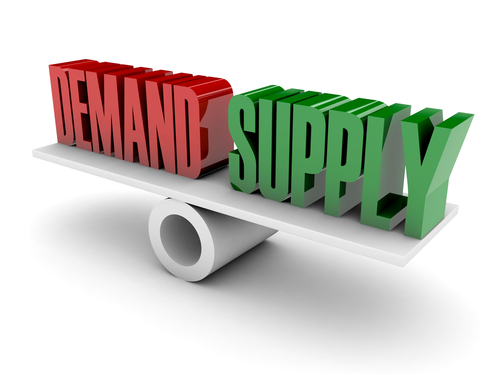
The old idea that inflation is created by an increase in money supply has distorted the minds of many people. Inflation is caused by numerous factors for it is not a one-dimensional aspect. For example, say a bird flu has rendered half of the egg production to be worthless, which would send egg prices soaring. This would have nothing to do with the quantity of money. So, obviously, a decline in the supply of some service or commodity can also lead to rising prices. Supply and demand.

Then there can be cost-push inflation as we saw during the 1970s due to OPEC. The first OPEC price shock was October 1973 from where we should see the next low in 2016 (43 years later). The sudden rise in oil sent a shockwave through the economy, driving up prices because the entire economy had to readjust to higher energy. This was not the result of an increase in demand nor an increase in the money supply.

When gold was used for money during the 19th century, it fell sharply in value with each new discovery from California, Australia, and Alaska. Inflation rose because of a dramatic increase in the money supply, which is exactly what took place in Europe when Spain brought back ship after ship of gold from the New World. The sudden dramatic rise in the supply of money unleashed inflation, and during both periods, money (gold) failed to provide a store of value.

Steady, slow growth in the supply of money does not lead to inflationary waves. We find that major waves of inflation are often tied to waves of speculation, which differ with each wave moving from real estate, commodities, stocks, or bonds, constantly rotating over decades within a domestic economy and then this movement of capital takes place internationally.

Inflation is not a single one-dimensional aspect. It moves up and down between the rise and fall in the demand for private assets vs. hoarding and uncertainty.


Is the population decrease a bad thing? Unpacking why population increase is an overall good


Posted originally on Rumble By Charlie Kirk show on: May 24, 2024 at 5:30 pm EST

Retail Sales Falling in the US – a Softer Tone


Posted originally on May 17, 2024 By Martin Armstrong 

Online Shopping

Retail sales in the US fell short of expectations this month, according to data compiled by the Commerce Department. Retail spending decreased 0.6% from April to March, undermining forecasts of a 0.4% decrease. Yet, Americans are spending MORE on the essentials such as groceries. How is this a shocking admittance to anyone?

Even online sales fell by 1.2% from March to April. Americans spent 1.6% less at clothing retailers, and 0.9% less at hobby stores on a monthly basis. Again, of no surprise, gasoline sales rose 3.1%.

The Fed is attempting to smooth over the data, using rhetorical language such as the economy is presenting a “softer tone.” Federal Reserve Bank of New York President John Williams, who believes monetary policy is “in a good place” albeit “restrictive.” Williams, like Chair Powell, said that there are no indicators stating a need to lower interest rates. “I don’t expect to get that greater confidence that we need to see on the inflation progress towards a 2% goal in the very near term.”

The Fed held rates loosely for so long that there was not much it could do, in addition to the utter disaster that is America’s fiscal policy. I explained in another post why the Fed simply cannot attain the 2% target.

People do not have the disposable income to spend on retail at this point, and those who do prefer to invest or save those funds as confidence has vanished, leading to a pullback in spending on nonessentials. Bad news for America’s consumer-based economy.

April’s CPI is up 3.4% YoY, slightly down from March’s 3.5% posting. I do not believe they are accurately calculating prices. No one believes them at this point. So, we should expect the Fed to maintain the 5.25% to 5.50% rates at the next FOMC meeting. Inflation is here to stay.

Powell Pessimistic After Q1


Posted Originally on May 16, 2024 By Martin Armstrong 

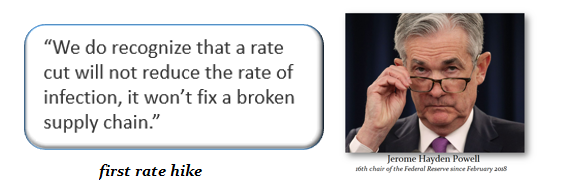
Powell Rate Hike

Powell reiterated this week that he does not see any short-term need to lower interest rates. The Fed remains delicate in its speech to the public. They knew that inflation would continue rising due to various factors but had to say they were awaiting incoming data. The data is in for Q1 and nothing indicates that inflation is easing, therefore, expect rates to hold.

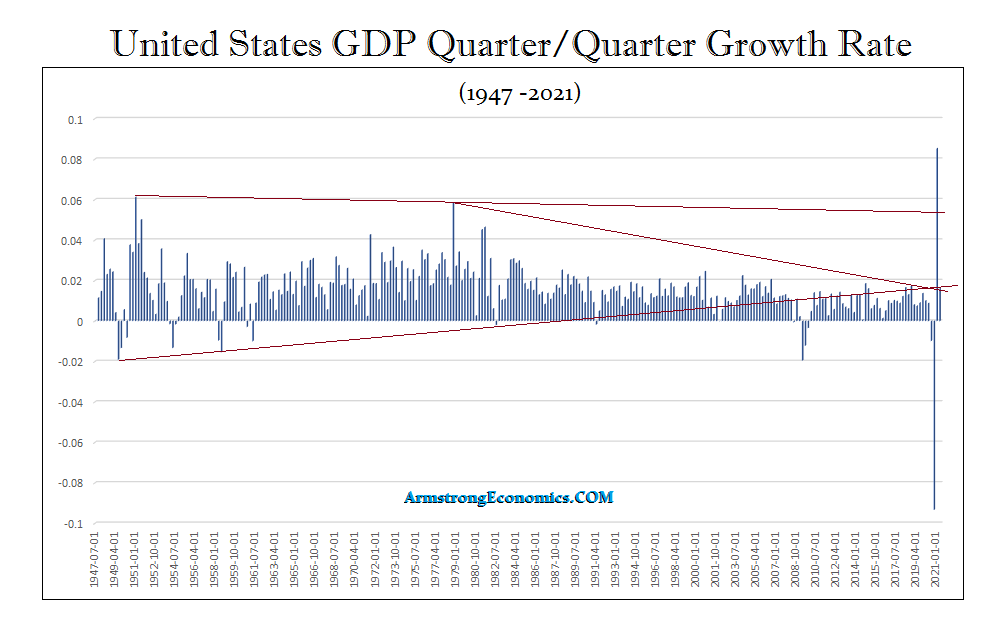
The Labor Department noted that the PPI rose to 0.5% in April from May, up 2.2% since the year prior. PCE, the Fed’s primary inflation indicator, rose 2.7% in Match from 2.5% in February. The US economy overall advanced 2.7% from October to December. We are looking at inflation beginning to rise faster than economic growth, which will lead to stagflation.

I have pointed out numerous times that the various measures provided to the public drastically downplay the dollar’s loss in purchasing power. Americans can feel it daily every time they make a purchase or check their bank accounts.

GDP Quarterly 1947 2021

I explained that we already began experiencing stagflation in 2021. Normally, the standard definition of “stagflation” has been explained as slow economic growth with relatively high unemployment/or economic stagnation that takes place with rising prices. Some have also defined it as a period of inflation combined with a decline in the gross domestic product (GDP).

Stagflation became a term that defined the 1970s because economic growth was still positive, but the rate of inflation was far greater due to the price shock of the OPEC embargo. The  Democrats are constantly pushing to raise taxes, and sent corporations fleeing offshore, and it was NOT merely because of the tax rate. Back then, I testified before the House Ways & Means Committee on taxation, and they wanted to know why NO American company got a contract from China to construct the Yellow River Dam. I explained that German companies were NOT taxed on worldwide income, and as such, they were already 40% less than an American company because Americans pay taxes on worldwide income, and the ONLY other country to that was Japan. Thus, American companies moved offshore, NOT because labor was cheaper, but so they could complete.

Now, we have additional regulations that are making it increasingly difficult for American businesses to prosper. The capital gains tax will be a nail in the coffin. The recent tariff slap on China will also cause the price of goods to rise and harm the supply chain.

Remember, inflation was only 1.4% when Joe Biden took office – far beneath the Fed’s target. Inflation has risen as a direct result of fiscal policies under Bidenomics. The government has completely ignored the Fed’s warning that it must curtail spending. We are sacrificing our economy for the interests of the globalists.

Episode 3604: Wasteful Spending To Just Buy Votes


Posted originally on Rumble By Bannons War Room on: May 11, 2024 at 06:40 pm EST

Why Does the Government Borrow Its Own Currency?


Posted May 11, 2024 By Martin Armstrong  

The problem with people’s attitudes toward the national debt is that everyone has forgotten why we borrowed in the first place. The theory was that if you borrowed rather than printed money, you were NOT increasing the existing money supply, and therefore, in theory, it would not be inflationary.

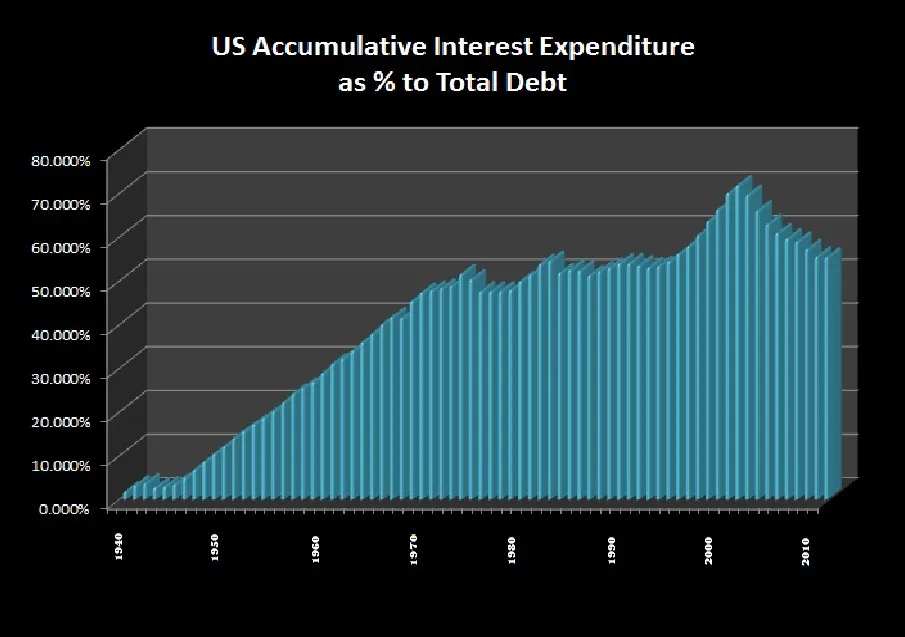
US Debt accumulated Interest as Percent of total

However, the Democrats forgot how to run for government without their Marxist agenda of bribing the people to vote for them. This led to always creating deficits. Add to this the NEOCONS who have done nothing but wage wars ever since World War II to defeat Communism and have spent money lavishly on trying to conquer the world.

Kennedy_Nixon_Debat_(1960)

October 13, 1960 Debate Transcript

During the Presidential Third Debate of 1960, the question about the outflow of gold from the USA reserves arose. This sparked a Gold Panic in the London gold market, whereby gold rallied to $40 for the first time, showing that the Bretton Woods System was beginning to collapse. The United States’ outflow of gold was not really from a trade deficit but from the fact that the USA was defending the world with its military establishing bases everywhere. That meant capital was leaving. Gold rallied again to $40 in the late 1960s, and finally, it forced the collapse of the convertibility of gold under the Bretton Woods System in 1971. Kennedy’s words were:

“Now, on the question of gold. The difficulty, of course, is that we do have heavy obligations abroad, that we therefore have to maintain not only a favorable balance of trade but also send a good deal of our dollars overseas to pay our troops, maintain our bases, and sustain other economies. In other words, if we’re going to continue to maintain our position in the sixties, we have to maintain a sound monetary and fiscal policy. We have to have control over inflation, and we also have to have a favorable balance of trade. We have to be able to compete in the world market.” 

The dollars were being spent not to benefit our economy but to fulfill the dreams of the Neocons; when Communism fell, they refused to accept any real change.

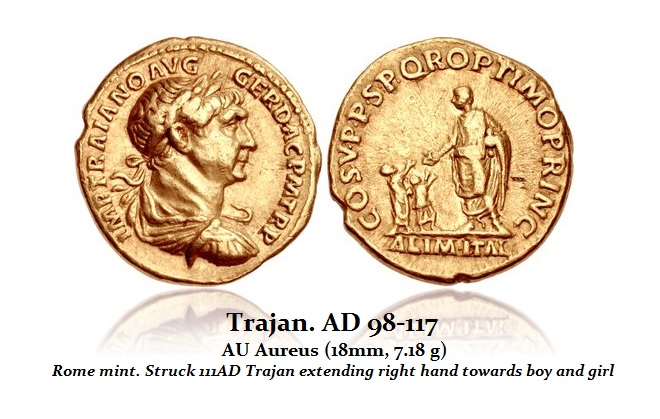
Trajan Welfare Youth

Rome takes care of widows and orphans.

We borrow, which is worse than printing because we have to pay interest on constantly rolling the debt. This year, we will spend about $1 trillion on interest, the total national debt when Reagan took office in 1981. At times, 70% of the national debt is accumulative interest. That means it went nowhere to improve society or care for widows and orphans, at least as the Romans did. Had we printed the money instead of borrowing, it would have been less inflationary and the capital would have created more jobs instead of investing in government debt which has only funded the Neocons’ wildest dreams.

Phillip Patrick Predicts Federal Debt Rising By $1 Trillion Every 90 Days


Posted originally on Rumble By Bannons War Room on: May 4, 2024 at 05:00 am EST

Ep 3345a – Fed Begins Rate Cut Narrative, We Are Sitting On A Time Bomb, Trump Will Diffuse It


Posted originally on Rumble By X 22 Report on: May 4, 2024 at 4:00 pm EST

US Home Prices Nearing All-Time Highs


Posted originally on May 3, 2024 By Martin Armstrong 

House US Real Estate

Home prices in the US are near all-time highs. As I repeatedly stated, we can no longer look at real estate on the national level. Demand and value are contained to certain states and areas of certain states that the public has deemed most desirable, largely due to political factors such as taxes. Yet, at the moment, buyers are swiping up real estate where available. The S&P CoreLogic Case-Shiller posted a 6.4% gain in February after January’s 6% spike, marking the fastest uptick in home prices since November 2022.

The 20-city composite jumped 7.3% on an annual basis, rising from January’s posting of 6.6%. The 10-city composite saw an 8% annual rise, up from 7.4% in January. February was the third consecutive month of rising home prices in all cities, with Washington D.C., New York, San Diego, and Los Angeles experiencing all-time highs in price.

San Diego saw an 11.4% annual rise in home prices, the largest jump in the 20-city composite. Detroit and Chicago posted 8.9% annual gains. Yes, we will eventually see the red states surpass the blue. Smart money is moving into assets like real estate. The downside of real estate is that they impose a property tax on it annually, but investors enjoy that passive income.

There is a notion of “now or never” among first-time buyers as it simply no longer makes sense financially to rent. A person’s ability to qualify for that first downpayment has diminished with rising rental costs. Rental costs increased 3.15% from February 2023 to February 2024, further rising to 3.6% annually in March of this year. This is close to the pre-pandemic growth rate of around 4.1%, but rental pricing is up 36.6% from the pre-pandemic era. While difficult to judge on a national basis, the average rental now costs $1,983 per month, but it is much higher in places like New York City ($3,206 average) or San Francisco ($3,024) hence why we are seeing people sweeping up real estate there.

Shelter is 34% of CPI. The April 10 release from the Bureau of Labor Statistics found that shelter costs have risen for the past 40 months. In March, shelter costs were the largest contributing factor for core inflation. Rising home prices will not benefit the economy or lead to any positive indicators that inflation is waning.

Jerome Powell on Stagflation


well

Posted originally on May 2, 2024 By Martin Armstrong 

Powell Jerome

“I don’t see the ‘stag’ or the ‘-flation’,” Fed Chairman Jerome Powell said during his Wednesday address.

Powell believed inflation would be “transitory.” He believed that the economy would come down for a “soft landing.” He believed we would enter the year and see numerous cuts due to waning inflation coming closer to the fictional 2% target. Yet again, Chairman Jerome Powell has missed the mark on stagflation.

If you really look at it, objectively, interest rates always rise during boom periods, and they decline during recessions and depressions. We will see increased inflation, probably into 2028 caused by shortages and war. But you’re looking at a declining economic growth, so that ends up being more like the economy of the 1970s, and you’re looking at what we call “Stagflation” where the inflation rate will be higher than economic growth.

Powell Rate Hike

Chair Jerome Powell said officials are prepared to hike again if price pressures return. He indicated that they were now considering when to cut rates as inflation subsides to their fictional and arbitrary 2% goal. Rate cuts are only sustainable once you see the economy decline. The events that unfold around May 7, primarily regarding war, will highlight what we need to know.

Inflation rising above economic growth is STAGFLATION, which is precisely what the economy experiences during war. Inflation will rise faster than GDP, causing the purchasing power of the USD to decline.

STAGFLATION

One major factor that is never included in the inflation numbers is TAXATION. Their theory is that taxes are the citizens’ obligation and not part of our cost of living. Yet, those at the top are seeing half or more of their wealth siphoned by Washington. We already know that the jobs reports are grossly distorted. To calculate GDP, they include total personal income and government spending. In March, we saw the public sector multiply, which only causes more of a burden on the taxpayer. The ADP that was released today indicated a spike in hospitality among the private sector, but we tend to see that before the summer months in the US. The public sector contributes absolutely nothing to GDP.

WAR WILL LEAD TO STAGFLATION. Of course, the Fed cannot come out and say that they see a looming escalation of war on the horizon, and Washington certainly would not come out and say to prepare for war. Socrates is impartial to bias and was correct about this inflationary trend into 2024. We are poised for a directional change in Q3 of 2025, implying an escalation in the war cycle post-2024.