QUESTION: Trump Impeachment. Y’know Marty, since the Democrats have tried unsuccessfully for so long to find some dirt on Trump, the guy must be squeaky clean, no?
NMM
ANSWER: Impeachment occurs when someone does something while in office. It is not based on what they did before. All the stuff they bring up from his past, such as tax returns to pictures with Epstein, are all an attack upon his character in hopes that it will persuade some to vote against him, but they are preaching to the choir. Both Republicans and Democrats bash the opposition to keep their constituents happy, for they are just biased and would never vote for the other party because they lack any ability to think objectively. I get emails that are always claiming Trump is a prior crook or something and how he should be impeached, but that only reveals their bias.
They are going after the Supreme Court Justice Brett Kavanaugh again. This is a pointless effort and highly damaging to the entire political system. What he did or did not do in college 40 years ago is absurd. No one’s entire life should be judged based on an incident they were involved in at a drunken party in college. It is rare to find someone who can even believe what they once did back in their school days.
Brett Kavanaugh cannot go to many places in Washington, according to the Washington Post. He is isolated by these personal attacks to this day. The allegations have scarred him and his family for life. As reported, at the La Ferme restaurant in Chevy Chase, a woman yelled at him and his wife insulting him in public, and on a different night, one customer stood to applaud him. He simply cannot go out in many parts of Washington for people are no longer respectful or civil.
The Democrats want to hold impeachment proceedings to try to remove him from the Supreme Court. Good luck with that. Again, you cannot impeach someone for what happened 40 years before. Only a fool does not learn from their mistakes. We all change as we mature. It is called wisdom.
Christine Blasey Ford who made the unsupported allegations that Kavanaugh had sexually assaulted her and in the process destroyed him and his family’s life forever, has herself been subjected to the new world where respect has vanished and people are no longer civil in public. She relocated four times and has been unable to return to teaching. She too cannot go out to dinner without being harassed. Welcome to the new world of political fragmentation. What she has experienced is not much different from the person she accused. Making such public accusations that are exploited for political purposes is something that will change your life forever. You will never convince the core of the opponent so your life will be destroyed in the process. You might as well move out of the country.
Worse still, Ford’s testimony exposed a gender war simmering below the surface. There were women who supported Ford ONLY because she was a woman. Their position was that women tell the truth and all men were scum and should not be believed. That was a raw feeling which also emerged in addition to the political divide. I am sure Ford would never testify if she knew the real cost of what has truly changed her life. This is society. There is no changing the way people will react in such a politically charged environment. Some women will say she has a right to tell her story. The difference is only between a local setting and one that will be plastered on the front pages of the entire world. Life is not fair — we just have to get used to that.
The fallout has been seriously damaging to the point that this will impact people who would normally be willing to take positions in government. There are people I know who would have been interested in being president, but they have no desire to put their family through such an ordeal.
The same is now true about any position from Federal Reserve to Supreme Court. What was done to Kavanaugh was such a violation of personal dignity that NOBODY who is qualified will want to subject their family to such nonsense. And as for Trump, he is probably the PERFECT person for president BECAUSE he has thick skin. It takes a rare person to be able to handle such personal attacks constantly.
This is the destruction of our government. All this hatred and demands to go after anyone you disagreed with defeats the very purpose of civilization. Years ago, if the opposition won you simply moved on. Today, they spill out such hatred there is no longer any point to being one nation under God. Divide the country, build a wall down the center, and FORCE everyone to move to the side where they politically agree or just leave. The day is coming when there will be no returning to normal.
Devin Nunes appears on Fox News with Sean Hannity to discuss the manipulated one party procedures within Pelosi’s impeachment program.
.
Speaker Pelosi cannot engage the courts for support against the Executive Branch because the House has not created their judicial authority. As a result of their lack of a vote to initiate the House “impeachment inquiry” there is no penalty for non-compliance behind any committee subpoena.
Attempting to compel testimony that crosses through the separation of powers; and goes even further in an attempt to penetrate the firewall around executive privilege; requires the House -or a committee therein- to carry “Judicial Authority“.
“Judicial Authority” is not absolute authority, but rather a legal reference and framework that forms the basis for an impeachment ‘compulsion demand‘ (or subpoena) by the House. Judicial Authority is the House saying they have a legal basis to make a demand.
The reason judicial authority is necessary, is because creating Judicial authority, via the Legislative Branch full chamber vote, gives the Executive Branch access to appeal any legislative demand via the Judicial Branch (federal courts).
Repeat for emphasis:
…The reason judicial authority is constitutionally required, is because creating Judicial authority, gives the Executive Branch a process to appeal any legislative demand via the Judicial Branch (federal courts)….
Absent the creation of judicial authority the House has not created a penalty for non-compliance. However, absent a penalty for non-compliance the Executive Branch has no process to engage an appellate review by federal courts. This is the purposeful trick within the Pelosi/Lawfare road-map.
Speaker Pelosi’s current Lawfare-inspired road-map (House and committee rule changes therein) attempts to construct a path to impeachment that avoids asserting House “judicial authority”; because they fear losses from a Judicial Branch ruling. Those who constructed the road-map are also concerned about outright blocks by the courts in their proceedings.
This process issue was argued by Lawfare member Douglas Letter today during a hearingon the topic of the House Judiciary Committee gaining access to Weissmann/Mueller’s grand jury evidence. [Expanded Here]
Here’s the bottom line: “Judicial Authority”, granted by a full House vote, gives the House of Representatives more authority in their impeachment construct. However, “judicial authority” also grants the Executive Branch a path to appeal via the Judicial Branch.
Because the Lawfare/Pelosi roadmap intends to subvert judicial authority, it is destined by design to end up running head-first into a constitutional problem; specifically separation of power and executive privilege. That predictable constitutional issue will end up with arguments to The Supreme Court. THAT is why the Democrats have been working for months to delegitimize the Supreme Court.
Please let me repeat for emphasis. The Lawfare impeachment road-map is designed to conflict with the constitution. It is a necessary -and unavoidable- feature of the plan, not a flaw. Pelosi and the Lawfare group know they are creating a constitutional crisis; that is why the background attacks against the Supreme Court were started months ago.
Earlier today President Trump held a White House event to sign an executive order on Transparency in Federal Guidance and Enforcement. [Details Here and Here]
In addition, President Trump took numerous questions from the media during a lengthy press conference [Video and Transcript below].
.
[Transcript] – THE PRESIDENT: Well, thank you very much. I’ll start by saying I just spoke with Boris Johnson, and we had a good talk about a number of subjects, and we’ll maybe talk about it a little bit later. But we had an extended conversation and some pretty good ideas, I think. They want to see if we can do a couple of things, and they’ll be doing certain things for us.
I want to also thank the Minneapolis Police Department. They have been so incredible, what they’ve done. Tomorrow, we have a tremendous amount of people planned to go. I know the requests have been incredible. So, I think it’s a great state and we’re going to have a lot of fun tomorrow night. I think a lot of you are going to be with us. And then, on Friday night, we’ll be going to Louisiana, and there’s a big election on Saturday to see whether or not there’s a runoff, most likely. And I think we’ll do very well. The Republicans are doing very well despite the witch hunt that they have on Republicans.
So I just want to thank everybody for being here and coming to the White House on this important occasion. In a few moments, I’ll be signing two executive orders to expand our record-breaking regulatory reduction campaign that is helping to fuel our incredible economic boom. I guess the stock market is up close to 250 points today, and this is despite lots of trade deals that are getting done one by one.
We did a deal with South Korea — a big one, a really big one. And we did one yesterday with Japan. And that now goes into effect, and it’s tremendous for our farmers.
As you know, we have China coming. They’ll be coming tomorrow. We have the Vice Premier of China coming. So we have a lot of big things happening. We have some tremendous deals under negotiation. So despite all of that, we have a great economy and a great market. Our housing market is on fire, and things are really doing well.
You look at Asia, they’re not doing well. Look at China; China is having a hard time at this moment, and I think they’d like to make a deal very badly.
And so we have a lot of things that are really exciting. And to be in the midst of negotiating some of the worst trade deals ever made, and to be breaking them up and changing them for the good of the American taxpayer and for our country, and to still be doing so well. We had over 100 record-breaking stock markets. I think 121 or something. I’ll get you the exact number. But many, many days, we broke the record. And we continue to do well.
And when these trade deals are done, and when certain other things that we’re doing are done, it’s going to be at a level that’s incredible.
(Baby coos.)
That was the cutest noise. What was that? (Laughter.) I heard this — see, I’m used to hearing them. (Laughter.) And there’s nothing cute about them. (Laughter.) So beautiful. And don’t feel bad, he can — just do whatever you want, okay? (Laughter.) That’s a beautiful sound.
Today, we take bold, new action to protect Americans from out-of-control bureaucracy and stop regulators from imposing secret rules and hidden penalties on the American people.
We’re delighted to be joined on this occasion by Acting Director Russ Vought, who has really done a fantastic job; Deputy Attorney [General] Jeffrey Rosen. Are you busy enough, Jeff? (Laughter.) Huh? And Congressman Mark Meadows. Mark, fantastic that you’re here. Louisiana Solicitor General — oh, I’ll be there — Liz Murrill. Where’s Liz? I’ll see you on Friday.
MS. MURRILL: Yes, sir.
THE PRESIDENT: I don’t know if you’ll be there, but we have a big crowd, so it’s going to be great. Thank you very much, Liz.
And several other state and local officials. We want to thank you all for being here.
For many decades, federal agencies have been issuing thousands of pages of so-called “guidance” documents — a pernicious kind of regulation imposed by unaccountable bureaucrats in the form of commentary on how rules should be interpreted.
All too often, guidance documents are a backdoor for regulators to effectively change the laws and vastly expand their scope and reach. Guidance has frequently been used to subject U.S. citizens and businesses to arbitrary and sometimes abusive enforcement actions. Ha! It sounds like they’re talking about me. (Laughter.) I think they’re talking about me. I might have a conflict in signing this deal.
Because of these materials and the fact that these materials are too often hidden and hard to find, many Americans learn of the rules only when federal agents come knocking on the door.
This regulatory overreach gravely undermines our constitutional system of government. Unelected, unaccountable bureaucrats must not be able to operate outside of the democratic system of government — wow — imposing their own private agenda on our citizens. A permanent federal bureaucracy cannot become a fourth branch of government, unanswerable to American voters. In America, the people must always reign.
With us today is Andy Johnson from Wyoming — great place — whose family is one of many that suffered from the absurd redefinitions and interpretations of federal bureaucrats. And Andy is here to say a few words. I’d like to hear that Andy because I think you might be speaking about me or to me. Thank you very much. Where’s Andy? Come on up here with that beautiful baby. Beautiful. That’s great. Thank you, Andy.
MR. JOHNSON: Thank you.
THE PRESIDENT: Thank you very much. Go ahead, please.
MR. JOHNSON: Well, thank you for having me, today, and my wife Morgan and my son, Roaman. I work as welder in Wyoming, and about five years ago, when I applied for a stock pond permit for my private property, I had no idea that the EPA would come knocking at my door and threaten me and my family — civilly, criminally, and a fine of $37,500 per day. The fines were up to $16 million when Pacific Legal Foundation stepped in and sued the EPA on my behalf, and my family.
And, at that point, the EPA changed their attitude; we were able to come to an agreement. We won our case, but unlike a lot of other middle class Americans, that’s not the case. They — we could have never fought. The litigation was way, way too expensive. So I’d just like to thank the President today for signing this executive order, which will hold the EPA and other government agencies more responsible for their actions. Thank you. (Applause.)
THE PRESIDENT: That’s fantastic. Thank you.
MR. JOHNSON: Thank you. (Applause.)
THE PRESIDENT: So they had you up to $16 million. But that’s peanuts for you, right? (Laughter.) That’s great. Glad it worked out and it’s working out even better.
We’re also joined by Richard Schok, who was prevented from expanding his business because of the obscure regulatory guidance on a rule from the 1980s — an old rule. And, Richard, please come up and talk about it. Thank you. Thank you, Richard. Please.
MR. SCHOK: Thank you.
THE PRESIDENT: Thank you very much. Thank you.
MR. SCHOK: Thank you.
Mr. President, I’d like to thank you for the invitation to speak and bring much-needed attention to the reform to the rulemaking process used by the regulatory agencies.
I operate a family-owned business in Fairbanks, Alaska. We purchased some land for our business about 20 years ago so we could move operations out of town to the new facility and expand our facilities. We’ve spent the better part of 10 years and over $300,000 fighting with the regulatory agencies over the arbitrary and capricious nature of the Army Corps of Engineers wetland designation and their use of the Alaska supplement versus the 1987 congressionally-mandated Wetlands Manual.
This is effort is also — this effort does not include the time and energy put forth by the Pacific Legal Foundation on our behalf. I’d like to thank those folks as well.
The last straw for us is when we lost our appeal in the Ninth Circuit Court when they held that the agencies can make the regulations they want and require without congressional approval or oversight.
I’m hopeful that the changes made today — with this executive order, other land owners will not be negatively impacted as we have. Thank you again for this opportunity.
THE PRESIDENT: It’s great. Thank you, Richard. (Applause.)
Well, thank you very much, Richard. You know, you mention the Ninth Circuit. So, we have a lot of great new judges in the Ninth Circuit, and we’re going to be very close to 182 new judges over the next very short period of time. So that’ll be — we are in record territory by a lot.
So we’re going to have 182 new federal judges, not including two Supreme Court judges. And I guess we’re already at the 156 number. Jeff and Mark, I think we’re at about 156 judges now signed and sitting and doing a great job. But we’ll be at about 182 before we normalize — normalize, meaning retirement and various other reasons that they leave. And we could average about 40 or so a year from that process. So we’ll have a — probably, a very big record number of judges — federal judges in this administration.
And I want to thank President Obama for leaving us 138 empty slots, because that’s a first. (Laughter.) That’s a first. I said, “How many do we have?” He said, “Sir, you have 138 to 142.” I said, “You’ve got to be kidding.” So I want to thank you, President Obama.
And again, Richard, thank you very much for your nice words. When Americans and their businesses are sued by government agencies, they are sometimes not even given an explanation of what they do wrong, and how they can fix it.
With us today is Kevin Lunny, whose company was forced out of business through the terrible practice of a certain way of government handling of things. Not fair; not right. Kevin, please come up and discuss it. Thank you. Thank you, Kevin. Thank you very much.
MR. LUNNY: My name is Kevin Lunny. I’m a third-generation cattle rancher at the Point Reyes National Seashore in California.
About several years ago, we also were the owners of the Drakes Bay oyster farm — a sustainable family business where we produced nearly half of all the oysters in the state of California.
THE PRESIDENT: Wow.
MR. LUNNY: In 2014, the National Park Service launched a National Environmental Policy Act process that costs millions of dollars and lasted over eight years. And the National Park Service forced our oyster farm out of business. And if that wasn’t enough for our family and our community, today the rest of agriculture, which includes about another 24 ranching family farm businesses within the National Seashore, are facing the exact same process.
Our fear is that that process could ultimately be facing — and those families may be facing what the oyster farm faced. And so I’m here, Mr. President, thanking you for calling this meeting together so we can have this discussion. We urge you to continue your good work in following these policies and making sure these federal policies are managed in a way that family farmers and ranchers like us can actually benefit and survive these procedures and — so they’re not just for federal agencies that have pre-decided what they want before the process has begun and for professional litigants that abuse the process.
Thank you, Mr. President.
THE PRESIDENT: Well thank you, Kevin. (Applause.) (Applause.) Thank you. And the business is — is the business gone now?
MR. LUNNY: The business is gone. Twenty million oysters destroyed.
THE PRESIDENT: Wow. They forced you out of business?
MR. LUNNY: Yes.
THE PRESIDENT: So, I have to say, Kevin, I really — I know what you’ve been through. I read a little bit about it. And I’ve heard about it, also. And it’s very sad. But we thank you both for being here, very much. Really, thank you very much.
No American should ever face such persecution from their own government — except, perhaps, your President. (Laughter.) Don’t feel bad, Kevin. (Laughter.) They treated you better than they treat me. (Laughter.) I do believe that’s true, huh? I do believe that’s true, Meadows.
Today, I am taking action to stop it. My first executive order will require agencies to publish guidance documents online, so that small businesses and everyday citizens can easily find them.
Agencies will have to seek public input on the most important guidance, and the whole process will be closely overseen by the White House. We’re going to have somebody right here in the White House looking at it, Kevin, so this doesn’t happen to other people. You’re very brave to be here. I really think it’s incredible. I really mean it. Americans will no longer be subject to the rules of hidden games that are played on the public.
The second order I will sign today will protect American citizens from secret interpretations of regulations, unexpected penalties, and violations of their rights. From now on, agencies will be required to inform individuals about any case against them and respond to their arguments. It will be the agency’s duty to fully educate small businesses about new regulatory changes.
Today’s action is just the latest step in my administration’s tireless fight to curtail job-killing, soul-crushing regulations. I want to thank Jeff for doing the great job. The Justice Department worked very hard with all of our people over here. They did a fantastic job and I want to thank you very much, Jeff.
We ended the war on American energy. We’re cancelling restrictions that devastated American autoworkers. We’re stopping regulations that micromanaged our great farmers. We’re bringing major companies back to our country. They want to be here. We’re the hot economy. We’re the place they want to be. And we are reversing the last administration’s ridiculous attack on, as an example, incandescent lightbulbs.
We’re also working, as you know — cars are very expensive. Far too expensive. And we’re going to be able to bring the price of cars down about $3,500 — and, at the same time, make the car a lot more affordable and a lot safer. So we’re going to have affordability, safety, and we’ll also be getting some of the old cars off the roads, because people now have an incentive to buy a new car that’s a lot less of a problem, from an environmental standpoint. It’s really an amazing thing.
We’re going against California. And they make their cars so light, it’s papier-mâché. And you get in an accident; it’s very, very dangerous. So we’re coming out with a whole new standard, and I think it’s going to be something very special. It’s gotten tremendous receptivity.
Same thing with the lightbulb, the incandescent lights. Aside from the fact you look better — of course, who cares about looks? But you do look better with incandescent. They weren’t allowed. And you have the privilege of buying now a much more expensive bulb under the past rules — much more expensive bulb that doesn’t have a good-looking light. But maybe, very importantly, when the bulb is out and no good, it’s literally considered a hazardous waste site, because it’s all the gasses. And if it breaks, you’re supposed to bring it to a certain location. And I say, “Who does that?” Nobody. Nobody does. It’s very dangerous.
So we have a — we’re allowing people to choose. They can buy a much less expensive bulb that looks better, or they can spend a lot more money on what they were doing, and that’s fine, too. They might like it. It might last longer, and that’s okay. But it is still a hazardous situation when you have to dispose of these things, whereas in the old system, you don’t have. So we’re bringing the incandescent bulb back for those that want it. We’re going to have both alternatives. We like to have alternatives.
At the start of my presidency, I imposed a two-for-one rule on new regulations, requiring that for every new regulation, two old regulations must be eliminated.
In the first two years of the Obama-Sleepy Joe Biden administration, the cost of regulatory compliance went up by $245 billion. Can you believe that? And in our administration, we’ve taken it down by more than that. So it’s $245 billion up, and we’ve taken it down by much more than that.
According to the Economic Council of Advisers, our regulatory reductions will save the average American household over $3,000 — think of this — every single year. Thanks to these regulation cuts, as well as our tax cuts and pro-American trade policies, our economy is stronger than it’s ever been. Stronger than ever before. And that’s despite all of these negotiations that we’re doing to really make us into something that we’ve never seen before — meaning, fair trade deals.
We’ve created 6.4 million new jobs. Just last month, unemployment reached the lowest rate in over 50 years. The African American, Hispanic American, Asian American unemployment rates have hit record lows. We have more people working in the United States today — almost 160 million people — than at any time in the history of our country. Wages are rising very fast, and twice as fast for low-income workers. The biggest beneficiary, actually, is the low-income worker. Their wages are rising at a rate that we haven’t seen in many, many decades.
When I first started campaigning — many of you were with me — I used to talk about workers that would make more, years ago, 21 years ago, than they made a few years ago, because now it’s gone up a lot. But a few years ago. And they’d have two jobs and three jobs, and yet they did better 21 years before.
With today’s executive order, we continue this incredible economic success and we defend American liberty for generations to come.
I would like to now invite Acting Director of OMB Russ Vought to say a few words about the exciting news. And I want to thank Russ for doing an incredible job. And when Russ is finished, we’re going to sign the executive orders. Thank you very much.
ACTING DIRECTOR VOUGHT: Thank you, Mr. President. As a result of your leadership, today we’re making a major step forward in the effort to drain the swamp and to get our arms wrapped around the administrative state. We can’t do that until we know all of the dark, regulatory, stealth regulation that is out there, and that’s one of the reasons why we’re asking all agencies to be putting on their website — on a searchable website — all of these regulations, so that we can understand what it is, and anything that’s not put up there is rescinded.
Secondly, we want to make sure that the American people — families and small businesses — are no longer bullied by their federal government. We’ve all had to deal with the motor vehicle department down the street from us. Think about dealing with the federal government; it’s an entirely different situation. And the people that are here today, who have flown in on their own dime to be a part of this celebration, can attest to that.
We want to make sure that there are no stories ever again of people being bullied by their federal government. So we’re thrilled that you took this on, Mr. President. Looking forward to these executive orders. Thank you.
THE PRESIDENT: Thank you. (Applause.)
Come on, folks. Gather around.
(The executive orders are signed.)
Where’s Kevin?
MR. LUNNY: Right here.
THE PRESIDENT: Come here. (Hands over pen.) (Applause.)
Plenty to go around. Okay. Thank you very much everybody. Congratulations. (Applause.)
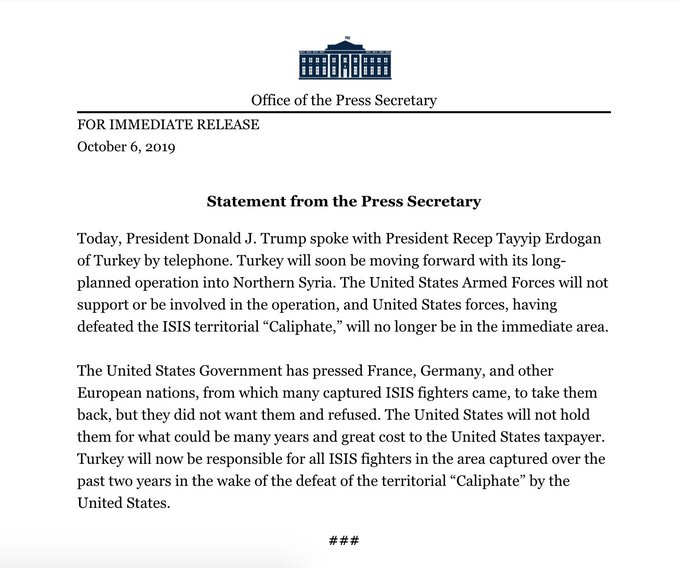
Q Are you going to take any action regarding the Turkish attacks in Northern Syria? And have the Kurds, as Senator Graham said, been shamelessly abandoned?
THE PRESIDENT: So, we have no soldiers in the area. We’ve been talking to Turkey for three years. They’ve been wanting to do this for many years, as you know. They’ve been fighting each other for centuries. They’ve been fighting each other for — hundreds of years, this has been going on.
We were put into this battle — interjected. It was supposed to be a 30 — a 30-day period. And we’ve been there for many, many years. And it’s time to get out. We’re speaking to both sides. We’ve told President Erdoğan how we feel. But we are speaking to both sides, and we’re seeing what can be made out of a situation.
But we have no soldiers in the area, you know. We’re getting out of the endless wars. We have to do it. And eventually somebody was going to have to make the decision. And, frankly, we’re getting a lot of praise from that decision. We — people are saying, “Got to sometime bring our people back home.”
We’re really serving and we were serving as a police force. We had defeated ISIS. We defeated the caliphate, 100 percent. Erdoğan and the existing groups of people, including Kurds — but you have the PKK, which is a natural enemy with Turkey, and likewise and opposite, they’ve been fighting, again, for many, many years. They have — they’re bitter enemies; have been always. Probably, possibly always will be.
So we are — we are out of there. We’ve been out of there for a while. No soldiers whatsoever.
We are taking some of the most dangerous ISIS fighters out. We’ve taken them out and we’re putting them in different locations where it’s secure. In addition, the Kurds are watching. And if the Kurds don’t watch, then Turkey is going to watch because they don’t want those people out any more than we do. But we have taken a certain number of ISIS fighters that are particularly bad. And we’ve wanted to make sure that nothing happened with them, with respect to getting out. And I think we’re doing a great job.
I think the people of this country — I campaigned on ending the endless wars. We’re all over the world, fighting wars. Half the places, nobody even knows what they’re doing over there. And I feel that we are doing the right thing, and I think the country feels that, too.
We’ve had tremendous support outside of the Washington — little Washington area. And even in Washington, people are saying, “You’re doing the right thing.” It has to be done; otherwise, you’re never going to do it.
At the same time, we’re dealing with both sides. We’re going to see what we can do.
Q In a statement this morning, you cautioned Erdoğan. Since then, it appears as though there have been casualties on the Kurdish side. Are you concerned about escalation? And are you concerned that Erdoğan will try to wipe out the Kurds?
THE PRESIDENT: I will wipe out his economy if that happens. I’ve already done it once, with Pastor Brunson. I’m sure that he — I hope that he will act rationally. You do have to understand: They’ve been fighting each other for many, many decades. Actually, for centuries, they’ve been fighting each other. And it was time for the Americans — we did a great job.
We took care of ISIS. We captured 100 percent. Do you remember I was thinking, John, of leaving at 97 and 96 percent? And that last 3 or 4 percent was the hardest part. And they told me it would take a year to two years to do it, and I did it in a month. Remember that?
I flew to Iraq and I met with a lot of great generals there. Great generals. They said, “Sir, we can do it in two weeks to a month.” And we did it in two weeks to a month, and we took it. And, in the meantime, we’ve been watching over a lot — with the Kurds — watching over a lot of prisoners. Some very bad — some very bad people. A few, in particular, are very bad. Really bad. And some of those people we’ve already taken. We’ve taken them out.
They should go back, by the way. They should go back to Europe. Many of them came from Europe, but they should go back to Germany, to France, to — I spoke with Boris Johnson a couple — to UK. Some to UK, actually. But they came from various parts of Europe. They didn’t come from our country, and we did them a big favor.
And we said to France, we said to Germany, we said to various countries in Europe: “We’d like you to take your people back.” “Well, we don’t want them. We don’t want them. How about you taking them?” I said, “We don’t want them either. Nobody wants them; they’re bad. But somebody has to watch over them.” I said, “Look, we did you a big favor. You take your people back. You take them back.”
They’re citizens, in many cases, of those countries — of France, Germany. They didn’t want to take them back. I gave them one chance, I gave them another chance, I gave them a third chance, and I even gave them a fourth chance. They didn’t want to take them back. Not that I blame them too much; they’re used to this with the United States — taking advantage of the United States, whether it’s on trade or NATO — to take advantage of the United States.
But we think that maybe the Kurds will do a job. And if not the Kurds, we think Turkey will do a job. But we have thousands of people. Thousands. I don’t know if you know that. We have thousands of captured fighters, and thousands and tens of thousands of family members. And we did a big favor to a lot of countries, and those countries didn’t want to take them back. So that’s the way it goes.
Steve.
Q What if some of these ISIS fighters escape and pose a threat elsewhere?
THE PRESIDENT: Well, they’re going to be escaping to Europe. That’s where they want to go. They want to go back to their homes, but Europe didn’t want them from us. We could have given it to them. They could have had trials. They could have
done whatever they wanted.
But as usual, it’s not reciprocal. You know my favorite word, “reciprocal.” That’s all I want. I don’t want an edge; I just want reciprocal. And it’s not reciprocal, Steve. It’s not a fair deal for the United States.
And when President Obama took the PKK — you know, where they bring in PKK — that’s a tough deal because that’s been a mortal enemy of Turkey. So when you bring them in into a partnership, it’s a tough situation because it’s tough for Turkey; it’s probably tough for them. They’ve hated each other for many, many years — for hundreds of years. I mean, it’s amazing, when you look at history and you look at culture. But you look at the length of the time and the fighting for so long.
So we imposed ourself into it. And look, I’ve said it — I said it just yesterday: The single worst country the United States — if you take a look at, you know, what we’re doing with countries and the relationships we have with countries —
But maybe putting it a different way: The worst mistake that the United States has ever made, in my opinion, was going into the Middle East. It’s a quagmire. We are up to close to $8 trillion, and we’re bringing our folks back home. We have great, talented military. We’re bringing them back home.
Our military has never been stronger, but we’re now acting as police. We’re — we’re policing areas. We’re doing jobs that other countries should be doing. We’re doing jobs, frankly, that Europe should be doing. We’re doing jobs that Russia should be doing, that Iran should be doing, that Iraq, Turkey, Syria should be doing. They should be doing this. We shouldn’t be doing it. We’re 7,000 miles away.
Q Lindsey Graham is talking about imposing economic sanctions on Turkey over this incursion into Syria. What do you think about that? Would you support that?
THE PRESIDENT: Well, I think it’s okay. I’ve already told that to President Erdoğan. Far more than sanctions — I’ll do far more than sanctions. Lindsey and I feel differently. I think Lindsey would like to stay there for the next 200 years and maybe add a couple of hundred thousand people every place. But I disagree with Lindsey on that.
But I will tell you that I do agree on sanctions, but I actually think much tougher than sanctions if he doesn’t do it in as humane a way as possible. But I’ve gotten him to stop for — virtually, from the first day that I was in office. But they wanted to fight, and that’s the way it is. And they’ve done it for so long.
Yes, go ahead, please.
Q Sir, what does “as humane a way as possible” actually mean? Does it mean civilians? Or —
THE PRESIDENT: Well, we’re going to have to see. We’re going to have to define that as we go along. They want to — if you listen to Erdoğan, he wants to have people go back to where they came from, go back to Syria. Right now, he’s holding — in all fairness to him, he’s holding millions of people that would be all over the place if he wasn’t holding them. So he wants to repatriate, he wants to have them go back into the area that he’s looking at.
But we’ll see. We’ll see how he does it. He can do it in a soft manner. He can do it in a very tough manner. And if he does it unfairly, he’s going to pay a very big economic price.
Q Mr. President, you said — with the letter that you sent up to Nancy Pelosi yesterday —
THE PRESIDENT: Yeah.
Q — you appeared to declare war on the impeachment inquiry. Can you tell us, in your own words, why you think it is incumbent upon the House to hold a full vote to authorize an inquiry? And if they were to hold the vote and it were to be positive, would you then cooperate with the inquiry?
THE PRESIDENT: Well, let me just say that the Republican Party — and President — but the Republican Party has been treated extremely badly by the Democrats — very unfairly — because they have a tiny margin in the House. They have eviscerated the rules. They don’t give us any — any fair play. It’s the most unfair situation people have seen. No lawyers — you can’t have lawyers. You can’t speak. You can’t do anything. You virtually can’t do anything.
And then, on top of it, they have a guy named Schiff. And Nancy Pelosi knows all this because she’s just as guilty as he is. But you have a man named Schiff, where I had a perfect phone call with the President of Ukraine — like, I mean perfect. People read it, but they don’t read that. They heard Schiff’s version of it. He defrauded the American public. He gave the most horrible rendition, adding his own words.
I mean, Mark Meadows is here. I think I can say honestly, Mark, you didn’t believe it when you heard it.
REPRESENTATIVE MEADOWS: Right.
THE PRESIDENT: And Mark has never heard anything like it. And many of the people that we work with, including Democrats, have never heard anything like it. He made up a phone call. He made it up. Because what happened is they spoke about a day too early. They heard a whistleblower who came out with a false story — you know, people say, “Oh, it was always fairly close.” It wasn’t close at all. What the whistleblower said bore no relationship to what the call was. We have a transcribed call, done by professionals. And the call was a perfect call, but Schiff made it up.
Then it turns out that the whistleblower was in cahoots with Schiff. Then it turns out that the whistleblower is a Democrat — strong Democrat — and is working with one of my opponents as a Democrat that I might end up running against. The whole thing is a scam. It’s a fix.
And we wrote a letter yesterday, and it probably ends up being a big Supreme Court case; maybe it goes a long time. I don’t know. But the Republican Party has been treated unbelievably badly and unfairly by the Democrats, John.
Q But then again, sir, if they held a vote in the full House, and the vote were to authorize, would you —
THE PRESIDENT: Well, yeah, that sounds okay.
Q — would you cooperate?
THE PRESIDENT: Well, we would if they give us our rights. It depends. If they vote and say you can’t have lawyers, you can’t ask questions, you can’t have anybody present — all of these crazy things. And even some of the reporters said to me, “It really is an unfair situation.”
They ask all the questions and then — for instance, the ambassador who testified was a fine gentleman. He gave great testimony for us. But we don’t get to do any of that or show any of that, so they brought out only the couple of negative things, all which were knocked out by his other statements. It was a great witness for us, but if you would’ve listened to them, you would’ve said it was a better witness for them. It wasn’t. It wasn’t even close. He was a fine gentleman. And we saw that, and we said that’s very unfair.
Yes.
Q Mr. President, there were reports this afternoon that the Chinese are lowering their expectations for a trade deal. Are you also lowering your expectations for a trade deal?
THE PRESIDENT: No, I don’t think so. I think they feel that I’m driving a tough bargain. But I have to. You know it better than anybody. You do a good job over there. I watch a lot.
We are so far down, in terms of where we started, from Presidents that didn’t do their job for many years. Since the World Trade Organization founding — China went in in 2001 or so — China went in and just ripped off the world.
So, and I told that to President Xi. I said, “You know, this can’t be like a 50/50 deal.” Because a 50/50 deal, you’re like up there and we’re down here. So a 50/50 deal, it doesn’t work, right? You got to have a little balance. This has to be a better deal from our standpoint. And I think they fully understand it.
One of the really good meetings I had today was with our people on opioids and drugs and fentanyl — and fentanyl, in particular, with respect to your question. And they said that Chinese leadership has a lot of respect for our President, and they are really being much more careful. It’s a much different situation.
We have some great drug numbers. Now, what is great drug — if you’re down 15, 16, 20, 25 percent, it’s still horrible what’s going on in this country and in the world. In the whole world, it’s horrible.
But no, I think they have a lot of respect for us. It’s the first time they’ve ever respected us. I think China has a lot of respect for me and for our country and for what we’re doing, and I think they can’t believe what they’ve gotten away with for so many years.
Q Are the Chinese wrong to be putting pressure on the NBA, sir?
THE PRESIDENT: Well, the NBA is a different thing. I mean, I watch this guy, Steve Kerr, and he was like a little boy. He was so scared to be even answering the question. He couldn’t answer the question. He was shaking. “Oh, I don’t know. I don’t know.” He didn’t know how to answer the question. And yet, he’ll talk about the United States very badly.
I watched Popovich. Sort of the same thing, but he didn’t look quite as scared, actually. But they talk badly about the United States. But when it talks about China, they don’t want to say anything bad. I thought it was pretty sad, actually.
Q So are you okay with the Chinese government pressuring the NBA, sir?
THE PRESIDENT: It’ll be — it’ll be very — it’ll be very interesting. Excuse me.
Q Are you okay then with the Chinese government pressuring the NBA over Hong Kong?
THE PRESIDENT: They have to work out their own situation. The NBA is — they know what they’re doing. But I watch the way that like Kerr and Popovich and some of the others were pandering to China, and yet to our country, they don’t — it’s like they don’t respect it. It’s like they don’t respect it.
I said, “What a difference. Isn’t it sad?” It’s very sad. To me, it’s very sad.
John.
Q Mr. President, Joe Biden came out for the first time today and said you should be impeached. Your response?
THE PRESIDENT: Well, he’s falling like a rock. We have him on tape with corruption. I mean, he’s getting the prosecutor for, I guess, John, it was $2 billion — saying, “We’re not giving you the $2 billion” — or whatever the amount was — “unless you get rid of this prosecutor.” And then he goes, “Lo and behold, the prosecutor was gone.”
Q It was $1.2 billion.
THE PRESIDENT: And that was the prosecutor — excuse me, John?
Q $1.2 billion.
THE PRESIDENT: $1.2 billion. Not a lot of money. And then his son takes out $1.5 billion from China.
And, by the way, the $50,000 a month that he was getting from Ukraine, it looks like it’s $168,000, split among him and somebody else — his friend. And also there’s a payment of about $3 million to his son. His son just got thrown out of the Navy.
So Biden is dropping like a rock. I don’t think he’s going to make it. I didn’t think he wasn’t going to make it for a long time. I don’t think he’s going to make it. And I guess this is one way he can do it. You know, he didn’t say that until right now. And he sees what’s happening to him. I guess he’s no longer the frontrunner.
But, look, I feel badly for him because I know he’s going through a lot. He’s been hit. And he’s been caught red-handed. I mean, here’s a man who is on tape saying exactly what he’s going to do in terms of corruption, and he gets away with it. If that ever happened to a Republican, they’d be getting the electric chair right now. They’d be right now being walked into the electric chair. It’s a whole different standard.
What Joe Biden said on tape — this isn’t like, “Gee-whiz, we think.” What he said on tape — and the fake media doesn’t want to play the tape. They hardly play it. So I feel, you know, that it’s too bad what’s happened to him. He is sinking and his campaign is sinking.
But he walked away with hundreds of — I mean, you look at the kind of numbers his son — who is, at best, incompetent — got thrown out of the Navy. I don’t even want to say why; A subject that we just discussed. I don’t want to say why. But he gets thrown — and then all of a sudden, he’s making a deal with Ukraine, where they’re getting $168,000 a month between the two of them — $168,000 — and he gets $3 million payments and all of this money coming out? And the kid has no expertise in energy, and it’s an energy company. He has no expertise. You and I both know much more than he does, John.
And then you walk into China, and a couple of days later — 10 days later, to be exact — he gets $1.5 billion out of China, and he’s got no expertise. And I have friends that are the smartest people on Wall Street. I said, “Is that possible?” They say, “No, it’s not possible.” It’s a pretty sad situation.
Please.
Q Mr. President, I just want to clarify something you said earlier. If Pelosi holds a vote on the floor on impeachment and commits to the rules of previous impeachment proceedings, you’ll participate in that investigation?
THE PRESIDENT: Yeah, if the rules are fair.
Q Okay.
THE PRESIDENT: I — because I don’t know how — I don’t know exactly your definition.
If Republicans get a fair shake — because the Republicans have been — look, we were very nice to them. When Paul Ryan was the Speaker, he really wouldn’t give subpoenas. And I’m not saying good, bad, or indifferent. Here’s a man that knows it very well. They’d go in with all of the corruption that you’ve been reading about, and all of the things that they did wrong with Comey, and all of these people and all of the things they did wrong.
When we wanted a subpoena — meaning, they wanted a subpoena — it was very hard to get it and I’m not sure he ever even issued a subpoena. And Nancy Pelosi issues subpoenas: “Come on in and get them.” Gives them to Nadler. Gives them to Crooked Schiff.
I mean, this Schiff is one crooked guy. The guy made up my phone call. Think of it. In the United States Congress, he made up my phone call. And I’ve had people that said, “I didn’t like the way you talked to the Ukrainian President.” I said, “Did you read my speech?” “No, I heard Schiff.” Shifty Schiff. “I heard Schiff.” I said — that’s how I said — I said, “Well, let me see what he said.” A lot of people saw that.
This — and frankly, I think if it wasn’t for me, I don’t know if anybody would have even noticed and called him out. He took my really — believe it or not — congenial and gentle words, and he made me sound like a tyrant. It’s a terrible thing. He defrauded the American public.
I mean, honestly, I don’t know what can happen, but there are those that say he should be prosecuted for what he did. He should certainly be impeached, but he should be prosecuted for what he did. And I think he’s a very bad leader of this movement.
Yes, please.
Q And just, on the phone call, there’s a new report out today that the whistleblower says a White House official came to him and said you committed a crime on that call. Did any White House official express any concern to you —
THE PRESIDENT: No, no.
Q — or speak to you about that phone call afterward?
THE PRESIDENT: It’s all a big con, don’t you understand? Look, the phone call, you have it; it’s the transcript. That’s why they keep saying, “Oh, the whistleblower said this and that.” What happened is, if they would have seen the transcript early, they wouldn’t have had a whistleblower, because he wouldn’t have said — there was nothing he could say. All you have to do is read the transcript. Very calm.
And what’s even more important than the transcript, in a certain way? Although, I think the transcript is the most important, because it was really plain vanilla. No emotion. No nothing.
These are crooked people that are doing — these are Democrats, headed by a — a Democrat lawyer, a big Democrat lawyer. This is a con job. This is a con being perpetrated on the United States public and even the world. And the world is watching, and they — they get it better than a lot of other people. It’s very interesting.
But a poll just came out today: A very small people want to see something — even though I only get negative press from you people — not you, necessarily. But — but, that’s the way it is.
So, I say this: Look, all you have to do is read the transcript. But you know what’s almost as good as the transcript, I think? Is the Ukrainian President saying — he didn’t even know that they were talking about — “no pressure.” The foreign minister of Ukraine saying, “No, it was a very normal call. There was no pressure at all.”
What is bad is when you see all of the elements, when you see that Schiff saw the whistleblower. When you see what the whistleblower said about the phone call, and it was totally different. He made it up. And I don’t know why a person that defrauds the American public should be protected, okay?
Q Sir, then why did your administration try to bury that transcript in the extra level of —
THE PRESIDENT: Well, that I don’t know. Again, I’m not a lawyer. I can say this: I assume it was for leaks. I have no idea. I’m just answering. Because this city is like the leaking capital of the world. If you want to get something out to the press, all you have to do is hand it to somebody in Washington.
So, I assume it was for leaks. I mean, I’ve read that, and it doesn’t seem like a big deal. What is a big deal —
Q (Inaudible.)
THE PRESIDENT: I think they’re probably trying to protect it from leaks.
But here’s the other thing: We gave that transcript over almost immediately. It wasn’t like we waited until now. Until now would be immediately, because it’s only been doing it for three weeks. We gave that transcript up almost immediately.
And you know, when I heard Schiff’s phony version, and when I heard what was being horribly said by this so-called whistleblower — and I’d like to find who is the person in between the whistleblower and hearing about this — the conversation? The conversation was, I think, a perfect conversation. But who’s the person giving this information?
If that person exists — I’m not sure that person exists — but I think it’s important — and I say this to Congress — I think it’s important to find out who that person is, because we could have a spy. And I don’t want to have spies when I’m negotiating with China and Syria and all of the countries — if you look at Turkey, with Erdoğan. I have calls with all these people. And Kim Jong Un.
I don’t want to have spies in the White House. I want to be free to make calls. I don’t think it’s fair that somebody interprets a call. He didn’t interpret it wrong; I don’t mind a misinterpretation. This was a fraud, because that call was perfect. And if you read the whistleblower’s report, that was no — it bore no resemblance to what the call was.
Steve?
Q Could we go back to your conversation with Boris Johnson?
THE PRESIDENT: Yeah.
Q There was a case involving a car crash involving a —
THE PRESIDENT: I hate the case. I —
Q — American diplomat’s wife. Did you bring — did you talk about that?
THE PRESIDENT: That’s true. I — we talked about it.
Q What did you decide?
THE PRESIDENT: So, what we’re going to do — it’s a very, very complex issue, as you know, because we’re talking about diplomatic immunity, which, in itself, is quite a subject, right? You people could lecture me on it, I suspect. But it’s quite a subject.
A terrible accident occurred. The person driving the car — they know who it was, and they have it on camera. A young man was killed on his motorcycle. He was killed — sounds like instantly killed.
The woman, through diplomatic immunity, left the UK, and came back to America. And what I’m going to try and do and see — because I understand where the people from the UK are. And, frankly, a lot of Americans feel the same way. We have — I was telling Boris, we have a lot of Americans that, you know, they side on the fact that, you know, you have two wonderful parents that lost their son, and the woman was driving on the wrong side of the road.
And that can happen. You know, those are the opposite roads. That happens. I won’t say it ever happened to me, but it did. When you get used to driving on our system and then you’re all of a sudden in the other system, where you’re driving — it happens. Have to be careful — very careful.
So a young man was killed, the person that was driving the automobile has diplomatic immunity. We’re going to speak to her very shortly and see if we can do something where they meet — it was an accident. It was an acc- —
Q Like send her back?
THE PRESIDENT: It was a terrible accident.
Q Send her back, you mean, for trial? Or —
THE PRESIDENT: We’re going to speak to her and we’re going to see the person driving the car — the wife of the diplomat. We’re going to speak to her and see what we can come up with so that there can be some healing. There’s tremendous anger over it. It’s a terrible incident. There’s tremendous anger, and I understand the anger from the other side very much.
Q Mr. President, when you met with Robert Mueller in May of 2017 at the Oval Office, were you in fact interviewing him for the position of FBI? And were you aware, at the time that he was in the Oval Office, that he had had prior conversations with Rod Rosenstein about potentially becoming Special Counsel?
THE PRESIDENT: Okay, to you second question: Absolutely not. I had no idea that he was doing that. To the first question, he absolutely wanted to become the FBI Director, and I said, “No.” I said, “Listen, you’ve been there for…” — I believe it was 12 years. And I said, “No.” And it has since been proven that I was right. Plus, we have witnesses to it. I interviewed numerous people that day. And he was one of the numerous people. Making a decision ultimately — but he was one of the people. I said no — nicely, respectfully.
Q Did you speak to him about a potential conflict of interest because of the dispute he had with you over the golf membership?
THE PRESIDENT: I knew about it. We didn’t speak about that, because I wasn’t going to accept him. That may have been one of the reasons I said no. Who knows? But I did have conflicts of interest with Robert Mueller. We had a business dispute. I thought we had, as you know, three basic conflicts of interest, and none of them were very good. But we had a — we had a business dispute.
But I thought he was there for 12 years. That was long enough, especially when you saw what happened with the FBI.
And you have to understand, nobody respects the FBI more than do. And I think, if you took a vote in the EBI, they’d vote me President right now — a vast, vast majority. And they’re great people. I know a lot of them. But your leadership was terrible, whether it was Comey or Mueller or anybody.
I mean, this leadership turned out to be a disaster for this country, when you look at Strzok and Page, when you look at the “insurance policy.” “You know, she’s going to win. But just in case she doesn’t, we have an insurance policy.” Well, that only means one thing; there’s no other interpretation.
So when you look at that — no, Robert Mueller wanted a job to be the Director, and I turned him — very nicely, respectfully — down. The other element of your question: I never — I never heard that until just recently when it’s being reported a little bit.
Q So these trade — the trade talks —
THE PRESIDENT: Please. Go ahead, Steve.
Q — coming up with China: Are you optimistic that some sort of deal will be reached with these —
THE PRESIDENT: Well, China wants to make a deal. In my opinion, China wants to make a deal more than I do, okay? But — but — look, I’m very happy right now. We’re taking in billions of dollars of tariffs. And despite what the news was saying, there’s no inflation. There’s not a very big price increase, if any, because they’ve eaten the tariffs. They’ve devalued their currency and they’re pouring a lot of money into their system.
Now, they’ve lost three and a half million jobs and their chain is breaking up; their supply chain is breaking up like a broken egg. They want to make a deal.
The question is: Do I want to make a deal? And the answer would be, if we make the right deal, I’d love to do it. I think it would be a great thing for China, also.
Q But they seem to be reluctant to make concessions on IP and (inaudible) —
THE PRESIDENT: Well, we’ll see. I mean, you don’t know that. Look, there is so many false reports. Everybody is trying to guess. But there’s really only two people that matter on this one, and that’s President Xi and myself. We get along very well.
I can’t imagine he likes me the way he did when I first became President, because, you know, it’s been — it’s been a rough time for China. China has gone down many trillions of dollars and we’ve gone up many trillions of dollars. I mean, we’ve — since I’ve been elected, many, many, many trillions of dollars have been — increased the value of — if you call it “value”; you could call it “worth” or “value” — of our country. We’ve you’ve increased — not just stock market, I’m talking our country. Our economy is bigger. It’s stronger.
And I believe if my opponent got in, you would have had a tremendous slide. And don’t forget, I only look at our numbers from the day after the election, because there was euphoria when I got elected and we picked up a tremendous amount from, let’s say, the 9th of November to January 20th, when we had the inauguration. And it’s been that way ever sense. It’s been a fantastic thing.
But China wants to make a deal very badly. And if we can make a deal, we’re going to make a deal. There’s a really good chance. There’s a really good chance, Steve.
Q Have you spoken — have you spoken at all, Mr. President, to the Attorney General about the coming Horowitz Inspector General’s report and/or the Durham report — either investigation?
THE PRESIDENT: No, I really — I’m leaving that to the Attorney General — highly respected man, a very highly principled man. I did read the Comey report — 78 pages of total kill. And I think it says, frankly, a lot to the Attorney General that he decided not to prosecute on that report, because I think most people reading that report would have done that. That report was horrible for Comey. Horrible. But he’s a highly principled man, and I’m leaving it up to him.
Q Mr. President, can you tell us what you said to President Erdoğan on Sunday when he said to you — did you promise him anything or did he promise you anything on Sunday?
THE PRESIDENT: No, we’re talking about it. No. But he said, “I want to go in. I want to go in.” But he’s been telling me that for two and a half years.
Q And did you agree to that?
THE PRESIDENT: He’s been telling that, virtually — he’s been saying this for many years, before me. And, you know, he’s ready to do it. They’ve been, again, fighting for so long. They’ve been fighting for so many — these are — this is like Israel and the Palestinians, okay? There’s only one difference: maybe the hatred is even greater. Is that possible? Maybe not. But it’s — this is a very, very serious hatred that’s come over many years.
Yes, sir.
Q But, Mr. President, the Kurds helped the U.S. defeat ISIS. And, by allowing this offensive, is it going to be more difficult in future times of need to develop alliances?
THE PRESIDENT: No, it won’t be. It won’t be at all. Alliances are very easy.
But, you know, our alliances have taken advantage of us. If you look at how much money we spent on NATO and how much money countries from Europe — who are really a much bigger beneficiary that we are, okay? You know, they’re there and we’re here. We’re many miles away. Our alliances, in many cases, have taken tremendous advantage of us.
If you look at NATO, I got them to pay $100 billion more. The Secretary-General, Stoltenberg, came out with a report recently that, because of President Trump, the other countries — 28 countries — so 27, not including us — they paid over $100 billion more because of me. But still, as good as that is — sounds good — it’s nothing compared to the kind of numbers you’re talking about.
So I’m very happy with that, but the United States is paying over 4 percent and Germany is paying 1 percent — maybe a tiny bit more, but I actually think, the way you calculate it — because you can look at it many ways — is probably less than 1 percent. France is paying less than what they’re supposed to.
Out of the 28 countries, 20 of them are delinquent. You know what the “delinquent” means? That’s an old real estate term. “He’s delinquent with his rent.” They’re delinquent with their payment. They owe us a tremendous amount of money and they never pay us back.
Because if Germany doesn’t pay — they don’t add that up, they just say, “Oh, that’s okay.” Then they don’t pay. And yet, they’re — if you go back that way, like the old fashioned way –like you don’t pay and you owe it. But they don’t pay and they just go on to the next year. They owe us hundreds and hundreds of billions of dollars. So, no. I don’t look at it that way.
Now, the Kurds are fighting for their land, just so you understand. They’re fighting for their land. And, as somebody wrote in a very, very powerful article today, they didn’t help us in the Second World War. They didn’t help us with Normandy, as an example. They mentioned names of different battles. They were there, but they’re there to help us with their land. And that’s a different thing.
In addition to that, we have spent tremendous amounts of money on helping the Kurds — in terms of ammunition, in terms of weapons, in terms of money, in terms of pay. With all of that being said, we like the Kurds.
Now you have different factions in there. Again, you have PKK — that’s a different faction. And they worked with us. It’s a rough group, but they worked with us. But we’ve spent a tremendous — and they’re fighting for their lands. So when you say, “They’re fighting with us” — yes, but they’re fighting for their land.
Now, if we go on the theory that some of the folks in Washington go by — who all do very well with the military-industrial complex. I mean, you know, the military-industrial complex. Take a look at Dwight Eisenhower; he had it figured right many years ago. It’s got tremendous power. They like fighting. They make a lot of money when they fight.
But it was time to bring our soldiers back home. So I see — and I will tell you: The hardest thing I have to do, by far, much harder than the witch hunt, is signing letters to parents of soldiers that have been killed. And it’s not only that — in areas where there’s not a lot of upside, if there’s any upside at all, and in many cases, it’s only downside.
And especially when that solider was killed in a Blue-on-Green attack. You know what that is, right? That’s where a solider being trained or whatever turns his gun on an American solider. “Here, son. Take your gun. You know how to use it.”
And he takes the gun and he turns it. And he shoots one — we have many of them in Afghanistan — in particular, in Afghanistan.
The hardest thing I have to do is signing those letters. That’s the hardest thing I have to do. And each letter is different. We make each letter different. And last week, I signed of them for Afghanistan; one in Iraq; one in Syria, from two weeks ago. And sometimes I call the parents. Sometimes I see the parents. I go to Dover, when I can, but it’s — it’s so devastating for the parents that — you know. It’s so devastating when they bring that boy or young woman out of the back of those big, powerful planes in a coffin, and the parents are there.
You know, we have people that do that. That’s what they do. They — they work that. They accommodate everybody. That’s what they do. They an incredible job. And they said — I said, “The parents seemed to be okay.” I’ll get there early. “The parents seemed to be okay.” “Well, actually, sir, they aren’t.” “No, no. The way they’re talking. They’re really okay, aren’t they?” “Sir, you never know until the back of that massive cargo plane opens up.” And they walk down holding a coffin with four or five great soldiers on each side of it, representing our various forces. That you never know.
And then I see it. And I see people that were smiling, “Oh, Mr. President, thank you for being here. Thank you for being here.” And I think they’re doing great. And then, twenty minutes later, we’ll be outside when that big plane pulls up and that door comes down, and they are walking the coffin with their boy inside this coffin with an American flag over the top. And they’re walking that coffin down this ramp. And I’ve seen people that I thought were really incredible the way they were ta- — I didn’t even understood how they could take it so well — scream, like I’ve never seen anything before. Sometimes they’ll run to the coffin. They’ll break through military barriers. They’ll run to the coffin and jump on top of the coffin. Crying mothers and wives. Crying desperately.
And this is on these endless wars that just never stop. And there’s a time and there’s a place, but it’s time to stop.
And just to finish, last Friday, I went to Walter Reed. And I gave out five Purple Hearts to incredible young men — in this case, all men. And they took a beating. Beautiful people. They took a beating. One couldn’t be there because the beating was so great that he was at a totally different part of the world. He lost a leg. He lost an arm. Ryan. He had tremendous damage, beyond even what these young folks went through.
But I’ll tell you what: For me, it’s very hard when I see that. It’s very hard. It’s easy to talk tough. You know, tough guys. All of these tough guys. “Let’s keep fighting. Let’s keep fighting.” If they had to go to Walter Reed — where they do unbelievable work. I have to tell you, these doctors are unbelievable. You know, it’s easy to say, “Oh, they’re not the…” They’re the best in the world. I’ve never seen anything like it.
One young man, last week, had his nose rebuilt. And they said it was in a thousand pieces. And, I said, “So where were you hurt?” He said, “My face, sir, was almost obliterated.” I said, “You have a better face than I do.” (Laughter.) And he said, “Sir, I had a doctor who was unbelievable, and they put it together.” They said — he said “a thousand fragments.” Now, I don’t if that’s even possible. But a thousand fragments. And they put it together.
And his father, who was crying, came up to me and said, “You’re not going to believe this, but my son didn’t have a great-looking nose and now his nose is better.” (Laughter.) Okay? It’s an amazing thing.
But when you see these — and the Purple Hearts — you see this kind of thing — and I see a lot of it at Walter Reed. And, again, the job those doctors and the people do at Walter Reed, it’s something to be commended.
Despite Wall Street headline writers trying to frame an opposite reality, President Trump has no disposition toward making a trade deal with China. Conversely, China has no intention of changing the closed and state-controlled structure of their economy. That’s the reality amid a trade dance that is going absolutely no-where.
This quote is priceless: “We can add the Diplomatic war to the Financial war, Currency war and Technology war, that we already have,” John Browning, managing director at brokerage BANDS Financial in Shanghai, said in a note to investors.
The Chinese position is thus:
REUTERS […] The U.S. demand that the Chinese Communist Party fundamentally change how it directs China’s massive economy to shift to a more Western model of free-market capitalism is irrational and misguided, a Chinese diplomat in the United States said.
“What we achieved during the past few decades shows that our system is good for development in China,” the official said, speaking on condition of anonymity.
China would not ask the United States to shift to an economy that relies heavily on state-owned enterprises, or ask it to start fully funding education, as China’s does, he said, so why should Washington expect the same from Beijing?
“We hope to strike an agreement but also accept the differences,” the diplomat added. (read more)
President Trump:
Speaking to reporters in Washington, Trump said: “If we can make a deal, we’re going to make a deal, there’s a really good chance.” “In my opinion China wants to make a deal more than I do,” Trump added. (link)
In an attempt to change their diminishing economic position and create leverage Beijing fires DPRK rockets.
The response from President Trump – The U.S. Department of Commerce on Monday blacklisted video surveillance firm Hikvision and 27 others, days ahead of the talks.
The Commerce Department barred the technology and artificial intelligence companies from doing business with U.S. firms, citing human rights violations of Muslim minority groups in Xinjiang. Chinese officials said the action interfered with China’s sovereignty. (Full Story)
Secretary Pompeo
✔@SecPompeo
·
China has forcibly detained over one million Muslims in a brutal, systematic campaign to erase religion and culture in Xinjiang. China must end its draconian surveillance and repression, release all those arbitrarily detained, and cease its coercion of Chinese Muslims abroad.
Secretary Pompeo
✔@SecPompeo
Today, I am announcing visa restrictions on Chinese government and Communist Party officials believed to be responsible for, or complicit in, the detention or abuse of Uighurs, Kazakhs, or other Muslim minority groups in Xinjiang.
US’ visa restrictions on Chinese officials seriously violate the basic norms that govern international ties, and interfere with China’s internal affairs, besides undermining China’s interests. #Xinjiang does not have the so-called human rights issue, as claimed by US: Chinese FM
Communist China and Chairman Xi Jinping are trying to wait-out President Trump hoping he doesn’t get re-elected in 2020. President Trump is using communist China’s strategy of waiting-him-out as an opportunity, and somewhat of a smart excuse, to put more punishment on Beijing.
President Trump has been very clear in his objective. However, President Trump has also been clear that he sees little possibility of any trade-agreement.
There is not going to be a U.S-China trade agreement.
The initial reports came last night indicating that former South Carolina republican congressman Trey Gowdy has joined President Trump’s legal team. Reporting todayconfirms that Trey Gowdy is no longer a Fox News contributor.
Specifically it appears Mr. Gowdy has joined the team as a proactive measure before a House impeachment vote which then leads to a trial in the Senate.
Given Gowdy’s specific legal skillset, and considering he is well known amid Senate chambers, I would surmise Gowdy would be the primary defense orator during a senate trial.
In that regard this is a good pick.
We do not yet know who House Speaker Nancy Pelosi will select to be the House “Impeachment Managers”, for all intents and purposes the House impeachment prosecutors. However, given recent court positioning it seems possible Lawfare member Douglas Letter -current House counsel- will be one of the two impeachment managers.
Mr. Gowdy has a rather mixed past in the political sphere. Heck, to be direct, his history of purple ties and political fence-positioning has been more than a little annoying. However, the 55-year-old former prosecutor is a strong litigator known for skilled oration and quick thinking in verbal arguments.
A smart chap with a disarming southern drawl is an asset in court. Considering the public spectacle of a Senate trial, this strength outweighs his prior shortcomings.
Additionally, another benefit to Trey Gowdy is there’s no need to bring him up-to-speed on the central issues. Mr. Gowdy was one of two House members who has reviewed every bit of classified documentary evidence gathered during the republican congressional investigations of the DOJ and FBI conduct.
House member John Ratcliffe and former member Trey Gowdy were selected by their colleagues to represent their interests. As a result Gowdy has seen all of the classified intelligence that lay behind all of the known events; and as a consequence all security clearances are pre-established. That could become an important benefit considering where this ridiculous impeachment path is heading.
CTH would not expect to see too much of Mr. Gowdy as the House impeachment battle continues. In the background Gowdy will likely be absorbing information, reviewing every document, process and witness, along with helping coordinate the aggregate defense strategy.
My hunch is Gowdy’s profile strength will be saved in the event a Senate trial becomes a reality.
Against new information that U.S. Attorney John Durham has lengthened the time-framefor this investigative inquiry into the DOJ and FBI activity around the 2016 election, earlier today Fox Business host Maria Bartiromo revealed (and President Trump tweeted) the FISA report by Michael Horowitz will be released on Friday October 18th.
If that time-frame for the IG report is accurate, that means the classification review has been completed; any remaining classified information not specifically authorized in the inspector general report, a decision granted to AG Bill Barr, would be placed in a classified appendix that is not available to the public.
A publication date in/around October 18th would also mean the time allotted for principal review has expired. Generally the people whose conduct is under review are granted a preview of the report that covers their activity. The IG may or may not include any response from the principals outlined. If the IG permits inclusion of a principal response, the IG usually outlines additional information to rebut or support the principal position.
A final draft is assembled only after the OIG administrative referencer makes a final review of all statements of fact and provides citations therein. Then things get a little troublesome…
If Bartiromo is accurate as to the size of the IG report; this is where the ‘summary of IG findings‘ becomes critical. Generally speaking the IG writes the full body of the report, but may not author the ‘executive summary’. The executive summary can be written by administrative state career officials and their priority is institutional preservation. If they are motivated to shape public opinion of the report content, the executive summary may be written to dilute institutional damage outlined within the main body of the report.
We saw a profound disconnect between the 14-page ‘executive summary’ and the main 568-page body of the investigative report when the DOJ and FBI released the IG report on FBI and DOJ handling of the Clinton Investigation. The summary was completely disconnected from the material within the report; stunningly so.
The June 14th 2018 OIG Executive Summary was so ridiculously detached from the evidence within the report; and the roll-out day was so transparently coordinated; FBI Director Christopher Wray held an immediate press conference to announce the “inspector general found no evidence of political bias” during the 18-month investigation.
Director Wray made that specific proclamation at 5:30pm on Thursday, June 14th, 2018,less than three hours after the 568-page IG report was published. The FBI timing was purposefully positioned just before the 6:00pm broadcast evening news, so that media could run with the headline “No Bias”. It was a transparent DOJ/FBI public relations and political con job.
The June 2018 IG report was full of examples of political bias, but Director Wray’s intentionally misleading proclamation -in combination with a profoundly obtuse executive summary- set the foundation for how the report was broadcast to the public by the majority of the media. Christopher Wray is still the current director of the FBI.
If Ms. Bartiromo is correct that DOJ officials are releasing the widely anticipated IG report on a Friday (October 18th), unfortunately that Friday document dump would be an indication the intent of the DOJ leans toward diminishing the content.
Defense Intelligence Agency (DIA) employee Henry Kyle Frese was arrested yesterday and charged with leaking multiple classified intelligence reports to media. (Full pdf below).
According to the indictment Mr. Frese was caught leaking classified intelligence information to two journalists, one of which he was romantically involved.
Mr. Kyle Frese has a twitter account HERE. Cross-referencing information from within the indictment, research by Matthew Keys has indicated journalist #1 is Courtney Kube from NBC, and journalist #2 is Amanda Macias from CNBC. The intelligence leaked by Mr. Frese to Ms. Macias likely revolves around North Korean defense systems. [DOJ Announcement Here]
WASHINGTON – A U.S. counterterrorism analyst was arrested at the Defense Intelligence Agency where he worked on charges related to alleged leaks of information to two journalists, the Justice Department said.
Henry Kyle Frese, 30 years old, accessed classified intelligence reports about a foreign country’s weapons systems last year and provided them to two unidentified journalists, according to newly unsealed court documents.
The journalists aren’t named in the indictment, but they are identifiable as Amanda Macias, a national security reporter for CNBC, and Courtney Kube, a national security reporter for NBC. Public tweets cited in the court filings correspond to tweets sent by Ms. Macias and Ms. Kube in July of last year.
Both journalists and NBC and CNBC didn’t immediately respond to requests for comment.
In a statement, the Justice Department said Mr. Frese “was caught red-handed disclosing sensitive national security information.” (link)
Intelligence analyst allegedly leaked classified info to journalist with whom he was romantically…
An analyst at the Defense Intelligence Agency has been charged with leaking top secret information about a foreign country’s weapons systems to journalists.
Once again we remind our current, and any potential future allies, that at some point we will fuck them over. https://twitter.com/NBCNews/status/1181043719497293824 …
BREAKING: In an extraordinary Sunday night statement, the White House announces that the US “will no longer be in the immediate area” of Northern Syria, allow Turkey to launch an invasion in the region and give Turkey responsibility for captured ISIS fighters in the area.
One aspect heavily monitored by CTH surrounds frequent redactions to ongoing DOJ releases that touch upon former Deputy Attorney General Rod Rosenstein. An additionally annoying thorn would be the continued holding-back of Rosenstein’s expanded scope memos authorizing the expansion of Mueller’s special investigation. [They remain hidden]
The reason Rosenstein’s behavior remains a high-priority is simply because without his ongoing participation and authorization in 2017 and 2018 the Weissmann/Mueller probe would not have been able to continue.
Rosenstein is a central character to all events, and at the end of the Mueller investigation -through today- the DOJ continued to black out any information that evidenced Rosenstein’s duplicitous activity.
As a result, CTH has viewed the transparent DOJ redactions as a purposeful effort to protect Rosenstein. However, recent activity and media reports outline the possibility of another motive. Perhaps, just perhaps, the evidence of Rosenstein’s activities has been withheld because Rosenstein is a subject of the Durham investigation. First watch this:
.
Setting aside the common mistake in part of that report by John Roberts, the fact that Durham is looking into the Mueller phase of the coup (early 2017); in combination with White House officials now sharing documents surrounding the Mueller-Rosenstein White House visit; and accepting the ongoing redactions by the DOJ on material that touches Rosenstein; there is a moderate possibility Rosenstein is now a Durham target.
REPORT THIS AD
There are four central actions taken by DAG Rod Rosenstein that frame the four corners of his active involvement within the “small group” coup effort. Four corners that would highlight Rosenstein as an “unindicted co-conspirator”:
♦Corner One – Rosenstein’s contact with Mueller immediately following the firing of James Comey (less than 15 hours); and the documented contact with Mueller during the period of May 10th through May 17th (leading to the appointment); and the material evidence that Rosenstein lied to the White House when he took Mueller into the Oval Office on May 16th to interview the special counsel target. As Devin Nunes outlined in January: “Rosenstein made Trump the target of Mueller“.
♦Corner Two – DAG Rod Rosenstein expanding the special counsel investigations. Rosenstein wrote three scope memos in total. The first initiated the special counsel under the predicate of looking at Russian interference in the 2016 election and/or Trump campaign official conduct therein. The second scope memo expanded the depth of the Mueller probe and allowed the investigation to look at other issues unrelated to Russia interference (Manafort taxes, FARA, etc.). The second scope memo also authorized Mueller to use the Steele Dossier as an investigative tool.
The third expanded scope memo allowed Mueller’s team to go after targets unrelated to Russia interference, and unrelated to the other matters. The third memo specifically allowed Mueller to target Mike Flynn Jr. as a tool to get General Flynn to take a plea deal.
REPORT THIS AD
♦Corner Three – DAG Rosenstein cooperated in the Mueller claim of Russian election activity through DOJ indictments of ridiculous Russian-related entities; none of which would ever be prosecuted – and almost all of which seemed constructed to promote the guise upon which the Special Counsel was launched. It would have also been DAG Rod Rosenstein who approved of the James Wolfe plea deal, burying the FISA leak and the involvement of senators within the SSCI in the overall coup effort.
♦Corner Four – DAG Rosenstein was specifically in charge of authorizing or granting the aggregate activity of Mueller’s team; which would include the aggressive methods used by the DOJ and FBI evidenced by raids on Paul Manafort and SWAT deployment against Roger Stone (with CNN media to broadcast). More concerning, and perhaps most damning, DAG Rosenstein would have to sign-off on the $10,000 sting operation against George Papadopoulos at Dulles International Airport. DAG Rosenstein also threatened President Trump not to declassify material in Sept. ’18 or he would face obstruction.
We’ve always said that Attorney General Bill Barr’s biggest challenge would not be gathering evidence of what took place; the evidence is so obvious there have been books written about it. The real challenge for AG Barr is navigating through what We The Peopleare already aware of; against a likely disposition that Barr would not want to believe it, and certainly would be conflicted in facing it.
REPORT THIS AD
The reports of AG Bill Barr personally going to see and interview the places and people at the very epicenter of the fraudulent 2016 predicate, is an indication that Barr doesn’t really have any options. The scale of what took place is so serious; and the evidence therein so obvious; if he doesn’t get his arms-around-it the Attorney General is looking at very serious long-term institutional damage.
The obvious stares us in the face. If Durham has indeed expanded his time-frame to looking at early 2017, he is looking at DOJ and FBI activity entirely under the authority of Rod Rosenstein.
It would be, at least should be, impossible for either Barr or U.S. Attorney John Durham to complete their investigation/review of what took place, and then deliver a report -or statement- that results in nothing; or worse, attempts to justify all of the known activity. Simply put, too many millions of Americans are aware.
All of that said, it could be possible the DOJ action to redact, remove and/or keep the demonstrable activity by Rosenstein hidden, is not to protect Rosenstein – but rather because Rosenstein is an investigative subject or target therein. Again, WATCH:
[Transcript] – MR. GIDLEY: Thank you so much everyone. We appreciate you joining the call. This is a background briefing regarding the letter to the House Representatives. Keep in mind that this call is attributable to a senior administration official, so on background only. It is also embargoed until the conclusion of the call.
With that, I’m going to turn it over to [a senior administration official] to give you a brief overview of the letter. And then I have [senior administration officials] to answer questions after the presentation.
So, with that, I’m going to turn it over to [senior administration official].
SENIOR ADMINISTRATION OFFICIAL: Thank you, Hogan. Thank you everyone for being on the call. Today, White House Counsel Pat Cipollone sent a letter to Speaker of the House Nancy Pelosi, and to the chairmen of the Foreign Affairs, Intelligence, and Oversight and Reform committees of the House of Representatives, explaining the President’s and the administration’s position with respect to recent requests for information in connection with what the House has characterized as an impeachment inquiry. And the letter explains that there are legal and constitutional flaws that make what has been labeled a so-called “impeachment inquiry” invalid as a constitutional matter.
For the first time in our nation’s history, the House of Representatives is now purporting to proceed on an impeachment inquiry against the President without conducting a vote on the House floor. This has never happened in the history of the country. There’s always been, in every prior inquiry into a presidential impeachment, a vote on the House floor.
And here, the House is purporting to proceed simply on the basis of a news conference that the Speaker of the House had. And that is simply not sufficient to establish the sort of accountability to show the will of the House to embark on this that is required out of due respect for the separation of powers and for the vote of the American people that was taken in the last election.
Even more importantly, the second legal and constitutional flaw is that the House is purporting to proceed without providing any of the due process protections that have been provided in all modern presidential impeachment inquiries in the past. The House is not providing any rules to provide the President any of the basic procedural rights that would apply in any proceeding that is designed to achieve a real search for the truth.
They have denied the President the right to cross-examine witnesses, to call witnesses, to receive transcripts as testimony, to have access to evidence, to have counsel present — all of these. And these have been in the 1970s, in the inquiries into President Nixon; in the late 1990s, the inquiries into impeachment with President Clinton. All these rights were available. It is unprecedented that they are being denied here, and it violates basic due process standards.
In addition to that, by failing to have any resolution on the House floor, the House has avoided giving even the minority on the committees the right to subpoena. So, in all prior modern presidential inquiries into presidential impeachment, the minority party has had co-equal authority to issue subpoenas to gather information along with the majority.
This is the first time ever that someone — that a House has tried to pursue such an inquiry while denying the minority that right. And it simply guarantees that this would be a one-sided inquiry, a one-sided effort by one party to gather the information that it finds favorable, without the same power on the other side to gather other information.
And that’s contrary to one of the basic tenets of our adversarial system of justice, which is that, in having an adversarial presentation of evidence — two sides trying to get at the truth — that is the best way to get at the truth of something. Again, it’s denial of basic fairness, fundamental fairness in this process.
And so, the letter explains that there are these flaws denying fundamental fairness and due process, contrary to all history and precedent in the country, and explains that the reason the Democrats are proceeding in this fashion is that this is really nothing but a political strategy.
It’s a political stratagem because the Democrats want to overturn the results of the 2016 election and they want to use impeachment as a political strategy to influence the results of the 2020 election. And this, again, is unprecedented in the history of our nation to use such a grave constitutional proceeding for such raw political ends.
It’s something that was denounced even by Chairman Nadler in the context of the Bill Clinton impeachment. He explained then that there should never be a narrowly voted impeachment, or impeachment supported by one political party and opposed by another — that that’s simply not the proper use of impeachment.
The letter goes on also to explain that there are some serious questions raised by some of the conduct of the committees — with Chairman Schiff, for example, first denying that he had any contact with the whistleblower, then having to admit that that was not true. And that these are questions that ought to be explored. But given the current procedures — the constitutionally flawed procedures that the committees have adopted, there is no opportunity either for the President or for the minority, so the Republicans in the House, to explore these issues. There’s no subpoena power for them. There’s no way for them to get access to evidence. There’s no opportunity for the President to confront witnesses at all or cross-examine them. So the entire process is flawed from the outset.
And the letter concludes by explaining that, given these constitutional flaws and the President’s obligations under the Constitution and to future occupants of the Office of the Presidency, that he cannot have his administration participate in this unconstitutional procedure, and that, under the current circumstances, at least as currently framed, that he and his administration will not participate in this process.
I think that’s a good summary of the letter, and we’d be happy to take questions.
Q Thank you. Alex Ward from Vox here. We were talking to House Democrats today who said any action along these lines could be seen as something that could lead to articles of impeachment over obstruction of justice. I’m wondering how you view those statements by Democrats.
SENIOR ADMINISTRATION OFFICIAL: Well, asserting rights under the Constitution cannot ever properly be framed as obstruction of justice. Democrats may try to spin it that way politically, they may try to make that argument politically, but that’s a political argument; it’s not a legal argument. Standing on rights and asserting rights under the Constitution, under the separation of powers and under the due process clause, is not obstruction of justice; it’s part of the constitutional system we have.
Q Hi. This is Andrew Feinberg with Breakfast Media. Thanks for doing the call. I have two questions. The first is: Aren’t you putting the due process cart before the horse here? Because the opportunity to question witnesses against the President, wouldn’t that come in a Senate trial?
And second, since Democrats took over Congress, you guys have argued that their oversight requests aren’t legitimate without a legitimate legislative purpose. You’re now arguing that the impeachment inquiry that you said — that you guys previously said that the administration would cooperate with — have the obligation to cooperate with — is illegitimate because there hasn’t been a House vote.
What’s to stop you from arguing that an impeachment inquiry, should the House take a vote, is illegitimate because not enough Republicans voted for it? I mean, isn’t the real (inaudible) you don’t see the Democratic House as having any legitimate authority over a Republican administration?
SENIOR ADMINISTRATION OFFICIAL: Well, no, that’s not accurate at all. And the answer to both of your questions, really, is grounded in precedent.
As to the first one, the ability to question witnesses in all modern presidential impeachment inquiries — even at the inquiry stage in the House — the President was afforded the ability to question witnesses. President Clinton’s counsel questioned witnesses in the House. So that’s before the Senate trial.
What is unprecedented is the denial of that ability under the current procedures that the House is pursuing right now. And in terms of oversight, you’ll see towards the end of the letter, we point out that Congress can’t have it both ways here. It can’t have — purport to be pursuing an impeachment inquiry without the requisite procedures and then try to rely on its oversight authority to be doing that.
And the precedent is that for impeachment inquiries, there is, for a presidential impeachment inquiry, a vote in the House. That’s what authorizes the inquiry to go forward. If the House wants to revert to regular order on oversight and not have an impeachment inquiry, we would be — we would respond to those requests, as we have according to the constitutionally mandated accommodation process and according to longstanding principles that have governed our approach.
Q Oh, hi there. It’s Josh Wingrove from Bloomberg. Thank you for taking the time. Can you give us sort of a practical sense of what this means? This means that all members of the administration will not testify; they will decline subpoena requests? It will not provide documents either in response to subpoenas or requests, as was the case with the Vice President? Basically, it’s just a full halt on the part of the administration. Is that correct?
SENIOR ADMINISTRATION OFFICIAL: That is correct. The administration’s policy, under the current circumstances — at least as these rules are currently framed — that the administration will have a full halt because this is not a valid procedure for going forward on an impeachment inquiry.
Q Hi. This is Yamiche Alcindor with PBS News Hour. I have a question about what happens if the House does hold a vote on the impeachment inquiry. Does the White House then say that it would provide documents and allow witnesses to testify?
And then the second question is, there’s going to be criticism that this is really the President stonewalling Congress because he doesn’t like this investigation and this impeachment inquiry. Can you say — can you answer both of those things please?
SENIOR ADMINISTRATION OFFICIAL: I don’t want to speculate about what would happen in various hypothetical situations. You know, we’ll take this step by step. We have one concrete situation now that we’re confronting; we’ve addressed it. If the House wants to engage and alter the current circumstances, then we’ll have to evaluate that as it goes along.
And in terms of your second question, this is really a situation where the President has an obligation to the institution, to the Executive Branch prerogatives and to future occupants of the Office, to protect certain principles and not to engage in a process that we believe is constitutionally defective. And it would set a precedent then for future proceedings by lowering the bar for starting an impeachment inquiry and making it much easier to use an impeachment inquiry simply as a political tool, when it should be an extraordinary remedy that is very rarely invoked, only for the gravest of circumstances.
Q Hi, it’s Steven Portnoy from CBS News. Thanks for taking this call. Gentleman, the Constitution doesn’t have too much to say about impeachment, but what it does say, you know, is rather powerful. It seems you’re going to have answer a threshold question if this is tested in court. And that question might be: How do any of the premises you’ve put in your letter — the discussion of precedent, you cite the Alcee Hastings case in a footnote — how does any of that outweigh the Constitution’s clear statement that the House shall have the sole power of impeachment? Starting from that very simple basis, what’s the legal, not political, but the legal argument that the President can have anything to say about this at all?
SENIOR ADMINISTRATION OFFICIAL: Well, as you probably know, particularly in the area of separation of powers, the Constitution doesn’t say very much explicitly. It’s a principle that’s derived from the structure of the Constitution.
And in that area in particular, courts tend to look at the practice — the precedent of the way that branches have handled inter-branch conflicts, and treat that as gloss in many circumstances on what the Constitution requires.
So here, the fact that precedent is completely on our side, and it’s not really disputed that it’s on our side, that precedent itself provides a powerful gloss on what the Constitution requires in terms of separation of powers.
And I think both for having the vote in the House to establish that is actually the action of the House — the elected representatives of the people — that they want to embark on this course of a very grave inter-branch conflict requiring a vote — for that is consistent with case law in other areas, such as the courts have required a vote from the House to authorize as to engage in litigation, because it’s that vote from the House that shows the will of the body, the institution, to engage in an inter-branch conflict.
And on the due process clause, or due process protections, these are fundamental protections that are regarded as essential for the search for the truth under our system of laws. And to say that in one of the gravest proceedings that affect the entire nation to remove the President from office, that the Constitution doesn’t imply that there is any process protection, I think would be untenable.
Q This is Ben Tracy from CBS. Could you specifically say what is the bar for cooperation? Is it simply taking this vote? Do you feel like you will get these due process issues settled? Or do they have to meet all of these requirements you’ve outlined in this letter?
SENIOR ADMINISTRATION OFFICIAL: I’m not going to try to provide particular red lines or things like that. The letter, I think, speaks for itself about flaws. We have to see what the House wants to do to try to remedy them. And as I said before, I don’t want to speculate. We’ll take it as the situations develop, and day by day as things change, be able to reevaluate.
SENIOR ADMINISTRATION OFFICIAL: Moderator, we have time for one more question. Thank you.
Q Hi, this is Noah Bierman of the LA Times. You are not willing to answer what circumstances would cause you to cooperate? A lot of people will take that as, basically, an open-ended statement that you’re not going to cooperate at all and not willing to get ahead of the President, who may change his mind on a whim. Is that an accurate characterization of what’s going on here?
And how do you respond to people who are concerned about that — that this is a constitutional prerogative of Congress that is being ignored here, basically?
SENIOR ADMINISTRATION OFFICIAL: Well, I think by saying that we don’t want to speculate about hypotheticals or draw red lines, or predict the future, we are definitely not saying that — we’re avoiding saying that there is no way we’d ever cooperate and laying down something definite.
What we have done in this letter is explain the flaws under the current circumstances and how changes could address those flaws and what that might hold for the future. I don’t want to try to predict now because we’ll have to see how it develops.
MR. GIDLEY: Thank you very much, Moderator. Just as a reminder to all the reporters on the call, this call is attributable to a senior administration official. Again, it’s a background call attributable to a senior administration official. And, of course, the embargo is now lifted. Thank you so much for your time.
(White House Press Secretary Stephanie Grisham) The President has done nothing wrong, and the Democrats know it. For purely political reasons, the Democrats have decided their desire to overturn the outcome of the 2016 election allows them to conduct a so-called impeachment inquiry that ignores the fundamental rights guaranteed to every American.
These partisan proceedings are an affront to the Constitution—as they are being held behind closed doors and deny the President the right to call witnesses, to cross-examine witnesses, to have access to evidence, and many other basic rights.
Today, on behalf of President Donald J. Trump, Pat Cipollone, Counsel to the President, sent a letter to Speaker Pelosi and Chairmen Engel, Schiff, and Cummings. The letter demonstrates that the Democrats’ inquiry lacks any legitimate constitutional foundation, any pretense of fairness, and even the most elementary due process protections.
Democrats are pursuing purely partisan goals, including influencing the upcoming 2020 election. In the process, they are violating civil liberties and the separation of powers, threatening Executive Branch officials with punishment simply for exercising their constitutional rights and prerogatives.
All of this violates the Constitution, the rule of law, and every past precedent. For these reasons, the Executive Branch cannot be expected to, and will not participate in, this exercise of partisan political theater.
President Trump and his entire Administration will, however, keep fighting for the American people, growing the economy, building prosperity, and protecting America’s interests at home and abroad. (LINK)
I have created this site to help people have fun in the kitchen. I write about enjoying life both in and out of my kitchen. Life is short! Make the most of it and enjoy!
This is a library of News Events not reported by the Main Stream Media documenting & connecting the dots on How the Obama Marxist Liberal agenda is destroying America


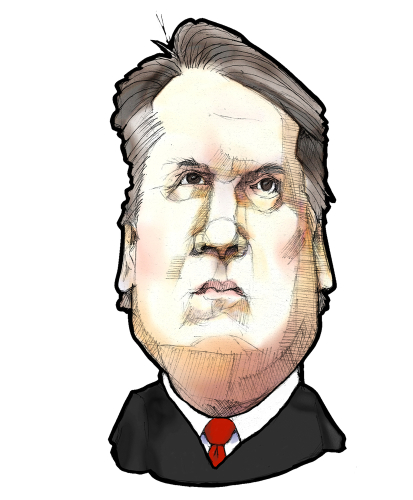
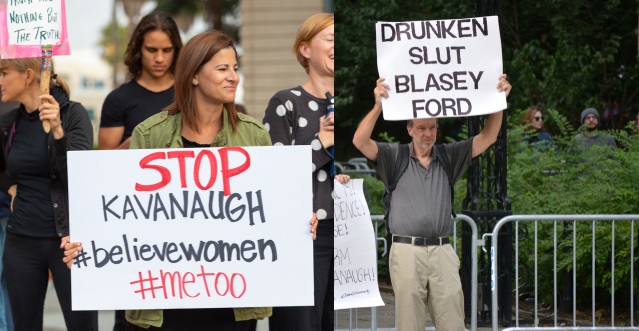


 Miguelifornia