WND Exclusive
Leo Hohmann is a news editor for WND. He has been a reporter and editor at several suburban newspapers in the Atlanta and Charlotte, North Carolina, areas and also served as managing editor of Triangle Business Journal in Raleigh, North Carolina.
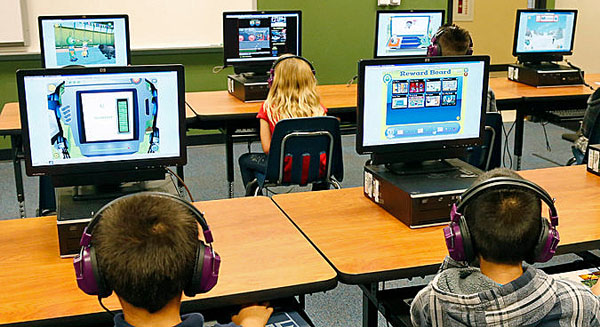
Technology is increasingly being used by schools to gather data on students, testing not just their knowledge of subjects like reading, math and science but subjective “social skills.”
Technology is increasingly being used by schools to gather data on students, testing not just their knowledge of subjects like reading, math and science but subjective “social skills.”
Parents and students have been “opting out” of high-stakes testing in record numbers over the past year, saying the standardized tests waste valuable instruction time, cause undue stress and often measure “skills” that have nothing to do with academic knowledge.
Rather than merely asking for a right or wrong answer to a math, history or science question, the new assessment industry is capable of boring into a child’s attitudes, values, opinions and beliefs, all of which parents and privacy advocates say is no business of the government’s.
The pushback has led some state education systems to recommend a reduction in the amount of high-stakes testing in public schools.
But, parents beware, the sudden realization that maybe too much testing is going on is not going to lead to less data being collected. Quite the opposite.
In fact, traditional testing may no longer be needed. Schools have found they have better, more efficient ways to collect even more data on your child, without resorting to paper and sharpened No. 2 pencils.
Oregon’s Gov. John Kitzhaber, for instance, assigned a task force to this problem recently and after a year of private meetings, the group is ready to unveil its recommendations which are expected to include replacing standardized tests with high-tech “observation” tools.
Fewer tests might sound like a relief to stressed-out students and wary parents.
But what if your child’s teacher could have access to a software application that allows her to collect data on your child in real time, without ever rolling out a test?
Enter the BOSS app. It is just one of countless new data-collection products available to school systems looking to collect data on the sneak.
BOSS stands for Behavioral Observation of Students in Schools. The app was designed to “enable psychologists to observe” patients but is now being marketed to schools interesting in tracking students’ behavioral patterns.
Created by the British-based textbook giant Pearson, the BOSS app can be loaded onto a smartphone and used to secretly monitor every move of targeted students in the classroom.
Does little Johnny fidget in his seat a bit too much? Does he socialize with the students around him in an appropriate manner? Does he tend to stare aimlessly out the window when he should be paying attention to the teacher?
All of this information can be pulled in and stored in an individual dossier for later analyzing and assigned an intervention and remediation that will deal with Johnny’s shortcomings, whether they be laziness, lack of assertiveness, over-aggressiveness or whatever psychological problem the app may discover.
BOSS app can be downloaded from iTunes for $29.99 and comes in age-appropriate versions from pre-K through 12th grade. The product description boasts that BOSS is able to “record students’ behaviors in real time. The BOSS software uses interactive buttons labeled to a particular behavior for the observer to press while observing a student during a given duration. The software keeps track of the amount of times a behavioral button is depressed during an observation.”
The app tracks “a student’s active or passive engagement in activities” and will collect data and email it to the teacher “for future use to help support a disability diagnosis,” the Pearson promotional material states.
The BOSS app is not the only new technology percolating in the education industry that has the ability to invisibly assess students in real time without their knowledge, or the knowledge of their parents.
Below is a small sampling of other apps being marketed to educators:
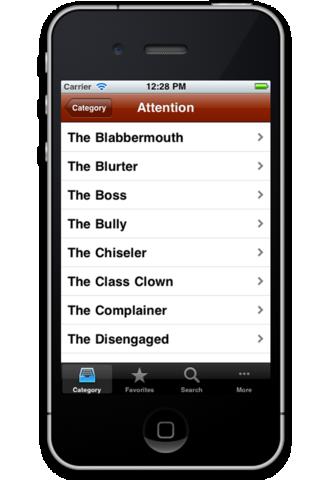
You Can Handle Them All app• “You Can Handle Them All”: This app, produced by Master Teacher, describes 124 behaviors that teachers may encounter in their students and identifies the primary cause of each. A teacher using this app places each student into a category, with options that include “The Blabbermouth,” “The Blurter,” “The Boss,” “The Bully,” “The Complainer,” “The Disengaged” and “The Class Clown.” It then prompts the teacher with suggestions on how to remedy each unwanted behavior.
• “Pearson Dash”: Another product by Pearson, Dash, according to the iTunes product description, enables teachers to “Organize and track your students” according to classroom seating charts, to “record, edit, and e-mail observational notes on your students,” to “View student performance and mastery of skills with SuccessTracker data.”
• “What Would You Do at School If”: This app focuses squarely on social skills. Put out by Super Duper Publications, it seeks to elicit answers to sensitive, revealing questions that help schools develop a psychological profile on each student. Instead of a test, this app is presented to a young child as a fun “game” while collecting data on the child’s parental upbringing and personality.
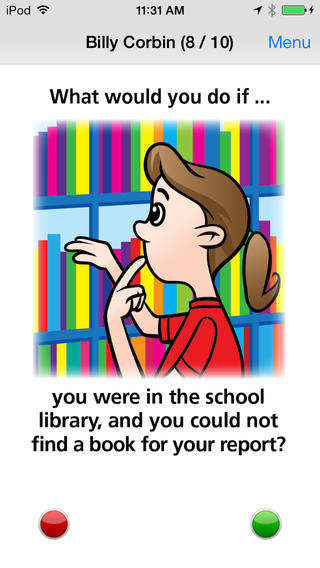
what would you do in school if“Select the cards you want students to see, and have them work on solving problems and practicing good social skills as they discuss situations in and around school,” the product description says. “The prompts include questions like, ‘What would you do if … you forgot your homework?’ and, ‘What would you do if … your classmate teased you about the new shirt you wore?’”
Students are then graded based on how many “right” answers they give in what is clearly a test of one’s attitudes, behaviors, values and beliefs. The problem with such questions, say privacy experts, is that the “right” answer is clearly subjective and has nothing to do with a student’s ability to acquire and retain objective academic knowledge.
For instance, a parent may teach a boy to defend a weaker boy or a girl who is getting beat up by a bully. But what if the “right” answer in the role playing game is to go and tell a teacher or principal? Will the child get marked down if he answers that he would intervene and physically stop the bully’s attack? What will the remediation for this “wrong” behavioral skill be?
According to promotional details on iTunes, the “What Would You Do at School If” app lets teachers:
• Track correct and incorrect responses for an unlimited number of players.
• Receive feedback for incorrect and/or correct responses
• View results in a graph and see which questions a player missed during a session.
• Print, E-mail and share your results.
The same vendor, Super Duper Publications, puts out a separate app called “Super Duper Data Tracker” that allows teachers to “increase the accuracy and efficiency of your data collection” on each individual student.
There are literally dozens of these apps out there being downloaded by teachers, often at the behest of administrators, and many of them come tailored to the Common Core national education standards.
One teacher who reviewed the Super Duper Data Tracker on iTunes said he liked it but wished the data came with increased portability and could be more easily integrated into other platforms.
“It would also be great if this was tied to a website where teachers had an account and could input large amounts of data on something other than the small screen or tempermental (sic) keyboard of an iPad/iPhone,” the teacher said. “Then everything would be backed up, we could share data with other team members (especially in situations where many people see one student!). It is a great app, I just think in the day of icloud and spreadsheets it is BEGGING for a big overhaul.”
Playing video ‘games’
Another hot trend is using role-playing computer games to assess students. The games would be programmed to scoop up data based on every reaction the child has to the challenges presented in the game. The questions could then be changed “on the fly” to probe areas of weakness and collect more data.
One of these games, called the MineCraft Behavioral Improvement Plan, can be programmed to pose a series of ethical dilemmas to which students are asked to respond. It has the ability to adjust the line of questioning depending on the student’s answer to the original set of questions.
“How is it legal or even remotely ethical for untrained teachers to be expected to use devices like these to assess the psychological status of your child?” asks Charlotte Iserbyt, a former aide to President Ronald Reagan’s Education Department and now a blogger on education issues at The ABCs of Dumb Down.
Iserbyt calls the replacement of high-stakes testing with high-tech data-collecting a “bait and switch” tactic that many parents won’t pick up on.
As one YouTube instructional video cited by Iserbyt explains about the personified video games, “We know whenever you click. We know how long you stood waiting to make a jump. We can take in vast amounts of data and if we want, dynamically alter the experience [of the student] based on that data.”
The New York Times recently reported that MineCraft is highly addictive and can quickly become an obsession for many students. Schools around the world are taking advantage. Schools in Stockholm, Sweden, for instance, made the game mandatory for 13-year-old students to learn about sustainable city planning and environmental issues.
While these games might have some value if programmed to build and evaluate students’ knowledge of math equations or science principles, they could be dangerously invasive when used to gauge students’ personalities, ethical responses, political views and emotional makeup.
All of the above apps and games are marketed for use on students in general-instruction classrooms, not just students in special-ed classes with known, serious behavioral problems.
Privacy advocates say technology meant to collect data on a student’s academic knowledge is one thing, but they question whether teachers should be acting like psychologists and collecting data on a student’s “social skills” and personality traits?
Some critics are sounding the alarm that schools will be building a psychological dossier on their students through the use of this technology, and they are starting to ask questions.
Who will have access to this data besides the teacher in the classroom who is collecting it? Where will the data ultimately be stored and for how long?
Who ultimately owns a child’s private data? The school, the school system, the state or the parents? And who has the right to view it?
Will this data be made available to any third-party contractors outside the school, the school district or the state? President Obama took executive action to weaken the FERPA (Family Education Rights and Protection Act) in 2011 giving third-party contractors access to some student data, lending more reason for concern among parents.
And what rules will be set to make sure these new tools are transparent for parents who actually want to know what their children are being taught or tested on?
Iserbyt poses a chilling question:
“If parents can’t even get a hard copy of the current high stakes assessments that their children are taking now, how are they EVER going to get evidence, much less be aware of, the assessments given to their children via computer games or teacher smart phone apps based on a child’s experiential or project-based work, or any of the other invisible assessment model coming down the pike?”
So far, at least, the jury is out on all these questions.
Read more at http://www.wnd.com/2015/03/orwellian-nightmare-unleashed-on-schoolkids/#LfuWMuRqkbqX3lhp.99





 Centinel2012