Tehran University Professor Foad Izadi: We Like What We Are Seeing on U.S. College Campuses; These Are Our People, They Will Support Iran in Case of Confrontation with the U.S.; Iran Can Repeat in America What It Did in Lebanon #Iran#campusProtests@IzadiFoadpic.twitter.com/5Xkm26C8ye
The Islamic Republic of Iran is amused by the US campus riots on behalf of Palestine, and they are interested in recruiting these impressionable youth. These [American students] are our people,” Tehran University Professor Foad Izadi proclaimed. Shiraz University is now offering US students wishing to join the jihadist movement free tuition to study abroad in Iran.
“Students and even professors who have been expelled or threatened with expulsion can continue their studies at Shiraz University and I think that other universities in Shiraz, as well as Fars Province, are also prepared,” Mohammad Moazzeni told Iranian state-owned Press TV, later adding, “If tensions between America and Iran rise tomorrow or the day after, these are the people who will have to take to the streets to support Iran.”
These students who desperately want to make a change should board the first plane to Iran to the reality of the Middle East. The die-hard feminists may not appreciate Iran’s “Youthful Population and Protection of the Family” law that seems large-scale abortion “corruption on earth” and could result in the death penalty. They will also enjoy the “Rejuvenation of the Population and Support of the Family” that limits access to contraception.
The Keffiyeh scarf has become fashionable on US college Campus as if some Coachella festival accessory will be insufficient coverage in Iran. Women must abide by the Quaran and cover three-fourths of their body, wear a full headscarf (hijab), along with loose clothing. Women may only shake hands with other women.
These effeminate men crying on campus while being handcuffed by police will need to get a grip. Men are actually expected to provide for and protect their families. You are expected to be a masculine man and the head of your household – you are financially responsible for supporting your family which was always the traditional role of men in every society until recent years.
Alcohol is also largely banned in the nation.
Gays may be for Palestine, but the Arab world does not condone homosexuality. Over 5,000 gay women and men have been executed since the 1979 Islamic Revolution. Same-sex marriages are prohibited, as is living with a same-sex spouse of simply identifying as gay. Absolutely no one cares about your pronouns. President Ebrahim Raisi called homosexuality a “very ugly and despicable practice” and said the West is trying to promote it to “end the generation of human beings.”
“We are watching the demonstrations and like what we see, but it should not end with this,” Izadi said. Izadi believes America’s youth could stop Washington from supporting the Zionist regime. Now universities are also pushing this agenda to radicalize teens and young adults. We are standing idle as foreign nations corrupt the youth, the same generation that America is relying on to fight in our wars.
Posted originally on May 6, 2024 By Martin Armstrong
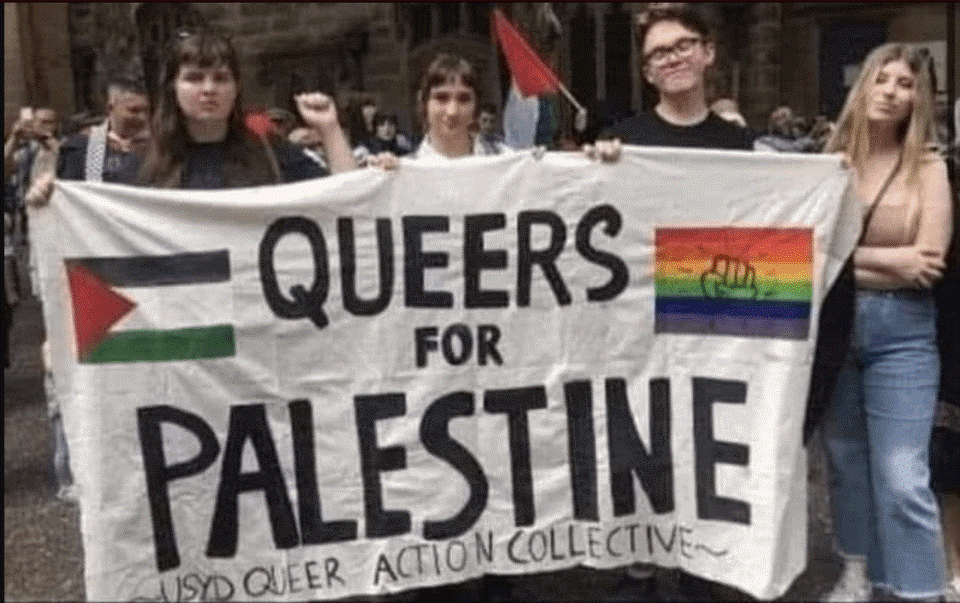
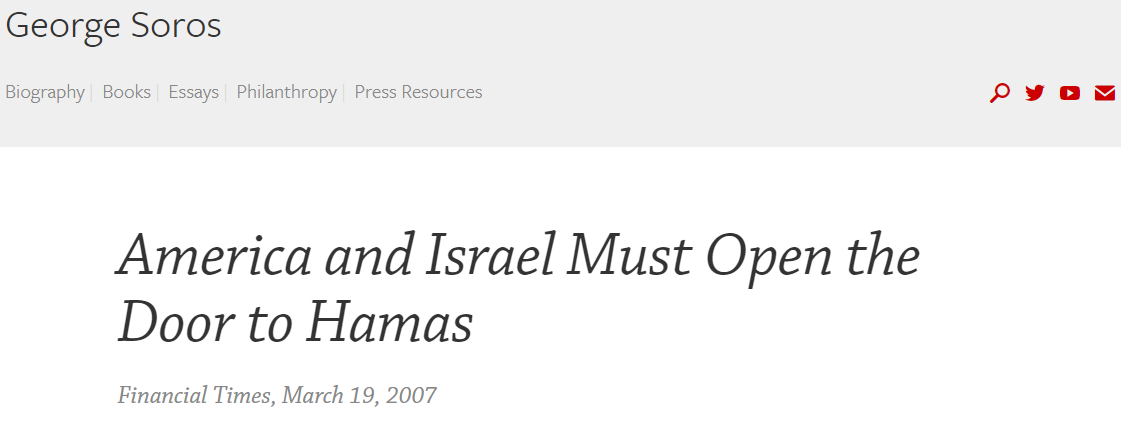
Staged actors have been embedded in US universities to promote the pro-Palestinian, anti-US sentiments. Professional agitators have been utilized countless times throughout periods of civil unrest, and while the media has repeatedly denied that Soros and other far-left funders are backing these protests, the evidence is in plain sight.
CNN reported that many of the “students”arrested at Columbia and City College of New York had no affiliation with either school. The New York Police Department arrested 282 people, and only 148 (a bit over half) were actually students.
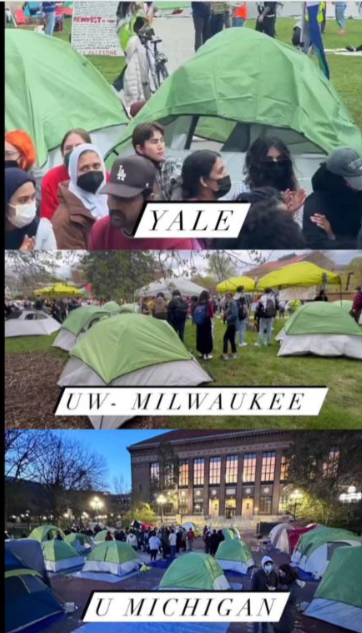
Take a look at the tents popping up across all major universities – they are identical. The media claims that students are simply searching for the cheapest tent, which appears to be the two-person Ozark Trail option at Walmart, which retails for around $30. However, it seems suspicious that hundreds of students purchase the same tent coincidentally. A lot of these privileged college kids in Ivy League schools are not known for sorting by price. It is more probable that an organization purchased these tents in bulk and distributed them on college campuses.
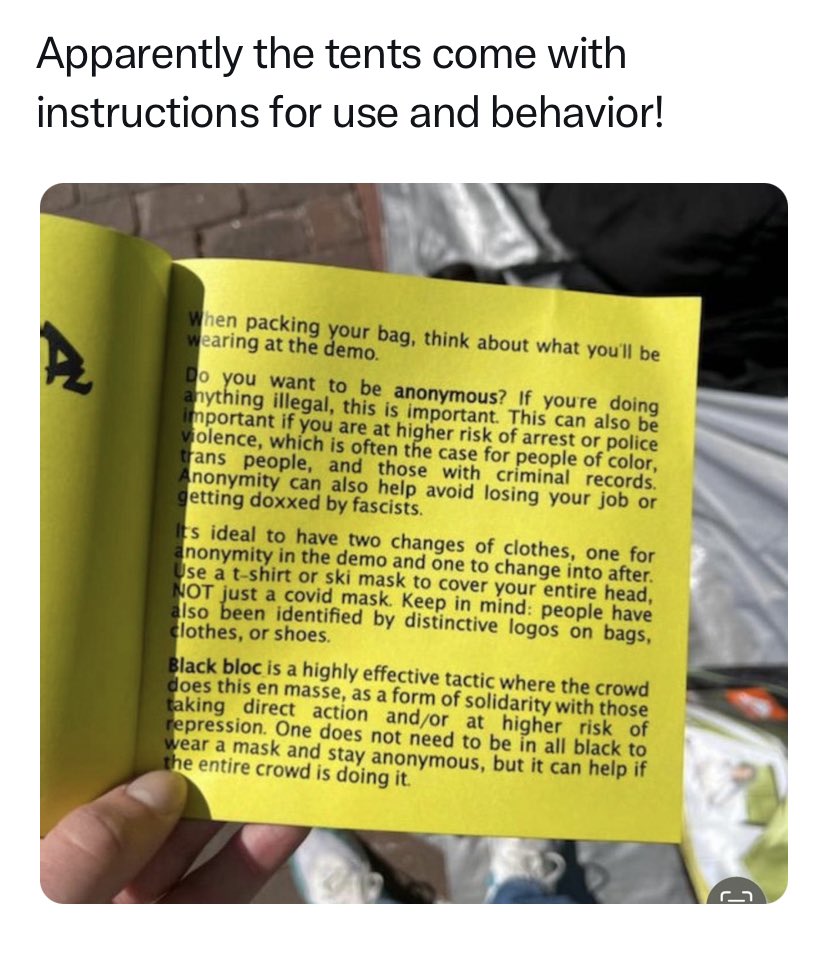
Students are also receiving instructional booklets on how to protest. Why is everyone wearing COVID-era masks? They have been directed to conceal their identities to stay anonymous, as “it can help if the entire crowd is doing it.” They are told to bring two sets of clothes and conceal any logos or identifiable items.
Deputy Commissioner Tarik Sheppard shows the chains used to secure Hamilton Hall at Columbia University.
"This is not what students bring to school. This is what professionals bring to campuses and universities." pic.twitter.com/fwFUPZlIj7
Officers are reporting uniformed supplies, and stating that they believe what is happening is not the result of mere student organizations. Again, everyone calls them conspiracy theorists and dismisses any claim that these events have been manufactured to create civil unrest and divide America. So we saw outside agitators used numerous times in recent years during Black Lives Matter riots and even on January 6. Organizations such as the Open Society Foundations openly donate to “grassroots” causes and specifically target the youth to carry out their messaging.
My wife Nahla in solidarity with the brave and very determined Columbia University students. pic.twitter.com/ximkHFbZeo
As reported by Fox, Sami Al-Arian, a known terrorist who was once deported, advised associates and his wife to camp out along with the college students. This man is admittedly associated with the Palestinian Islamic Jihad group. He has taken to social media to promote the civil unrest across American universities. This is a clear and REAL threat to national security. Again, these students are too naive to understand the root cause of these issues or the truly dangerous actors fueling the flames.
I cried today… What's happening across US university campuses is unprecedented. I lived four decades in the US, 28 years of which were in academic settings. During my time, it was a very challenging struggle to present an anti-Zionist narrative. But the passion, courage,…
The Dawn of a Global Students Movement to challenge the Zionist movement and Israeli occupation. Look at this impressive list of colleges and universities. pic.twitter.com/p0uYUtFJvc
Even Democratic New York City Mayor Eric Adams believes that these events are staged. “I know that there are those who are attempting to say, ‘Well, the majority of the people have been students.’ You don’t have to be the majority to influence and co-opt an operation. That’s what this is about,” said New York City Mayor Eric Adams. “We’re going to protect our city from those who are attempting to do what is happening globally. There is a movement to radicalize young people and I’m not going to wait until it’s done and all of a sudden acknowledge the existence of it.”
Adams went on to say that the goal of these protests is to create “discord and divisiveness,” and for once, I actually agree with the guy.
Where is the president amid this ongoing crisis? He mumbled a few words from a teleprompter but he should be meeting with university presidents and law enforcement agencies. These professional agitators are manipulating the vulnerable youth into making decisions that will prevent them from seeking employment and stain their records.
The Black Lives Matter riots heated up in May 2020 ahead of the election, and now we are seeing that same issue play out once again where the left is permitted to wreak havoc on the public in the name of social justice.
Biden said he would be willing to accept Palestinian refugees into the US, a move that no country in the Arab world has agreed to do. The worldwide media is covering these events, but the POTUS has failed to condemn the ongoing violence, and then you have his former handler, Obama, publicly sending letters urging Biden to agree to a ceasefire. The “students” are now requesting “humanitarian aid,” showing how utterly clueless and lost they have become. Tensions are rising, protests have turned into riots, and violence will escalate if something is not done to promote law and order.
Posted originally on the CTH on February 2, 2024 | Sundance
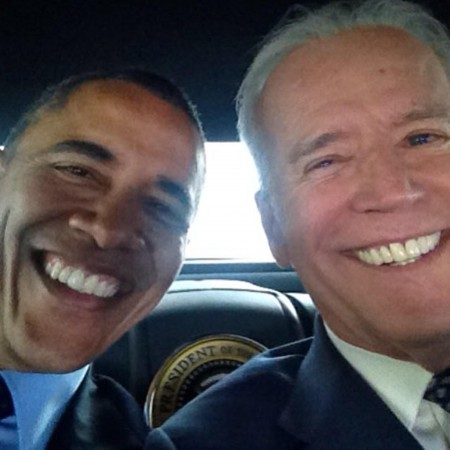
Obama and Biden like Iran. Obama and Biden are facilitating a pro-Iran policy. Obama and Biden don’t want to do anything against the interests of their pro-Iran position. That’s the simple baseline.
As a direct consequence, the same U.S. intelligence community that proclaimed the Hunter Biden laptop was disinformation, now modify their prior intelligence to proclaim that Iran likely doesn’t have any control over the various terrorist networks they support. As a result, Biden cannot conduct a retaliatory strike against Iran because Biden cannot prove a direct link to Iran.
Our intel agencies are essentially falling on the sword of ‘some people did something, but we can’t be sure.’ See how this works?
WASHINGTON – Intelligence officials have calculated that Tehran does not have full control over its proxy groups in the Middle East, including those responsible for attacking and killing U.S. troops in recent weeks, according to two U.S. officials familiar with the matter.
The Quds Force — an elite branch of Iran’s Revolutionary Guard Corps — is responsible for sending weapons and military advisers as well as intelligence to support militias in Iraq and Syria as well as the Houthis in Yemen. The groups have varying ambitions and agendas, which sometimes overlap, but Tehran does not appear to have complete authority over their operational decision-making, the officials said.
While the disclosure means it may be particularly hard to predict what actions these groups will take, it also could lower the chance of the U.S. getting pulled into a direct confrontation with Iran. Any indication that Tehran was directly involved in ordering or overseeing the attacks would make U.S. retaliation against Iran more likely. (read more)
Posted originally on Jan 4, 2024 By Martin Armstrong
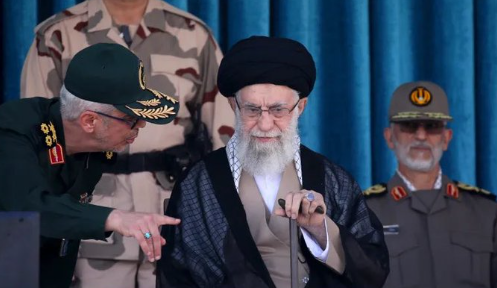
The Supreme Leader of Iran, Ali Khamenei, clearly understands the game at foot. He is aware that the Neocons want to engage Iran, for that would force Russia to defend them as well and turn the heat up in the Middle East. Ali Khamenei has reportedly ordered IRGC Military Commanders to LIMIT their ongoing Attacks on U.S. and Coalition Forces within Syria and Iraq. Khamenei Has made it clear that Iran must Avoid any Direct Military Confrontation with the United States at all Costs. The comment I am getting from the Middle East is the perception that Israel is trying to compel the US into war with Iran. In truth, it is the American Neocons pushing Israel.
Posted originally on the CTH on January 4, 2024 | Sundance
White House National Security Council Coordinator for Strategic Communications, John Kirby, previously pledged that Iran would be limited on how they could use the $6 billion in funds we gave them through the Qatari bank.
Iran has made withdrawals of the funds, and today John Kirby was asked about what Iran is doing with that money. Here is his response: WATCH:
.
Check out the video in the Tweet Below to see just how opposite the story is from THEN to NOW.
Kirby on the $6 billion that Biden gave to Iran.
If it were a sitcom, it would be funny. Unfortunately these people are running our country, so it's tragic. pic.twitter.com/6TZPZ379fz
Posted originally on Nov 29, 2023 By Martin Armstrong
An Iranian hacker group, Cyber AV3ngers, had the ability to break into a water municipality station in Pennsylvania. The system operated on Unitronics, owned by Israeli entities. The alarms immediately sounded, but the authorities are claiming the water is still safe to drink. Iran and the US have secretly been at war since this Israel-Palestine situation began, and now, Iran is targeting US infrastructure.
“I am closely monitoring this cyberattack on the Municipal Water Authority of Aliquippa. My office is in touch with leadership, which reports that there has been no loss of water service for folks. Federal officials are assisting the investigation, and I remain ready to help with federal agencies,” Congressman Chris Deluzio announced in a statement. This is expanding far beyond Pennsylvania as numerous municipalities along the East Coast of America also use Unitronics. “Every equipment made in Israel is Cyb3rAvengers legal target!” the group posted on X, where it has a social media profile. “The CyberAv3ngers will continue their activities, andthe worst is coming.”
“Attacks on our critical infrastructure like water are unacceptable,” said Deluzio. “I intend to push for a full investigation here and accountability for the attackers, and I will continue the important bipartisan work on the House Armed Services Cyber, Information Technologies, and Innovation Subcommittee to shore up America’s defenses,” Deluzio declared.
It is laughable to think that 0% of the migrants released into the country have ties to terrorism. New wars need not be fought with bombs and bullets. The war has arrived at our doorstep, and the enemy can attack us without stepping foot on our soil.
Posted originally on the CTH on November 5, 2023 | Sundance
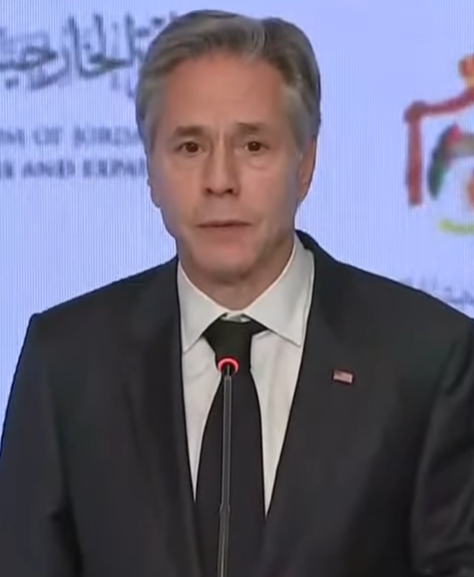
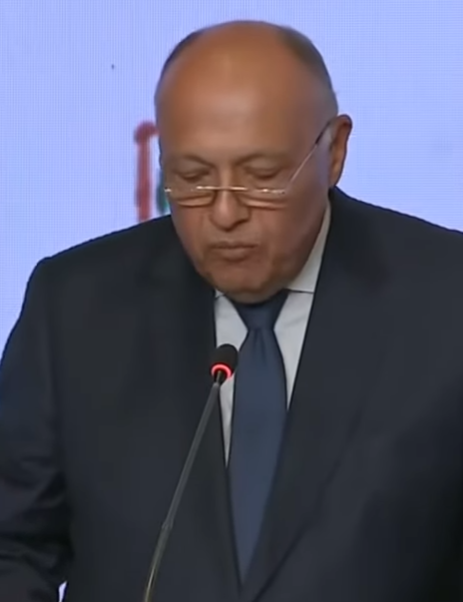
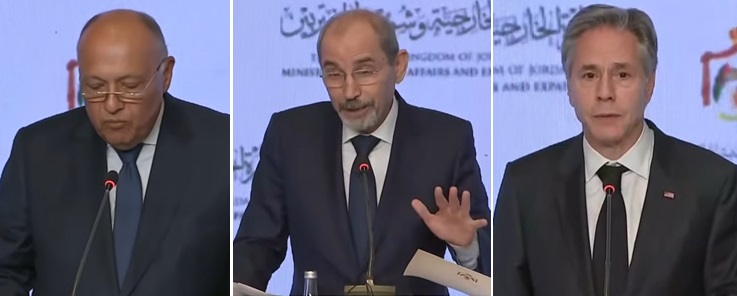
U.S. Secretary of State Antony Blinken, Egyptian Foreign Minister Sameh Shoukry, and Jordanian Deputy Prime Minister/Foreign Minister Ayman Safadi hold a joint press conference at the conclusion of their discussions. The video and transcript are below.
Overall, the Egyptians and Jordanians want a cessation of hostilities, an end to the bombing and Israeli war response against Hamas. In part they appear motivated by concerns of regional instability; in part they seem driven toward resolution because they do not want life-long radical Palestinian jihadists crossing into Egypt and Jordan; and in part it’s because their country was not attacked.
I find it interesting that none of the remarks in the group mention the influence of Iran at all. The U.S. and Israel talk about the influence of Iran when speaking individually and together; but add an Arab country into the discussion and Iran is never brought up.
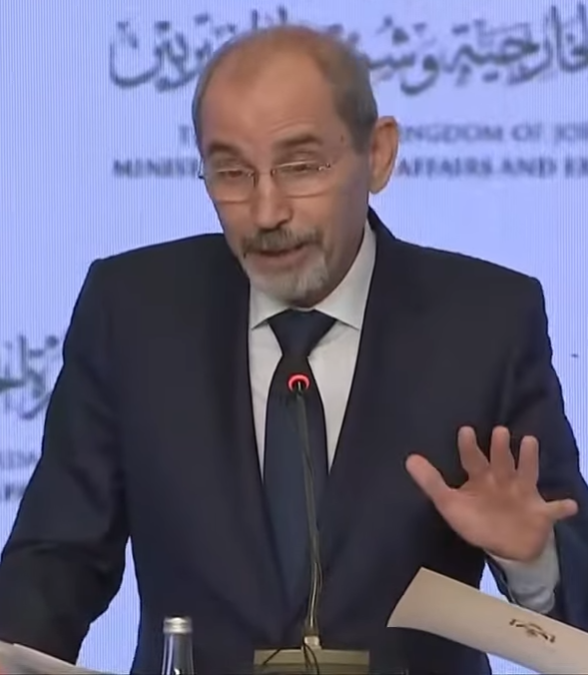
JORDAN – DEPUTY PRIME MINISTER SAFADI: Good evening to you all. I’ll start in Arabic and then I’ll switch to English if you don’t mind. So —
(Via interpreter) In the name of Allah, Most Merciful, Most Gracious, I welcome Their Excellencies Sameh, Tony and the other colleagues, the foreign ministers of United Arab Emirates and Qatar and Saudi Arabia, and the secretary general of the Palestinian Liberation Organization, at this hardship – at this extremely difficult time, a time that reflects that – reflect our interest to protect our peoples from the destruction of war and to work together continuously to stop this disaster that erupted on the 7th of October and actually evolved into the war that Israel is waging against Gaza.
And our speech today was honest, was direct, was comprehensive and in-depth, and with all transparency. It has reflected the Arab and the U.S. stances in what is – should be done immediately to end this catastrophe. But it ascertained also the mutual keenness to our involvement actually to stop what we can describe as a catastrophe that will haunt the region for generations. And we all want just and comprehensive peace on the basis of the two-state solution as a path for ensuring the security of the region, of the Palestinians, of the Israelis, and the peoples of the region.
And also, there were points of meeting and these points of agreement between the U.S. and the stances that the Arab foreign ministers have actually expressed, and these points included the necessity to – the importance of delivering humanitarian assistance, enough humanitarian assistance, to Gaza, and protecting civilians; the importance of abidance to the – our international humanitarian law and the international law, and the rejection of the displacement of Palestinians, of their land.
And as we said before at the Arab League – and we in Jordan and all the Arab countries – we consider that this is a war crime that we will stop with all our strengths. The Arab countries, the Arab world demand an immediate ceasefire that will end this war and end the killing of the innocent and the destruction it is causing. And we don’t accept that it is a self-defense; it is a ranging war that is killing civilians, destroying their homes, their hospitals, their schools, their mosques, and their churches. It cannot be justified under any pretext, and it will not bring Israel security; it will not bring the region peace.
The killing must stop, and also Israel immune from committing war crimes must stop. And please allow me now to switch to English and speak.
(In English) We cannot allow this war to undermine all that has been done to bring about just peace to the region. With every missile unleashed on Gaza, with every killing of a Palestinian child – and Israel has killed in this war more children than all global conflicts did since 2019 – the whole region is sinking in a sea of hatred that will define generations to come. That is already starting to manifest itself in expressions and acts of hatred in the region and, to be honest, in the deplorable acts and expressions of Islamophobia and Anti-Semitism. And that’s something that we all stand against unequivocally on principle and in accordance with our human values.
This is not a religious war. It’s not a war between Muslims and Jews. This is defined in its context and all our values – Muslim, Christian, Jewish, all other human values dictate that we work for peace and we stop this madness and we do not allow for the very dangerous dehumanization that we see.
Rage cannot and should not be allowed to destroy the lives of millions of people. We understand that there is pain. Nobody in their right mind will belittle the pain that was felt by Israelis on October 7th and that’s being felt by Palestinians – all of us – it doesn’t matter who we are – Arab, Muslims, Christian, Jews, human beings – and that pain cannot be belittled. But again, we cannot allow rage to determine where we go forward. We condemn the killing of all civilians. We condemn the killing of Palestinian civilians, we condemn the killing of Israeli civilians – on October 7th and before and after regardless of nationality, as I said.
We are extremely worried on this – our situation in – on the West Bank – again, killing and violation of international law cannot continue there. Settlers should not be allowed to rampage Palestinian communities and kill innocents in the West Bank. Israeli soldiers who brought despicable humiliation to Palestinians after illegally detaining them should be held accountable.
Palestinians and Israelis deserve to live in peace with dignity, with security and freedom from occupation and freedom from fear. Only a just and lasting peace that fulfills the right of the Palestinian people to freedom, their sovereign state with East Jerusalem as their capital and (inaudible) 1967 lines, living side by side. A secure Israel will bring security to all.
The priority now is to ending this war, to saving innocent lives, to preventing further destruction, restoring hope, and to stopping the very dangerous dehumanization. All lives matter to all of us.
And Mr. Secretary, dear Tony, the U.S. has a leading role to play in these efforts. And on it and on all of us fall the very heavy responsibility of ending this catastrophe, achieving the just peace that is the right of every Palestinian, every Israeli – mother, child, father – and that will ensure that none of them or any other in the region will ever have to live the horrors that this vicious cycle of violence and war is bringing.
We will continue to work with you and with all of our partners to fulfill this responsibility to make sure that our common human values prevail, international law prevails, and peace for all prevails. Thank you so much. If I now may give to floor to you, Tony?
USA – SECRETARY BLINKEN: Thank you. Good afternoon, everyone, and let me first say that I’m grateful to His Majesty King Abdullah, to Foreign Minister Safadi, Ayman, and his entire team for their hospitality, and for the opportunity to be with Foreign Minister Shoukry and also with Foreign Minister Faisal bin Farhan, Prime Minister Al Thani, Foreign Minister Abdullah bin Zayed, and Secretary General Hussein Al-Sheikh.
We appreciate the engagement of every country, and we’re particularly grateful to Jordan and to Egypt, two partners who have long worked to advance a two-state solution, for their dedication to a more stable and to a more peaceful Middle East.
We’ve come together here today sharing the same fundamental interest and objective: to end this conflict in a way that ensures lasting peace and security in the region. We may have different views and positions on certain necessary steps to achieve that objective, but today we reaffirmed our individual commitments to continuing to work toward that end, an end that we share.
Throughout this conflict, countries across the Middle East – and beyond – have played an essential role in preventing its spread. Today, we all agreed on the importance of using our respective influence and capabilities to deter any state or non-state actor from opening another front in this conflict or taking other destabilizing actions. All of us have a direct interest in this.
Our joint efforts have also been critical in increasing the flow of humanitarian assistance to Gaza. I am particularly grateful to Egypt for its significant efforts to facilitate a mechanism with Israel and with the United Nations to do just that. Each day, more than a hundred trucks are moving to Rafah, up from zero just a little over a week ago. But that is not nearly enough.
Today, we spoke about ways to accelerate and expand the sustained delivery of aid. This morning, I had an opportunity to meet with Commissioner General Lazzarini of UNRWA and I spoke with UNRWA staff that is located in Gaza. I heard firsthand about the extraordinary lifesaving work that they are doing in Gaza in the face of extremely difficult conditions, and how we can expedite efforts to get assistance to them so that they can get it to the Palestinian people.
We’re also working to continue the progress we’ve made in getting our citizens, other foreign nationals, critically wounded people out of Gaza. But even as we welcome their safe exit, we remain resolutely committed and focused on securing the release of hostages held by Hamas. I had the opportunity to discuss this, the status of our ongoing efforts, with Prime Minister Al Thani this morning.
We all spoke today about the clear need to protect Palestinian civilians. The United States supports Israel’s right to defense against Hamas, a terrorist organization that attacked it brutally and that cares not a whit about the Palestinian people or their futures. This is the same right that each of our countries has. But as Israel conducts its campaign, how it does it matters.
Israel must take every possible measure to prevent civilian casualties. In my meetings with Israeli officials yesterday, I conveyed additional steps that they can and should take to do just that. Protecting civilians will help prevent Hamas from further exploiting the situation. But most important, it’s simply the right and moral thing to do. When I see a Palestinian boy or girl pulled from the wreckage of a building, it hits me in the gut just as it hits everyone’s gut, and I see my own children in their faces. And as human beings, how can any of us not feel the same way?
This morning, I heard from the UNRWA staff in Gaza, many of whom are displaced themselves, about the immense human toll this conflict has taken – for UNRWA itself, they’ve lost 77 of their colleagues who were there simply trying to provide people with their basic needs – the trauma of being under constant bombardment and in constant danger, the inability to assure their own children that nothing will happen to them.
What we have to do more than anything else – all of us, everyone concerned – is to prevent the dehumanization of each other. If we don’t do that, then we do exactly Hamas’s work for it. So we have to look out for each other. We have to look out for every innocent life.
Now, the United States believes that all of these efforts would be facilitated by humanitarian pauses. We believe pauses can be a critical mechanism for protecting civilians, for getting aid in, for getting foreign nationals out, while still enabling Israel to achieve its objective: defeat Hamas. Yesterday, I spoke in depth with Israeli leaders about how, when, and where such arrangements could be implemented, and what needs to be done to make them possible. Today, regional partners discussed many of these same questions.
We’re all deeply concerned about escalating extremist violence against Palestinian civilians in the West Bank. This has been a serious problem that’s only worsened since the conflict. I updated ministers today on my discussions with- throughout the Israeli Government yesterday, where I underscored that incitement and extremist violence must be stopped – and perpetrators must be held accountable.
As we work together to address each of these immediate challenges, we also have to concurrently work to build a secure and lasting peace. And for that to happen, we have to create the conditions to ensure that we do not find ourselves in the same place just weeks or months from now.
We had substantial discussions today about our shared interest in creating the foundation for durable security and for enduring peace. The United States continues to believe that the sole viable path is a two-state solution, with Israelis and Palestinians each exercising their legitimate right to live in a state of their own, with equal measures of security, freedom, of opportunity and dignity. And we discussed some of the meaningful and practical steps we might take to help advance that proposition to get us there.
The United States and our partners will have different views on how best to advance or achieve these steps, but we all recognize that we cannot go back to the status quo. And we all understand that we not only have an interest, but a responsibility, to do everything we can to chart a better path forward together.
Now, none of us are under the illusion that this will be easy, particularly our partners from Egypt and Jordan, who have for decades worked to facilitate a real peace. But it’s precisely now – when the stakes are highest, and even when the outlook seems darkest – that we have to intensify our work to meet this moment.
EGYPT – FOREIGN MINISTER SHOUKRY: Thank you so much. (Inaudible)
(Via interpreter) My brother Ayman, my friend Tony, ladies and gentlemen, I would like to thank His Excellency Mr. Ayman Safadi, the Minister of Foreign Affairs and Expatriate Affairs.
Ladies and gentlemen, our meeting you is to discuss the developments of the crisis in Gaza and give room for the Arab countries involved to express their positions toward this crisis. I was keen through this meeting to explain the vision or the position of Egypt that is consistent with our Arab brothers, and I stressed that we need to take time into consideration and look at the development.
The unfortunate killing events in Gaza cannot be justified. We would not accept to go into an argument or accept the justification of these practices as considered against the – our right to self-defense. The collective punishment – Israel targeting innocent civilians and facilities, medical facilities, paramedics, in addition to trying to force migration for Palestinians to leave their lands – this cannot be a legitimate self-defense at all.
Egypt is exerting it all efforts to guarantee that delivering aid to the Gaza Strip and help treating the civilians wounded, and we will continue our efforts in spite of all the obstacles we are facing.
In this regard, I would like to ask for an immediate and intensive ceasefire in Gaza without any condition, and that Israel would stop what its – its violations of the international law and the laws of war. And we need to double our work to deliver humanitarian aid as soon as possible with quantities that would meet the needs of the Palestinians, and with open space to talk later on how to come out of this crisis before it gets broader and the conflict would inflict all the peoples of the region and go through a dark tunnel.
I also reiterated that we should not deal with this crisis of international peace and security in a double standard where, while some are condemning targeting civilians and describing this as a gross violations of humanitarian law and to adhere to the demands of a ceasefire, while we find that they are opposed the same principles for the same people when things are related to the Palestinian cause, as if the Arab blood is lesser than the bloods of other people, although that the numbers of people who were killed from civilians in Gaza over the last few weeks, including working in relief and journalists, cannot be justified any way.
And in this regard we are still asking for an immediate ceasefire and that Israel would stop hindering the delivery of humanitarian aid. And we also all demand an international investigation for these violations of the international law in this war.
And finally, what we are witnessing of an escalation and the human tragedy and suffering of civilians as a result of not addressing the deep root of the problem and to address the rights, of the Palestinian rights. I reject any attempts to (inaudible) the Palestinian cause, and I ask that we need to work as soon as possible to revive the peace process based on the two-state solution and end the Israeli occupation and establish a Palestinian state based on the lines of the fall of July 19 – and its capital East Jerusalem.
JORDAN – DEPUTY PRIME MINISTER SAFADI: Thank you, Tony. Thank you, Sameh. I’m sure the three of us would love to stay and answer all your questions, but we really have a very, very tight schedule still ahead of us, so we’ll take just a very, very limited number of questions, and I’d appreciate it if all our colleagues could just limit their intervention to one question and one question only.
(Inaudible), can you please —
MODERATOR: “Shukran”, (inaudible). (Inaudible) Khaled Issawi of AlSharq AlAwsat.
QUESTION: (Via interpreter) My question to Mr. Sameh Shoukry: Perhaps today’s meeting was at a very important time and attended by the ministries of foreign affairs of important countries that are very influencing the Palestinian cause. Do you feel that American – the American administration is able to stop the aggressions against civilians in the Gaza Strip, or did the American side during this meeting has offered any roadmap or any map to resume the peace process or to – or end the current crisis? Thank you.
EGYPT – FOREIGN MINISTER SHOUKRY: (Via interpreter) Thank you very much. I think it’s inappropriate for me to talk about the U.S. position in the presence of the U.S. Secretary of State. I believe we had a very comprehensive and transparent conversation and with countries that share the desire to work effectively to contain this crisis and to put down the foundations and solutions that would spare the region from these conflicts that allows us also to talk about and deal with all issues using the same measures, and to protect civilians and to ensure the flow of humanitarian assistance, and also to deal with the root causes of the crisis, which is the failure to implement decades later the agreement to establish a two-state solution given that this would put an end to the conflict and end the enmity between the two parties and would mitigate all the threats related to that.
We always look forward to work closely with the U.S. We have a strategic relationship with the U.S. and we appreciate the capabilities available to the U.S. There was interest and very clear interest that we reached, and we will work in the future to translate these ideas and visions into a reality on the ground to contain this severe crisis and humanitarian crisis. All efforts should be – should come together and to work positively and end this conflict, not just even end this crisis but also the root causes of the conflict.
MODERATOR: (Inaudible.) Simon Lewis of Reuters.
QUESTION: Hi, thank you. One question, but I’d appreciate an answer from all of you, if possible.
To the Egyptian and Jordanian ministers specifically: Are you engaging in talks about the future of Gaza, a future of Gaza without Hamas, and what role you can play in that future?
And to Secretary Blinken: How do you respond to the calls from your allies here for a ceasefire, and are you hearing – are you finding receptive ears for your calls to talk about Gaza after Hamas?
USA – SECRETARY BLINKEN: Simon, thanks very much for the question. It’s our view that a ceasefire now would simply leave Hamas in place, able to regroup and repeat what it did on October 7th. And you don’t have to take my word for it – just a few days ago, a senior Hamas official said that it was their intent to do October 7th again and again and again. No nation – none of us – can accept that. No one would find that palatable.
And so it is important to reaffirm Israel’s right to defend itself, indeed its obligation to do so, and to take necessary steps so that October 7th can never happen again. But it’s also very important the way Israel does that – and that’s what we’ve talked to the Israeli Government about – with taking every possible measure to protect human life, to prevent civilian casualty, as well as to ensure that those who are in need have the assistance that they need.
To that end, I think we all share deep concern about the plight of civilians in Gaza – men, women, and children who need the most essential things to get by. We’ve worked very hard to make sure that that assistance can flow to them. But it’s also one of the reasons why a humanitarian pause would be so important to make sure that we can maximize the assistance getting to the Palestinians, that we can make sure that people can move about safely, that they can get to places where they’re safe, and that, again, we can make sure that not only is aid flowing in but those who are responsible for distributing it get in, the right structures can be built to make sure that people can benefit from it.
So we’re focused on this and we’ll continue the work that we’re doing together with our partners to make sure that that assistance can get there.
JORDAN – DEPUTY PRIME MINISTER SAFADI: Thank you, Tony. Sameh?
EGYPT – FOREIGN MINISTER SHOUKRY: As related to the issue of a ceasefire, it is our position that the ceasefire is imperative to deal with the consequences, the humanitarian consequences of this conflict. And we believe that dealing with the various components of this crisis should be dealt with as well in an appropriate manner.
It is the international community’s responsibility always to seek the cessation of hostilities, not to promote the continuance of violence, military activity that has a very dire impact on the well-being of the civilian population in a very restricted area and which has specific and special characteristics like Gaza.
As for the issue of the future of Gaza, we believe this is premature at this time. We have to concentrate on the subject at hand, whether it be the cessation of hostilities, addressing the humanitarian needs of the people of Gaza, addressing the issues of displacement and the provision of safety for the civilians, and addressing the overall context of the conflict. We believe that at this stage, those are the issues that we need to concentrate on. Thank you.
JORDAN – DEPUTY PRIME MINISTER SAFADI: Thank you, sir. We are focused right now on stopping this war, stopping the destruction it’s causing, stopping the killing that it’s caused.
What happens next? How can we even entertain what will happen in Gaza when we do not know what kind of Gaza will be left after this war is done? Are we going to be talking about a wasteland? Are we going to be talking about a whole population reduced to refugees? Simply we do not know – we do not have all the variables to even start thinking about that.
I think we need to focus now on stopping this war so at least we have a – we start even to begin to imagine the kind of miserable reality that will exist there. And after that, let me just be very, very clear: Gaza alone would just not cut it. We’ve been through security treatment of the conflict before. Where did it lead us? The only way going forward to achieve what we all want, which is a just and lasting peace that protect the rights of all, is to look at the comprehensive conflict, look about bringing the two-state solution back and realize it as soon as possible, convincing the Palestinians that they have a future, and – and again, creating conditions different from the miserable conditions of despair and anger and hatred and occupation in which the – this just – a cycle of violence erupted.
So I think we need to get our priorities straight. Right now we have to make sure the war stops. Right now, we have to make sure that we bring in sufficient – enough food and water and medicine and fuel to Gazans, because with every minute of delay, a child or a woman or (inaudible) is dying because they don’t have access to these basic services. So after that, again, we have to look at the comprehensive picture. We have to make sure that we do not contribute to creating the same conditions that – in which this violence erupted, and I think we are all committed to working together on that. As we always say, the United States has a leading role. We need that role. The rest of us will have to do our part as well. Everybody will have to do their part, again, to make sure that we bring security and peace to the Palestinians and to the Israelis.
(Inaudible.)
MODERATOR: “Shukran. “Iyad AlFodouli, Al Mamlaka.
QUESTION: (Via interpreter) Your Excellency, Mr. Blinken, why don’t – doesn’t Washington exert pressure on Tel Aviv to cease the war and stop it and allow for – and allow for delivery of humanitarian aid after all what happened?
USA – SECRETARY BLINKEN: Thank you. We are intensely focused on the delivery of humanitarian assistance. On my last trip to the region, I spent considerable time with the Israeli Government and then in consultation with the Egyptian Government, the United Nations on establishing a channel to make sure that we could get assistance into people who needed it in Gaza. And as I mentioned a short while ago, whereas just a little over a week ago nothing was getting in, we had zero trucks moving in, today I think we had 105 trucks move into Gaza with essential needs for people.
But as I also say, and as we all agree, that is not nearly enough. So what we’re working on now is expanding that access, making sure that more is getting to people who need it, and that we have the structure in place to be able to absorb it, to use it, to distribute it effectively. This is exactly what we’re doing. When I was in Israel yesterday, this was a big focus of my conversations with the Israeli Government. And it’s also, as I mentioned, one of the reasons why we think it would be important to have humanitarian pauses. That would further facilitate the ability to deliver aid, and not only to deliver aid – again, to expand the aid that we’re delivering.
So we’re looking to that. We agreed with the Government of Israel yesterday to look at how that might happen. There are a lot of questions that have to be answered about how to make that work, so we’re focused on doing that. But again, we have been intensely focused on getting humanitarian assistance to people who need it in Gaza.
JORDAN – DEPUTY PRIME MINISTER SAFADI: Last question.
MODERATOR: (Via interpreter) Tamer Smadi from Al Jazeera channel.
[NOTE: Al Jazeera = Muslim Brotherhood]
QUESTION: (Via interpreter) Tamer Smadi, Al Jazeera. My question to Mr. Blinken: After around one month of the Israeli war on Gaza, what are the results that Israel has achieved except killing around 10,000 civilians, most of them children and women? What are the results that Israel has achieved, and what is the number of victims exactly, of civilians, that would make the United State to stop and think and look at this most open massacre and to ask Israel decisively to stop this bloodshed in the Gaza Strip?
USA – SECRETARY BLINKEN: What took place on October 7th defies almost the human ability to digest or describe. And I think for many that day has receded in their minds and in their consciousness, but I can say this and I’ll say it again: Not a single one of the countries represented here or that met together today, or for that matter pretty much any country in the world, would simply accept the slaughter of its citizens and do nothing about it.
So we maintain again that Israel has a right and indeed an obligation to defend itself and to try to take the steps necessary to ensure that what happened on October 7th never happens again. But equally, it is very important how Israel does it, and in particular it’s important to take every possible measure to protect civilians and prevent harm to them, as well as to ensure that those who need assistance get it. And in our conversations with the Israeli Government, including just yesterday, we have pointed to steps that they could and should take to minimize harm to civilians, to prevent civilian casualties.
Now, this is also an extraordinary challenge. Hamas cynically, monstrously embeds itself in the midst of civilians; puts its fighters, its commanders, its weapons, its ammunition, command and control in residential buildings, under schools and in schools, under hospitals and in hospitals, under mosques and in mosques – monstrous.
But nonetheless, Israel has an obligation to abide by the laws of war, humanitarian law, and to do everything possible to prevent civilian casualties. And this is very much part of what we’re saying to the Israeli Government and what I said again yesterday.
At the same time, providing humanitarian assistance to those in need, making sure that men, women, and children in Gaza are cared for – this is also an intense focus of our actions, including with the Israeli Government.
JORDAN – DEPUTY PRIME MINISTER SAFADI: Thank you, and before I close I just want to reaffirm once again that we are going to continue to work together, bridge whatever gaps we have in our position, because ultimately we want the same thing.
But again, I just want to say one thing: Imagine you are a Palestinian father, mother. You have to leave your home and your already miserable existence of a refugee camp in Gaza. You take your kids to the south. You take shelter in a hospital, and you’re looking at your eye – at the eyes of your children, and you know you cannot protect them. You know that you cannot find a place where they can escape the bombing. How do you explain to these that this is (inaudible)? How do you explain to a father whom we saw (inaudible) yesterday in the rubble looking for four children of his that are still buried in the rubble and he cannot – he cannot find them?
I think we need to remind each other of our humanity, and I think we need to accept that killing more people will not bring those who are lost on both sides, as tragic as the loss is. I think we need to all emphasize that everything we can do to save one more life is imperative upon all of us.
I don’t want to go into characterization of what the international law so says about that or what the international law says about this, but I would say what we all, as human beings – as you said, that Sameh said – as we all say: As human beings, we just cannot accept to see all that killing unfolding, to see all that reduction of life to a complete loss. How is – how can we justify to anybody that killing 9,000 people, killing 3,700 children, destroying 150,000 house, killing – destroying hospitals – how can we justify that this is self-defense?
I think let’s get back to the basic. Let’s step back and take a pause. And again, we all understand the pain, but we are – this war is just going to produce more pain for Palestinians, for Israelis, and this is going to push us all, again, into the abyss of hatred and dehumanization that will make killing even more acceptable.
So that needs to stop. That’s our priority. It has to stop now; it has to end. And we should all work for a future when a Palestinian child sees an Israeli child, they see in each other a potential friend, not a future enemy. I think that’s what we need to do, and I look forward to working with all of our colleagues and here to create that reality, and just once and for all end the need for war and the need for violence and end conditions in which only misery and an environment that enables the kind of extremism that produces (inaudible) also on the side of Israel, that would also end.
Posted originally on the CTH on November 4, 2023 | Sundance
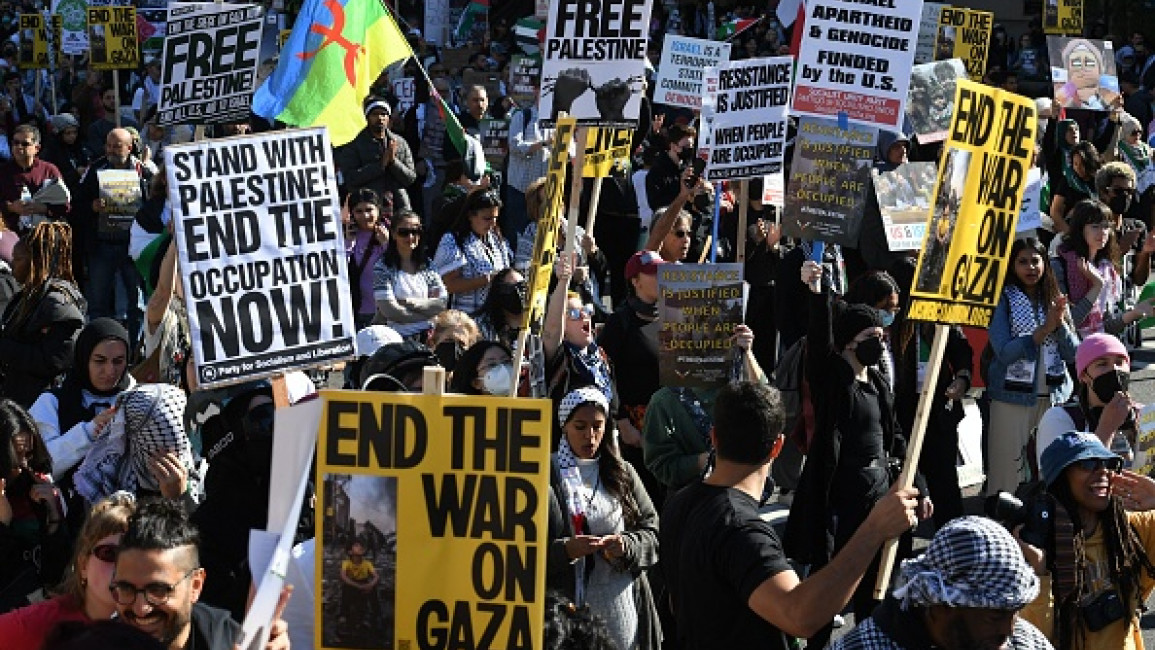
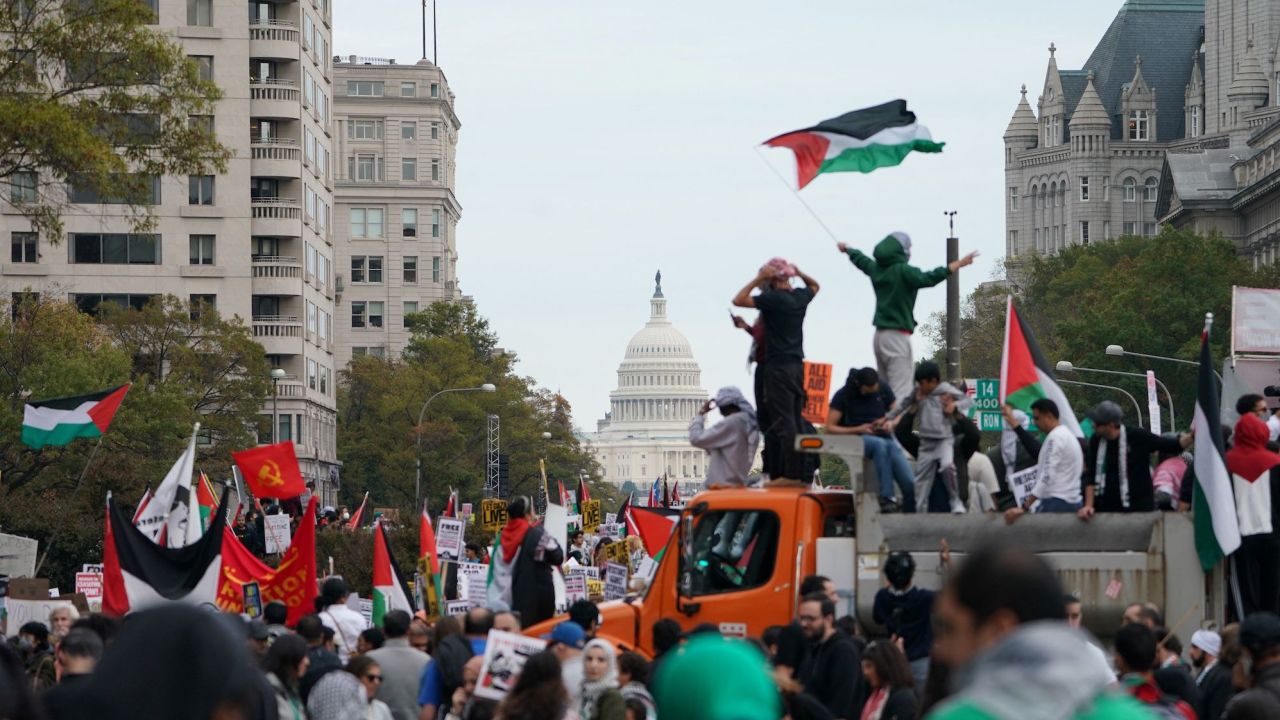
Washington DC saw a massive assembly of pro-Hamas, pro-Palestinian groups today. Tens of thousands of people protesting against Israel in support of Hamas and the Palestinian cause shouted, “from the river to the sea,” an increasingly popular slogan calling for the elimination of the nation state of Israel.
After the march and protest, the angry pro-Hamas groups converged on the White House, scaling the fence and waving the Palestinian flag. The chant changed to “long live the Intifada,” a nod of approval to the protests against Israel from within the West Bank and Gaza.
.
WASHINGTON DC – Tens of thousands of pro-Palestinian protesters massed in Washington, DC, Saturday afternoon before descending upon the White House to chant, “Allahu akbar” and “F–k Joe Biden” as they accused the president of genocide and demanded a ceasefire in the Gaza Strip.
“From the river to the sea, Palestine will be free,” the crowd dotted with Palestinian flags and signs cried at the start of the event, which drew attendees from across the country.
The chant – which is growing increasingly popular in the wake of Hamas’ deadly incursion into southern Israel last month and Israel’s subsequent retaliatory attacks on Gaza – is widely considered antisemitic because it implies the elimination of the State of Israel and its people.
Others chanted, “Long live the Intifada,” an Arabic word used to refer to Palestinian uprising, specifically to conflicts that ran from 1987 and 1993 and from 2000 to about 2005 that left thousands dead.
Unofficial reports estimate 300,000 showed up to the protest, but DC Police could not confirm, telling The Post it does not estimate crowd size.
[…] Around 7:30 p.m., protesters were smearing red paint on the gates of the White House and chanting: “Allahu akbar,” “F–k Joe Biden,” a Post reporter observed. (read more)
Posted originally on the CTH on November 3, 2023 | Sundance
It’s an odd dynamic to watch the professional political left support extremism yet pretend not to support the violent outcomes of the extremists.
We saw this dynamic domestically with Occupy Wall Street violence; we saw this with the Ferguson violence; we saw this with the Baltimore violence; we saw this with Black Lives Matter violence; we see this dynamic with the Antifa violence, and we continue to see this dynamic unfold on the streets and college campuses with the pro-Hamas terror rallies and sympathetic politicians.
There is a lot of pretending needed in order to reconcile how the professional political left embraces violence, then claims to desire peace. The easier approach is always to just accept things as they are, not as we would pretend them to be. However, if you understand this confliction, then you can well imagine how Israeli Prime Minister Benjamin Netanyahu must feel each time he talks to Secretary of State Anthony Blinken.
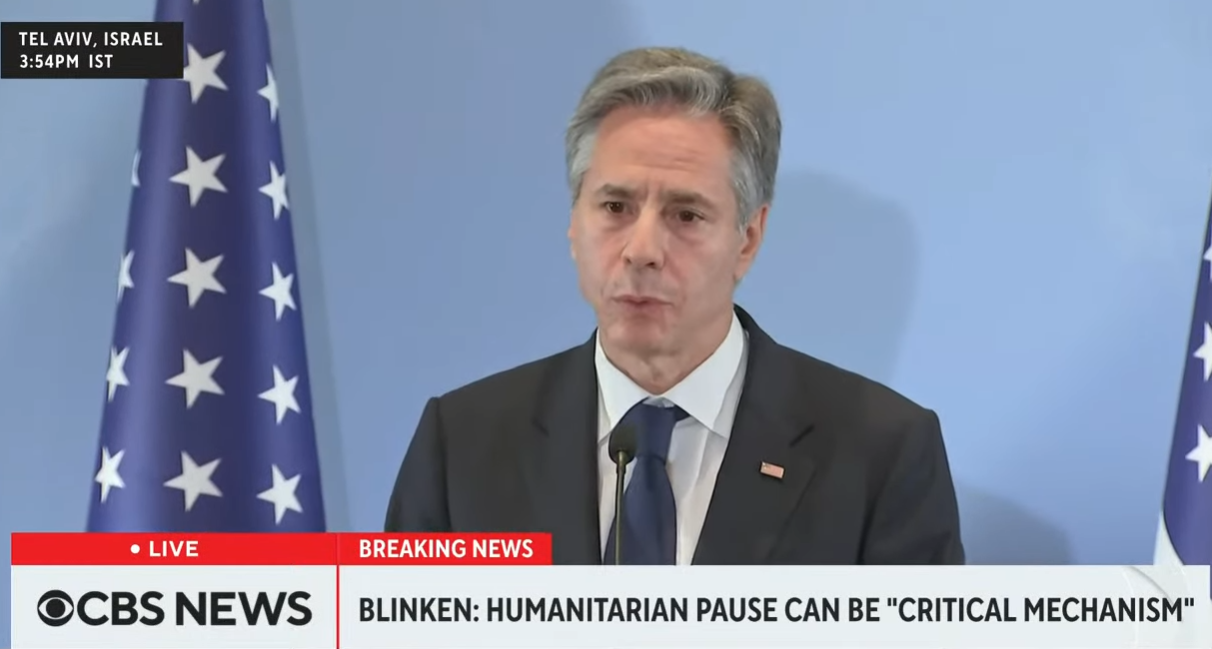
Today, Secretary Blinken is back in Israel and gave remarks to the press after his meeting with Netanyahu. There were actually some good questions raised during the press Q&A segment. One question about the “ultimate goal and vision in the aftermath” was particularly interesting. WATCH:
[TRANSCRIPT] – SECRETARY BLINKEN: Good afternoon, everyone.
“Days after Hamas’s attack on October 7th, I came to Israel, followed soon thereafter by President Biden, to make clear that as long as the United States stands, Israel will never stand alone. Today, in my fourth visit to Israel since October 7th, I reiterated that in all my discussions – with Prime Minister Netanyahu, President Herzog, the security cabinet. I reiterated and made clear our support for Israel’s right to defend itself, indeed its obligation to defend itself. That includes through the additional assistance that we’ve worked with Congress and we’re working with Congress now to provide for Israel’s defense, as well as for urgent humanitarian needs in Gaza.
This right to self-defense, indeed this obligation to self-defense, belongs to every nation. No country could or should tolerate the slaughter of innocents. You’ve heard me speak to some of the stories that Israelis have experienced on October 7th. Today, we saw additional images, additional footage collected by the Israeli Government from video cameras – some the terrorists’ own, others in communities that were attacked. It remains almost beyond the human capacity to process, to digest.
I saw, for example, a family on a kibbutz – a father of two young boys maybe 10, 11 years old grabbing them, pulling them out of their living room, going through their very small backyard and into a shelter, followed seconds later by a terrorist who throws a grenade into that small shelter and then, as the father comes staggering out, shoots him down. And then the boys come out, and they run into their house, and the camera in the house is filming everything. And they’re crying. “Where’s daddy?” one says. The other says, “They killed daddy.” “Where’s my mommy?” And then the terrorist comes in and casually opens the refrigerator and starts to eat from it.
That’s what we’re dealing with. And it is striking and in some ways shocking that the brutality of the slaughter has receded so quickly in the memories of so many. But not in Israel, and not in America. Thirty-five Americans were murdered that day as well, and more than 200 foreign nationals from 35 countries.
I’ve returned to the region to engage in intense diplomacy with our partners to try to help ensure that an attack like October 7th never happens again, and in doing so that we forge a different future, a very different future, for Israelis and Palestinians alike; that out of this tragedy emerges a better tomorrow for both peoples and for the region. There are a number of important steps that we can, indeed we must, take now to help make that possible.
First, we need to continue to prevent escalation of this conflict, its spread to other areas and other theaters. The United States has and we will continue to respond to attacks by Iran’s proxies to defend our personnel in the region, personnel who are here in Iraq and in Syria to help prevent the resurgence of ISIS. We will do what is necessary to deter and, as I said, respond to any attacks.
Partners throughout the Middle East and beyond have a critical role to play in averting escalation, and that will be a major focus of my conversations throughout this trip.
Second, we need to do more to protect Palestinian civilians. We’ve been clear that as Israel conducts its campaign to defeat Hamas, how it does so matters. It matters because it’s the right and lawful thing to do. It matters because failure to do so plays into the hands of Hamas and other terror groups. There will be no partners for peace if they’re consumed by humanitarian catastrophe and alienated by any perceived indifference to their plight.
This is what binds us as human beings. I’ve seen images too of Palestinian children, young boys and girls, pulled from the wreckage of buildings. When I see that, when I look into their eyes through the TV screen, I see my own children. How can we not?
Hamas doesn’t care one second or one iota for the welfare, for the well-being, of the Palestinian people. It cynically and monstrously uses them as human shields, putting its commanders in command posts, its weapons and ammunition within or beneath residential buildings, schools, mosques, hospitals.
But civilians should not suffer the consequences for its inhumanity and its brutality. We’ve provided Israel advice that only the best of friends can offer on how to minimize civilian deaths while still achieving its objectives of finding and finishing Hamas terrorists and their infrastructure of violence. Today, I spoke with Prime Minister Netanyahu and other senior officials about concrete steps to do that.
President Biden has consistently stressed the need for Israel to operate according to international humanitarian law. I also emphasized that the protection of civilians must take place not just in Gaza, but also in the West Bank, where incitement and extremist violence against Palestinians must be stopped – and perpetrators held accountable.
Third, we need to substantially and immediately increase the sustained flow of humanitarian assistance into Gaza, and getting American citizens and other foreign nationals out of Gaza.
Since we reached agreement with Israel, Egypt, and the United Nations two weeks ago on mechanisms to enable humanitarian aid to begin reaching civilians in need, we have scaled up deliveries. We’ve gone from zero to now over 100 trucks going into Gaza through the Rafah Crossing every day. But this is still not enough.
I spoke to Israeli leaders about tangible steps that can be taken to increase the sustained delivery of food, water, medicine, fuel, and other essential needs while putting in place measures to prevent diversion by Hamas and other terrorist groups. We’ve identified mechanisms to enable fuel to reach hospitals and other needs in the south.
Israel has raised appropriate concerns, concerns that we share, about Hamas’s hoarding and syphoning of fuel in northern Gaza. Again, its cynicism knows no bounds, denying fuel itself that it has to hospitals and other places that desperately need it. In meetings with regional partners, I’ll continue conversations about getting assistance to flow, including with help from the United Nations.
Over the last several days, U.S. citizens, foreign nationals, and critically wounded Palestinian civilians have begun to transit out of Gaza. We expect more to leave over the coming days. Even as these people are able to exit Gaza, we remain relentlessly focused on securing the release of hostages, including American citizens. We discussed these ongoing efforts today. Our Deputy Special Representative for Hostage Affairs Steve Gillen, who came with me on my first visit a couple of weeks ago, has remained here on the ground to help bring our people home and also to work with their families.
We believe that each of these efforts would be facilitated by humanitarian pauses, by arrangements on the ground that increase security for civilians and permit the more effective and sustained delivery of humanitarian assistance. That was an important area of discussion today with Israeli leaders: how, when, and where these can be implemented; what works needs to happen, and what understandings must be reached? Now, we recognize this would take time to prepare and coordinate as well with international partners.
A number of legitimate questions were raised in our discussions today, including how to use any period of pause to maximize the full humanitarian assistance, how to connect a pause to the release of hostages, how to ensure that Hamas doesn’t use these pauses or arrangements to its own advantage. These are issues that we need tackle urgently, and we believe they can be solved.
We’ve agreed to have our teams continue to discuss practical solutions. I’ve instructed our Special Envoy for Middle East Humanitarian Issues David Satterfield, who has been doing remarkable work here over the last couple of weeks, to continue these discussions. Ultimately, we believe this can be a critical mechanism for protecting civilians while enabling Israel to achieve its objectives of defeating Hamas.
Finally, and importantly, even as we work towards progress on each of these urgent needs, we’re focused on setting the conditions for a durable and sustainable peace and security. The United States continues to believe that the best viable path – indeed, the only path – is through a two-state solution. That’s the only guarantor of a secure, Jewish, and democratic Israel; the only guarantor of Palestinians realizing their legitimate right to live in a state of their own, enjoying equal measures of security, freedom, opportunity, and dignity; the only way to end a cycle of violence once and for all.
And it’s precisely now, in the darkest moments, that we have to fight hardest to preserve a path of stability, of security, of opportunity, of integration, of prosperity, and of peace – not tomorrow, not after the war, but today.
Thank you.
MR MILLER: First question goes to Leon Bruneau with AFP.
QUESTION: Yes. Excuse me. Hi, Leon Bruneau, Agence France-Presse. Thank you for doing this, Mr. Secretary. You mentioned it in your opening speech, of course, and yesterday also you said that you would – it was urgent or concrete measures needed to be taken to ease the fate of Palestinian civilians. What assurances did the prime minister, Benjamin Netanyahu, give you this morning in your talks? And also on the issue of humanitarian pauses that you say you have discussed – and I understand that you said you don’t know where, how, and when – but could you give us a little bit more details on what you mean by that exactly? I mean, is it stop bombings or what have you? Can you give us some details on that?
And then last question, very quickly, there was a strike yesterday on AFP’s office in Gaza where we have a continued live feed for – since the beginning of the conflict. The – apparently a missile strike – did serious damage to our office there. I’d like your thoughts on that, please.
SECRETARY BLINKEN: Great, Leon. Thank you very much. A few things in response. First, when it comes overall to humanitarian assistance, the Israeli Government is committed to providing that assistance – or enabling that assistance, more accurately – to get to people in Gaza. And as I said, just over the last two weeks, we’ve gone from nothing getting in through the Rafah gate to now, I think just today, well over 100 trucks. And as I said, that’s significant progress in the space of a couple of weeks, but it’s also insufficient. And there’s a recognition not only by us of that fact but also by the Israeli Government, as well as our Egyptian partners, as well as the United Nations.
So we are looking at very concrete, practical ways to widen the aperture, to significantly increase the assistance that’s getting in – the food, the medicine, the water, fuel, other critical needs for people who, through no fault of their own, are in desperate, desperate need. And we had a good conversation about that today. Again, Ambassador Satterfield, who’s here, is working on this every single day; but I’m confident, based on the conversations we had, that you’ll see a further increase in the assistance that’s getting in to people who need it.
With regard to humanitarian pauses, again, we see this as a way of further facilitating the ability to get assistance in, to make sure that the resources are in place as well to absorb the assistance coming in, to make sure that it gets to the people who need it. We see it as a way also, and very importantly, of creating a better environment in which hostages can be released. And this is a very important piece.
So as I mentioned already, and I won’t repeat it, there are a number of very important practical questions that go along with this that we’ve agreed to discuss and work on. We’ve agreed that our teams will continue to talk about this in the days ahead. And from our perspective, this can be a critical way to advance many of the interests that I discussed earlier.
I haven’t seen the details about the strike, Leon, that you alluded to that hit the AFP office in Gaza. And let me just say, and say again, that as we stand strongly for Israel’s right and obligation to defend itself, we also believe that it’s vitally important how Israel does this, including with the highest regard for the protection of civilians, and that of course includes journalists, journalists who are doing extraordinary work under the most dangerous conditions, to tell this story to the world something that we deeply admire, deeply respect, and we want to make sure that they are protected.
MR MILLER: The next question goes to Keren Betzalel with Channel 12.
QUESTION: Thank you. Thank you, Secretary Blinken, for being here. Two issues. Hasan Nasrallah, the secretary-general of Hizballah, is talking right now. If, following his speech or his remark, another front will open in the north, will the U.S. actually use its firepower in the region not only to deter but also to destroy target in Lebanon, or if needed, in Iran?
And on the hostages, the Biden administration is asking Israel for a temporary pause, and we understand it is not a ceasefire. But do you have any guarantees, any assurances, that this temporary pause will lead to hostage release? And I know you have heard the family of the hostages today outside the Kiyra base. And if – may I – can you assure us that the United States will not hold Israel back before the main objective of this war will fulfill, which is eliminating Hamas?
SECRETARY BLINKEN: Thank you.
QUESTION: Thank you.
SECRETARY BLINKEN: Let me take the second question first. There are no guarantees about anything as a general proposition, and maybe even more specifically, in the context of the fight against Hamas. But we are absolutely focused on getting hostages back and getting them back to their families in safety, and we believe that, among other things, a humanitarian pause could help that effort, could facilitate it. It’s one of the reasons why we’re focused on it. But regardless, our determination to get people back is manifested every single day in our efforts to do – to do just that.
And as I’ve said and said repeatedly, and as President Biden has said and has said repeatedly, we stand strongly with and behind Israel in its right and obligation to defend itself, defend its people, and take the steps necessary to try to ensure that this never happens again. Nothing has changed and that won’t change.
With regard to Lebanon, with regard to Hizballah, with regard to Iran, we have been very clear from the outset that we are determined that there not be a second or third front opened in this conflict. President Biden said on day one to anyone thinking of opening a second front, taking advantage of the situation, don’t. And we’ve backed up those words not only with work that we’ve done with many partners in the region to reinforce that message. but with practical deeds, including the deployment of two aircraft carriers battlegroups to the region; including with action that we’ve taken for example against missiles coming from Yemen in the direction of Israel, shooting them down; including as well with strikes that we took in response to multiple attacks on our personnel in Iraq and Syria who are there, as I said earlier, to try to prevent the resurgence in the region of ISIL, of Daesh. We remain absolutely determined in that effort. And I’m not going to get into hypothetical situations, but all I can say is we’re committed to deterring aggression from any part and we’ll take the steps necessary to deal with it.
MR MILLER: For the next question, Vivian Salama with The Wall Street Journal.
QUESTION: Mr. Secretary, thank you as always for bringing us along with you in your travels. Before we left D.C., you stressed that the U.S. was discussing with Israel the current conflict, and you added, “We will also be focusing on the day after.” Can you talk a little bit about what that looks like? In particular, what is being done to ensure that whatever does come after doesn’t spin into potentially short- or long-term occupation?
And also, are there discussions at all to create a multilateral force for Gaza? And if so, would the U.S. be willing to take part in something like that? Thank you.
SECRETARY BLINKEN: Thanks, Vivian. Here’s what we know and I think is agreed among everyone: There cannot and must not be a return to the pre-October 7 status quo. That’s unacceptable. It’s not tolerable for Israel; it shouldn’t be acceptable or tolerable by anyone else. And that means that the idea of Hamas remaining responsible for governance, such as it was, and security, and posing an ongoing and enduring threat to Israel and its citizens, is unacceptable. So that’s one thing we know.
We also know that Israel cannot reassume control and responsibility for Gaza. And it’s important to note that Israel has made clear it has no intention or desire to do that.
So within those parameters, we are and will continue to have discussions with partners throughout the region and well beyond about what should follow once Hamas is defeated. There are a number of possibilities, permutations, but it’s really premature to get into any detail about that.
As important is putting this into a bigger picture, a bigger vision of how we achieve enduring and lasting peace and security in the region. And as I said earlier, the United States is convinced – we have been for some time, and I think we’re only reinforced in that conviction since October 7th – that the best path, maybe even the only path, as I said, is through two states for two peoples. Again, that is the only way to ensure lasting security for a Jewish and democratic Israel, the only way to ensure that the Palestinians achieve their legitimate aspirations for a state of their own.
So I think it’s important, as we’re talking about all of this with every partner in the region – Israel, our Arab partners, and many others, as well as the broader international community – that we have that big frame in mind, and whatever we do, whatever is done, also helps to advance that. So that’s how we’re looking at it right now.
QUESTION: Can I just press you, Mr. Secretary? Because you’re talking about the defeat of Hamas. And I’m wondering for – Hamas is not just a bunch of individuals but probably an ideology as well. And especially with the intense bombardment that we’re seeing in Gaza right now, the potential for extremism down the line is high. And so when you say defeat Hamas, is that being factored in? And what are you doing, then, to address those issues as well?
SECRETARY BLINKEN: Yeah, Vivian, I – you’re exactly right. This is about dealing with Hamas in terms of defeating it physically, that is, making sure that it can’t repeat what it did on October 7th. But it is also about defeating an idea, a perverted idea, but an idea that we have to combat with a better idea, with a better future, with a better vision for what that future can be, and demonstrating that we’re committed to achieving that future, that vision. Because in the absence of that, even after Hamas, those who sing the siren song of nihilism will find open ears.
So it’s imperative, in our judgment, that not only is Hamas dealt with in a way that October 7th can never be repeated, but that we lay out a clear vision and a path to achieve that vision that gives people something to hope for, to buy into, to grab onto. And I believe that there is a broad and strong coalition throughout the region that wants to do exactly that. All of these countries are on one side of the equation. Who’s on the other side of the equation? Hamas, Hizballah, and Iran.
So it’s incumbent upon us, I think, not only to lay out that vision but to be clear about the ways that we propose to achieve it. This is not flipping a light switch, needless to say, given how deep-rooted and enduring these problems are. But there – we have to – we have to address this, and we have to address it in concrete ways and with determination because, again, it comes back to exactly what you said. We have to demonstrate that we have a better idea and a way to achieve it.
MR MILLER: For the final question, Muhannad Tutunji with BBC.
QUESTION: Thank you, Mr. Secretary. First question: The whole world is looking to end this war – when will you ask Israel to stop it? And the next question: The wave of settler violence is increasing with unarmed Palestinians being killed daily – what is the United States doing to address increasing settler violence against Palestinians in the West Bank? Thank you.
SECRETARY BLINKEN: Thank you. With regard to the first part of the question, again, I’ll repeat what I’ve said: We stand behind Israel’s right and, indeed, obligation to defend itself and to do everything it can to make sure that October 7th never happens again. And we will continue to stand with Israel to achieve that. And as I’ve also said repeatedly, the way that Israel does so matters, and we’ve discussed today, as well as in many preceding days, the imperative of doing everything possible to protect civilians, the imperative of doing everything possible to get assistance to those who need it.
With regard to extremist violence that we’re seeing in the West Bank, this is something that, before October 7th, was a real concern for the United States and one that we’ve repeatedly raised in our engagements with the Israeli Government, and it’s an acute concern right now. Look, I don’t want to speak for the Israeli Government; it’s not appropriate. But I think it’s fair to say that what I heard today was a clear commitment from the government to deal with extremist violence in the West Bank – to condemn it, to take action to prevent it, to take action against those who perpetrate it. So this is important, and we will be looking closely to ensure that our friends make good on that commitment.
MR MILLER: Thank you.
SECRETARY BLINKEN: Thank you very much. Thanks, everyone.
Posted originally on the CTH on October 26, 2023 | Sundance
This could be the beginning of World War III, or just another step in the general direction.
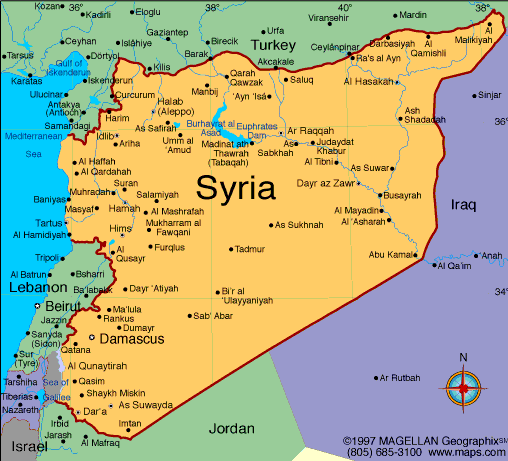
According to the Pentagon, the U.S. just launched airstrikes against the Islamic Revolutionary Guard Corps in Syria.
PENTAGON – Today, at President Biden’s direction, U.S. military forces conducted self-defense strikes on two facilities in eastern Syria used by Iran’s Islamic Revolutionary Guard Corps (IRGC) and affiliated groups. These precision self-defense strikes are a response to a series of ongoing and mostly unsuccessful attacks against U.S. personnel in Iraq and Syria by Iranian-backed militia groups that began on October 17.
As a result of these attacks, one U.S. citizen contractor died from a cardiac incident while sheltering in place; 21 U.S. personnel suffered from minor injuries, but all have since returned to duty. The President has no higher priority than the safety of U.S. personnel, and he directed today’s action to make clear that the United States will not tolerate such attacks and will defend itself, its personnel, and its interests.
The United States does not seek conflict and has no intention nor desire to engage in further hostilities, but these Iranian-backed attacks against U.S. forces are unacceptable and must stop. Iran wants to hide its hand and deny its role in these attacks against our forces. We will not let them. If attacks by Iran’s proxies against U.S. forces continue, we will not hesitate to take further necessary measures to protect our people.
These narrowly tailored strikes in self-defense were intended solely to protect and defend U.S. personnel in Iraq and Syria. They are separate and distinct from the ongoing conflict between Israel and Hamas, and do not constitute a shift in our approach to the Israel-Hamas conflict. We continue to urge all state and non-state entities not to take action that would escalate into a broader regional conflict. (link)
(Via CNN) – […] Earlier Thursday, the US announced it is deploying about 900 troops to the Middle East – with the potential for many more. The US has also moved two carrier strike groups to the eastern Mediterranean Sea and an amphibious ready group closer to Israel in the waters of the Middle East.
The US strikes follow a growing number of attacks against US forces in Iraq and Syria since October 17. As of Thursday afternoon, US forces had come under attack at least 12 separate times in Iraq and four separate times in Syria, resulting in 21 US service members suffering injuries. The Pentagon said the injuries were all minor and that the troops have returned to duty. One US civilian contractor suffered a fatal heart attack as a result of a false alarm at one of the bases in Iraq.
On Wednesday, Biden issued a strong warning to Iran about its proxies attacking US forces in the region. “My warning to the ayatollah was that if they continued to move against those troops, we will respond, and they should be prepared.” Biden also said the presence of US troops in Iraq and Syria is focused on the campaign to defeat ISIS and is not related to the ongoing conflict in Israel.
But Iranian Foreign Minister Hossein Amir-Abdollahian did not attempt to tamp down the tensions Thursday at an emergency session of the UN General Assembly, stating that the US “will not be spared from this fire” if the war in Gaza doesn’t end. Earlier this week, the minister had said that Iran had received two messages from the US, though he would not say how or when the messages were delivered. The first message said the US was not interested in a wider expansion of the conflict, he said, while the second urged Iran and its partners to have self-restraint. (read more)
I have created this site to help people have fun in the kitchen. I write about enjoying life both in and out of my kitchen. Life is short! Make the most of it and enjoy!
This is a library of News Events not reported by the Main Stream Media documenting & connecting the dots on How the Obama Marxist Liberal agenda is destroying America






 Centinel2012