Former CIA deputy director: Absolute risk of US-China war over South China Sea


I agree that there is a major issue here that the Obama administration is incapable of addressing as he down sizes the US military to unheard of levels.

StMA's avatarConsortium of Defense Analysts

This evening, May 20, 2015, former CIA Deputy Director Michael Morell told CNN’s Erin Burnett that the confrontation of U.S. and China over the latter’s increasingly aggressive moves in the South China Sea indicates there is “absolutely” a risk of the U.S. and China going to war sometime in the future.

South China Sea - China's claimChina’s territorial claims in the South China Sea

Jim Sciutto reports for CNN, May 20, 2015, that today, the Chinese navy issued warnings eight times as a U.S. surveillance plane swooped over islands in the South China Sea which are used by Beijing to extend its zone of influence.

The series of man-made islands and the massive Chinese military build-up on them have alarmed the Pentagon, which is carrying out the surveillance flights in order to make clear the U.S. does not recognize China’s territorial claims. The militarized islands have also alarmed America’s regional allies.

A CNN…

View original post 1,007 more words

Bill Whittle What We Believe Full Version


Bill Whittle – How to reach youth with a conservative message


Published on May 16, 2013 Bill Whittle talked about conservative messaging in the 21st century and ways conservatives could use pop culture to reach young voters and make candidates more appealing.

Not Arms But Character


Prof. Paul Eidelberg

Israel, which has the most formidable military power in the Middle East, has been the victim of non-stop Arab-Islamic terrorism since the Government signed the Oslo or Israel-PLO Agreement of September 1993. Why?

How are we to explain that regardless of which party is at the helm, whether it be Labor or the Likud, Israel displays no deterrent power against her sworn enemies?

A common explanation is that Israel’s enemies are animated by religious fervor, that is, by Islam’s 1,400-year tradition of jihad. This explanation is certainly relevant, but let me offer another reason for the indecisiveness of Israel’s military power.

The most important reason is this. First and foremost, Israel is a secular democratic state whose leaders are not animated by any distinctive Jewish goal, one that would endow Israeli prime ministers with national pride and purpose.  Absent in these politicians is serious and steadfast conviction in the truth and grandeur of the Torah and in the unique nobility of the Jewish heritage, which even learned Gentiles admire as unsurpassed in wisdom and creativity.

Israel simply lacks statesmen whose intellectual and moral character is unworthy of this heritage. These half-educated leaders can only boast of Israel’s being “the only democracy in the Middle East.”  They are mindless of the fact that Aristotle, the world’s greatest political scientist – indeed, the founder of political science – held that democracy, though not as bad as oligarchy, is basically an unjust form of government!

That the formidable State of Israel should be locked in an interminable war with the PLO, a mere consortium of terrorist groups, and that Israel’s rulers should yield sacred Jewish land to these thugs, confirms Aristotle’s assessment that democracy is a perverse and contemptible form of government.

I say this regardless of the government’s achievements when weighed against 15,000 Jewish casualties as well as by the trauma suffered by even more Jewish women and children. This suffering of Jewish women and children prompted former Israeli politician Ephraim “Effi” Eitam, a military commander and member of the National Religious Party, to question the manliness of Israel’s ruling elites!

Is it any wonder that Muslims persist in their genocidal war against Israel and her anything but heroic leaders? It comes down not to a question of arms, but to a question of character or morale, ultimately, the most important factor of a nation’s military power

Islamic Jihad Comes to Campus


Those that want war almost always start this way.

Garry Kasparov Discusses President Obama Foreign Policy: “I think we are now facing disaster beyond belief”…


I, for one, am very concerned that this is moving toward WW III and not something simple like the last 14 years.

Obama’s UN Ambitions


Obama-at-UN

Obama’s UN Ambitions

Read more: http://www.americanthinker.com/articles/2015/04/obamas_un_ambitions…

Why does Obama do dangerous and irrational things? By now half of American voters have pretty much figured him out as a power-hungry and self-serving Chicago pol with strange Muslim sympathies, and damn the U.S. Constitution and the law.

A lot of Obama’s actions make no sense in terms of American politics, where even the Democrats are running away from their messiah of yesteryear. The radical Left, which runs the Democrats today, is now yearning for Liz Warren to be their newest false prophet. She looks younger than Hillary, and the left likes to flatter itself as being the party of the young and good looking.

Obama’s eyes have always been on the biggest prize in the world, the virtual Presidency of the Planet. He has been signaling (the way he always does) to the fantasists of the Left, the people who think world government is the answer. That’s the point of the global warming scam and similar power grabs. It is also why Obama pretends that the UN can guarantee the Iranian nuclear surrender, rather than the U.S. Senate, as required by the Constitution.

This is Tony Blair’s Third Way Socialism, the Marxist ideology that runs the European Union. The key is for the socialist power caste to use the economic efficiencies of capitalism to leverage their own power. That is Obama’s political game, and to make it work he will play footsie with Wall Street, robber barons, and theofascists in Iran.

That is also why Israel’s safety and security had to be sacrificed to the Iranians, along with the safety of Iran’s Arab enemies. The inevitable result is nuclear proliferation, and the Saudis are giving out hints they are getting armed up.

Obama needs those “57 Muslim states” to become UN secretary general, once a Democrat nominates him. He can count on Eurosocialists, and he may be trading away Eastern Europe to Putin to get Russia’s support

Obama is all about self-glorification and power, and even after two terms as president his hunger for more is not abated. He would need a personality replacement to change. The best hypothesis is that he has been using the presidency to collect IOU’s from Muslim nations, and probably from Putin and the rest. Obama didn’t resist China’s gigantic grab of disputed seabed territory from Japan, South Korea, and the Philippines. As a quid pro quo, China might support Obama for secretary general. And Obama would get to be King of the World.

Remember Obama’s deep bow campaign? Remember his failure to place promised antimissile defenses in Eastern Europe? Remember his retreat from the Middle East, and his support for the Muslim Brotherhood terror-sponsors?

Islamic fascists want to control the world. So does the radical Left. Obama is a creature of both. To become secretary general, Obama might even officially become a Muslim, a publicity smash that may make him the favorite of those 57 states. Europe is run by socialists who also believe in world conquest — by peaceful means, of course. As for Putin and China, they will demand a high price — such as crippling limitations on US energy production, which Obama has already promised China. Putin is advancing in the Arctic for mineral exploitation, and has taken over a major northern base on the Russian border with Norway that was abandoned after the Cold War.

Obama will never let the words “Muslim violence” escape his lips. This seems increasingly bizarre — but it would fit his ambition to go beyond U.S. president to build up the UN as a superior center of real power. UNocrats and EUrocrats would love it, because they follow an imperialistic Marxist ideology. Islamic extremism actually helps them, which is why Europe’s International Criminal Court just allowed the Muslim Brotherhood terrorist arm, Hamas, to gain recognition in the EU.

Obama has no American sense of self-restrained power. Just the opposite. Obama has no ethical absolutes, not even if hundreds of women and children in Kenya and Nigeria are stolen from their homes for Boko Haram slave markets. Not even if the CIA ends up smuggling arms to the barbaric Sunni rebels in Syria, thereby making that civil war even worse.

The silence of our “Civil Rights” establishment watching Muslim depredations in Africa, exactly like the slave taking their ancestors suffered, is just one straw in the wind. Obama is not bothering to oppose African slave kidnapping by Muslim raiders. That is an amazing fact.

Obama is after something else than promoting the well-being of this country and the world. He is always grandiose, ruthless, abusive, and willing to sacrifice our allies to his own desires.

The likely reason is that Obama does not plan to stop after two presidential terms.


Less than Meets the Eye…


Re-Post from Family Security Matters
by AMBASSADOR HENRY F. COOPER
April 9, 2015

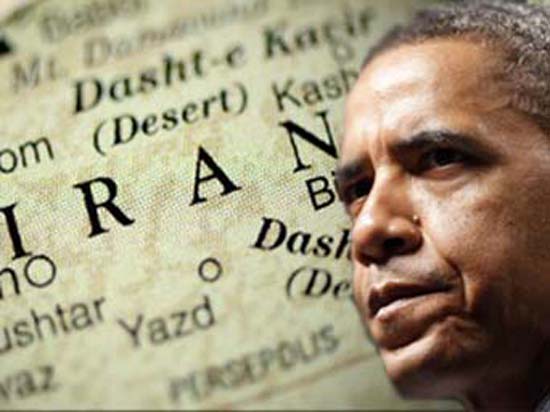
20130110_obama_IRAN_LARGE

“The Framework Agreement announced on 2 April 2015 is concerning on a number of counts, but in fact merely kicks the can down the road to additional negotiations between the P5+1 and Iran, gifting Iran with more time to complete its drive to deliverable nuclear weapons. . . . The entire world took a step closer to Armageddon this week, which as Bernard Lewis has said, is no deterrent to the apocalyptic Shi’ite regime in Tehran but rather an inducement.”

~ Clare M. Lopez, Former CIA Operations Officer

The last sentence above, attributed to Clare Lopez, is most important-and often forgotten as some folks review the details of the April 2nd “deal” with Iran-which at best is, as Clare noted, a “framework” to reach a real agreement by the end of June. As anticipated in my message last week, this is probably little more than another successful Iranian effort to “kick the can” down the road while persistently pressing its nuclear weapons agenda. Iranian President Hassan Rouhani’s strategy is working again, as was intended by Supreme Leader Ali Khamenei. But I digress . . .

Clare’s last statement above indicates that the deterrence theory that dominated the West’s policies and strategy during the Cold War with the Soviet Union and their client states cannot be expected to work in our standoff with Iranian leaders-or other Islamic leaders, whether of Shia or Sunni persuasion, who seek to end Western Civilization.

In particular, Mutual Assured Destruction (MAD) won’t work with the Iranian Shia Mullah’s and their followers-they are happy to die in retaliation of a nuclear attack on the West if that will hasten the return of the Mahdi.
Background from the Reagan Years.

Full disclosure for judging the pertinence of the following comments this week: I was pleased to serve as President Ronald Reagan’s Chief Negotiator in the Geneva Defense and Space Talks with the former Soviet Union-during which it was my main job to find creative ways to say “Nyet” to the Soviets who wanted to kill President Reagan’s Strategic Defense Initiative (SDI), while we achieved the deep reductions in offensive nuclear forces that Reagan wanted.

For years we held firm, against much pressure from the Soviets, the American political elite and many allies who wanted us to compromise on SDI. However, SDI was our main source of negotiating leverage as demonstrated in the October 1986 Reykjavik Summit, when President Reagan walked out because Soviet General Secretary Gorbachev demanded that SDI’s space defense programs be limited to the laboratory. Many, including yours truly, believe that was the “straw that broke the camel’s back,” and we soon were on our way to the first arms control treaties ever to actually reduce nuclear arms-while continuing our SDI efforts.

President Reagan wanted to move beyond MAD, our “mutual suicide pact” with the Soviet Union. MAD meant that we bet the Soviets would be deterred from attacking the West because if they did, we would destroy them with our nuclear deterrent forces. He wanted truly effective defenses and deep reductions in offensive nuclear forces to provide a secure strategic relationship. And he was prepared to share the benefits of truly effective defenses to underwrite that more secure relationship. He wanted “mutual assured survival” instead.

We were on our way in subsequent talks, and I was privileged to lead the SDI efforts during President George H.W. Bush administration, which continued to pursue Reagan’s objective of providing truly effective defenses for the American people and our allies and friends around the world-including Russia and other states of the then dissolving former Soviet Union. Our long term goal was to replace MAD as the dominant strategy of some of our most important global relationships. Russia’s President Boris Yeltsin bought into this approach in early 1992, but President Bill Clinton and his administration dropped Reagan’s agenda and reversed course in early 1993.

As I previously discussed in some detail (Click here and here.), it took Democrat leaders in Congress and the Clinton administration to kill Reagan’s SDI effort-and reinstate MAD as the mainstay of our strategy, while ignoring all efforts to build truly effective defenses.

That regrettably is where we remain today. Although many would try to persuade you that we are building the most effective ballistic missile defenses possible, I assure you that claim is simply not true. The sad fact is we are not even close to Reagan’s original vision-or mine in 1993 when I passed the baton to the Clinton administration, and then Defense Secretary Les Aspin “took the stars out of Star Wars” by killing the most effective defense technologies that had been produced by the $30 billion dollars invested during the SDI decade (1983-93).

Then maturing programs to employ most important technologies remain dormant today-and are not even mentioned in the lament of Sunday’s Los Angeles Times article, “The Pentagon’s $10 Billion Bet Gone Bad,” which keyed off the plight of a large sea-based radar system-an easy target for advancing threat missile systems.

We are paying the price for prematurely curtailing our most important SDI programs when time and technology was on our side.
So What for Dealing with Iran?

Persistent advocacy of SDI was our most important leverage in our negotiations with the Soviets-and that leverage was instrumental in achieving the historic Intermediate Range Nuclear Forces (INF) and Strategic Arms Reductions Talks (START) Treaties in 1987 and 1991. It brought the Soviets back to the negotiating table in March 1985 (They had walked out of all negotiations in October 1983.); induced them to negotiate seriously; and eventually led to the first real reductions in nuclear arms in history. And except for its premature demise during the Clinton administration SDI could have produced truly effective defenses long before now.

Sanctions on Iran, pressed on the Obama administration by congress, have provided our most important leverage in the P5+1 negotiations with Iran. (P5+1 = the five permanent members of the UN Security Council-the U.S., Britain, France, Russia and China-plus Germany.)

In my opinion, the most harmful concessions by the P5+1-of many harmful ones elaborated by press reports this past week-are those that could lead to a premature removal of sanctions on Iran. Notwithstanding the claims of President Obama and Secretary of State Kerry, once removed they will not be easily reinstated-they are not likely to “snap-back” as Obama administration spokesmen claim.

Such concessions would be analogous to Reagan agreeing to restrict to the laboratory the testing of SDI space defense technology. In that event, we would have given Gorbachev what he most wanted-and before nailing down the deep reductions in offensive nuclear forces that we wanted, especially in a way that also met Reagan’s demand for effective verification.

No doubt, there would have been much cheering in Moscow had Reagan traded away SDI at Reykjavik, though perhaps not with the large crowd that welcomed home Iranian Foreign Minister Mohammad Javad Zarif, as illustrated below. Click here for an April 4th Aljazeera report of this “happy homecoming” and a brief summary of Zarif’s accounting of why this framework is good for Iran.

By the way, I doubt President Obama’s claim that his deal with Iran includes “unprecedented” verification measures. As best I understand them, they do not measure up to Reagan’s standard. Again, I refer you to last week’s message for a discussion of the implications of that failure.

For further discussion of stark differences between the overarching “dangerously naïve” Obama negotiating strategy and Reagan’s successful approach, consider the April 3rd National Review article by Bob Joseph and Eric Edelman, “Here’s the Difference Between How Reagan and Obama Handled Nuke Negotiations.”
Bottom Lines.

In my opinion, no deal at this time would be better for the West than a bad deal that at best delays Iran’s progress in achieving a deliverable nuclear weapons capability-especially when the Obama negotiators have traded away our greatest leverage in the talks that have not actually reached agreement, now due by the end of June. Iran already has delivery systems for such weapons to attack the “Great Satan” America as well as the “Little Satan” Israel-and Iran’s highest authorities make no bones about their desire to do so.

Some of us believe Iran is already further along in gaining that nuclear capability than is generally assumed. Thus, we are very skeptical of claims that the conditions of the “framework agreement” are supposed to increase the warning time from a couple of months to a year. And in any case-under the best of circumstances, the framework only promises to delay them getting nuclear weapons-whether from a couple of months to a year or a decade or so.

Comments by Israeli Prime Minister Benjamin Netanyahu on Sunday’s Meet the Press are entirely consistent with my concerns. He again emphasized his concerns about this “historically bad deal” with the Shia Islamic leaders of Iran, which he called “the preeminent terrorist state of our time.” He noted that, unless improved, this deal would spark a nuclear arms race among the Sunni nations of the Middles East-and a Middle East crisscrossed with nuclear trip wires “is a dream deal for Iran and a nightmare for the world.”

Note the consistency of this vision with Clare Lopez’s statement quoted at the beginning of this article. Events last week support the Iranian mullah’s interest in hastening Armageddon. And there’s direct, explicit evidence of this interest by Iran’s leadership.

Netanyahu illustrated his understandable position by referring to an Iranian general, who on the eve of the framework deal said that “the destruction of Israel is non-negotiable.” He was referring to an event as reported by April 1 Israel Radio, the day before the deal was announced. Apparently, Brig.-Gen. Mohammad Reza Naqdi, commander of the Iranian Revolutionary Guard’s Basij (volunteer) militia, said on the occasion of Islamic Republic Day in Tehran that “wiping Israel off the map is not up for negotiation.”

Perhaps even more pertinent to Americans was that as the “deal” approached its conclusion, Iran’s Supreme Leader Ali Khamenei insisted that sanctions be lifted, while his audience chanted “Death to America.” His response, “Of course, yes, death to America, because America is the original source of this pressure” of the sanctions. (Click here.)

Neither the “framework” nor the eventual “deal” will change these conditions anytime soon. And giving up the sanctions accelerates the process toward a nuclear Iran and a likely nuclear arms race in the Middle East.
Recommended Next Steps.

In the remaining time leading up to the “real deal” now alleged to be reached by the end of June, we should find a way to “ratchet up the sanctions” to gain pressure and get a better deal for curtailing the Iranian nuclear program.

Since the Obama administration seems unlikely to take this approach, it is up to congress to do so-in spite of the President’s claim that they will be blamed for scuttling the negotiations. Congress was the primary source of the sanctions that have given us the key leverage in the first place, so this would not be an unprecedented initiative.

In addition, we should do all we can to assure that we have effective missile defense programs that can defeat an Iranian attack-especially from vessels off our coasts, particularly in the Gulf of Mexico, and from satellites approaching America from over the South Polar regions. We are especially vulnerable to an electromagnetic pulse (EMP) attack strategy that we know Iran understands-and for which we are ill prepared. The consequences could shut down the electric power grid for an indefinite period-and without electricity most Americans would likely perish within a year.

Currently, counters to this existential threat are not apparent among the Pentagon’s approved programs. If the administration continues to ignore these issues, congressional initiatives should “provide for the common defense.”
Near Term High Frontier Plans.

We will continue our focus on informing state and local authorities about the EMP threat and expanding our work with the National Guard to help them gain knowledge and workable plans to help harden the electric grid and counter the EMP threat. This work should go hand in hand with the efforts to gain support from State legislators to expand on the excellent work in Maine and Virginia, which have passed legislation requiring serious studies of the EMP threat and the needed countermeasures to protect the electric power grid.

In particular, we will continue working with South Carolina folks to build a coalition to engage constructively with private citizens and their local and state representatives and other authorities to work with the SC National Guard in understanding and responding to this serious threat. We will expand this effort to neighboring and other states. We expect support from Cong. Jeff Duncan (R-SC) whose district includes my SC farm-who is a member of the Congressional EMP Caucus seeking legislation to counter the EMP threat. Our next meeting will be at the Palmetto Panel Conference at Clemson University on 17 April. (See http://www.PalmettoPanel.com.)

We will be working with members of the EMP Coalition and others who are seeking to take our message across the country-especially with Bob Newman, a former Adjutant General of Virginia to help us link our SC plans more broadly and especially into the National Capital region.

20140429_hankcooper

Ambassador Henry F. Cooper is Chairman of High Frontier and a former Acquisition Executive for all U.S. ballistic missile defenses. He also served in several other senior USG acquisition and policy positions, including as President Reagan’s Chief Negotiator at the Geneva Defense and Space Talks with the Soviet Union. He is currently focused on helping local, state and federal authorities protect against the natural and manmade EMP threat by building effective ballistic missile defenses and hardening the electric grid. Otherwise, loss of the electric grid would freeze America’s “just in time” economy, leaving most Americans without means for survival.

Read more: Family Security Matters http://www.familysecuritymatters.org/publications/detail/print/less-than-meets-the-eye#ixzz3Wp9wtpnH

Obama And Iran: Let’s Make A Deal At Any Cost


Family Security Matters

Just as Academy Award Oscar nominees have prepared remarks should their name be called, President Obama had his ready to go announcing a nuclear deal (albeit a framework one) with Iran. The major difference: while uncertainty remains for nominees until the envelope is opened, not so for Obama who knew a deal was never in doubt.So eager to make a deal, Obama started on it before he was first elected. Presidential candidate Obama sent an emissary to Iran in 2008 advising the mullahs he would be elected and be a much kinder negotiator on a nuclear deal. (Unsurprisingly, Team Obama failed to mention this Logan Act violation while leveling accusations of treason against the 47 GOP senators who wrote an open letter to the mullahs warning any Obama deal may not survive his presidency.)

Two developments concerning what he calls a “once-in-a-lifetime opportunity” are disturbing.

First, it is not a bad deal – it is a terrible one. Any agreement placing nuclear weapons in the hands of Armageddon-minded mullahs bent on creating the global chaos deemed necessary to expedite a messianic leader’s descent from an occulted state to establish Islam as the world’s religion should cause us worry. Yet Obama gives these madmen the bomb.

Second, while this is only a deal to make a deal later, polls already credit Obama with a major accomplishment. This suggests Americans fail to understand Obama has violated repeated assurances Iran would never have nuclear weapons.

Sometimes polls tell less about substantive issues and more about public ignorance.

During the U.S./USSR SALT II arms control negotiations, poll results revealed most Americans favored such a deal capping the number of missiles each side could have. But a follow up poll revealed respondents failed to understand SALT II would do that at levels giving the Soviet Union a larger numerical missile advantage – which respondents then rejected. They favored SALT II, until they realized what was in it.

This mindset is reminiscent of Nancy Pelosi’s incredulous statement on Obamacare legislation she had never read – i.e., “we have to pass it to find out what’s in it.” Such an approach with Iran will prove fatal.

How bad did Obama want this deal? So bad our negotiators capitulated on 80 percent of Iran’s demands. Nothing would deter Obama from such an agreement – not even international provocations days before a framework deal was announced.

With negotiations ongoing, a U.S. Navy helicopter over the Persian Gulf was buzzed by an Iranian military jet – the incident kept quiet so as not to upset the Iranians with a protest.

Obama negotiators also remained silent last month when the commander of Iran’s Basij militia, Brig. Gen. Mohammad Reza Naqdi, declared Israel’s destruction “non-negotiable.” Yet despite this, we negotiate a deal giving Tehran access to nukes!

Also ignored by U.S. negotiators was evidence Iran’s nuclear program is for military purposes, refusing to confront the mullahs on an Iranian document describing an electro-magnetic pulse (i.e., nuclear) weapon attack against the U.S.

A good sign one side has fallen under the spell of the other in negotiations is the latter using the former’s language. When asked at one point by a Westerner if a deal was possible, Secretary of State John Kerry’s “Inshallah” (God willing) response suggested as much.

Other recent developments quite telling about Iranian intentions also were ignored.

Obama refuses to hold Tehran accountable for its terrorist acts but U.S. courts do. Last month, a civil court ordered Iran pay $75 million to the family of a sailor lost in the October 2000 USS Cole suicide attack. Awards by other courts totaling billions recognize Iranian involvement in numerous attacks including the 1983 Beirut barracks bombing and 9/11.

It appears our “tough” negotiators failed to win promises Iran stop such terrorist activity, release Americans being held, stop threats against the West or otherwise act as a responsible member of the international community.

Iran’s terrorist proxy group Hezbollah understands far better than Americans what this deal contains – calling it a victory making Tehran “a member of the nuclear club.” It is chilling to have a terrorist organization say such words about a terrorist state.

Usually a supporter of Obama’s policies, the Washington Post is very critical of the deal for failing to shut down any of Iran’s nuclear facilities or dismantle any of the 19,000 centrifuges used to enrich uranium. Additionally, while the existing enriched uranium stockpile is to be reduced, no demand (after Tehran rescinded willingness to do so) is made it be shipped outside the country. The deal leaves Iran’s nuclear infrastructure intact – theoretically freeze-dried for a decade – before claiming nuclear club membership. But this foolishly assumes a nation yet to honor any arms control agreement signed will do so now.

One expert, Joe Cirincione, head of the American anti-nuclear proliferation group the Ploughshares Fund, finds the deal so bad it will enable Iran to reduce its “breakout” time should it make a run for the bomb. This is because it allows installation of improved centrifuge technology shortening breakout from several months to three weeks.

Although U.S. law requires the topic of Iran’s suspected warhead research be addressed before sanctions are lifted, the deal is silent on this.

The U.S. negotiating trend throughout has been one of unwillingness to discuss critical issues – definitive of Iranian intentions – for fear of disrupting talks. That gave the Iranians an enormous negotiating advantage.

America’s Arab allies describe the agreement as “Obama’s bad and dangerous deal” – resulting from U.S. “weakness” that feeds Iranian “expansionist” plans. Ironically, this deal will trigger an arms race, completely defeating Obama’s declared policy during his first year to rid the world of nuclear weapons. Saudi Arabia is closely working with Pakistan on acquiring one as well.

U.S. law requires lobbyists representing foreign governments register as such. Obama’s ‘let’s make a deal at any price’ strategy with Iran represents a complete capitulation of U.S. interests. No lobbying firm could have better represented a client. Perhaps we should check – Obama’s name may well be on the registry.

A version of this piece previously appeared on The Daily Caller.

Lt. Colonel James G. Zumwalt, USMC (Ret.), is a retired Marine infantry officer who served in the Vietnam war, the U.S. invasion of Panama and the first Gulf war. He is the author of “Bare Feet, Iron Will–Stories from the Other Side of Vietnam’s Battlefields,” “Living the Juche Lie: North Korea’s Kim Dynasty” and “Doomsday: Iran–The Clock is Ticking.” He frequently writes on foreign policy and defense issues.

You can find this online at: http://www.familysecuritymatters.org/publications/detail/obama-and-iran-lets-make-a-deal-at-any-cost

Intent of Russian military aircraft near U.S. shores remains unclear


Monitoring Russian aircraft
‘They’re obviously messaging us,’ U.S. Air Force officer says of Russian military aircraft
Russian bombers in international airspace are a sign of deteriorating ties between Moscow and the West

The air is frigid and the wind is howling as Air Force Col. Frank Flores lifts a pair of foot-long binoculars and studies a hazy dot about 50 miles west across the Bering Strait.

“That’s the mainland there,” he shouts above the gusts.

It’s Siberia, part of Russia, on the Asian mainland.

Named for an old mining camp, Tin City is a tiny Air Force installation atop an ice-shrouded coastal mountain 50 miles below the Arctic Circle, far from any road or even trees. The Pentagon took over the remote site decades ago and built a long-range radar station to help detect a surprise attack from the Soviet Union.

At least from this frozen perch, America’s closest point to Vladimir Putin’s Russia, the Cold War is turning warm again.

Is this a second Cold War? It doesn’t matter what we think. Maybe they think the Cold War never ended.- Navy Adm. William E. Gortney

U.S. F-22 fighter jets scrambled about 10 times last year — twice as often as in 2013 — to monitor and photograph Russian Tu-95 “Bear” bombers and MiG-31 fighter jets that flew over the Bering Sea without communicating with U.S. air controllers or turning on radio transponders, which emit identifying signals.

The Russian flights are in international airspace, and it’s unclear whether they are testing U.S. defenses, patrolling the area or simply projecting a newly assertive Moscow’s global power.

“They’re obviously messaging us,” said Flores, a former Olympic swimmer who is in charge of Tin City and 14 other radar stations scattered along the vast Alaskan coast. “We still don’t know their intent.”

U.S. officials view the bombers — which have been detected as far south as 50 miles off California’s northern coast — as deliberately provocative. They are a sign of the deteriorating ties between Moscow and the West since Russia’s annexation of Ukraine’s Crimea region in March of last year and its military intervention to support separatists in eastern Ukraine.

Similar Russian flights in Europe have irked leaders in Britain, Ireland, Sweden, Norway and elsewhere. In January, British authorities were forced to reroute commercial aircraft after Russian bombers flew over the English Channel with their transponders off.

In all, the North Atlantic Treaty Organization says its jets scrambled to monitor Russian warplanes around Europe more than 100 times last year, about three times as many as in 2013. Russian air patrols outside its borders were at their highest level since the Soviet Union collapsed in 1991, NATO said.

Russian Defense Minister Sergei Shoigu said in a statement in November, as tensions heightened over Ukraine, that Russia’s strategic bombers would resume patrols in both the Atlantic and the Pacific.

“In the current situation we have to maintain military presence in the western Atlantic and eastern Pacific, as well as the Caribbean and the Gulf of Mexico,” he said.

Russian bases and territorial claims in the Arctic

Although the Arctic draws less attention, Russia is flexing muscles there after years of decline. President Vladimir Putin’s government has announced plans to reopen 10 former Soviet-era military bases, including 14 airfields, that were shuttered along the Arctic seaboard after the Cold War.

A shipyard in Severodvinsk, the largest city on the Russian Arctic Coast, has begun building four nuclear-powered submarines for the first time in decades, according to Russian news reports. The Pentagon says the reports are accurate.

The Pentagon has responded by spending $126 million last year to upgrade Tin City and other coastal radar stations in Alaska. It also has added military exercises with northern allies — including flying U.S. strategic bombers over the Arctic for the first time since 2011.

Last week, four B-52s flew from bases in Nebraska and Louisiana on simultaneous, round-trip sorties to the Arctic and North Sea regions, the Air Force announced. Along the way, the bomber crews engaged in “air intercept maneuvers” with fighter jets from Canada, England and the Netherlands.

The Air Force has said it may base the first squadrons of next-generation F-35 fighter jets at Eielson Air Force Base in Alaska starting next year.

The buildup comes as melting ice caps are opening valuable new sea lanes, sparking a scramble for oil and other untapped natural resources by the eight nations with territorial or maritime claims in the far north.

“We’re experiencing a reawakening of the strategic importance of the Arctic,” said Navy Adm. William E. Gortney, commander of the Pentagon’s Northern Command and of the North American Aerospace Defense Command.

“Is this a second Cold War? It doesn’t matter what we think,” Gortney said. “Maybe they think the Cold War never ended.”

Analysts say Putin’s government may be ordering the bomber flights as a morale booster for a military that saw its ships turned to scrap, its aircraft grounded and its bases closed after the Cold War.

“The ability to project military power from bases in the Arctic region is one area in which they are still capable,” said Christopher Harmer, a military analyst at the Institute for the Study of War, a nonpartisan public policy group in Washington.

“This is much less compared to what they were doing in the Cold War,” said Dmitry Gorenburg, a research analyst at the nonprofit Center for Naval Analyses in Washington. “I don’t think they’re threatening anyone. They just want to make sure that no one comes into the Arctic and messes with them.”

The U.S. military downsized but never fully disengaged in the Arctic after the Cold War.

If an alarm sounds, fighter pilots still sometimes slide down gleaming fireman poles at Joint Base Elmendorf-Richardson in Anchorage and run to F-22 Raptors kept idling in small hangars. The jets, in “hot-cocked” condition, carry fully armed cannons and missiles.

In an underground room on the base, rows of radar technicians sit at glowing screens watching small crescent-shaped blips, each representing an aircraft moving in Alaskan airspace. On the wall, four large screens track aircraft across the Arctic, including Russian airspace.

The wall also holds 261 plaques with red stars. Each represents a successful U.S. intercept of Russian aircraft. A total of 424 Russian planes have been detected since 1983, mostly during the Cold War.

“If they come this way, we’re going to track them, determine who they are and what their intent is,” said Maj. Carrie Howard, an officer in charge of the air defense squadron.

Most of the time, the blips are commercial planes that identify themselves by emitting transponder codes or communicating with regional air controllers. But some aircraft stay silent.

If commanders here decide to respond, they grab a tan telephone marked “scramble” in red letters. It rings in a wardroom by the runway where F-22 pilots are always on duty.

“When the phone rings, it stops your heart, it rings so loud,” said one pilot, who asked not to be named for his security.

Once airborne, the pilots are supposed to get a visual identification of the other aircraft. But the F-22 can fly nearly three times as fast as the lumbering Tu-95 bomber, so slowing down is the challenge.

“You want to go fast,” the pilot said. “The jet wants to go fast. But you just have to ease up alongside of them.”

On Sept. 17, he scrambled in pursuit of radar blips that turned out to be two Russian “Bears,” two MiG-31s and two refueling tankers. The American pilot drew close, radioed his sighting back to Anchorage and returned to base.

“Our presence was felt,” the pilot said. “That’s all that’s needed.”

It was difficult to feel much of anything but cold at Tin City on a recent afternoon, where the temperature was far below zero, the wind was bone-chilling and the world faded into a blinding white of snow, ice and fog.

Vance Spaulding, 53, and Jeff Boulds, 52, two contractors, spend up to four months maintaining the radar site before they fly out on break.

While here, they hunt musk ox, a long-haired, long-horned animal known for its strong odor, and Arctic hare, which they claim can grow to 20 pounds or more, on the surrounding coastal plain.

“We get cooped up here, so we try to get out in the open whenever we can,” Boulds said. “But I never seen no Russkies. Not yet anyway.”

william.hennigan@latimes.com