So much good news:WASHINGTON (Reuters) – The trade deal between the United States and Mexico will stand even if Canada does not come to an agreement with the Trump administration in the renegotiation of the North American Free Trade Agreement (NAFTA), Mexico’s foreign minister said on Monday.
“If for any reason the government of Canada and the United States do not reach an agreement, we already know that there will still be a deal between Mexico and the United States.”
Remember those “private meetings” between Jesus Seade and Robert Lighthizer?
It is said: a picture is worth a thousand words. Cue the audio visual:
The incoming Mexican President, Andrés Manuel López Obrador,(AMLO)’s representative is Jesus Seade. The outgoing Mexican President Pena Nieto’s representative is Mexican Secretary of Economy Idelfonso Guajardo.
Why the joy in Seade and the defeated Guajardo? The answer is inthe details:
One of President Trump’s principal objectives in the renegotiation is to ensure the agreement benefits American workers. The United States and Mexico have agreed to a Labor chapter that brings labor obligations into the core of the agreement, makes them fully enforceable, and represents the strongest provisions of any trade agreement.
Key Achievement: Worker Representation in Collective Bargaining
The Labor chapter includes an Annex on Worker Representation in Collective Bargaining in Mexico, under which Mexico commits to specific legislative actions to provide for the effective recognition of the right to collective bargaining.
BOOM !!
Key Achievement: Labor Rights Recognized by the International Labor Organization
The Labor chapter requires the Parties to adopt and maintain in law and practice labor rights as recognized by the International Labor Organization, to effectively enforce their labor laws, and not to waive or derogate from their labor laws.
Additionally, the chapter includes new provisions to take measures to prohibit the importation of goods produced by forced labor, to address violence against workers exercising their labor rights, and to ensure that migrant workers are protected under labor laws.
Key Achievement: New Labor Value Content Rule
To support North American jobs, the deal requires new trade rules of origin to drive higher wages by requiring that 40-45 percent of auto content be made by workers earning at least $16 USD per hour.
Why is this important?
Massive consequences.
♦First, this is the part where AMLO gets a key win for his new Mexican economic agenda; the right of workers to form collective bargaining agreements, ie. unions. Mexico’s President-elect Andrés Manuel López Obrado is not only coming into office with a mandate, he is also bringing with him a majority parliament on his agenda.
By putting the rights of Mexican workers in the forefront two win/win objectives are accomplished for both AMLO and Trump. (1) The reason U.S. corporations moved to Mexico was party to exploit cheaper labor. Now that those corporations have invested themselves in Mexico they will have to agree to collective bargaining; thereby raising the standard of living for Mexican workers (an AMLO goal). (2) For future investment considerations the low-wage incentive of U.S. manufacturing is now eliminated (a Trump goal).
Multinational vulture corporations can no longer bribe local Mexican officials for low-wage regional labor. The Mexican worker, with AMLO legislation, will have the ability to fight off exploitation.
Manufacturing corporations will need to raise wages (AMLO win), and corporations will be less likely to move out of the U.S. based on the wage analysis portion of the total cost equation (Trump win). I have no doubt this was part of the ‘closed-door’ private discussions between Seade and Lighthizer. No doubt.
♦Secondly, how is the left-wing political opposition in Canada and the U.S. going to fight against this deal which includes protections for collective bargains and union representation? Trump fractures the Democrats/Liberals by supporting a policy that they claim is at the heart of their support base. Do you really think Senator Patrick Leahy, or Senator Bernie Sanders are going to go on record against organized labor?
How can Justin or Chrystia from Canada going to argue against higher Mexican wages?
The U.S./Mexico 75% auto rule of origin for manufacturing parts works in synergy with the demand that 45% of those manufacturing components must come from assembly and manufacturing wages of $16/hr or higher. In essence AMLO and Trump are controlling the calculations within the Total Cost of Manufacturing.
Watch the Canadian Leftists try to reconcile today’s events while not yet absorbing how the projected Mexican wage increases are factored into the total agreement. (first six minutes):
.
Here’s the Mexican trade team press conference. Use the ‘closed caption’ for the English sub-titles:
.
Within this agreement President-elect Lopez-Obrador and President Trump have fractured Wall Street’s exploitative multinational Big Club. No doubt, despite his hundreds of millions spent, U.S. Chamber of Commerce Tom Donohue is finally seeing significant defeat on the horizon.
The first White House visit by AMLO is going to be epic!
In direct relationship to the checkbook policy that impacts middle-class Americans the U.S./Mexico trade deal is the biggest win so far in Trump’s presidency. There are such massive ramifications it could take days for anyone to comprehend how the granular details have such massive downstream consequences. The deal is incredibly complex.
At the 30,000 ft level, the deal positions Mexico to retain their current multinational investments, and through a series of sector-by-sector standards on origination the deal simultaneously closes the fatal NAFTA loophole. The agreement makes an economic manufacturing partnership between the U.S. and Mexico; and for assembly products third parties will have to produce parts and origination material within the U.S. and Mexico.
U.S.T.R. Lighthizer has put some details forward:
♦The NAFTA Loophole closure is explained in Summary Form HERE; with emphasis on the Auto-Sector. The key is a 75% part origination level for auto-assembly; and a 40-45% level for parts with a minimum $16/hr wage rate. The source-origination rate (75%) is even higher than all previously forecast negotiation results.
Example of downstream consequences/benefits: German auto-maker BMW recently built a $2 billion assembly plant in Mexico (almost complete). Most of their core parts were coming from the EU (steel/aluminum casting components) and/or Asia (electronics). Now the assembly plant will have to source 75% of the auto-parts from the U.S. and Mexico, with 45% of those parts from facilities paying $16/hr. Result: BMW will need to modify their supply chain and build auto parts in the U.S. and Mexico.
♦Agriculture is another important sector, explained in Summary Form HERE. CTH needs to dig into the details on this sector. Overall it appears Mexico has agreed to a common set of food manufacturing safety standards. Additionally the removal of any/all subsidies in agricultural trade between the U.S. and Mexico. There’s more, a lot more, but it will require some analysis akin to separating grains of sand with a toothpick.
♦U.S.T.R. Lighthizer also provides a Summary Fact Sheet HERE with a broad high-level review of the agreement principles.
New “rules of origin” requirements to incentivize billions a year in vehicle and automobile parts production in the United States, supporting high-wage jobs.
The strongest, fully enforceable labor standards of any trade agreement.
New commitments to reduce trade-distorting policies for agricultural goods.
Improvements enabling food and agriculture to trade more fairly.
Strong and effective intellectual property protections.
The strongest disciplines on digital trade of any international agreement.
The most robust transparency obligations of any United States trade agreement.
NOTE: #7 is a critical point, with a great deal of emphasis, given the complexity of the rules of origin now constructed to close the NAFTA loophole.
CTH will have a lot more on the specific details, but we wanted to get the links to the fact sheets out quickly. Because of the fundamentally flawed prior agreement, this new trade agreement has massive consequences far beyond what would normally be considered.
Not only is Asia, specifically China, impacted; but so too are the EU and other international trade partnerships. The critical point is that the U.S. and Mexico have agreed to partner in our approach toward the rest of the world. Outgoing globalist Mexican President Pena Nieto is not happy; incoming nationalist Mexican President Andres Manuel Lopez-Obrador is ultimately the winner.
Through the efforts of Robert Lighthizer (U.S.) and Jesus Seade (AMLO) the Trump administration has now closed one of the access routes into coveted U.S. market, exploited by multinational corporations and countries (using NAFTA). The Mexico route is secure, agreements are made, and now attention turns toward Canada.
Think about the BMW example above, the downstream ramifications within this agreement are massive. It is not coincidental that Canada’s Foreign Minister Chrystia Freeland is in Germany coordinating the response. Now that a deal with Mexico has been reached, Canada has lost all prior leverage.
Remember, the U.S. and Mexico have agreed to “no protectionist tariffs/subsidies” in the agricultural sector. Canada protects its dairy sector with massive protectionist tariffs and subsidies. It is doubtful Trudeau and Chrystia can retreat from their construct.
Therefore:
“I think with Canada, frankly, the easiest we can do is to tariff their cars coming in. It’s a tremendous amount of money and it’s a very simple negotiation. It could end in one day and we take in a lot of money the following day,” Trump said.
Canada responded:
Canada responded with a statement Friday night, saying: “Our focus is unchanged. We’ll keep standing up for Canadian interests as we work toward a modernized trilateral NAFTA agreement.” (link)
This will likely be the outcome. Like it or not, Canada gets to continue protecting dairy sector and gives up its auto-manufacturing sector as a consequence.
Freeland is expected to arrive in the U.S. tomorrow….
Promises made, promises kept. The CTH community is in a unique position to understand exactly what has taken place today as President Donald Trump announces the termination of NAFTA and simultaneously announces a bilateral trade agreement has been made between the U.S. and Mexico. This is exactly what CTH predicted. Most, not all, but most of the media are absolutely clueless.
In an Oval Office announcement today President Trump put outgoing Mexican President Enrique Peña Nieto on his speaker phone as the press watched in the Oval Office. U.S. Trade Representative Robert Lighthizer, Mexican Secretary of Economy Idelfonso Guajardo, and the key figure for incoming Mexican President, Andrés Manuel López Obrador (AMLO), Jesus Seade was present for the announcement.
CTH will have much more on the details of the trade agreement. This is the most comprehensive and complex trade agreement in U.S. history. However, in the interim here’s the full video of the announcement (including nuance). ENJOY:
.
[Transcript] Oval Office – 11:09 A.M. EDT – PRESIDENT TRUMP: Hello everybody. It’s a big day for trade, a big day for our country. A lot of people thought we’d never get here because we all negotiate tough. We do, and so does Mexico. And this is a tremendous thing.
This has to do — they used to call it NAFTA. We’re going to call it the United States-Mexico Trade Agreement, and we’ll get rid of the name NAFTA. It has a bad connotation because the United States was hurt very badly by NAFTA for many years. And now it’s a really good deal for both countries, and we look very much forward to it.
And I believe the President is on the phone. Enrique? You can hook him up. Tell me when.
How are you? It’s a big thing. A lot of people waiting. Hello? Do you want to put that on this phone, please? Hello? Be helpful.
♦PRESIDENT PEÑA NIETO: (As interpreted.) President Trump, how are you? Good morning.
♦PRESIDENT TRUMP: Thank you, Enrique. And congratulations. That’s really a fantastic thing. We’ve all worked very hard, and your brilliant representatives are sitting right in front of me. And I thought we would congratulate each other before it got out. And I know we’ll have a formal news conference in the not-too-distant future.
♦PRESIDENT PEÑA NIETO: (As interpreted.) Thank you very much, President Trump. I think this is something very positive for the United States and Mexico. And the first reason for this call, Mr. President, is, first of all, to celebrate the understanding we have had between both negotiating peace on NAFTA, in the interest we have had for quite a few months now to renew it, to modernize it, to update it, and to generate a framework that will boost and potentiate productivity in North America.
It is our wish, Mr. President, that now Canada will also be able to be incorporated in all this. And I assume that they going to carry out negotiations of the sensitive bilateral issues between Mexico — rather, between Canada and the United States.
And I’m really grateful, Mr. President. I want to say that you — I greatly recognize and acknowledge your political will and your participation in this. And on this paved path, I want to bear my testimony, Mr. President, and my acknowledgement to both negotiating teams, especially the team that is headed and led by Mr. Robert Lighthizer, and also the accompaniment and the support we have had from the White House through Jared Kushner.
And I also extend this recognition to the Mexican team. They are listening to you. They are close to you right now — Foreign Minister Luis Videgaray and the Secretary of the Economy, Mr. Guajardo.
Yes, in terms of (inaudible) the negotiations that have taken months, it’s been difficult, complex, and a very hard negotiation altogether with difficult moments, of course. But I truly acknowledge now the fact that we’ve been able to reach an agreement that we are about to make public. And this is the result of good understanding and good work. And I — of course, I am quite hopeful that now Canada would start discussing with the United States the sensitive bilateral issue.
Congratulations, President Trump. I am very grateful and I am attentive to your comments.
♦PRESIDENT TRUMP: Well, Mr. President, thank you very much. It’s an honor. You’ve been my friend. It’s been a long time since I traveled to Mexico, where we got to know each other quite well and we actually had a good meeting. Some people weren’t sure if it was a good meeting, but I was.
I have a lot of good meetings that a lot of people aren’t sure if they were good or not.
But it’s been a long time, and this is something that’s very special for our manufacturers and for our farmers from both countries, for all of the people that work for jobs. It’s also great trade and it makes it a much more fair bill. And we are very, very excited about it.
We have worked long and hard. Your representatives have been terrific. My representatives have been fantastic too. They’ve gotten along very well, and they’ve worked late into the night for months. It’s an extremely complex bill and it’s something that I think will be talked about for many years to come. It’s just good for both countries.
As far Canada is concerned, we haven’t started with Canada yet. We wanted to do Mexico and see if that was possible to do. And it wasn’t — I think, it wasn’t from any standpoint something that most people thought was even doable when we started.
If you look at it, you remember, at the beginning, many people thought that this was something that just couldn’t happen because of all of the different factions, all of the different sides, and the complexity. And we made it much simpler, much better. Much better for both countries.
Canada will start negotiations shortly. I’ll be calling the Prime Minister very soon. And we’ll start negotiation, and if they’d like to negotiate fairly, we’ll do that. You know, they have tariffs of almost 300 percent on some of our dairy products, and we can’t have that. We’re not going to stand for that.
I think with Canada, frankly, the easiest thing we can do is to tariff their cars coming in. It’s a tremendous amount of money and it’s a very simple negotiation. It could end in one day and we take in a lot of money the following day.
But I think we’ll give them a chance to probably have a separate deal. We can have a separate deal or we can put it into this deal. I like to call this deal the United States-Mexico Trade Agreement. I think it’s an elegant name. I think NAFTA has a lot of bad connotations for the United States because it was a rip-off. It was a deal that was a horrible deal for our country, and I think it’s got a lot of bad connotations to a lot of people. And so we will probably — you and I will agree to the name.
We will see whether or not we decide to put up Canada or just do a separate deal with Canada, if they want to make the deal. The simplest deal is more or less already made. It would be very easy to do and execute.
But I will — I will tell you that working with you has been a pleasure. Speaking with and working President-elect López Obrador has been absolutely a very, very special time.
You both came together for your country. You worked together. I think that’s important for the media to know. We have a little — a small amount of media in our presence, like everybody. And the media should know that the President and the President-elect worked very closely together because the President felt it was important that the President-elect liked what he was seeing.
And our teams worked together. Our teams were really well unified, and your team was very well unified. I was very impressed with the fact that the two Presidents came together and worked out something mutually agreeable.
So it’s an incredible deal. It’s an incredible deal for both parties. Most importantly, it’s an incredible deal for the workers and for the citizens of both countries. Our farmers are going to be so happy. You know, my farmers — the farmers have stuck with me; I said we were going to do this. And Mexico has promised to immediately start purchasing as much farm product as they can. They’re going to work on that very hard.
And as you know, we’re working — unrelated to this, we’re working very much with other countries. China is one; they want to talk. And it’s just not right time to talk right now, to be honest, with China. It’s been — it’s too one-sided for too many years, for too many decades. And so it’s not the right time to talk. But eventually, I’m sure, that we’ll be able to work out a deal with China. In the meantime, we’re doing very well with China.
Our economy is up. It’s never been this good before, and I think it’s only going to get better.
But, Mr. President, you’ve been my friend and you have been somebody that’s been very special in a lot of ways. We talk a lot. We talked a lot about this deal. And I’d like to congratulate you and the Mexican people.
♦PRESIDENT PEÑA NIETO: (As interpreted.) Thank you very much, Mr. President.
I finally recognize this, especially because of the point of understanding we are now reaching on this deal. And I really hope and I desire — I wish — that the part with Canada will be materializing in a very concrete fashion; that we can have an agreement the way we proposed it from the initiation of this renegotiating process, a tripartite.
But today I celebrate the (inaudible) between the United States and Mexico because we’re reaching a final point of understanding. And I hope that in the following days we can materialize (inaudible) in the formalization of the agreement.
Something additional, Mr. President — and you have already mentioned it — it has to do with an involved and committed participation of the administration and the President-elect of Mexico. As you know, we are now going through a period of transition, and it has been possible to create a highly unified front between the negotiating team of this administration and the people appointed by the President-elect of Mexico to be observers and participate in this agreement, in this understanding, to reach the point we are now reaching.
The President-elect has been aware of everything that has been happening, and I have also had the opportunity of talking to him directly and personally on the progress being made.
You have also had direct conversations with President-elect. Things that we have to do and I hope we have the space to do it would be to find — to toast a good toast with tequila, of course — (laughter) — to celebrate this understanding.
♦PRESIDENT TRUMP: Enrique, I think that’s exactly right. And you know the good relationship that I’ve already established with the President-elect. I was very impressed with him, I must tell you. He was terrific in every way. And he wants — you know, he loves your country like you love your country. You want to do the right thing. And we’re really doing the right thing for all of us. So I really enjoy that. Please send him my regards, and I will speak to him very shortly.
But this was great that you were able to do it together. I think doing it mutually as opposed to just you doing it — or even just him doing it — I think a mutual agreement between your two administrations was a fantastic thing. I suggested that early on, and I think it was immediately embraced and I think it was a really fantastic thing that you were able to do it — and with great spirit. I mean, it was great coordination and spirit. So I think that is really just great.
And, you know, one of the things that I’m excited about is you’re going to be helping us at the border. You’re going to be working together with us on agriculture. You’re going to be working in many different ways, and we’re going to be working with you in many different ways. This is a very comprehensive agreement.
So, Enrique, I will see you soon. I think we’re going to have a very formal ceremony. This is one of the largest trade deals ever made. Maybe the largest trade deal ever made. And it’s really something very special that two countries were able to come together and get it done.
And I just want to thank all of my people — Bob and Jared. And, gentlemen, you have been really great, the way you’ve worked so long. And I know you’ve been going up until three o’clock, four o’clock in the morning, and then getting in at eight.
So I just want to — on behalf of the United States, I want to thank you very much. And I can say that Mexico is very proud of you. They’re very proud of you. Thank you all very much.
Enrique, I’ll see you soon. I’ll talk to you soon. And congratulations, and job well done.
♦PRESIDENT PEÑA NIETO: (As interpreted). Thank you, Mr. President, and congratulations as well to you, to the negotiating team, to the (inaudible) of both countries. We’ll be waiting for Canada to be integrated into this process.
I send you an affectionate hug. And all my greetings to you and my regards.
♦PRESIDENT TRUMP: A hug from you would be very nice. (Laughter). Thank you. So long. Thanks. Goodbye, Enrique.
Okay, so we’ve made the deal with Canada. It’s a very —
Q With Canada?
♦PRESIDENT TRUMP: They’re starting. We made the deal with Mexico. And I think it’s a very — deal. We’re starting negotiations with Canada, pretty much immediately. I can’t tell you where those negotiations are gone. It’s going to be a — it’s a smaller segment, as you know. Mexico is a very large trading partner. But we’ve now concluded our deal and it’s being finalized.
And, Bob, when would you say it will be signed — actually, formally, signed?
♦AMBASSADOR LIGHTHIZER: Well, it will likely be signed at the end of November because there’s a 90-day layover period because of our statute. But we expect to submit our letter to Congress, beginning that process on Friday.
♦PRESIDENT TRUMP: Okay, so that starts the process.
♦AMBASSADOR LIGHTHIZER: And then 90 days later, it will be signed.
♦PRESIDENT TRUMP: We have an agreement where — both with Canada and with Mexico — I will terminate the existing deal. When that happens, I can’t quite tell you; it depends on what the timetable is with Congress. But I’ll be terminating the existing deal and going into this deal. We’ll start negotiating with Canada relatively soon. They want to start — they want to negotiate very badly.
But one way or the other, we have a deal with Canada. It will either be a tariff on cars, or it will be a negotiated deal. And, frankly, a tariff on cars is a much easier way to go. But perhaps the other would be much better for Canada.
And we’re looking to help — you know, we’re looking to help our neighbors, too. If we can help our neighbors, that’s a good thing, not a bad thing. So we’re going to start that negotiation imminently. I’ll be speaking with Prime Minister Trudeau in a little while.
So I want to thank everybody. I want to thank you. What a great job you’ve all done. And it’s been — it’s been a long one, but a lot of people thought this was not a doable transaction. It’s going to be great for our people. And again, I want to thank you folks. And we’ll see you at the signing, and we’ll see you many times before that, I’m sure.
So, congratulations to the people of Mexico. Great job.
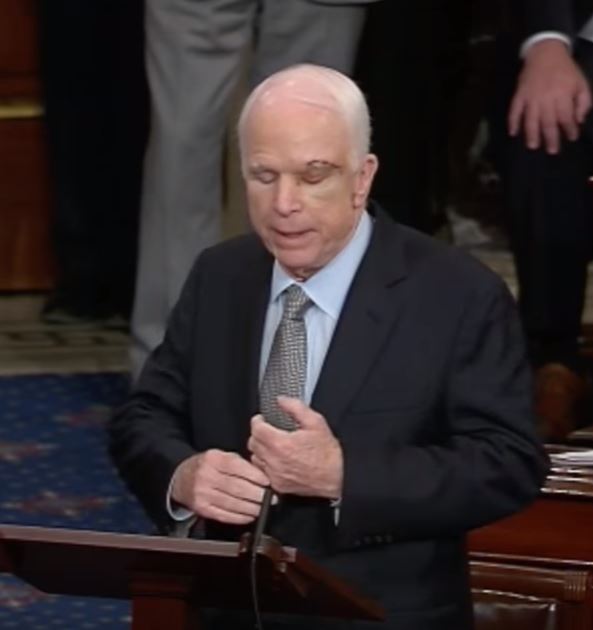
John S. McCain has died at 81. Of course, the media calls him a war hero which make others angry. But still, it is not an appropriate time to criticize the man. Condolences are appropriate for his family who survive him. It is never easy to lose a family member. What rises to the surface for them is all the memories. They will miss him.
After the Michael Cohen guilty plea. his attorney Lanny Davis began pitching a claim that the longtime Trump loyalist/lawyer had information Trump knew of the Russian hacking of Democratic emails ahead of time.
Davis said: “I believe that Mr. Cohen has direct knowledge that would be of interest to Mr. Mueller that suggests -I’m not sure it proves- that Mr. Trump was aware of Russian government agents hacking illegally, committing computer crimes, to the detriment of the candidate who he was running against, Hillary Clinton.” And the media ate it up, and put Davis on just about every possible TV show imaginable.
However, in an interview with the Washington Post this weekend, Mr Davis not only walked back that claim, he entirely retreated from it:
(Via Washington Post) An attorney for Michael Cohen, President Trump’s former lawyer, is backing away from confident assertions he made that Cohen has information to share with investigators that shows Trump knew in 2016 of Russian efforts to undermine Democratic nominee Hillary Clinton.
Lanny Davis, a spokesman and attorney for Cohen, said in an interview this weekend that he is no longer certain about claims he made to reporters on background and on the record in recent weeks about what Cohen knows about Trump’s awareness of the Russian efforts.
[…] asked Saturday how confident he was that Trump knew about the hacking before it became public, Davis said: “I am not sure. There’s a possibility that is the case. But I am not sure.” […] “I was giving an instinct that he might have something to say of interest to the special counsel” about hacking, Davis said. In retrospect, he said, “I am just not sure.” (more)
This follows on the heels of Mr. Davis also walking back his prior claim that candidate Trump knew of the Trump Tower meeting. During a CNN interview Lanny Davis told Anderson Cooper, per his client, candidate Donald Trump had no knowledge of the Trump Tower meeting between Don Jr. and Natalia Veselnitskaya.
And Davis has also stated that all of the claims within the Clinton-Steele dossier about Michael Cohen are also 100% false. “Thirteen references to Mr. Cohen are false in the dossier, and he has never been to Prague in his life,” Davis told Bloomberg news.
So, there we have it. Lanny Davis is saying the dossier is false; Trump never knew about the Trump Tower meeting with the Russian lobbyists; and his client, Michael Cohen, has no knowledge of anything to do with Donald Trump and Russians.
:::poof::: …gone. Just like that!
But why is uber-partisan Democrat Lanny Davis now deconstructing the entire ‘Muh Russia’ conspiracy theory? Why is Clinton acolyte Lanny Davis now single-handily dismantling two years of narratives promoted by the left-wing media?
Well, the answer to those questions is likely found in the outlet now helping to systematically retreat from years of false-reporting; The Washington Post.
There never has been any truth to the vast ‘Muh Russia’ conspiracy, you know that; all research proves that; it is a fundamentally made-up narrative initiated to support the deployment of the scheme team insurance policy. Eventually it was always going to end up hitting a dead end. However, the Washington Post is also the outlet for the aggregate U.S. intelligence apparatus, and particularly the CIA, FBI and DOJ-NSD. Essentially WaPo is their PR and Narrative Engineering firm.
Before giving Lanny Davis any credit for magnanimous honesty, think about what the remaining inside elements of the scheme team need (in combination with the risk matrix of those now on the outside).
Impeachment was the end-objective of the insurance policy. Lanny Davis is now the pivot man to take the impeachment ball from Robert Mueller (Muh Russia) and pass-it-off to the Southern District of New York under the auspices of ‘campaign finance violations‘.
With the DOJ Inspector General FISA and Spygate investigation ongoing -likely nearing completion, and quite possibly bringing unwanted sunlight upon the entire scheme architecture- the impeachment crowd need a way to draw focus away from the risky IG sunlight outcome and still maintain morale amid the resistance movement.
Lanny Davis becomes the tool for the entire shift.
Watch…
The sun is setting on the ‘Muh Russia’ narrative. There was no obstruction. Both failing narratives no longer provide any benefit for the 2018 mid-term elections. Democrats need a valid reason to keep impeachment hopes alive; hence the visible shift toward campaign finance laws…. and terribly immoral Trump etc.
Lanny Davis is the pivot-man.
Remember, this is the Washington Post, CNN, New York Times, MSNBC primary audience; and the democrat party standard voter:
The overwhelming majority of Sunday political talk-show discussion focuses around the death of UniParty Senator John McCain, etc. There is little value there, and grandma’s rule always applies.
However, Representative Darrell Issa appeared on Sunday Morning with Maria Bartiromo for a discussion on multiple subjects including the DOJ, Robert Mueller, North Korea and ongoing trade reset initiatives with China.
Remember the ju-ju bones?… Well…. The U.S. Main Street economic engine is almost firing on all cylinders as brick-and-mortar retailers drop their historic complaints of e-commerce impacting their sales and foot-traffic, and instead begin seeing the real life consequences from a resurgent American middle-class.
Target CEO Brian Cornell: “There’s no doubt that, like others, we’re currently benefiting from a very strong consumer environment — perhaps the strongest I’ve seen in my career.” “We’re seeing a great consumer response … unprecedented traffic. As we go back and look, we’ve never seen traffic growth like this.” (link)
The growth in retail foot-traffic is a critical KPI for the economy. Despite economic and business school theory (pushed over the past 20 years), everything of consequence is dependent on a thriving American middle-class; blue and white collar.
Target CEO Brian Cornell is not alone in his optimism:
Walmart VP of Investor Relations Dan Binder: “Job growth is great. Wages are up. Credit is expanding … So the consumer is in great shape. In the surveys that we look at, they tell us that they are feeling good about their financial condition.”
Home Depot CFO Carol B. Tomé: “As we look to the back half of the year, we continue to expect strong economic growth, with the backdrop of a healthy home improvement environment. Homeowners continue to enjoy home price appreciation, and rising wages and low unemployment have driven consumer confidence to record high levels.”
Macy’s CEO Jeffrey Gennette: “Based on the first-half performance, our strong execution and the anticipation of continued healthy consumer spending, we’re raising both sales and earnings guidance for the year.”
Lowe’s CFO Marshall A. Croom: “We expect to see solid sector growth driven by gains in employment which should boost disposable income and consumer spending.”
The middle-class economic engine can/is self-sustaining around the basic principles of MAGAnomics. Additionally, finalizing America-first trade deals could explode U.S. GDP growth as investment pours into the U.S.A. We will soon need to build a bigger-engine to handle all the high-octane investment fuel.
The economic models of the entire last generation+ are based on the assumptions of continuing globalist economics which advances, and has advanced, the interest of Wall Street over Main Street. They were driving a “service-driven economy” message.
The investing class economy, ie. another name for a ‘service-driven economy’, has been the only source of historic reference for approximately three decades. These talking heads convinced themselves that a “service driven economy” was the ONLY economy ever possible for the U.S. in the future. WATCH:
.
Back in January 2017 Deutsche Bank began thinking about it, applying new models, trying to conceptualize and quantify MAGAnomics, and trying to walk out the potential ramifications. They began talking about Trump doubling the U.S. GDP growth rate when all U.S. investment groups couldn’t yet fathom the possibility.
As we have continued to share, CTH believes the paycheck-to-paycheck working middle-class are going to see a considerable rise in wages and standard of living. How high can wages rise?… that depends on the pressure; and right now the pressure is massive. I’m not going to dismiss the possibility we could see 10 to 20% increases in year-over-year wage growth in multiple Main Street economic sectors.
Winnamins. We need lots of them…
Now here’s the critical leadership part…. After two-plus decades of Wall Street emphasis on inventory and supply chain management: Who is going to be bold enough to ramp up inventories high enough to prepare for, and take advantage of, the upcoming MAGAnomic holiday season?
It is an inarguable fact that ideologues within the U.S. Department of Justice and Federal Bureau of Investigation used their official positions to conduct a political operation against the candidacy of President Trump. It is also an inarguable fact that DOJ/FBI contractors were exploiting the NSA/FBI database for opposition research as evidenced in the FISA 702(16)(17) abuses admitted by the DOJ and outlined in a FISA ruling by presiding FISA Judge Rosemary Collyer. There is currently an Office of Inspector General investigation by Michael Horowitz into FISA abuse to discover the scale of the corrupt use.
Major HatTip@JohnWHuber – Today in the Spectator U.K. another sketchy journalist with deep ties to the intelligence apparatus, and specific ties to leaks from former CIA Director John Brennan, outlines that Robert Mueller has “electronic records” showing Michael Cohen travel to Prague:
[…] The more important question is whether Cohen has even been to Prague. Steele’s dossier claims he did go, in 2016, to meet Russian hackers and Russian intelligence officers. Cohen was asked by The Atlantic magazine about this claim, and about Russia. He responded: ‘I’m telling you emphatically that I’ve not been to Prague, I’ve never been to [the] Czech [Republic], I’ve not been to Russia.’ If my ‘eyewitness’ to the Moscow meeting is telling the truth, then perhaps Cohen was, in the same breath, being misleading about Prague, too — and the whole Russia ‘conspiracy’ starts to unravel. I have spoken to one intelligence source who says Mueller is examining ‘electronic records’ that would place Cohen in Prague. (link)
Michael Cohen has never been to Prague; even Cohen’s anti-Trump lawyer Lanny Davis admits the Cohen claims inside the Steele dossier are nonsense. CNN, again another anti-Trump voice, confirmed in January Cohen was never in Prague as the dossier claimed. Quite simply, Trump’s lawyer Michael Cohen has never been to Prague.
However, the Paul Wood source, likely Brennan, is claiming there are “electronic records” that would place a Michael Cohen in Prague. Accepting this claim as possibly true, this actually confirms our initial research into this issue. The intelligence apparatus, either in the U.S. or connected to Brennan’s international CIA objectives (U.K and Australia), extracted electronic FISA records mistakenly identifying the wrong Michael Cohen.
The issue is two-fold. (#1) the mistake is inside the Steele Dossier: meaning the intelligence community was feeding Steele information and vice-versa; and (#2) by extension this shows an official IC conspiracy attached to the use of the dossier.
The Cohen-travel-mistake almost certainly links the use of FBI and NSA database searches to the intelligence laundry scheme between the Clinton campaign, Fusion GPS, Nellie Ohr and the Christopher Steele Dossier….. washed through the DOJ (Bruce Ohr) and passed on to the FBI (Peter Strzok); and then reconstituted for a FISA surveillance application:
The FISA-702(16)(17) abuses lie at the heart of the initial opposition research being conducted against all of Clinton’s opponents. Indeed, as outlined by FISA Judge Collyer, from November 2015 through May 2016 eighty-five percent of the thousands of search queries were unlawful violations of the Foreign Intelligence Surveillance Act:
85% of all FISA search queries were in violation. 85% !!!
The intelligence mistake of Michael Cohen traveling to Prague, is a fingerprint connecting the FBI/DOJ/IC FISA(702)(16)(17) database searches to the Intelligence Community, Fusion-GPS, contractors, and the Steele dossier.
This Cohen-travel-mistake then becomes a risk. As such there would be a very strong motive for similarly aligned political entities within the U.S. intelligence apparatus to cloud the connection.
Thus the origin of the July 31st, 2016, FBI Counterintelligence Operation against candidate Trump began as an unofficial outcome of an unofficial CIA referral (John Brennan) connected to unofficial contacts with political and intelligence people within the U.K and Australia. An unofficial and Machiavellian construct.
After Donald Trump won the election, all of the aligned intelligence entities -including Obama officials therein- were now at risk. Hence “the insurance policy”. The issues extend beyond the unlawful activity of the DOJ and FBI; however, one of the trails of their collective activity ended up inside the Steele Dossier with the false fact surrounding Michael Cohen in Prague.
Paul Wood isn’t the first person to claim Robert Mueller has records. In April of this year, McLatchy, leaking from Mueller’s team, also claimed “electronic record” evidence:
WASHINGTON – The Justice Department special counsel has evidence that Donald Trump’s personal lawyer and confidant, Michael Cohen, secretly made a late-summer trip to Prague during the 2016 presidential campaign, according to two sources familiar with the matter.
Confirmation of the trip would lend credence to a retired British spy’s report that Cohen strategized there with a powerful Kremlin figure about Russian meddling in the U.S. election. (read more)
It is almost certain that CIA Director John Brennan was the source for the most recent U.K. statement about Mueller having electronic records claiming Michael-Cohen-Travel. This is pertinent because in a recent interview with Rachel Maddow the former CIA Director made some remarkable admissions.
Now we come to the segment where I believe Brennan may have slipped badly – and exposed some potentially illegal tactics (19:18 mark):
BRENNAN: When I left office on January 20th of 2017, I had unresolved questions in my mind about whether or not any of those U.S. persons were working in support of the Russian efforts.
MADDOW: And those were referred, those concerns about specific U.S. persons referred to the FBI.
BRENNAN: We call it incidental collection in terms of CIA’s foreign intelligence collection authorities. Any time we would incidentally collect information on a U.S. person, we would hand that over to the FBI because they have the legal authority to do it. We would not pursue that type of investigative, you know, sort of leads. We would give it to the FBI.
So, we were picking things up that was of great relevance to the FBI, and we wanted to make sure that they were there – so they could piece it together with whatever they were collecting domestically here.
That’s not how incidental collection is supposed to work. And the collection doesn’t sound incidental.
FISA Title I and III provisions relate to the conduct of electronic surveillance and physical searches for foreign intelligence purposes of persons, facilities, or property inside the United States.
Section 702 permits the government to target for surveillance foreign persons located outside the United States for the purpose of acquiring foreign intelligence information. To carry out monitoring under Section 702, the government chooses targets, which cannot be individuals known to be US persons.
The law specifies that a “significant” purpose of the monitoring must be to obtain “foreign intelligence information”. Again, U.S. Citizens cannot be the primary target.
Targeting procedures are designed to ensure that only foreign persons located outside the U.S. are targeted for foreign intelligence collection purposes. Minimization procedures are intended to protect any U.S. person information that is incidentally acquired in the course of Section 702 collection.
There are many loopholes to the entire process. The FBI can query acquired Section 702 data. And they can do so using U.S. person inquiries – without a warrant. But U.S. persons are not supposed to be a target of the initial Section 702 collection.
Here’s why Brennan probably chose the surveillance route he did.
Unlike Title I and Title III FISA surveillance, Section 702 collection is not subject to individual formal FISA Court approvals. Due to frequency of collection, instead of issuing individual court orders, the FISC approves annual certifications submitted by the Attorney General and the Director of National Intelligence.
What Brennan discussed sounds eerily similar to what Devin Nunes uncovered in March 2017:
Devin Nunes– “I recently confirmed that on numerous occasions, the intelligence community incidentally collected information about U.S. citizens involved in the Trump transition. I have seen intelligence reports that clearly show the President-elect and his team were at least monitored and disseminated out in intelligence, in what appears to be raw—well I shouldn’t say raw—but intelligence reporting channels.
Details about persons associated with the incoming administration, details with little apparent foreign intelligence value were widely disseminated in intelligence community reporting. From what I know right now, it looks like incidental collection. We don’t know exactly how that was picked up but we’re trying to get to the bottom of it. This is normal incidental collection. It was normal foreign surveillance.
I think the NSA’s going to comply. I am concerned – we don’t know whether or not the FBI is going to comply.”
Earlier today U.S. President Donald Trump highlighted an optimistic outlook toward the framework for a U.S./Mexico trade deal. Not unanticipated:
We continue to remind everyone to focus on U.S.T.R. Robert Lighthizer and AMLO’s guy, Jesus Seade; everyone else is multinational corporate media chaff and countermeasures.
“We are already looking at all the issues. We might close this, not in a matter of hours, but these days. We still have next week,” Jesus Seade, designated chief negotiator of Mexican President-elect Andres Manuel Lopez Obrador, told reporters.
It is important to note that U.S. Trade Representative Robert Lighthizer has twice asked Jesus Seade to remain AFTER hours when all other trade officials have concluded discussions. Closed-door conversations between Lighthizer and Seade; and no-one else. [Refer back to the two Trump baselines again]
Now, clear the MSM fog from all perspectives; and instead look directly at the discussion framework expressed by Jesus Seade, AMLO’s guy:
[…] Asked by reporters outside the offices of the U.S. Trade Representative in Washington if Canada would then join the talks, [Seade] said: “I don’t see any reason why they have to come after we finish. It’s up to (U.S. Trade Representative Robert) Lighthizer to organize his time.”
The Mexican delegation — and sources familiar with the closed-door negotiations — have said previously Canada would return to the table as soon as the other two resolved their bilateral issues — maybe even this week. Seade’s comments seemed to indicate otherwise. (LINK)
Previously:
WASHINGTON (Reuters) – Mexico and the United States are close to resolving remaining bilateral issues in the revamp of the NAFTA trade deal, officials said.
[…] “We are already looking at all the issues. We might close this, not in a matter of hours, but these days. We still have next week,” Jesus Seade, designated chief negotiator of Mexican President-elect Andres Manuel Lopez Obrador, told reporters.
“We shouldn’t rush, but we’re already close,” Seade added as he left the Washington offices of U.S. Trade Representative Robert Lighthizer following the latest talks on renegotiating the North American Free Trade Agreement.
Since restarting last month, the talks have focused on settling differences between Mexico and the United States that go to the heart of U.S. President Donald Trump’s complaint that NAFTA has hollowed out U.S. manufacturing to Mexico’s benefit. (read more)
Always draw references from what you know to be empirically true. President Trump will not accept the NAFTA fatal flaw. NAFTA is not currently a trade bloc. NAFTA is currently an internal agreement of terms-for-commerce between the U.S., Mexico and Canada. Because it is not a trade bloc, NAFTA is bad.
The U.S. is the host (market), and Mexico/Canada are the parasites exploiting free-movement and economic access to that host. Without new NAFTA rules; making it an actual trade bloc, where Canada and Mexico can only engage with 3rd parties based on the NAFTA group rules; there is no value in NAFTA.
That’s why Trump has essentially sidelined any 3-way discussion, and is engaged in bilateral trade talks. In addition to hiding the ‘fatal flaw’ U.S. financial and corporate media are willfully blind and intentionally obtuse on this key point.
All indications, look at it from a 30,000/ft level, are that Lighthizer has explained this to Seade. President Trump wants to see the Mexican economy gain stability and strength; and he is willing to afford time and economic value toward AMLO to achieve economic strength and more broad-based economic stability; however, team Trump will NOT allow the current exploitation to continue. Period.
Therefore, Mexico has an incredible opportunity…. but only ONE opportunity…. THIS opportunity…. to take advantage of the offer. If they politicize the deal; if they mislead, scheme, or attempt to covertly structure a trade relationship that undermines the basic offer…. POTUS Trump, regardless of opinion or political pressure, will deliver an economic backlash of the size and scale never seen. Mexico has one opportunity.
After the terms are finalized, Mexico will likely have a time-frame where POTUS will permit the slow withdrawal of the ‘fatal flaw’ issue, while simultaneously supporting Mexico’s own internal growth in manufacturing and economic independence.
This is also the goal of AMLO, who wants to see Mexico gain economic independence from the manipulation of the multinational corporations, Wall Street and vulture economics driven by Chinese interests; and this outlook builds the framework of the Win/Win.
It will take time for Mexico to withdraw from prior corrupt agreements with multinational corporations who have invested in exploitative enterprise and bribed corrupt Mexican officials. President Trump is EXACTLY the guy AMLO needs to help guide him through a complex business and economic process of extracting his country from the tentacles of economic exploitation.
Canada is an entirely different kettle-of-fish. Expect no magnanimous Trump approach toward Canada. Hence Jesus Seade said: “I don’t see any reason why they [Canada] have to come after we finish. It’s up to (U.S. Trade Representative Robert) Lighthizer to organize his time.”
By politicizing their economic interests, Justin and Chrystia have made themselves an economic adversary. Battle-hardened Trump, who is impervious to political pressure on trade/economics, will not relent. He simply doesn’t care.
In July 2017, after a speech by former President Obama to the Montreal Board of Trade, Obama instructed Trudeau on how to best weaponize his economic policy to join the anti-Trump resistance. [Conversation pictured above]
President Trump isn’t stupid; he is an apex predator when it comes to the issues of trade, commerce and economics. Trump knew the scheme, he knew the meeting, he knew the likely direction that Trudeau and Chrystia would take after receiving these instructions. And, in typically predictable form, Justin from Canada followed the left-wing plan and began working against any NAFTA renegotiation.
Justin and Chrystia intentionally planned to undermine any change and scuttle the negotiations. Hence the demands for gender issues and climate change within NAFTA.
I have created this site to help people have fun in the kitchen. I write about enjoying life both in and out of my kitchen. Life is short! Make the most of it and enjoy!
This is a library of News Events not reported by the Main Stream Media documenting & connecting the dots on How the Obama Marxist Liberal agenda is destroying America