What Started Us Down the Path of Destruction to Our Constitution?


I am in the final stages of publishing a book exposing the false claims that mankind is destroying the planet by the use of fossil fuels i.e. coal, oil and natural gas. The lies that have been told on this subject put the lies of Hitler and Goebbels into the league of rank amateurs. But like those two infamous Politicians those Politicians today that practice those same arts of lies and deceit have the same motives in mind; absolute power over the people.

When I became a Green Beret one of the things I was taught as an officer, besides the arts of war, was how to bring down a government for that was our original mission.  So today when I see what is being done in America I see that there are those that are doing what I was taught to do. The only way to counter that is with the truth and that is the purpose of this blog as I stated in my About section.

The wedge that those that desire “power” are using against us is “CLIMATE CHANGE” that we are told is caused by too many people and using too much energy therefore we are not sustainable. The truth is that the climate has always changed and that there isn’t enough carbon based fuels on the planet to do what they claim will happen. The original projections of doom and gloom have continued to be pushed into the future as we reach points in time where the disasters were to happen and they were not there. The latest IPCC assessment AR5 does this again. So what follows is a section from the introduction of the book I am written to destroy this travesty against our way of life.

The belief that CO2 is causing climate change on the planet by raising the planet’s temperature came primarily from the late 1960’s. The belief was that the increased temperatures, from CO2, would then change the world’s climate patterns which would then result in the melting of the world’s glaciers, increased storms and probably loss of valuable crop lands by rising sea levels. The implied result on the world’s civilizations will be catastrophic and therefore there will be a significant loss of life from both the climate change and the probable wars that will be fought over dwindling resources.

To prevent this from happening the United Nations Conference on the Human Environment, having met at Stockholm from 5 to 16 June 1972, made a statement part of which is, “… having considered the need for a common outlook and for common principles to inspire and guide the peoples of the world in the preservation and enhancement of the human environment …” and then they established a set of principles and an international forum, the first of which was held in Rio de Janiero in June 1992 and then later Kyoto in 1997 where goals for a reduction in the CO2 emissions from the burning of fossil fuels primarily from petroleum, coal and natural gas were agreed to by the parties. Efforts to date have been totally unsuccessful and the CO2 levels have now reached 400 ppm and the rate of growth is increasing at an accelerating rate that is currently above ~2 ppm per year.

The first major program to began the task of changing how the entire world would adapt to the “required” reductions in Carbon Dioxide was made public at the UN Conference on Environment and Development (Earth-Summit), held in Rio-de-Janeiro on June 13, 1992, where 178 governments voted to adopt the program called UN Agenda 21. The final text was the result of drafting, consultation, and negotiation, beginning in 1989 and culminating at the two-week conference. Agenda 21 is a 300-page document divided into 40 chapters that have been grouped into 4 sections that was published in book form the following year:

Section I: Social and Economic Dimensions is directed toward combating poverty, especially in developing countries, changing consumption patterns, promoting health, achieving a more sustainable population, and sustainable settlement in decision making.

Section II: Conservation and Management of Resources for Development Includes atmospheric protection, combating deforestation, protecting fragile environments, conservation of biological diversity (biodiversity), control of pollution and the management of biotechnology, and radioactive wastes.

Section III: Strengthening the Role of Major Groups includes the roles of children and youth, women, NGOs, local authorities, business and industry, and workers; and strengthening the role of indigenous peoples, their communities, and farmers.

Section IV: Means of Implementation: implementation includes science, technology transfer, education, international institutions and financial mechanisms.

The goal of UN Agenda 21 is to create a world economic system that equalizes world incomes and standards of living and at the same time reduces Carbon Dioxide levels back to the levels that existed prior to the industrial age of ~300 ppm. We are now at 400 ppm and growing at a geometrically increasing rate now a bit over 2 ppm per year and at that rate we will reach 500 ppm in 2050 at which point the UN Climate models and there spokespersons Al Gore and James Hansen say we will have an ecological and economic disaster that is irreversible.

There are only two ways to achieve this reduction back to their ideal ~300 ppm and they are not mutual exclusive. One is to reduce the world’s population and the other is to either reduce energy consumption or make a switch to non carbon burning fuels such as solar PV or wind turbines. Agenda 21 is the driver for all the sustainability programs that are being implemented at this time in the United States and the European Union; which mean that if the belief that Carbon Dioxide is the ultimate reason for changes in global climate is not true, that untold trillions of dollars and massive economic restructuring would be unwarranted.

According to the International Energy Agency (IEA) we are using about 500 Quad of energy world wide right now of which maybe 15% is classed as sustainable, and there are estimated to be 7.0 billion people on the planet. That means that 425 Quad of energy usage is not sustainable and the world’s population could reach 9.0 billion by 2050. By then we would be using 900 Quad of energy at current growth trends of which probably 650 Quad will not be sustainable if nothing major changes. The goal of Agenda 21 is therefore to find ways to reduce the number of people or significantly reduce how much energy they use. Carbon taxes and the redistribution of wealth from rich countries to poor countries are the means to achieve this but there are no engineers on the planet that would say it would be possible to produce 650 Quad of sustainable generating capacity in 35 years (335% more than now), especially since no real effort has yet been made. And some of the “sustainable” categories are mutually exclusive e.g. growing plants for ethanol verses food.

To put this in perspective if we could make 250 Quad of reliable sustainable generating capacity annually that would mean that we could not have more than 1 billion people (actually the goal seems to be about half of that) on the planet and even those would not be able to live as well as we in the US do now. Prior to the 2008 financial collapse the US used about 100 Quad and had 300 million people. If the goal is 250 quad and 1 billion people that would mean a 25% reduction in the standard of living for all the advanced socialites. Since this is what is “required” to achieve the stated goals of preventing 500 ppm from happening it’s very obvious that there is a major problem brewing.

How did all this negativism about our future come about? Well actually it started in 1798 when Thomas Robert Malthus (b-1766 to d-1834) who was a cleric in the Church of England and a famous Classical English economist published his An Essay on the Principle of Population. This work and understanding it is critical to understanding our current situation. From Wikipedia we have the following. Malthus argued in his Essay (1798) that population growth generally expanded in times and in regions of plenty until the size of the population relative to the primary resources caused distress:

“Yet in all societies, even those that are most vicious, the tendency to a virtuous attachment is so strong that there is a constant effort towards an increase of population. This constant effort as constantly tends to subject the lower classes of the society to distress and to prevent any great permanent amelioration of their condition”.

—Malthus T.R. 1798. An Essay on the Principle of Population. Chapter II, p 18 in Oxford World’s Classics reprint.

Malthus argued that two types of checks hold population within resource limits: positive checks, which raise the death rate; and preventive ones, which lower the birth rate. The positive checks include hunger, disease and war; the preventive checks, abortion, birth control, prostitution, postponement of marriage and celibacy. In later editions of his essay, Malthus clarified his view that if society relied on human misery to limit population growth, then sources of misery (e.g., hunger, disease, and war) would inevitably afflict society, as would volatile economic cycles. On the other hand, “preventive checks” to population that limited birthrates, such as later marriages, could ensure a higher standard of living for all, while also increasing economic stability. Malthus also argued against a variety of imaginable solutions, such as the notion that agricultural improvements could expand without limit and that would also prevent this from happening.

Of the relationship between population and economics, Malthus wrote that when the population of laborers grows faster than the production of food, real wages fall because the growing population causes the cost of living (i.e., the cost of food) to go up. Difficulties of raising a family eventually reduce the rate of population growth, until the falling population again leads to higher real wages. In the second and subsequent editions Malthus put more emphasis on moral restraint as the best means of easing the poverty of the lower classes.

Despite facts to the contrary as science found ways to provide more food from less land, the limitation of the world’s population has been the goal of many thinkers ever since. Today that view started by Malthus is promoted by the Club of Rome which was founded in 1968 about the same time as all the other like organizations started. From this group and others like it a one world government has been promoted which would be run by the world’s intellectual elites and they would limit growth and population to achieve a level that they believe is sustainable.

There are many scientists in the world that do not agree with the conclusions of the IPCC, not necessarily from bad science but from a lack of sufficient knowledge of all the relevant variables and the lack of computers of a sufficient capability to properly process the number of equations that would be required. Many of these scientists also believe that the world’s temperature is primarily controlled by other factors than CO2. The problem has been showing a provable theory based on science and physics on how this might occur and how could this alternative explanation be used to predict future global temperatures.

In this book we will show that properly constructed mathematical modeling can be used to predict world temperature with significantly greater accuracy than the IPCC computer models. The reason that the model proposed here is more accurate is that it is based on past changes in temperatures that have been observed and have documented patterns and those patterns have a reoccurring cycle. When those patterns are broken down into their simplest from and then properly modeled and plotted into the future it is found that the resultant model’s predictions match very closely with the observed world temperatures as published monthly by NASA.
 

A Public System for Economic Development


How to create growth

Background

This was written in 2008. Until only a few decades ago economic development in the sense that it is viewed today did not exist. New developments happened by personal salesmanship and hard work. Everything changed after the federally funded “Manhattan project” showed what directed research could do. Then shortly thereafter when Silicon Valley was created in California as a result of mostly federally directed research for computational power for the military and space markets precedence was set. Now every city in the country would like to have a success like that in their town but how?

The focus over the past several decades has been on entrepreneurs and venture capital with emphases on the venture capital thinking that that was the key, to have seed, angel and traditional venture money available. That approach only partially works for the funds managers looking for a return, which they must, go where the perceived opportunities are which is not necessarily where the “local” community is. The local community is being defined here as where the fund is located.

But actually, if you think about it, the focus on money and trying to find the next hot deal is an exact backwards approach for a region or city. The key is not in making the venture money available for the money will come to the deals that are good. The key is creating a concentration of creative people and entrepreneurs.

The logic here is that no one knows what the next hot deal will be but the entrepreneur that has it. In fact, no one foresaw the benefit to any of the major development trends until after they happened. Further there is no way to know which entrepreneur will be successful and when they will first get an idea that’s good. Therefore for any locality, such as Cleveland, that wants to create growth the most cost efficient method to get real economic development would be to attract a large numbers of entrepreneurs. For if enough of them could be concentrated in a location their very numbers would almost guarantee a big hit at some point in time. This is a shotgun approach and when there is no hard target in sight a shotgun is better than a rifle.

To bring entrepreneurs to a location in the numbers required to guarantee a major hit would mean a number of thing are required and money is not one of them. Money is the most mobile of the requirements for success and will come to the ideas. What is needed is to focus on the innovation process and set up a process to facilitate all the steps. There areas can easily be identified and there are a place to live, a place to invent and a place to get help.

A place to live:

Create an economic empowerment zone by tearing down the worst ward in any inner city and build a village of middle class homes at say $150,000 each for the home. Say 500 to 1,000 homes so we would need maybe $250,000,000 for the project which can be done with bonds. These homes are loaned to anyone who submits a valid business idea to a review committee and they are allowed to live there free for 10 years. They get a reduction in the $150,000 home commitment that they make of $5,000 for every job created in the city. At the end of 10 years or sooner they get brought out. The home is then cleaned up and given to the next entrepreneur. There is a lot more to this but we’ll skip for brevity.

A place to invent:

Most inventors are hampered by a lack of resources. So the next step is to create a place they can go were all the tools for making and doing things exist. Let’s call it a craft center for lack of a better term. A place that has research facilities, a small machine shop a computer lab with appropriate software and all the other things that you might need to develop or build something. Ideally this craft center would be in the center of the entrepreneur’s village. That keeps travel time to a minimum which facilitates that innovation. Like in the previous discussion there is a lot that goes with this but those are only details. An educated guess would be $50,000,000 to build the center again well within the reach of local bonds.

A place to get help:

The third thing needed is knowledge and education; so how about a 2 year, a 4 year and a master’s degree in entrepreneurship for the curriculum in a special school or college within a university. In each case the requirement for graduation would be a business plan. What would be taught would be how to find markets how to manage and how to plan. A combination of a business and technology program so to speak. But since some of the areas where growth could be expected are very technical and science oriented some method of traditional education would be also be required. Combining an engineering degree with the entrepreneur’s school so all the non engineering courses required for a traditional engineering degree would be supplied by the entrepreneur’s courses.

Student loans could be given out with the entrepreneur either paying in cash, as normal, or given a credit of $5,000 for each job created. Again many details but we’ll skip those for now. Hard to estimate the costs but lets say a thousand students so it would probably be under $100,000,000 to put 1,000 students through 4 years. If those 1,000 students each created only 25 to 35 jobs, on average, that is 30,000 jobs per year after the first 4 years of the program.

Discussion:

Every location in the country, or the world for that matter would like to foster economic development within its geographic area of responsibility. Governments, States, Counties and Cities have all set up programs to try and find a way to promote economic growth, especially technology based growth with all kinds of “programs,” “grants” and “tax breaks.” Not many of these programs have worked as well as they were hoped to, and in my opinion there are several major reasons why promoting this kind of growth is very difficult. These are: one, true “New Ideas” typically don’t come from organizations they come from unknown inventors or entrepreneurs; two, these inventors (word used to mean both inventor and entrepreneur) normally don’t have “experience” or “money;” three, many of the traditional methods of help result in the inventors losing most of the value of what they came up with; four, because of politics with the use of “public money” most of these programs end up being very conservative; five, even with these programs there is no one source shop to go to.

Many, if not most, of the core issues for the inventor center on finding money for doing the designs, building prototypes and getting patent protection without losing their idea. Writing business plans and securing seed and/or start up money are also high on the list of needs as well. Getting through these hurtles is extremely hard for most inventors and many good ideas never get made because of this. So is there a way to help these inventors and promote technology based growth. I think there is.

At the State or better at the County level within a state a special kind of community could be established with public money that did the following.

A. Have a place to live for the entrepreneur and his/her family. This would consist of homes build for the city or county where they were located, preferably located near a major university. In the community would be created an environment that would facilitate inventing. That means as many of the daily needs of the community as possible would be located here. The logic being that you want the inventor to spend as little time as possible doing things that aren’t inventing.

B. In the center of this community would be a facility that would contain: a number of good computers and appropriate software (both business and technical), related support equipment like desks, phones, file cabinets, copiers and fax machines, a complete machine shop, a model making shop to include stereo lithography, and an electrical and electronics lab. This listing is only meant to show breath not every aspect. In essence this facility would have everything that an inventor would need to take his or her idea from concept to working model.

C. Have a small staff of support people such as technicians, attorneys, engineers, programmers, accountants, business people and machine operators knowledgeable in all aspects of making things. These people would be there for advice and could come from the nearby college and/or from retired business executives. Existing organizations like SCORE would fit in here perfectly. Obviously there would need to be some admin people as well to keep the place running.

D. Have the support of local business that had previously agreed to help or mentor those using the facility.

E. Have ongoing contacts with the seed and venture capital community and even hold investment conferences during the year where inventors could present their case or ideas to interested parties.

In other words this would be a comprehensive facility where and inventor could get access to design and make almost anything be it hardware or software in nature. And it would be a place that took no ownership in the idea its sole purpose would be to facilitate the inventor and give him or her a place to work.

To gain access to this facility an inventor would need to write up his/her idea and submit it to a review committee. The main purpose of the review would be to make sure the idea was within the scope of the facility to handle and that it had some economic potential if it could be produced. This would not have to be a formal presentation and its purpose would not be not to judge whether the idea would work or whether the inventor had the ability to make it. The secondary purpose would be to see if the inventor had the will to make things happen. Based on a positive review of the idea presented the inventor would be allowed to use the assets of the facility to design and build their idea. However this is not an open ended deal and part of the review would be to tell the inventor for how long they had the use of the facility. It is assumed some form of scheduling would be required and the facility should be open 24/7 to accommodate people that are holding jobs. They would have to do the work and the “state” would provide the tools to do so. The inventor would not be given any money only the means to design and build their idea. The technical and business staff would be there for guidance and support but not for doing the work. However if the inventor needed help in an area and wanted to pay for help it could be provided at minimal cost to them.

To an inventor buying all the equipment needed to build something would be cost prohibited and to try and find a range of local companies that would even do it for them would be very hard as most companies are looking for production work not one or a kind projects with unestablished companies or inventors where they may not get paid for what they did.

To the state buying all the equipment needed to establish a facility of this kind is not out of the question but finding new ideas are. Public employees are not risk takers and so most publicly funded programs end up being to make small improvements to existing ideas. The state here provides the expensive physical plant and since it is a conservative use of funds the public is not seeing their money being given away.

Since local and state money was part of the funds used to build the facility the inventor would agree to start their venture in the immediate locality if at all possible and within the state in any case. That is not too much to ask for the use of the facility and is really the only string attached.

Analysis:

Using Cleveland as an example since it has gone from the top to the bottom in less than 80 years we can see what works and what doesn’t work. Cleveland in the last half of the 19th century and the first part of the 20th century was a center of innovation. That innovation created growth. Cleveland in the ’00’s is for all practical purposes brain dead and is now ranked as the second poorest city in the country.

If nothing changes than nothing changes and in Cleveland if it doesn’t work the first second or third time just keep trying till it does. Sadly no matter how many times we study the problem and try it has never worked and so we are where we are. We’ve been trying the same formulas for several generations and so the people have figured out that the politicians and community leaders don’t have a clue so they voted with their feet, their gone. Even the PD figured that out in the editorials they have done over the past several years. Much good it did as no one is reading them but then maybe the flaw in the PD work is they assumed Clevelanders can actually read.

A solution that has worked well in other areas of the country, where similar but not as bad problems existed, was to combine all the affected communities into one large city. Again the PD has recommended that for Cleveland but I guess we would all rather disappear as a community rather than fix the problem. Too many politicians involved to actually make this possible. For think about it there would be a lot of mayors and council people out of a job if this was enacted. So since that will never happen here this entrepreneur’s village maybe something that could be done.

Recommendation:

The underlying logic here is to find a way to attract entrepreneurs here not the money as for the jobs it’s the people not the funds that is the key to turning Cleveland or any city around. So, using this White paper as background any of the local colleges could do an economic analysis of this idea to include pro forma economic projects of implementing these recommendations. The study would cost little and given the critical condition of the city what is there to loose?

The Responsibilities of the Citizens and the Press


The unsaid understanding of the Constitution

The Constitutional Convention in Philadelphia in 1787 ended with a Proposal to Change the existing Articles of Confederation to the Constitution that we now have.  There was a procedure to make changes in the Articles just as there is in the present Constitution and so a national debate ensued. On one side were those that wanted a stronger agreement between the states to solve existing problems; on the other side were those that felt the proposed Constitution went too far.  Those for the Constitution were the Federalists and those that were not (as written) were the Anti-Federalists. The compromise to get the votes necessary to make the change, were what we now know as the Bill-of-Rights which are the first 10 amendments to the constitution. Specifically they were a listing of things that the Federal Government could not do or had no jurisdiction over, the reason these were enacted as the first order of business of the new government was that the citizens, who had just fought the American Revolutionary War, did not want a Ruling Class to take over and negate what so many had just died for.  We would call this process consensus today as everybody got enough of what they thought was needed to get all 13 states to agree, albeit it was a long process lasting until 9th state ratified it on June 8, 1778 making it legal by the terms of the Articles. Four years later Vermont, the last state, ratified the Constitution making it all thirteen.

The first Amendment of the Constitution was of a guarantee of various fundamental freedoms; of freedom of religion, of free speech, a free press, the right to assemble, and the right to petition the government.  This was very important and so it was the first of what ended up being the Bill-of-Rights.

That held for almost 200 years and then we became spoiled and forgetful and to trusting of our elected representatives and we are where we are now with a congress, both the House and the Senate, and President and Vice President that have desires to nullify much of the Constitution and Bill-of-Rights.  These 537 elected representatives, both political parties, are now trying to tell 317,674,000 Americans (when this was written) that they know better than we do how to live our lives. Most families have issues managing 3 or 4 individuals so to assume that, that so few a number could manage the most complex economy that ever existed is frankly absurd.

There were three checks to the concentration of Federal power. The first was a knowledgeable citizenry, the next were the states themselves, and the last was the press. The Free Press was the last defense for maintaining a free country.  Their duty was to question and research everything the government was doing and to assume that there were nefarious reasons for anything that they proposed.  There should have been no distinction as to who was in power as all of them are human and we all have the same faults, self interest.

The politicians are no different from any of us and if given the opportunity they will find ways to gain power and influence. One of the ways they do this is to convince us that they are different from any of the rest of us, how that would be possible I’m not sure since they have the same DNA as we do.  According to them Businessmen and Financiers are all corrupt and they need to be managed by them. This would be no different from letting the Fox guard the hen house. The people in the government and the people in private business are identical and many go back and forth between the two sectors.  The only difference between the two is if a business does not provide a service or product you don’t like you don’t buy it and with no sales they go out of business.  In the public sector what you want does not matter it’s what the government will give you that you will get and if they need more money they tax you, which is not a choice you will pay them what they want.

The free Press is now incapable of doing its job, for various reasons, and so the citizens are not aware of what has been going for the past twenty some years.  The problem is that there are a host of very fundamental changes in play now in this country; it’s unlikely, in my opinion, that many of these “fundamental” changes will be successful and that will result in a high probability of economic collapse.

What is left of the free press will be one of the first to go. Unless they wake up!

The Repeating Cycles of Social Time


A Major War is Coming!

Strauss and Howe in their 1997 book The Fourth Turning An American Prophecy outline how social or political time runs in cycles. There is much they have to say in their book and much of that goes all the way back to the Roman times where they find the name for this cycle from the Romans and it’s a Saeculum meaning a long human life of 80 to 90 years. This Saeculum is composed of 4 generations of about 20 some years each. Read the book for the full analysis which is very compelling but for here the salient point is near the end of each Saeculum there is a major war, no exceptions.

The cycles they identify go back to England and the war of the Roses 1459 to 1487 and since then there have been five complete cycles and we are now in the final stages of the sixth cycle which according to them ends around 2025 plus or minus a few years. This period that we are now in is the fourth turning (a turning meaning going from one generation to the other in the Saeculum) hence the name of the book. They can pin down the basic times that all this occurs because these changes have repeated themselves for 555 years now.

The last three major wars going back from the present were: WW II from 1941 to 1945; the American Civil War from 1861 to 1865 and then the American Revolution from 1775 to 1783. The civil war started 86 years after the American Revolution; WW II started 80 years after the Civil War started. The scary thing right now is that 80 years from 1941 is 2021 which is a likely start for the next major world war. However over all the Saeculum’s since the War of the Roses have been getting progressively shorter so that 80 years may not be a good guess.

Straussand Howe are not the only ones to see the pattern but even still they go to great lengths to show why it occurs and how many other sociologists have also seen all or some of the pattern they have identified in their book. I read the book after it came out in 98 or 99 and thought it was interesting and put in on my book shelf. After 9/11 I went back and read the book again since I remembered that they talked about that kind of an event happening around 2005. Since then I’ve read it a couple more times and I am now convinced they are right on and a major war is now eminent.

So based on current events (read my previous post on the Ukraine) which seem to parallel the years before WW II started, actually in 1938 in Europe, we can make a case for the next world war to start any time from 2016 to no later than 2022.

What to do with the Russians?


But the real worry is what about the Chinese?

This president came into office just over 5 years ago with the “Stated” goal of making a “Fundamental” change to America.  Whether the American’s believed him or not he was going to do just that!  Progressives’ like Obama and his appointed minions believe that America is the problem in the world and that our large military scares everyone and that is why they do not like us. I would not agree with this proposition one bit, but but my opinion is irrelevant I’m not in politics either here nor there. However, that doesn’t mean I cannot understand what is going on in the world for I have studied the subject of global politics from both the military and civilian perspectives.

To the rest of the world what has Obama done? Well a partial listing follows: First a world apology tour for “us” being so bad; then he cancels the anti missile agreement with Poland, then he cancels the US manned space program, he does not negotiate a status of forces agreement in Iraq; he does nothing with the green movement in Iran; he begins to cancel DOD advanced weapons programs soon after assuming office; he encourages the Arab spring; he ignores Iran’s nuclear program for all practical purposes; he gives the impression that he does not like Israel; he proposes major reductions in US nuclear weapons; he announces that all American troops will be out of Afghanistan in 2014; he does nothing In Syria or prior to that in Georgia; he was AWOL after the Benghazi terrorist attack, he has his EPA continue to make regulation that start to close down major sections of the U.S. economy; then he announces that the U.S. military will be significantly reduced and more military programs are to be eliminated.

Foreign leaders with real world experience see a U.S. president with no experience dismantling the US military as fast as he can. They will obviously take advantage of this as real leaders always do.  So it’s no surprise that Putin is doing what he is doing which is to attempt to reestablish the old U.S.S.R. as there will be no military action against him; since the EC has no military and is dependent on Russian e.g. Putin, for their natural gas so there really is nothing that they can do other than complain.

The real issue is not Russia reassembling its empire but what will China do?  The logical thing for them is to see how the world acts or doesn’t act to the absorption of at minimum the eastern Ukraine into Russia.  If Putin gets away with this and its hard to see how he will not given the box that Obama has put himself in, unfortunately along with the rest of the country, they will likely make a similar move in their sphere of influence with those disputed islands with Japan or maybe even a much bigger target Taiwan.

The American Eagle has clipped wings and can no longer fly.

Image

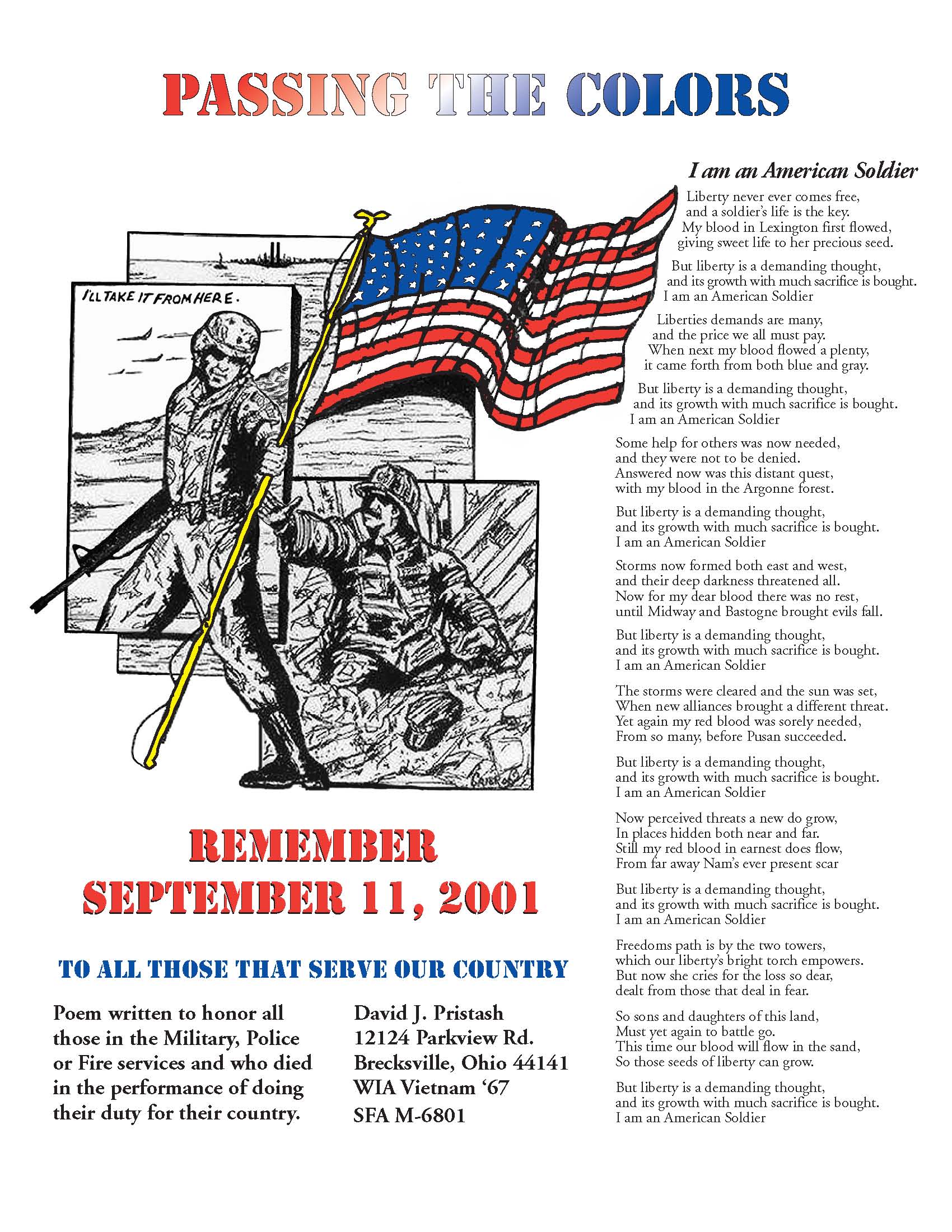
Tribute to those that Serve!


PassingtheColors

Does God have a Place in Government?


The Founders Believed that it was Required

We have been conditioned today into believing that in the United States of America there is a wall between the church and the government — “The Separation of Church and State” — as it is now called.  Further we are told that this comes from our founding documents so it must be true — but is it? In searching those documents we find that those words or any derivation of them do not appear in any of the founding documents. But we also know that the use of the words God or the Creator (used inter-changeably here) and a fundamental belief in God was very important to the founders and that they reference God a lot in their writing and God was very prominent in all the public buildings; Federal, State and Local until after World War II. So how did we get from a nation founded on the belief in God to a secular state that can’t even acknowledging the existence of God?

Much, but not all, of this change can be traced to the American Civil Liberties Union (ACLU) and its influence on the legal system up to and including the U.S. Supreme Court.  The ACLU was founded by Crystal Eastman, Roger Baldwin and Walter Nelles (an interesting fact is that Nelles has ties to what becomes the infamous ‘Students for a Democratic Society’  from the 60’s) who were all avid socialists and in all probability, communists at heart, if not in practice.  It could be said that they used their beliefs in what is called social justice today, to destroy the influence of religion since religion was deemed to be bad by Karl Marx, the founder of the principles of communism and the precursor of modern socialism.  Since the communist movement was very strong when these three were growing up this is a likely connection. Why else would so many of the court cases promoted by the ACLU be used to drive a wedge between the religious people of this country and their government; especially in the public schools of the country? The result is that ever since shortly after the end of WW II, we have been moving away from God.  God is no longer “fashionable”.

By what logic could this transformation be done? There must have been something that those wishing to change the American System found to give them an opportunity to make the change they desired. And there was; in a letter written by Thomas Jefferson in 1802 to a Baptist Association he wrote: “… I contemplate with sovereign reverence that act of the whole American people which declared that their legislature should ‘make no law respecting an establishment of religion, or prohibiting the free exercise thereof,’ thus building a wall of separation between Church & State.” Jefferson reflected his frequently as a speaking theme that the government is not to interfere with religion.

Jefferson in his misused reference was of course referring to the national or federal government which was proscribed in the First Amendment to not interfere with religion and specifically not establish a “state” religion.  This Amendment, part of the ‘Bill-of Rights,’ was written to keep the federal government out of the states and local communities where they, the local government could do as they pleased.  Meaning the people there could have their local government participate in religious activities without being dictated to, one way or the other, by the federal government.  Since for almost 200 years this principle held and the federal government used religion itself although non denominational it is hard to see how this has been turned around to what we have today.  We are constantly hearing how some religious item such as the Ten Commandments are being removed from public buildings as being offensive to the citizens. How did they get there then and be there for so long? Further if the founding fathers didn’t agree with how this issue was handled in the first few decades of the republic they would have changed something; since they did not this is prima fascia evidence that the ‘new’ interpretation is false.

However, with the ACLU now in full get religion out of the government mode they used Jefferson’s comments, out of context, to argue a case at United States Supreme Court and they were successful in 1947 by a 5 to 4 ruling in the Everson vs Board of Education case in stopping a state from using public funds for transporting student to a faith based school. The result of this ruling is directly responsibly for all that followed.

This view is absurd on face — since we know that in political theory the belief in a Supreme Being was a major requirement to have a viable Democratic Republic. This view is in all the political writing of the eighteenth century and very clearly stated by those writers for example Adam Smith and John Lock since only a moral (religious) people could vote for representatives to their legislative bodies and end up having representatives that were moral. In most societies dating back to earliest recorded history, people got their sense of morality from religion.  Therefore, if we did not have morality in public life, the representatives we elect would become corrupt and the government would become oppressive.  We see this corruption happening now in our country and it is my opinion that this is a direct result of removing God from the public conscious and in fact making belief in any God a target for ridicule and cheap humor by politicians and certainly those in the media and entertainment industry.

So, that gives us the basis for the rest of this discussion on God and Government and why the two cannot be separated in the sense that it now is; that is if we are to continue to remain a free people.

At the core, there are only two kinds of governments.  The first is based on the existence of a “creator”, or prime mover.    The second is purely secular and proposes a “random spontaneous life” argument. Monarchies, democracies, republics and dictatorships, free markets, communism and fascism all have their roots in one of these systems.  But first we need to understand the basis for where the law used to govern us originates.

After reading many books and other material on government: John Lock, Adman Smith, Benjamin Franklin, Thomas Pain, Thomas Hobbes, Charles-Louis Montesquieu and Jean-Jacques Rousseau to name a few, we find that some basic principles as to God and Government can be developed.  I have drawn my conclusions and beliefs from these writings and present my interpretation below. However, any mistakes in interpreting their views are entirely of my own invention.  Due to time and space restrictions, I have regrettably omitted many others philosophers and scholars that have contributed over centuries to the principle views held during the eighteenth century when our country was founded.  I mean them no disrespect and it’s only my late coming to this subject that prevents me from a more complete listing.

The first form of government is that which is based on natural law and natural law is that which man can see in nature, though the use of reason, because the Creator, God, put it there when he created the universe.  Man in the state of nature (meaning there is no government) is sovereign in himself; in that he has made no oath to serve another man nor entered into any compact to share that power so he alone can control what he does or does not do.  This is what gives the meaning to the sovereign which is simply put that there is no law above the person that has the sovereign. Therefore this man in nature has the sovereign power and it must come directly from God.  He is his own master free to do as he pleases within the framework of what the creator made available to him.

In this state of nature with no government all men are therefore equal and they control their own lives, what they do or don’t do. They do everything they do in the belief that it is in their self interest to provide for their existence (food, water, shelter etc).  But men soon found that two could do more than one and three more than two and so they would share the fruits of their combined labor in some agreed upon manner.  This might work for one or two or even three men but in a larger group of men, who would decide on the division of labor and division of the fruits of their labors?  In all probability the strongest and/or the smartest would get the others to cede power and authority.

At that point what is called a ‘social contract’ was formed, and since protection would be one of the primary goals of this contract, that was typically the reason that this person was given the right of leadership.  In so doing, individuals had effectively transferred their sovereign to that leader and he now held ‘only’ what they had given him by consent.  By the early eighteenth century it was thought that once the sovereign was given to a leader, it stayed with that leader or his heirs permanently.  However starting with the Magna Carta and solidifying in the mid 18th century other ideas became prominent and they were very different.  The new belief was that if those that made the laws (called the magistrates) did not serve the people, then the people had the right to take back the sovereign power and form a new government. The historical logic and writing of this is a bit more complex than what I present here but in general that is the core principle. The US War of Independence and French Revolution, although very different, are prime examples.

From this line of thought comes our Declaration of Independence and the first two paragraphs are shown next.  I have added bold to the key provisions.

When in the Course of human events, it becomes necessary for one people to dissolve the political bands which have connected them with another, and to assume among the powers of the earth, the separate and equal station to which the Laws of Nature and of Nature’s God entitle them, a decent respect to the opinions of mankind requires that they should declare the causes which impel them to the separation.

We hold these truths to be self-evident, that all men are created equal, that they are endowed by their Creator with certain unalienable Rights, that among these are Life, Liberty and the pursuit of Happiness.That to secure these rights, Governments are instituted among Men, deriving their just powers from the consent of the governed, That whenever any Form of Government becomes destructive of these ends, it is the Right of the People to alter or to abolish it, and to institute new Government, laying its foundation on such principles and organizing its powers in such form, as to them shall seem most likely to effect their Safety and Happiness. Prudence, indeed, will dictate that Governments long established should not be changed for light and transient causes; and accordingly all experience hath shewn, that mankind are more disposed to suffer, while evils are sufferable, than to right themselves by abolishing the forms to which they are accustomed. But when a long train of abuses and usurpations, pursuing invariably the same Object evinces a design to reduce them under absolute Despotism, it is their right, it is their duty, to throw off such Government, and to provide new Guards for their future security.

What follows next in the Declaration is a listing of the grievances which aren’t necessary for this discussion, and so we skip to the last paragraph.

We, therefore, the Representatives of the United States of America, in General Congress, Assembled, appealing to the Supreme Judge of the world for the rectitude of our intentions, do, in the Name, and by Authority of the good People of these Colonies, solemnly publish and declare, That these United Colonies are, and of Right ought to be Free and Independent States; that they are Absolved from all Allegiance to the British Crown, and that all political connection between them and the State of Great Britain, is and ought to be totally dissolved; and that as Free and Independent States, they have full Power to levy War, conclude Peace, contract Alliances, establish Commerce, and to do all other Acts and Things which Independent States may of right do. And for the support of this Declaration, with a firm reliance on the protection of divine Providence, we mutually pledge to each other our Lives, our Fortunes and our sacred Honor.

From this we can state the following, in the Creator based form of governance:

ONE. There is a Creator — a God that created the universe and all that is in it.

TWO. The Creator gives us our rights through natural law, such as: the right to life, liberty and property. These rights being God given cannot be taken away.

THREE. We cede the administration of those rights by our government in return for the government’s agreement to protect us and insure equal justice.

FOUR. The agreement between the People and the government is the social contract and in our case is embodied in the Constitution.

FIVE. The proof of the above is in the oath of office of elected office holders and military personnel, especially the officer corps.  They swear an oath to defend the Constitution, not the government.

SIX. Therefore the sovereign that the people possess resides not in the government but in the Constitution itself.

SEVEN. The People cannot give the government what they did not have and so a government based on the sovereign given by the people cannot do anything that the people did not specifically give the government or that they had in their power to give.

EIGHT. The Constitution can only be changed by the process defined within it and so since a procedure for change is contained in the document there can be no justification for interpreting in anyway other than the way it was originally written.  It is a living document.  However, only the people can change it, not the legislators the executives or the judges. A Constitutional change can be made by a 2/3’s vote of approval of the various States so the people can change their government any time if they desire.

NINE. If a politician does not follow his oath to defend the Constitution and in fact states that he believes that it is no longer valid, he has broken his oath and must be removed from office.  The procedure for doing this is impeachment.

TEN. If the government does not follow the guidelines of the Constitution it is the duty of the citizens either to elect new representatives or to form a new government.

This then is the basis of our form of government which is called a Federal Republic or sometimes a Constitutional Republic.  We are a federation of states with elected representatives and they govern based on the limits of power we have given them as defined in the Constitution and Bill of Rights.  It was assumed that those elected would be believers in God, primarily Christians of any of the various denominations.  Since the country was founded on Judeo-Christian principles for a Judeo-Christian people, The Constitution as written would only work for a society with those values.  If the People’s beliefs have changed then the form of the government would have to change as well — this would be a fundamental change.

The other form of government is very different. This form is not based on a belief in God but is purely secular in nature. This is not to say that the people don’t have religion, only that it plays no part in their government.  In this form the sovereign resides in the government and how it got there matters not.  There may be elections and there may not be, but one thing is common and that is that there is a “ruling class” and a “class that is ruled”.  Those in power come from the historical vestiges of wars, revolutions, dynasties, feudal societies or wealth.  The common man may or may not live reasonably well but he is the common man and a change in class status is uncommon and unlikely.

Typically in these governments the documents that form the government are not fixed nor are they based on natural law.  This means that those that rule can change anything they desire for any reason they desire.  They can do this because there are no real limits placed on them as might exist in a true Constitutional government.  Their usual oaths of office are to swear allegiance to the primary ruler; be it a King, Queen, Emperor or Party Leader.  You can see that if an oath is given to the ruler then there is no recourse available if that leader turns bad.  An oath is an oath and must be honored.

In this form of government the people have no real power, the rulers are hand picked from among those in the ruling class and the government appoints a much higher percentage of the workers in the legislative branches and local administrators in the various functions of government.  This is not to say that these people are oppressed or without any benefits, for that is not the case in most governments today.  But the amount of true freedom they have depends on the exact form of their government which can be a social democracy an aristocratic democracy and or one of the other forms such as would be found in a communist state or even a monarchy or a dictatorship.  Outside the United States this is the form most other people live under.

In any event, they have no God given rights of any kind, only those rights that the state and its ruler allows them to have; today meaning ‘Positive Rights’ as exposed by our current president. These forms of government are not stable.  They may last for a hundred years but few last much longer without some form of revolution or civil war that changes the form of that government. Some would say that we had a civil war so why are we different?

The difference is that the issue of slavery was put aside initially to gain freedom from the British Crown.  Because slavery, which was common in the world, (in fact the word Slave comes from Slav, due to the fact that in the Middle Ages a vast number of Europeans were regularly taken into slavery by raiding Ottomans’ and Arabs and carted off to Africa and the Middle East) was an anathema to a system based on freedom, there was considerable opposition to it that needed to be resolved before the new country could move forward. This was largely resolved by the Civil War, although cultural artifacts remained for years afterward.  Further, the essential form of our government did not change.

From this we can state the following in the Secular form of governance:

ONE. There may or may not be a Creator, but whether there is or not is not material to the governance of man.

TWO. Once a government is formed by a people, that government has ‘all’ the sovereign power and can make any laws that it choices to.

THREE. Therefore there is no ‘real’ limit to the power of this form of government.

Four. Whether there is a founding document or not is not relevant in this form of government since the government has the absolute sovereign which can not be taken back other than by a revolution.

Five. All the rights of the people come from the government and are only what it allows them to have.

SIX. In most if not all cases the public servants swear an oath to the head of the government not to their founding documents.

SEVEN. Further, since there is no direct link to a creator there are no natural laws and without natural laws there are no fixed morals.  This is called moral relativism.

EIGHT. Without a moral base there is no way to measure good or evil and without a way to measure good and evil a leader or ruler can justify any action they desire in that it is only his opinion as to what is good for the country that counts.

NINE. The lack of a frame of reference for the morals of the people in this form of government mean that at some point the government will become oppressive.

TEN. In these kinds of governments there is strong trend to a state of minimum personal freedom.

So in summary, we have the first model of governance which allocates power in this order: God, the individual, then government. We have a second model, Secular Governance, which allocates power first to the government then to the individual.  In the first form God is the primary source of power and in the second form the government is the primary source of power.  Since we know from thousands of years of history that men can be corrupted, and they often are, why would anyone want a government based solely on the wishes of what a man would want?

Some would say today that we are an enlightened people now and the old ways of the founders and the restraints of our constitution are no loner needed.  To them I say they are wrong.  History has repeated itself many times with great republics formed and then lost to the corruption of men and their government.  There can be no rational basis for this belief other than one of our ignorance of history.

We can either believe in the ways of Christ, which were non violent in the New Testament and can be summed up in the statement, “Do onto others as you would have them do unto you” or you can have a belief that men can make better rules of living and behavior then those of nature’s Creator.  You can either believe in God or believe in man as the source of understanding, but not both.

The Founders believed in a Christian God as found in our Bible.  The government they established was one that had those beliefs at its core.  Being men we are not perfect and so neither was our conduct neither in the formation of the country nor in the application of our government.  However, despite our faults and misdirection in our Constitution we formed the best system yet devised by man.  And, during the debate on the form of that document, a major impasse came to be with arguments back and forth and hard positions being taken.   With no compromises possible Benjamin Franklin proposed that they all pray to God for guidance.  They all went to a nearby church and did as he suggested.  Coming back the mood was completely changed and compromises to the things that separated them were found.  In short order thereafter we had the Constitution; so was this the work of God or do we want to believe that it was pure chance?  Given the results of what that divinely inspired document produced, at least until now, it is clear that we were destined to be a force of good in the world — the Beacon of Freedom that all looked to for guidance.  We do not need to be fundamentally changed.

Ronald Reagan, “You and I have a rendezvous with destiny. We will preserve for our children this, the last best hope of man on earth, or we will sentence them to take the first step into a thousand years of darkness. If we fail, at least let our children and our children’s children say of us we justified our brief moment here. We did all that could be done.”

Justification of a Modern Government


From Aquinas to Rousseau

This is a very brief summary of the basis of our government and in my opinion this process started in earnest between 1259 and 1264 in Paris France when St. Thomas Aquinas (1225 -1274) wrote Summa Contra Gentiles (The Summa Against the Gentiles) which is considered to be a seminal work perhaps the best of the middle ages.  In this work he blends the then newly discovered works of Plato and Aristotle, which had been lost to Europe since the fall of Rome, along with Roman law and the teachings of Christianity into one work. There is no doubt that he was a man of very high intellect and even today, 750 years later, his work should be read by anyone interested in the foundations of and the justifications of law and government.

He left no stone un-turned discussing theology, ethics, politics, just war, sexual ethics including birth control and abortion and even property rights.  Although many of us today would take exception with some of his views we can all agree that his writing on the subject set the tone for what was to follow between then and July 4, 1776 over 500 years later.

This blog is not about historical political theory so we’ll skip forward almost 400 years and look at three great thinkers that shaped the modern state. First to Thomas Hobbes (1588 – 1679) and his LEVIATHAN, or The Matter, Forme, & Power of a COMMON-WEALTH Ecclesiastical and Civil Published in 1651.

Then John Locke (1632 – 1704) and his Essays on the Law of Nature (1663-64); An Essay Concerning Human Understanding (1671- 90) and The Two Treatises of Government in the former, The False Principles and Foundation of Sir Robert Filmer and his Followers, are Detected and Overthrown The later Is an Easy Concerning the True Original, Extent, and End, of Civil Government (1689).

Then finally to Jean-Jacques Rousseau (1712 – 1778) who is best known for his Discourse on Inequality (1755); Discourse on Political Economy (1755) and On Social Contract (1762).  The writings of these men are instrumental to the logic and basis for the writing of the Constitution of the United States.

Hobbes wrote in Leviathan his support of a constitutional monarchy and that it was the natural order to have a strong authoritarian monarchy. He proposed that man had agreed to this in a ‘social contract’ wherein man acknowledged the monarchy in return for the protection that gave him.  This view was based on the premise that without a strong government man would be no more then a lone individual living by his own wits and subject to no law or rule; therefore he could do solely as he pleased.  He called this being in the state of nature.  The following quote from Leviathan “Chapter XIII.: Of the Natural Condition of Mankind As Concerning Their Felicity, and Misery” is one of the best known passages in English philosophy; it describes the ‘natural state’ that mankind would be in, were it not for the political community.

“In such condition, there is no place for industry; because the fruit thereof is uncertain: and consequently no culture of the earth; no navigation, nor use of the commodities that may be imported by sea; no commodious building; no instruments of moving, and removing, such things as require much force; no knowledge of the face of the earth; no account of time; no arts; no letters; no society; and which is worst of all, continual fear, and danger of violent death; and the life of man, solitary, poor, nasty, brutish, and short.”

So according to Hobbes:

In this state, people fear death, and lack the things necessary to commodious living, and the hope of being able to work to obtain them. Therefore, man accedes to a ‘social contract’ and establishes a civil society to avoid this.

Society is a population living beneath a sovereign authority, to which all individuals in that society cede some of their rights for the sake of protection. Abuses of power by this authority are to be accepted without question as the price of peace. There is no separation of powers in this view as we know them.

The sovereign must have total control over civil, military, judicial and ecclesiastical powers.

Locke writing twenty or so years after Hobbes came to a very different view developing what would be called today a liberal republicanism and a foundation for a republic.  He was probably the biggest although not the only political theorist to influence those that wrote the U.S. Constitution.

Locke takes a more optimistic view then Hobbes writing that in the state of nature man is characterized by reason and tolerance not always brute force as could be inferred from Hobbes. However he also believed in the social contract between men and their government but in a more limited sense where the government had a responsibility to the subjects and that if exceeded actually gave the subjects the right to rebel.  Locke went on to state that in a natural state all were equal and independent and they all had a right to defend themselves.  This was the basis for the words in the 1776 American Declaration of Independence, “life Liberty, and the pursuit of happiness” in the preamble.

Locke believed in the right to private property; the accumulation of wealth (qualified); and in the principle that labor was the basis of property.  He also developed the principles of money and monetary policy and the relationship to trade.  His views on money probably had an influence on Adam Smith and his seminal work The Wealth of Nations published in 1776.

Lock also wrote that education was very important stating that, “I think I may say that of all the men we meet with, nine parts of ten are what they are, good or evil, useful or not, by their education.”  In that same line of thought Locke wrote that “the little and almost insensible impressions on our tender infancies have a very important and lasting consequences” then he argued that “associations of ideas” that one makes when young are more important than those made later because they are the foundation of the self.”

One other thing that Locke believed in was ‘religious’ freedom and equal rights.  Further Thomas Jefferson used Locke views when he wrote a bill for religious freedom in Virginia.  Locke like Hobbes believed in Natural Law which was the belief that there were moral principles that were set by nature (God) and were therefore valid every where.  Natural law is not to be confused with common law or case law which are laws which are not universal and are based on ‘local’ judicial recognition.

One of Locke’s more controversial ideas was that because of the ‘social contract’  between the people and the governing body the legislative branch of government that if those representatives went against the wishes of the people that the people had the ‘right’ to rebel against their government.  What is new about this is the right of the people to withdraw from the ‘social contract.’ However, Locke did not take this to go as far as overthrowing the monarch unless that monarch had broken is obligation to defend the country.

Rousseau is the developer of the liberal democracy principles which is a third way of looking at the ‘social contract’ and ‘natural law.’  Rousseau born in Geneva which was a Republic had a different view and took what Lock had developed and went further eliminating the monarchy at least in part.  Rousseau published his The Social Contract in 1762 fourteen years before the American Declaration of Independence. The work begins with, “Man is or was born free, and he is everywhere in chains, One man thinks himself the master or others, but remains more of a slave than they.”

Rousseau argues that the sovereignty (or the power to make laws) should be in the hands of the people. The terms he used then are different today but what he said was that the power to make laws rested in the people and the people allowed the legislators (that represented them) to make the laws.  This would be a true Representative Democracy but Rousseau stated that this system would only work in a small city state like the Geneva he grew up in.

Rousseau also wrote, “…that the general will exists to protect individuals against the mass, not to require them to be sacrificed to it.” This was a recognition that a pure democracy would not work.

Rousseau was one of the first to propose developmental education dividing the process into three stages.  The first stage is from birth to the age of about 12 when Children are guided by the emotions and impulses.  In the second stage from 12 to about 16 reason starts to develop.  Lastly from 16 onward the child develops into an adult and should also be required to learn a manual skill even if high education is pursued. He also states that at the age of 16 they are ready for a companion of the opposite sex.

An explanation of terms due to language change:

The ruler of a territory could be the Monarch the Prince or today the President

The legislative body could be an Assembly the Magistrate or a Delegate today a representative or senator

Democracy is where all eligible voters vote directly on all issues

Representative government is where the people elect a person to represent them on legislative maters

Unintended Consequences


Politicians should never make technical decisions

It has been very popular for many intellectuals to adopt the view of Malthus that the planet’s resources are limited and that there are way to many people on the planet.  A good portion of the environmental movement is also based on these same views.  Unfortunately most of these “intellectuals” and “do gooders” are not knowledgeable in the science and engineering that relate to energy production and development. What we do know is that the generation and control of large amounts of cheap energy is critical to maintaining a high standard of living.  We also know that when the need for large families is eliminated that the people will have fewer children.

The solution therefore is to raise the standard of living which then results in fewer children being born.  How many people the planet will support is unknown for it depends on the technology we have and how much energy we can control.  If we assume that the politicians want the citizens to lead happy and productive lives (which is not certain) then we know the only way that can be done is through having cheap and abundant energy available.  This is the opposite of the current directions of those in positions of power mostly because they do not have the education, intelligence or the vision to see the real solutions.  Most of them operate on a zero sum game where it’s all about the distribution of the pie not the making the pie bigger.

What we do know is that if zealots are left unchecked and the environmentalists are zealots then they will destroy civilization.  For example, the banning of the incandescent light bulb in the United States starting with 100 watt incandescent lamps in January of 2012.  The replacement lamps for now appear to be mostly compact florescent lamps (CFL) which produce more light per watt of electricity. LED lamps are the same with slightly different numbers. This is being done for only one reason and that is to use less energy.  But is what is being said about less energy a true fact, well let’s find out.

A 100 watt incandescent lamp will produce when turned on 90 watts of heat and 10 watts of light. A 100 watt CFL replacement lamp will produce when turned on 50 watts of heat and 50 watts of light.  These numbers are not the actual numbers but they are reasonable estimates used for discussion purposes.  So we can say that for every five incandescent lamps we only need one CFL lamp.   So lets say we have 10 incandescent lamps and we replace them with 2 CFL’s that reduces the electric load from 1,000 watts (10 x 100) to 200 watts (2 X 100) and we save money.

Maybe, maybe not those 10 100 watt lamps that we replaced were helping to heat your home in the winter.  When they were replaced by the 2 100 watt CFL’s we removed 800 watts of heat which is where all the energy that the incandescent lamps used went.  They are hot to touch remember.  The difference between the two types 800 watts will need to be made up for by the furnace in the winter so depending on the rate one pays for power you could be spending more for the heating then you were saving from the electricity.

In general the addition cost of heating in the North could be higher then the savings if air conditioning is not used. And in some cases the higher cost of the lamps even with the offsetting longer life and with air could make this a bad investment.  In the south with little heating the CFL’s would save money especially with the reduced air conditioning load.  The point to this is that the savings will not be as advertised. And if it isn’t did it really make sense to shift 100% of lighting manufacturing to China along with all the jobs.

In Summary

National policy should be determined through independent private sector research and development, and outside the political system to include funding.

If Governmental is involved it should be used only to recommend general policy and never to actually provide any services.

Business should be responsible for all goods and services

Costs should be allocated as closely to the user as is practical

The American Dream


In danger of being eliminated

There is a current movement of social change that has been put into play by those politicians wishing to make changes that will give them more power.  There is no other way to say this for it is and has always been that those that rule are never happy with some power they always want more.  Machiavelli’s the Prince is probably the best book on that subject ever written. This need for absolute power is not related to left or right political views both of these artificial categorizations want the same things each for themselves and only with a different twist.  This has always been the case since recorded history begins and from that we can assume before that to the beginning of mans rain on earth.

This drive for power and wealth is a fundamental aspect of our very nature and it can result in both good and bad if not properly channeled.  The problem arises when we allow those with the desire for power to manipulate the education system and change the way our children are taught.  This is easy to do if the Citizens are not vigilant and we have been asleep for a half century now.

Political Correctness (PC), Multiculturalism, Class Warfare and the cradle to grave welfare state are  the tools that are being used and they have erased from our history the knowledge of all that allows us to be free, which is knowledge.  The promise that was instilled in the young was that with just a little more government and less private sector that all the people would be better off and have more.  We just need the government to make things fairer by asking those with more to share what they had with the rest of us.  What could possibly be wrong with that?

Much of what is being put in place in America now is being allowed because of the way the last two or three generation we taught. Few today much young than 50 would not be able to have even a basic discussion on limited government and big government and on central planning and free markets. This post is not and cannot be an economics text but never-the-less the basics must be understood if we are to discus government so based on the excellent book written my Mark Skousen The Big three in Economics Adam Smith, Karl Marx and John Maynard Keynes we will quickly introduce the reader to those three plus one others who has had a big impact on the way we view our world.

Skousen, a gifted writer, takes the reader through six phases of economic development starting with the man that started it all Adam Smith and ending with Milton Freidman (my interpretation of his work).  These six phases are the first six chapters in Skousen’s book:
One, Adam Smith declares an economic revolution in 1776
Two, From Smith to Marx: the rise and fall of Classical Economics
Three, Karl Marx leads a revolt against capitalism
Four, From Marx to Keynes: Scientific economics comes to age
Five, John Maynard Keynes: Capitalism faces its greatest challenge
Six, A turning point in twentieth century economics

The first period is the world’s first formal development of economics principles by Adam Smith where he declares that we will ALL be better off if we are free to produce and sell goods and services as we see fit. That competition in the market place will lower the prices and improve the products.  And that for this to work there must be honest transactions monitored by a fair and just legal system.  This can be boiled down to two principles being “natural liberty” and “laissez-faire.”

The second period is one where questions arise over Smith’s writings that result in the basic principles being questioned.  Smith did not develop equations and formulas his work was one of logical development based on empirical evidence.   Since this was the period of rapid industrialization in Europe and America there were dislocations that were occurring that appeared to disprove what Smith had developed in his work.

The third period was that of Karl Marx and his view that all production belonged to Labor and that land and capital should be placed in the collective for all to use.  Marx believed that the workers were being oppressed and that a new system would be developed based on the principles of Hegel’s Dialectic where a thesis caused an antithesis to develop and that lead to a synthesis (a new order).  Marx’s view was that his Communism was the new order.

The fourth period was where Smith’s views were proved correct by many others when mathematics resolved some of the problems that had developed in Smith’s principles which until now were verbal descriptions not mathematical formulations.  This period ended in the thirties with the great depression.

The Fifth period was dominated by Keynes and his theories of deficit spending, no or minimal private savings and government intervention in the market place.  Keynes developed his theories in response to the great depression that was causing much hardship in Europe and America except for Germany and Russia which had turned to a powerful central government albeit for different reasons.  This economic growth under a strong government gave credibility to Keynes views.

The Sixth period is that which we are now enduring.  Additional work especially by Milton Freidman shows that Keynes was not correct in his views — his work was distorted by the events of those times when he lived which lead him to make assumption that have now proved to be false.  Then there was the fall of the communist states and/or their embracing free market principles in portions of their economies has proved that Marx was wrong as well.  So with both Marx and Keynes both disproved Smith’s views of a free market and laissez-faire were now proved to be true once more.

Skousen’s book was published in 2007 before the housing bubble burst and we elected a very socialist President in 2008.  Those in Washington today believe in Keynes or at least in his big government e.g. like in China.  This view is false as over the past several decades congress has passed legislation here in the United States to the point that our market was free neither in its conduct nor in interference from the federal government.  We therefore find ourselves once again in a period where the politicians that have wrecked the economy are telling us that they need more power to fix the problems.  Since they are the very ones that created the problems this transference of power to them must be avoided at all costs.

Unfortunately, Economics is a complex subject and the politicians depend on that to keep the public misinformed.  Six books that go a long way to showing where the problems lie are now listed. But keep in mind that a full study of the issue would take much more then just these few books.

A Monetary History of the United States, 1867 – 1960 by Milton Friedman and Anna Jacobson Schwartz published in 1963. One section in the monumental book shows how the newly created FED caused the Great Depression.

Free to Choose, Milton & Rose Friedman first published in 1979. Milton and Rose Show how the welfare state cannot exist in the long run, indirectly it explains the collapse of the old Russian U.S.S.R. ten years after the book was published.

The Five Thousand Year Leap, by W. Cleon Skousen first published in 198, an excellent book on political philosophy written for those without a degree in this subject showing how things are not what we may think they are..

The Ruling Class, By Angelo M. Codevilla published in 2010, excellent contemporary book explaining the current push in American to set up a Ruling Class.

Reckless Endangerment by Gretchen Morgenson and Joshua Rosner published in 2011, Very well document analysis of the 2008 house bubble collapse and what caused it — and it was not the banks it was the US Congress aided and abetted by the FED.

Extortion, by Peter Schweizer published in 2013, an absolutely devastating description of the rampant corruption in the US Government.  The founding fathers are turning over in their graves right now and I would not be surprised to see them come back to get rid of the entire crop of obscenity that now resides in Washing DC.

There are a few other books that would help the argument but they get technically complicated and so the last two are enough I think.  The line of though developed here is that we started with a Constitutional Republic without universal suffrage and the purpose of that was to place “strong” limits on the federal government.  Those limits we needed because of the failing of human nature and that if they were not here a ruling class with arise and the republic would be gone.

This is done by legislation which gives us a large bureaucracy with has the power to write regulations, create rules, make fines for non compliance and set up permits for almost everything. All this is done for our benefit of course but every one of those things takes away a bit of our personal freedom and at some point, not far off now, the freedom is all gone.