Biden Cancels Previously Issued ANWR Oil and Gas Leases in Alaska


Posted originally on the CTH on September 7, 2023 | Sundance 

24 hours before Joe Biden announced he was cancelling all previously issued oil and gas leases in Alaska’s ANWR region, Saudi Arabia and Russia announced oil production limits would continue.  Oil prices spiked near $100/bbl and then Joe Biden amplifies the problem by cancelling previously sold oil and gas leases.

There’s no other way to look at the timing here, other than to accept this is Joe Biden intentionally driving up the cost of domestic energy in the U.S. and creating as much pain as possible.
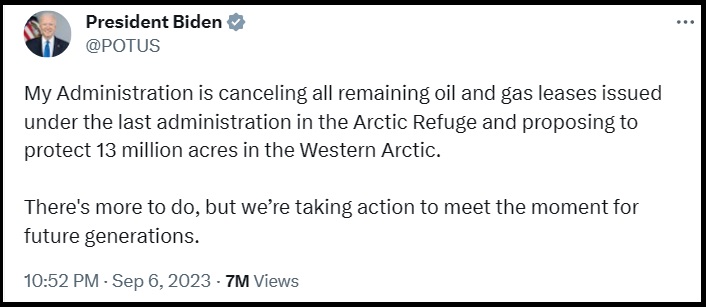
(Reuters) – Sept 6 (Reuters) – The U.S. Interior Department on Wednesday said it would cancel oil and gas leases in a federal wildlife refuge that were bought by an Alaska state development agency in the final days of former President Donald Trump’s term.

President Joe Biden, a Democrat, has pledged to protect the 19.6 million-acre (7.9 million-hectare) Arctic National Wildlife Refuge (ANWR) for polar bears and caribou.

“As the climate crisis warms the Arctic more than twice as fast as the rest of the world, we have a responsibility to protect this treasured region for all ages,” he said in a statement.

Trump’s Republican administration had issued the Alaska Industrial Development and Export Authority (AIDEA) seven leases a day before Biden’s inauguration.

Environmentalists praised the decision, but it was lambasted by a Republican Senator from Alaska, where officials have sought to open up drilling in the reserve to secure jobs and revenues for the state.

The government also said it would forbid new leasing on more than 10 million acres in the National Petroleum Reserve in Alaska, a 23-million-acre area on the state’s North Slope that is the largest undisturbed public land in the United States. (read more)

WHITE HOUSE – […] Canceling all remaining oil and gas leases issued under the previous administration in the Arctic Refuge and protecting more than 13 million acres in the Western Arctic will help preserve our Arctic lands and wildlife, while honoring the culture, history, and enduring wisdom of Alaska Natives who have lived on these lands since time immemorial. From day one, I have delivered on the most ambitious climate and conservation agenda in our country’s history. But there is more to do… (link)

Food For Thought


Armstrong Economics Blog/Climate Re-Posted Sep 6, 2023 by Martin Armstrong

How is it that the government can’t rig elections but they can rig weather by regulation to stop what they call global warming?

Oil Prices Surge After Saudi Arabia and Russia Announce Extended Oil Production Cuts Through End of 2023


Posted originally on the CTH on September 6, 2023 | Sundance 

Oil prices shot passed $90/bbl today after Saudi Arabia and then Russia announced a continuance of production cuts through the end of this year.

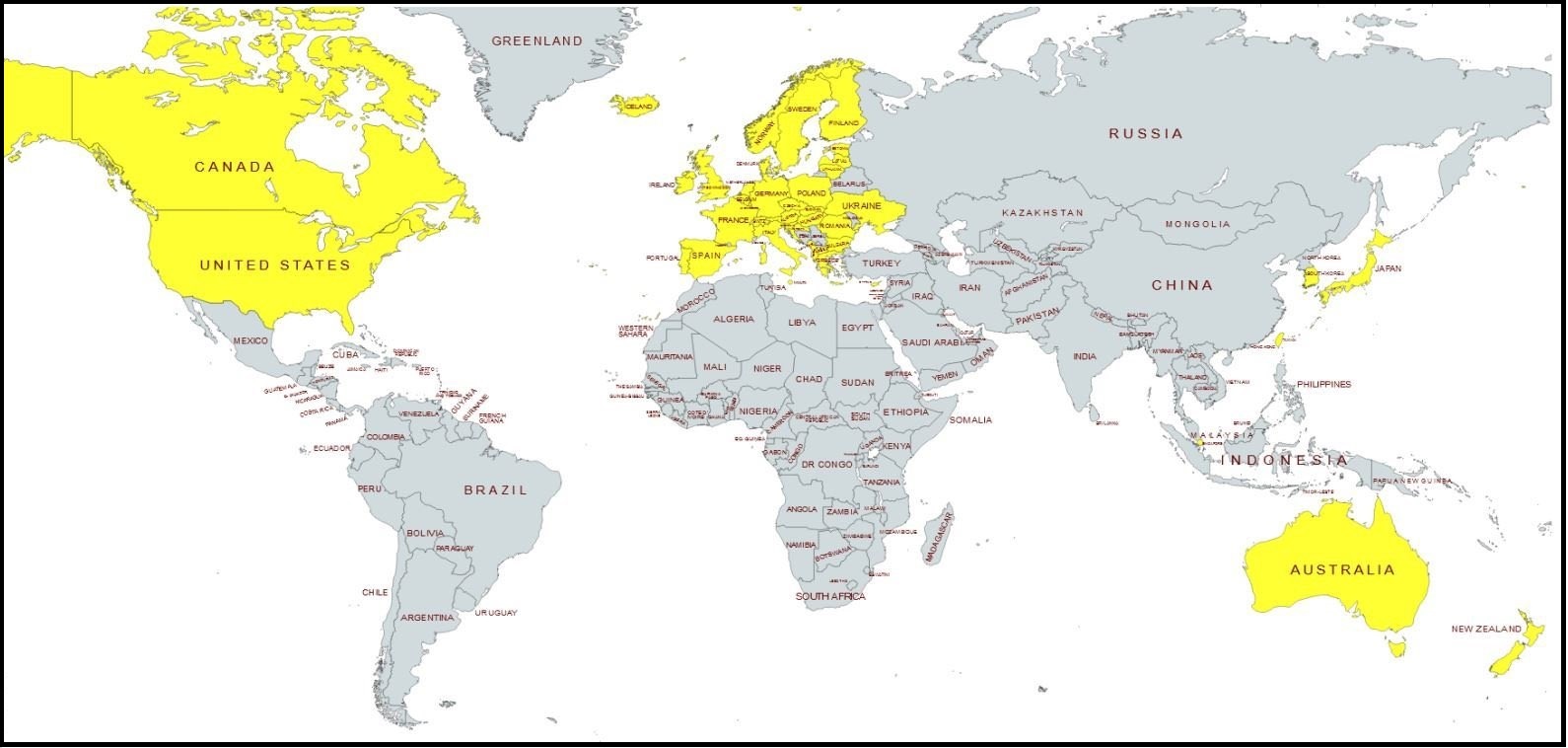
The BRICS alliance is going to deliver some pain to the Western alliance.  Those people living in the yellow zone, with leadership chasing climate change and Green New Deal policies, are going to see more durable inflation as the cost of oil is attached to just about every product and service.

Gasoline, energy products, petroleum products, home heating oil, groceries, everything will cost more as the geopolitical battle continues; but we are supposed to pretend we are unaware of the global political dynamic.

(Zero Hedge) – […] Just after 9am ET, Saudi Arabia said it would extend the voluntary cut of 1 million b/d of for another 3 months, from October until the end of December, well beyond the expectation of just 1 more month. Saudi press agency SPA notes that the voluntary cut decision will be reviewed monthly to consider deepening the cut or increasing production.

The extension of cuts is meant to reinforce the precautionary efforts made by OPEC countries with the aim of supporting the stability of the oil market. The Saudi announcement came a shock to market as 20 of 25 traders and analysts surveyed by Bloomberg last week had predicted the additional cutback would be continued for just one additional month.

And then, literally seconds after the Saudi decision, Russian deputy PM Novak said Russia would also extend its reduction of oil exports until the end of the year, reducing its oil output by 300kb/d in voluntary cuts until December 2023.

Similar to the Saudis, Russia said that the decision to reduce oil production to be reviewed monthly to consider possibility of deepening reduction or increasing production depending on situation on the world market. (read more)

“The U.S. Strategic Petroleum Reserve is empty, my friend”… 

(Yahoo) – […] Higher oil prices are bad news for the world’s central banks, which have been trying to tame high inflation since last year. Energy is a key input for economic activities, so higher oil prices generally lead to inflation.

But Saudi Arabia and Russia’s keeping their oil supply cuts for longer means “they have no interest in what central banks are worried about,” Naeem Aslam, the chief investment officer of Zaye Capital Markets, wrote in a Tuesday note seen by Insider. (read more

.

Maui Fires


Armstrong Economics Blog/Conspiracy Re-Posted Sep 4, 2023 by Martin Armstrong

A Series of Unfortunate Coincidences


The reduction of the population has began in Hawaii

US Real Estate Market


Armstrong Economics Blog/Real Estate R-Posted Sep 2, 2023 by Martin Armstrong

QUESTION: Mr. Armstrong, You were the only one who forecasted that real estate would continue to rise in conjunction with the rate increases by the Fed. I have been following you only since 2020 and COVID-19. I am impressed with your computer and your analysis, which does not change with every passing headline. Can you elaborate on the real estate market a bit?

Thank you very much for the education.

FH

ANSWER: The traditional forecast on real estate is always one-dimensional. Homeownership has historically been in the top 5 of surveys about what Americans most want in life. Property values have been rising despite rising high prices combined with higher mortgage rates. There is little sign on the horizon before the ECM peaks in May 2024. Analysts have been confused and caught up in this economic conundrum of the continued economic growth that has defied all their recession predictions.

Normally, housing has been one of the sectors that has been the most sensitive to interest rates. Over the past two years, mortgage rates have risen from less than 3% to more than 7%. That means that the median family today faces mortgage payments that have doubled from roughly 14% of monthly household income in 2020 to nearly 29%  by mid-2023. This is the strongest rise since the economic turm on our ECM when it bottomed in 1985.65.

Nevertheless, the conundrum that has baffled traditional analysts has not led to a decline in house prices as they expected. They paused during the COVID-19 lockdowns and fell in the Blue States, which had the most draconian COVID-19 measures. Currently, housing prices during the second quarter of this year rose at an annualized pace of 15% according to the S&P Case-Shiller index.

There is a tight supply in the South, where much of the migration has taken place. I get, on average three calls a week asking if I want to sell my house here in Florida. The annual sales of property nationally have been around $2 trillion.  Smart institutional investors have been shifting from public unsecured debt to private mortgages. The average person does not look at CPI numbers or GDP numbers. They look at the cost of this rising, and the confidence in the Biden Administration has been collapsing. When people no longer trust the government, they shift to the private sector. So add to that the great migration from Democratic states to the southern red states, and you will see collapsing real estate values in places like San Francisco and Chicago in comparison to even Wall Street, have been quietly moving to the Miami region. There are still buyers in the market and a shortage of supply in the Red States like Florida. Thus, sales have declined, but this appears to be more the result of the decline in supply.

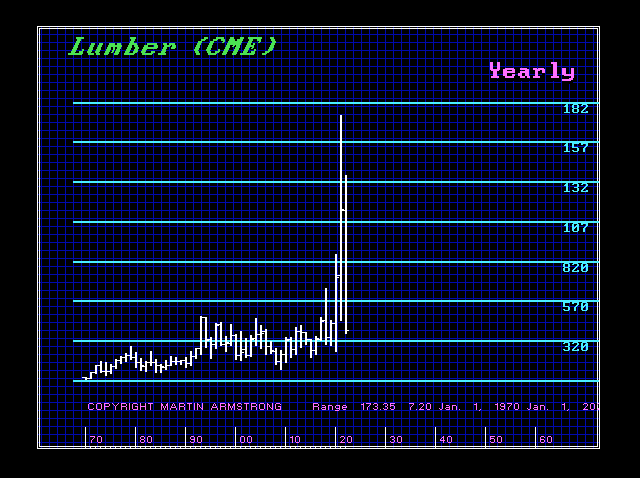
Additionally, the rising inflation in materials means that the replacement cost of homes is often higher than the prices being paid, not to mention the waiting time for construction. The sheer replacement costs of housing have skyrocketed. Even pain was in short supply thanks to the COVID-19 lockdowns. This has impacted the market, and traditional analysis simply never considered that the replacement costs on preexisting houses, in many cases, are 40% to 100% higher. Add to that the shortage in labor. It was very hard to find a contractor in Florida who even was available. Most contractors I talked to were booked beyond 2024.

Newly built homes account for about one-third of active listings in 2023. This was up from an average of 13% over the two decades before pre-COVID-19. Add to all of this is the influx of foreign money looking at US property as a hedge against future wars and destabilization of the monetary system. Then we have had funds like Blackrock buying property and renting them out.