
Tag Archives: Quantitative Easing


Communism vs. Left-Wing Beliefs
Armstrong Economics Blog
Re-Posted Apr 8, 2016 by Martin Armstrong

There are some in left-wing in Western Europe who argue that Communists are not represented in politics and this is somehow unfair. They do not understand that left-winged beliefs and communism are completely different. The left wing in the USA and Europe are really Socialists who champion gay rights and other social issues. In Russia under communism, the communists would imprison anyone who championed gay rights.
Under communism, the state is supreme and everyone is subservient to the state. There is no championing of individual rights for everyone is equal (except for politicians) and really just the property of the state. It is true that in Russia this thinking process still comes against some groups as a residual from the days of communism. This illustrates the stark difference between left-wing socialism and communism.
Trump Predicts a Massive Recession
Armstrong Economics Blog
Re-Posted Apr 4, 2016 by Martin Armstrong

Trump’s latest comments over the weekend regarding the economy are interesting, but still fall short of reality. He argues the unemployment number is really in the 20%+ zone and the number is bogus deliberately contrived to make politicians look good. That is basically true, but his number is a bit high. He says the stock market is overvalued and that is clearly the traditional view that whenever you say economic downturn the assume bonds up and stocks down. That will not hold true when people realize the bubble is in bonds not stocks.
Then Trump vows to pay off the national debt be renegotiating trade deals within 8 years. Sorry, that is just impossible. He also vows to break NATO if other countries do not pay. That at least is long overdue. So he grabs the headlines predicting a massive recession ahead. There he is correct, but he is off the mark in comprehending its cause and outcomes.
ADDED COMMENT
TRUMP MAY NOT HAVE IT 100% CORRECT HOWEVER HE IS THE ONLY ONE THAT IS EVEN IN THE BALL PARK WITH WHAT IS GOING ON.
Fed Admits it is the World’s Central Bank – not just the USA Central Bank
Armstrong Economics Blog
Re-Posted Mar 30, 2016 by Martin Armstrong

Janet Yellen signaled that the Fed is grappling with the problem I have been warning about; the dollar has become the de facto only real currency and the Fed is indeed becoming the world’s central bank. Yellen has admitted that the Fed is being lobbied by everyone to surrender its domestic policy objectives to international. This is precisely what took place in 1927. Yellen stated that the Fed should worry less about inflation domestically than about global growth risks. While pointing to the slowdown in China and depressed commodity prices, Europe is a real basket case. She used the words that the Fed must consider “caution is especially warranted” when it comes to raising interest rates. This has put most Fed watchers off to expecting any possible rate hike into retirement as they expect nothing before September. The BREXIT will most likely be rigged because it is exactly opposite of what they are telling the Brits that they will be isolated and the economy will collapse if the exit the EU. Nobody says Britain did fine before it joined only in 1973 or that it is the other-way-around; with BREXIT, Europe will fail. This heated issue in Britain is most likely the final nail in the coffin. Britain will collapse with the Euro and should have just handed its sovereignty to Brussels. Europe will never reform so it will be all go down together. The political risk in Europe is tremendous and Yellen cannot prevent that with simply interest rates.

It is ironic that it is also the same conditions setting up today as was the case in 1927. The Fed back then lowered US rates to try to deflect the capital inflows to help bailout Europe. The markets eventually backfired and capital shifted pouring into the USA doubling the US share market despite doubling interest rates to try to prevent the crisis they helped to create. This all led to the 1931 Sovereign Debt Crisis and those economic declines resulted in political chaos. In 1933 FDR came to power. But so did Hitler and Mao. That was all made possible because of the collapse in government debt. We are in the very same position today and the Fed is surrendering domestic policy objective for international concerns.

What is astonishing is just how brainwashed society has become. They cheer lower interest rates as if this will eventually work to stimulate the economy and markets. Interest rates decline with economic declines and rise with economic booms. The analysis on TV is just ass-backwards. When a stock is doing well, the price rises because there is a bidding war. Mr. Larry Summers, the father of negative interest rates, admits he cannot forecast anything. Yet he advocates manipulation without any understanding the consequence of his theories in pure stupidity and remains clueless as to history or how markets even move. We can see that the Fed raised rates from 3.5% in 1927 up to 6% in 1929 and the stock market doubled on capital inflows. The Fed cannot lower US rates to prevent a crisis in Europe or to reverse the Chinese economy no less bring a bid back to commodities when the economy is not expanding. As the stock market rises, Congress will criticize the Fed for making the rich richer, and the Fed will then be forced to return to domestic policy objectives raising rate to try to stop the rally. Yet the rally will begin to take off when the public at large begins to realize government is in trouble. This is part of the 4 elections coming with the Year from Political Hell.
The risks and the reality that the Fed has lost any real ability to manage the economy have become so real, it is slapping people in the face and still they cannot see it. The Fed has little conventional monetary policy ammunition to counteract a downturn at this time. Larry Summers’ negative interest rates are destroying the fabric of the global economy. Far too many pension funds are unfunded and many countries in Europe by law require they be managed conservatively and invest EXCLUSIVELY in government bonds. The risks of total meltdown beginning in 2017 are on the horizon.
Yellen has inherited a complete nightmare. This decision to delay the long-awaited liftoff from a zero interest rate illustrates that the world economy is totally screwed. There is a lot of speculation about why the Fed seems so reluctant to “normalize monetary policy”. However, besides the normal issues such as low inflation, weak wage gains, and strong job growth, the real issue nobody seems to look has been the fact that government are now crack addicts on life-support with negative rates. A hike will increase the Federal deficits of all countries globally. The smart institutional clients coming to our World Economic Conferences have shifted their portfolios selling government debt and moving to blue-chip corporate. Corporate debt is the only alternative to government debt in crisis and emerging market debt other bought thinking they have no risk since it is dollar denominated. When government debt goes bust, you get absolutely nothing and they can change the law at any given moment. They can re-denominate your debt holdings as well as extend the maturity and there is absolutely nothing any bondholder can possible do.
SELL GOVERNMENT BONDS & SHIFT TO BLUE-CHIP CORPORATE BEFORE IT’S TOO LATE
Guaranteed Basic Income
Armstrong Economics Blog
Re-Posted Mar 28, 2016 by Martin Armstrong
Richard Nixon unsuccessfully tried to pass a version of Milton Friedman’s plan, and his Democratic opponent in the 1972 presidential election, George McGovern, also suggested a guaranteed annual income. Milton’s basic guaranteed income proposal was well thought out and substantially different than simply the welfare state. Our welfare system has seriously alter human behavior. It has paid people not to work and paid others per child creating incentives to have children to gain more money. The welfare system has done much to alter human behavior and destroyed the family structure.
Milton’s proposal was to flip the process to create incentives rather than destroy them. It is ironic that the one president who tried to implement this plan was taken down by the Watergate Scandal. The proposal passed Congress and the Democrats stopped in in the Senate under the pretense they wanted more money.
Another important aspect of this Friedman proposal was that there were no string attached. The government did not attempt to tell people what they could buy or do with the money. Whenever government get involved, the typically screw things up pretty good. Driving to work I see signs offering cash for diabetes materials people get from government on welfare. Others would sell the food stamps. When you just hand people things, they will alter behavior to get them if if they do not need them. Milton’s proposal eliminated the government red tape yet instilled the spirit to raise oneself up out of poverty. This type of system made sense.
Depression verses “helicopter money”
Armstrong Economics Blog
Re-Posted Mar 26, 2016 by Martin Armstrong
 QUESTION: you wrote the Socrates site on 3/23/2016 “Once the “confidence” in government cracks for the BULK OF THE SILENT MAJORITY who do not listen to money supply and conspiracy theories, then we move into game over. That is when we will see assets rise as confidence shifts from a corrupt government for the majority will no longer trust then and they will turn to the private sector.” Mr. Armstrong can you please name the private assets that will appreciate? and if there are similarities with 1929, where we are now in 2016? Thank you for all your efforts to teach us the world economy.
DS

ANSWER: There is absolutely no correlation with 1929 from the USA perspective. The people who see that nonsense do not know the facts or the history. The 1931 Sovereign Debt Crisis was omitted from the history books. John Kenneth Galbraith blamed corporations in his book the Great Crash which ignored the government defaults and blamed corporate America. There was no “helicopter money” for it was exactly the opposite – massive DEFLATION. There was a shortage of money to the point that hundreds of cities began to issue their own “Depression Scrip”.
All of these forecasts keep projecting hyperinflation are based solely upon a misguided notion of what caused the German hyperinflation. The USA suffered massive DEFLATION because of a contraction in money supply, not inflation. So what we face is not a 1929 scenario and the analysis put out there on that event is commingled with the German hyperinflation creating a hybrid of something which has NEVER taken place in history even once.

Everything hinges upon the “confidence” of the silent majority. They are starting to rumble. That is the key to the future. We are watching this beginning and that is Trump, precisely in line with out model calling for political chaos to emerge in 2016.
Have Governments Always Spent More than Tax Revenues?
Armstrong Economics Blog
Re-Posted Mar 26, 2016 by Martin Armstrong
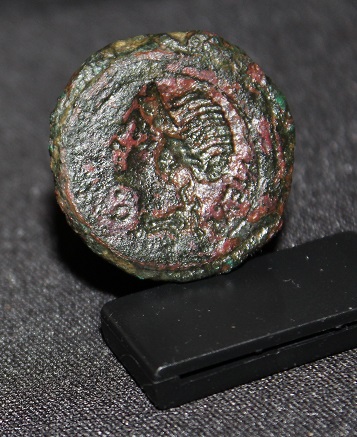
 It might surprise many, nonetheless, governments have routinely spent more than they take in from taxes. In ancient times, governments simply minted more coins to fund their operations, they did not generally borrow. Some Greeks borrowed from the temples to fund wars and did default. However, typically, tax revenues amounted to only about 80% of expenditure. Records have survived as well as dies from which coins were struck. Pictured here, you will see an actual Roman die from the Republican period which has survived. Each die was hand carved so we can distinguish between dies and as such, the fact that the average number of coins produced before a die breaks is about 15,000. Here is a coin struck from this issue that this die represents. Since we can catalogue the number of known dies, we then can reasonably estimate the annual production of money in the Roman Republic as well as the Imperial era.

 The above chart demonstrates the annual production of coinage during the Roman Republic 155-66BC. We can differentiate periods of contraction (deflation) from inflation. We can see that some periods were clearly deflationary and there emerged a shortage of money at times. The Roman Emperor Tiberius, who followed Augustus in 14AD, was notoriously frugal. We find private coinage appearing as tokens to make up the difference for such periods of deflation.
The private token issues during the period of Tiberius (14-37AD) are reminescent of the Great Depression when hundreds of cities issued Depression Scrip. We also find private token coinage produced during the American Civil War. They even issued Postage Currency whereby stamps were exchanged as money.

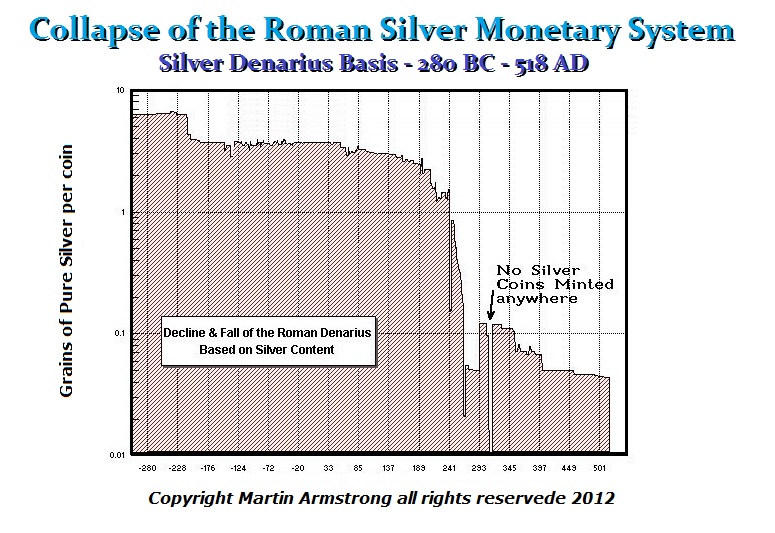 If we then can ascertain the annual production of coinage with a reasonable degree of accuracy, adding up those annual production figures will give us a look at the total money supply. We are then able the also reasonably ascertain that the Roman government collected only about 80% of its total expenditure from taxes. The rest was not borrowed, but simply produced.
Consequently, this provides the understanding as to why there would even be the practice of debasement. The fact that tax revenues fell short of expenses explains that about 20% of the annual budget was covered by new mine production. Rarely has there ever been a “balanced” budget based exclusively on tax revenue.
This further explains why coins of someone like Gordian I (238AD) who reigned only thirty-six days have survived and bring today about $3,000 instead of hundreds of thousands.

Then there is the coinage of Didius Julianus, his wife and daughter who ruled only for 66 days in 193AD. The corruption had reached such levels that it was clear that the decline and fall of the Roman Empire began at this junction in time. The Praetorian Guard actually accepted bids for the position of Emperor. There were two rival bidders who presented themselves – Titus Flavius Sulpicianus (father-in-law of Pertinax) and Marcus Didius Julianus. Didius’ bid was 25,000 sestertii per man, which was the high bid and he was duly declared Emperor. This is why there was so much coinage which has survived for someone who was in office just 66 days.
Today, to cover the short-fall, governments borrow each year with no intention of paying anything back. The Romans did not borrow, they increased the money supply to cover the short-fall in expenditure. This was the common practice and it did not cause runaway inflation. That came during the 3rd century following the capture of Valerian I by the Persians who turned him into a royal slave and when he died, they stuffed him as a trophy. This resulted in the collapse in the money supply as people hoarded and feared the invasion of barbarians. This is when the wall was built around Rome by Aurelian (270-275AD).

Should we stop the borrowing and just increase the money supply as a finite percent of GDP? This makes sense when at time up to 70% of the accumulated national debt has been simply interest expenditures.
We Want Free trade, but what is it?
The concept of Free Trade is very simple but it is found nowhere on the planet today and for most of the past as well; and a hard fact is that if a federal government is involved even a little bit you can bet your bottom dollar there is no Free Trade. Free Trade means that ever transaction is a negotiation between the two parties which are the buyer and the seller for a greed to price in some currency for a good or service in a different country.
So let’s set up a two country world model country A the USA and country B China. The buyer in country A gets the goods and the seller in country B gets the currency. Where things get sticky is what does the seller do with the currency he gets, dollars in this case, since he can’t spend it in his country? Well you say he takes it to the bank and converts it into the currency the seller uses, Yuan in this case, at some specified exchange rate; but that doesn’t solve the problem it just transfer it to the bank. The bank will hold the dollars for a time as the bank knows that a buyer in the banks country will need the Dollars they are holding to buy something in the USA at some time in the near future. Now so long as the need for Dollars and Yuan are proportionally equal, say one Dollar for one Yuan the trading system is in balance and we have Free Trade; meaning at the end of the year the bank has no dollars or yuan in its trading account.
Now we add a complication to the analysis which is what does the bank do if at the end of the year it has a balance of dollars, a surplus, which were not needed? Well since we are still in a Free Trade situation the bank could reduce the exchange rate making the Dollars cheaper vis-a-vis the Yuan say two Dollars for one Yuan which makes the USA goods 50% cheaper. So the demand for dollars goes up and more USA goods are purchase and the system is back in balance. So there is a method to insure that the trade is in fact free; meaning free of government interference i.e. tariffs, customs inspections, fixed exchange rates and various standards and quotas.
What the cleaver Asians have figured out, first the Japanese, is that the American politicians are stupid and corrupt and like buying votes with free things to the poor. But to get the money for paying for the free things (someone does have to pay) they would need to tax the rich and since they are the rich that wouldn’t work so well so they needed another way to get the money that they could blame on others, evil companies. In the previous example we had a surplus of Dollars in China being held by the bank and so in this example the Chinese government took the Dollars from the banks at the previous rate of one Dollar per one Yuan so they now had the dollars. Now the cleaver part was that they didn’t buy goods in the USA they bought US Treasuries, basically they were leading their Dollars to the US Government. And our government was glad to get them as it gave them more money to buy free things for the masses. However there was a price this system made it almost impossible for the US companies to compete in China; and worse it made the Chinese goods so cheap that they had to start buying their parts from China. This system is not sustainable as there are only so many jobs that can be shipped to China and at that point they will have trillions of Dollars in their hands and they will end up buying the country with it.
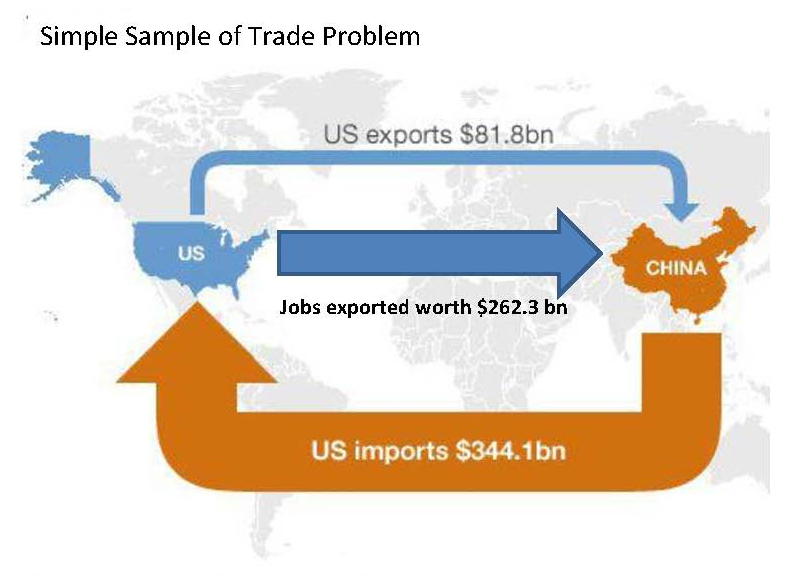
We are now in a political a system, not an economic system, where we get cheap goods and in return we ship them our jobs. No sane government would ever do this as it can’t last very long and at some point there is no returning to the old system, and we are almost there.
Will Gold and Silver Become the Underground Currencies of the Future?
Armstrong Economics Blog
Re-Posted Mar 14, 2016 by Martin Armstrong

QUESTION: Martin … the reasoning behind goldbugs … advising people to buy gold to thwart the cashless society that govts will soon impose on us all. Do you think gold and silver will become the underground currency of the alternative economy as people try to get around the official cashless economy or not?
thanks
Regards
P
ANSWER:They probably will to some extent, but it will be very limited. Gold and silver have lost their mobility. You can no longer hop on a plane with a briefcase full of metal. The more likely outcome is that gold and silver will simply be a hedge against government. It is unlikely that everyone will simply be using them at the local Starbucks.
Government will make transactions in gold or silver illegal and equivalent to money laundering. These people are not about to let anything circumvent their dreams. Nevertheless, their plans are by no means sustainable. The more likely outcome will be that they collapse and we move to some new political system. However, keep in mind that this could take until 2032 for a complete reboot.
In France, a train that passes through Switzerland and Liechtenstein is routinely stopped. The French financial police enter and search bags and luggage for valuables. You cannot travel with valuables worth more than $10,000. They will confiscate whatever they can. In Italy, if you look like you have a lot of gold chains on they will pull you over and weigh them.

The likelihood that you will be able to travel with gold is about zero. The likelihood that you will be able to go to the local grocery store and buy food with silver or gold coins is also zero. The more probable outcome is that this will provide a hedge against government to make the transition to the next monetary system. These people are fighting for dominance over society. Do you really think it will be that easy that everyone will be using gold and silver coins? They will not go down without a fight and the first blood draw will be on our side — not theirs.
4 Elections Away from 2017 the Year from Political Hell
Armstrong Economics Blog
Re-Posted Mar 13, 2016 by Martin Armstrong

 There has been a major political uprising in Germany. For the first time, the Green Party has beaten the establishment in Baden-Württemberg. I have been warning that Trump is not some freak show. This is a global uprising we are watching in politics as we head into 2017 – the year from Political Hell. We are indeed, only three major elections away from perhaps the revision of NATO, the fall of the European Union, and the end of the socialist world order as we have know it. We have not just the US election, we have Germany, France.
Then we have this June and the British Exit vote which is actually the first. If Britain votes to leave, the EU is finished. If they vote to stay, Britain is finished and going down with the EU as the Muslim refugees pour in for free healthcare and welfare, and perhaps a few good looking girls as a bonus. This is like two guys walking in the field in Rockies. Suddenly they see a mountain lion. One quietly slips on his running shoes. The other looks at him and asks: “Do you really think you can out run him?” His friend replies: “No. I just have to outrun you.”
 Centinel2012