There is a geopolitical strategy happening this week that is essentially under the radar.
U.S. Treasury Secretary Steven Mnuchin, USTR Robert Lighthizer, Economic Council Chairman Larry Kudlow, and the U.S. trade team are heading to China.
The outcome of their discussions connects the initiatives behind North Korea, China and NAFTA. The steel and aluminum tariffs are part of the toolbox. Only one media personality, our favorite suspicious cat, appears to understand the larger economic play and how it is being deployed.
From the U.S. perspective, NAFTA has a fatal flaw. Mexico and Canada admitted the flaw for the first time a few weeks ago. The flaw is Mexico and Canada’s exploitation of NAFTA as a backdoor into the U.S. market for Asian, mostly Chinese, manufactured products. Multinational corporations who have invested Canada and Mexico are determined to retain the flaw.
President Trump understands that as long as Canada and Mexico can unilaterally make trade agreements with the EU and ASEAN nations, any NAFTA agreement between the U.S., Canada and Mexico is moot. The NAFTA talks are paused.
The U.S. Team now heads to China. There’s no doubt part of the objective is to begin a structural discussion that must happen for the U.S. trade team to approach closing the fatal NAFTA flaw from the source of origin. [*note* on the EU side of this issue, Commerce Secretary Wilbur Ross is leading a similar discussion. Mnuchin and Lighthizer are focused on Asia, Ross has responsibility for Europe]
The North Korean nuclear denuclearization agreement, and substantive peace treaty between North and South Korea, is part of the geopolitical trade negotiation with the U.S. (President Trump) and Beijing (Chairman Xi).
All three issues: •NAFTA, •China Trade Deal, and •North Korea all become part of the larger dynamic. These economic initiatives and Korean strategic peace initiatives are connected by President Trump’s unique use of economic leverage.
I have no idea how Team U.S.A. plans to frame a deal with China that simultaneously solves NAFTA (fatal flaw) and North Korea; however, there’s no doubt -due to the sequencing and timing- that this objective is well underway.
I spent two months shy of 4 years in the army from 1965 to 1969 first as enlisted and then as an officer. I had one partial tour in Nam where I was wounded and sent home to recover after 4 months in combat. I was qualified with most infantry weapons and used a CAR-15 (Colt Automatic Rifle-15) in Vietnam which was a short barrel version of the M16 riffle. The more modern version of that rifle line is the M4 and a civilian look alike is commonly referred to as the AR-15 Assault rifle. The civilian AR-15 cannot fire full auto even with a “bump stock” add on, it still requires a separate trigger pull for each round fired. In Vietnam on patrol I never fired my CAR-15 on full auto; it’s a waste of ammo in most cases. In the jungle often with no communications you didn’t waste your ammo.
The following is a quick summary of the various kinds of guns or weapons made as simple as possible. Manufacturers and others give brand names and descriptions to models they make and there are all kind of fancy add-on’s most, if not all, are meaningless to the actual function of the weapon; which is feed a round into the chamber and fire it with a trigger pull. Not considered here, are the various kinds of bullets but it must be kept in mind that the bullets are designed to kill, there is no such thing as a safe bullet.
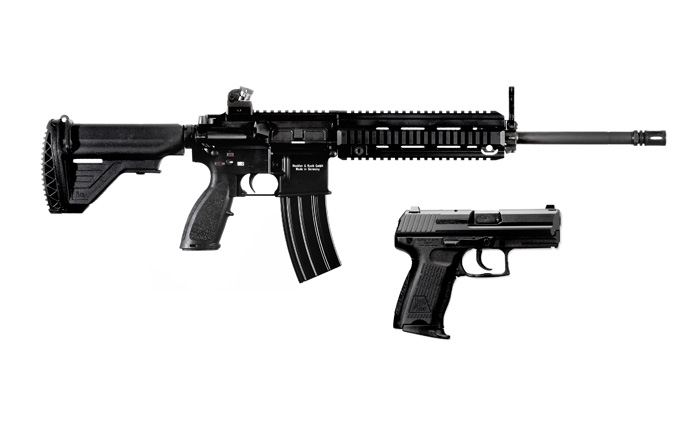
But first I have a test for you, below are the images of two weapons, what is the main functional difference between them, assume they are civilian weapons? At the end of this post I will give you the answer.
Forgetting muzzle loaders there are really only two kinds of guns (including; hand guns, rifles, machine guns and shot guns) the first and most common kind is where one trigger pull fires one round. The other kind is when a trigger is pulled, and held, the weapon will continue to fire until either the supply of bullets is gone or the trigger is released. Some of the different common names are: machine gun, revolver, semi-automatic, rifle, carbine, long riffle, shot gun and derringer that refer to the means of feeding a bullet into the weapon and the length of the barrel.
Bullets can be placed in one at a time as in a derringer, or 6 in a cylinder that can be placed in the revolver, or a small number from 3 to 8 or more in a feed tube under the barrel of a lever action rifle, or a pump action shot gun, or in a clip of 5 bullets that can be pushed into the opening under the bolt as in the old M-1 Garand rifle of WW II, or in a magazine that holds 5 to 30 bullets or more like a AR-15 or M4 or AK-47, or a belt of bullets held together by small metal clip of 100 or more bullets as in a M-60 machine gun.
The next consideration is how the bullets get into the position to be fired; which can be a rotating cylinder, a hand operated bolt, a pump action, a lever action, a mechanism related to the energy contained in the detonated charge in the bullet that will directly or indirectly cause the bolt to move back into a position where the next bullet can be feed in (commonly referred to as a semi-automatic).
For all practical purposes, from a functional point of view, there are only 4 kinds of guns or weapons:
Civilian Weapons (some also used by the military):
1 Semi-automatic single pull and release trigger with a short barrel
2 Semi-automatic single pull and release trigger with a long barrel
Military Weapons:
3 Full-automatic and single pull and hold trigger with a short barrel
4 Full-automatic and single pull and hold trigger with a long barrel
The problem that the people that don’t like the 2nd Amendment, and want to ban guns, have is that there is no way to actually ban “assault” rifles as it does not appear as a type of weapon: it’s a look, not a kind of weapon. It would be like trying banning Kleenex tissue. The closest actual type would be a scout rifle or a carbine which are short barreled rifles. Legislation that these people try to write, as to what constitutes an assault rifle, end up having a great many pages of descriptions as they try and describe something that does not actually exist.
The answer to the quiz is the biggest functional difference between those two weapons is the length of the barrel.
A man in Toronto drives a van into a crowd of people, killing 10. No one calls for banning vans. So why does the left call to ban guns when we all know its people who are the problem?
There are those times when Senator Lindsey Graham carefully weighs the politics of the moment and seems to align with the policies of President Trump and the MAGA movement. This is one of those times.
The tender senator hits the quadruple-lindy… Agreeing with President Trump on: North Korea, Iran, China and FBI Director James Comey’s insufferable nonsense. As winged pigs seemingly aviate in our blind spot, here’s a full 17 minutes of the tender senator praising President Donald J Trump:
The Bureau of Economic Analysis (BEA), who track GDP -and- U.S. Labor Department (DoL) Bureau of Labor and Statistics (BLS), who track wage growth, have released the initial sets of analysis for Quarter 1 of this year (Jan-March). The first quarter growth in GDP comes in at 2.3%. [Most estimates initially expected 2.0% or slightly less.]
CBS – […] It’s common for economic growth to slow in the first quarter and then accelerate later in the year. Still, the January-March increase was better than expected: Economists had foreseen a 2 percent annualized rate. In the current quarter, economists expect growth to surpass 3 percent.
The 2.3% first quarter result puts 2018 on track to achieve President Trump’s targeted growth rate: over three percent combined growth for the full year. Due to seasonal fluctuations the first quarter is historically the weakest for GDP growth. The second quarter will likely rebound well above 3.5% as the historic Q1 -vs- Q2 trend shows above.
One of the positive factors driving the strong Q1 outcome was growth in exports that helps to offset climbing imported purchases, and the continued trade deficits which POTUS Trump is confronting.
Additionally, beyond the strong GDP result, we see a very positive sign in wage growth. Year-over-year wage growth well exceeded expectations at 2.9%
Compensation costs for private industry workers increased 2.8 percent over the year. Wages and salaries increased 2.9 percent for the current 12-month period. (link)
Continual wage growth is a part of President Trump’s MAGAnomic policy; and remember the lowered tax rates went into effect in December. Meaning Q1 wages were higher and simultaneously income tax withholding on those wages are lower… that means more take home pay. Emphasis:More Take-Home Pay!!
CTH has been predicting that MAGAnomics as applied would mean in “Quarter Two” of this year we would begin the period of strongest wage rate growth in three decades. [ FYI, that’s right now ] We have repeatedly predicted that April through June 2018 is the beginning of “the big lift” in blue-collar wages.
A key part of the America-First MAGAnomic ‘Main Street’ policy is to protect the middle-class by driving wages up at a faster rate than the rate of inflation.
This is how the middle-class is able to afford a higher standard of living, and simultaneously ‘savers’ will gain higher rates of return on their savings.
For 30 years economic policy was doing exactly the opposite; now, with MAGAnomics in full swing, we are reversing that trend. CNBC begins to note the activity:
CNBC – […] According to surveys, the tax cuts did not reflect on many workers’ paychecks until late in the first quarter. Income at the disposal of households increased at a 3.4 percent rate in the first quarter, accelerating from the fourth quarter’s 1.1 percent pace. Households also boosted savings during the quarter. (link)
Absolutely stunning remarks today from North Korean Leader Kim Jong-un. Not only do both Kim Jong-un (North) and Moon Jae-in (South) discuss peace, but the DPRK actually goes the full-way-forward toward a unified Korean peninsular. Jumping ju-ju bones, these remarks are absolutely gobsmacking.
Kim Jong-un remarks begin at 09:00 of video below. MUST WATCH:
.
This is incredible. Not only does Kim Jong-un commit to a fully denuclearized Korean peninsular, but also the ending of all hostilities; the end of the Korean war; and stunningly the process to begin entering a phase for a completely unified North and South Korea.
We had a generally optimistic sense about swords turned to plowshares because we could see the outline of the approach last year, but this sequence of events goes way beyond what was even contemplated… I’m speechless.
“Rebranding Kim Jong-un Will Likely Be a Key Part of The Strategy“
Almost everyone understands the term “re branding”. Don’t laugh when you consider the possibility of re-branding Kim Jong-un; and more importantly, as an outcome, the entire geopolitical architecture of North Korea. Rebranding takes time. This type of re branding takes silent and subtle persuasion.
It’s not a short term process, but look for indicators like this to ever-so-slowly morph. China’s Xi Jinping seeding ploughshares over missiles needs careful and controlled fertilization.
Business suits replacing General’s uniforms would be very good for the people of North Korea. Ultimately that’s an honorable goal.
We’re talking about massive amounts of distrust and psychological misinformation to overcome – because China previously benefited from using/supporting North Korea as a hostile proxy province toward the collective enemy. That historic approach and use of N-Korea was the winning hand for China.
The winning economic hand for China, specifically Chairman/President Xi Jinping now rests on being able to change the direction of the DPRK and Kim Jong-un.
Kim Jong-un’s sense of self and disposition has been defined by rockets, military and such. His personal currency is ‘loyalty’ and how ‘loved’ he perceives himself to be in the eyes of his audience.
In order for China to generate enough influence (toward the larger objective of shifting away from militaristic endeavors) Chairman Xi Jinping will now need to shift emphasis on what generates Kim Jong-un’s currency. Loyalty and love must be achieved by alternate methods. Seeds must be planted, fertilized and nurtured.
Turning rockets into ploughshares is a good strategy.
[…] “Here in Seoul, architectural wonders like the Sixty-Three Building and the Lotte World Tower — very beautiful — grace the sky and house the workers of many growing industries.
Your citizens now help to feed the hungry, fight terrorism, and solve problems all over the world. And in a few months, you will host the world and you will do a magnificent job at the 23rd Olympic Winter Games. Good luck. (Applause.)
The Korean miracle extends exactly as far as the armies of free nations advanced in 1953 — 24 miles to the north. There, it stops; it all comes to an end. Dead stop. The flourishing ends, and the prison state of North Korea sadly begins.
Workers in North Korea labor grueling hours in unbearable conditions for almost no pay. Recently, the entire working population was ordered to work for 70 days straight, or else pay for a day of rest.
Families live in homes without plumbing, and fewer than half have electricity. Parents bribe teachers in hopes of saving their sons and daughters from forced labor. More than a million North Koreans died of famine in the 1990s, and more continue to die of hunger today.
Among children under the age of five, nearly 30 percent of afflicted — and are afflicted by stunted growth due to malnutrition. And yet, in 2012 and 2013, the regime spent an estimated $200 million — or almost half the money that it allocated to improve living standards for its people — to instead build even more monuments, towers, and statues to glorify its dictators.
What remains of the meager harvest of the North Korean economy is distributed according to perceived loyalty to a twisted regime. Far from valuing its people as equal citizens, this cruel dictatorship measures them, scores them, and ranks them based on the most arbitrary indications of their allegiance to the state.
Those who score the highest in loyalty may live in the capital city. Those who score the lowest starve. A small infraction by one citizen, such as accidently staining a picture of the tyrant printed in a discarded newspaper, can wreck the social credit rank of his entire family for many decades.
An estimated 100,000 North Koreans suffer in gulags, toiling in forced labor, and enduring torture, starvation, rape, and murder on a constant basis.
In one known instance, a 9-year-old boy was imprisoned for 10 years because his grandfather was accused of treason. In another, a student was beaten in school for forgetting a single detail about the life of Kim Jong-un.
Soldiers have kidnapped foreigners and forced them to work as language tutors for North Korean spies.
In the part of Korea that was a stronghold for Christianity before the war, Christians and other people of faith who are found praying or holding a religious book of any kind are now detained, tortured, and in many cases, even executed.
North Korean women are forced to abort babies that are considered ethnically inferior. And if these babies are born, the newborns are murdered.
One womans baby born to a Chinese father was taken away in a bucket. The guards said it did not deserve to live because it was impure.
So why would China feel an obligation to help North Korea?
The horror of life in North Korea is so complete that citizens pay bribes to government officials to have themselves exported aboard as slaves. They would rather be slaves than live in North Korea.
To attempt to flee is a crime punishable by death. One person who escaped remarked, “When I think about it now, I was not a human being. I was more like an animal. Only after leaving North Korea did I realize what life was supposed to be.”
And so, on this peninsula, we have watched the results of a tragic experiment in a laboratory of history. It is a tale of one people, but two Koreas. One Korea in which the people took control of their lives and their country, and chose a future of freedom and justice, of civilization, and incredible achievement. And another Korea in which leaders imprison their people under the banner of tyranny, fascism, and oppression. The result of this experiment are in, and they are totally conclusive.
When the Korean War began in 1950, the two Koreas were approximately equal in GDP per capita. But by the 1990s, South Koreas wealth had surpassed North Korea’s by more than 10 times. And today, the Souths economy is over 40 times larger. You started the same a short while ago, and now you’re 40 times larger. You’re doing something right.
Considering the misery wrought by the North Korean dictatorship, it is no surprise that it has been forced to take increasingly desperate measures to prevent its people from understanding this brutal contrast.
Because the regime fears the truth above all else, it forbids virtually all contact with the outside world. Not just my speech today, but even the most commonplace facts of South Korean life are forbidden knowledge to the North Korean people. Western and South Korean music is banned. Possession of foreign media is a crime punishable by death. Citizens spy on fellow citizens, their homes are subject to search at any time, and their every action is subject to surveillance. In place of a vibrant society, the people of North Korea are bombarded by state propaganda practically every waking hour of the day.
North Korea is a country ruled as a cult. At the center of this military cult is a deranged belief in the leaders destiny to rule as parent protector over a conquered Korean Peninsula and an enslaved Korean people.
The more successful South Korea becomes, the more decisively you discredit the dark fantasy at the heart of the Kim regime.
In this way, the very existence of a thriving South Korean republic threatens the very survival of the North Korean dictatorship.
This city and this assembly are living proof that a free and independent Korea not only can, but does stand strong, sovereign, and proud among the nations of the world. (Applause.)
Here, the strength of the nation does not come from the false glory of a tyrant. It comes from the true and powerful glory of a strong and great people — the people of the Republic of Korea — a Korean people who are free to live, to flourish, to worship, to love, to build, and to grow their own destiny.
In this Republic, the people have done what no dictator ever could — you took, with the help of the United States, responsibility for yourselves and ownership of your future. You had a dream — a Korean dream — and you built that dream into a great reality.
In so doing, you performed the miracle on the Hahn that we see all around us, from the stunning skyline of Seoul to the plains and peaks of this beautiful landscape. You have done it freely, you have done it happily, and you have done it in your own very beautiful way.
This reality — this wonderful place — your success is the greatest cause of anxiety, alarm, and even panic to the North Korean regime. That is why the Kim regime seeks conflict abroad — to distract from total failure that they suffer at home.
Since the so-called armistice, there have been hundreds of North Korean attacks on Americans and South Koreans. These attacks have included the capture and torture of the brave American soldiers of the USS Pueblo, repeated assaults on American helicopters, and the 1969 drowning [downing] of a U.S. surveillance plane that killed 31 American servicemen. The regime has made numerous lethal incursions in South Korea, attempted to assassinate senior leaders, attacked South Korean ships, and tortured Otto Warmbier, ultimately leading to that fine young man’s death.
All the while, the regime has pursued nuclear weapons with the deluded hope that it could blackmail its way to the ultimate objective. And that objective we are not going to let it have. We are not going to let it have. All of Korea is under that spell, divided in half. South Korea will never allow what’s going on in North Korea to continue to happen.
The North Korean regime has pursued its nuclear and ballistic missile programs in defiance of every assurance, agreement, and commitment it has made to the United States and its allies. It’s broken all of those commitments. After promising to freeze its plutonium program in 1994, it repeated [reaped] the benefits of the deal and then — and then immediately continued its illicit nuclear activities.
In 2005, after years of diplomacy, the dictatorship agreed to ultimately abandon its nuclear programs and return to the Treaty on Non-Proliferation. But it never did. And worse, it tested the very weapons it said it was going to give up. In 2009, the United States gave negotiations yet another chance, and offered North Korea the open hand of engagement. The regime responded by sinking a South Korean Navy ship, killing 46 Korean sailors. To this day, it continues to launch missiles over the sovereign territory of Japan and all other neighbors, test nuclear devices, and develop ICBMs to threaten the United States itself. The regime has interpreted Americas past restraint as weakness. This would be a fatal miscalculation. This is a very different administration than the United States has had in the past.
Today, I hope I speak not only for our countries, but for all civilized nations, when I say to the North: Do not underestimate us, and do not try us. We will defend our common security, our shared prosperity, and our sacred liberty.
We did not choose to draw here, on this peninsula — (applause) — this magnificent peninsula — the thin line of civilization that runs around the world and down through time. But here it was drawn, and here it remains to this day. It is the line between peace and war, between decency and depravity, between law and tyranny, between hope and total despair. It is a line that has been drawn many times, in many places, throughout history. To hold that line is a choice free nations have always had to make. We have learned together the high cost of weakness and the high stakes of its defense.
America’s men and women in uniform have given their lives in the fight against Nazism, imperialism, Communism and terrorism.
America does not seek conflict or confrontation, but we will never run from it. History is filled with discarded regimes that have foolishly tested Americas resolve.
Anyone who doubts the strength or determination of the United States should look to our past, and you will doubt it no longer. We will not permit America or our allies to be blackmailed or attacked. We will not allow American cities to be threatened with destruction. We will not be intimidated. And we will not let the worst atrocities in history be repeated here, on this ground, we fought and died so hard to secure. (Applause.)
That is why I have come here, to the heart of a free and flourishing Korea, with a message for the peace-loving nations of the world: The time for excuses is over. Now is the time for strength. If you want peace, you must stand strong at all times. (Applause.) The world cannot tolerate the menace of a rogue regime that threatens with nuclear devastation.
All responsible nations must join forces to isolate the brutal regime of North Korea — to deny it and any form — any form of it. You cannot support, you cannot supply, you cannot accept. We call on every nation, including China and Russia, to fully implement U.N. Security Council resolutions, downgrade diplomatic relations with the regime, and sever all ties of trade and technology.
[…] It is our responsibility and our duty to confront this danger together — because the longer we wait, the greater the danger grows, and the fewer the options become. (Applause.) And to those nations that choose to ignore this threat, or, worse still, to enable it, the weight of this crisis is on your conscience.
I also have come here to this peninsula to deliver a message directly to the leader of the North Korean dictatorship: The weapons you are acquiring are not making you safer. They are putting your regime in grave danger. Every step you take down this dark path increases the peril you face.
North Korea is not the paradise your grandfather envisioned. It is a hell that no person deserves. Yet, despite every crime you have committed against God and man, you are ready to offer, and we will do that — we will offer a path to a much better future. It begins with an end to the aggression of your regime, a stop to your development of ballistic missiles, and complete, verifiable, and total denuclearization. (Applause.)
A sky-top view of this peninsula shows a nation of dazzling light in the South and a mass of impenetrable darkness in the North. We seek a future of light, prosperity, and peace. But we are only prepared to discuss this brighter path for North Korea if its leaders cease their threats and dismantle their nuclear program.
The sinister regime of North Korea is right about only one thing: The Korean people do have a glorious destiny, but they could not be more wrong about what that destiny looks like. The destiny of the Korean people is not to suffer in the bondage of oppression, but to thrive in the glory of freedom. (Applause.)
What South Koreans have achieved on this peninsula is more than a victory for your nation. It is a victory for every nation that believes in the human spirit. And it is our hope that, someday soon, all of your brothers and sisters of the North will be able to enjoy the fullest of life intended by God.
Wow. You have to watch this video to see how history was just encapsulated.
North Korean Leader Kim Jong Un and South Korean President Moon Jae-in meet at the village of Panmunjom, the historic site where the Korean War armistice was signed in 1953 for the start of talks between the two countries.
Their unified meeting is the third inter-Korean summit, but this meeting is the first time a leader from the communist North has entered the democratic South. South Korea then holds a welcoming ceremony for the North Korean leader that includes full military honors and a military guard review.
.
North Korean leader Kim Jong Un writes: “new history starts now; age of peace, from the starting point of history” on guest visitor book at Peace House.
WHITE HOUSE – On the occasion of Republic of Korea President Moon Jae-ins historic meeting with North Korean leader Kim Jong Un, we wish the Korean people well. We are hopeful that talks will achieve progress toward a future of peace and prosperity for the entire Korean Peninsula.
The United States appreciates the close coordination with our ally, the Republic of Korea, and looks forward to continuing robust discussions in preparation for the planned meeting between President Donald J. Trump and Kim Jong Un in the coming weeks.
The Senate voted Thursday to confirm CIA chief Mike Pompeo as President Trump’s next secretary of state. Secretary Pompeo was confirmed on a 57-42 vote. All Republicans present voted to confirm Pompeo. Seven Democrats voted yes.
After the vote, Pompeo was sworn in by Supreme Court Justice Samuel Alito in the West Conference Room of the Supreme Court:
I am pleased with the Senate’s confirmation of Mike Pompeo to serve as our country’s top diplomat. Having a patriot of Mike’s immense talent, energy, and intellect leading the Department of State will be an incredible asset for our country at this critical time in history. He will always put the interests of America first. He has my trust. He has my support. Today, he has my congratulations on becoming America’s 70th Secretary of State.
An interesting discussion this morning on CNBC with White House economic adviser Larry Kudlow beings to highlight the principal purpose of his forte’.
President Trump is the first U.S. president who came to the table of economic policy with a plan of action that is uniquely his own. POTUS doesn’t need “advisers” to frame possible policy, he already has the program mapped out; POTUS needs ‘advisers” who are not actually “advisers” per se’ but rather a sales-force to explain and advance his program agenda to the world markets as the policies are implemented….
.
…Because this is such a substantial shift from historic reference, President Trump’s unique position of actually creating the economic policy must be emphasized and continually repeated. It’s not Kudlow creating the policy; these are President Trump’s policies. The granular details are carried out by U.S.T.R Lighthizer, Commerce Secretary Ross, Treasury Secretary Mnuchin.
Trade explainer Peter Navarro and Economic explainer Larry Kudlow are people specifically enlisted by President Trump to explain Main Street action (policy) and Main Street consequence (outcomes) to Wall Street markets.
It’s easier to understand the importance of Navarro and Kudlow when you remind yourself MAGAnomic policy is operating in a space between two historic economic engines. As Trump de-emphasizes multinational interests, and re-emphasizes domestic Main Street interests, a generation of financial and economic media have no frame of reference.
MAGAnomics operates in the space between two entirely divergent economic engines.
Go through the archives and you’ll note a strategy unfolding that few, including us, could fully conceptualize when it first appeared. Way back when candidate Trump first began to put his economic plans into platform outlines the subtle signature was there, but few were paying attention.
In order to reverse three decades of middle-class economic erosion, there were indicators that Trump’s strategy was a radical change in approach. In essence the strategy was to split the economic policy into two areas and sequence the policy: highly-consumable goods (first) and durable goods (second).
Both product sectors have historically been viewed and approached by economic policy makers using a single financial strategy. That singular approach gave rise to Wall Street benefiting and Main Street suffering. Investment-class gained; middle-class suffered.
Trump outlined an approach –albeit vaguely– that was multidimensional.
His policy would first target multinational corporations, using the U.S. Treasury (Mnuchin) to weaken their grip and influence; simultaneously, he would use energy policy to drive down domestic prices in highly-consumable products (fuel, food, energy sector). These sectors are not measured in fed inflation indexes; however, if lowered, these facets of consumer spending can also increase the amount of disposable income available for workers.
In essence, expand the economy by lowering the aggregate cost of living for the middle-class who live paycheck-to-paycheck. Use monetary policy, fiscal policy and trade policy to entice domestic investment and create jobs; and ultimately put upward pressure on wages.
When the tax cut and reform package passed in December 2017, phase-one cemented and a new phase immediately began. Phase II, 2018.
The second aspect, or second phase of Trump economic policy, is geared toward ‘durable goods’. That’s where the trade imbalance plays a larger role in the strategy.
As the economy expands, Americans can now afford rises in the prices of durable goods. However, as with all manufacturing systems -geared toward retaining market share inside a consumer economy (ie. the U.S. market)- the foreign creators will first seek to retain competitive pricing structure by making efficiencies within their own business models.
When foreign manufacturers entering a phase of cost-cutting analysis (note what happened when Trump left Asia after visit) you immediately hit them with stronger forecasted trade rules on their products.
The financial analysis and five-year-plans, being conducted by the manufacturers, then has to contain the possibility of new rules. That’s where Commerce Secretary Wilbur Ross and U.S. Trade Representative Robert Lighthizer come in:
On Oct. 5, 2017 the ITC [International Trade Commission] voted unanimously in favor of Whirlpool, which brought a complaint forward accusing Samsung and LG Electronics, its South Korean competitors, of flooding U.S. markets with cheap washing machines and pricing out domestic manufacturers. While the ITC didn’t say material harm was coming from South Korea in particular, Whirlpool alleged the country’s manufacturers shifted production into other countries (Thailand and Vietnam) in order to avoid U.S. anti-dumping tariffs imposed in previous years.
The ITC’s recommendations will be sent to President Donald Trump, who will have two months to make a final decision.
This second phase is where the two economic engines: Wall Street and Main Street; begin to come into parity again. The FED (monetary policy) does measure the cost of durable goods in their inflation index. Rises in durable goods are recorded in inflation indexes and monetary policy (interest rates) is influenced accordingly.
Trump’s phase-one befuddled the FED who were perplexed over inflation being virtually non existent. Most of the reason for this disconnect has been the downward price pressure on (non-measured) highly-consumable goods; and static prices on (measured) durable goods. The FED could see the economy expanding, but they cannot, or at least couldn’t until now, reconcile the lack of inflation.
Wages are growing, albeit modestly at first – but now gaining speed, as a result of economic expansion and increased employment. This wage growth, in combination with keeping downward pressure on high-consumable prices, allows Trump to begin a series of aggressive trade policies that will slowly raise durable good prices.
The trade policy, tightly executed by Trump, Mnuchin, Ross and Lighthizer, will put increased pressure on manufacturers to make products in the U.S. In turn this puts further demand on U.S. workers; which, in turn, drives up the wages – to afford the prices of durable goods as they increase. This action/consequence is not accidental, it is planned.
Simultaneously, it must be remembered that every dollar removed from imports actually increases the GDP. The value of all imported goods is deducted from the combined value of all goods and services we produce. If we drop $1 billion in imports on Washing Machines, and simultaneously manufacture $1 billion on Washing Machines in the U.S., the U.S. GDP gains $2 billion in value. The U.S. economy actually expands by more than $2 billion because the attached manufacturing wages are also inside the U.S.
This multi-prong approach is one of the reasons why it still doesn’t seem to be part of the strategy to keep the U.S. inside NAFTA as it currently is constructed. Perhaps, just perhaps, the NAFTA exercise is more optical than actual. Perhaps, it’s more about the outside world seeing the U.S. trade position as executed, than actually negotiating. Regardless of motive we shall soon find out.
President Donald Trump called-in to ‘Fox & Friends’ morning show for a wide-ranging interview on numerous subjects. Topics included: the Iranian nuclear agreement; Ronny Jackson’s withdrawal decision; Michael Cohen and possible North Korea summit.
Additionally, President Trump shared his disappointment with the Justice Department; noted James Comey’s book was likely a big mistake; and also thanked Kanye West for his support.
I have created this site to help people have fun in the kitchen. I write about enjoying life both in and out of my kitchen. Life is short! Make the most of it and enjoy!
This is a library of News Events not reported by the Main Stream Media documenting & connecting the dots on How the Obama Marxist Liberal agenda is destroying America

 There is a geopolitical strategy happening this week that is essentially under the radar.




 Centinel2012