Forecasting RecessionsForecasting


Posted originally on Sep 10, 2024 By Martin Armstrong |  

COMMENT: Mr. Armstrong, I find it incorrigible that everyone now claims recession when they have never predicted a recession before. That was clear from the video you had of Larry Summers, who admitted nobody could do that. It is very strange how you are the only person who has ever forecast recessions and new highs in markets when everyone was called the opposite. Even in August, you had these people clamoring for an emergency rate cut while you said it was a three-day plunge and a new high would follow.
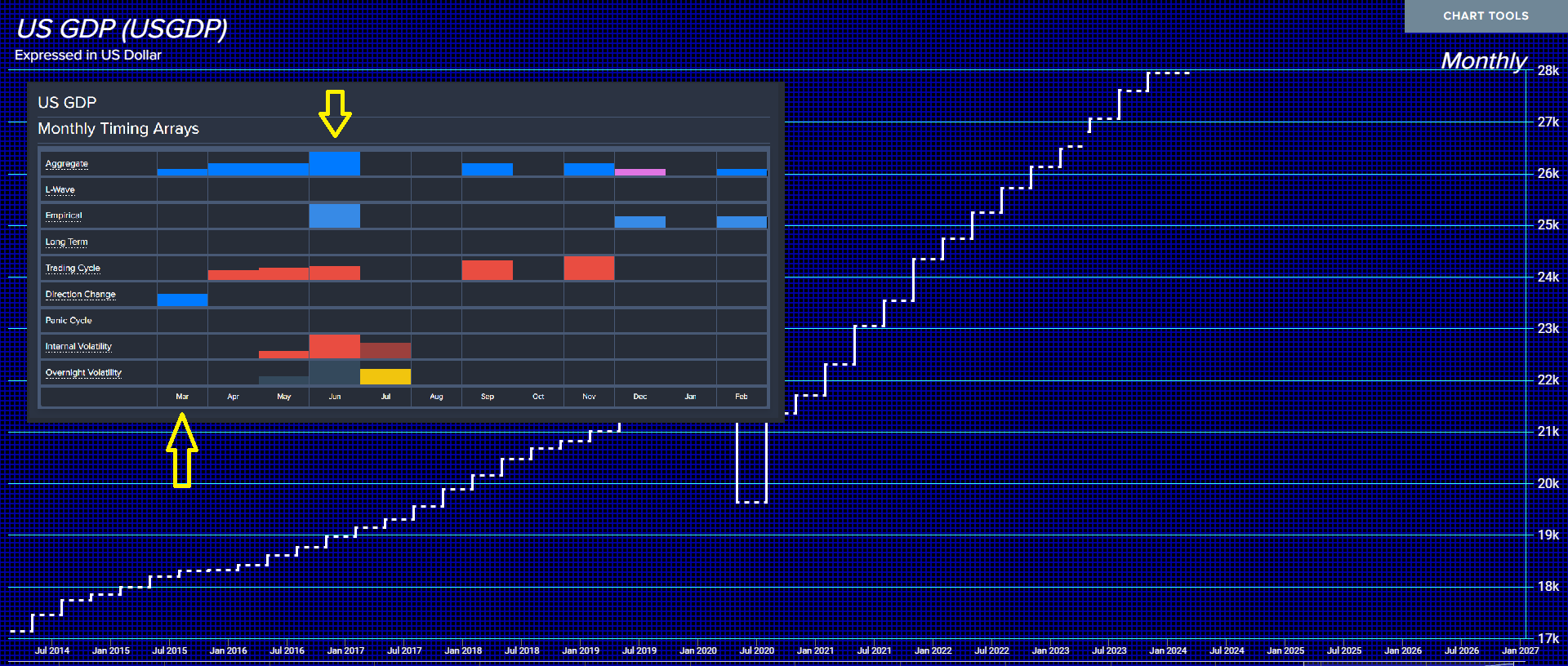
US GDP 4 25 24

I looked back, and even in your April 25, 2024 post, you said a recession would follow the ECM turn on May 7th. Nobody gives you credit. They all copy you. But without you, they have no forecast. They are stupid, for what you have done is essential for society. These people want to pretend they are something they are not.

They do not even understand what makes a recession unfold.

Thank you so much. I wish people would be honest and give you credit, for that is the only way to hope for what comes after 2032. All they do is plagiarize you.

Peter
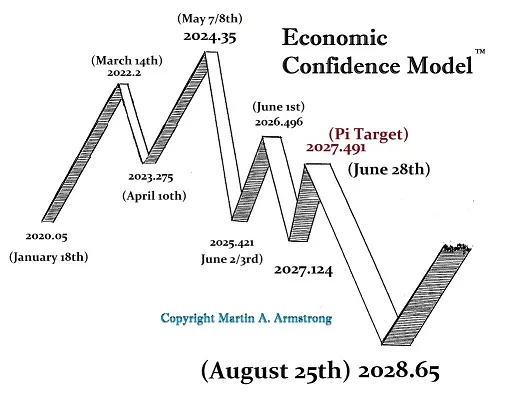
ECM 2020 2028 R

REPLY: Sadly, what you are describing is human nature. We are a flawed species – tragic in so many ways, like a Greek play. We seem to cling to our expectations of a just and moral world when history records anything but morality. And Thraymachus basically said JUSTICE is always the same – the self-interest of those in power – JUST US is the real spelling.

We have Europe and South America censuring free speech because the LEFT does not believe in civilization; they only see their own self-interest. Their failure in life is caused by the success of others—never themselves. As a species, we seem to believe there is ethical meaning behind everything when we live in an unethical and meaningless world that bathes only in self-interest.
Recession Global

I understand what you mean. Only this model has projected booms, busts, and recessions decades in advance. We have to learn to live with the cycle. Pretending you called a recession from a gut feeling or just looking at US statistics is a joke. We are all in this together. The US cannot withstand a global recession. That is why I say we are all connected. When you have the Neocons threatening war on four fronts, China, Korea, Russia, and Iran, the future is colored with uncertainty. That results in the contraction of spending.

Then, inflation is set in motion by shortages and tax increases. Throw in Kamala’s taxation of unrealized gains and make it only the billionaires. They are then forced to see stock to pay the tax, and you create the biggest crash in history that wipes out people’s pensions. NOTHING takes place in isolation. NEVER do the Democrats ever once question their spending. They are Marxists and must constantly promise more, never less, and that necessitates endless tax increases that always reduce GDP.
InvisibleHand 2

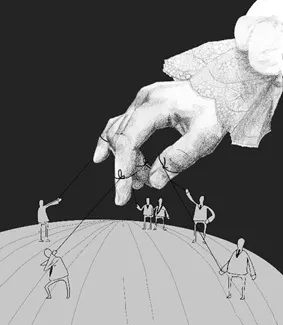
It’s always the invisible hand – we all act in our own self-interest.

Why Formal Education Can Be Just Propaganda


Posted originally on Aug 29, 2024 By Martin Armstrong 

Galbraith Great Crash
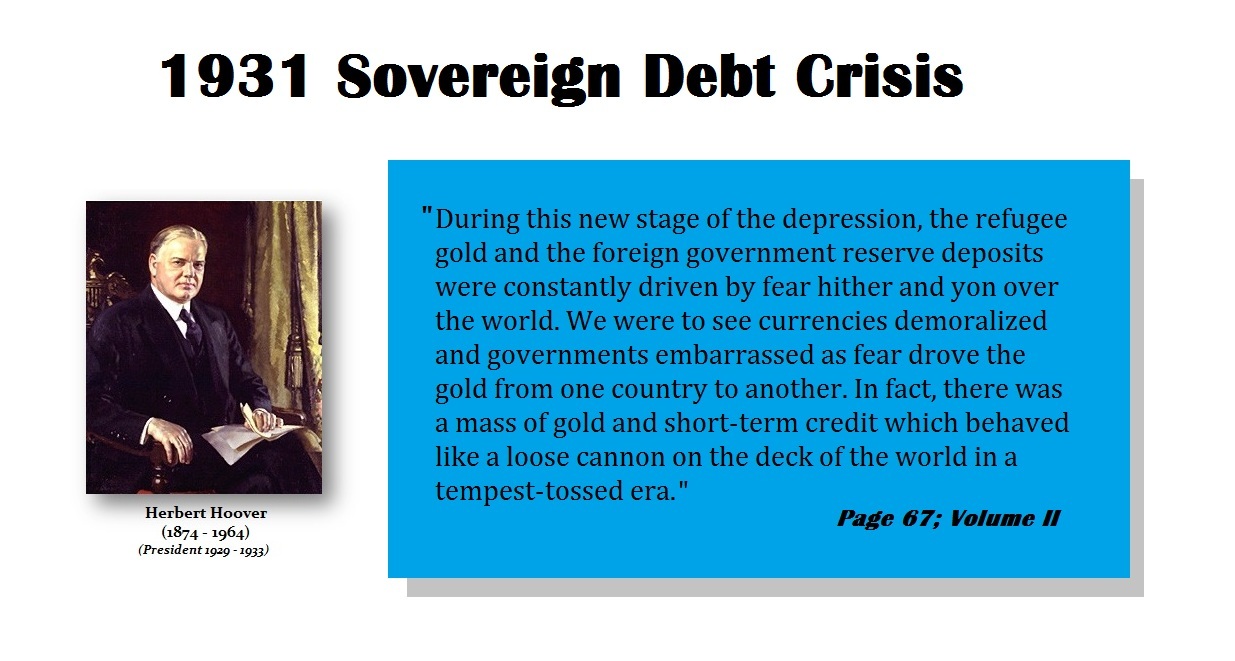
Herbert Hoover Memoirs

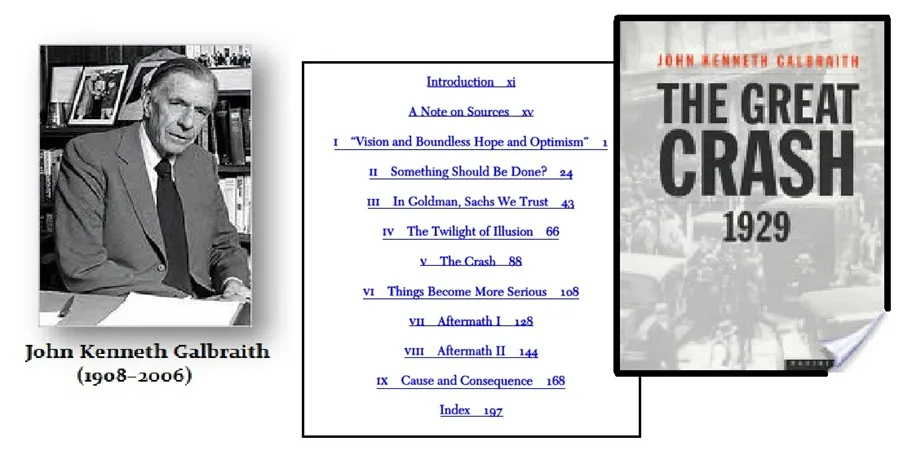
When I was in high school history class, I had to read Galbraith’s The Great Crash. It was not until I came across a two-volume set of Herbert Hoover’s Memoirs that my eyes were pulled open. Nowhere in Galbraith’s book was there ever any mention of a 1931 Sovereign Debt Default because he was a Socialist, and the object of his book was to pin all the blame on corporations and the rich. He omitted everything that ever remotely pointed to the government as a cause. We should all own nothing, shut up, and be happy. Speak up, and today, you go to prison for Free Speech.

The conflict surfaced in my mind in high school. As I have said, in physics class they said nothing is random. Then in economics class, they said everything is random so government has the power to manipulate society and prevent recessions. That was a conflict to me that began my questioning of what I was being taught.

It is becoming painfully obvious schools are programming children for political agendas. This is very Stalinistic, for he, too, instructed children that the state was their parent and if their biological parents ever said anything against the state, they were to report them.

It has gotten far worse than when I was a kid. They were trying to brainwash us that the government is good and the corporate world is all evil. Today, that has gone into being gay, changing your gender, and not telling the parents like Stalin for the State is your parent. This is a movement to reduce the population to make Schwab, Gates, and Soros happy.

What does this all say? Today, if I had to start over, I would choose homeschooling.

(read Chapter on 1931)

Hoover Quote

Yellen Denies Food Inflation


flation

Posted Jul 2, 2024 By Martin Armstrong 

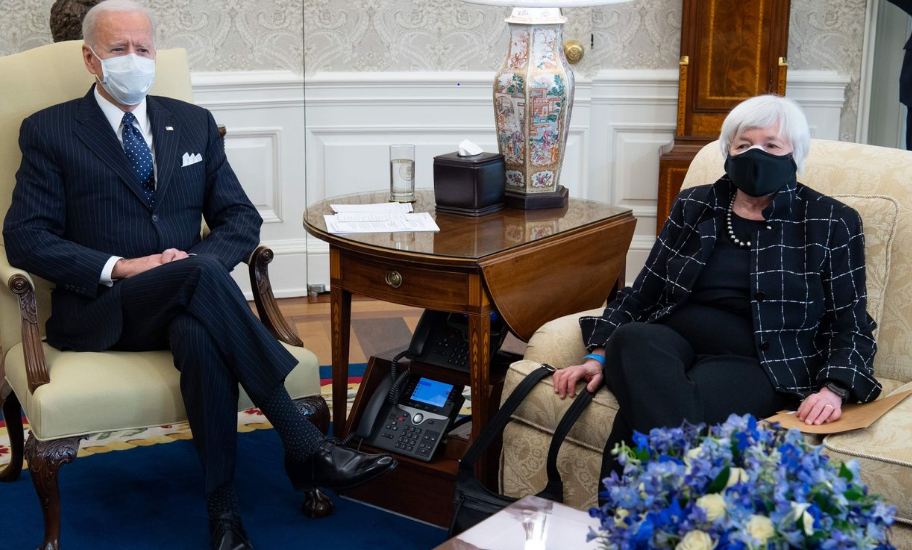
Biden Yellen

Treasury Secretary Janet Yellen once again is once again gas lighting the public to believe that the Biden Administration has inflation under control. When questioned about the rising prices at grocery stores, Yellen denied that prices have soared astronomically.

“I think largely it reflects cost increases, including labor cost increases that grocery firms have experienced, although there may be some increases in margins,” Yellen, who has a net worth of $20 million, stated.  She later touted that she met with several grocery store CEOs who said they were cutting costs. After all, Biden has continually blamed “greedy corporations” for rising food prices. “I think that’s to be applauded, I think that kind of thing is helpful, but I would be reluctant to agree that we should be centralizing agriculture,” Yellen added.

She also stated, once again, that the Fed will reach the arbitrary 2% target by next year. Treasury Secretary Janet Yellen is proof that the establishment is completely clueless when it comes to the lives of the average citizen. This is the same Treasury Secretary who touted, “People are better off than they were pre-pandemic.” She is all-in on the globalist agenda to sacrifice the economy of the United States on behalf of foreign interests.

Yellen has said that the US has not done enough for Ukraine, despite sending more money than Zelensky has time to spend or circulate back into the military-industrial complex. When questioned about America’s immediate involvement in Israel after the Hamas attack, the Treasury Secretary proclaimed America could “certainly” afford two wars, or rather, the government would “certainly” be willing to tax the public to afford the cost of two wars and send your sons and daughters to die fighting them.

https://www.tiktok.com/embed/v2/7384568413810691371?lang=en-US&referrer=https%3A%2F%2Fwww.armstrongeconomics.com%2Farmstrongeconomics101%2Finflation%2Fyellen-denies-food-inflation%2F&embedFrom=oembed

A popular video is circulating the internet of a man who was shocked to discover that the exact same groceries he purchased in 2022 for $126.67 now cost an alarming $414.39. He was shopping at Walmart, arguably one of the most affordable grocery chains. Yet they alter the numbers to claim that food inflation has come down since last year. They say food inflation in America eased to 2.1% in May, making similar claims of declining costs throughout the West. Food inflation has run rampant, and the figures projected by governments are a LIE.

We once had Treasury Secretaries who actually attempted to align national interests with policies. That is no longer the case within Biden’s cabinet for absolutely everyone has sold out to the globalist cabal. It was Yellen who admitted America’s largest spending package, the Inflation Reduction Act, was merely a scheme to push forward the climate change agenda.  “The Inflation Reduction Act is, at its core, about turning the climate crisis into an economic opportunity,” Yellen admitted earlier in the year.  She has never been concerned about inflation or the average American citizen who has been forced to reduce their quality of life.

Fed Holds Rates – What Tools Are Left?


Posted originally on Jun 13, 2024 By Martin Armstrong

Federal Reserve Eagle

The Federal Open Market Committee unsurprisingly voted to maintain rates at 5.25% to 5.5%. The numerous cuts others were anticipating are completely off the table, as the central bank said there might be one reduction for the year compared with their optimistic tone forecast made in March of three rate reductions in 2024.

“In recent months, there has been modest further progress toward the Committee’s 2 percent inflation objective,” the voting members of the Fed said in their statement. They changed their forecast on inflation from “a lack of” to “modest” progress toward the 2% inflation objective.

Four voting members do not believe the central bank should raise rates at all this year. The central bank continues to exclude food and energy, two of the primary drivers of inflation when creating their summaries and dot plots. They certainly would never include taxation in those figures. The Fed claims there will be multiple rate cuts come next year, but they would never cut rates in the face of war which is completely inflationary and produces nothing.

Raising interest rates can have no impact on demand, as the government will simply borrow more, and the central banks simply have no say. Fed Chair Powell has repeatedly said that government spending is completely unsustainable and the Biden Administration is borrowing against future generations.

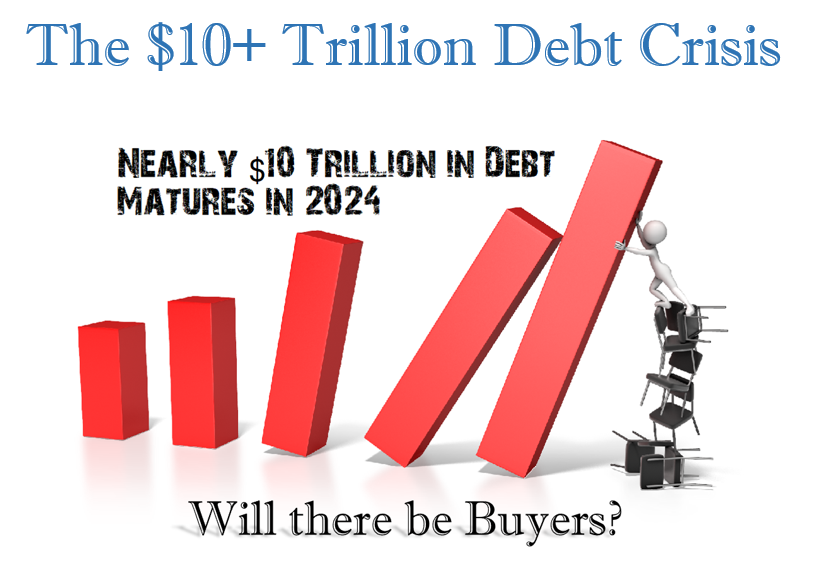
I explained in an earlier post why Keynesian Economics is collapsing. That theory was created when the US had a balanced budget and the government was actually expected to repay what they borrow. They still mistakenly believe that the business cycle can be manipulated. There is not much that the Federal Reserve can do at this point in time besides hope and pray for a miracle before that $10 trillion in debt is due to expire this year.

Why is Keynesian Economics Collapsing?


Posted originally on Jun 10, 2024 By Martin Armstrong 

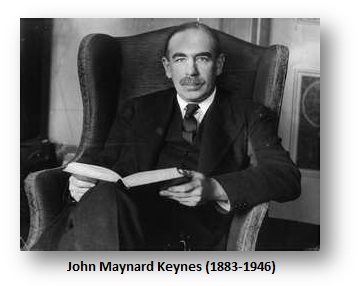
Keynes 5

John Maynard Keynes in his 1936 book, ‘The General Theory of Employment, Interest and Money,” argued aggregate demand was too volatile to be stable and would lead to inflation or recessions. His theory honed in on spending as a means of price control. Low aggregate demand, Keynes argues, would lead to high unemployment and stagflation. Government could intervene through fiscal policies to increase aggregate demand, as an example, increased government spending could tame inflation. Interest rates, according to Keynes, could also be modified to encourage spending and stimulate demand. So why are these theories failing miserably today?

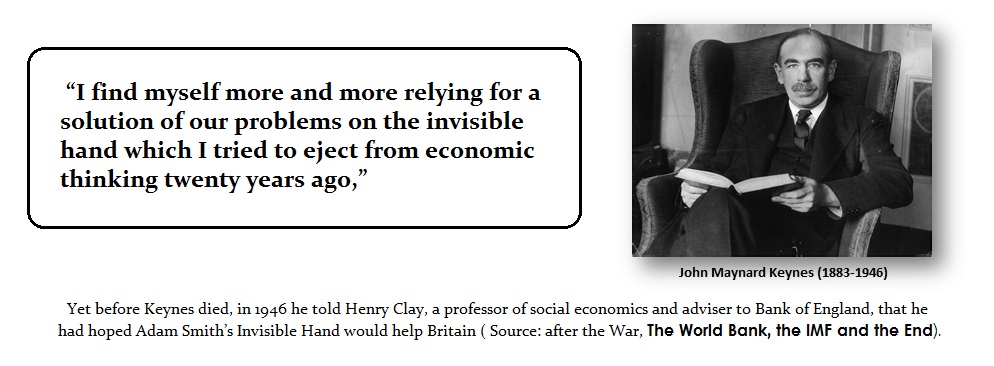
To begin, the United States had a balanced budget when Keynes presented his theory. The government is now the biggest borrower, acting in its own self interest under Adam Smith’s theory of the invisible hand that Keynes spent his career attempting to deny. According to Keynes, “there is no self-correcting mechanism in a free market economy that automatically restores full employment.” He believed that the government could change the business cycle but arguably regretted this notion on his deathbed.

Keynesian economics gave the government the green light to manipulate the economy, or at least make numerous failed attempted to do so. There is that old joke about communism that you can vote your way in but must shoot your way out, seemingly fitting to the utter disaster governments have created in regards to our economic situation.

Keynes quote on Invisible Hand

The government is by far the biggest borrower. Raising interest rates can have no impact on demand, as the government will simply borrow more, and the central banks simply have no say. During the Great Depression, for example, Washington forced the Federal Reserve to implement QE policies to artificially lower rates to increase demand. Yet, when Washington ordered the Federal Reserve to do the same during the Korean War in 1951, the central bank first broke with Washinton and refused to comply as it knew it would hurt the economy as America’s budget was no longer balanced.

Quantitative Easing destroyed the Keynesian model, and there is now no other alternative for central banks to control the economy. If they raise rates, the budget explodes. The Keynesians advocate manipulating demand and advocate fiscal spending that the central bank cannot control. However, the other part of Keynesianism is the manipulation of taxes. Keynes argued that to stimulate demand, you lower taxes. He saw this correctly, but again, it does not fit with government agendas.

There is no limit to what the government will spend with “money” that simply does not exist. Governments continue to borrow perpetually with no real intention of paying back their debts. This is one piece of the Sovereign Debt Crisis that will implode like a nuclear bomb the likes of which we have never witnessed. The business cycle cannot be manipulated, and what’s more, the Keynesian model cannot account for declining confidence in both government and the economy.

Credit Card Delinquencies Spike Among the “Rich”


Posted originally on Jun 6, 2024 By Martin Armstrong 

CreditCardDelinquency_byClass

Inflation can be felt at every tax bracket. Federal Reserve Bank of Minneapolis President Neel Kashkari came out this week and said the public “viscerally hates high inflation,” and for good measure. Everyone is seeing the impacts of inflation on their quality of life. Those defined as rich, the demographic one side of the political spectrum believes must be taxed into oblivion, have not come out of this inflationary cycle unscathed, as indicated by a new report from the St. Louis Federal Reserve.

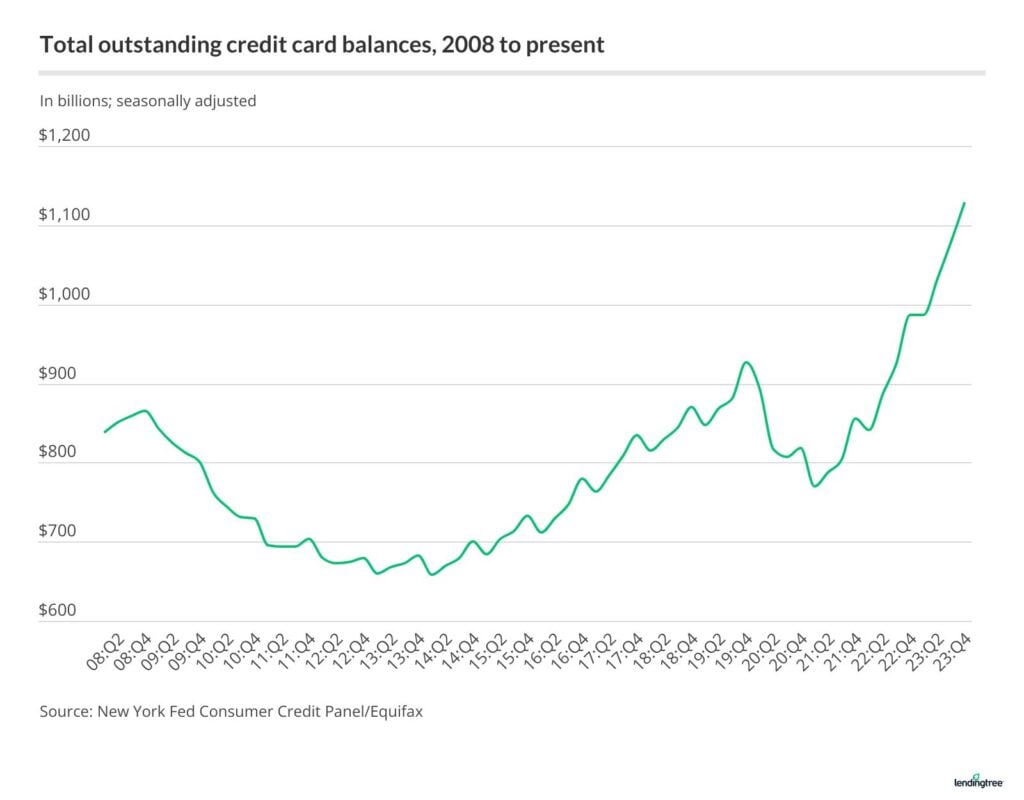
Credit card delinquencies (missing a payment by over 30 days) have been steadily rising across America. The poorest Americans experienced the hardship first, and now those in higher tax brackets are also falling behind on bills. Delinquencies have increased for the last eight to 11 quarters, as indicated by the Fed. Among the poorest zip codes in the US, delinquency rose from 11% in Q2 of 2021 to 17.4% in Q1 of 2024 or 58%. Every region in America has experienced an increase in delinquencies by AT LEAST 32.2% in relative terms.

CreditCardDebt.Chart_

“The richest 10% of ZIP codes have experienced the greatest proportional increase; their delinquency rate climbed from 4.8% in the second quarter of 2022 to 7.4% in the first quarter of 2024, or 54% in relative terms,” the Fed noted. “For the poorest 10% of ZIP codes, the delinquency rate increased from 14.9% in the third quarter of 2022 to 21% in the first quarter of 2024, or 41% in relative terms.”

Credit card delinquencies are now exceeding pre-pandemic levels, and the Fed believes this suggests “that a trend which began prior to the pandemic has accelerated.” Discontent will grow as people are forced to stretch their dollars and watch their quality of life decline. The discontentment is fueling this political upheaval and the people can not vote their way out of this current situation because it is becoming apparent that the elections are not fair. We the people have been discarded by our government.

These delinquencies will fall on the banks eventually. The government does not realize that reckless spending and raising taxes has an impact on absolutely everyone. The people who push for more taxes and social programs fail to realize the larger implications.

Interest on US National Debt Hits New Record


Posted Jun 6, 2024 By Martin Armstrong

NationalDebtNYCVBillboard

Government spending has consequences. The US national debt has surpassed $34.6 trillion at the time of this writing and continues to grow every minute. America has never been in a deeper deficit. The Committee for a Responsible Federal Budget (CRFB) has reported that America was forced to pay $514 billion in the first seven months of FY2024 on interest costs alone.

This means that America paid more in servicing its debt than on any other program besides Social Security ($837 billion), which is a separate problem entirely. To put it into perspective, the US shelled out $498 billion on national defense, funding 2.5 wars, during this time. Around $465 billion was spent on Medicare, with an additional $355 billion spend on Medicaid, and neither surpassed the amount paid on simply holding onto debt.

US debt to China Buy Bullets
10 trillion Debt Crisis Default

What can be done when the government refuses to curtail spending? Biden audaciously labeled one of the largest spending packages in the nation’s history the “Inflation Reduction Act,” and expects the people to believe that it has not greatly contributed to the rising costs of goods and services. Every week, Biden signs a new check to Ukraine or a climate change agenda, but no one can stop him from draining the Treasury. Even the Federal Reserve is utterly helpless and can do nothing besides sit back and watch as America spirals down.

Imploding this situation is China’s rightful refusal to purchase US debt. Other central banks see how careless US politicians have become with their spending and question if they ever intend to pay off their growing debt. How could they at this point? No one in Washington has a clue on what to do. Instead, they will continue spending with no concern for the long-term consequences that are inevitable.

Fed President Says Americans Would Prefer a Recession to Inflation


Posted originally on Jun 5, 2024 By Martin Armstrong 

Fed Ship in STorm

Federal Reserve Bank of Minneapolis President Neel Kashkari has advised against anticipating near-term rate cuts. While speaking to the Financial Times, the Fed president stated that people would simply prefer a recession to continued inflation.

“I have learned that the American people—and maybe people in Europe equally—really hate high inflation. I mean, really viscerally hate high inflation,” he told the Financial Times’ The Economics Show podcast. Kashkari is speaking as if we are not already in a recession. It is not difficult to understand the “visceral” hatred people around the world feel toward rising prices. The effects of inflation are felt with every purchase, causing the average person to adjust their entire lifestyle.

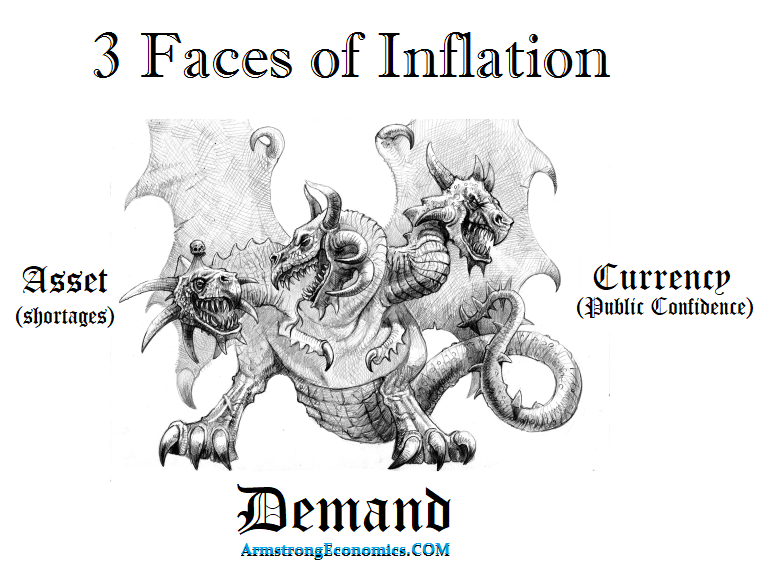
3 faces of Inflation Dragon

Vague issues such as rising unemployment or declining wages do not impact everyone. “I lose my job, I lean on my sister or my parents or my friends, and they help me through it. But high inflation affects everybody. There’s no one I can lean on for help because everyone in my network is experiencing the same thing I’m experiencing,” Kashkari explained. Mass layoffs, for example, would only impact a fragment of the overall population, and people would feel lucky simply to keep their jobs.

“In the US, GDP has been remarkably strong, very strong,” he noted. “The labor market has been resilient. Wage growth has been mostly resilient. And we’re seeing even the housing market has shown signs of resilience. So if I look at this resilience and economic activity, that does not look like an economy that is under pressure of very high, very tight monetary policy.” Yet, inflation is outpacing wage increases and people are watching their savings dwindle while spending less. The average person cares not of the health of the overall economy as they simply want to be able to continue maintaining or improving their standard of living. Most Americans, for example, do not invest and live paycheck to paycheck.

CPI Formula

Real prices have far surpassed anything they calculate in CPI. Everyone understands that prices have risen far more than the arbitrary number the Fed provides us. Taxes are continually increasing for everyone in every tax bracket. The government not only adds to inflationary issues with their spending but then expects their citizens to foot a portion of the bill with taxes, which will simply never be enough.

Then we have Washington telling the masses to blame corporations for price gouging while raising their taxes and making it increasingly difficult to conduct business and maintain a large workforce. It is not that the people would prefer to be in a recession, the real issue is that countless people are entering survival mode. People everywhere want to hold onto whatever they may have out of fear for the future, but they are unable even to hoard as real prices now demand they hand over whatever they have to maintain their lives.

The Problem with K-Waves


Posted originally on May 29, 2024 By Martin Armstrong 

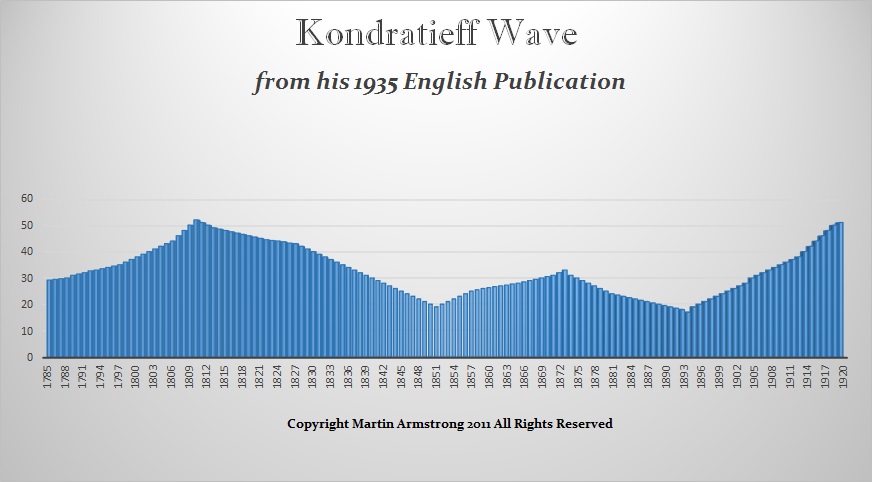
K Wave MAA

All those investigating cycles within the economy made a simple mistake. Kondratieff followed agriculture/commodity prices when agriculture accounted for 70% of the GDP pre-19th century. That only began to decline from 1850 forward, dropping to 40% by 1900 as the Industrial Revolution emerged with the invention of the steam engine. Moreover, aside from climate impacting the food supply, there were also wars. So the Kondratieff Wave failed to take into account all of the external forces.

If we extend the K-Wave 54 years from the commodity high in 1919, that brings us to 1973, which was close to the end of Bretton Woods in 1971 and the OPEC Oil crisis. Another 54 years from there will bring us to 2027. Therefore, this may be based entirely on commodities, but they were impacted by weather and war. Note that 2027 is the ideal target on our model for war derived from entirely different sources.

KONDRATF

There is a cycle of industrialization as well. Rome began as an agrarian society and moved toward trade, which brought them into conflict with Carthage. Rome itself became more like New York and grain was imported from Egypt. As agriculture became more of an import, Rome blossomed like New York into the arts and culture. The shift toward industrialization also resulted in a decline in birth rates for children. Large families were needed in an agrarian society but not so much in a developed society – hence the family laws of Augustus.

The first known Clean Air Act occurred in 535 AD by Emperor Justinian in Constantinople. He proclaimed the importance of clean air as a birthright. “By the law of nature these things are common to mankind—the air, running water, the sea.” Even Cicero wrote about pollution in the ancient city of Rome. This went hand and hand with developed societies and urbanization.

Consequently, when looking at long-term cycles, a few hundred years is not enough data. If Kondratieff were alive today and based his study on the current system, he would focus on services rather than commodity-based economies. Agriculture has fallen to just 1.2% of the civil workforce, so we cannot follow K-Waves as the innovator intended.

Commodities Trade Differently


Posted originally on May 29, 2024 By Martin Armstrong 

Wheat1220 1375

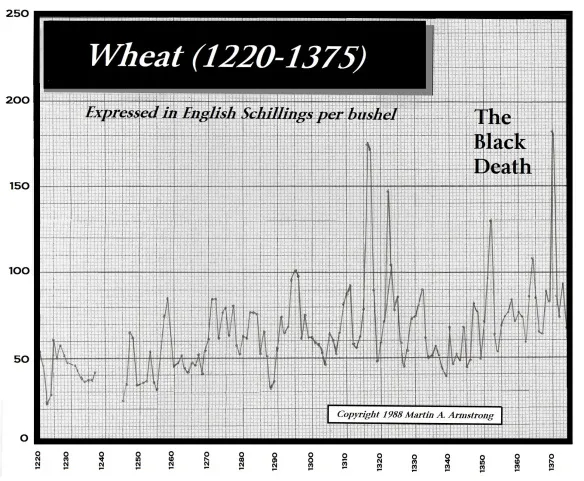
All commodities, including gold, trade substantially differently than stocks or real estate. Pictured here is wheat back to 1200. Note that you see what appears to be a brain wave. Commodities trade differently because they are subject to nature. Manufactured items can be produced on a more regular basis. However, commodities are subject to weather, and even mining is subject to discovering supply.

Look at energy. The US was dependent on imports and was virtually self-sufficient from foreign production until Biden was appointed.

Here is wheat impacted during the Black Death. Two trends were clashing. There was a 50% drop in population, so demand dropped, but also there was a collapse in labor, so production declined. Prices rose because there was still a shortage of supply because land went vacant and that forced landlords to begin paying wages. There are always far more complicated trends involved in commodities.

WheatWholesaleWWI

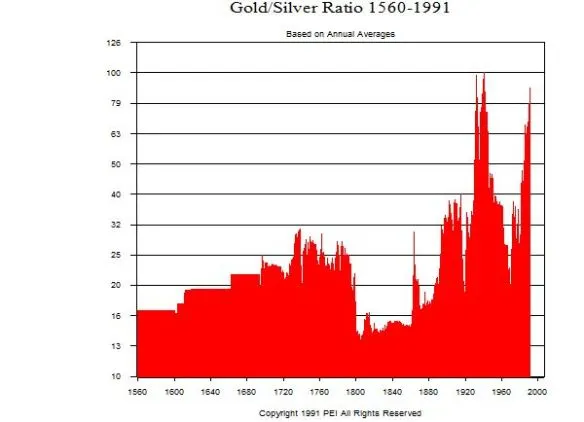
War has also impacted commodities. But when gold was MONEY, it declined in purchasing power WITH inflation. When gold is a free market as present, it moves opposite to inflation because, yes, it too is then a commodity. Making gold money will NEVER prevent the cycles as illustrated above and it will decline in purchasing power with inflation that is in part driven by nature.

GOLD1560to1991

Consequently, even gold makes runs to the upside (bursts) that are largely catch-ups. It does not remain constant even against silver. Gold is the worst investment from an inflationary standpoint if you expect it to track inflation, for it does not and will not. Right now, we are in a cycle where CONFIDENCE has waned, and we will see gold rise with the stock market, but it trades far differently from stocks.

Cyclical analysis is all about defining WHEN such events will take place. Price is entirely a different aspect. The burst is just that – a rally that appears to come from nowhere playing catch-up because EVERYTHING has an international value.