KOMMONSENTSJANE – THE BREXIT QUESTION THAT NOBODY ASKED


Respected economists (real economists) give the EU at most 2 or 3 years before it goes under. Smart money is coming to the US as the only save haven let in the world.

kommonsentsjane's avatarkommonsentsjane

Aug 21, 2016

By
Clive Crook

BRITIS

Mervyn King, former governor of the Bank of England, has written the best article I’ve read on Britain’s exit from the European Union. In an essay for the New York Review of Books he makes many excellent points, but one is of surpassing importance. It’s an obvious point, or ought to be, that nonetheless has been almost entirely ignored by other respectable commentators: Whether Britain should stay in the EU depends on where the EU is heading.

The EU is plainly in deep trouble with or without the U.K., and its condition as a political project is anything but stable. Judging whether Britain is better off as a member therefore requires a judgment not only about what Britain has gained or lost from membership up to now but also an assessment of the future character of the whole EU enterprise. Britain’s Remain campaign, expressing…

View original post 711 more words

Central Bank Intervention Against the Dollar


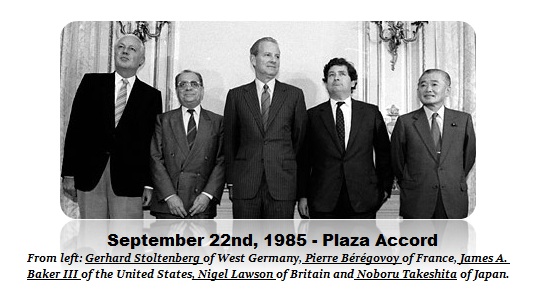
PlazaAccord-1businessman_juggle_dollar_symbols_150_clr_18746In the first six months of the year, the raw data has shown that several central banks have been selling US government bonds in an attempt to support their currencies against the dollar. This has come in part at the request of the United States, exactly as took place back in 1985 at the Plaza Accord. The United States has a strikingly different view as to currency value. You even hear Trump calling China a currency manipulator because they have seen a declining currency. He does not view that this has been a global trend. Nonetheless, European central banks see a weak current as a weakness politically and thus want a high valued currency.

Therefore, our capital flow analysis has clearly shown that the central banks have been selling US Treasuries in an attempt to support their currencies. Nonetheless, this is has not reversed the trend.

Knee Jerk v Spike v Temp v Reaction Events


CRUDE-D 8-17-2016

QUESTION: All energy says spike low on monthly global market watch. Now we had a correction from 52 to $39 so that qualifies but we also had a rally from 39 to 47 so does it still qualify? If Socrates uses the last data point 47 it would not be a spike low  but if it accesses the low for the month its correct. So which One?

Analysis-2ANSWER: The Global Market Watch is purely a pattern recognition model. It is by no means perfect because the computer is still learning for we have introduced ETFs and global stocks. Therefore, it is still registering new patterns as it collects pattern development around the world. There are wilder patterns for example in agriculture compared to bonds or stocks with respect to the percentage movement. Nonetheless, keep in mind it is looking at this extremely dynamically with respect to the last entry weekly to yearly. That means it looks at the ENTIRE range and assumes at that close what would the pattern be if that had completed that unit of time. So a weekly will assume the week if complete each day as the week moves forward. The same is true with monthly to yearly. However, it is the full range and not just the last closing price that determines the pattern. Also, introducing global stocks has implicitly introduced within any price currency. A market will typically rise to offset the decline of a currency so that real value tends to remain unless it is perceived to be a political risk to the entire country, then sell everything.

This model does not use the last data point alone. It uses the FULL range of the current session. So it knows it made a low but a “spike low” is short lived and tends to be a trust type move. A “spike low” is different from a “temp low” or “reaction low” inasmuch as the latter two are part of a trend.

In the case of Crude Oil, it made a high in June so a “knee jerk” is just one unit of time and “spike” is short and quick but more than just one time unit.” Both types of moves are trust types meaning sharp and swift. These are no normal action of like a bear market finally making its low. Both the “knee jerk” and the “spike low” can be followed by a resumption of the trend in motion or a retest of the previous high or low. That retest would be the reaction. Often the “knee jerk” and “spike” events may also involve the slingshot type of movement.

Why Corporate America Can’t Prop Up Stocks Much Longer


More good news from the private sector — well almost private as the Fed’s are into everything now!

The New Highs in US Share Market Are they the Prelude to a Crash?


trifecta

1998 SP500 July 20Finally, the Dow made new highs in the face of constant calls for a crash. This past week, in a horse race we would call it a trifecta where the Dow Jones Industrials,  S&P 500,and  the NASDAQ all made new record highs.  This sent a bunch of analysts to look again and began to proclaim that this was the first time that all three major indices have reached new highs on the same day since 1999. They then look at the charts and pronounce that the 1999 rally lasted only until 2000 and then crashed. Of course that was the DOT.COM Bubble and there was a massive wave of retail investor in the market back then compared to today.
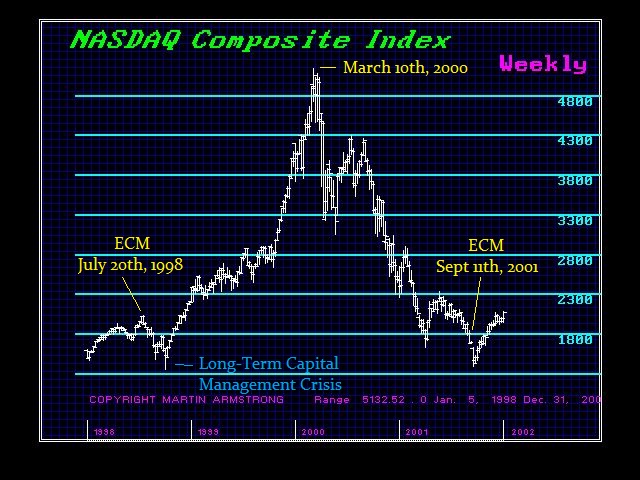
There really is nothing similar whatsoever to this latest pronouncement. As always, people will try to reduce everything to turn upon a single reason. Here is a chart of the S&P500 and the crash of 1998, which was the Long-Term Capital Management debacle and the fall of Russian debt.

The market again peaked exactly to the day of the ECM back then. However, the crash was 58 days and then in 32 days the market rebound to the former high. Note that the there were three lows with the last and final low creating a Slingshot move, As I have warned, these type of moves are the most powerful and very necessary to propel any market to new record highs. You simply must trap the majority on the wrong side of the trend,


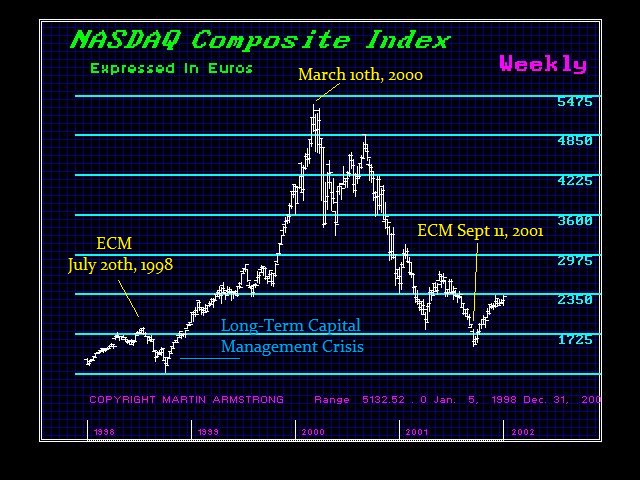
NASDAQ-EURO-1998-2012-WNASDAQ-1998-2012-W

The DOT.COM Bubble was the last great capital inflow from around the world. Both Europeans and Asians were pouring money into the DOT.COM Bubble – it was by no means a local event. This move was the classic Phase Transition. However, when we look at that in terms of the Euro (which we recreated using the same formula extending back in time), we get the same Phase Transition rally

We do not see a stark difference between the patterns in dollars as we see in euros. Hence, this attracted foreign capital creating an explosive rally which we call the Phase Transition.


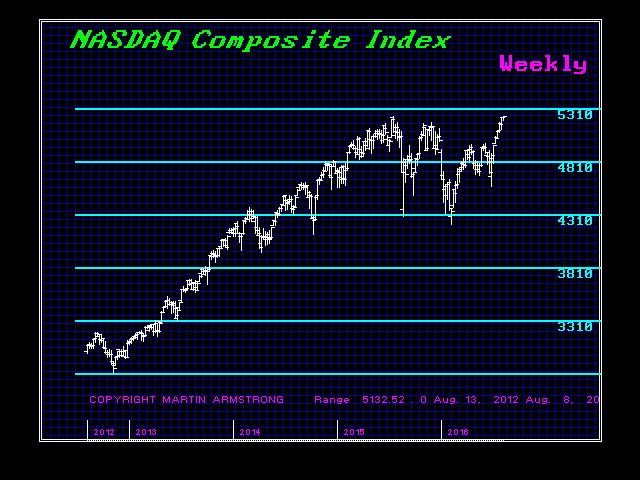
NASDAC-W Euro 8-13-2016NASDAQ-W 8-13-2016

Now, when we look at the current position of the NASDAQ both in dollars and euros, we see something different. In dollars we made the new highs. However, when looking at this is euros, we do not yet see new highs being made. As always, things are not always as they seem to the local observer.

So the last magic formula going around was the 9 day consecutive decline which was supposed to lead to a crash. OOPS. Here might be another brilliant observation.

The Panic of 1683 Was the First


Panics-168301907

This is the list of panics I discovered in the library at Princeton University. I simply added the period of 224 years from 1683 to 1907 which yield 8.615 as the common frequency dividing that period by the 26 events. I did not expect this to produce events to the day. The mere fact that events would happen precisely to the day as they did in 1981, 1985, 1987, 2001, 2002, and 2007 just to mention a few, beat the odds that this was somehow just coincidence or dumb luck. It has been fascinating discovering how this frequency has dominated history from ancient times to the present.

DecFollis295-348AD

From the collapse of the Roman Monetary System to just 8.6 years or six wave creating 51.6 years intervals like the collapse of the Roman Follis. It is fascinating to say the least that such a calculation has been so powerful throughout nature, humanity, and destiny.

Nevertheless, by dumb luck, this list of Panics was international and not relegated to a single isolated country. With 1683 for a start, that was the financial panic that disrupted Europe for the Ottoman invasion of Europe with the attempt to take the capital of Europe, the seat of the Holy Roman Emperor in Vienna. So where this calculation began, obviously included was as well.

Germany the 800 pound Gorilla


Armstrong Economics Blog

Re-Posted Aug 14, 2016 by Martin Armstrong

800-pound-gorrila

This week, a German cooperative savings bank in the Bavarian village of Gmund am Tegernsee with less than 10,000 in population, announced it will begin charging retail customers to hold their cash starting in September. This will apply to accounts greater than €100,000 euros. This means the bank will charge customers 0.4 percent, which amounts to a direct pass-through of the current level of the ECB’s negative deposit rate. After speaking directly with banking sources, what is happening is that cash is flooding into German banks from around Europe just to park avoiding the negative deposit rate. Now, the banks are starting to pass the negative rates back to the clients. However, much of this flow of capital has also been money fleeing other banks outside of Germany for fear that the euro will break and they will get Deutschemarks.

However, THE 800 POUND GORILLA in the corner of the room is Deutsche Bank itself. Rumor has it that its derivative book is 5 times the GDP of Germany. The real issue here is what happens when Deutsche Bank needs more than a banana? This is the largest bank in Germany and thus the most important bank for all of Europe even if you do not bank there. Can Germany really allow the BAIL-IN process to take place? Politically, this would be total disaster economically, politically, and for the stability of the EU itself. The theory which destroyed Cyrus and has wreaked havoc in Greece, if applied to the largest economy of Europe, will destroy all confidence in Brussels.

Does the fate of Europe hinge on the fate of Deutsche Bank? If the Germans blink, what are the ramifications that will reverberate throughout Europe? These are issues we will discuss at the upcoming WEC Institutional Session.

Solar Physicist Sees Global Cooling Ahead


Day AFter Tomorrow

While the government is using the global warming theory to raise taxes, the real danger is global cooling. The significance of being unprepared means that we will face a rising threat of a food shortage in the years ahead. This is the real danger of global cooling.

CRNFOR-Y

It does appear that we are looking at a rise in food prices after 2017. This will, in part, be caused by  weather, but we must also respect that there is rising civil unrest that typically corresponds to a reduction in food supplies.

Productivity unexpectedly drops for third straight quarter…


NOT A GOOD SIGN

IMF & Gold Reserves


IMF

QUESTION: Mr. Armstrong; People are adamant that there is a move to return to the gold standard. They claim various scenarios. Is there any such plot by the IMF and it seems strange that the ECB gold reserves are minimal. Can you explain the truth in this matter?

Thank you

GS

ANSWER: The IMF has actually been jockeying positions for decades to remove gold as a monetary instrument quite to the contrary of these reports. IMF Special Drawing Rights (SDR) was first established with one SDR being equal to 0.888671 gram of fine gold, which was the par value of the US dollar on July 1, 1944. The IMF acquired its gold holdings through four main channels. First, 25% of initial quota subscriptions to join the IMF and subsequent quota increases were to be paid in gold. This represents the largest source of the IMF’s gold. Furthermore, all payments of charges (interest on member countries’ use of IMF credit) were also normally made in gold. The structure was established with Bretton Woods and then a member wishing to acquire the currency of another member could do so by selling gold to the IMF. The major use of this provision was sales of gold to the IMF by South Africa in 1970–1971. Thereafter, member countries could use gold to repay the IMF for credit previously extended.

The IMF has decided to either return gold to member countries or to sell some of its holdings. The reasons for this are varied; between 1957 and 1970, the IMF sold gold on several occasions to replenish its holdings of currencies. The IMF also sold gold to the United States and invested in U.S. government securities to offset operational deficits during this same period.

The Second Amendment was to make the SDR the principle reserve asset in the international monetary system, paving the way to remove gold as the ultimate reserve asset. The Second Amendment to the Articles of Agreement in April 1978 fundamentally changed the role of gold in the international monetary system by eliminating its use as the common denominator of the post-World War II exchange rate system. Gold ceased to be the basis of the value underlying the SDR. The Second Amendment, therefore, abolished the official price of gold and ended any obligatory use in transactions between the IMF and its member countries. Consequently, the Second Amendment of 1978 decreed that the IMF would no longer manage the price of gold or establish a fixed price. This, in part, helped the rally initially to $400 by 1979.

Under the Second Amendment to the Articles of Agreement, the use of gold in the IMF’s operations and transactions was very limited. Furthermore, the IMF may sell gold outright according to prevailing market prices under the 1978 Second Agreement. It may accept gold in the discharge of a member country’s obligations (loan repayment) at an agreed price based on market prices. This officially ended the idea of a gold standard set out at Bretton Woods. If the IMF were to sell gold, it would require Executive Board approval by an 85% majority vote. Therefore, the Second Agreement eliminated any IMF authority to engage in gold loans, gold leases, gold swaps, or use of gold as collateral. The IMF also no longer had the authority to buy gold under the Second Agreement formally ending the gold standard.

So in short, the IMF had been desperate to remove gold as a monetary instrument. From the mid-1960s, the total central bank gold reserved fell by about 25% by 2007. There is no evidence of any intent to return to a gold standard, and if anything, the hope is that the IMF will take on the role of making the SDR the new reserve currency that will replace the dollar when everything crashes and burns.