Black Friday – A Key Weekend for Retailers


Posted originally on Nov 24, 2023 By Martin Armstrong 

Recession

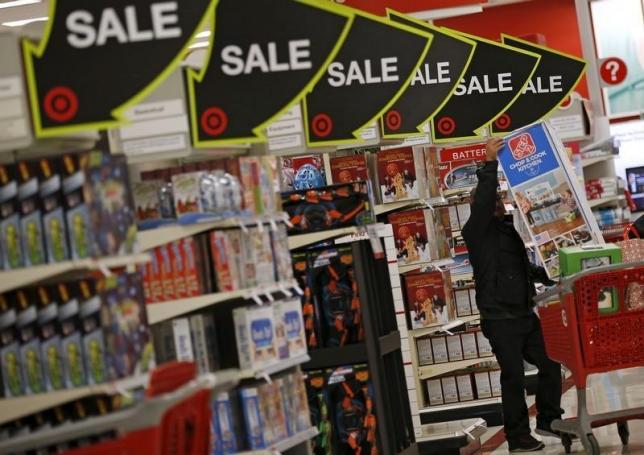
Retailers have been preparing for Black Friday and Cyber Monday all year. The tradition of post-Thanksgiving shopping has spread internationally with companies throughout the world promoting special sales. The National Federation of Retailers in America predicts that 2023 will be one of the busiest shopping holidays in the nation’s history.

Around 182 million shoppers are expected to make purchases from Thanksgiving Day through Cyber Monday, marking a 15.7 million uptick from 2022. This also marks the highest estimate since the organization began compiling data in 2017. Despite inflation, 61% of 8,424 respondents to a poll said the deals presented are too good to pass on.

The bulk of spending is expected to occur on Black Friday with 130.7 million participants, followed by Cyber Monday which is expected to attract 71.1 million shoppers. Half of shoppers will be searching for presents for the upcoming holidays. In total, retail spending in November and December will reach up to $966.6 billion.

“The Thanksgiving holiday weekend marks some of the busiest shopping days of the year, as consumers enjoy the tradition of shopping for the perfect gifts for friends and loved ones,” NRF President and CEO Matthew Shay said. “Retailers have been preparing for months for this occasion. They are stocked and ready to help customers find the gifts and other items they want at great prices during the entire holiday season.”

Although consumer spending accounts for 2/3 of GDP, the majority of Americans are living off of credit due to record inflation. So while people are spending during this 5-day holiday in anticipation of tomorrow’s price being higher, consumer spending at this point in time merely adds to the private debt crisis sweeping the nation.

Interview: Gold and the Dollar will Rise Together Re-Posted Nov 5, 2023 By Martin Armstrong 


Watch the video above or click here to watch my latest interview with Goldseek Radio.

Head of Armstrong Economics, Martin Armstrong, outlines his gold market projections in lieu of unraveling geopolitical conditions.

Armstrong says, “You have a lot of uncertainty and confusing trends developing. When this materializes in people understanding what’s happening…the dollar and gold would go up together. Because you are looking at a flight of capital. Some people want to buy gold, some people want to get out of Europe, etc. Not everybody does the same thing. The two trends will come together. That’s what our computer is projecting, and it’s happened many times in history.”

– Epic gold breakout ahead!
– Convergence of economic themes – recession next year and escalating conflicts?
– Comments on crude oil.
– On the cusp of WWIII by 2025?
– How to foment de-escalation within the ranks of the power-hungry elite.
– Might societal decay accelerate?
– Tangible assets are key to surviving collapse.
– 90% silver coins remain an ideal survival investment.

A Strong Possibility Twitter Will IPO and Go Public Again, Here’s Why


Posted originally on the CTH on October 3, 2023 | Sundance 

I wasn’t going to write about this, but so many requests and contacts have come in, and considering that my background conversations with people are leading to actionable positioning, that I feel it is only fair to share publicly what I am analyzing privately.

The predicate for all assumptions is several fold: {Go Deep One} and {Go Deep Two}. Most of the financial groundwork for analysis already exists. In summary, Elon paid $44 billion for the platform. Current valuations are around $15 billion.  Current debt service is $1.5 billion/yr (roughly $100m/mo).  Current expenses include $100m/yr AWS, $100m/yr Goog cloud (both contracts), +payroll and misc.

Approximately 9 months ago, Musk had $1 billion in cash reserve for Twitter.  The burn rate deficit was roughly $100m/month. That put timeline estimates for an inflection point on/around October 2023.  It is now October 2023.

Approximately a week ago, Twitter CEO Linda Yaccarino made a bold statement.  Yaccarino stated that from her review of the current status, Twitter would start to turn a profit in the first quarter of 2024 {link}.  However, with $100 million per month in debt service alone, this statement seemed too far of a stretch.  At pre-musk levels of revenue, maybe; but that $1.5 billion debt service is a heavy nut to carry.

Timing – Remember, it’s October.  Last Friday, the Securities and Exchange Commission (SEC) gave special regulatory approval to Bill Ackman’s firm, Pershing Square (hedge fund), for a new investment vessel called SPARC, whose purpose is to invest in private companies in order to take them public.  As noted by CNBC, “In a SPARC, investors will know what company the financing vehicle would be used to merge with before they have to pledge their investments.”  The financial mechanism avoids some of the issues with typical IPO’s.

•It’s October, inflection time.  •Yaccarino says a strategy is underway for profitability in Q1 2024.  •Ackman gets SPARC approval, and then suddenly:

[…] “The answer is I have a lot of respect for Musk. I think Twitter is a really important platform,” Ackman told CNBC. “I think he’s made tremendous improvements to the platform, and I think it’s a unique, very difficult-to-disrupt, kind of asset and one that could grow.” 

[…] Though Musk hasn’t expressed any interest in working with Ackman to take X public, and despite the $13 billion in debt tacked to the company, Ackman has worked out a loose plan to make it happen, if Musk were interested. 

“What’s interesting here is we could commit $2 billion to a transaction, set the rights price to $121 million, set it at $100 a share and announce a transaction,” he said. 

“And then we tell the story and then the rights holders have a chance to decide whether to invest. As long as the rights have positive value, they’re all going to get exercised, and the IPO raises $13 billion.” (read more)

The heavy nut disappears.

Investors roll the debt into discounted shares of stock.  If Ackman can generate a $17-$20 billion outcome for Twitter, Musk nets $5b and retains 20-25% of shares.  Yaccarino gets well compensated.  It’s a win/win/win.

Critics would say the IPO would mean Musk compromising on the free speech commitment.  However, in reality Musk has already reinstalled many of the control mechanisms of the previous “safety council,” along with the “freedom of speech, not freedom of reach” outlook.  Musk and Yaccarino have also partnered with the Global Disinformation Index.

The compromises are already baked into the platform, and seemingly have been since Yaccarino became CEO.  The 2024 election is next year, and influence is a lucrative business.

Frances Fox Piven vs. Milton Friedman, Thomas Sowell (Video 1980)


Armstrong Economics Blog/Uncategorized R-Posted Sep 30, 2023 by Martin Armstrong

US Govt Shutdown Over Ukraine?


Armstrong Economics Blog/Politics Re-Posted Sep 22, 2023 by Martin Armstrong

It happens every year – the US Congress cannot disagree so they may simply shut down. They’re our public servants but we permit them to throw their hands up and shrug that they cannot work together. One of the hot topic items right now is Ukraine, and with good reason as we are $3.3 trillion in debt but those in charge believe we have unlimited funds for Ukraine.

https://x.com/RandPaul/status/1704485590085812595?s=20

Senator Rand Paul refuses to continually aid Ukraine in the proxy war. “Today I’m putting congressional leadership & @POTUS on notice that I will oppose any effort to hold the federal government hostage for Ukraine funding,” Paul said on X, the social media platform formerly known as Twitter. “I will not consent to expedited passage of any spending measure that provides any more US aid to Ukraine.” Rand double-downed on his views in front of his peers, saying, “It’s as if no one has noticed that we have no extra money to send to Ukraine,” he said. “Our deficit this year will exceed $1.5 trillion. Borrowing money from China to send it to Ukraine makes no sense.”

We do not have the money to spend on Ukraine – period. The money funneled to the most corrupt European country comes from US taxpayers. Biden asked for another $24 billion for Ukraine last month. Some Republicans scoffed but there are neocons on both sides who want this war. “When will the aid requests, and when will the war end?” Rand asked the Senate. “Can someone explain what victory in Ukraine looks like? President Biden certainly can’t. His administration has failed to articulate a clear strategy or objective in this war, and Ukraine’s long-awaited counteroffensive has failed to make meaningful gains in the east.” There is no victory for Ukraine. The aftermath will be bloody and expensive, and people on both sides of the fight have declared that this will be a long war.

Republicans are a minority in the Senate. Schumer will do what it takes to push through all of Joe’s reckless spending budgets that he always exceeds. Congress needs to be held accountable. A business couldn’t simply say, “Hey, we do not know what to do. Let’s shutdown operations until we figure it out.” The No Pay for Congress During Default or Shutdown Act introduced by Brian Fitzpatrick (R-PA), and Abigail Spanberger, (D-VA), that would prevent members of Congress from receiving a paycheck in the event of a shutdown. Imagine that – having to work for your pay! James Lankford (R-PA) introduced a stricter bill dubbed the Prevent Government Shutdowns Act of 2023 that would forbid these politicians from returning home until a final decision is made. There are numerous measures on the table that should be signed into law to prevent lazy government workers from holding the United States hostage.

Let us not forget that America’s credit rating was downgraded by Moody’s because our politicians are incapable of running the country. Smart money has fled the public sector. There is absolutely no confidence in government anymore. The hundreds of billions to Ukraine must stop. One must wonder why government would threaten to shutdown over the topic of funding a foreign unaffiliated nation when the war does not benefit Americans in any way.

The Birth of the US Dollar


Armstrong Economics Blog/USD $ Re-Posted Sep 17, 2023 by Martin Armstrong

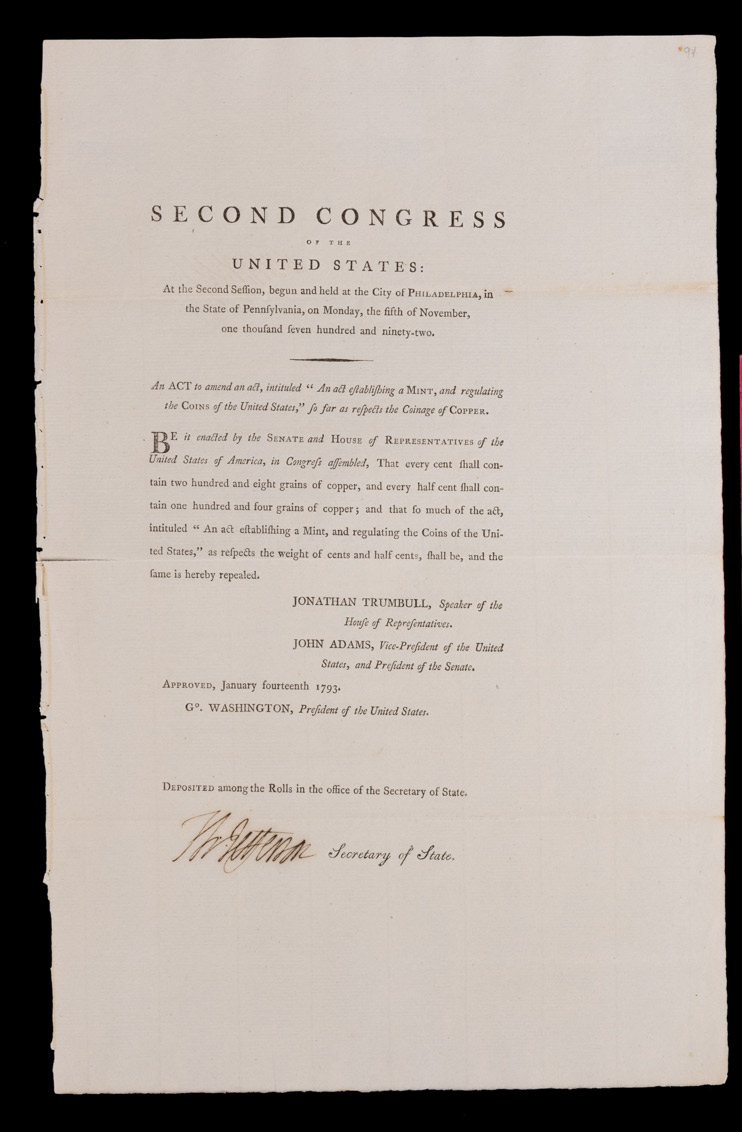
Thomas Jefferson Act of Congress Signed as Secretary of State, January 14th, 1793,

Second Congress of the United States (1743-1826)

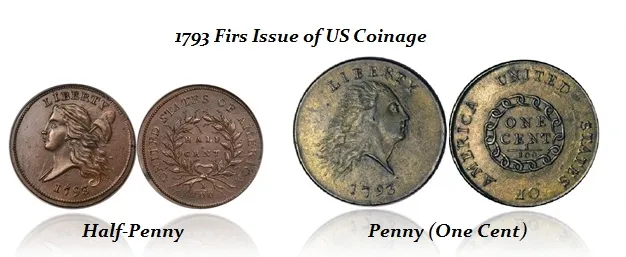
As Secretary of State, Thomas Jefferson amended a previous Act, “establishing a Mint and regulating the Coins of the United States,” establishing the copper weight specifications for the first US coins issued in 1793 – the Cent and Half Cent. This is a document from our collection on the Monetary System of the World, establishes the birth of the US dollar authorizing the first issue of the coinage of the United States. It is unique and of tremendous historical importance.

The first copper coins created by the new United States of America were introduced into circulation in March of 1793. This document is signed “Th’ Jefferson” as Secretary of State and countersigned (in type) by George Washington as President, John Adams as Vice President and President of the Senate, and Jonathan Trumbull as Speaker of the House of Representatives.

“Second Congress of the United States: At the Second Session, begun and held at the City of Philadelphia, in the state of Pennsylvania, on Monday, the fifth of November, one thousand seven hundred and ninety-two. An act establishing a Mint, and regulating the coins of the United States, so far as respects the Coinage of Copper.”

“Be it enacted by the Senate and House of Representatives of the United States of America in Congress assembled, That every cent shall contain two hundred and eight grains of copper, and every half cent shall contain one hundred and four grains of copper; and that so much of the act ‘An act establishing a mint, and regulating the coins of the United States,’ as respects the weight of cents and half cents, shall be, and the same is hereby repealed…. Approved January fourteenth 1793…”

Interview: Martin Armstrong Predictions / Digital Currency & The End of Your Liberty


Armstrong Economics Blog/Armstrong in the Media Re-Posted Sep 3, 2023 by Martin Armstrong

Teaching Hedging


Armstrong Economics Blog/Trading Re-Posted Aug 27, 2023 by Martin Armstrong

COMMENT: Marty, I just wanted to thank you. I attended your 1985 World Economic Conference, and you taught me how to hedge. That made my career, and now I am about to retire. Nobody was teaching hedging in the early 1980s. You have impacted the world far more than you realize.

I will be at the WEC this year in my official capacity. Next year, it will be for me personally. I sincerely wanted to thank you, and you should post this. The newbies need to know you were there decades before anyone else.

God bless.

GK

REPLY: George, it has been a long journey. I am glad I helped you in your career. You have always been there for me and I appreciate old friends. BTW, they still do not teach hedging in universities. Just amazing.

Japan Exports Fall in July, Driven by 14.3% Decline in Shipments to China


Posted originally on the CTH on August 17, 2023 | Sundance 

Some economic data released by the land of the rising sun points to a larger global weakness in manufacturing demand.   Within the data year-over-year exports from Japan fell in July by 0.3%, which is the first time since 2021 the contraction was noted.

Digging a little deeper, the weakness in Japanese exports is driven primarily by a decline in exports to China of 14.3% in July, which follows a 10.9% decline in June.  Japan is a component supplier to China, which would indicate the demand for Chinese products globally is substantially less than Beijing has previously admitted.

That said, Japan’s direct export of finished goods to the U.S. actually increased 13.5%, mostly driven by the export of electric vehicles.

However, 13.5% is identical to the overall decrease in Japanese imports.

Essentially, component parts to China are down, but completed finished goods to the U.S. are up.  Overall, the results from Japan point to a soft overall global economic status, the result of continued contraction of Western economic activity.

TOKYO, Aug 17 (Reuters) – Japan’s exports fell in July for the first time in nearly 2-1/2 years, dragged down by faltering demand for light oil and chip-making equipment, underlining concerns about a global recession as demand in key markets such as China weaken.

Japanese exports fell 0.3% in July year-on-year, Ministry of Finance (MOF) data showed on Thursday, compared with a 0.8% decrease expected by economists in a Reuters poll. It followed a 1.5% rise in the previous month.

[…] Japanese policymakers are counting on exports to shore up the world’s No. 3 economy and pick up the slack in private consumption that has suffered due to rising prices.

However, the spectre of a sharper global slowdown and faltering growth in Japan’s major market China have raised concerns about the outlook.

The World Bank has warned that higher interest rates and tighter credit will take a bigger toll on global growth in 2024. (read more)

Meanwhile, I would not bet against Michael Burry.

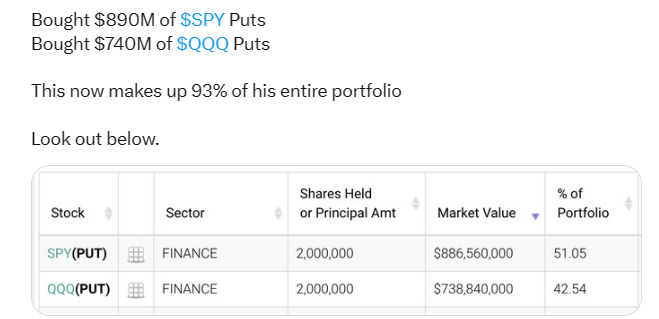
Burry is betting against the S&P 500 and Nasdaq 100 this week, according to his fund’s latest releases. Securities and Exchange Commission filings.  The filing shows that he is now holding options against the S&P 500, hedging $886.6 million against the index.

The filing also revealed that Burry sold his shares in Capitol One, First Republic, PacWest Bancorp, Wells Fargo and Western Alliance after betting on them earlier this year in Trying to make money from the regional banking crisis.  Burry also sold his stakes in Chinese e-commerce giants Alibaba and JD.com.

In addition, he bought $738.8 million in put options against the Invesco QQQ Trust ETF – a fund made up of popular high-tech Nasdaq companies, such as big tech companies Apple and Microsoft as well as Nvidia, Tesla and PepsiCo.

Burry has pulled money out of China investments and U.S. banks and is hedging against tech and the S&P.  He took these positions before the data from Japanese exports to China was released.

Moody’s Slashes Bank Ratings


Aemstrong Economics Blog/Banking Crisis Re-Posted Aug 10, 2023 by Martin Armstrong

Moody’s has cut the credit ratings of ten small and mid-sized banks. The agency cited higher funding costs, rising interest rates, and increased risked due to the failing commercial real estate sector. M&T Bank, BOK Financial, Webster Financial, Pinnacle Financial, Old National Bancorp, and Fulton Financial were among the banks that received downgraded ratings.

But it does not stop there. Moody’s is also reviewing six giant banks, including Trist Financial, Bank of New York, Cullen/Frost Bankers, State Street, Northern Trust, and US Bancorp, as they may also be downgraded. Eleven other banks such as Capital One, Citizens Financial, and Fifth Third Bancorp has their ratings changed to negative. Moody’s predicts a “mild recession” on the horizon for 2024. They believe the quality of assets will decline with certain banks facing increased risks due to their commercial real estate (CRE) portfolios.

“U.S. banks continue to contend with interest rate and asset-liability management (ALM) risks with implications for liquidity and capital, as the wind-down of unconventional monetary policy drains systemwide deposits and higher interest rates depress the value of fixed-rate assets,” Moody’s analysts wrote in an accompanying research note explaining the decision. The agency also noted that investors are vulnerable “to a loss of confidence.”

The US banking system is failing. Moody’s noted that rising interest rates would “exacerbate” the ongoing banking crisis, and they foresee the Federal Reserve continuing with hikes for longer than anticipated since inflation was never transitory. The Fed maintained artificially low rates for too long, and their attempts to ease inflation by hiking rates are failing, as is the ECB’s. We will see the behemoths like JPMorgan Chase sypher in failing banks, making it easier for agencies to switch to CBDC. European banks will be the first to fail, so keep an eye on Europe.