Win/Win – Speculation of Mike Pompeo Running for Kansas Senate Seat…


Several news articles are speculating that Secretary of State Mike Pompeo might run for the U.S. Senate Seat from Kansas [Here and Here].  If accurate, that move would seem to solve a few personnel issues in a rather diplomatic way.

Since the Sept./Oct. impeachment operation started there has been a considerable shift notable in the relationship between President Trump and Secretary Pompeo; especially after officials from within the Dept. of State came out strong against President Trump after CIA whistle-blower Eric Ciaramella lit the fuse…. and Pompeo was, well, essentially mute.

Getting rid of Pompeo for a Senate bid would be a win/win.

Absent the dangerous Siren voice from Nikki Haley :::spit-spit-spit::: moving Treasury Sec. Mnuchin (or similar) to State would be a good transition.  Mnuchin already knows the players and has contacts therein etc.  A Senate Foreign Relations Committee confirmation should be seamless, well, sans the predictable Mitt Romney grandstanding.

Spitballing CTH could see moving Mick Mulvaney (or similar) to Treasury (Senate Finance Confirmation) and then put Mark Meadows in as chief-of-staff and/or Robert O’Brien with Meadows becoming Nat Sec Advisor.   Or something similar.

Internationally, geopolitically and economically, term two is obviously going to be more EU centric (U.K and EU trade etc.)… while grouchy panda takes a backseat and has to prove his reform promises were genuine.  Panda being tied up in promises leaves room to navigate the hostage release of Little Rocketman.

Meanwhile the strategic, fracturing, pressure on the EU would be a role Mnuchin would seem well adept to deliver….

Regardless, the Senate campaign is a diplomatic way of getting Pompeo out of the picture.

I’d wager President Trump will find a way to encourage Pompeo to run.

A primary race between Mike Pompeo and Kris Kobach would be interesting.

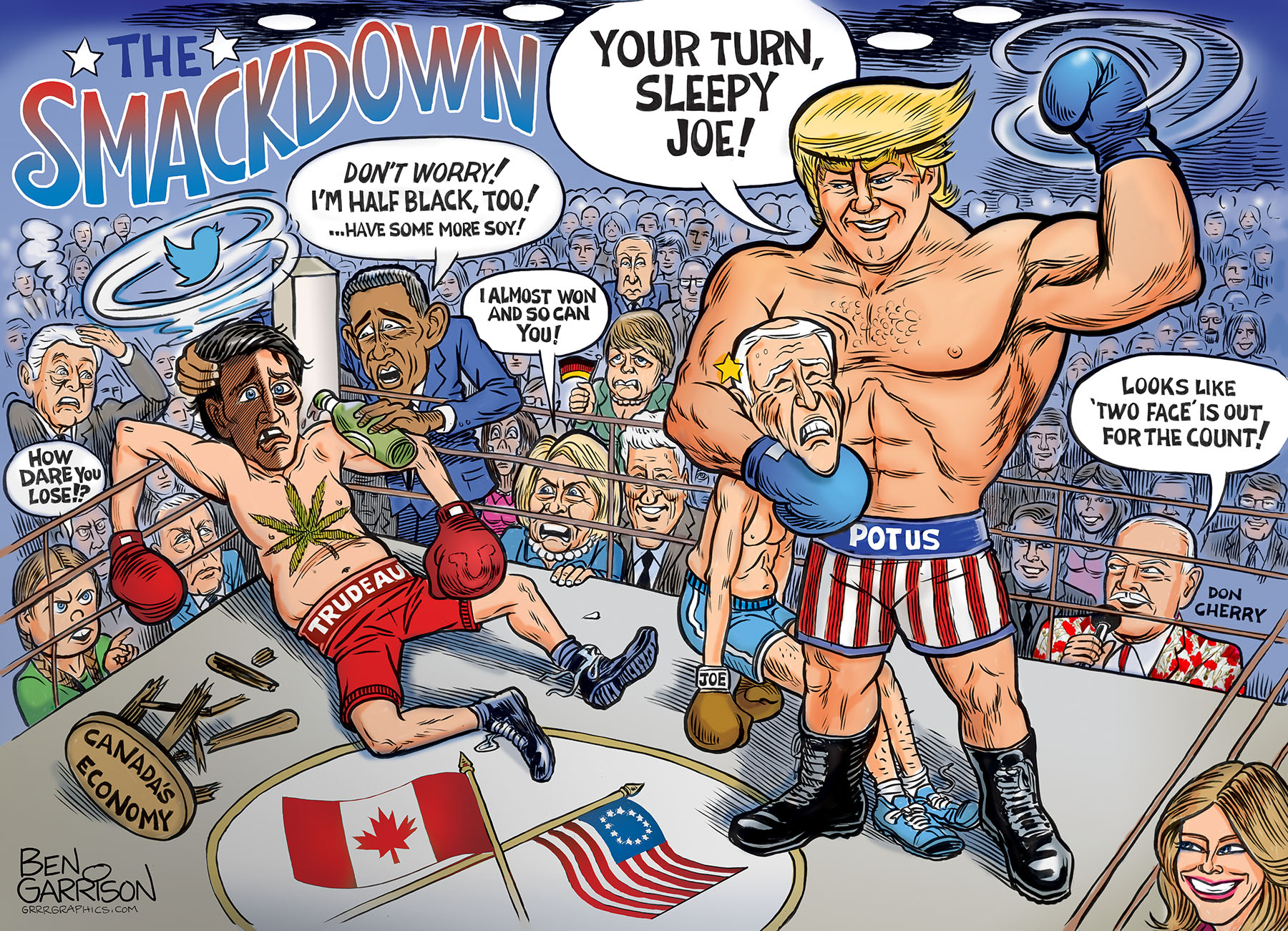
Smack Down Time


HAPPY BOXING DAY!

TRIGGER WARNING! DO NOT PLACE THIS CARTOON WITHIN 25 FEET OF A LEFTY! WE ARE NOT RESPONSIBLE FOR EXPLODING HEADS! THANK YOU

“It’s Smackdown Time!” Guest Post by a Canadian Patriot

There are several politicians that talk a great deal, but always come up short time after time when it comes to fight.

Just in case Justin ‘Two-Face’ Trudeau has not had enough of bad news in losing his majority government, being ridiculed by the whole world or being ousted as blackface three times and gaining the title of world class hypocrite; he will not be able to offer any resistance to his superior adversary who will send him to his corner, beaten!

Sleepy Creepy Joe will finally meet justice. He has single handedly given a new definition to rope-a-dope! The canvas will soon be his only friend. If only his son Hunter could be found to come to his aid. Hunter’s sniffing days are numbered!

Trump understands that process matters. Armed with courage and audacity and hardcore persistence, he has overcome many past fights in his journey as president with boundless energy and firm resolve.

He is in a league of his own. None are his equal. He will continue to dispatch the globalist puppets and all will meet the same fate as Two-Face and Sleepy Joe!

Trump is the STORM! He’s the silent majority’s strength and Canada’s best hope.

With the great First Lady and true Canadian patriot and icon such as Don Cherry in Trump’s corner, the globalists and climate warriors are going down!

It’s time for patriots to stand up and join the fight against corruption and not fall victims to their lies, tricks, and deceit.

Mr. President, we’re in your corner!

—A Canadian Patriot

Rules for Radicals: What Constitutional Conservatives Should Know About Saul Alinsky


122K subscribers
SUBSCRIBE
David Horowitz Published in 1972, Saul Alinsky’s Rules for Radicals still enjoys brisk sales. With a former community organizer now commander-in-chief, and the idea of transformative leadership through radical change not just a theory, it is important for partisans of the Constitution to understand the roots of today’s radicalism. Presented as part of the First Principles on First Fridays series for the month of July, 2010. Recorded July 9, 2010. (c) Hillsdale College, 2010. http://kirbycenter.hillsdale.edu/

Canada Lost 71,200 Jobs Last Month and is Worried About Trump in Christmas Movies?…


President Trump responded to the Canadian Broadcasting Company (CBC) editing out his appearance in the Christmas movie “Home Alone 2”.

President Trump jokes Justin from Canada likely having a case of the sads after getting called out for not meeting NATO funding obligations and the new trade agreement favorable to American interests.

Too funny.  We will miss this humor in 2025 when Trump leaves office.

It is worth remembering that Canada does not allow competition in their media sector.  The Canadian government considers the news media a protected “cultural industry”; and through a process of subsidizing broadcast all news media is essentially state run media.

Why is this important?  Well, when the expressed priority of the government is controlling broadcast information if you are intellectually honest you should apply that same ideological outlook toward any information from the government in a general sense.

Canada is worried about Trump appearing in Christmas movies?

Think about that for a few minutes…

Now consider:

In combination with leftist economic policies on energy development that strangles economic growth through excessive regulation, the leftist government of Trudeau has dismantled the natural underpinnings of a market-based economy.  The manufacturing base of Canada is compromised, perhaps to the point of no return.

For two decades liberal (left-wing) Canadian policy essentially transformed their economic model from manufacturing to “assembly“.   The goods-based production within the Canadian economy was structured to take advantage of the NAFTA loophole.

Goods production in Canada was reduced from full manufacturing to a process of assembling parts brought in from overseas and then selling them into the U.S. market.   This process exploited the NAFTA loophole allowing foreign companies to ship parts to Canada and then assemble for transport into the U.S. without tariffs.

Over time the Canadian economy became more and more dependent on this system of brokering goods, while Canada simultaneously dismantled their heavy industry at the request of extreme environmentalists.

The Canadian assembly system for durable goods was always at risk of the NAFTA loophole being closed.  When President Trump renegotiated the USMCA, primarily with Mexico, the loophole was closed.  The USMCA rules on origination now require the parts to come from inside the North American manufacturing system.

Importing parts from Asia and simply assembling them in Canada is no longer permitted under the USMCA agreement.  The majority of the parts -which require heavy industry to produce- must originate from North America.  Canada has little capacity to take advantage of this economic opportunity because they dismantled their heavy industry.

As a consequence, if any multinational company wanting to invest in a manufacturing system, that avoids tariffs, to bring their end product to the massive U.S. market… well, Canada is no longer a viable option for that investment.

The multinational banks and investment groups who fund corporate manufacturing investment; and who are now no longer willing to underwrite Asian investment due to the impact of Trump tariffs; are focusing on where that investment can support the economic activity.

As with the November jobs report, when we see: “Canada’s goods-producing industries saw a decline of 26,600 net jobs, largely on manufacturing” leading the headline, this is a direct consequence of the economic dynamic identified above.

Elections have consequences; and those economic consequences are extraordinarily impactful in the era when U.S. President Trump is dismantling global supply chains; focusing on bringing high-wage manufacturing industry back to the U.S; and driving a process of profound consequence through economic nationalism.

Economic Security is National Security” ~ President Trump

…And Canada is worried about Trump in Christmas movies?

.

.


Jobless Claims Drop – Labor Market Remains Very Strong….


The Dept. of Labor reveals [DATA HERE] initial claims for unemployment fell again last week, creating the following Reuters headline: “The number of Americans filing applications for unemployment benefits fell last week in a sign of ongoing labor market strength.”   Another strong labor report, followed by another media report outlining how the results beat all economic analyst expectations; a consistent theme throughout 2019.

White House – DRIVING A RECORD-SETTING ECONOMY: The booming economy and strong labor market allow Americans of all backgrounds to find work and succeed.

♦ The current labor market revival is not a continuation of past trends, but instead a direct result of President Trump’s pro-growth policies.

  • Since President Trump was elected, more than 7 million jobs have been added to our economy – surpassing the Congressional Budget Office’s predictions by 5 million jobs.
  • This year, the unemployment rate has fallen to 3.5%, its lowest level in 50 years.
  • Unemployment for African Americans, Hispanic Americans, Asian Americans, veterans, individuals with disabilities, and those without a high school diploma have all reached record lows under President Trump.
  • The President’s policies are bringing people off the sidelines and into the labor force.
  • The prime age labor force has grown by 2.1 million under President Trump.
  • The surge in labor demand has resulted in 7 million job openings, which outnumber job seekers by more than 1 million.
  • Before President Trump took office, there had never been more recorded job openings than unemployed workers.

♦ LOWERING INEQUALITY: President Trump’s policies are helping forgotten Americans across the country prosper, driving down income inequality.

  • Annual nominal wages grew by 3 percent in 2019 for the first time in a decade.
  • Nominal wage growth has now been at or above 3 percent for 16 straight months.
  • Wage growth for many previously forgotten groups is now higher than wage growth for more advantaged groups.
  • This is the case for lower-income workers compared to higher-income workers, workers compared to managers, and African Americans compared to white Americans.
  • These income gains mark a fundamental change compared to before President Trump’s inauguration, contributing to reduced income inequality.
  • When measured as the share of income earned by the top 20 percent, income inequality fell in 2018 by the largest amount in over a decade.
  • The Gini coefficient, an overall measure of inequality in the population, also fell in 2018.

At 3.7 percent, November year-over-year wage growth for production and nonsupervisory workers was near a post-recession high achieved last month and again exceeded overall year-over-year wage growth.

From the start of the current expansion to the end of 2016, average wage growth for production and nonsupervisory workers lagged that of managers, the bottom 10 percent of wage earners lagged that of the top 10 percent, those without a college degree lagged that of college graduates, and African Americans lagged that of white Americans.

However, since President Trump took office, each of these trends has been reversed, contributing to lower income inequality.

♦ LIFTING UP AMERICANS: The booming economy is lifting millions of Americans out of poverty and providing all people with the opportunity for a brighter future.

  • In 2018 alone, nearly 1.4 million Americans were lifted out of poverty.
  • The poverty rates for African Americans and Hispanic Americans reached historic lows in 2018.
  • Over 600,000 children being raised by single mothers were lifted out of poverty in 2018.
  • The number of people claiming unemployment insurance as a share of the population is the lowest on record.
  • Nearly 7 million fewer people are on food stamps than at the time of the 2016 election.
  • 380,000 fewer people are on Social Security Disability insurance than before the 2016 election.

Americans in economically-distressed communities are benefiting from increased investment thanks to the Opportunity Zones included in President Trump’s historic tax reform.

As further evidence of how much the labor market has improved under President Trump, other data released by BLS  show that the number of people who experienced unemployment last year declined by 2.4 million compared to 2016. This number should decline again in 2019 because, under the Trump Administration, the number of people claiming unemployment insurance as a share of the population is the lowest on record since the data began in 1967.

Conservative Judicial Legacy Will Last for Decades, Even if Trump Loses in 2020


150K subscribers

The lede spells out just why so many conservatives overlooked their concerns, and voted for Donald Trump, and why many more will do so in November 2020. “After three years in office President Donald has remade the federal judiciary, ensuring a conservative tilt for decades, and cementing his legacy no matter the outcome of November’s election.” — Colby Itkowitz, reporter, Washington Post, 12/21/2019 Our May 2020 Royal Caribbean 3-night Bahamas cruise will allow you to relax, unwind, hangout with like-minded folks, and see live productions of our shows. Book your cabin now at https://BillWhittleCruise.com Bill Whittle Now with Scott Ott comes to you 20-times each month from our Members, who fund this enterprise, and run their own blog and vibrant comment sections, in addition to enjoying other Members-only features of our site. Find out more, and find your people at https://BillWhittle.com/register/ Listen to audio versions of our shows: https://Bit.ly/BWN-Podcasts

Passion for Politics Meets the Story of Christmas


150K subscribers

Join Bill Whittle, Scott Ott, Stephen Green and the Members and fans of this show on a 3-night cruise in May 2020. Reserve your cabin now at https://BillWhittleCruise.com —– Why do you even care about politics — a distant enterprise, operated by people you don’t really know, arguing about things that often don’t even impact you? The passion for politics, that inner drive that keeps you on fire with emotion, has a reason. Scott Ott has a theory that ties your desire for good governance to the story of Christmas. Right Angle comes to you 20-times each month thanks to our Members. Meet them and unlock new levels of engagement by becoming a one of us at https;//BillWhittle.com/register/ Listen to audio versions of this show at https://bit.ly/BWN-Podcasts Ask Alexa to play Bill Whittle Network on TuneIn Radio , or watch Bill Whittle Network on your Fire TV

The Poorest 20% of Americans Are Richer on Average Than Most Nations of Europe


A groundbreaking study by Just Facts has discovered that after accounting for all income, charity, and non-cash welfare benefits like subsidized housing and Food Stamps—the poorest 20% of Americans consume more goods and services than the national averages for all people in most affluent countries. This includes the majority of countries in the prestigious Organization for Economic Cooperation and Development (OECD), including its European members. In other words, if the U.S. “poor” were a nation, it would be one of the world’s richest.

Notably, this study was reviewed by Dr. Henrique Schneider, professor of economics at Nordakademie University in Germany and the chief economist of the Swiss Federation of Small and Medium-Sized Enterprises. After examining the source data and Just Facts’ methodology, he concluded: “This study is sound and conforms with academic standards. I personally think it provides valuable insight into poverty measures and adds considerably to this field of research.”

The “Poorest” Rich Nation?

In a July 1st New York Times video op-ed that decries “fake news” and calls for “a more truthful approach” to “the myth of America as the greatest nation on earth,” Times producers Taige Jensen and Nayeema Raza claim that the U.S. has “fallen well behind Europe” in many respects and has “more in common with ‘developing countries’ than we’d like to admit.”

“One good test” of this, they say, is how the U.S. ranks in the OECD, a group of “36 countries, predominantly wealthy, Western, and Democratic.” While examining these rankings, they corrupt the truth in ways that violate the Times’ op-ed standards, which declare that “you can have any opinion you would like,” but “the facts in a piece must be supported and validated,” and “you can’t say that a certain battle began on a certain day if it did not.”

A prime example is their claim that “America is the richest country” in the OECD, “but we’re also the poorest, with a whopping 18% poverty rate—closer to Mexico than Western Europe.” That assertion prompted Just Facts to conduct a rigorous, original study of this issue with data from the OECD, the World Bank, and the U.S. government’s Bureau of Economic Analysis. It found that the Times is not merely wrong about this issue but is reporting the polar opposite of reality.

Poor Compared to Who?

The most glaring evidence against the Times’ rhetoric is a note located just above the OECD’s data for poverty rates. It explains that these rates measure relative poverty within nations, not between nations. As the note states, the figures represent portions of people with less than “half the median household income” in their own nations—and thus—”two countries with the same poverty rates may differ in terms of the relative income-level of the poor.”

The upshot is laid bare by the fact that this OECD measure assigns a higher poverty rate to the U.S. (17.8%) than to Mexico (16.6%). Yet, World Bank data shows that 35% of Mexico’s population lives on less than $5.50 per day, as compared to only 2% of people in the United States.

Hence, the OECD’s poverty rates say nothing about which nation is “the poorest.” Nonetheless, this is exactly how the Times misrepresented them.

The same point applies to broader discussions about poverty, which can be measured in two very different ways: (1) relative poverty or (2) absolute poverty. Relative measures of poverty, like the one cited by the Times, can be misleading if the presenter does not answer the question: “Poor compared to who?” Absolute measures, like the number of people with income below a certain level, are more straightforward and enlightening.

Unmeasured Income and Benefits

To accurately compare living standards across or within nations, it is necessary to account for all major aspects of material welfare. None of the data above does this.

The OECD data is particularly flawed because it is based on “income,” which excludes a host of non-cash government benefits and private charity that are abundant in the United States. Examples include but are not limited to:

  • healthcare provided by Medicaid, free clinics, and the Children’s Health Insurance Program.
  • nourishment provided by Food Stamps, school lunches, school breakfasts, soup kitchens, food pantries, and the Women’s, Infants’ & Children’s program.
  • housing and amenities provided through rent subsidies, utility assistance, and homeless shelters.

The World Bank data includes those items but is still incomplete because it is based on government “household surveys,” and U.S. low-income households greatly underreport both their income and non-cash benefits in such surveys. As documented in a 2015 paper in the Journal of Economic Perspectives entitled “Household Surveys in Crisis”:

  • “In recent years, more than half of welfare dollars and nearly half of food stamp dollars have been missed in several major” government surveys.
  • There has been “a sharp rise” in underreporting of government benefits received by low-income households in the United States.
  • This “understatement of incomes” masks “the poverty-reducing effects of government programs” and leads to “an overstatement of poverty and inequality.”

Likewise, the U.S. Bureau of Economic Analysis explains that such surveys “have issues with recalling income and expenditures and are subject to deliberate underreporting of certain items.” The U.S. Census Bureau says much the same, writing that “for many different reasons there is a tendency in household surveys for respondents to underreport their income.”

There is also a wider lesson here. When politicians and the media talk about income inequality, they often use statistics that fail to account for large amounts of income and benefits received by low- and middle-income households. This greatly overstates inequality and feeds deceptive narratives.

Relevant, Reliable Data

The World Bank’s “preferred” indicator of material well-being is “consumption“ of goods and services. This is due to “practical reasons of reliability and because consumption is thought to better capture long-run welfare levels than current income.” Likewise, a 2003 paper in the Journal of Human Resources explains that:

  • “research on poor households in the U.S. suggests that consumption is better reported than income” and is “a more direct measure of material well-being.”
  • “consumption standards were behind the original setting of the poverty line,” but governments now use income because of its “ease of reporting.”

The World Bank publishes a comprehensive dataset on consumption that isn’t dependent on the accuracy of household surveys and includes all goods and services, but it only provides the average consumption per person in each nation—not the poorest people in each nation.

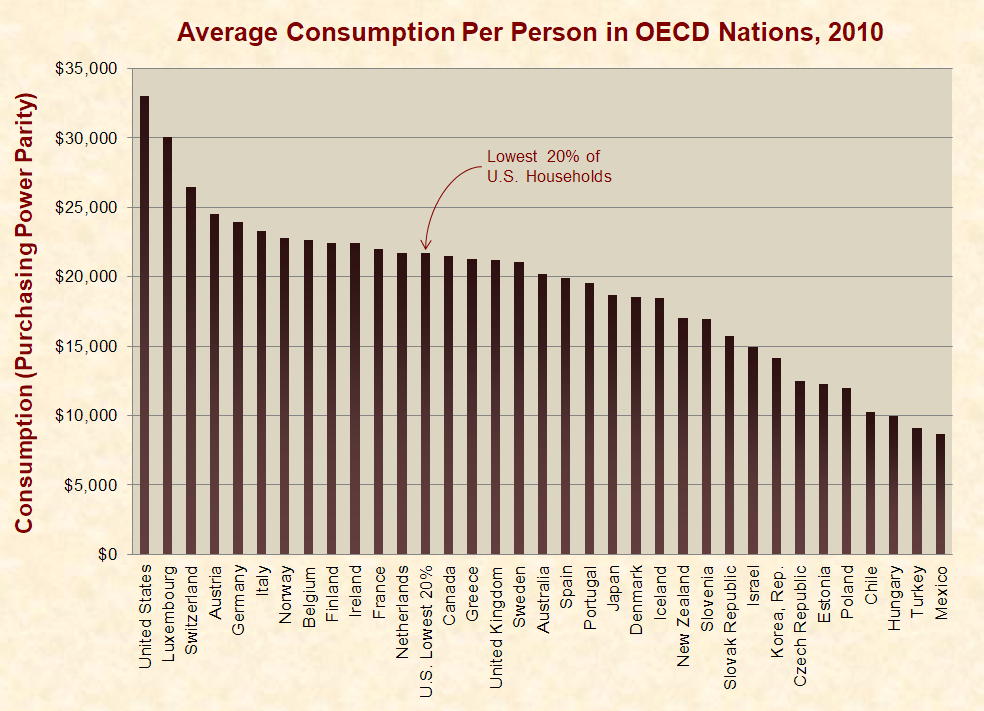
However, the U.S. Bureau of Economic Analysis published a study that provides exactly that for 2010. Combined with World Bank data for the same year, these datasets show that the poorest 20% of U.S. households have higher average consumption per person than the averages for all people in most nations of the OECD and Europe:

Average Consumption Per Person in OECD Nations, 2010

The high consumption of America’s “poor” doesn’t mean they live better than average people in the nations they outpace, like Spain, Denmark, Japan, Greece, and New Zealand. This is because people’s quality of life also depends on their communities and personal choices, like the local politicians they elect, the violent crimes they commit, and the spending decisions they make.

For instance, a Department of Agriculture study found that U.S. households receiving Food Stamps spend about 50% more on sweetened drinks, desserts and candy than on fruits & vegetables. In comparison, households not receiving Food Stamps spend slightly more on fruits & vegetables than on sweets.

Nonetheless, the fact remains that the privilege of living in the U.S. affords poor people with more material resources than the averages for most of the world’s richest nations.

Another important strength of this data is that it is adjusted for purchasing power to measure tangible realities like square feet of living area, foods, smartphones, etc. This removes the confounding effects of factors like inflation and exchange rates. Thus, an apple in one nation is counted the same as an apple in another.

To spot check the results for accuracy, Just Facts compared the World Bank consumption figure for the entire U.S. with the one from the Bureau of Economic Analysis. They were within 2% of each other. All of the data, documentation, and calculations are available in this spreadsheet.

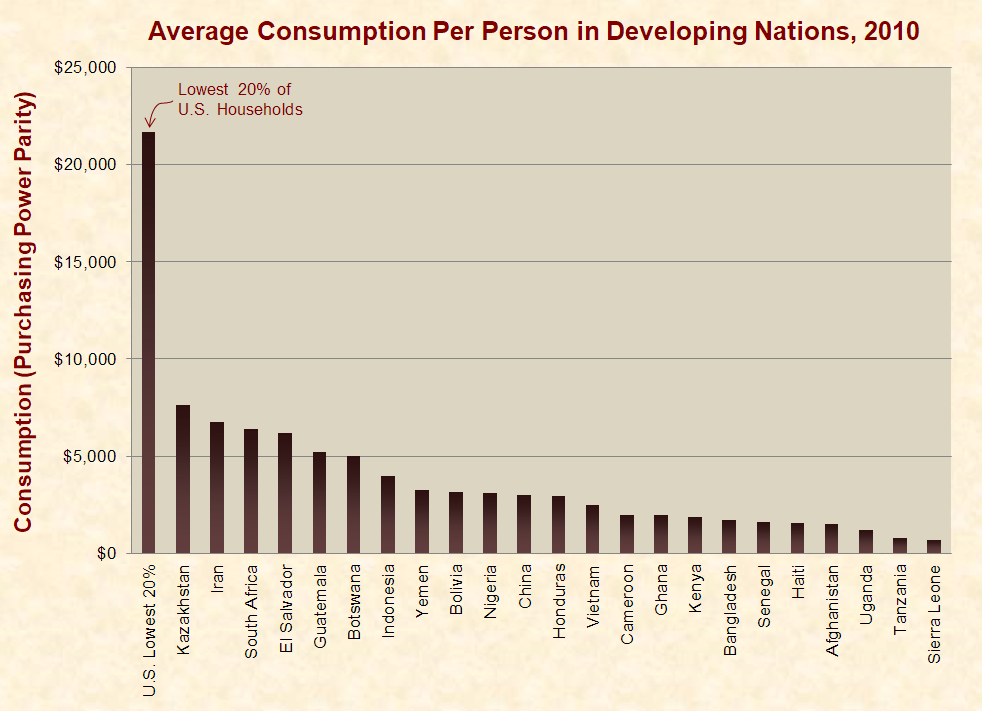
In light of these facts, the Times’ claim that the U.S. has “more in common with ‘developing countries’ than we’d like to admit” is especially far-fetched. In 2010, even the poorest 20% of Americans consumed 3 to 30 times more goods and services than the averages for all people in a wide array of developing nations around the world:

Average Consumption Per Person in Developing Nations, 2010

These immense gaps in standards of living are a major reason why people from developing nations immigrate to the U.S. instead of vice versa.

Why Is the U.S. So Much Richer?

Instead of maligning the United States, the Times could have covered this issue in a way that would help people around the world improve their material well-being by replicating what makes the U.S. so successful. However, that would require conveying the following facts, many of which the Times has previously misreported:

  • High energy prices, like those caused by ambitious “green energy” programs in Europe, depress living standards, especially for the poor.
  • High tax rates reduce incentives to work, save, and invest, and these can have widespread harmful effects.
  • Abundant social programs can reduce market income through multiple mechanisms—and as explained by President Obama’s former chief economist Lawrence Summers, “government assistance programs” provide people with “an incentive, and the means, not to work.”
  • The overall productivity of each nation trickles down to the poor, and this is partly why McDonald’s workers in the U.S. have more real purchasing power than in Europe and six times more than in Latin America, even though these workers perform the same jobs with the same technology.
  • Family disintegration driven by changing attitudes toward sex, marital fidelity, and familial responsibility has strong, negative impacts on household income.
  • In direct contradiction to the Times, a wealth of data suggests that aggressive government regulations harm economies.

Many other factors correlate with the economic conditions of nations and individuals, but the above are some key ones that give the U.S. an advantage over many European and other OECD countries.

Summary

The Times closes its video by claiming that “America may once have been the greatest, but today America, we’re just okay.” In reality, the U.S. is so economically exceptional that the poorest 20% of Americans are richer than many of the world’s most affluent nations.

Last year, the Times adopted a new slogan, “The truth is worth it.” Yet, in this case and others, it has twisted the truth in ways that can genuinely hurt people. The Times makes other spurious claims about the U.S. in this same video, which will be deflated in future articles.

Total Holiday Sales +3.4% Year-Over-Year, Biggest Holiday Sales in U.S. Retail History…


Whooo-doggies, middle-class Americans spent more this holiday shopping season than any year before it.  Despite losing a week due to the late Thanksgiving holiday, total Christmas sales growth was +3.4 percent year-over-year.

(Reuters) […] The holiday shopping season is a crucial period for retailers and can account for up to 40% of annual sales. But this year, Thanksgiving, which traditionally starts the U.S. holiday shopping period, was on Nov. 28, nearly a week later than last year’s Nov. 22, leaving retailers with six fewer days to drive sales between Thanksgiving and Christmas.

E-commerce sales this year made up 14.6% of total retail and rose 18.8% from the 2018 period, according to Mastercard’s data tracking retail sales from Nov. 1 through Christmas Eve. Overall holiday retail sales, excluding autos, rose 3.4%.

“E-commerce sales hit a record high this year with more people doing their holiday shopping online,” said Steve Sadove, senior adviser for Mastercard.

Now watch the Reuters spin…

U.S. President Donald Trump, whose support in the polls has been buoyed by strong economic data despite his impeachment by the House of Representatives, heralded the news in a tweet in all capital letters.

“2019 HOLIDAY RETAIL SALES WERE UP 3.4% FROM LAST YEAR, THE BIGGEST NUMBER IN U.S. HISTORY. CONGRATULATIONS AMERICA!,” Trump tweeted.

However, Mastercard spokesman William Tsang, citing 2018’s 5.1% growth in total sales, said this year’s holiday sales growth was not the biggest ever.

The White House had no immediate comment on the apparent discrepancy.

Despite slowing global growth, U.S. consumer spending is benefiting from wage growth and a strong labor market, retail consultants and analysts say. (link)

There is no discrepancy.  Trump’s tweet was recognizing the record-breaking total amount of U.S. sales, not simply the growth rate.   Knuckleheads.   Mamet principle on full display.

Total Holiday Sales an outcome of a very strong economy, low unemployment, low inflation, higher wages and more disposable income… MAGAnomics at work.

Keep in mind U.S. GDP growth is driven by consumer spending.  A whopping 3.4% gain year-over-year is tens of billions more in economic activity.  More WINNING !


The President and First Lady Christmas Message 2019…


Today President Donald Trump and First Lady Melania Trump share their Christmas message to all Americans.

Presidential Message on Christmas

Melania and I send our warmest greetings to those celebrating Christmas in the United States and around the world. During this joyous time of year, we join a grateful Nation in thanking God for His abundant blessings and boundless love.

As families, friends, and communities come together to rejoice in the birth of Christ, we are reminded of the divine message from the first Christmas: “Glory to God in the highest, and on earth peace, good will toward men.” While the challenges that face our country are great, the bonds that unite us as Americans are much stronger. Together, we must strive to foster a culture of deeper understanding and respect—traits that exemplify the teachings of Christ.

As we celebrate Christmas, we remember the precious religious liberties our forefathers so righteously fought to secure. We also pause to pay tribute to those courageous men and women of our Armed Forces who continue to fight for our cherished freedoms. As Commander in Chief, I salute them for their service and thank their family members for their shared sacrifice in this noble mission, especially during the holiday season.

We hope your heart is filled with the love and joy of your faith, family, and friends this Christmas. We send our best wishes for a merry Christmas and a happy and prosperous New Year.

Donald J Trump