Sometimes we just read and think; sometimes we just read and laugh. This is the latter.
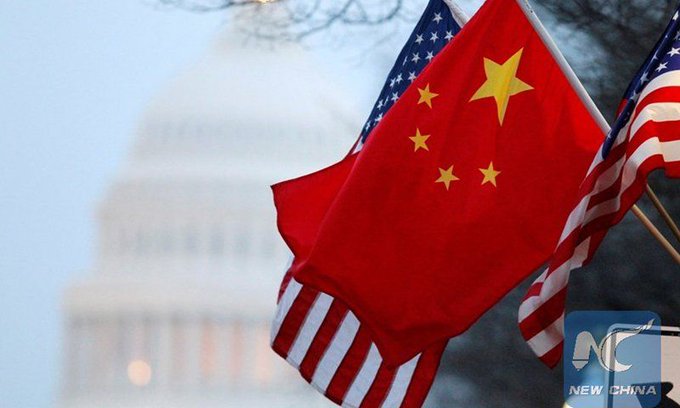
China continually looks at President Trump and the U.S. trade position through the wrong prism. Those around Chairman Xi genuinely seem to be incapable of understanding a U.S. President who independently represents long-term U.S. larger interests, and simultaneously leverages the U.S. market as a customer in a one-sided transaction.
The disconnect in Beijing analysis of the dynamic is really quite something.
After last weeks strategic magnanimous panda maneuver, Beijing was shocked, shocked, that President Trump continued to maintain “wrong thinking” toward the upcoming discussion with Chairman Xi.
It appears China fully expected some reciprocal trade bargaining based on their implied promise to release North Korean Chairman Kim Jong-un from manipulation; but Trump didn’t flinch. Instead, of acquiescence to magnanimous panda, President Trump sends Chairman Kim a letter filled with “excellent content“. Beijing was snubbed.
So yesterday as a follow-up Beijing indicates a willingness to revisit the prior agreement by putting the face of Vice-Premier Liu He back into their negotiation position:
(Reuters) […] Chinese Vice Premier Liu He held a phone conversation with U.S. Trade Representative Robert Lighthizer and U.S. Treasury Secretary Steven Mnuchin, China’s Ministry of Commerce said in a statement posted to its website on Tuesday morning. (more)
Liu He was the chief negotiator for Chairman Xi, and was stripped of the official title as spokesperson for the Xi regime after Beijing reneged on the deal. The message was clear: during the three months of negotiations Liu He had agreed to too much structural change on China’s side of the trade confrontation. The deal was scrapped by Beijing, and Liu He was stripped of his special envoy status as a person speaking for Chairman Xi.
By putting Liu back into the discussion this week, Beijing was signaling a willingness -likely a ruse, but a willingness nonetheless- to revisit the terms that existed prior to the breakdown.
The G20 is rapidly approaching… Beijing needs to identify POTUS Trump’s position. Things in Beijing are urgent as preparations (mostly optics) for how Chairman Xi will engage with President Trump are needed.
So into this dynamic of China evaluating where they can expect to find their position, we’ve got two signals from a series of public messages: (1) magnanimous panda will give up DPRK nukes, in exchange for better terms; and when that didn’t get the desired result, (2) China signals they are willing to revisit the prior terms.
However, today Team Donald Trump responds to the messages: NO DEAL !
Can you see what President Trump is doing here?
Trump is mirroring the historic approach deployed by China. Beijing is facing a new dynamic where the U.S. President will not accept any retreat from his current position. This zero-sum outlook is exactly the same approach all Chinese negotiators use…. only this time it’s Trump using their strategy against them. It’s President Trump who will not retreat from gained position. This has to be seriously perplexing for Beijing.
Now, to be fair, unlike China President Trump is not constitutionally predisposed to never give ground… he’s a negotiator of reasonable compromise. However, President Trump has modified his approach based on his knowledge of his adversary.
In essence, Donald Trump is mirroring the ideology and negotiating position of the person on the other side of the table….. only now, based on two-years of groundwork in preparation for his position, President Trump is carrying all the strength and leverage.
China is on its heels. Trump has set up a dynamic where a pre-planned group of regional allies can easily compensate for any manufacturing deficit caused by Trump’s adversarial position toward China. The corporate exodus visible within this plan has already begun.
The G20 is being held in Osaka, Japan. Essentially President Trump’s home turf as expressed by his relationship with Prime Minister Shinzo Abe and the recent high-honor of the first state visit to celebrate new Japanese Emperor Naruhito.
The geography for the G20 is perfect for this moment. The dynamic of regional allies are all aligned with Trump as planned from the November 2017 ‘golden ticket‘ tour of Asia. Additionally, President Trump carries all of the economic leverage he was quietly assembling as Beijing underestimated and misinterpreted the Trump bravado.
At no time in history has a U.S. President ever had all of the consequential dynamics aligned in his favor. This did not happen accidentally.
That’s why U.S. officials are saying they are not coming to the meeting with any concessions, and for the first time in modern history Beijing will have to make the compromise, or suffer a very visible set of consequences.
Quite remarkable.
Enjoy.
TheLastRefuge@TheLastRefuge2
Yes. Things coming together nicely. This was planned long ago…. even back when PDVSA (Venezuela) came under sanctions in 2017, the long-range target was always Beijing. https://twitter.com/NBRnews/status/1143517559930675202 …
NBR@NBRnews
A federal court ruled that U.S. authorities can punish several Chinese banks for working with North Korea, @AP reports http://m.nbr.org/31NRxVT The ruling gives the Americangovernment the option to terminate these banks’ ability to process transactions in U.S. dollars
Stephanie Grisham has served as spokeswoman for First Lady Melania Trump since March 2017. She’s sharp as a tack, fierce as a wolverine and intensely loyal to the first family. [Twitter Here]
Today First lady Melania Trump announces Stephanie Grisham will replace Sarah Huckabee Sanders as White House press secretary.
Ms. Grisham will also serve as White House communications director, a position that has been vacant since Bill Shine stepped down in March to advise President Donald Trump’s reelection campaign. “I can think of no better person to serve the Administration & our country,” Melania Trump tweeted Tuesday.
I am pleased to announce @StephGrisham45 will be the next @PressSec & Comms Director! She has been with us since 2015 – @potus & I can think of no better person to serve the Administration & our country. Excited to have Stephanie working for both sides of the @WhiteHouse. #BeBest
One of the reasons why the Flynn legal situation is so interesting is not really because of Flynn himself; but rather because the Flynn situation is a likely example of President Obama’s surveillance network in operation.
Tenuous legal theories (Logan Act) and obscure laws (technical FARA violations) appear to have been exploited by DOJ administration officials, in close ideological alignment with the Lawfare Group. In association with overall Obama administration officials, the fellow travelers used the legal system to create a DC surveillance network.
At the 30,000 ft. level Obama’s surveillance network looks like this:
• White House identifies a target; •passes request to the DOJ National Security Division (middlemen); •who then use the auspices of possible FARA violations to pass the instructions to the FBI contractors; •who data-mine the NSA database.
•The FBI results are then passed back to the DOJ-NSD; •who weaponize the information for FISA applications (becomes legal cover); and •pass the authorized surveillance (spying) results back to the White House etc.
It’s a circle of surveillance activity that could encompass almost every politician in Washington DC as they network with foreign lobbyists and special interests.
Those warrants then permit surveillance and the unwitting targets can infect anyone they come into contact with.
Using this process unwitting targets would be carrying surveillance like an ebola virus, and the Obama administration would be monitoring almost everyone in Washington DC.
Throughout the weaponized process there’s an element of plausible deniability, and a tenuous legal justification to protect the participants. If questioned the first line of defense would be to assert National Security; and almost all of the activity would be considered “classified”.
Obviously the purposes and intents of the surveillance would be political. However, by using The Foreign Agent Registration Act (FARA), there’s a useful legal cover story. Exploiting the NSA database also ties in neatly to this process. The database is how the FBI would get the evidence for the DOJ-NSD FISA applications.
Restrictions on Title III 4th amendment privacy protections are worked-around by using Title-1 national security claims; and conveniently everything around FISA is classified.
It is not coincidental that Paul Manafort, Rick Gates, George Papadopoulos and Michael Flynn were all charged or threatened with FARA violations. Additionally, in the one known FISA application Carter Page was called an “agent of a foreign government”.
Extending the legal theory into action, the Special Counsel, and particularly DOJ prosecutor Andrew Weissmann, can be viewed as simply charging forward with a pre-existing process all the special counsel participants were familiar with.
Michael Flynn is a case-study in the exact type of target this process would be perfect to ensnare. [Explained Here] Now, whether what’s left of Flynn’s case is enough to drag this political surveillance system into the sunlight is yet to be seen. However, as explained, this is why Flynn’s case is so interesting.
That said, here’s the status hearing from yesterday:
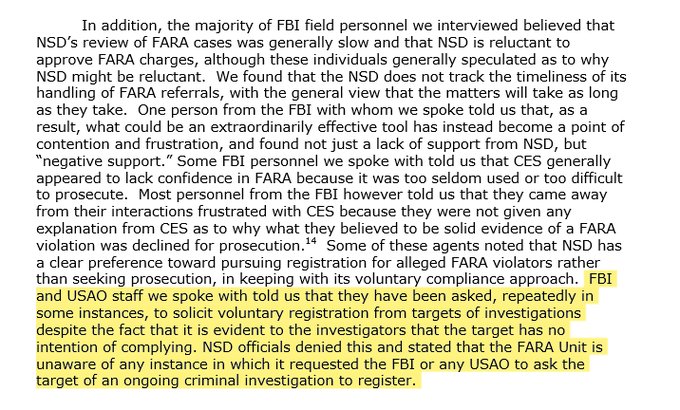
Per DOJ IG, FARA prosecutions are very rare. 7 in 50+ years.
The reason for this may be that the NSD has decided to focus on 18 USC 951.
Why Section 951? Because they can go after “political or non-political activities of agents under the control of foreign governments.”
Techno Fog@Techno_Fog
The NSD Officials say “a Section 951 case generally involves espionage-like or clandestine behavior… or a connection to an intelligence service”
Meanwhile, the FBI’s system “commingles both FARA and Section 951 cases.”
There’s no reason to prosecute FARA violations when the more robust Section 951 is available for intelligence collection.
Case in point: General Flynn.
Potential charge: Not FARA (618) but Section 951.
Techno Fog@Techno_Fog
Section 951 (foreign agent) would have been the tool used to gain a FISA warrant on Flynn – whether through the Turkey work or through the IC’s use of Halper.
This may also explain Judge Sullivan’s freak out over “treason” and Mueller’s mention of the Espionage Act re: Flynn.
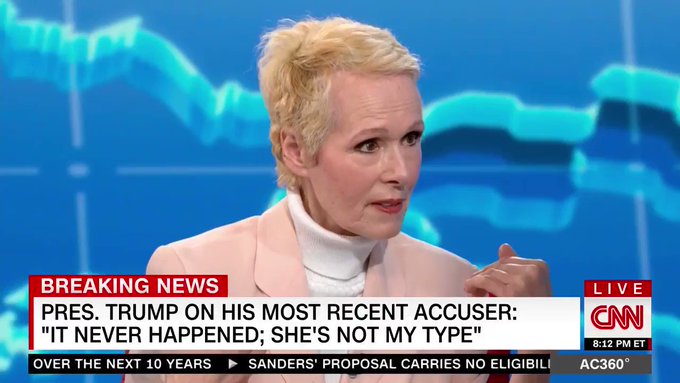
E Jean Carrol made headlines recently with her rather bizarre and sketchy claims of a forced sexual encounter with Donald Trump in a Bergdorf Goodman dressing room two decades ago. President Trump denies even knowing who she is…. but the media, well, you know…. OrangeManBad; so anything goes.
In addition to personifying an abject lack of credibility Ms. Carrol just imploded on CNN with Anderson Cooper, explaining her definition of rape is not sexual, nor doe it include sex. However, before getting to that recent development, a historic reference to Ms. Carrol is, well, weird.
(h/t BAXT3R) In 1995 E. Jean Carroll shares her unique perspectives on an Esquire article, “Do Women Love Men?” and discusses changing gender roles with Charlie Rose:
At this point it’s difficult to imagine anyone lending credibility to this claim. Then again, this is 2019, and the media is fraught with Trump Derangement Syndrome.
The official media account of how the intelligence community gained the transcript of incoming National Security Adviser Michael Flynn talking to Ambassador Sergey Kisliyak on December 29th, 2016, surrounds “incidental collection” as a result of contact with an agent of a foreign power. Meaning the Flynn call was picked up as the U.S. intelligence apparatus was conducting surveillance on Russian Ambassador Kisliyak.
If this version of events were accurate (it’s not), it would fall under FISA-702 collection: the lawful monitoring of a foreign agent (Kislyak) who has contact with a U.S. person (Flynn).
In order to review the identity of the U.S. person, a process called ‘unmasking’, a 702 submission must be made. That submission, the unmasking, leaves a paper/electronic trail. In a 2017 congressional hearing, Senator Lindsey Graham asks Deputy Attorney General Sally Yates and former DNI James Clapper about this process. [Watch first 3 minutes]
.
However, in the two years following this testimony, there was nothing that would deliver the answer as to: who unmasked General Michael Flynn?
The reason is simple, Flynn wasn’t unmasked – because he was under FISC authorized active surveillance. Here’s how we know.
♦ First, Lisa Page and Peter Strzok were watching that hearing where Senator Lindsey Graham was questioning Sally Yates and James Clapper. As they discussed in their text messages the issue of “unmasking” is irrelevant. “incidental collection” is the “incorrect narrative”:
The “incidental collection” is an “incorrect narrative” because the collection was not incidental. Flynn was actively being monitored. Flynn was under an active FISA surveillance warrant.
♦ Second, more evidence of Flynn under active surveillance is found in the Mueller report where the special prosecutor outlines that Flynn was under an active investigation prior to the phone call with Ambassador Kislyak:
Mary McCord was the Assistant Attorney General in charge of the DOJ National Security Division, after John Carlin left in October of 2016. McCord would have signed-off on the Flynn FISA warrant, or any extension therein, throughout the Trump transition period.
[McCord was also the person who Sally Yates took with her to the White House to confront White House Counsel Don McGahn about the Flynn call and FBI interview.]
♦ Third, from the 2017 House Permanent Select Committee on Intelligence (HPSCI), when Devin Nunes was Chairman, the four targets of the Trump campaign -under investigation throughout 2016- were outlined:
SUMMARY: ♦In real time Lisa Page and Peter Strzok were saying the “incidental contact” (unmasking) narrative was incorrect. ♦Then Devin Nunes outlines the targets of the 2016 FBI investigation which included Flynn. ♦Then Robert Mueller says Flynn was under investigation prior to the 12/29/16 phone call with Kislyak.
Put it all together and…. (1) There was never an unmasking request because the collection was not incidental…. (2) Because the intercept was not incidental. (3) Because the intercept was part of the FISA court granting a surveillance warrant.
The lack of incidental collection is why FISA-702 doesn’t apply; and why there’s no paper trail to an unmasking request. The intercept was not ‘incidental‘ because the intercept was the result of direct monitoring and FISC authorized surveillance being conducted on Michael Flynn.
There are only three options:
Incidental collection = unmasking request.
Direct intercept / Legal = Active FISA Title-1 surveillance authority.
Direct intercept / Illegal = Active surveillance without Title-1 authority.
All of the evidence from documents over the past two years indicates #2 was the status of Michael Flynn at the time of the Sergey Kislak call.
The incoming National Security Advisor of President-Elect Donald Trump was under active FBI surveillance as granted by the FISA court. That’s how the FBI intercepted the phone call with Sergey Kislyak and why there’s no unmasking request.
This doesn’t deal with the propriety of the FISA warrant, or the legal basis, the legal predicate that must exist prior to granting the FISA warrant. However, accepting that Michael Flynn was under court approved surveillance reconciles all the issues.
Additionally, this would explain two more issues. #1) President Obama warning incoming President Trump not to hire Michael Flynn as his Nat. Sec. Advisor; and #2) a very strong possibility that Flynn’s status is the redacted paragraph in the January 20th, 2016, Susan Rice memo.
At 12:15pm on January 20th, 2017, Obama’s outgoing National Security Advisor Susan Rice wrote a memo-to-self. Many people have called this her “CYA” (cover your ass) memo, from the position that Susan Rice was protecting herself from consequences if the scheme against President Trump was discovered. Here’s the email:
“On January 5, following a briefing by IC leadership on Russian hacking during the 2016 Presidential election, President Obama had a brief follow-on conversation with FBI Director Jim Comey and Deputy Attorney General Sally Yates in the Oval Office. Vice President Biden and I were also present.
President Obama began the conversation by stressing his continued commitment to ensuring that every aspect of this issue is handled by the Intelligence and law enforcement communities “by the book“.
The President stressed that he is not asking about, initiating or instructing anything from a law enforcement perspective. He reiterated that our law enforcement team needs to proceed as it normally would by the book.
From a national security perspective, however, President Obama said he wants to be sure that, as we engage with the incoming team, we are mindful to ascertain if there is any reason that we cannot share information fully as it relates to Russia.”
[Redacted Classified Section of Unknown length]
“The President asked Comey to inform him if anything changes in the next few weeks that should affect how we share classified information with the incoming team. Comey said he would.”
I would suggest the redacted section relates to President Trump being under FBI investigation; and NSA Advisor Michael Flynn being under investigation and FISA surveillance. Hence the issues with “sharing information”.
While Michael Flynn being under active FISC authorized surveillance would indicate there’s no need for unmasking of Flynn, there would be a need for unmasking of everyone else captured within the Flynn surveillance. Hence the dozens of White House unmaskings identified by Devin Nunes in March 2017.
Additionally, Flynn being under FISA authorized surveillance still doesn’t excuse the leak -likely by Andrew McCabe- to the Washington Post about the phone contact between Flynn and Ambassador Kislyak on December 29th, 2016.
There are likely multiple FBI 302 reports on all sorts of contacts by Michael Flynn; as the FBI was investigating and updating their files.
This FBI surveillance background of Flynn would also reconcile another unusual date within the Mueller report. An FBI 302 written on January 19th, 2017,before the Flynn interview on January 24th, 2017, about Kislyak:
Flynn was under surveillance and the FBI reports on Flynn’s surveillance did not start with the January 24, 2017, interview of Flynn – As you can see above there are FBI 302 reports that preceded it. [h/t Techno Fog] This aligns with Lisa Page, Peter Strzok, Mary McCord, Devin Nunes and Robert Mueller all saying Flynn was under investigation prior to the 12/29/16 Kislyak call.
Lastly, release and unredact the Comey memos, and Flynn’s status under a FISA warrant is likely outlined by copious Comey CYA diary entries.
Earlier today President Trump announced a new executive order, constructed to facilitate a regulation change, that will require healthcare providers to inform patients of the cost of their procedures in advance of treatment. [Lots of Background Here]
The President makes the announcement [Video and Transcript Below]
[Transcript] – 3:17 P.M. EDT – THE PRESIDENT: Thank you very much. (Applause.) Thank you. Thank you. Wow. (Applause.) Wow. That’s very nice. Thank you very much everybody. Wow. We must be doing something right lately. (Laughter.) That’s very nice. I appreciate it very much. And welcome to the White House. Great place. No place like it, actually.
We’re here to announce new groundbreaking actions that we’re taking to dramatically increase quality, affordability, and fairness to our healthcare system. This landmark initiative continues our campaign to put American patients first. This is a truly big action. People have no idea how big it is. Some people say bigger than healthcare itself. This is something that’s going to be very important.
For too long, it’s been virtually impossible for Americans to know the real price and quality of healthcare services and the services they receive. As a result, patients face significant obstacles shopping for the best care at the best price, driving up healthcare costs for everyone.
With today’s historic action, we are fundamentally changing the nature of the healthcare marketplace. This is bigger than anything we’ve done in this particular realm. And probably, Alex, it’s not even close, from what they’re telling me.
We will empower patients with the information they need to search for the lowest costs and the highest-quality care. In other words, they’ll be able to seek out their doctor, seek out the doctor they want, and they’ll be given vast amounts of information about those doctors.
We’re grateful to be joined by Secretary Alex Azar and Administrator Seema Verma. Thank you very much. Alex? Where’s Seema? Hi, Seema. (Applause.)
And I also want to recognize and thank a great senator, Chuck Grassley. Chuck, thank you very much. (Applause.) And, by the way, congratulations on ethanol. E15, right? He fought so hard. Oh, he’s tough. When he goes after you, he’s brutal. (Laughter.) But he gets what he wants and then he likes you, right? Anyway, congratulations to the farmers, frankly, Chuck. Right? Great job. Appreciate it. And that’s all year-round.
And Mike Braun. Mike, thank you. Thank you, Mike. Great job you’re doing.
Representatives Greg Walden — we worked so hard together on Right to Try, Greg. Right? Right to Try. People are loving it. Michael Burgess, Doug Collins, Devin — Devin Nunes. Thank you all. Incredible people.
Lieutenant Governors Geoff Duncan and Dan Forest. Thank you, fellas. Thank you. Thank you. You didn’t get a very good seat. I can’t believe it. (Laughter.) That’s not like you.
And all of our great state legislators. We have a lot of them with us today, and a lot of great medical people and doctors.
For decades, powerful insurance companies, lobbyists, and special interests have denied the public access to the real cost of the healthcare services they provide. It’s that simple. This lack of price transparency has enriched industry giants greatly, costing Americans hundreds of billions of dollars a year.
Patients have been billed nearly $800 for saline; more than $6,000 for a drug test, at the simplest methods used, and $6,000 — I’ve seen them; and over $17,000 for stitches to just stitch up a minor wound. Often, prices differ drastically between providers and hospitals for the exact same services. And there’s no consistency. There’s no predictability. And there’s, frankly, no rhyme or reason to what’s been happening for so many years.
As a result, Americans, such as Erika Jay, who is here today, find themselves in deeply unfair situations. Erika, please, if you would come up and just explain what happened to you. Thank you very much. Thank you very much. (Applause.)
MS. JAY: Thank you. Over the last three and a half years, while fighting a stage-three cancer, we visited many healthcare facilities. We saw price variations that just caught us off-guard and really surprised us — took us by surprise — from one facility to the next. And it caused us financial hardship.
An example of this is when I had two identical bone biopsy procedures only 11 days apart at facilities that were only 17 miles apart from each other. We learned, when we received the bills for the second procedure, that it cost us more than 330 percent than the first time we had it done. Different facility, identical procedure: drastically different pricing.
This is one of many stories our family has. If price transparency had been required, we would have been empowered to find the best pricing for my care, saving thousands of dollars over the last three years.
Mr. President —
THE PRESIDENT: Yes. I’m right here. (Laughter.)
MS. JAY: Thank you for this executive order.
THE PRESIDENT: Thank you.
MS. JAY: And thank you for empowering and helping families like mine all over the nation.
THE PRESIDENT: Thank you very much. That’s very nice. (Applause.) Thank you. Thanks very much, Erika.
We believe the American people have a right to know the price of services before they go to visit the doctor. Therefore, in just a few moments, I will be signing a breakthrough executive order. It will create unprecedented transparency about healthcare prices and provide this information to the American people for the first time ever — first time it’s ever been done. People knew it should have been done years ago, but they never got it done. I wonder why.
With this order, hospitals will be required to publish prices that reflect what people actually pay for services in a way that’s clear, straightforward, and accessible to all. And you’ll be able to price it among many different potential providers, and you’ll get great pricing. Prices will come down by numbers that you won’t even believe. You won’t even believe it. More price transparency will mean more competition, and the cost of healthcare will go way, way down.
Vanderbilt economist — highly respected — Dr. Larry Van Horn is here with us. Larry was introduced to me by a gentleman who is a great gentleman, great economist: Art Laffer. And Art Laffer just got — as you know, Larry — just got the Presidential Medal of Freedom a couple of days ago. And Art was telling me that he’s the head of a hospital, where he comes from. He’s on the board. And they did this. He said it is beyond anything he’s seen, from an economic standpoint and even a health standpoint.
And I said, “Let’s talk about it.” And we discussed it, and it’s something known very well, but a lot of people don’t do it because there won’t be some rich people that will be too happy about this. But the people will be happy about it.
So, Larry, could you — (applause) — so, Larry, if you would — one thing, before Larry gets up: One of the other big beneficiaries are really good doctors. The good doctors. And they should be the beneficiaries — not the bad doctors, but the good doctors. And I think all of the doctors in the audience know exactly what I’m talking about. So thank you for being here, because I guarantee you’re all probably very good doctors.
So, Larry, if you would, please come up and share a little of your wisdom and what this is all about. Thank you. Thank you very much. (Applause.)
DR. VAN HORN: Thank you, Mr. President, for taking this action that will put healthcare information in the hands of the American consumer. This truly will be transformational.
For years, I’ve studied the impact of hidden prices and what that’s had — the impact that’s had on markets — healthcare markets — as well as American consumers.
My analysis suggests that when cash prices are transparent, upfront, in the market, on average, they’re 39 percent cheaper than the amounts that third-party payers pay for like services.
Even when insurance covers the cost, there is, on average, a 300 percent price variation within a market across — for the exact same services. Your healthcare transparency initiative will empower consumers and use free market forces to drive healthcare markets towards lower prices, better outcomes, greater access, and greater value.
But this is bigger than healthcare. Lower prices for healthcare leaves more money in Americans’ wallets and in their paychecks for the purchase of all other goods and services that are important parts of their lives. This will be good for America and good for Americans. (Applause.)
THE PRESIDENT: Thank you very much, Larry.
Today’s action is not just about lower prices. It’s also about helping Americans find excellent care. Currently, patients do not have adequate tools to find the doctors who would deliver better health outcomes at an affordable cost.
And when they used to talk about Obamacare, “You can keep your doctor,” that turned out to be a lie. Twenty-eight different times it turned out to be a lie. Here, you can keep your doctor, but you can also maybe find somebody other than your doctor at your choice, and that would be based on talent and it would also be based on price.
Because of this, you’ll be able to search out for the right doctor. And it really is, in a true sense, the opposite of Obamacare. You get much better pricing, and you’ll get the doctor that you want and maybe you’ll get better than the doctor that you originally thought about. It’s pretty incredible.
Low-quality care often means unnecessary services. For example, a bad doctor may routinely perform an expensive spinal surgery for back pain without first trying physical therapy.
That’s why my order directs agencies to help inform the public about the quality of doctors and hospitals by leveraging all of this data. By making much better use of this new information, we will save money and save lives, and your care will be much better. It’s incredible.
We’re also joined by Dr. Elaina George, a longtime advocate for patients. Elaina, please come up and tell them a little bit about what transparency means. Thank you. (Applause.)
DR. GEORGE: I love being a doctor. However, one of the most challenging things has been the inability to be an effective advocate for my patients. I’ve had patients deny themselves care because they don’t know how much a service will cost, or, worse, be stuck with a costly bill that they didn’t expect.
I have felt powerless at times because of my inability to help them, especially if I have to send them to a hospital and we can’t find out the price of the service.
Price transparency is a solution to this problem. When patients become healthcare consumers, it will drive prices down, quality up, and most importantly, help doctors serve their patients better.
Thank you, President Trump, for this executive order. (Applause.)
THE PRESIDENT: Thank you, Elaina. Thank you very much. Great job. Thank you, Elaina.
As we fight to increase transparency and lower costs for patients, more than 120 Democrats in Congress support Bernie Sanders’s socialist takeover of American healthcare. It’s very dangerous. The Democrat plan would terminate the private health insurance of over 180 million Americans who are really happy with what they have.
Under my administration, we will never let that happen. We believe in giving patients — (applause) — we believe in giving patients choice and freedom in healthcare, ensuring access to the doctors they want, the treatments they need, and the highest standard of medical care anywhere in the world. And this will make it much better than it’s ever been.
This is a truly historic day. I don’t know that it will be covered that way by the fake news. (Laughter.) But this is truly a historic day. This is a very big thing that’s happening right now. And it’s pretty much going to blow everything away, Alex, as we discussed. People never thought they’d see us do this.
We’re making new affordable health options available to millions of American workers through the association health plans, short-term plans, and health reimbursement arrangements.
We’re working with Congress to stop surprise medical billing. And when you hear “surprise” — (applause) — right? And when we hear “surprise medical bill” we’re not talking about a positive surprise. (Laughter.) We’re talking about, you know, not surprise, “Oh, gee. How happy I am.” You’re talking about, like, a disaster.
Because no American should be blindsided by bills for medical service they never agreed to in advance. Because people get sick. They don’t really think in terms of, “Let’s sit down and negotiate for 20 minutes.” You want to get better. And then you get hit, and you get hit really hard. And that stops.
We’re expanding access to tax-free health savings accounts. To give critically ill patients access to lifesaving cures, we passed Right to Try. We were helped so much by these gentlemen in the front row. What a job you all did, and I really appreciate it. And you, too, Senator. I’ll tell you, that was really great. We think in terms of the House — because I know how hard you fought for it, Greg and Doug. You guys were amazing. But — and Devin, I know you worked on this one very, very hard with everything else you do, but I appreciate it. And very few people would’ve done that.
You know, Right to Try is interesting because it’s been — they’ve been trying to get it for 45 years. And they couldn’t do it. And it sounds simple, but it’s not, because everybody had a reason for not wanting it. The insurance companies didn’t want it because of liabilities. The country didn’t want it because they didn’t want to be sued.
But now you have terminally ill patients that used to — if they were rich enough, they’d go Asia. They’d go to Europe. They’d go all over the world looking for a cure. And we have the greatest doctors in the world right here; the greatest lab technicians and labs and medical services. We have everything. But it takes a period of time to get a certain potential cure approved. Sometimes 15 years. And, by the way, we brought that down to probably an average of six.
But you need time because you don’t want to hurt anybody. But these are patients that are terminally ill and they didn’t want to give them a potential cure because they didn’t want to hurt them, but they’re terminally ill. So we agreed that people would sign a waiver. Nobody is going to be held liable. The drug companies, which didn’t want it because they didn’t want it on their record, we made it a much less part of their record. And we set up different standards where it would be in other parts, which was great for them.
And everybody is happy, and many lives have been saved. And I’ll tell you, we had one the other day that was on — so incredible. A young — incredible young woman where they made a medical mistake and it was over for her. They were explaining last rites. And then, all of a sudden, she did this and she’s now healthy. They think she’s going to be actually fine. You might have seen it. It’s been — it was actually an incredible thing.
So I’m really happy. I talk about it a lot. Right to Try — something that sounds so simple, and yet for 45 years they’ve been trying to get it approved. And they got it.
And just so you feel good, Greg and Doug and everybody — tremendous success. Have you been seeing what’s going on? So many people that were definitely not going to make it are now living, and, in many cases, they’re going to be just fine. So it’s something very — you can all be very proud of that.
So for the first time in a long time, we’re doing things that nobody has ever done before, from the standpoint of what we’re here for.
We eliminated the Obamacare individual mandate penalty, which was the most unpopular thing in Obamacare, by far. And I had a decision to make: Do we do a good job with Obamacare — the remnant of Obamacare? Or do we do a bad job? If I do a bad job, well, there you can blame Obama and the Democrats. If we do a good job, they’ll get a little bit more credit. But it’s still very faulty. It doesn’t work, and it’s too expensive. And I told our great Secretary Alex Azar, “Don’t do a good job, do a great job. Do what you have to do. Work with the states. Do whatever you have to do to make it as good as possible.” Once we got rid of the individual mandate, it made it better.
But Obamacare doesn’t work, but it works at least adequately now. And we had that choice to make. And, politically, it’s probably not a good thing that I did, but it’s the right thing to do for a lot of people. So I want to thank you and I want to thank Seema for doing a fantastic job. I appreciate it. (Applause.)
And we spend a lot of time defending Medicare and Social Security, and we’re always going to protect patients with preexisting conditions. People don’t understand that — that we are fighting very, very hard to get it taken care of for preexisting conditions. And if we weren’t, that wouldn’t happen.
But the Republicans are very much behind that. Totally behind that. And if we do anything and if you see anything a little unusual, it doesn’t make it because we’re putting in very, very strong — taking care of patients with preexisting conditions.
And I would say, Alex, that that is, really, a very strong foundation of what we’re doing and what we’re all about. So it’s very important.
Together, we’re taking power away from bureaucrats. We’re taking it away from insurance companies and away from special interests. We’re giving that power back to patients, and we’re giving Americans the right to know. So we have the right to try, and now we have the right to know, and the right to negotiate, and the right to pick your own doctor, and the right to get great prices. And other than that, you know, what can I tell you? (Laughter.) You can’t do better than that.
But we’re taking one more giant step toward a healthcare system and a healthcare system that’s really fantastic, and it’s going to be good, and it’s going to work for the people.
So I just want to thank everybody for being here. I’m going to go and sign the executive order. And if this is half as big as some people are saying it will be, it will be one of the biggest things ever done in this world, in this industry, in this profession.
And I want to especially thank all of the doctors for being here. We have a lot of doctors in this room, and they’re very proud of what they do, and they want to have our system work. And this is something that I think is going to get it to really work efficiently and well.
Thank you very much for being here. I’m going to sign the executive order. Thank you. (Applause.)
Following an executive order signed by President Trump, Treasury Secretary Steven Mnuchin holds a press conference to deliver the details [Video and Transcript]:
[Transcript] SECRETARY MNUCHIN: So I think, as you know, I just left the Oval Office, where President Trump signed a new executive order authorizing even more expanded sanctions against Iran. So now — along with our existing sanctions authority, we have additional sanctions to go after the Supreme Leader’s Office and lock up literally billions of dollars more of assets. Along with that action today, we are also announcing specific actions targeting those responsible for recent activities.
I think, as you know, previously, we have sanctioned Soleimani for his behavior. Along with that, today I am going to announce three of his other senior leaders: Tangsiri, who is responsible for the Iranian regime’s forces threatening to close the Strait of Hormuz; Hajizadeh, who is the Commander of the Air Force and responsible for downing the U.S. unmanned aircraft in international air space; as well as Pakpour, who is responsible for IRGC’s ground forces.
Along with those, we are also designating five Naval District’s leaders: Gholamshahi, Zirahi, Yadollah Badin, Mansur Ravankar, and Ozma’i. These sanctions are all very important for recent activities.
The President has also designated — instructed me that we will be designating Zarif later this week.
So, with that, I am happy to take a few questions.
Q Mr. Secretary, the President indicated last week that he believed that the shoot-down of the drone may have been a mistake that was made by local commanders on the ground. Taken together what you’ve announced today, it would seem to indicate that maybe this wasn’t a mistake, that it was an intentional act that was known all the way up the chain of command.
SECRETARY MNUCHIN: No, I wouldn’t read anything into that. Again, many of these — the executive order that the President signed was in the works previously. These actions are people who have either made threats, or specific things. And, again, I don’t think you should interpret this anywhere otherwise, other than we are designating people who we believe were responsible for the chain of command, whether they knew it or not.
Q Secretary Mnuchin, thank you so much for doing this briefing. What is your response to your critics who say these sanctions are more symbolic than substantive, and they won’t bring Iran to the negotiating table because Iran has said they’re not coming back to the negotiating table after the President ripped up the nuclear deal?
SECRETARY MNUCHIN: Well, I think the President was very clear. If they want to come back to the negotiating table, he’s ready. If not, they won’t. For the people who say these are just symbolic, that’s not the case at all. We’ve literally locked up tens and tens of billions of dollars. These sanctions will come along with additional entities where people are hiding money. So, no, these sanctions are highly effective.
Q Mr. Secretary, we’ve seen the attack on the oil tankers. We’ve seen the attack on the drone. What makes you think that these sanctions have been effective? What signs are there that they have been —
SECRETARY MNUCHIN: Oh, there’s no question these sanctions have been very effective in cutting off funds going to the IRGC and other people. And I can only presume — I’m not going to presume why they’re doing things, but these are highly, highly effective on locking up the Iranian economy. And as the President said, we look forward to a time in releasing sanctions if they’re willing to negotiate.
Q Thank you. When you talk about sanctions on the Supreme Leader, that is as high as you can go inside of Iran. Can you give us the thinking as to why the administration wanted to bring it up to that level?
SECRETARY MNUCHIN: I think the President had been clear: maximum pressure on the sanctions. So that is — that is our strategy. And it’s not just him; it’s the Leader’s office, which encompasses a whole range of activities.
Q Mr. Secretary, thank you. Have you done the intelligence research to figure out what assets any of these individuals that you just named actually have in the United States or in the global financial system? That is, do any of these people have money or assets outside of Iran?
SECRETARY MNUCHIN: So the answer is: Whenever we do sanctions, we do do intelligence. I can’t comment on any of the specific intelligence. But again, I would say we follow the money and it’s highly effective.
Q Do any of these people have assets outside of Iran?
Q Mr. Secretary, thank you. Is a military option or military reprisal still on the table?
SECRETARY MNUCHIN: I obviously can’t comment on that. I’m going to leave that to the President.
Q Thank you, Mr. Secretary. Have you consulted with America’s allies, regarding these sanctions? And is there buy-in from America’s allies? Will they also be imposing sanctions similar to what the U.S. —
SECRETARY MNUCHIN: No, I have not consulted on these specific sanctions. The answer is: In general, I’ve had many, many conversations with all our allies. I was in Japan 10 days ago, meeting with the finance ministers and discussed our sanctions program. I’ll be going to the G20 with the President. Again, this will continue to be a topic of discussion.
Q Yeah, Mr. Secretary, if that’s to me —
SECRETARY MNUCHIN: I’ll give it to you. It wasn’t, but then we’ll go to you.
Q All right, thank you. You said this was in response to events of — and the recent events. Is that about the shooting down of the drone or the attack on the six tankers or both?
SECRETARY MNUCHIN: Again, what I said is: Some of these were in the works. Some of these are an addition. All of the above.
Yes. Go ahead.
Q I mean, you know, this is — the President came close to military action. Now you’re coming back with sanctions. What was the direct response to the shoot-down of the drone?
SECRETARY MNUCHIN: Again, I said “some of them.” I’m not going to identify which ones are which. I’ve said that some of this was in the works, some of this is a result of recent activities.
Q Mr. Secretary, how do these sanctions deal — how do these sanctions relate to President Trump’s “deal of the century” — what’s happening coming up in Bahrain?
SECRETARY MNUCHIN: I look forward — I’m leaving for Bahrain in about an hour. So I look forward to our discussion in Bahrain. We’ll be rolling out the economic plan, which will be great opportunities for the people of Palestine. We have a terrific group there of finance ministers, business leaders all around the world. I think we have about 350 people going. So I look forward to it.
Q Mr. Secretary, thank you, sir. Yeah, just following up on an earlier question. You talked about the sanctions are effective, in terms of inflicting pain on the economy. Is there evidence yet — or will there be evidence, do you think — that this is having an effect on Iran’s behavior?
SECRETARY MNUCHIN: Well, let me first comment that our issue is not with the people of Iran. So I just want to be very clear: We are not looking at creating issues for the people of Iran.
Having said that, we are — have sanctions against bad behavior. And there’s no question that locking this money up worked last time. And there’s no question locking the money up works now.
When General Michael Flynn entered into the seemingly coerced plea agreement with the special counsel team and prosecutor Brandon Van Grack (November 30, 2017), he gave up the right to defense discovery in his case. In hindsight this will likely be viewed a mistake.
(h/t Techno Fog) During a court appearance today by new attorney Mrs. Sidney Powell, the topic of needing a classified security clearance -to review documents- was raised. The DOJ responded to the assertion by saying no classified information was provided to the prior Flynn defense team, therefore Ms. Powell doesn’t need not carry that concern.
However, by admitting the DOJ provided no classified information to the defense, the prosecution is simultaneously admitting they never provided Flynn with a copy of the phone call transcript (December 29, 2016) between President-elect Trump’s incoming National Security Advisor and Russian Ambassador Sergey Kislyak. The content of that phone call lies at the heart of the FBI interview that took place on January 24th, 2017.
Judge Emmet Sullivan originally asked for the Flynn/Kislyak transcript; however, the prosecution said it was irrelevant to their case. The judge accepted the non-production.
Mike Balsamo
✔@MikeBalsamo1
·
Former national security advisor Michael Flynn appeared in federal court today for a status conference in his criminal case. His new lawyer, Sidney Powell, said Flynn is still expected to testify in Bijan Kian’s trial in EDVA and that his cooperation is “fully ongoing.”
Mike Balsamo
✔@MikeBalsamo1
Powell raised the possibility of needing a security clearance and said she may need to review classified information. But prosecutors say they did not turn over any classified info as part of discovery. Prosecutors & the judge seemed confused about what the info might be.
The judge ultimately decided that the defense team, prosecutors and the court’s classified information security officer should be in touch and figure out if the judge needs to step in.
Mike Balsamo
✔@MikeBalsamo1
Flynn’s lawyers asked for his travel restrictions to be lightened (and let him travel to NC/Texas/Calif. freely) but the judge denied it. He said he didn’t want to give Flynn preferential treatment. The judge ordered a status report in Flynn’s case for the last day in August.
Powell raised the possibility of needing a security clearance and said she may need to review classified information. But prosecutors say they did not turn over any classified info as part of discovery. Prosecutors & the judge seemed confused about what the info might be.
It is suspected Flynn may have been under a FISA surveillance warrant which seems confirmed by the Weissmann/Mueller report. The FBI intercepted, recorded, and later transcribed the December 29, 2016, conversation.
This is why the issue of how the FBI agents write the 302 summary of the Flynn January 24, 2017, interview becomes such an important facet.
On June 6, 2019, the DOJ released the FBI agent report (FD-302) written after their interview of Michael Flynn on Jan 24th, 2017. (Full pdf below) From prior testimony we know that FBI Agent Peter Strzok did the questioning and FBI Agent Joe Pientka took notes.
For some reason, within the DOJ release of the report they are continuing to redact the name Joe Pientka. [Could be due to ongoing employment]
It’s worth noting according to Mark Meadows the Office of Inspector General Michael Horowitz has interviewed Joe Pientka extensively; prior attempts by congress to gain testimony from Pientka were blocked by the FBI and Rod Rosenstein.
FBI Agent Joseph Pientka was never interviewed by the joint House judiciary and oversight committees (Goodlatte and Gowdy). The reason, as explained by Meadows, was simple; Pientka was on Weissmann and Mueller’s special counsel team. Congress was not allowed to interfere in the Mueller probe. In hindsight this looks like Weissmann, Mueller & Rosenstein strategically using the investigation as a shield from sunlight.
The interview took place on January 24, 2017. The report was written Jan 24th, 2017. The wording was then deliberated by the small group, approved by FBI Deputy Director Andrew McCabe, and entered into the record on February 15th, 2017.
Prosecutor Brandon Van Grack filed a cover letter attempting to explain the reason for the Flynn interview on January 24th, 2017, and a delay in the official filing of the interview notes (FD-302) on February 15th, 2017, and then another edit on May 31st, 2017.
To explain the FBI delay, Van Grack claimed the FD-302 report “inadvertently” had a header saying “DRAFT DOCUMENT/DELIBERATIVE MATERIAL” (screen grab)
What the special counsel appeared to be obfuscating was a process of deliberationwithin the investigative unit, headed by FBI Deputy Director Andrew McCabe, surrounding the specific wording of the 302 report on the Flynn interview. Likely how best to word the FBI notes for maximum damage.
In late 2018 Prosecutor Brandon Van Grack was attempting to hide the length of the small group deliberations within the FBI. In hindsight it seems he did not want the court to know Andrew McCabe was involved in shaping how the Flynn-302 was written.
However, we know there was a deliberative process in place, seemingly all about how to best position the narrative, because we can see the deliberations in text messages between Lisa Page and Peter Strzok: See below (note the dates):
The text message conversation above is February 14th, 2017.
The Michael Flynn FD-302 was officially entered into the record on February 15th, 2017, per the report:
The interview took place on January 24th, 2017. The FD-302 was drafted on January 24th, and then later edited, shaped, and ultimately approved by McCabe on February 14th, then entered into the official record on February 15th.
It was a deliberative document from the outset. Thanks to the Strzok/Page text messages we know the 2018 cover letter from the Special Counsel is misleading. The Feb 15th, 2017, date was the day after McCabe approved it (three weeks after the FBI interview).
May 17th, 2017, Robert Mueller was assigned as special Counsel. Then, the FD-302 report was re-entered on May 31st, 2017, removing the header; paving the way for Mueller’s team to use the content therein.
The original authorization for the appointment of Special Counsel Robert Mueller was May 17th, 2017. The recently released Weissmann report shows there were two additional scope memos authorizing specific targeting of the Mueller probe. The first scope memo was August 2nd, 2017, OUTLINED HERE, and is an important part of the puzzle that helps explain the corrupt original purpose of the special counsel.
The second scope memo was issued by Rod Rosenstein to Robert Mueller on October 20th, 2017. The transparent intent of the second scope memo was to provide Weissmann and Mueller with ammunition and authority to investigate specific targets, for specific purposes. One of those targets was General Michael Flynn’s son, Michael Flynn Jr.
As you review the highlighted portion below, found on pages 12 and 13 of the Weissmann report, read slowly and fully absorb the intent; the corruption is blood-boiling:
This second scope memo allowed Weissmann and Mueller to target tangentially related persons and entities bringing in Michael Cohen, Richard Gates, Roger Stone and Michael Flynn Jr. Additionally this memo established the authority to pursue “jointly undertaken activity“.
The four identified targets within the original July 2016 investigation, “Operation Crossfire Hurricane”, were George Papadopoulos, Michael Flynn, Paul Manafort and Carter Page. (See HPSCI report):
General Flynn was under investigation from the outset in mid-2016. The fraudulent FBI counterintelligence operation, established by CIA Director John Brennan, had Flynn as one of the early targets when Brennan handed the originating electronic communication “EC” to FBI Director James Comey on/around July 31st, 2016.
The investigation of General Flynn never stopped throughout 2016 and led to the second investigative issue of his phone call with Russian Ambassador Kislyak:
The first redaction listed under “personal privacy” is unknown. However, the second related redaction is a specific person, Michael Flynn Jr.
In combination with the October 2017 timing, the addition of Flynn Jr to the target list relates to the ongoing 2016/2017 investigation of his father for: (1) possible conspiracy with a foreign government; (2) unregistered lobbying; (3) materially false statements and omissions on 2017 FARA documents; and (4) lying to the FBI.
This October 20th, 2017, request from Weissmann and Mueller aligns with the time-frame when special counsel team lawyers Brandon L. Van Grack and Zainab N. Ahmad were prosecuting Michael Flynn and cornering him into a guilty plea.
Getting Rosenstein to authorize adding Mike Flynn Jr. to the target list (scope memo #2) meant the special counsel could threaten General Flynn with the indictment of his son as a co-conspirator tied to the Turkish lobbying issue (which they did) if he doesn’t agree to a plea. Remember: “jointly undertaken activity“.
Forcing a plea for ‘lying to investigators‘ by threatening prosecution for FARA violations was the identical strategy used against both George Papadopoulos and Michael Flynn.
The October 20th, 2017, expanded scope memo authorized Mueller to start demanding records, phones, electronic devices and other evidence from Mike Flynn Jr, and provided the leverage Weissmann wanted. After all, Mike Flynn Jr. had a four month old baby.
The amount of twisted pressure from this corrupt team of prosecutors is sickening. A month later, General Flynn was signing a plea agreement:
Megan Mineiro@MMineiro_CNS
Michael Flynn emerges from federal court Monday without commenting on the outcome of his first appearance with new counsel Sidney Powell.
Earlier today President Donald Trump issued an executive order outlining new sanctions on Iranian interests and entities that will be determined by the U.S. Treasury Dept. The sanctions target the Supreme Leader of Iran and the Office of the Supreme Leader of Iran.
.
“We call on the regime to abandon its nuclear ambitions, change its destructive behavior, respect the rights of its people, and return in good faith to the negotiating table.” – President Donald J. Trump
By the authority vested in me as President by the Constitution and the laws of the United States of America, including the International Emergency Economic Powers Act (50 U.S.C. 1701 et seq.) (IEEPA), the National Emergencies Act (50 U.S.C. 1601 et seq.), section 212(f) of the Immigration and Nationality Act of 1952 (8 U.S.C. 1182(f)), and section 301 of title 3, United States Code,
I, DONALD J. TRUMP, President of the United States of America, in order to take additional steps with respect to the national emergency declared in Executive Order 12957 of March 15, 1995, in light of the actions of the Government of Iran and Iranian-backed proxies, particularly those taken to destabilize the Middle East, promote international terrorism, and advance Iran’s ballistic missile program, and Iran’s irresponsible and provocative actions in and over international waters, including the targeting of United States military assets and civilian vessels, hereby order:
Section 1. (a) All property and interests in property that are in the United States, that hereafter come within the United States, or that are or hereafter come within the possession or control of any United States person of the following persons are blocked and may not be transferred, paid, exported, withdrawn, or otherwise dealt in:
(i) the Supreme Leader of the Islamic Republic of Iran and the Iranian Supreme Leader’s Office (SLO); or
(ii) any person determined by the Secretary of the Treasury, in consultation with the Secretary of State:
(A) to be a person appointed by the Supreme Leader of Iran or the SLO to a position as a state official of Iran, or as the head of any entity located in Iran or any entity located outside of Iran that is owned or controlled by one or more entities in Iran;
(B) to be a person appointed to a position as a state official of Iran, or as the head of any entity located in Iran or any entity located outside of Iran that is owned or controlled by one or more entities in Iran, by any person appointed by the Supreme Leader of Iran or the SLO;
(C) to have materially assisted, sponsored, or provided financial, material, or technological support for, or goods or services to or in support of any person whose property and interests in property are blocked pursuant to this section;
(D) to be owned or controlled by, or to have acted or purported to act for or on behalf of, directly or indirectly any person whose property and interests in property are blocked pursuant to this section; or
(E) to be a member of the board of directors or a senior executive officer of any person whose property and interests in property are blocked pursuant to this section.
(b) The prohibitions in subsection (a) of this section apply except to the extent provided by statutes, or in regulations, orders, directives, or licenses that may be issued pursuant to this order, and notwithstanding any contract entered into or any license or permit granted before the date of this order.
Sec. 2. (a) The Secretary of the Treasury, in consultation with the Secretary of State, is hereby authorized to impose on a foreign financial institution the sanctions described in subsection (b) of this section upon determining that the foreign financial institution has knowingly conducted or facilitated any significant financial transaction for or on behalf of any person whose property and interests in property are blocked pursuant to section 1 of this order.
(b) With respect to any foreign financial institution determined by the Secretary of the Treasury in accordance with this section to meet the criteria set forth in subsection (a) of this section, the Secretary of the Treasury may prohibit the opening, and prohibit or impose strict conditions on the maintaining, in the United States of a correspondent account or a payable-through account by such foreign financial institution.
(c) The prohibitions in subsection (b) of this section apply except to the extent provided by statutes, or in regulations, orders, directives, or licenses that may be issued pursuant to this order, and notwithstanding any contract entered into or any license or permit granted before the date of this order.
Sec. 3. I hereby determine that the making of donations of the types of articles specified in section 203(b)(2) of IEEPA (50 U.S.C. 1701(b)(2)) by, to, or for the benefit of any person whose property and interests in property are blocked pursuant to section 1 of this order would seriously impair the President’s ability to deal with the national emergency declared in Executive Order 12957, and I hereby prohibit such donations as provided by section 1 of this order.
Sec. 4. The prohibitions in section 1 of this order include:
(a) the making of any contribution or provision of funds, goods, or services by, to, or for the benefit of any person whose property and interests in property are blocked pursuant to this order; and
(b) the receipt of any contribution or provision of funds, goods, or services from any such person.
Sec. 5. The unrestricted immigrant and nonimmigrant entry into the United States of aliens determined to meet one or more of the criteria in subsection 1(a) of this order would be detrimental to the interests of the United States, and the entry of such persons into the United States, as immigrants or nonimmigrants, is hereby suspended. Such persons shall be treated as persons covered by section 1 of Proclamation 8693 of July 24, 2011 (Suspension of Entry of Aliens Subject to United Nations Security Council Travel Bans and International Emergency Economic Powers Act Sanctions).
Sec. 6. The Secretary of the Treasury, in consultation with the Secretary of State, is hereby authorized to take such actions, including adopting rules and regulations, to employ all powers granted to the President by IEEPA as may be necessary to carry out the purposes of this order, other than the purposes described in section 5 of this order. The Secretary of the Treasury may, consistent with applicable law, redelegate any of these functions within the Department of the Treasury. All departments and agencies of the United States shall take all appropriate measures within their authority to implement this order.
Sec. 7. (a) Any transaction that evades or avoids, has the purpose of evading or avoiding, causes a violation of, or attempts to violate any of the prohibitions set forth in this order is prohibited.
(b) Any conspiracy formed to violate any of the prohibitions set forth in this order is prohibited.
Sec. 8. For the purposes of this order:
(a) the term “person” means an individual or entity;
(b) the term “entity” means a partnership, association, trust, joint venture, corporation, group, subgroup, or other organization;
(c) the term “foreign financial institution” means any foreign entity that is engaged in the business of accepting deposits, making, granting, transferring, holding, or brokering loans or credits, or purchasing or selling foreign exchange, securities, commodity futures or options, or procuring purchasers and sellers thereof, as principal or agent. The term includes, but is not limited to, depository institutions, banks, savings banks, money service businesses, trust companies, securities brokers and dealers, commodity futures and options brokers and dealers, forward contract and foreign exchange merchants, securities and commodities exchanges, clearing corporations, investment companies, employee benefit plans, dealers in precious metals, stones, or jewels, and holding companies, affiliates, or subsidiaries of any of the foregoing. The term does not include the international financial institutions identified in 22 U.S.C. 262r(c)(2), the International Fund for Agricultural Development, the North American Development Bank, or any other international financial institution so notified by the Secretary of the Treasury;
(d) the term “knowingly,” with respect to conduct, a circumstance, or a result, means that a person has actual knowledge, or should have known, of the conduct, the circumstance, or the result; and
(e) the term “United States person” means any United States citizen, permanent resident alien, entity organized under the laws of the United States or any jurisdiction within the United States (including foreign branches), or any person in the United States.
Sec. 9. For those persons whose property and interests in property are blocked pursuant to this order who might have a constitutional presence in the United States, I find that because of the ability to transfer funds or other assets instantaneously, prior notice to such persons of measures to be taken pursuant to this order would render those measures ineffectual. I therefore determine that for these measures to be effective in addressing the national emergency declared in Executive Order 12957, there need be no prior notice of a listing or determination made pursuant to section 1 of this order.
Sec. 10. (a) Nothing in this order shall be construed to impair or otherwise affect:
(i) the authority granted by law to an executive department or agency, or the head thereof; or
(ii) the functions of the Director of the Office of Management and Budget relating to budgetary, administrative, or legislative proposals.
(b) This order shall be implemented consistent with applicable law and subject to the availability of appropriations.
(c) This order is not intended to, and does not, create any right or benefit, substantive or procedural, enforceable at law or in equity by any party against the United States, its departments, agencies, or entities, its officers, employees, or agents, or any other person.
Sec. 11. The measures taken pursuant to this order are in response to actions of the Government of Iran occurring after the conclusion of the 1981 Algiers Accords, and are intended solely as a response to those later actions.
Oh dear, China is unhappy. According to the Global Times President Trump is not “showing enough good faith” to demonstrate he “wishes to ease the trade tensions” with magnanimous panda. Sincerity is not being observed.
The G20 is coming up next week. Magnanimous panda has exhibited great gesture with North Korea. Expectations of reciprocal acquiescence abound, and yet President Trump is maintaining wrong thinking toward trade conflicts with China.
Beijing is not pleased; not pleased at all:
Global Times – Ahead of President Xi Jinping’s trip to attend the G20 summit, which takes place from Thursday to Saturday, the US is not showing enough good faith to demonstrate that it wishes to ease the trade tensions, Chinese observers said.
G20 members should unite to oppose protectionism and unilateralism at the summit, and be realistic about the prospects that the two largest global economies will reach a deal in the near future, they said.
Xi will attend the 14th G20 Summit in Osaka, Japan from June 27 to 29, at the invitation of Japanese Prime Minister Shinzo Abe, Foreign Ministry spokesperson Lu Kang said in Beijing on Sunday.
At the request of the US, Xi had a phone conversation with US President Donald Trump on June 18, and the two sides agreed to meet during the G20, the Xinhua News Agency reported.
Li Haidong, a professor at the China Foreign Affairs University’s Institute of International Relations, told the Global Times on Sunday that “a meeting between the two leaders could ease the tension to some extent, but the international community should not be too optimistic, since the complicated disputes between the two sides can’t be solved by only one meeting.”
The US put five more Chinese tech entities on a trade blacklist on Friday, Bloomberg reported on Friday.
Observers said the move shows the US is not showing enough good faith ahead of the G20, and it may even add to the difficulty of easing the tension. (read more)
Unless President Trump adopts a conciliatory tone, the glory of great panda will be diminished… Currently President Trump is not displaying the approach required to facilitate global panda unity.
The pre-G20 signals tomorrow and Tuesday should be quite fun.
Ahead of the #G20 summit, which takes place from Thursday to Saturday, the #US is not showing enough good faith to demonstrate that it wishes to ease the #trade tensions with China: observers. http://bit.ly/2N8yYbx
I have created this site to help people have fun in the kitchen. I write about enjoying life both in and out of my kitchen. Life is short! Make the most of it and enjoy!
This is a library of News Events not reported by the Main Stream Media documenting & connecting the dots on How the Obama Marxist Liberal agenda is destroying America


 Can you see what President Trump is doing here?
 TheLastRefuge@TheLastRefuge2