

Just as Academy Award Oscar nominees have prepared remarks should their name be called, President Obama had his ready to go announcing a nuclear deal (albeit a framework one) with Iran. The major difference: while uncertainty remains for nominees until the envelope is opened, not so for Obama who knew a deal was never in doubt.So eager to make a deal, Obama started on it before he was first elected. Presidential candidate Obama sent an emissary to Iran in 2008 advising the mullahs he would be elected and be a much kinder negotiator on a nuclear deal. (Unsurprisingly, Team Obama failed to mention this Logan Act violation while leveling accusations of treason against the 47 GOP senators who wrote an open letter to the mullahs warning any Obama deal may not survive his presidency.)
Two developments concerning what he calls a “once-in-a-lifetime opportunity” are disturbing.
First, it is not a bad deal – it is a terrible one. Any agreement placing nuclear weapons in the hands of Armageddon-minded mullahs bent on creating the global chaos deemed necessary to expedite a messianic leader’s descent from an occulted state to establish Islam as the world’s religion should cause us worry. Yet Obama gives these madmen the bomb.
Second, while this is only a deal to make a deal later, polls already credit Obama with a major accomplishment. This suggests Americans fail to understand Obama has violated repeated assurances Iran would never have nuclear weapons.
Sometimes polls tell less about substantive issues and more about public ignorance.
During the U.S./USSR SALT II arms control negotiations, poll results revealed most Americans favored such a deal capping the number of missiles each side could have. But a follow up poll revealed respondents failed to understand SALT II would do that at levels giving the Soviet Union a larger numerical missile advantage – which respondents then rejected. They favored SALT II, until they realized what was in it.
This mindset is reminiscent of Nancy Pelosi’s incredulous statement on Obamacare legislation she had never read – i.e., “we have to pass it to find out what’s in it.” Such an approach with Iran will prove fatal.
How bad did Obama want this deal? So bad our negotiators capitulated on 80 percent of Iran’s demands. Nothing would deter Obama from such an agreement – not even international provocations days before a framework deal was announced.
With negotiations ongoing, a U.S. Navy helicopter over the Persian Gulf was buzzed by an Iranian military jet – the incident kept quiet so as not to upset the Iranians with a protest.
Obama negotiators also remained silent last month when the commander of Iran’s Basij militia, Brig. Gen. Mohammad Reza Naqdi, declared Israel’s destruction “non-negotiable.” Yet despite this, we negotiate a deal giving Tehran access to nukes!
Also ignored by U.S. negotiators was evidence Iran’s nuclear program is for military purposes, refusing to confront the mullahs on an Iranian document describing an electro-magnetic pulse (i.e., nuclear) weapon attack against the U.S.
A good sign one side has fallen under the spell of the other in negotiations is the latter using the former’s language. When asked at one point by a Westerner if a deal was possible, Secretary of State John Kerry’s “Inshallah” (God willing) response suggested as much.
Other recent developments quite telling about Iranian intentions also were ignored.
Obama refuses to hold Tehran accountable for its terrorist acts but U.S. courts do. Last month, a civil court ordered Iran pay $75 million to the family of a sailor lost in the October 2000 USS Cole suicide attack. Awards by other courts totaling billions recognize Iranian involvement in numerous attacks including the 1983 Beirut barracks bombing and 9/11.
It appears our “tough” negotiators failed to win promises Iran stop such terrorist activity, release Americans being held, stop threats against the West or otherwise act as a responsible member of the international community.
Iran’s terrorist proxy group Hezbollah understands far better than Americans what this deal contains – calling it a victory making Tehran “a member of the nuclear club.” It is chilling to have a terrorist organization say such words about a terrorist state.
Usually a supporter of Obama’s policies, the Washington Post is very critical of the deal for failing to shut down any of Iran’s nuclear facilities or dismantle any of the 19,000 centrifuges used to enrich uranium. Additionally, while the existing enriched uranium stockpile is to be reduced, no demand (after Tehran rescinded willingness to do so) is made it be shipped outside the country. The deal leaves Iran’s nuclear infrastructure intact – theoretically freeze-dried for a decade – before claiming nuclear club membership. But this foolishly assumes a nation yet to honor any arms control agreement signed will do so now.
One expert, Joe Cirincione, head of the American anti-nuclear proliferation group the Ploughshares Fund, finds the deal so bad it will enable Iran to reduce its “breakout” time should it make a run for the bomb. This is because it allows installation of improved centrifuge technology shortening breakout from several months to three weeks.
Although U.S. law requires the topic of Iran’s suspected warhead research be addressed before sanctions are lifted, the deal is silent on this.
The U.S. negotiating trend throughout has been one of unwillingness to discuss critical issues – definitive of Iranian intentions – for fear of disrupting talks. That gave the Iranians an enormous negotiating advantage.
America’s Arab allies describe the agreement as “Obama’s bad and dangerous deal” – resulting from U.S. “weakness” that feeds Iranian “expansionist” plans. Ironically, this deal will trigger an arms race, completely defeating Obama’s declared policy during his first year to rid the world of nuclear weapons. Saudi Arabia is closely working with Pakistan on acquiring one as well.
U.S. law requires lobbyists representing foreign governments register as such. Obama’s ‘let’s make a deal at any price’ strategy with Iran represents a complete capitulation of U.S. interests. No lobbying firm could have better represented a client. Perhaps we should check – Obama’s name may well be on the registry.
A version of this piece previously appeared on The Daily Caller.

Lt. Colonel James G. Zumwalt, USMC (Ret.), is a retired Marine infantry officer who served in the Vietnam war, the U.S. invasion of Panama and the first Gulf war. He is the author of “Bare Feet, Iron Will–Stories from the Other Side of Vietnam’s Battlefields,” “Living the Juche Lie: North Korea’s Kim Dynasty” and “Doomsday: Iran–The Clock is Ticking.” He frequently writes on foreign policy and defense issues.
You can find this online at: http://www.familysecuritymatters.org/publications/detail/obama-and-iran-lets-make-a-deal-at-any-cost
Intent of Russian military aircraft near U.S. shores remains unclear


The air is frigid and the wind is howling as Air Force Col. Frank Flores lifts a pair of foot-long binoculars and studies a hazy dot about 50 miles west across the Bering Strait.
“That’s the mainland there,” he shouts above the gusts.
It’s Siberia, part of Russia, on the Asian mainland.
Named for an old mining camp, Tin City is a tiny Air Force installation atop an ice-shrouded coastal mountain 50 miles below the Arctic Circle, far from any road or even trees. The Pentagon took over the remote site decades ago and built a long-range radar station to help detect a surprise attack from the Soviet Union.
At least from this frozen perch, America’s closest point to Vladimir Putin’s Russia, the Cold War is turning warm again.
U.S. F-22 fighter jets scrambled about 10 times last year — twice as often as in 2013 — to monitor and photograph Russian Tu-95 “Bear” bombers and MiG-31 fighter jets that flew over the Bering Sea without communicating with U.S. air controllers or turning on radio transponders, which emit identifying signals.
The Russian flights are in international airspace, and it’s unclear whether they are testing U.S. defenses, patrolling the area or simply projecting a newly assertive Moscow’s global power.
“They’re obviously messaging us,” said Flores, a former Olympic swimmer who is in charge of Tin City and 14 other radar stations scattered along the vast Alaskan coast. “We still don’t know their intent.”
U.S. officials view the bombers — which have been detected as far south as 50 miles off California’s northern coast — as deliberately provocative. They are a sign of the deteriorating ties between Moscow and the West since Russia’s annexation of Ukraine’s Crimea region in March of last year and its military intervention to support separatists in eastern Ukraine.
Similar Russian flights in Europe have irked leaders in Britain, Ireland, Sweden, Norway and elsewhere. In January, British authorities were forced to reroute commercial aircraft after Russian bombers flew over the English Channel with their transponders off.
In all, the North Atlantic Treaty Organization says its jets scrambled to monitor Russian warplanes around Europe more than 100 times last year, about three times as many as in 2013. Russian air patrols outside its borders were at their highest level since the Soviet Union collapsed in 1991, NATO said.
Russian Defense Minister Sergei Shoigu said in a statement in November, as tensions heightened over Ukraine, that Russia’s strategic bombers would resume patrols in both the Atlantic and the Pacific.
“In the current situation we have to maintain military presence in the western Atlantic and eastern Pacific, as well as the Caribbean and the Gulf of Mexico,” he said.
Although the Arctic draws less attention, Russia is flexing muscles there after years of decline. President Vladimir Putin’s government has announced plans to reopen 10 former Soviet-era military bases, including 14 airfields, that were shuttered along the Arctic seaboard after the Cold War.
A shipyard in Severodvinsk, the largest city on the Russian Arctic Coast, has begun building four nuclear-powered submarines for the first time in decades, according to Russian news reports. The Pentagon says the reports are accurate.
The Pentagon has responded by spending $126 million last year to upgrade Tin City and other coastal radar stations in Alaska. It also has added military exercises with northern allies — including flying U.S. strategic bombers over the Arctic for the first time since 2011.
Last week, four B-52s flew from bases in Nebraska and Louisiana on simultaneous, round-trip sorties to the Arctic and North Sea regions, the Air Force announced. Along the way, the bomber crews engaged in “air intercept maneuvers” with fighter jets from Canada, England and the Netherlands.
The Air Force has said it may base the first squadrons of next-generation F-35 fighter jets at Eielson Air Force Base in Alaska starting next year.
The buildup comes as melting ice caps are opening valuable new sea lanes, sparking a scramble for oil and other untapped natural resources by the eight nations with territorial or maritime claims in the far north.
“We’re experiencing a reawakening of the strategic importance of the Arctic,” said Navy Adm. William E. Gortney, commander of the Pentagon’s Northern Command and of the North American Aerospace Defense Command.
“Is this a second Cold War? It doesn’t matter what we think,” Gortney said. “Maybe they think the Cold War never ended.”
Analysts say Putin’s government may be ordering the bomber flights as a morale booster for a military that saw its ships turned to scrap, its aircraft grounded and its bases closed after the Cold War.
“The ability to project military power from bases in the Arctic region is one area in which they are still capable,” said Christopher Harmer, a military analyst at the Institute for the Study of War, a nonpartisan public policy group in Washington.
“This is much less compared to what they were doing in the Cold War,” said Dmitry Gorenburg, a research analyst at the nonprofit Center for Naval Analyses in Washington. “I don’t think they’re threatening anyone. They just want to make sure that no one comes into the Arctic and messes with them.”
The U.S. military downsized but never fully disengaged in the Arctic after the Cold War.
If an alarm sounds, fighter pilots still sometimes slide down gleaming fireman poles at Joint Base Elmendorf-Richardson in Anchorage and run to F-22 Raptors kept idling in small hangars. The jets, in “hot-cocked” condition, carry fully armed cannons and missiles.
In an underground room on the base, rows of radar technicians sit at glowing screens watching small crescent-shaped blips, each representing an aircraft moving in Alaskan airspace. On the wall, four large screens track aircraft across the Arctic, including Russian airspace.
The wall also holds 261 plaques with red stars. Each represents a successful U.S. intercept of Russian aircraft. A total of 424 Russian planes have been detected since 1983, mostly during the Cold War.
“If they come this way, we’re going to track them, determine who they are and what their intent is,” said Maj. Carrie Howard, an officer in charge of the air defense squadron.
Most of the time, the blips are commercial planes that identify themselves by emitting transponder codes or communicating with regional air controllers. But some aircraft stay silent.
If commanders here decide to respond, they grab a tan telephone marked “scramble” in red letters. It rings in a wardroom by the runway where F-22 pilots are always on duty.
“When the phone rings, it stops your heart, it rings so loud,” said one pilot, who asked not to be named for his security.
Once airborne, the pilots are supposed to get a visual identification of the other aircraft. But the F-22 can fly nearly three times as fast as the lumbering Tu-95 bomber, so slowing down is the challenge.
“You want to go fast,” the pilot said. “The jet wants to go fast. But you just have to ease up alongside of them.”
On Sept. 17, he scrambled in pursuit of radar blips that turned out to be two Russian “Bears,” two MiG-31s and two refueling tankers. The American pilot drew close, radioed his sighting back to Anchorage and returned to base.
“Our presence was felt,” the pilot said. “That’s all that’s needed.”
It was difficult to feel much of anything but cold at Tin City on a recent afternoon, where the temperature was far below zero, the wind was bone-chilling and the world faded into a blinding white of snow, ice and fog.
Vance Spaulding, 53, and Jeff Boulds, 52, two contractors, spend up to four months maintaining the radar site before they fly out on break.
While here, they hunt musk ox, a long-haired, long-horned animal known for its strong odor, and Arctic hare, which they claim can grow to 20 pounds or more, on the surrounding coastal plain.
“We get cooped up here, so we try to get out in the open whenever we can,” Boulds said. “But I never seen no Russkies. Not yet anyway.”
The Burdens of Thought Policing

It is not easy being a contemporary thought policeman.
No sooner had the radical gay Left demonized the owners of an Indiana pizza parlor, which does not cater weddings, for suggesting that in theory they might not wish to cater a gay wedding than all sorts of stories surfaced saying that lots of Muslim eateries professed that they too would not cater gay weddings. What can the thought bullies do if one victim should victimize another?
Money complicates thought policing as well. The CEO of Apple is outraged at the thought crimes of Indiana pizza-parlor owners who offer his trillion-dollar company no chance of lucre — but he is not outraged at the concretely homophobic culture of the Middle East or the religious intolerance of China, which are hooked on i-products. Are theoretical sins worse than actual ones?
We are back in spirit to the scripted outrage of a few years ago at Mormons in California for supposedly voting down gay marriage on a ballot proposition — until exit polls suggested that the state’s black voters had proved as much opposed to gay marriage as the so-called Religious Right. Figuring out who is and who is not an enemy of the people, and so subject to banishment to the PC gulag, is as difficult as it was for the Stalinists in the 1930s to hound out the last Russian counterrevolutionaries.
In the George Zimmerman case, we have to give the thought police of the New York Times and NBC News some credit for matching the untiring zealousness of Inspector Javert. The Timesinvented a new rubric, “white Hispanic,” to preempt any competing Zimmerman claim on ethnic victimhood. NBC doctored a 911 tape to make Zimmerman sound like a foul racist. Other news outlets tried to Photoshop away police images that had shown a bleeding Zimmerman after the fight; in contrast, Trayvon Martin, who by the time of the confrontation was a tall teenager, was often seen in photos as a cuddly preteen in his football uniform. But finally even the thought police could not stop a supposedly poor, honest woman of color who was a witness for the defense, Rachel Jeantel, from testifying as an unapologetic racist (“creepy-ass white cracker”) and homophobe who seemed to confirm the defense’s argument that Martin started the fight (“whoop ass”).
In the Michael Brown case in Ferguson, Mo., a nearly-300-pound thug — who had just strong-armed a liquor store, walked down the middle of the road under the influence, and rushed and attacked a policeman — had to be transmogrified by the thought police into a “gentle giant.” When Big Brother got through with Brown, he had been gunned down in cold blood by a racist cop after pleading for his life with a final “hands up, don’t shoot.” The makeover almost worked — if it were not for a few honest eyewitnesses and the laws of ballistics and criminal forensics. Note one constant “true lies” theme of thought policing, whether in Ferguson or in the recent Rolling Stone rape-allegations caper: When exposed, falsifiers never apologize to their real victims, whether the smeared Officer Darren Wilson or the University of Virginia fraternity members. Instead, we are subjected to ends-justifying-the means throat clearing and worries that the lies may prevent discussion of real racism or actual rapes — as if the untruth at least served some social good by raising our awareness.
To believe the media’s acceptance of Hillary Clinton’s e-mail yarns, we would have to engage in mental gymnastics that would make Rose Mary Woods’s physical contortions during Watergate seem a trifle in comparison. Hillary sort of had four mobile devices, but also sort of had only one. Everyone knows you need two separate smartphones to have two separate e-mail accounts, and thus she had only one of each. She protected her server from hackers by having bodyguards on the premises — but not from her more dangerous alter ego, who deleted thousands of e-mails and crashed her server. She wanted a private account to e-mail her husband – and, as proof, Bill Clinton said he had written only two e-mails in his entire life. She swears that she knew which e-mails were private and which were public, and so understandably destroyed the former to prove just that to the American people. What Hillary Clinton did was not at all unusual, although no other high-ranking administration official communicated only through a private e-mail account and server. Listening to her gibberish was like an exasperated Dorothy watching the stammering Oz as the tiny man behind the curtain frantically twisted dials and pulled levers to let out steam and project a defiant, though empty, talking head.
The Obama administration has prompted a new use for the old adverb “unexpectedly,” which has been repeatedly used by the media to characterize dismal current statistics on economic growth and employment. “Unexpectedly” now means that massaged federal statistics and media spin are still not enough to hide the fact that something that inevitably should have happened actually has happened. Jaw-boning down business, hiking taxes, creating the Obamacare mess, expanding entitlements and regulations, running up $1 trillion deficits on the way to an $18 trillion national debt — all that and more “unexpectedly” led to more dismal economic news on flat employment and stagnant economic growth.
Do we remember how the thought police cited the unexpected Japanese tsunami, the unexpected Washington earthquake, the unexpected Arab Spring, unexpected online ticketing, unexpected ATM machines, an unexpected BP oil slick, unexpected Hurricane Irene, and unexpectedly soft Americans (cf. Barack Obama’s pronouncement: “The way I think about it is, this is a great, great country that had gotten a little soft, and we didn’t have that same competitive edge that we needed over the last couple of decades”), which all unexpectedly combined to cause a sluggish economy?
The Iran nuclear deal poses the greatest challenge to thought policing — largely because of the simple fact that if the theocracy, as it professes, did not wish to enrich uranium to get a bomb, there would never have been any enriched uranium there in the first place, and therefore no need for talks with an already energy-rich Iran.
President Obama and his administration had in the past warned us that we must not do what they just did. Suddenly Iran can keep the subterranean Fordow enrichment site. The Arak plutonium facility is now apparently okay too. Thousands of centrifuges can keep spinning. Enriched uranium does not have to be sent to Russia for inspection. Sanctions can be lifted before full compliance. Ballistic-missile development is a separate issue.
John Kerry had done his best multicultural mimicry (“Inshallah!”) since “Jenjis” Khan to convince us that he fathoms the Middle East. Barack Obama, who speaks no foreign languages and confuses the Falklands with the Maldives, let loose his pseudo-authentic Tay-hrran to prove that he too has special expertise to decipher the Iranians — in the tired fashion of his faux-erudite Pock-kee-stahn, Chee-leh, and Ta-lih-ban. So why worry about Ee-rahn when it is a legitimate regional power naturally flexing its muscles a bit in Iraq, Lebanon, Syria, and Yemen?
The thought police have been busily at work. The Iranians will no doubt fear crossing Obama in the same way that Putin feared destroying reset, that Assad feared crossing the Obama red line on WMD use, and that the ISIS jayvees feared Obama. The only alternative to the Iran deal is supposedly a war ginned up by the neoconservatives — never tougher sanctions, embargoes, or blockades. Iran, unlike other nations in the Middle East, is supposedly a great and powerful country that deserves singular respect. The greater fear is that Republican extremists in the Senate could derail the sober and judicious diplomacy of foreign-policy pros like John Kerry.
Why fight them? Close your eyes like Winston Smith and accept that you kept your doctor, that your premiums and deductibles went down $2,500 a year as your coverage expanded, and that the health-care savings reduced the deficit. When you wake up in your pod with a snatched body, Bibi Netanyahu is a coward and chickens–t, and Hassan Rouhani a new American ally.
RUSSIANS HACKED THE WHITE HOUSE: ACCESS OBAMA’S DATA
Obama is such a fool there will be nothing left of the country before he leaves office in January 2017


The Diplomatic Track to World War III
by CAROLINE GLICK April 7, 2015

The world powers assembled at Lausanne, Switzerland, with the representatives of the Islamic Republic may or may not reach a framework deal regarding Iran’s nuclear program. But succeed or fail, the disaster that their negotiations have unleashed is already unfolding. The damage they have caused is irreversible.
US President Barack Obama, his advisers and media cheerleaders have long presented his nuclear diplomacy with the Iran as the only way to avoid war. Obama and his supporters have castigated as warmongers those who oppose his policy of nuclear appeasement with the world’s most prolific state sponsor of terrorism.
But the opposite is the case. Had their view carried the day, war could have been averted.
Through their nuclear diplomacy, Obama and his comrades started the countdown to war.
In recent weeks we have watched the collapse of the allied powers’ negotiating positions.
They have conceded every position that might have placed a significant obstacle in Iran’s path to developing a nuclear arsenal.
They accepted Iran’s refusal to come clean on the military dimensions of its past nuclear work and so ensured that to the extent UN nuclear inspectors are able to access Iran’s nuclear installations, those inspections will not provide anything approaching a full picture of its nuclear status. By the same token, they bowed before Iran’s demand that inspectors be barred from all installations Iran defines as “military” and so enabled the ayatollahs to prevent the world from knowing anything worth knowing about its nuclear activities.
On the basis of Iran’s agreement to ship its stockpile of enriched uranium to Russia, the US accepted Iran’s demand that it be allowed to maintain and operate more than 6,000 centrifuges.
But when on Monday Iran went back on its word and refused to ship its uranium to Russia, the US didn’t respond by saying Iran couldn’t keep spinning 6,000 centrifuges. The US made excuses for Iran.
The US delegation willingly acceded to Iran’s demand that it be allowed to continue operating its fortified, underground enrichment facility at Fordow. In so doing, the US minimized the effectiveness of a future limited air campaign aimed at significantly reducing Iran’s nuclear capabilities.
With this broad range of great power concessions already in its pocket, the question of whether or not a deal is reached has become a secondary concern. The US and its negotiating partners have agreed to a set of understanding with the Iranians. Whether these understandings become a formal agreement or not is irrelevant because the understandings are already being implemented.
True, the US has not yet agreed to Iran’s demand for an immediate revocation of the economic sanctions now standing against it. But the notion that sanctions alone can pressure Iran into making nuclear concessions has been destroyed by Obama’s nuclear diplomacy in which the major concessions have all been made by the US.
No sanctions legislation that Congress may pass in the coming months will be able to force a change in Iran’s behavior if they are not accompanied by other coercive measures undertaken by the executive branch.
There is nothing new in this reality. For a regime with no qualms about repressing its society, economic sanctions are not an insurmountable challenge. But it is possible that if sanctions were implemented as part of a comprehensive plan to use limited coercive means to block Iran’s nuclear advance, they could have effectively blocked Iran’s progress to nuclear capabilities while preventing war. Such a comprehensive strategy could have included a proxy campaign to destabilize the regime by supporting regime opponents in their quest to overthrow the mullahs. It could have involved air strikes or sabotage of nuclear installations and strategic regime facilities like Revolutionary Guards command and control bases and ballistic missile storage facilities. It could have involved diplomatic isolation of Iran.
Moreover, if sanctions were combined with a stringent policy of blocking Iran’s regional expansion by supporting Iraqi sovereignty, supporting the now deposed government of Yemen and making a concerted effort to weaken Hezbollah and overthrow the Iranian-backed regime in Syria, then the US would have developed a strong deterrent position that would likely have convinced Iran that its interest was best served by curbing its imperialist enthusiasm and setting aside its nuclear ambitions.
In other words, a combination of these steps could have prevented war and prevented a nuclear Iran. But today, the US-led capitulation to Iran has pulled the rug out from any such comprehensive strategy. The administration has no credibility. No one trusts Obama to follow through on his declared commitment to prevent Iran from becoming a nuclear power.
No one trusts Washington when Obama claims that he is committed to the security of Israel and the US’s Sunni allies in the region.
And so we are now facing the unfolding disaster that Obama has wrought. The disaster is that deal or no deal, the US has just given the Iranians a green light to behave as if they have already built their nuclear umbrella. And they are in fact behaving in this manner.
They may not have a functional arsenal, but they act as though they do, and rightly so, because the US and its partners have just removed all significant obstacles from their path to nuclear capabilities. The Iranians know it. Their proxies know it. Their enemies know it.
As a consequence, all the regional implications of a nuclear armed Iran are already being played out. The surrounding Arab states led by Saudi Arabia are pursuing nuclear weapons. The path to a Middle East where every major and some minor actors have nuclear arsenals is before us.
Iran is working to expand its regional presence as if it were a nuclear state already. It is brazenly using its Yemeni Houthi proxy to gain maritime control over the Bab al-Mandab, which together with Iran’s control over the Straits of Hormuz completes its maritime control over shipping throughout the Middle East.
Israel, Jordan, Egypt, Saudi Arabia, Sudan and Eritrea, and their global trading partners will be faced with the fact that their primary maritime shipping route to Asia is controlled by Iran.
With its regional aggression now enjoying the indirect support of its nuclear negotiating partners led by the US, Iran has little to fear from the pan-Arab attempt to dislodge the Houthis from Aden and the Bab al-Mandab. If the Arabs succeed, Iran can regroup and launch a new offensive knowing it will face no repercussions for its aggression and imperialist endeavors.
Then of course there are Iran’s terror proxies.
Hezbollah, whose forces now operate openly in Syria and Lebanon, is reportedly active as well in Iraq and Yemen. These forces behave with a brazenness the likes of which we have never seen.
Hamas too believes that its nuclear-capable Iranian state sponsor ensures that regardless of its combat losses, it will be able to maintain its regime in Gaza and continue using its territory as a launching ground for assaults against Israel and Egypt.
Iran’s Shiite militias in Iraq have reportedly carried out heinous massacres of Sunnis who have fallen under their control and faced no international condemnation for their war crimes, operating as they are under Iran’s protection and sponsorship. And the Houthis, of course, just overthrew a Western-backed government that actively assisted the US and its allies in their campaign against al-Qaida.
For their proxies’ aggression, Iran has been rewarded with effective Western acceptance of its steps toward regional domination and nuclear armament.
Hezbollah’s activities represent an acute and strategic danger to Israel. Not only does Hezbollah now possess precision guided missiles that are capable of taking out strategic installations throughout the country, its arsenal of 100,000 missiles can cause a civilian disaster.
Hezbollah forces have been fighting in varied combat situations continuously for the past three years. Their combat capabilities are incomparably greater than those they fielded in the 2006 Second Lebanon War. There is every reason to believe that these Hezbollah fighters, now perched along Israel’s borders with Lebanon and Syria, can make good their threat to attack and hold fixed targets including border communities.
While Israel faces threats unlike any we have faced in recent decades that all emanate from Western-backed Iranian aggression and expansionism carried out under a Western-sanctioned Iranian nuclear umbrella, Israel is not alone in this reality. The unrolling disaster also threatens the moderate Sunni states including Jordan, Egypt, Saudi Arabia, Kuwait and the United Arab Emirates. The now regional war in Yemen is but the first act of the regional war at our doorstep.
There are many reasons this war is now inevitable.
Every state threatened by Iran has been watching the Western collapse in Switzerland.
They have been watching the Iranian advance on the ground. And today all of them are wondering the same thing: When and what should we strike to minimize the threats we are facing.
Everyone recognizes that the situation is only going to get worse. With each passing week, Iran’s power and brazenness will only increase.
Everyone understands this. And this week they learned that with Washington heading the committee welcoming Iran’s regional hegemony and nuclear capabilities, no outside power will stand up to Iran’s rise. The future of every state in the region hangs in the balance. And so, it can be expected that everyone is now working out a means to preempt and prevent a greater disaster.
These preemptive actions will no doubt include three categories of operations: striking Hezbollah’s missile arsenal; striking the Iranian Navy to limit its ability to project its force in the Bab al-Mandab; and conducting limited military operations to destroy a significant portion of Iran’s nuclear installations.
Friday is the eve of Passover. Thirteen years ago, Palestinian terrorists brought home the message of the Exodus when they blew up the Seder at Netanya’s Park Hotel, killing 30, wounding 140, and forcing Israel into war. The message of the Passover Haggada is that there are no shortcuts to freedom. To gain and keep it, you have to be willing to fight for it.
That war was caused by Israel’s embrace of the notion that you can bring peace through concessions that empower an enemy sworn to your destruction. The price of that delusion was thousands of lives lost and families destroyed.
Iran is far more powerful than the PLO. But the Americans apparently believe they are immune from the consequences of their leaders’ policies. This is not the case for Israel or for our neighbors. We lack the luxury of ignoring the fact that Obama’s disastrous diplomacy has brought war upon us. Deal or no deal, we are again about to be forced to pay a price to maintain our freedom.
Originally published in The Jerusalem Post.

Caroline Glick, Chicago-born, is deputy managing editor of the Jerusalem Post and the senior Middle East fellow at the Center for Security Policy in Washington, D.C. A former officer in the Israel Defense Forces, she was a core member of Israel’s negotiating team with the Palestinians and later served as an assistant policy advisor to the prime minister. During Operation Iraqi Freedom, the widely-published Glick was an embedded journalist with the U.S. Army’s Third Infantry Division. She was awarded a distinguished civilian service award from the U.S. Secretary of the Army for her battlefield reporting.
Under Creative Commons License: Attribution
GUN CONTROL WORKS
Democracy in an Age of Thermonuclear Weapons
Prof. Paul Eidelberg
In an age of ballistic-tipped thermonuclear weapons, the basic principles of democracy, including freedom of speech and of the press, due process of law, and limited government break down.
Imagine prosecuting an individual or a group of individuals for a hate crime when your country is threatened by Muslims who not only have access to weapons of mass destruction, but whose leaders gleefully chant “Death to America.”
How would a member of the American Civil Liberties Union react in a lawsuit against an Imam who uttered that malediction in a mosque? Would he invoke the “clear and present danger” doctrine associated with the First Amendment of the American Constitution, which liberals call a ”living constitution?
Would Muslims in America invoke that doctrine against limitations on their freedom to advocate the teachings of Islam, including that which regards Jihad as a major religious obligation?
It is well known to legal scholars that America has two constitutions, one for times of peace, and one for times of war. But they also know that there is no clear line between the two.
Although Senator Rand Paul is correct in saying that the Constitution invests Congress with the authority to declare war, would he engage in a debate on the Senate floor on that issue if, ten minutes after the commencement of the debate, the president pro tempore is informed that an Iranian ballistic missile is heading toward Washington, D.C.?☼
Decoding the Obama Doctrine
by Daniel Pipes
The Washington Times
April 6, 2015
 Are the Obama administration’s policy failures in the Middle East a random series of errors by an incompetent leadership, or does some grand idea stand behind the pattern?
James Jeffrey, Barack Obama’s former ambassador extraordinary and plenipotentiary to Iraq, has this to say about the administration’s current record in the Middle East: “We’re in a goddamn free fall.”
Count the mistakes: Helping overthrow Muammar Qaddafi in Libya, leading to anarchy and civil war. Pressuring Husni Mubarak of Egypt to resign, then backing the Muslim Brotherhood, leading now-president Sisi to turn toward Moscow. Alienating Washington’s most stalwart ally in the region, the Government of Israel. Dismissing ISIS as “junior varsity” just before it seized major cities. Hailing Yemen as a counterterrorism success just before its government was overthrown. Alarming the Saudi authorities to the point that they put together a military alliance against Iran. Coddling Recep Tayyip Erdoğan of Turkey, encouraging his dictatorial tendencies. Leaving Iraq and Afghanistan prematurely, dooming the vast American investment in those two countries.
| As a man of the left, Obama sees the U.S. historically having exerted a malign influence on the outside world. |
And, most of all: Making dangerously flawed deals with the nuclear-ambitious mullahs of Iran.
Is this a random series of errors by an incompetent leadership or does some grand, if misconceived, idea stand behind the pattern? To an extent, it’s ineptitude, as when Obama bowed to the Saudi king, threatened Syria’s government over chemical weapons before changing his mind, and now sends the U.S. military to aid Tehran in Iraq and fight it in Yemen.
But there also is a grand idea and it calls for explanation. As a man of the left, Obama sees the United States historically having exerted a malign influence on the outside world. Greedy corporations, an overly-powerful military-industrial complex, a yahoo nationalism, engrained racism, and cultural imperialism combined to render America, on balance, a force for evil.
 Saul Alinsky, the community organizer par excellence, on Chicago’s south side in 1966 (the author of this article met him around this time). |
Being a student of community organizer Saul Alinsky, Obama did not overtly proclaim this view but passed himself off as a patriot, though he (and his charming wife) did offer occasional hints of their radical views about “fundamentally transforming the United States.” On ascending to the presidency, Obama moved slowly, uneager to spread alarm and wanting to be reelected. By now, however, after six full years and only his legacy to worry about, the full-blown Obama is emerging.
The Obama Doctrine is simple and universal: Warm relations with adversaries and cool them with friends.
Several assumptions underlie this approach: The U.S. government morally must compensate for its prior errors. Smiling at hostile states will inspire them to reciprocate. Using force creates more problems than it solves. Historic U.S. allies, partners, and helpers are morally inferior accessories. In the Middle East, this means reaching out to revisionists (Erdoğan, the Muslim Brotherhood, the Islamic Republic of Iran) and pushing away cooperative governments (Egypt, Israel, Saudi Arabia).
| The Obama Doctrine is simple and universal: Warm relations with adversaries and cool them with friends. |
Of these actors, two stand out: Iran and Israel. Establishing good relations with Tehran appears to be Obama’s great preoccupation. As Michael Doran of the Hudson Institute has shown, Obama during his entire presidency has worked toward rendering Iran what he calls “a very successful regional power … abiding by international norms and international rules.” Contrarily, his pre-presidential friendships with truculent anti-Zionists such as Ali Abunimah, Rashid Khalidi, and Edward Said point to the depth of his hostility toward the Jewish state.
The Obama Doctrine demystifies what is otherwise inscrutable. For example, it explains why the U.S. government blithely ignored the Iranian supreme leader‘s outrageous “Death to America” yelp in March, dismissing it as mere domestic pandering, even as Obama glommed onto the Israeli prime minister‘s near simultaneous electoral campaign comment rejecting a two-state solution with the Palestinians during his term of office (“we take him at his word”).
The doctrine also offers guidelines to predict possible developments during Obama’s remaining tenure, such as: Wretched P5+1 deals with Iran compel Israel’s government to attack Iranian nuclear facilities. Gentle policies toward Damascus clear the way for the Assad regime to re-extend its power. Ankara chooses to provoke a crisis in the eastern Mediterranean over Cypriot gas and oil reserves.
The great question ahead is how, in their wisdom, the American people will judge the Obama Doctrine when they next vote for president in 19 months. Will they repudiate his policy of shuffling and contrition, as they comparably did in 1980 when they elected Ronald Reagan over Jimmy Carter? Or will they choose four more years of it, thereby turning the Obama Doctrine into the new norm and Americans into European-style remorseful masochists?
Their verdict in 2016 has potentially world-historical implications.
Daniel Pipes (DanielPipes.org, @DanielPipes) is president of the Middle East Forum.
The 21st Century Munich Agreement
Post by Jeff Longo
The more we learn about the “framework” for an Iranian nuclear deal, the more apparent it becomes that we have sold out our Israeli allies. Iran’s nuclear infrastructure will be left intact, economic sanctions will be lifted and unannounced snap inspections will not be permitted.
In a desperate attempt to sell this framework to a deal, President Obama assures us the world will become a much safer place. He insists the only alternative to his deal is a war with Iran. The truth is the alternative to this bad deal is a good deal and anything short of that must be rejected.
America has come to expect lies and deceit from Iran’s leadership. Unfortunately we’ve come to expect the same from Barack Obama. Our negotiations have come from a position of weakness and the results are a framework for disaster. This president no longer deserves the benefit of any doubt and it’s past time for Congress to stand up to him and kill this horrible deal once and for all.
The Obama Balanced Budget
This travesty will not change until the American people realize they are flat brook (they have sold their soul to the Devil for a few dollars a good joint and birth control) and then it will be way to late.

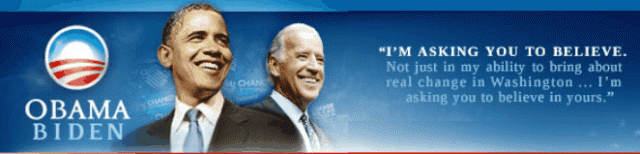
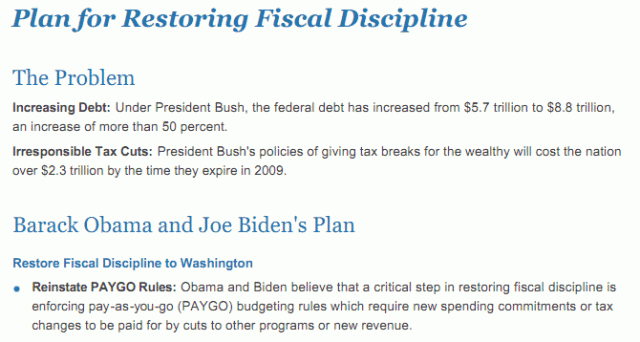
In 2008 Obama complained about Bush increasing the debt by $3 trillion, and promised to restore fiscal discipline.
http://moveleft.org/obamas_promises/www-barackobama-com_issues_fiscal.pdf
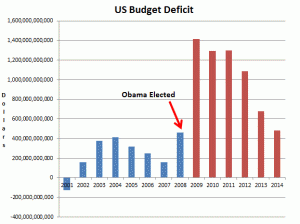
Instead, he tripled the deficit and has accumulated three times as much debt in six years as Bush did in eight. Obama’s smallest deficit is larger than Bush’ largest.
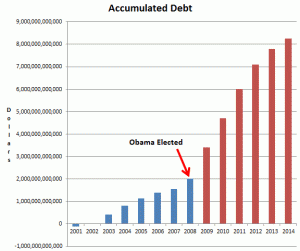
But it is worse than it seems. Obama’s original claim was also a lie – according to the White House Budget Office, Bush increased the debt by $2 trillion, not $3 trillion. Obama has increased it by $6 trillion so far.
Table 1.1—Summary of Receipts, Outlays, and Surpluses or Deficits (-): 1789–2020
I have created this site to help people have fun in the kitchen. I write about enjoying life both in and out of my kitchen. Life is short! Make the most of it and enjoy!
De Oppresso Liber
A group of Americans united by our commitment to Freedom, Constitutional Governance, and Civic Duty.
Share the truth at whatever cost.
De Oppresso Liber
Uncensored updates on world events, economics, the environment and medicine
De Oppresso Liber
This is a library of News Events not reported by the Main Stream Media documenting & connecting the dots on How the Obama Marxist Liberal agenda is destroying America
Australia's Front Line | Since 2011
See what War is like and how it affects our Warriors
Nwo News, End Time, Deep State, World News, No Fake News
De Oppresso Liber
Politics | Talk | Opinion - Contact Info: stellasplace@wowway.com
Exposition and Encouragement
The Physician Wellness Movement and Illegitimate Authority: The Need for Revolt and Reconstruction
Real Estate Lending

