Conservative Judicial Legacy Will Last for Decades, Even if Trump Loses in 2020


150K subscribers

The lede spells out just why so many conservatives overlooked their concerns, and voted for Donald Trump, and why many more will do so in November 2020. “After three years in office President Donald has remade the federal judiciary, ensuring a conservative tilt for decades, and cementing his legacy no matter the outcome of November’s election.” — Colby Itkowitz, reporter, Washington Post, 12/21/2019 Our May 2020 Royal Caribbean 3-night Bahamas cruise will allow you to relax, unwind, hangout with like-minded folks, and see live productions of our shows. Book your cabin now at https://BillWhittleCruise.com Bill Whittle Now with Scott Ott comes to you 20-times each month from our Members, who fund this enterprise, and run their own blog and vibrant comment sections, in addition to enjoying other Members-only features of our site. Find out more, and find your people at https://BillWhittle.com/register/ Listen to audio versions of our shows: https://Bit.ly/BWN-Podcasts

Passion for Politics Meets the Story of Christmas


150K subscribers

Join Bill Whittle, Scott Ott, Stephen Green and the Members and fans of this show on a 3-night cruise in May 2020. Reserve your cabin now at https://BillWhittleCruise.com —– Why do you even care about politics — a distant enterprise, operated by people you don’t really know, arguing about things that often don’t even impact you? The passion for politics, that inner drive that keeps you on fire with emotion, has a reason. Scott Ott has a theory that ties your desire for good governance to the story of Christmas. Right Angle comes to you 20-times each month thanks to our Members. Meet them and unlock new levels of engagement by becoming a one of us at https;//BillWhittle.com/register/ Listen to audio versions of this show at https://bit.ly/BWN-Podcasts Ask Alexa to play Bill Whittle Network on TuneIn Radio , or watch Bill Whittle Network on your Fire TV

The Poorest 20% of Americans Are Richer on Average Than Most Nations of Europe


A groundbreaking study by Just Facts has discovered that after accounting for all income, charity, and non-cash welfare benefits like subsidized housing and Food Stamps—the poorest 20% of Americans consume more goods and services than the national averages for all people in most affluent countries. This includes the majority of countries in the prestigious Organization for Economic Cooperation and Development (OECD), including its European members. In other words, if the U.S. “poor” were a nation, it would be one of the world’s richest.

Notably, this study was reviewed by Dr. Henrique Schneider, professor of economics at Nordakademie University in Germany and the chief economist of the Swiss Federation of Small and Medium-Sized Enterprises. After examining the source data and Just Facts’ methodology, he concluded: “This study is sound and conforms with academic standards. I personally think it provides valuable insight into poverty measures and adds considerably to this field of research.”

The “Poorest” Rich Nation?

In a July 1st New York Times video op-ed that decries “fake news” and calls for “a more truthful approach” to “the myth of America as the greatest nation on earth,” Times producers Taige Jensen and Nayeema Raza claim that the U.S. has “fallen well behind Europe” in many respects and has “more in common with ‘developing countries’ than we’d like to admit.”

“One good test” of this, they say, is how the U.S. ranks in the OECD, a group of “36 countries, predominantly wealthy, Western, and Democratic.” While examining these rankings, they corrupt the truth in ways that violate the Times’ op-ed standards, which declare that “you can have any opinion you would like,” but “the facts in a piece must be supported and validated,” and “you can’t say that a certain battle began on a certain day if it did not.”

A prime example is their claim that “America is the richest country” in the OECD, “but we’re also the poorest, with a whopping 18% poverty rate—closer to Mexico than Western Europe.” That assertion prompted Just Facts to conduct a rigorous, original study of this issue with data from the OECD, the World Bank, and the U.S. government’s Bureau of Economic Analysis. It found that the Times is not merely wrong about this issue but is reporting the polar opposite of reality.

Poor Compared to Who?

The most glaring evidence against the Times’ rhetoric is a note located just above the OECD’s data for poverty rates. It explains that these rates measure relative poverty within nations, not between nations. As the note states, the figures represent portions of people with less than “half the median household income” in their own nations—and thus—”two countries with the same poverty rates may differ in terms of the relative income-level of the poor.”

The upshot is laid bare by the fact that this OECD measure assigns a higher poverty rate to the U.S. (17.8%) than to Mexico (16.6%). Yet, World Bank data shows that 35% of Mexico’s population lives on less than $5.50 per day, as compared to only 2% of people in the United States.

Hence, the OECD’s poverty rates say nothing about which nation is “the poorest.” Nonetheless, this is exactly how the Times misrepresented them.

The same point applies to broader discussions about poverty, which can be measured in two very different ways: (1) relative poverty or (2) absolute poverty. Relative measures of poverty, like the one cited by the Times, can be misleading if the presenter does not answer the question: “Poor compared to who?” Absolute measures, like the number of people with income below a certain level, are more straightforward and enlightening.

Unmeasured Income and Benefits

To accurately compare living standards across or within nations, it is necessary to account for all major aspects of material welfare. None of the data above does this.

The OECD data is particularly flawed because it is based on “income,” which excludes a host of non-cash government benefits and private charity that are abundant in the United States. Examples include but are not limited to:

  • healthcare provided by Medicaid, free clinics, and the Children’s Health Insurance Program.
  • nourishment provided by Food Stamps, school lunches, school breakfasts, soup kitchens, food pantries, and the Women’s, Infants’ & Children’s program.
  • housing and amenities provided through rent subsidies, utility assistance, and homeless shelters.

The World Bank data includes those items but is still incomplete because it is based on government “household surveys,” and U.S. low-income households greatly underreport both their income and non-cash benefits in such surveys. As documented in a 2015 paper in the Journal of Economic Perspectives entitled “Household Surveys in Crisis”:

  • “In recent years, more than half of welfare dollars and nearly half of food stamp dollars have been missed in several major” government surveys.
  • There has been “a sharp rise” in underreporting of government benefits received by low-income households in the United States.
  • This “understatement of incomes” masks “the poverty-reducing effects of government programs” and leads to “an overstatement of poverty and inequality.”

Likewise, the U.S. Bureau of Economic Analysis explains that such surveys “have issues with recalling income and expenditures and are subject to deliberate underreporting of certain items.” The U.S. Census Bureau says much the same, writing that “for many different reasons there is a tendency in household surveys for respondents to underreport their income.”

There is also a wider lesson here. When politicians and the media talk about income inequality, they often use statistics that fail to account for large amounts of income and benefits received by low- and middle-income households. This greatly overstates inequality and feeds deceptive narratives.

Relevant, Reliable Data

The World Bank’s “preferred” indicator of material well-being is “consumption“ of goods and services. This is due to “practical reasons of reliability and because consumption is thought to better capture long-run welfare levels than current income.” Likewise, a 2003 paper in the Journal of Human Resources explains that:

  • “research on poor households in the U.S. suggests that consumption is better reported than income” and is “a more direct measure of material well-being.”
  • “consumption standards were behind the original setting of the poverty line,” but governments now use income because of its “ease of reporting.”

The World Bank publishes a comprehensive dataset on consumption that isn’t dependent on the accuracy of household surveys and includes all goods and services, but it only provides the average consumption per person in each nation—not the poorest people in each nation.

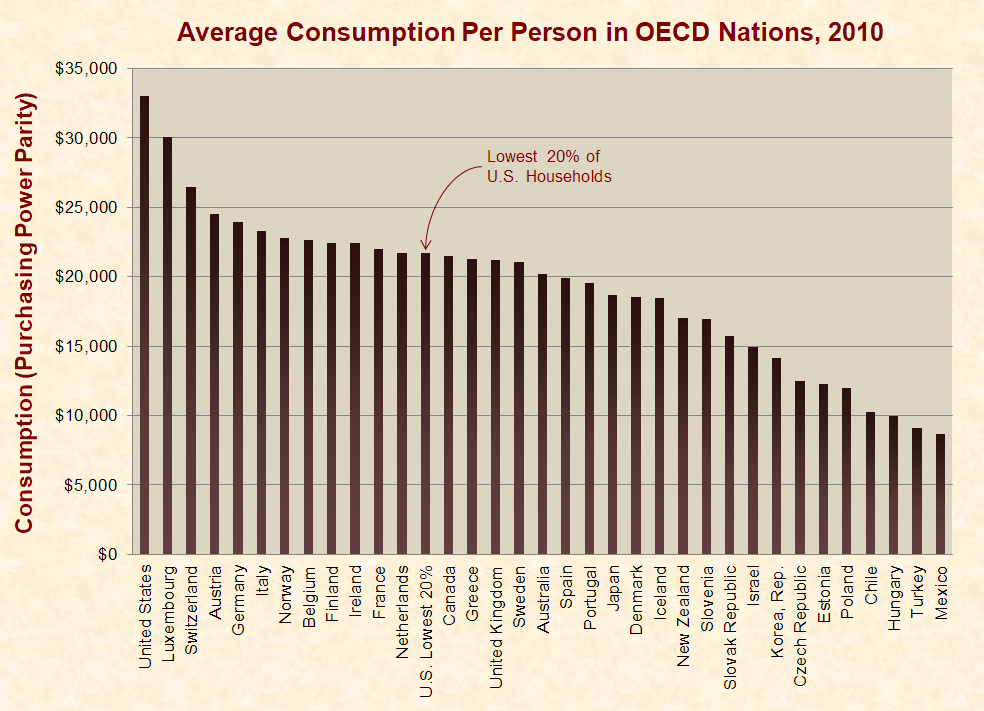
However, the U.S. Bureau of Economic Analysis published a study that provides exactly that for 2010. Combined with World Bank data for the same year, these datasets show that the poorest 20% of U.S. households have higher average consumption per person than the averages for all people in most nations of the OECD and Europe:

Average Consumption Per Person in OECD Nations, 2010

The high consumption of America’s “poor” doesn’t mean they live better than average people in the nations they outpace, like Spain, Denmark, Japan, Greece, and New Zealand. This is because people’s quality of life also depends on their communities and personal choices, like the local politicians they elect, the violent crimes they commit, and the spending decisions they make.

For instance, a Department of Agriculture study found that U.S. households receiving Food Stamps spend about 50% more on sweetened drinks, desserts and candy than on fruits & vegetables. In comparison, households not receiving Food Stamps spend slightly more on fruits & vegetables than on sweets.

Nonetheless, the fact remains that the privilege of living in the U.S. affords poor people with more material resources than the averages for most of the world’s richest nations.

Another important strength of this data is that it is adjusted for purchasing power to measure tangible realities like square feet of living area, foods, smartphones, etc. This removes the confounding effects of factors like inflation and exchange rates. Thus, an apple in one nation is counted the same as an apple in another.

To spot check the results for accuracy, Just Facts compared the World Bank consumption figure for the entire U.S. with the one from the Bureau of Economic Analysis. They were within 2% of each other. All of the data, documentation, and calculations are available in this spreadsheet.

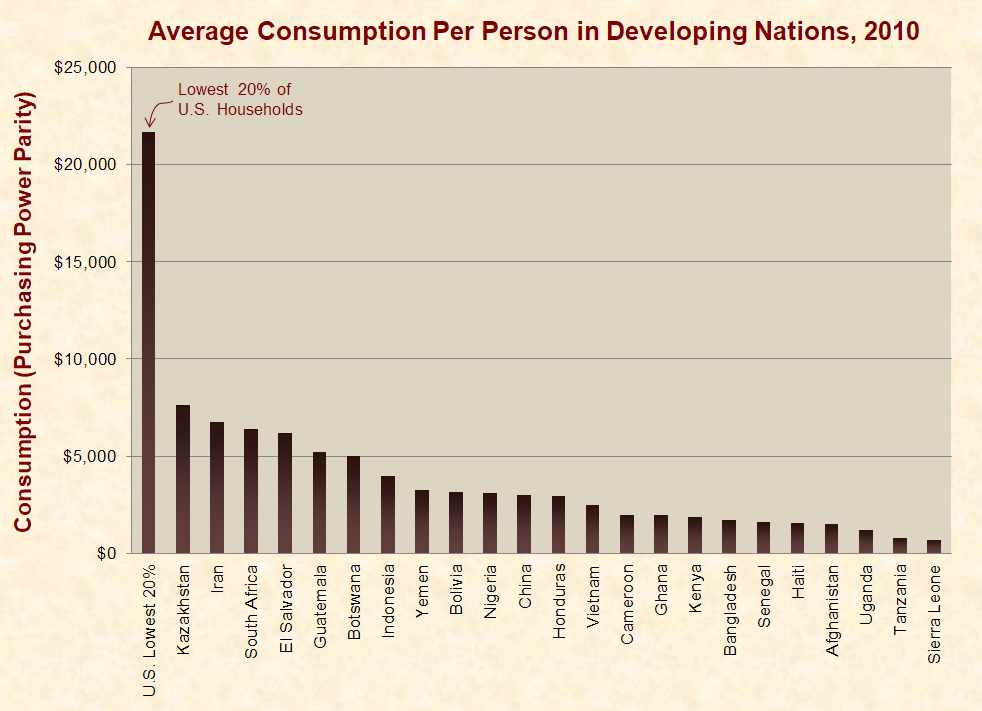
In light of these facts, the Times’ claim that the U.S. has “more in common with ‘developing countries’ than we’d like to admit” is especially far-fetched. In 2010, even the poorest 20% of Americans consumed 3 to 30 times more goods and services than the averages for all people in a wide array of developing nations around the world:

Average Consumption Per Person in Developing Nations, 2010

These immense gaps in standards of living are a major reason why people from developing nations immigrate to the U.S. instead of vice versa.

Why Is the U.S. So Much Richer?

Instead of maligning the United States, the Times could have covered this issue in a way that would help people around the world improve their material well-being by replicating what makes the U.S. so successful. However, that would require conveying the following facts, many of which the Times has previously misreported:

  • High energy prices, like those caused by ambitious “green energy” programs in Europe, depress living standards, especially for the poor.
  • High tax rates reduce incentives to work, save, and invest, and these can have widespread harmful effects.
  • Abundant social programs can reduce market income through multiple mechanisms—and as explained by President Obama’s former chief economist Lawrence Summers, “government assistance programs” provide people with “an incentive, and the means, not to work.”
  • The overall productivity of each nation trickles down to the poor, and this is partly why McDonald’s workers in the U.S. have more real purchasing power than in Europe and six times more than in Latin America, even though these workers perform the same jobs with the same technology.
  • Family disintegration driven by changing attitudes toward sex, marital fidelity, and familial responsibility has strong, negative impacts on household income.
  • In direct contradiction to the Times, a wealth of data suggests that aggressive government regulations harm economies.

Many other factors correlate with the economic conditions of nations and individuals, but the above are some key ones that give the U.S. an advantage over many European and other OECD countries.

Summary

The Times closes its video by claiming that “America may once have been the greatest, but today America, we’re just okay.” In reality, the U.S. is so economically exceptional that the poorest 20% of Americans are richer than many of the world’s most affluent nations.

Last year, the Times adopted a new slogan, “The truth is worth it.” Yet, in this case and others, it has twisted the truth in ways that can genuinely hurt people. The Times makes other spurious claims about the U.S. in this same video, which will be deflated in future articles.

Total Holiday Sales +3.4% Year-Over-Year, Biggest Holiday Sales in U.S. Retail History…


Whooo-doggies, middle-class Americans spent more this holiday shopping season than any year before it.  Despite losing a week due to the late Thanksgiving holiday, total Christmas sales growth was +3.4 percent year-over-year.

(Reuters) […] The holiday shopping season is a crucial period for retailers and can account for up to 40% of annual sales. But this year, Thanksgiving, which traditionally starts the U.S. holiday shopping period, was on Nov. 28, nearly a week later than last year’s Nov. 22, leaving retailers with six fewer days to drive sales between Thanksgiving and Christmas.

E-commerce sales this year made up 14.6% of total retail and rose 18.8% from the 2018 period, according to Mastercard’s data tracking retail sales from Nov. 1 through Christmas Eve. Overall holiday retail sales, excluding autos, rose 3.4%.

“E-commerce sales hit a record high this year with more people doing their holiday shopping online,” said Steve Sadove, senior adviser for Mastercard.

Now watch the Reuters spin…

U.S. President Donald Trump, whose support in the polls has been buoyed by strong economic data despite his impeachment by the House of Representatives, heralded the news in a tweet in all capital letters.

“2019 HOLIDAY RETAIL SALES WERE UP 3.4% FROM LAST YEAR, THE BIGGEST NUMBER IN U.S. HISTORY. CONGRATULATIONS AMERICA!,” Trump tweeted.

However, Mastercard spokesman William Tsang, citing 2018’s 5.1% growth in total sales, said this year’s holiday sales growth was not the biggest ever.

The White House had no immediate comment on the apparent discrepancy.

Despite slowing global growth, U.S. consumer spending is benefiting from wage growth and a strong labor market, retail consultants and analysts say. (link)

There is no discrepancy.  Trump’s tweet was recognizing the record-breaking total amount of U.S. sales, not simply the growth rate.   Knuckleheads.   Mamet principle on full display.

Total Holiday Sales an outcome of a very strong economy, low unemployment, low inflation, higher wages and more disposable income… MAGAnomics at work.

Keep in mind U.S. GDP growth is driven by consumer spending.  A whopping 3.4% gain year-over-year is tens of billions more in economic activity.  More WINNING !


The President and First Lady Christmas Message 2019…


Today President Donald Trump and First Lady Melania Trump share their Christmas message to all Americans.

Presidential Message on Christmas

Melania and I send our warmest greetings to those celebrating Christmas in the United States and around the world. During this joyous time of year, we join a grateful Nation in thanking God for His abundant blessings and boundless love.

As families, friends, and communities come together to rejoice in the birth of Christ, we are reminded of the divine message from the first Christmas: “Glory to God in the highest, and on earth peace, good will toward men.” While the challenges that face our country are great, the bonds that unite us as Americans are much stronger. Together, we must strive to foster a culture of deeper understanding and respect—traits that exemplify the teachings of Christ.

As we celebrate Christmas, we remember the precious religious liberties our forefathers so righteously fought to secure. We also pause to pay tribute to those courageous men and women of our Armed Forces who continue to fight for our cherished freedoms. As Commander in Chief, I salute them for their service and thank their family members for their shared sacrifice in this noble mission, especially during the holiday season.

We hope your heart is filled with the love and joy of your faith, family, and friends this Christmas. We send our best wishes for a merry Christmas and a happy and prosperous New Year.

Donald J Trump

China’s Communist State Council Promises to Offset Economic Slowdown…


Perhaps the status of the economy in China is even worse than many have suspected.  An interesting public statement from their State Council today highlights a promise by China to support jobs during their current economic downturn.

Against the backdrop of Hong Kong’s protests toward Beijing oppression, a rebellion of the people against the command authority is the single-most feared action by those in charge of government.  If the economy is in worse position than previously thought, this latest statement might explain some of Beijings’ recent trade and economic concessions.

(Reuters) – China will step up support for employment to cope with rising pressure on job security due to internal and external challenges, the cabinet said on Tuesday, as the world’s second-largest economy slows.

Simultaneous downturns in the services and manufacturing industries pose a major problem for authorities seeking to keep a lid on unemployment and prevent social unrest as economic growth decelerates to near three-decade lows.

“At present, China’s employment situation is generally stable, but risks and challenges at home and abroad are increasing and the pressure to stabilise employment is increasing,” the State Council said in a statement.

The government will attach equal importance to creating new jobs and safeguarding existing jobs, and make more effort to head off risks of unemployment, it said.

China will step up financial support for private and small firms, including implementing targeted reserve requirement cuts and encouraging banks to boost long-term loans to small firms in the manufacturing sector, the cabinet said. (read more)

There are always lags within economies based on adverse conditions.  The economic landscape today is likely the surfacing of economic conditions six months ago (+/-).

It was always a question of when the devaluing of currency and over-use of state subsidies to cover financial gaps caused by the trade conflict would surface.  Perhaps Beijing is responding to the beginning of those consequences?…

President Trump Remarks During Mar-a-Lago Press Availability…


Following a Christmas eve call to U.S. service members, President Trump answers questions on a variety of topics from the press pool.  [Video Below]

President Trump Hosts Christmas Eve Video Teleconference with Members of Army, Marine Corps, Navy, Air Force, and Coast Guard…


Earlier this morning Commander-in-Chief President Donald Trump hosted a Christmas Eve video teleconference with members of the Army, Marine Corps, Navy, Air Force, and Coast Guard to thank them for their service and wish them a merry Christmas.

Participating on the call were: ♦ARMY Unit: 103 Sustained Command, Location: Camp Arifjan, Kuwait Captain Roxanna Flores.  ♦MARINE CORPS Unit: Task Force Southwest 19.2, Location: Camp Shorab, Afghanistan, Brigadier General David Odom. ♦NAVY
Unit: USS Forest Sherman (DDG 98), Location: Gulf of Aden, Commander Frank Azzarello.  ♦AIR FORCE Unit: 20th Attack Squadron, Location: Whiteman AFB, Missouri
Lieutenant Colonel Daniel Wassmuth; and ♦COAST GUARD Unit: CG Air Station Sitka,
Location: Sitka, Alaska, Captain Michael Frawley.  [Video Below]

More MAGAnomic Super-Winning: Saturday Sales $34.4 BILLION, Biggest Shopping Day in U.S. Retail History…


Jumping Ju-Ju Bones, Santa cancelled the recession!!

According to the latest data stats from last weekend, Saturday holiday shopping in the U.S. was more than $34.4 billion in sales.  That’s the largest single day in the history of U.S. retail sales.  Higher wages, record employment, low inflation, consumer confidence and economic security means more disposable income… boy howdy, these numbers are huge.

Keep in mind U.S. retail sales account for two-thirds of U.S. GDP growth. Wow:

(MSM-Bloomberg) Holiday shopping set records over the weekend, with Super Saturday sales reaching $34.4 billion, the biggest single day in U.S. retail history, according to Customer Growth Partners.

“Paced by the ‘Big Four’ mega-retailers — Walmart, Amazon, Costco and Target — Super Saturday was boosted by the best traffic our team has seen in years,” said Craig Johnson, president of the retail research firm.

Job growth and fatter wallets, along with stronger household finances, have put consumers in a buying mood this season, Johnson said. And more of them are shopping online. As retailers offer improved web platforms, online spending so far this season has accounted for 58% of sales growth from a year earlier, he said.

Super Saturday’s results topped Black Friday’s $31.2 billion in sales by 10%. The next biggest shopping days were Dec. 14, with $28.1 billion, and Cyber Monday, with $19.1 billion. (more)

Your Vote for President Donald Trump Produced…


Tax cuts and regulatory reform; USMCA trade agreement negotiated and passed; Mexico halting illegal migration flows; new central American amnesty agreements; border wall under construction; lower energy costs; lower and stabilized fuel costs; highest blue collar wage gains in decades; largest resurgence of manufacturing jobs in 50 years; Korea-US trade agreement (KORUS); U.S-Japan trade agreement; U.S-China trade agreement (phase-1); withdrawal from Trans-Pacific multinationals (TPP); dissolution of Paris climate treaty; approval for ANWR energy development; five new gasoline refineries; U.S. energy independence; U.S. worlds largest producer of energy; LNG energy exports; elimination of excessive federal regulations; SNAP reforms; 3.5% unemployment; largest employed U.S. workforce in history; 150,000 employer registrations to U.S. trade-skills apprenticeship; seven new industrial steel manufacturing plants; low and stable 1.5% inflation; highest GDP growth amid industrial nations; highest consumer confidence in decades; highest small business confidence in decades; 7.3 million jobs available (JOLTS); one year net employment gain 2.4 million workers; two supreme court justices; no new wars; NATO countries stepping up defense financing; troops coming home; pay raises for military; VA Choice created; right-to-try legislation passed; U.S. embassy in Jerusalem; North Korean hostages released; ISIS destroyed, caliphate dismantled; al-Bagdadi dead.  These are just a few of President Trump’s recent accomplishments off the top of my head: