Governments Going Insane with New Ways to Tax People


Ireland TV Tax on Computers

In Ireland, a reader has sent this gem in. The Communications Minister Denis Naughten is so proud of himself for changing the definition of a ‘television set’ to include your laptop in order to extend the TV license fee to be applied to computers, laptops, and large tablets. He believes he will generate an extra €5m a year. As our reader put it: “from that ‘shining light’ of the EU, Ireland is prepared to stoop in hunting even more cash from its people. … Is there no end to this lunacy? Internet next I’m sure!”

In Sweden, as of April 1st, a new tax will be applied to ALL electronics. Are you ready for this? The reason is of course not to raise money, but to protect people from electronics; including everything from the fridge to tvs and laptops. On April 1, Sweden will impose a new so-called “chemical tax” on electronics and appliances. The purpose of the new tax is said to reduce the amount of hazardous flame retardants in our homes.

We are faced with tax revolts throughout Western Culture. Governments are all broke. Of course, they will never consider reform. The answer is always just grab more and more money from the people. This is why they are moving to eliminate cash to prevent people from evading taxes. This is not going to end nicely. The American Revolution was “No taxation without representation” and the French Revolution was also over excessive taxes – Let them eat cake. This is why we must crash and burn. You simply cannot reason with those in government to recognize that they are the problem. Thus, history constantly repeats and taxation is the driving force behind revolution historically in all cultures.

Benchmarks to False Moves – The Constant Cycle of Change


QUESTION: Mr. Armstrong; You said China will become the financial capital of the world after 2032. That means the US must decline. At the same time, you have been consistent in forecasting a bull market in the U.S. share market when everyone else keeps calling for a crash. Are the two connected in some way?

Thank you

HS

ANSWER: Yes, these two events are interlocked. All markets function very distinctly. They move like a pendulum. The famous one in the United Nations building with the classic physics experiment, Foucault’s pendulum, is propelled by the rotation of the earth itself. While it had long been known that the Earth rotates, the introduction of the Foucault pendulum back in 1851 was the first visual proof of the rotation of the Earth in an extraordinary easy-to-see experiment. The pendulum remains in a constant oscillation relative to the universe. As the earth rotates, we can see that it does so around the constant path of the pendulum swing.

Bulls-BearsThis applies to market behavior as well. There is a constant oscillation to everything we call our Benchmarks. They remain constant within the universe and everything else rotates around them. The energy that maintains the cycle is the constant oscillation between two extremes. The further it swings in one direction, the greater the energy moves in the opposite direction.

This is the very essence of how everything moves. This is the creation of energy to keep things going from the instant of creation also known as big bang. Personally, I do not believe in just a simple big bang. I believe after big bang; the expansion will stop and then reverse and move back toward the point of origin. Then it will explode outward once again. I do not believe it was a one-time event since energy can neither be created nor destroyed – only transformed between states.

DJ2731-W False Move

Now apply this to markets. The real energy within a market is always to trap the majority, for then they lose money and it forces them to cover their position. If 90% of the people are long, then any news can set off the collapse. If you scare the majority, there will be no bid when you try to sell, which results in a flash crash. Likewise, this current rally in the Dow from 2009 has been the most bearish in history. The majority of analysts still keep calling for an inevitable crash. Retail participation still remains near historic lows. You cannot get a crash of major consequence as long as the bulk of the people are not invested in the market. Here you see how the market ALWAYS makes a false move just before it makes the real move in the direction of the underlying trend. At each correction, the emotions run high and people ALWAYS expect whatever trend is in motion will remain in motion. Hence, shorts build up and then they are compelled to cover and that gets the rally moving.

DJIND-1790-1923

Markets are fractal. So whatever you see on only level of time, must exist on all levels of time or else it is not real. The Dow made a Yearly FALSE MOVE on a number of occasions. For example, the high of 1916 dropped from 8500 to 6590 and established the low in 1917. It then swung to the upside, reached new highs at 11960 in 1919, and then on the panic back down.

The Dow made its intraday high in 1889, which was followed by a one year panic into 1890. It then swung back to the highest yearly closing in 1892 with the famous Panic of 1893 immediately thereafter.

A similar pattern unfolded with a high in 1872, a panic penetrating the previous year’s low in 1873, and then a dramatic swing to new high the next year in 1874.

These are just a few examples.

Gold False Moves

The goldbugs simply hate me even saying that gold can still move below $1,000. They approach everything only in a linear concept – it must only move up and never down. This is how they lose money consistently. The extreme ones are married to this idea that gold will rise in an apocalyptic fashion when everything else turns to dust. There is always a FALSE move before the true direction. A move for gold below $1,000 will create the energy needed to send it soaring past the $2300 level which is the 1980 high adjusted for inflation. This is what our Reversal System is all about. It is to define that point of no return where we can differentiate between a false move and a real breakout.

WorldEconomy

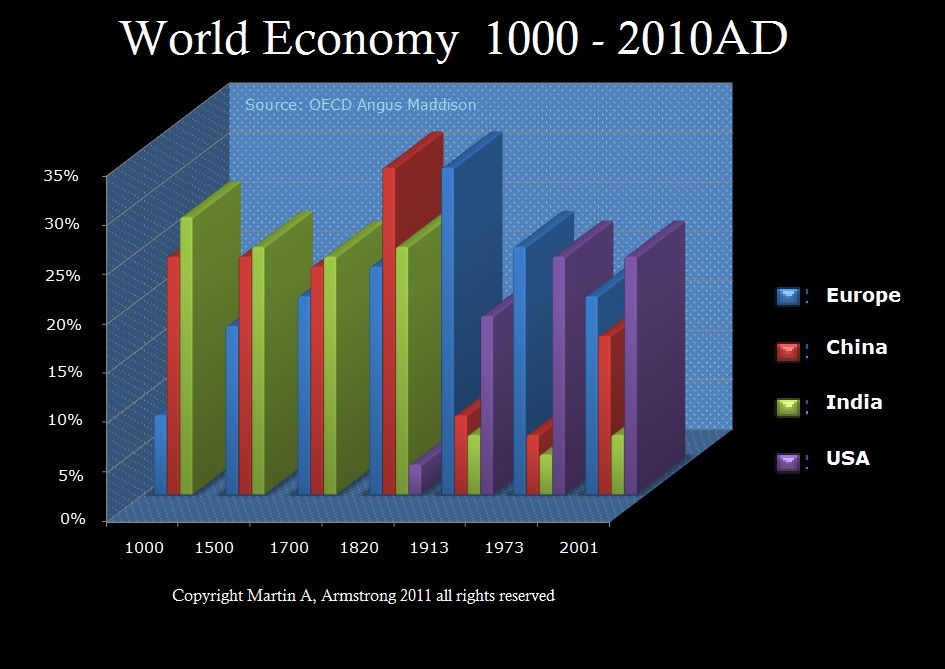
Now, because everything is fractal, and we have been able to identify the existence of constant Benchmarks in everything, it becomes possible to observe the rotation of capital around the world which is behind the rise and fall of every civilization since the dawn of the human race. In 1990, China was just 5% of world GDP. Now in 2015 it has risen to 15%. The United States is the world’s largest national economy in nominal terms representing 24.5% of nominal global GDP.

marx-4We first must send the share markets up dramatically. This will be the FALSE MOVE that makes everyone see that the USA is the only game in town. That will be the extreme point, reaching the maximum swing and then its own weight will cause it to move back in the opposite direction. Just as the British Empire rapidly collapsed following World War I handing that title of Financial Capital of the World to the USA, we will see the same take place as that title moves to China. One of the critical factors that will kill the US economy will be taxes and overregulation – both the socialist’s dreams come true. What broke the back of China and Russia in 1989, was this same failure of Marxist philosophies that call for total central planning by government. It is merely the West’s turn to now collapse because of the same philosophy of Karl Marx.

Only a fool believes in the fairy-tales of happily ever after. There is a cycle to everything. The Pension Crisis Report went into detail. Men mature slower than women, so historically the man was always much older than his wife. Hollywood sold lust as love at first sight and as the age difference collapsed, divorce reached cyclical highs. As they say, a girl becomes a woman at 23 but a boy does not become a man until 40. Women married boys but expected them to be men. Today, much of the youth reject marriage and having children. The demographics and changing life styles are undermining the entire idea of pension systems. This is a crash that will also propel the shift. Interestingly enough, in the former communist regions, people never trusted government so they expected nothing in return by tyranny. In the West, society still believes in government and the dream that they will be there. When government falls, Western society will not be as self-sufficient as they were in China. Socialism replaced the family structure in the West so children did not save to take care of their parents – that was government’s job. We face a lot of real social problems moving into 2032. That’s what our WEC conferences are all about.

Are we On the Verge of a Market Explosion to the Upside?


DJIND-Q 3-30-2017

Tomorrow we end the first quarter of 2017. Politics on a global scale are the driving force. The failure of Trump and reform movements in Europe are the catalyst to send the stock market to record highs once again as people lose confidence in government completely and we then turn to just look how to park money. We cross that line moving beyond the point of no return where money pours into equities, not because of earnings, but because capital is fleeing from government and banks and it just needs a place to park. As we move forward, we will look at good stocks to park money to survive the political chaos on the horizon.

PE Ratio 1871-2016

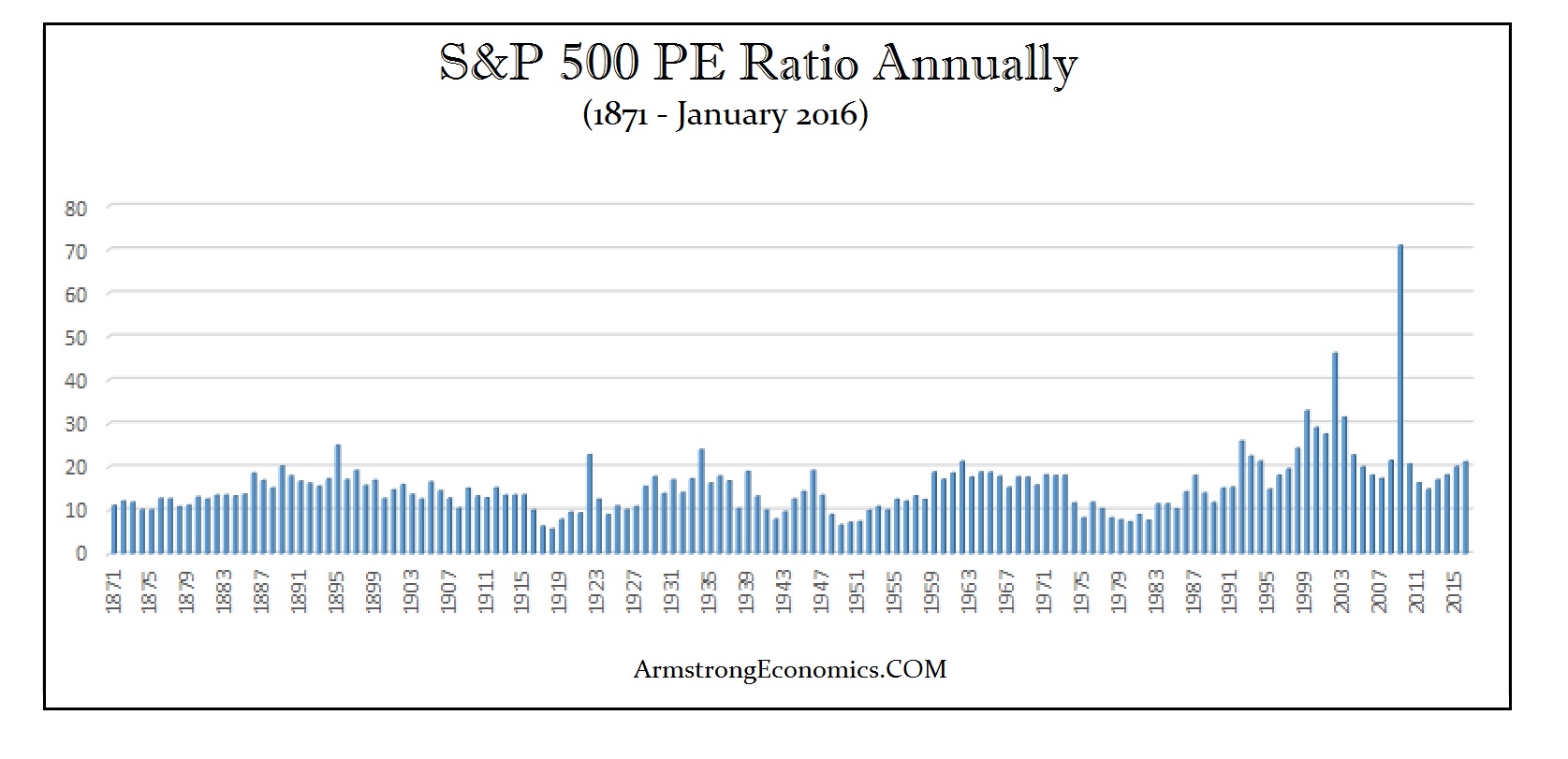
The historical high in the PE Ratio was in 2009 at the bottom of the crash – NOT THE HIGH! When you reach a point that you no longer trust banks, the currency, or government, where does big money go? Individuals can buy gold, but you cannot keep it in a safe deposit box in a bank if the banks can be seized. Big money parks in blue chips and tangible assets like real estate (if out of the path of war). The 2009 peak in the PE Ratio reflects that moment of a complete collapse in confidence. This is the key point we must understand. So, while I am focusing on politics, that is the fuel to ignite the collapse in public confidence. Nobody can stop this – not Trump, not Le Pen, or any other reactionary politician. We have crossed the point of no return because nobody is talking about restructuring the entire monetary system and debt system. That will not take place UNTIL we crash and burn. Nobody changes anything until they have to.

obama-change-we-can-believe-inWe can technically see that the Dow has broken-out on the Quarterly level. Support lies at the 19,230 level. The only way to make a serious correction requires the Dow to break the 17,000 area on a closing basis. Closing the quarter above 19,230 keeps the market positive from a broader perspective.

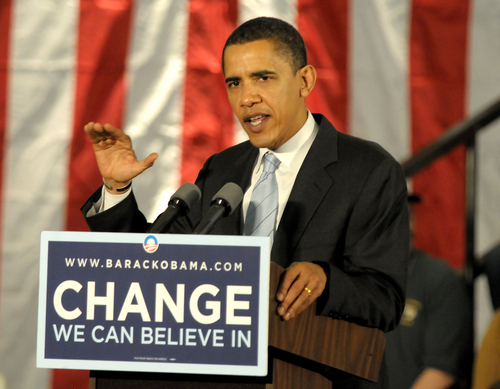
Keep in mind that Trump WILL FAIL! This much is inevitable. The trend is against him and you cannot fight the trend. People had such high hopes for Obama that he would live up to his promises and we would really see “Change We Can Believe In.” When everything he did was the same as Bush, that destroyed the confidence in the two-party system and set the stage for Trump as our computer was forecasting. He became effectively a third-party candidate with the Republican Party. Now, when he fails to reverse the global trend, where will people turn? Once you raise the hopes for change and Trump cannot deliver, all bets are off moving forward. That is when the stock market starts to rise for reasons that will confuse most. This is not the “Trump Rally” but the collapse in public confidence rally.

This is the Year from Political Hell on a global scale. This is all about capital flows and Trump is dead wrong on trade, the dollar, and whatever he does with the taxes, he better do it fast, for when the politics shifts again, they will only rise because governments; federal, state, and local, are broke and that will not change. Political change is sweeping Europe, Australia, and even in Asia.

This is the collapse in confidence in government and Trump cannot reverse that trend. In fact, Trump has raised hopes among the silent majority that things will change. His failure, especially on trade, will then sour the confidence in government completely, exactly as Obama. This is when civil unrest becomes really dangerous. The same is true in Europe. The loss of the extreme right in the Netherlands has only emboldened Brussels assuming this is just a short-lived “populist” movement that will die out. This defeats any possible reform movement and ensures we will crash and burn starting in 2018.

At the end of the day, the next level of resistance is still in the 23000 level. After that, we cross the threshold into a Phase Transition. That is when everything begins to get truly confusing and crazy. This year’s WEC in Hong Kong, I will focus on how to trade a vertical market.

Are we On the Verge of a Market Explosion to the Upside?


DJIND-Q 3-30-2017

Tomorrow we end the first quarter of 2017. Politics on a global scale are the driving force. The failure of Trump and reform movements in Europe are the catalyst to send the stock market to record highs once again as people lose confidence in government completely and we then turn to just look how to park money. We cross that line moving beyond the point of no return where money pours into equities, not because of earnings, but because capital is fleeing from government and banks and it just needs a place to park. As we move forward, we will look at good stocks to park money to survive the political chaos on the horizon.

PE Ratio 1871-2016

The historical high in the PE Ratio was in 2009 at the bottom of the crash – NOT THE HIGH! When you reach a point that you no longer trust banks, the currency, or government, where does big money go? Individuals can buy gold, but you cannot keep it in a safe deposit box in a bank if the banks can be seized. Big money parks in blue chips and tangible assets like real estate (if out of the path of war). The 2009 peak in the PE Ratio reflects that moment of a complete collapse in confidence. This is the key point we must understand. So, while I am focusing on politics, that is the fuel to ignite the collapse in public confidence. Nobody can stop this – not Trump, not Le Pen, or any other reactionary politician. We have crossed the point of no return because nobody is talking about restructuring the entire monetary system and debt system. That will not take place UNTIL we crash and burn. Nobody changes anything until they have to.

obama-change-we-can-believe-inWe can technically see that the Dow has broken-out on the Quarterly level. Support lies at the 19,230 level. The only way to make a serious correction requires the Dow to break the 17,000 area on a closing basis. Closing the quarter above 19,230 keeps the market positive from a broader perspective.

Keep in mind that Trump WILL FAIL! This much is inevitable. The trend is against him and you cannot fight the trend. People had such high hopes for Obama that he would live up to his promises and we would really see “Change We Can Believe In.” When everything he did was the same as Bush, that destroyed the confidence in the two-party system and set the stage for Trump as our computer was forecasting. He became effectively a third-party candidate with the Republican Party. Now, when he fails to reverse the global trend, where will people turn? Once you raise the hopes for change and Trump cannot deliver, all bets are off moving forward. That is when the stock market starts to rise for reasons that will confuse most. This is not the “Trump Rally” but the collapse in public confidence rally.

This is the Year from Political Hell on a global scale. This is all about capital flows and Trump is dead wrong on trade, the dollar, and whatever he does with the taxes, he better do it fast, for when the politics shifts again, they will only rise because governments; federal, state, and local, are broke and that will not change. Political change is sweeping Europe, Australia, and even in Asia.

This is the collapse in confidence in government and Trump cannot reverse that trend. In fact, Trump has raised hopes among the silent majority that things will change. His failure, especially on trade, will then sour the confidence in government completely, exactly as Obama. This is when civil unrest becomes really dangerous. The same is true in Europe. The loss of the extreme right in the Netherlands has only emboldened Brussels assuming this is just a short-lived “populist” movement that will die out. This defeats any possible reform movement and ensures we will crash and burn starting in 2018.

At the end of the day, the next level of resistance is still in the 23000 level. After that, we cross the threshold into a Phase Transition. That is when everything begins to get truly confusing and crazy. This year’s WEC in Hong Kong, I will focus on how to trade a vertical market.

Banks Secretly Report All Cash Transactions to the Police


$10,000 NZ Dollars

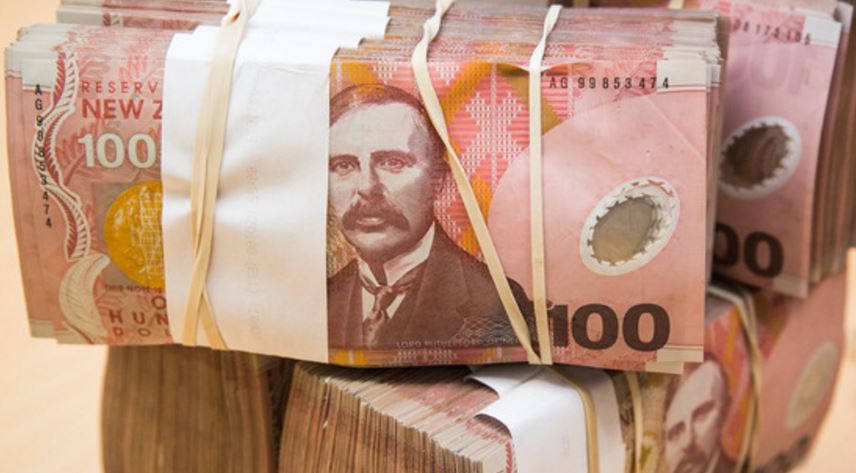
I have warned that governments around the world are engaged in the greatest collection of data in human history, tracking everything we do because they are going broke. This is just the hunt for money pretending to be looking for terrorists. Collecting every phone call, email, and text message is far too much data to ever allow preventative action. They have been limiting cash everywhere. India simply cancelled the currency overnight to eliminate cash. Now, New Zealand banks are being ordered to provide police with customer details on each and EVERY cash transaction over $10,000, claiming this is a crackdown on money laundering and the potential financing of terrorism. Of course, the money laundering really means hiding money from the government to avoid taxes.

Under new rules, banks will give police personal information including names, locations, and even phone numbers of any person depositing or withdrawing cash, for now making that $10,000. In the USA, if you did three transactions over a week of say $9,000 each, that in itself is another CRIME they call structuring, which is the practice of executing financial transactions such as making bank deposits in a specific pattern, calculated to avoid triggering financial institutions to file reports required by law. Under the US Bank Secrecy Act (BSA) and Internal Revenue Code section 6050I (Form 8300), structuring is a pattern of avoiding taxes they call money laundering, which they pretend is now to protect us against terrorists when in fact 99.9% is all about tax revenues. The penalty is up to 5 years in prison. Should this involve $100,000 over one year, the penalty is up to 10 years in prison under Title 31, Section 5324.

To make this perfectly clear, they DO NOT NEED TO PROVE that the money is part of any other crime. Merely trying to avoid reporting by structuring transactions is the crime even if you have already paid your taxes on that money. The New Zealand police say that this is a “crucial step in gathering intelligence”, but there is no requirement that any other crime took place. Simply hiding your own money is a crime.

These people elected to government DO NOT represent us, they only represent the state and we are presumed to all be criminals. In their mind, nobody is innocent. It’s just a question of proof.

What The World Needs Now


The Fed’s job has changed from stabling banking in 1913 to promoting means for the government to borrow money at low cost .i.e low interest rates which is creating a sovereign debt bubble (related to monetary policy) that will implode either slightly before or slightly after 2020

How Many Jobs Do Robots Destroy? Answers Emerge


I wrote about this effect in my economics thesis in 1965 and the bottom is that you have to look at the distribution of IQ/Education and the shift has been away from the jobs in the average range of IQ/Education into the upper ranges i.e. from labor to tech jobs. What this means as the shift continues is very simple there will be fewer and fewer people ABLE to do the jobs that are created.

Dollar Stores are Falling, Spelling Trouble for the Economy


More lower paying jobs than in the past with higher taxes, more expensive energy and food health care and school leaves less money for anything else.

The Euro Crisis & The Previous Debt


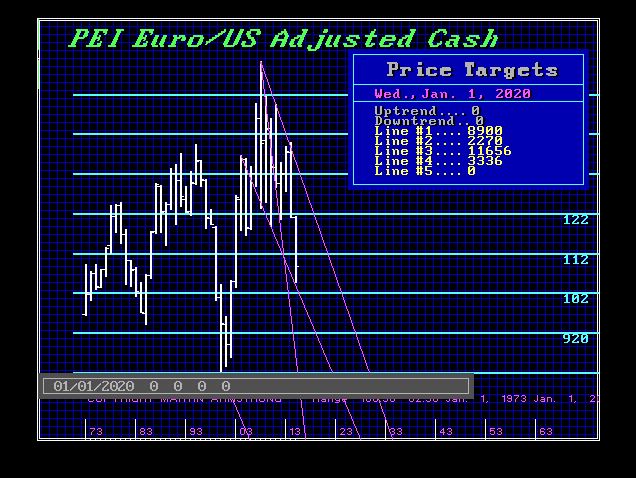
IBEUUS-Y TEK TO 2020 1-22-2016

QUESTION: Hello Martin, I understand and agree to what you are saying in your post however I cannot understand what you mean when you say that: “Secondly, leaving all individual member states with past debt yet converted that to euro, then resulted in their debts doubling in international value as the euro doubled going into 2008.” Here, I cannot follow how it is possible that Greece’s PAST debt could double due to the euro doubling in value since the PAST debt has already been converted to euro. If the PAST debt had been in any other currency and then when the euro would double then I could understand that the debt also could double. Am I missing out something here?

Regards,

MG

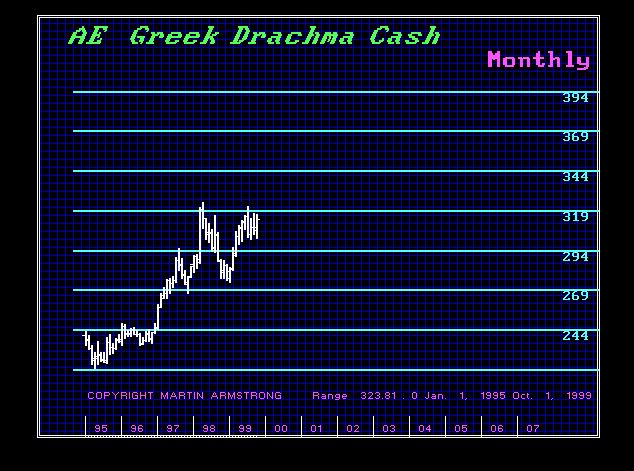
Drachma 1994-1999-M

ANSWER: All members past debts were in their home currency, including Germany. Upon joining the Euro, the  past debts were converted to the Euro also, because their old currencies were abandoned. What I mean by international value is if you look at the debts of all member states, when the euro doubled in value from 80 cents to the US dollar to $1.60, from a US investor, he doubled his money holding Greek debt or any member’s debt. We can see that the dollar rose sharply against the drachma between 1995 going into 1999 demonstrating that the drachma declined 47% going into the formation of the euro. The cost of servicing the past debt rises in real terms and when they had to pay off the debt and roll into new debt, they were paying in international value more than it was worth upon joining the euro.

1000 drachma

Back during the Reagan Administration, I met with the U.S. Treasury and warned that Volcker raising rates to 14% meant he was suppressing inflation immediately, but causing it to exponentially rise by the end of the decade. Why? Because central banks cannot stimulate or suppress and economy with interest rates when the government is the biggest borrower. Whatever they think they are doing by raising rates to stop people from borrowing has no impact upon government for they will always spend other people’s money freely. In that meeting, I was flatly told it was OK because the government would be paying back with cheaper dollars. In this case, the rise in the euro to $1.60 meant the opposite – member states would be contracting and had to pay out huge sums beyond what they originally owed. This was no different from people who took out Swiss loans and then the Swiss franc/euro peg broke. Suddenly the borrowers owed q lot more in their home currency when the Swiss rallied.

Consequently, the past debt of Greece was in drachma and the decline in the currency meant that its debt in terms of dollars (international value terms) fell almost by 50%. Upon joining the euro, the past debt was then converted to euro – not before. Therefore, in international terms of value, the debts effectively doubled in real terms. This would NOT have been a problem had all the debt of member states been consolidated into a federal debt for Europe. Thereafter, any new borrowing would have been purely state debt NOT acceptable for reserves in the banking system.

Euro-US$In this manner, the past debt, which does not stimulate the immediate economic position, doubled in real terms and increased the cost of servicing the past debt. This is how the economy was strip-mined. Had the debt been consolidated into one federal debt, that burden would have been relieved upon by member states. This would have allowed the euro to then actually compete against the dollar. It is likewise a total joke that people think China and Russia can sell US bonds and somehow that will dethrone the dollar. Pension funds and institutions in Europe and the US  will not suddenly sell all dollars and buy rubles and yuan denominated debt. There is such a thing as credit ratings.

As long as federal debt exists and pension funds are compelled by law to own government debt, you will not dethrone the dollar simply by trade or any combination of China and Russia. That is just absurd. The big money simply cannot move to rubles and yuan. A lot more has to change.

“They ‘Buy The Dip’ Yet Again”: Global Stocks, US Futures Rebound; Dollar Rises Off 4 Month Lows


Tyler Durden's picture

European, Asian stocks have rebounded as investor anxiety over Trump economic policy and US tax reform eased following yesterday’s remarkable comeback in the US market. S&P futures point to a slightly higher open, with oil higher and the dollar rebounding off fout month lows. It is a relatively quiet day in the US with the economic calendar focusing on wholesale inventories, consumer confidence and the Case-Shiller index.

European and Asian equities rose and S&P 500 futures edged higher as investor bullishness returned after the failure of U.S. President Donald Trump’s health-care bill.  Hopes that the Trump administration will now prioritize tax reforms coupled with still-robust economic data and corporate earnings forecasts spurred some investors to look past creeping doubts about Trump’s ability to deliver on campaign promises.

According to Bloomberg, the resumption of demand for risk assets signals investors are still pinning hopes on Trump’s ability to push through tax cuts and regulatory changes, pledges that helped trigger a reflationary upswing in global markets after his election. “Bond and FX market participants’ reaction to the failure of the health-care bill has been to re-price Treasuries and the dollar under the assumption that President Trump has lost a little of his shine,” Kit Juckes, a London-based global strategist at Societe Generale SA, wrote in a note.

Equity market participants have taken a look at the lower yields and weaker dollar and decided that since absurdly low rates are the elixir that the equity bull market lives on, they might as ‘buy the dip’ yet again.”

Europe’s Stoxx 600 rose 0.4% helped by financials and pharmaceutical stocks. Futures on the S&P 500 rose 0.1 percent. The underlying gauge dropped 0.1 percent Monday, paring a loss of as much as 0.9 percent.

In FX, the dollar index against a basket of major currencies edged up 0.1 percent to 99.252, after plumbing a trough of 98.858 overnight, its lowest level since Nov. 11. “Risky asset markets have rebounded from yesterday’s opening low, supporting our view of the current market setback as a risk pause and not a turning point towards generally lower risk valuations,” analysts at Morgan Stanley said in a note to clients. Morgan Stanley said that given some of the savings that were to come from replacing Obamacare would be lost, the upcoming tax reform may turn out to be a smaller package or result in a higher fiscal deficit.

The dollar steadied after its worst week since Trump’s election after talk of more rises in Federal Reserve interest rates this year. “Clearly we shouldn’t forget we are going to see at least two more hikes by the Fed this year and that there is still the potential for the next one to be pulled forward to June,” said CIBC strategist Jeremy Stretch. Sterling edged up a notch, trading within a narrow range as Britain prepared to start formal divorce proceedings with the European Union on Wednesday.

Recent weakness in the dollar underpinned crude oil prices though persistent worries about oversupply kept gains in check. Prices for front-month Brent crude futures were up 0.6 percent. In the United States, WTI crude futures rose 0.7% .

Yields on 10-year TSYs were unchanged at 2.38% after falling three basis points on Monday. European bonds mostly rose, with 10-year German yields falling one basis point to 0.39 percent.

On today’s calenar, Fed Chair Yellen will make a speech on workforce development in low-income communities. Although it does not seem like she will address monetary policy, we will watch her speech for any clues about the Fed’s thinking. Otherwise, Tuesday looks set to be a very quiet day. In the US, the Conference Board Consumer Confidence index for March will probably rise further.

Bulletin Headline Summary from RanSquawk

  • A brighter spark for European equities today with much of the upside attributed to an unwind of yesterday’s flight to quality price action
  • The USD recovery has been a modest one this morning, with limited upside traction seen in USD/JPY as focus falls on EM amid ZAR softness
  • Looking ahead, highlights include potential comments from Fed’s Yellen, George, Kaplan & Powell and ECB’s Coeure

US Markets

  • S&P 500 futures up 0.1% to 2,340.50
  • STOXX Europe 600 up 0.3% to 376.11
  • MXAP up 0.8% to 148.71
  • MXAPJ up 0.6% to 480.79
  • Nikkei up 1.1% to 19,202.87
  • Topix up 1.3% to 1,544.83
  • Hang Seng Index up 0.6% to 24,345.87
  • Shanghai Composite down 0.4% to 3,252.95
  • Sensex up 0.6% to 29,399.95
  • Australia S&P/ASX 200 up 1.3% to 5,821.23
  • Kospi up 0.4% to 2,163.31
  • Brent Futures up 0.7% to $51.11/bbl
  • German 10Y yield fell 1.2 bps to 0.39%
  • Euro down 0.1% to 1.0850 per US$
  • Brent Futures up 0.7% to $51.11/bbl
  • Italian 10Y yield fell 2.7 bps to 2.197%
  • Spanish 10Y yield fell 0.5 bps to 1.683%
  • Gold spot down 0.1% to $1,253.74
  • U.S. Dollar Index up 0.1% to 99.29

Top Overnight News

  • Amazon Wins Battle to Buy Middle East E-Commerce Firm Souq.com
  • Trump to Kill Suite of Obama-era Climate Change Policies
  • Akzo Pledges Plan for Profitable Split to Repel PPG Takeover
  • Credit Suisse Progress Buys Swiss Bank Room on Capital
  • Ericsson Sees Up to $1.7 Billion in Costs as Revamp Begins
  • Engie Aims to Fill U.S. Power and Gas Trading Gap Left by Banks
  • American Air to Invest $200 Million in China Southern Deal
  • Manhattan Landlords Turn to Retailer Giveaways as Stores Go Dark
  • Brookfield Finds Solar ‘Entry Point’ After SunEdison’s Collapse
  • Dakota Access Oil Line Outlasts Protests, Readies for Service
  • Huntsman Sees Venator Spinoff on Time Despite Damaged Ti02 Plant

Asian market sentiment improved as the region’s major indices shrugged-off the subdued Wall Street lead and traded mostly positive. ASX 200 (+1.1%) outperformed with the index led by financial and energy sectors, while Nikkei 225 (+1.1%) was underpinned as exporters found early respite from the recent JPY advances and with participants noted be on the bid ahead of ex-dividend dates. China traded mixed as the Hang Seng (+0.5%) conformed to the upbeat tone seen in its major regional counterparts, while Shanghai Comp. (-0.4%) lagged after the PBoC refrained from open market operations for the 3rd consecutive session, which resulted in a daily net liquidity drain of CNY 70bIn. 10yr JGBs traded slightly lower with demand dampened amid an improvement in risk sentiment and also following the enhanced liquidity JGB auction which saw weaker demand than the prior. PBoC refrained from open markets operations for a 3rd consecutive session, for a daily net drain of CNY 70bIn.

Top Asian News

  • Didi Said to Be Weighing $6 Billion SoftBank-Backed Funding
  • Malaysia Central Bank Sees March Inflation Exceeding 8-Year High
  • Unreachable Huishan Executive Exposes China Debt Woes, Bank Risk
  • Philippine Central Bank Chief Says Successor Must Be Named Soon

Europe likewise has seen a brighter spark for equities with much of the upside attributed to an unwind of yesterday’s flight to quality price action. The reprieve in commodity prices has seen energy and material names among the best performers. However, market moves have been somewhat contained ahead of the invoking of A.50 tomorrow. Of note, Members of the Scottish Parliament are to vote on giving First Minister Sturgeon authority to call a second independent referendum. In credit markets, French opinion polls keep OATs afloat with polls showing Macron would ease to victory ahead of Le Pen. In turn, this has alleviated concerns of the French political risk, subsequently narrowing the GE-FR spread (currently 57.5bps).This has also accounted for 2yr German Schatz yields rising, although the upside will likely be capped given the ongoing collateral squeeze as we approach month-end and financial year-end, the Schatz also saw a particularly soft auction today, which was technically uncovered (1.1) and saw a retention of 27.75%.

Top European News

  • Tesco to Pay $269 Million Over U.K. Accounting Scandal
  • U.K. Businesses Prepare Brexit Wish Lists as EU Talks Commence
  • Le Pen 25%, Macron 24%, Fillon 18% in 1st Round: Ipsos Poll
  • Dufry Rallies After Report China’s HNA May Buy Stake in Retailer

In currencies, the rand slid 1.9 percent to 12.98 against the dollar at 10:38 a.m. in London following Monday’s 2.5 percent decline. Prior to this drop, the currency had gained 9.5 percent year-to-date, making it a top emerging-market performer. The British pound climbed 0.2 percent to 1.2581. The Bloomberg Dollar Spot Index rose 0.1 percent after dropping 0.4 percent Monday. The USD recovery has been a modest one this morning, with limited upside traction seen in USD/JPY. Gains have extended to a little over 110.80, but with the market waiting for the next move from the Trump administration,
Treasuries find some near term support. The key 10yr rate is holding off 2.40%, and is only 3-4 bps higher from EUR/USD has pulled back off the 1.0900 level, and the market may sense the response to the policy shift at the ECB is now adjusted for. This is not to preclude a move on 1.0950 or 1.1000, but with French election fever hotting up from next week, gains may prove tough. Similar price action seen in GBP today as we saw Monday, though Cable gains towards 1.2600 are struggling amid modest USD buying. EUR/GBP continues to press for 0.8600-10 on the downside, the support here is likely to be aided by the familiar month end flow from Europe. Article 50 set to be triggered tomorrow, and even though this looks priced in, we cannot account for the subsequent rhetoric from Europe which may or may note add some colour to the negotiations which lie ahead.

In commodities, gold fell 0.1 percent at $1,253.50 an ounce after rising 0.9 percent Monday. West Texas Intermediate crude rose 0.8 percent at $48.11 per barrel following a 0.5 percent drop the previous day. As the USD recovers on the modest drop off in Treasuries, precious metals have come back off better levels, but not to any notable degree. The tenuous recovery in risk assets is largely behind this, as the market awaits the next move from the Trump administration — on tax reform. Gold still above USD1250.00, silver USD18.00. In contrast, base metals have recovered, though perhaps unconvincingly as yet — for the same reasons as above. Iron ore prices have come under pressure from Chinese stockpiles also, and this naturally impacts across the board. Copper is tentatively back above USD2.60. Oil prices also stabilise, with further comments — from Iran — that an extension to the production cuts agreed to late last year is on the table. Inventory levels and prospective shale production continues to counterbalance any relief rally. Iranian oil minister says that extending the OPEC and non-OPEC deal is likely but time is required in order to evaluate the decision.

Looking at the day ahead, the early data is the advance goods trade balance reading for February and the preliminary wholesale inventories data for February. Following that we’ll get the S&P/Case- Shiller house price index print in January before we then get the March consumer confidence print (expected to nudge down to 114.0 from 114.8) and Richmond Fed manufacturing survey. Away from the data it is a busy day for  Fedspeak. The Fed’s George speaks this afternoon at 12.45pm before Fed Chair Yellen speaks shortly after at 12.50pm. The Chair is however scheduled to speak on workforce development challenges so there is little suggestion that she will touch on monetary policy. Also due up today is Kaplan at 1pm and Powell at 4.30pm. The other potentially interesting event today is the  Scottish Parliament debate on a independence referendum.

US Event Calendar

  • 8:30am: Advance Goods Trade Balance, est. $66.4b deficit, prior $69.2b deficit, revised $68.8b deficit
  • 8:30am: Wholesale Inventories MoM, est. 0.2%, prior -0.2%; Retail Inventories MoM, prior 0.8%
  • 9am: S&P CoreLogic CS 20-City YoY NSA, est. 5.6%, prior 5.58%
  • 10am: Conf. Board Consumer Confidence, est. 114, prior 114.8; Present Situation, prior 133.4; Expectations, prior 102.4
  • 10am: Richmond Fed Manufact. Index, est. 15, prior 17

Central Banks

  • 12:45pm: Fed’s George Speaks in Midwest City, OK
  • 12:50pm: Fed Chair Janet Yellen Speaks
  • 1pm: Fed’s Kaplan Speaks in Dallas
  • 4:30pm: Fed Governor Jerome Powell Speaks

* * *

DB’s Jim Reid concludes the overnight wrap

After a bad start to the US session it felt like the market had its own sugar hit as the day wore on yesterday. Indeed whether you’re shocked at the fact that the S&P 500 only fell -0.10% yesterday (after being as low as -0.94% intra-day) perhaps depends on how much you think Trump’s most radical policies were priced into markets. There is an argument for saying that such trades weren’t actually priced in much anyway. The examples discussed yesterday within DB were that the 1) Fed funds market pricing are well below the FOMC dots; 2) the Dollar index is now back to where it was at the end of October; 3) the S&P 500 has been performing similarly to how it normally does after a close election even if there was a small pop up in February; and 4) that global PMIs are all consistent with where equities should be given the recent strength – a point we’ve made in previous EMRs. What we don’t know though is if some of the strong survey data contains some element of animal spirits only there because of Trump optimism. The fact that global numbers have been strong perhaps indicates that a lot of the optimism is in fact a global story and not a Trump one. So unless the global story turns then the healthcare debacle shouldn’t be too big a hit. Having said that, failure in the tax reform agenda will surely have more impact on animal spirits given its economic importance. So all to play for even if on some measures little obvious indication of success is priced in.

In markets the leader of the big selloff at the US open yesterday were Banks which tumbled over -2.50% within the first 10 minutes or so of trading. In doing so that meant US Banks briefly entered correction territory after plummeting -10.70% from the early month highs. After that, like the broader index, the sector bounced back impressively into the close and although finished a shade in the red by the end of play at -0.37% still recouped over 2% of the early losses. That move also came in the face of another day of tumbling Treasury yields with the 10y finishing the day 3.4bps lower at 2.379%. That is the lowest closing yield now since February 27th although yields did briefly dip below 2.350% at one stage yesterday. It’s worth noting that Chicago Fed President Charles Evans said yesterday that he sees the possibility of the Fed only hiking one more time this year should uncertainty continue to linger around the outlook for inflation and government spending.

The excitement for volatility also peaked fairly early in the day yesterday after the VIX touched an intraday high of 15.11 and the highest since November, before then settling back to finish at 12.50 and down over 3% on the day. Meanwhile Gold (+0.91%) found a bid amongst the risk-off moves and in doing so has now rebounded nearly 5% from the early month lows. Elsewhere metals had a day to forget with Copper (-0.76%), Aluminium (-0.46%) and Iron Ore (-4.10%) all down, while in FX the Greenback retreated -0.46% although as we noted above is back to pretty much where it was in October last year. It’s worth noting that the biggest mover in currencies yesterday was the South African Rand which tumbled -2.57% following the news that President Zuma ordered Finance Minister Gordhan to return home early from investor meetings in the UK and US. While there was no reason provided much of the chatter was that Zuma is preparing for an imminent cabinet reshuffle, raising uncertainty further around what is already a fragile situation.

As we refresh our screens this morning it appears that the positive momentum which saw Wall Street pare early losses has continued into Asia. The Nikkei (+1.07%), Hang Seng (+0.52%), Kospi (+0.28%) and ASX (+1.12%) are amongst the bourses higher while markets in China are largely flat. US equity index futures are also up about +0.20% while Gold has eased back a touch and rates markets are generally holding in around yesterday’s levels.

Moving on. Yesterday we saw the latest ECB CSPP numbers where the average daily rate of purchases of €308mn last week was the lowest outside of the summer and Xmas lull (average since start of €365mn). One week’s numbers do not make a trend but with the ECB tapering as of next week there will be some speculation that they are preparing to lower purchases. We’ll know in two weeks when the first week of April numbers are in. These will be important in working out the direction of spreads as this will give us an idea of whether they are planning tapering credit purchases as well as Governments. At the moment I would say the consensus is that they taper credit less.

The rest of the data yesterday was a little less exciting. In Germany the IFO survey surprised to the upside after the headline business climate reading rose 1.2pts in March to 112.3. Expectations had been for no change. The details also revealed a relatively equal contribution from both the expectations (+1.5pts to 105.7) and current assessment (+0.9pts to 119.3) components. Our economists in Germany made the point that the survey corroborates the strength of the PMI’s heading into Q2 and that both indices point to about 0.7% qoq GDP growth in Q1. The hard data continues to tell a different story though and the February hard data points will be important to gauge when and how this divergence will be resolved. Meanwhile the other data out in Europe yesterday was the ECB’s money and credit aggregates for February. M3 money supply growth was reported as slowing slightly to +4.7% yoy from +4.8% and as a result roughly staying in the range of the last couple of years. The credit side of the numbers also saw some retreat following strong January data. Banks lending to households slowed while lending to corporates saw its slowest pace in 5 months with the annual growth of corporate lending retreating to +2.0% yoy from +2.3%. Markets in Europe largely ignored the data yesterday and instead followed much of the lead from across the pond with the Stoxx 600 closing -0.40% but paring early heavier losses. In the US yesterday the sole release was the Dallas Fed’s manufacturing survey which was reported as falling 7.6pts in March to 16.9 (vs. 22.0 expected).

Looking at the day ahead, this morning in Europe it’s a particularly quiet start with no notable data due out, although we will hear from a couple of ECB speakers in Coeure and Makuch. Over in the US this afternoon the early data is the advance goods trade balance reading for February and the preliminary wholesale inventories data for February. Following that we’ll get the S&P/Case- Shiller house price index print in January before we then get the March consumer confidence print (expected to nudge down to 114.0 from 114.8) and Richmond Fed manufacturing survey. Away from the data it is a busy day for  Fedspeak. The Fed’s George speaks this afternoon at 4.45pm GMT before Fed Chair Yellen speaks shortly after at 4.50pm GMT. The Chair is however scheduled to speak on workforce development challenges so there is little suggestion that she will touch on monetary policy. Also due up today is Kaplan at 5pm GMT and Powell at 8.30pm GMT. The other potentially interesting event today is the  Scottish Parliament debate on a independence referendum.