The Real Crisis Trump Will Face With Trade


world-trade

The entire problem with trade and jobs has been its focus on only the job and not the consumer. David Ricardo developed his principle that nations should pursue their own competitive advantages. In other words, just because I might want to be a brain surgeon does not mean that (1) I might be very good at it, and (2) that I am entitled to state protectionism to prevent others coming into the field who could expose me as second-rate.

When the collapse of socialism is in motion, people demand state benefits and assume they can just legally take. Governments have been in serious trouble and are raising taxes to try to make ends meet, but at the same time, their economies are moving into sharp declines. The greater the instability in Europe and Asia, not to mention emerging markets, the stronger the dollar becomes.

282-total-us-bal-of-trade

348-b-us-bal-trade-usTrade has always been misunderstood for the two primary elements are jobs and currency. If you do not comprehend both elements, then you cannot properly manage trade. It is always a great topic to expose for votes during elections, but quite honestly, there is nothing any politician has ever been able to accomplish but confusion and chaos. The entire protectionism of the Great Depression was set off by (1) economic implosion in Europe reduced sales to Europe, and (2) the rise in the dollar reduced the competitiveness of US goods and lessened the cost of imports. The US entered a trade deficit with the rest of America because of the strong dollar.

$19002140

The dollar soared in value as European countries began to default on their sovereign debts. Trump will face the same crisis once again. One solution will be to index tariffs to the dollar. Thus, a 10% tariff across the board would be plausible on the trade issue. However, the danger of protectionism will emerge if you pick and choose between products and fail to understand the link to the currency.

The left socialists are out in force to say Trump’s 10% on time tax on foreign held money by U.S. corporations will do nothing for the economy. EBay was looking to take over two companies to expand domestically. They had to decline because the expansion meant they would have to bring cash in from overseas and the added tax would make the deal unattractive. Yes, some companies will bring back cash and pay out dividends and buy back their own shares. Trump should also eliminate the dividend tax; thus the money would go to shareholders who would pay their one-time tax on income. This will be a far better stimulus plan than the Fed handing money to bankers in hopes that they will lend it out, which never happens. Small businesses are turned down by the bankers for more than 80% of all loans. The banks do not invest in innovation that is the mother of jobs.

think-out-of-boxTrump should impose a 10% tariff on everything, and then index it to the US dollar index. That will avoid a protectionism crisis and deal with the largest influence being the currency. The entire reason why Germany wanted the euro was to eliminate currency risk for German companies so they would not need to worry about currency swings.

We have to start thinking out of the box. What politicians have been doing for decades is always listen to only academics who never think out the box as a rule.

Confiscating Gold


gold-2017-report

The assault on gold is by no means casual. The hunt for money and the global effort to eliminate cash to be able to increase taxation is also targeting gold. All the sales pitches that gold will survive have ignored the fact that government is well aware of gold and people using it to store wealth. China has imposed gold import restrictions, and India’s demonetization and gold confiscations have provided a blueprint for other government to follow, and the success to them is that there have not been riots and bloodshed in the streets of India like has unfolded in Venezuela. Now the European Commission has also proposed tightening controls on cash and have included precious metals transfers from outside the EU. They are using terrorism as the excuse that they need to shut down that route of funding of militant attacks on the continent. It was Winston Churchill who said – “Never let a good crisis go to waste.” Indeed, our politicians in Europe remember those words and they are indeed not allowing any terrorist attack in Europe go to waste. The USA followed this advice with 911, which they took part in, creating TSA, Homeland Security, and began seizing everyone’s phone calls as in the book 1984. The EU politicians are not letting any terrorist attack go to waste and see each event as an opportunity to do things they could not do before. Gold is rapidly becoming the target of confiscation in Europe following the Berlin Christmas attack.

Reuters reported that after the attack on a Christmas market in Berlin, where 12 people were killed as a truck plunged into a crowd, was such an opportunity that could not go to waste so the European Commission proposed to tighten capital controls – specifically cash and precious metals – into and out of Europe.

Under the new European proposals, customs officials in European Union will now expand checks on cash, precious metals, and even prepaid payment cards sent by mail or in freight shipments. The hut for money is rapidly expanding. Agents will now be able to seize cash or precious metals carried by individuals entering the EU even below the €10,000 euros threshold. Cash has already been required to be declared at customs when entering the EU and in the USA it is $10,000. The new European rules would allow authorities to seize money below that threshold “where there are suspicions of criminal activity.”

A friend in Germany tried to send €200 as a gift to their father and the government demanded they prove where the money came from. EU officials are claiming recent attacks in Europe were carried out with limited funds. Indeed, are we talking about buying food while hijacking a truck, which cost nothing?

The plan included virtual currencies such as bitcoin, and prepaid cards, which French authorities said were used to fund the bombings. Under this new proposal, even holders of prepaid cards would have to show some form of identity when they make payments of €150 euros or more. The question becomes why include precious metals? You cannot pay for a room with gold coins or but food. You have to convert that to cash and when you do all sales or purchases are already reported.

This is the covert hunt for money. We will be providing a detailed report on additional issues that are arising which will significantly impact your investment strategy moving forward. Will all these restrictions send even more money fleeing to the United States

U.S. Prepares To Sell Off Its Oil Reserves


Tyler Durden's picture

Submitted by Nick Cunningham via OilPrice.com,

The U.S. is beginning to wind down one of the core energy security policies of the past half century as the boom in domestic drilling eases concerns about supply.

The U.S. Department of Energy could begin to sell off some of its strategic petroleum reserve (SPR) as soon as January, the beginning of a multi-year process to shrink the nation’s stockpile of oil. Congress has authorized DOE to sell off $375.4 million worth of oil in its recent budget resolution. The DOE said that such a sale could be held in January 2017.To be sure, part of the motivation to sell crude is to finance upkeep for the SPR itself. The reserves are held in salt caverns in Louisiana and Texas, setup decades ago in the aftermath of the Arab Oil Embargo in 1973. The SPR system can hold more than 700 million barrels of oil, the largest strategic stockpile in the world. The idea is that the SPR holds 90 days’ worth of oil supplies, which could be released in the event of a global outage. A release has only occurred a handful of times, such as the Persian Gulf War, Hurricane Katrina and the Arab Spring.

Some of the storage systems are rusting and corroding after decades of use. In September, the DOE issued a report to Congress, which came to a dire conclusion about the condition of the reserve. “This equipment today is near, at, or beyond the end of its design life,” the report said. The sale “will allow the Department to take necessary steps to increase the integrity and extend the life” of the reserve, a DOE spokesperson said in December after the budget resolution was passed.

It is hard to overstate the significance of the SPR to U.S. energy policy. In fact, some analysts would argue the U.S. does not really have a comprehensive energy security policy. There is no coherent theory, policy or philosophy driving U.S. energy security concerns, other than the U.S. military policing the world to ensure the security of supply, a mission that has governed American actions abroad since the Carter administration at least.

The one cornerstone of energy security policy has been the SPR. As long as the U.S. had 3 months’ worth of supply, it could weather unexpected disruptions. The International Energy Agency was setup in the 1970s as well, and participating members – in addition to the U.S., the group includes Europe, Japan, Korea, Australia and New Zealand – also have pledged to hold a 90-day supply.

But U.S. policymakers no longer view the SPR is all that important. Even the more hawkish members of Congress have been lulled into a sense of security from the surge in U.S. oil production and the resulting crash in oil prices. The world is awash in oil, so why does the U.S. need to stockpile such a massive volume of oil at great expense? The ostensible reason of selling off oil from the SPR is to finance its maintenance to ensure its existence over the long-term, but if the Congress still truly believed in the importance of the SPR, they would have found funding elsewhere instead of reducing the stockpile.

Indeed, some of the proceeds from the sale of oil will go towards other uses beyond paying for repairs, namely, the U.S. treasury, which belies the notion that the sales are simply for upkeep. The sales are only occurring because U.S. policymakers are no longer concerned about the security of oil supply for the U.S. economy.

Various pieces of legislation have put the U.S. on a path to sell off 190 million barrels of oil from the stockpile gradually over the next decade. The sales are slated to take in $2 billion by 2020 to finance maintenance.

Beyond the question about the SPR’s relevance to U.S. energy security, a few other issues come to mind. First, the sale of oil from the SPR will occur at a moment of unusually low oil prices. The government could have taken twice as much revenue if it had sold the oil a few years ago instead of today when WTI trades for $50 per barrel. In the event that the U.S. decides to replenish the stockpile at some future moment, it will probably do so in a higher price environment. Selling low and buying high, any investor will tell you, is not a wise strategy.

A more immediate question is how the SPR sales will affect global supplies today. The release of oil will occur in already oversupplied market, and while the volumes are not huge, they will add pressure to prices. “Given stretched bullish positioning and the toppy state of inventories at Cushing, the sales of SPR oil could temporarily curb incentives for barrels in Cushing to flow to the U.S. Gulf Coast,” Barclays analysts recently said. The oil could reach the market in March or April, just “as refineries exit their turnabouts, but that could still steepen the WTI contango,” the Barclays analysts added.

“The DOE could not have picked a worse time to test the market,” said Bob van der Valk, senior editor at The Bakken Oil Business Journal, according to MarketWatch.com

Can Rates Rise with Deflation?


CALLMONY-MA

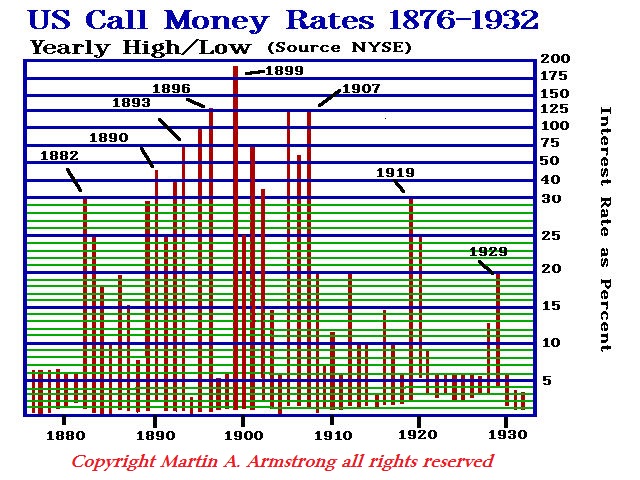
QUESTION: Hi Marty, How does the model’s call for deflation (earlier blog posts) fit in with the likely major cycle low in interest rates (per your recent posts)? Can there be general price deflation and yet interest rates increase significantly?

dow-1870-1940-int

ANSWER: Yes. Rates can soar to outrageous levels during the collapse of a system, which reflects a collapse in confidence that causes a simultaneous deflation in assets. Look at the highest levels of interest rates that reached nearly 200% in 1899. That was not a reflection of speculation in the markets. This was when J.P. Morgan had to arrange a gold loan to bail out the government.

Normally, interest rates are the price of inflation in a normal growth environment where confidence exists within the system as a whole. You can get hyperinflation if confidence in government collapses, but when you are on a gold standard, you end up with hoarding and the velocity of money collapses and causes the interest rate to soar like with a loan shark.

You can see we had the biggest asset rally into 1929, but this was the lowest spike in interest rates because the confidence was with the dollar as Europe, Asia, and South America defaulted. The key is where the confidence resides. That’s why I called it the Economic Confidence Model.

The ECB is Insolvent Based on Their Standards


Draghai Euro Crisis

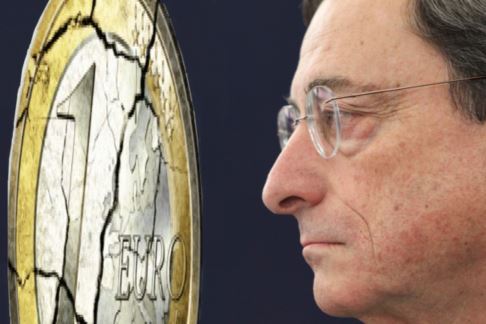
As we approach 2017, the euro appears far worse than anyone could imagine. The biggest hypocrite is actually Mario Draghi who is outrageously managing the European Central Bank (ECB). To make this as plain as possible, the ECB is the largest individual creditor of the euro countries, and is thus a bank that is undermined completely by the poor creditworthiness of the debtors. If the ECB were to apply its own rules to the banks in Europe that say bail-in, not bail-out, then by its own supervision rules, the ECB is insolvent and should be shut down.

Just look at the data. The ECB has been buying government bonds through its Quantitative Easing (QE) program and the failure of that expanded into other securities that now include corporate junk bonds. Looking at the balance sheet, the central bank currently has receivables amounting to €1,627 billion, of which €1,220 billion are directly attributable to government bonds.

Let’s begin to dive deeper. Of the 19 countries of the Eurozone, the total debt is €9.816 billion. Together, all the Eurozone banks hold €1,695 billion in government bonds. Additionally, there are €1,100 billion in outstanding bank loans. The ECB is already the largest individual holder of government debt as is the Bank of Japan. Neither have anything to show for their QE efforts but failure. Draghi is continuing to buy even more questionable debt to the tune of €80 billion a month, dropping down to €60 billion.

risk

The presumptions that government debt is RISK-FREE is built entirely upon this idea that they can tax. But taxes are at their highs and history warns we have a tax revolution on the horizon. Government debt cannot be looked upon as free of risk when there is no further room to raise taxes. Draghi has placed all his eggs in one basket. Governments NEVER pay off their debts, they only spend more and more. This is a major crisis that seems to be out of focus for the majority of the world and certainly the press who are bought and paid for.

The bottom line: this is not going to end nicely. Draghi has no way out and there is only one end result. As the Eurozone breaks apart, so will the assets of the ECB. Under their own rules, the ECB should now be declared INSOLVENT. The Federal Reserve is not in the same position as the ECB or Japan. Nevertheless, it too will be insolvent if it attempts to follow this path. The Fed only has Federal debt, not state debt which would be more like the ECB.

Could the Sharia Gold Standard Save Gold?


gold-bugs

QUESTION: Aloha Martin, Can you please comment about the new Sharia gold standard. It is being touted as allowing Muslims to more gold vehicles besides owning the usual physical coins and jewelry thus increasing the demand. I understand it as long as the paper is backed by physical is is allowed. I remember you commenting on this in the past but how does this tie in?

Thank you very much for what you are doing.

ANSWER: The gold promoters only surface to report on anything that could support their conclusion. The Sharia gold standard is by no means a game changer. We are in a global trend that is far bigger than anyone actually comprehends. We are talking about the collapse of government structures. Gold will be supported ONLY when the majority comes to see how dangerous the future is. The Sharia gold standard will by no means alter the trend. Gold is heading lower. Gold gave up its entire gains in 2016, and is trading below the closing of 2015. The trend is your friend — everything else is noise.

Scandinavia – Leader in the War on Cash


global_currency

The Scandinavian countries Sweden, Denmark and Norway are regarded as a pioneer in the the effort to eliminate money and move totally electronic. Denmark closed its final Mint outsourced the operation to Finland. This means that there is no coinage in the three states struck anymore. In this war on cash, about 20% of all transactions were settled in Denmark last year with cash. In Germany and Austria, cash transactions accounted for 80%. Scandinavia is pushing hard to eliminate all cash completely to enable 100% efficient tax collecting.

The demand for paper dollars is rising in Europe significantly. The average person will continue to increase their hoarding of US dollars, especially in the aftermath of India. Especially with Trump in office, there will be no cancellation of cash overnight. Even getting rid of $100 bills will be extremely problematic since the 1990s, about 50% of all paper dollars are held outside the United States, which was the Federal Reserve’s estimate back in the 1990s.

holding-us-dollars-by-country

The demand for U.S. currency internationally has actually replaced gold. US currency is being held for the same reasons since it is a recognized as a unit of account globally, THE international medium of exchange, and especially in light of events in India and Turkey, the dollar has become the store of value. No doubt the goldbugs will yell about that statement. But it is true. Far more people are using dollars than gold internationally, particularly since you cannot hop on a plane with gold. Japan, Norway, and Sweden are the top three holders of US currency in small denominations. Switzerland is the largest holder of $100 billion followed by Netherlands and Belgium. Germany is rising EXTREMELY fast and may now rise to the second largest holder on that list.

money-plane-new-york-magazine-january-22nd-1996

It was Edmond Safra and Republic National Bank that was sending plane-loads of $100 bills to Russia. I personally saw these skids of cash in the bank. To get this much cash back then, meant that the U.S. Treasury had to have approved and sent these skids of cash to the bank (money-plane-crec-1996-02-13-pt1-pge196-2).

Australia Looking Into Cancelling the $100 Bill


a100

The Australian federal government is planning a full assault on the black or underground economy by appointing a taskforce who will consider the future of the $100 note and bans on cash payments over a certain level. Australia, like everyone else, is facing a monetary crisis whereby the current system of taxes and social programs with pensions are colliding and will simply collapse. This idea of perpetual borrowing cannot be sustained. Instead of reforming the system, they prefer to attack the people, as always — we are just the enemy.

The Australian black economy of unrecorded economic activity that is untaxed by government is estimated to be worth $21bn or 1.5% of gross domestic product. Even if they got all the taxes that they think they deserve, it would still not solve any problems. We are simply doomed and the longer governments postpone real reform, the worse the collapse will be.

Former KPMG Global Chairman Michael Andrew will head the new underground economy taskforce, which I suspect is one reason to think twice about KPMG. It will also include the Australian Tax Office, Reserve Bank of Australia, the Australian Securities and Investment Commission, the Australian Transaction Reports and Analysis Center, and immigration and human services departments. They plan on considering the continued use of the $100 note of which there are $30bn in circulation. They are also looking to France, a fantastic role model, where the government banned cash payments of over €1,000.

The taskforce is looking at putting a limit on cash transactions, and they are no doubt keeping one eye on how India’s cancellation of currency with no notice works out. Indian Prime Minister Narendra Modi told the nation that the cancellation of the currency would protect the interests of “those citizens earning honestly and with hard work.” Modi’s actions are sending probably more than 400,000 people into unemployment while shops have closed as they are unable to collect money or pay workers.

Steve Mnuchin & Gary Cohn


mnuchin-steve

QUESTION: What do you think about Steve Mnuchin as Secretary of Treasury? He does have a beautiful Scottish fiancee.

Bill

ANSWER: Not a fan. Yes, Steven Terner Mnuchin used to work for Goldman Sachs but he left them in 2002. That is really not an issue. It is good that he has real, live experience as an investment banker and hedge fund investor. After he left Goldman, he worked for and founded a number of hedge funds but with George Soros involvement, which would leave a question mark in my mind. During the financial crisis, Mnuchin bought failed house lender IndyMac and rebuilt it into OneWest Bank, which he then sold in 2015 to CIT Group.

OneWest Bank gained a reputation for having 17% of the federally insured reverse mortgage market, and almost 40% of all federally insured reverse mortgage foreclosures during that time. I would have to say that as the CEO, there is no possible way he did not know what was going on. One of the most egregious examples of OneWest Bank’s insane foreclosures was the story of Ossie Lofton, a 90-year-old Lakeland, Florida, homeowner on a reverse mortgage who OneWest foreclosed on over a 27-cent payment error with her insurance.

linton-louise

Obviously, the computer program foreclosed anyone who was late on a payment, but it did not even have a basic amount test. Normally, a mortgage foreclosure results in a loss for the bank. Here we are talking about a reverse mortgage. That is where they get to buy the home on the cheap.

As for his Scottish fiancée, Louise Lintonwell she is stunning. But then again, I may be prejudice having some Scottish blood running in my veins.

I also strongly disagree with Goldman Sachs President Gary Cohn for the top White House economic post — National Economics Council. This guy was deeply involved in sending Greece down the river. I think this is a huge conflict of interest.

Housing Starts, Permits Crash In November (Despite Soaring Homebuilder Confidence)


Tyler Durden's picture

Just yesterday homebuilders raged hard about how awesome everything was – sending their optimism index to its highest since the previous peak in 2005. It seems they are all talk and no action as November’s data for housing starts and permits collapsed (following the trajectory of mortgage apps).

Housing Starts crashed 18.7% MoM – near the biggest monthly plunge since the crisis peak in 2005.


Housing Starts are down 6.9% YoY.


Driven by a 43.9% collapse in Multi-family Starts MoM: look at the volatility in that time series: is that what a “stable” housing market looks like?


Housing Permits plunged 4.7% MoM – the most since March – as it seems optimism talk from homesbuilders is not reflected in their actions.


Once again it was multi-famly permits that collapsed the most MoM.


As usual, actions speak louder than words