Does the Fed Fear a Dollar Rally & Bond Crash?


Curiousity-Question
QUESTION: Numerous people have asked:

Does the FED actually also see these trends coming (strong US dollar, bond crash) ?
K.

ANSWER: Yes. The Fed has sent people to the major banking houses and told them outright that their models are wrong. They have been telling them quietly that there may not be a rush to quality being bonds. Moreover, the selling of US Treasuries by some central banks has been an effort to try to prevent the dollar from rising. China’s holding of US Treasuries has declined to its lowest level in several years, but it is having little effect causing markets to simply coil.

Failure is Part of Success


failure-is-part-of-success

QUESTION: Marty; You said at the Berlin Conference that failure is not the opposite of success. It is part of success. I found this intriguing. Is this part of the training sessions for this year’s WEC?

ANSWER: Yes. The way we learn is by making mistakes. If you claim to have never been wrong, then you have never learned anything. Mistakes are part of life as they are in trading. The trick is to survive your mistakes to make it to the next round. There is no such thing as failure — only learning lessons. This is why I also say we must crash and burn. It is impossible to argue to governments that they will fail as long as they have the power to try to defend themselves. Only a crash and burn provides an opportunity for change to emerge. This applies in politics as well as trading.

The Coming Cashless Society & Automatic Driving Car Age


credit-cards

COMMENT:

Martin –

I wanted to let you know that I stopped at a Jimmy John’s today and they wouldn’t allow me to use cash.
They had no drawer or physical money on the premises. It was either chip card or no sandwich. They claimed it was their first store in the nation to go cashless.
So, bravo for highlighting this trend. I have a feeling that the next generation of American tax payers might not even know what Federal Reserve notes or nickel and copper coins are even for.

JB

REPLY: I kept a 2011 BMW 535i as long as I could because it was a manual drive. I went to a place for dinner where they had a valet to park cars, but the valet did not know how to drive manual. That happened a couple of time. I then pulled into a car wash. Again, they had to call the cashier who was a woman, perhaps in her 50s, to drive the car. The youth already do not know how to drive a stick shift. Very dramatic.

We now have cars that are starting to drive themselves. Can you image a two-year-old today growing up and asking, “Wow. You used to drive a car? How was that?”

We are advancing. There will be no physical money any more than there will be manual cars or cars you drive. Things are changing. The greatest risk to small business is people stealing from them. Eliminate cash and you do not have to worry about employees taking the cash.

The Shift in the Financial Capitol of the World


WorldEconomy

QUESTION: Hi Martin
I am a follower of your blog.
I have a question on your post “Financial Capital of the World & Its Migration” dated 30th sep 2016.
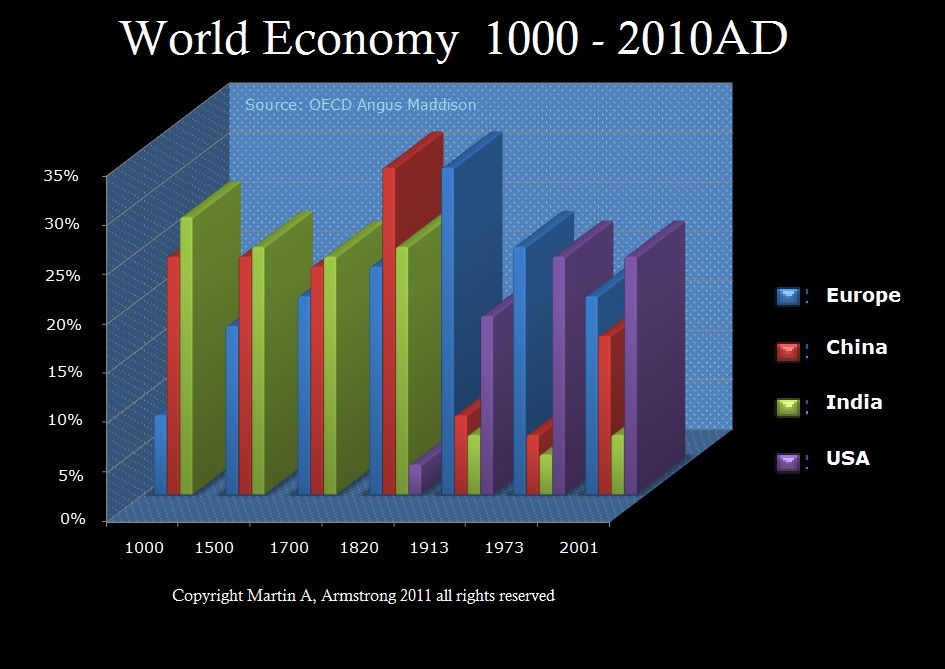
I was looking at the graph where Y-axis indicates the scale of Economic Progress (in terms of % of world GDP) against time on X-axis.
The decline of China and India have been like a jump off the cliff. Why is it that it is not so in case of Europe?
I am guessing some component of your model is able to hold it up .Could you pls explain.
Again many thanks for your education.
AB

1715-fleetcobset

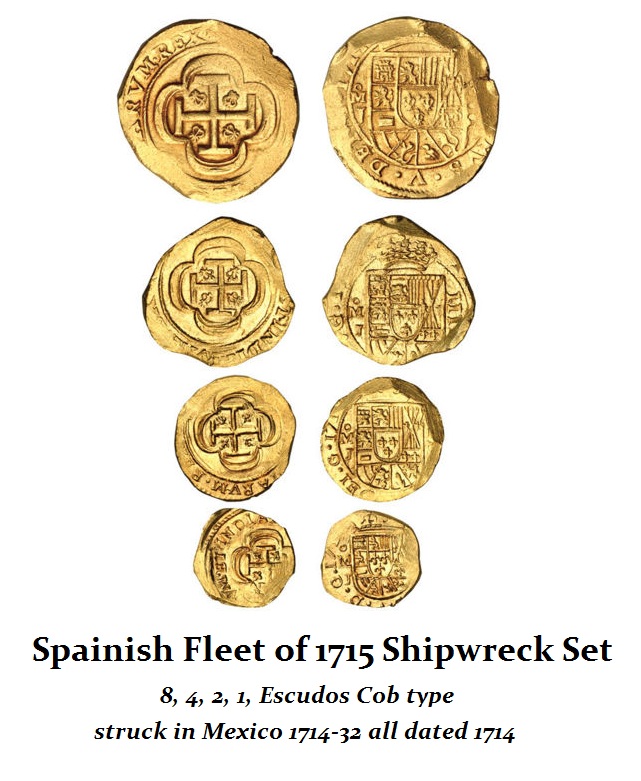
ANSWER: The reason for this is that we have treated Europe as a whole. The devil is always in the detail. The beginnings of the Portuguese Empire can be traced to July 25, 1415, when the Portuguese Armada set sail for the rich Islamic trading center of Ceuta in North Africa. The economy of Portugal was centered in trade, raw materials, and related activities within its vast colonial possessions, mainly in Asia (spices, silk, dyes, porcelain and gems), Africa (ivory, timber, oil and diamonds), and South America (sugar cane, dyes, woods and gold). The country, with a transcontinental empire with plenty of natural resources and vast unexploited areas, was among the most powerful nations in the world. Spain really became a country only in 1492 with the merger of two crowns by the marriage of Ferdinand and Isabella.

From 1580 to 1640, the crown of Spain was also the ruler of the Portuguese Empire and its wealth. This was accomplished through a dynastic union referred to as the Iberian Union. The Iberian Union opened to both countries a worldwide span of control. Portugal dominated the African and Asian coasts surrounding the Indian Ocean, while Spain held the Pacific Ocean and both sides of Central and South America. Therefore, Spain then displaced Portugal as the financial capitol of the world.

Wisselbank

The Spanish Inquisition led to the flight of the Jews to the Netherlands. They took with them the accounting and trading skills. This is why Amsterdam became the financial capitol of the world, equipped with the first bank as well as insurance. This is where the modern financial markets actually began to take shape.

wm-iii-recoinage-1696

The English Civil War and the hatred of the Pope and Catholics led them to invite William of Orange to become King of England. He brought the Dutch way of doing finance to Britain in 1688, and that began the process of shifting the capitol to London. That lasted until 1914, when it passed to the United States following World War I.

Why Corporations Die


business-failure

QUESTION: Hello Martin and thank you for all your fascinating and informative emails.
I’m probably naive and unrealistic (if everything goes in cycles maybe it’s just the way of the World) but I just read your email about Sears and felt pretty sad to see something that survived well for a long time and provided so many with jobs and goods for so long seem doomed.
Do you ever feel like that and can’t you help such companies? Would they even listen? Should you help them or is this just something we all have to accept is a natural demise?
Love to your mum too and a belated happy birthday to her. She is a star. It’s lovely to see you’re close and she looks so good. You must be taking good care of each other,

CP

rca-victorANSWER: I have been called into many board meetings over the years. I have watched this process first hand. Typically, companies must simply die just like any biological entity. I began my computer engineering training at RCA (Radio Corporation of America).

In 1901, the Victor Talking Machine Company was formed. In 1919, RCA was incorporated to control US patents of General Electric, AT&T, Westinghouse, United Fruit. The same year, David Sarnoff became the General Manager of RCA. In 1926, NBC established by RCA (50%), GE (30%), and Westinghouse (20%).

Meanwhile, the Victor Talking Machine Company of Japan, was founded in 1927, as a wholly owned subsidiary of the Victor Talking Machine Company of the the USA. Its purpose was to manufacture and market phonographs in Japan. The Japanese Victor Company (JVC) sold minority shareholdings to the Mitsubishi and Sumitomo financial groups. JVC was thereafter operated as a U.S.-Japanese joint venture. However, Victor was purchased in 1929 by the Radio Corporation of America and renamed RCA Victor. RCA bought Victor Talking Machine for US$154m going into the top of the bull market in 1929. As the Great Depression began, the government began anti-trust investigations of RCA during 1930, which was followed by General Electric and Westinghouse selling their stakes in RCA in 1932. Then in 1941, the Federal Communications Commission Report on Chain Broadcasting recommended that RCA dispose of one of its networks.

From 1965 onward, RCA sought to become a major conglomerate. In 1965, RCA bought Random House, and then two years later in 1967, RCA bought Hertz Rent-a-Car. Then in 1969, RCA bought Cushman & Wakefield followed by FM Stamper, renamed Banquet Foods, in 1970. Then in 1973, it purchased Ballantine Books, once again going into the peak of the market in 1974.

With the Crash of 1974 and the sharp economic decline into 1976, RCA sold in 1976 Cushman & Wakefield to Rockefeller Group. Its fortunes had peaked with the bottom in book value of the Dow Jones Industrials, which took place in 1977, which is precisely a 51.6-year cycle wave from its birth in 1926. In 1980, RCA then sold Random House to Advance and Banquet Foods to ConAgra and turned around and bought CIT financial group. Then in 1984, RCA sold CIT to Manufacturers Hanover Bank for US$1.5bn. Then in 1986 RCA-Victor (RCA’s music arm) was sold to Bertelsmann and the following year Thomson bought RCA’s consumer electronics operations. General Electric acquired RCA in 1986 since it owned NBC and it sold off all its remaining operations. Its total life from inception was 67 years. From its peak in 1977, the fall was just 8.6 years.

The life cycle of corporations are very much like a biological lifeform, as is the case with governments. The inventor has the creativity. That breathes life into the entity. When that person dies or is forced out, like Steve Jobs, the company tries to be “institutional” and proper. The board is then run by the lawyers and bean counters. They lack creativity. They will then move into the acquisition phase and buy startups and other companies to expand their business. They lack the genius of creativity. They will typically buy the high and sell the low like everyone else because they act based upon the immediate trend. This leads to over-expansion and then comes the decline and fall.

Can such companies be saved? Only if the board listens. They typically will not since they lack creativity and any comprehension of the business cycle. They can rarely make the leap forward for they are always chained to the past and what they think is the proper way to run a company, which is always wrong.

Gold to be or Not to Be


gold-bugs

QUESTION: Marty; I won a bet against a goldbug. He bet gold would soar and the dollar would crash October 1st because of the SDR and said you would be exposed as a fraud. I won the $100 bet. I tried to bet an ounce of gold, but he would do that.

I too studied Latin. Remember Julius Caesar your favorite: Fere libenter homines, id quod volunt, credunt – People almost always willingly believe what you want (De Bello Gallico, III, 18). That is their whole problem. They want something so bad they are blind to everything around them. You can lead a horse to water, but you cannot make him drink.

With gold down at 1275, when is your next video update?

CB

ANSWER: Yes I admired Caesar. But he forgave his enemies and they killed him for his generosity.

You cannot enlighten certain people because they have too much invested in their beliefs. There are people who will vote for Hillary no matter what as there are people who will vote Republican no matter what. There is always those who just believe and never question.

I will update a video soon. The timing is not right for gold to break out. It failed to elect the Monthly Bullish and then failed to elect the Quarterly Bullish Reversal despite the fact it was much lower. Gold rallied right to that reversal and bounced off. That was the kiss of death.

People are still uncertain about the future. They have no idea which way to go with this year from Political Hell. Will do a Private Blog Update for tomorrow.

Gold – Dollar – Bonds


businessman_juggle_dollar_symbols_150_clr_18746

QUESTION: Hi,
I have two questions:
a) do you believe US dollar has been kept artificially lower than it should be (or at least in long range trading range) by at least two central banks lately? if so how long you think it would last, years?
b) you remind many times gold does not yield so investors should avoid it at any cost – as the most investors have done. benefits of stocks are clear but why many investors still buy / have bought bonds even with negative interests or buy fiat currencies with very low interest levels.
BR, J

ANSWER: Yes. The central banks have been trying to keep the dollar down because a rising dollar will undermine Europe exposing the ECB total failure, and then there is the risk of major sovereign defaults among emerging markets who issued their debt in dollars. The IMF has lobbied hard with the Fed pleading not to raise rates for this fear of capital pouring into the dollar. They do not appear to be able to sustain this policy beyond January.

Gold is not something to avoid. True, institutions cannot buy gold for they earn no income. Gold is really for the individual and it will eventually be the hedge against government and the change in the monetary system which could come as early as 2018 but by 2020 if on schedule.

Gold-Fluctuated

Institutions buy bond because they simply go by the book. Then pension funds often have restraints requiring various portions MUST be in government debt to varying degrees. Social Security is only in US debt. Fiat money is currency that a government has declared to be legal tender, but it is not backed by a physical commodity according to most people. The value of fiat money is supposed to be derived from the relationship between supply and demand rather than the value of the material that the money is made of. But throughout history, ALL money has always been fiat. Bretton Woods collapsed because they continued to print money and the claimed backing was not there. So even the pretend gold standard was fiat. When money was gold coins during the 19th century, it was legal tender, not backed but anything else, and yet it still rose and fell in purchasing power. There is no such period in monetary history of such a Utopia or money remaining steady and a constant purchasing power. It has never existed.

OPEC & Manipulating Oil Prices


oil-middle-east

Electric CarsThe Organization of Petroleum Exporting Countries’ (OPEC) agreement to cut production is supposed to end Saudi Arabia’s policy of the last to years to pump-at-will. This has sent Middle Eastern economies into a tail-spin and the glut of oil has meant rising taxes and selling bonds to raise capital. With this new claimed reversal of that pump-at-will policy, there are of course the optimists who say oil should now soar, yet they overlook some very critical points. OPEC deals have routinely failed, and there is a real glut of oil in inventories, not to mention the reduction in oil demand rising from electric cars.

The EU first introduced mandatory 2015 CO2 standards for new passenger cars way back in 2009. Mandatory targets for light-commercial vehicles come into play in 2017, which was passed back in 2011. Then by the end of 2013, the EU reached an agreement that will implement mandatory 2020 CO2 emission targets for new passenger cars and light-commercial vehicles. Europe is applying these standards for 95% of vehicles in 2020 with 100% compliance in 2021 and the light-commercial vehicle standards are are required for 2020. Electric cars are becoming commonplace in Europe. Charging stations are seen just about everywhere including in London. This is not the case in the United States. Clearly, demand will decline for oil moving forward.

The optimists also overlook the reality of the oil production countries. OPEC cannot control the 60% of world production outside its membership. The United States is the largest oil producer. In the top five oil producing countries, only Saudi Arabia makes that list as number two. Of the top 10 producing countries, only four are OPEC members. The bottom line; OPEC can not manipulate oil prices any more.
2014 Country Production (bbl/day)

1 United States 11,973,000
2 Saudi Arabia (OPEC) 11,624,000
3 Russia 10,853,000
4 China, People’s Republic of 4,572,000
5 Canada 4,383,000
6 United Arab Emirates (OPEC) 3,471,000
7 Iran (OPEC) 3,375,000
8 Iraq (OPEC) 3,371,000
9 Brazil 2,950,000
10 Mexico 2,812,000
11 Kuwait (OPEC) 2,767,000
12 Venezuela (OPEC) 2,689,000
13 Nigeria (OPEC) 2,427,000
14 Qatar (OPEC) 2,055,000
15 Norway 1,904,000
16 Angola (OPEC) 1,756,000
17 Algeria (OPEC) 1,721,000
18 Kazakhstan 1,719,000
19 Colombia 1,016,000
20 India 978,000
21 Oman 951,000
22 Indonesia (OPEC) 911,000
23 United Kingdom 906,000
24 Azerbaijan 856,000
25 Argentina 715,000
26 Malaysia 697,000
27 Egypt 667,000
29 Libya (OPEC) 516,000
30 Australia 478,000
31 Thailand 422,000
32 Vietnam 316,000
33 Turkmenistan 276,000
34 Equatorial Guinea 269,000
35 Sudan and South Sudan 262,000
36 Congo, Republic of the 259,000
37 Gabon 240,000
38 Peru 180,000
39 Denmark 171,000
40 Italy 169,000
41 Germany 160,000
41 South Africa, Republic of 160,000
43 Japan 137,000
44 Yemen 127,000
45 Brunei 124,000
46 Trinidad and Tobago 116,000
47 Ghana 106,000
48 Romania 104,000
49 Chad 103,000
50 Pakistan 98,000
51 Uzbekistan 85,000
52 Cameroon 81,000
53 South Korea 79,000
54 Timor-Leste 76,000
55 Bolivia 67,000
56 Ukraine 66,000
57 Bahrain 64,000
57 Netherlands 64,000
59 France 61,000
59 Turkey 61,000
61 Tunisia 59,000
62 New Zealand 50,000
63 Cuba 49,000
64 Spain 40,000
65 Poland 39,000
66 Ivory Coast 37,000
67 Papua New Guinea 34,000
68 Syria 33,000
69 Belarus 32,000
70 Austria 27,000
71 Philippines 26,000
72 Hungary 25,000
73 Taiwan 22,000
74 Albania 21,000
74 Myanmar 21,000
78 Congo, Democratic Republic of the 20,000
78 Niger 20,000
78 Singapore 20,000
81 Croatia 18,000
82 Chile 15,000
82 Virgin Islands, U.S. 15,000
84 Guatemala 14,000
84 Suriname 14,000
86 Belgium 13,000
86 Estonia 13,000
88 Sweden 12,000
89 Czech Republic 11,000
90 Finland 10,000
91 Lithuania 9,100
91 Slovakia 9,100
93 Greece 8,700
94 Portugal 7,100
95 Mauritania 6,000
96 Palestine 5,800
97 Morocco 5,100
98 Bangladesh 4,800
99 Switzerland 3,900
100 Bulgaria 3,400
101 Aruba 2,800
102 Jamaica 2,100
103 Paraguay 2,000
104 Belize 1,800
105 Netherlands Antilles 1,500
106 Uruguay 1,200
107 Barbados 1,000
107 Georgia 1,000
107 Latvia 1,000
110 Ireland, Republic of 900
111 Puerto Rico 700
112 Costa Rica 300
112 Slovenia 300
114 Jordan 200
114 Malawi 200
114 Tajikistan 200
114 Zambia 200
118 Ethiopia 100
118 Hong Kong 100
118 Zimbabwe 100

Understanding Deutsche Bank’s Possible Bail-in


Deutsche_Bank_Frankfurt

Chancellor Merkel cannot afford to bailout Deutsche Bank from the point of view of foreign policy perspective within the EU since she has taken such and intolerable hard line in the Italian bank rescue not to mention Greece. On the other hand, Deutsche Bank is different since it is the primary clearing bank in Europe. Any bail-in is more likely to take place by wiping out its bonds called CoCos which have no maturity date. Indeed, investors may never get their money back. Under the terms, the bank can redeem them, usually after five years if it wants to. The annual coupon payments are contingent on the bank’s ability to keep its capital above certain critical threshold levels. If the bank’s capital falls below that threshold, the bank won’t make the coupon payment. Investors cannot call a default on these bonds, and that sets them up for a bail-in. Investors are simply sitting on bonds that they bought because they had a 6% coupon. However, there is not maturity and no guarantee of redemption and if capital falls below the threshold they plunged in value and pay no coupon. Consequently, if regulators deem that the bank is failing, then these CoCos will be bailed-in by either being converted into declining values in shares or could be just canceled.

These 6% CoCo notes have traded as high as 104 cents on the euro in early 2014 shortly after they’d been issued, and plunged to about 70 cents and are trading in the 77 level in this latest crisis. Therefore, the CoCos are a good indication of public confidence for if investors believe those thresholds are approaching, the bank will not pay the coupon and the risk of being converted to shares rises. Of course, converting to shares at any value could be a blessing in disguise since shares can be sold.

de-y

When we look at Deutsche Bank, we elected a Yearly Bearish Reversal at the close of 2015. Support lies at 8.55 and this is really important. We have reach 11.19 so far and resistance overhead will stand at 15.50. The primary target for a major turning point still appears to be 2017 whereas 2016 could produce the lowest yearly closing.

de-for-y-10-2-2016

Whatever we get in 2017, should be followed by the opposite direction into 2019. This means a rally into 2017 without making a new low under 2016 levels, would most likely result in a Knee Jerk reaction high (one time unit). This becomes possible only if we exceed the 15.50 level. Even that is minor for the Monthly Bullish Reversal really cap this stock standing at 17.90 warning it is not over just yet.

defor-m-10-2-2016

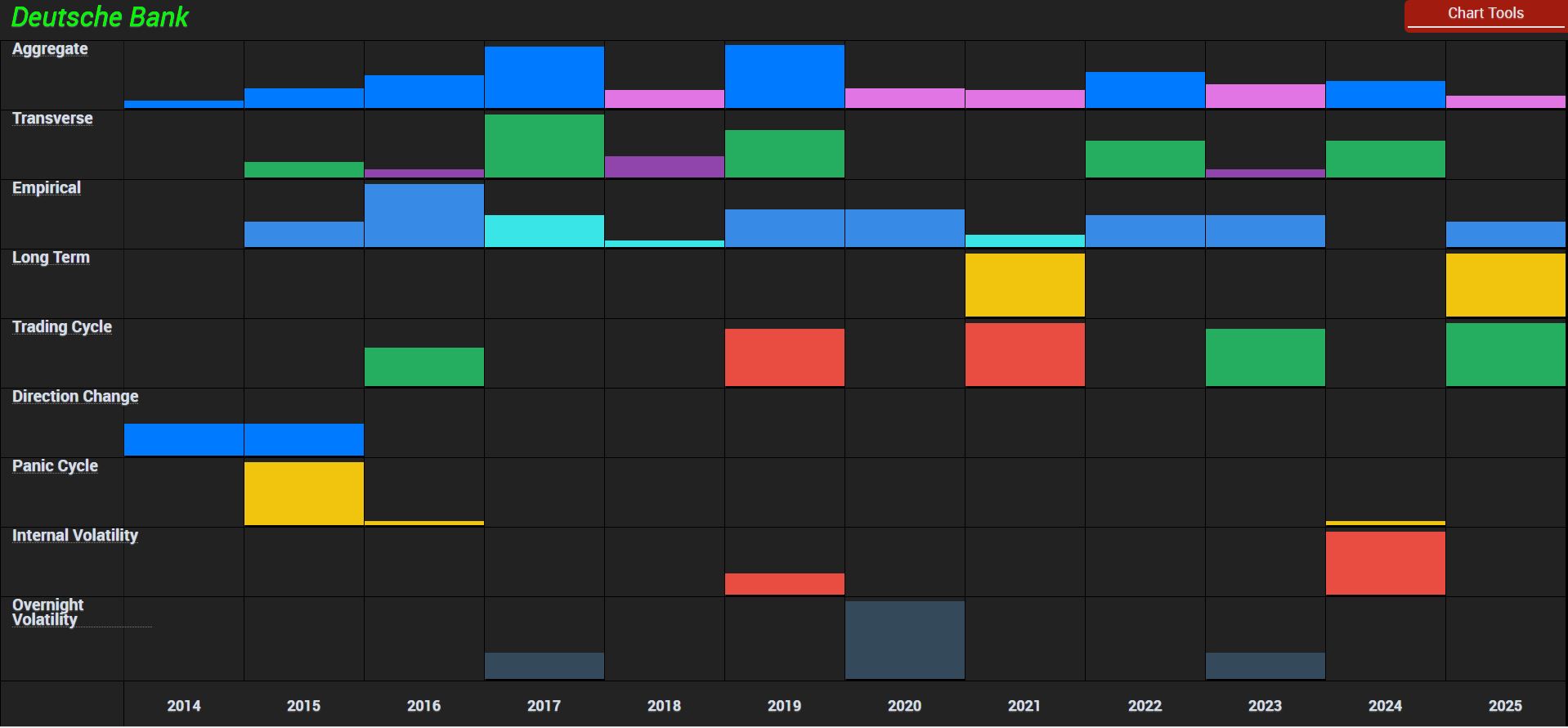
The timing Array in Deutsche Bank has been targeting September all along. There are back to bank Directional Changes for September October and the next main target for a turning point is November. The Panic Cycle play out well for September as well. This all warns that is last week’s low holds, a bounce into November becomes possible.

Romans Landed in America and Sent Ambassadors to China


urma-okinawa-runins

roman-coin-discovered-in-japanHistory is being rewritten all the time for the timeline of the past is far from definitive. Ancient Roman Coins issued under Constantine I the Great have been excavated from the ruins of a castle in Uruma, located in Okinawa Prefecture., This is the first such discovery made in Japan of Roman coins. Four copper coins were discovered in the ruins of Katsuren Castle. This location was actually only in existence from the 12th to 15th centuries where the coins were from the 4th century.

We do know that Okinawa traded both with China and Southeast Asia. These coins are curious since this is from the dark period of Japan when the only coins used were all foreign. Yet the history of Rome that claimed to rule the world (orbis terrarum) stood at the opposite end of the world from the strikingly similar Han Dynasty (206BC-220AD) in China, which also claimed to have ruled the world (tianxia). There is the History Book for Tang-Dynasty in China covering the period 618-907AD. Yet the text mentions 17 times what appears to be the Roman Empire. It also describes an envoy that was sent by the Roman Emperor to China. The Roman Emperor was recorded to have been “Anton“. The account of such an envoy who visited the older Han Dynasty predates the Venetian traveler Marco Polo (1254-1325) by more than 1,000 years. This envoy has been attributed to 166AD during the reign of Marcus Aurelius Antoninus (121-180AD). It is the death of Marcus Aurelius, that has marked the peak in the Roman Empire and the turning point that begins the Decline and Fall of the Roman Empire where its monetary system collapses just 72 years thereafter. This envoy established diplomatic contact at the peak in the Roman Empire from which a disastrous decline begins. Any political-economic aspirations to further such a relationship would then die with Marcus Aurelius. Yet also, both empires would suffer the same fate of barbarian invasions. The Han Dynasty falls in 220AD from which emerges the chaotic period known as the Three Kingdoms (220-280AD) – the division of the once unified Chinese Empire.

roman-swordRoman artifacts have been discovered also in Canada. This clearly establishes that the ancient Roman sailed across the Atlantic long before Columbus or the Vikings. This discovery in Canada has created a storm for it rewrites history. The unquestionable discovery of a Roman sword in Canada is rather stark evidence that history is different from what academics believed.


These discoveries are significant for they confirm world travel and trade. This is up there with the discovery of the Cocaine Mummies from Egypt confirming trade between Africa and South America.