The Fed Feedback Loop


And now it can only end very very badly!

The Infamous Labor Day Event in Markets


Labor-Day 1929

Of course, the 1929 high took place on September 3rd, the day everyone came back on Tuesday following the summer holidays. It has been a long-standing joke that after spending time with the family, they come back and just sell everything without reason.

Labor-Day 1987

The 1987 high was on August 25th just before Labor Day. In both instances, the panic low was October.

DJFOR-W 7-16-2016

The array picked the high for the week of August 15th and we have Directional Changes that were appearing the weeks of September 12th and 19th.

DJFOR-W 9-1-2016

As we move forward in time, the movement of recent trading being to alter some aspects of the array, but the primary targets tend to remain the same. They will differ mostly in intensity. The week of 09/05 was a turning point in the first array being the end of a trend with the lowest bar on the top plot calculated in July. A month later, we see the project for the week of 09/05 start to rise to the strangest target in September.

I have explained before that the plotting in this array is proportional to the hits within this slice of time. Therefore, back in July looking 12 weeks forward, the week of 08/15 was the biggest target. Then as we get closes and the weeks thereafter come into play, the size of the bars will change even if the same number of hits are present should there be another bar coming into this window with more hits.

This is suggesting that we should pay attention this week.

Conquistador Trump


A Good analysis and yes we need to rethink our priorities and also consider or poor financial state which does not allow us to be all over the world. We need to set the EU free as they have decided to go Islamic. The eastern countries in the EU and Russia would make much better friend than France, Sweden, Denmark, Germany and Italy now that they are free of Marx.

John Maynard Keynes’ “General Theory” Eighty Years Later


After Keynes’ work was published the politicians knew they has a winner for Keynes add the Government to the calculations to determine GDP. That and tell them politicians that savings was bad as you needed to spend every penny if you wanted full employment. Well that was it a license to spend and spend and a theory that claimed it was OK. So what if now we know better, well some of us do, it doesn’t mater the politicians knows that no one is smart enough to realize its a Ponzi scheme and we are at the end where the chickens come home to roost!

No Matter What Century, It’s Always Politics


July-August

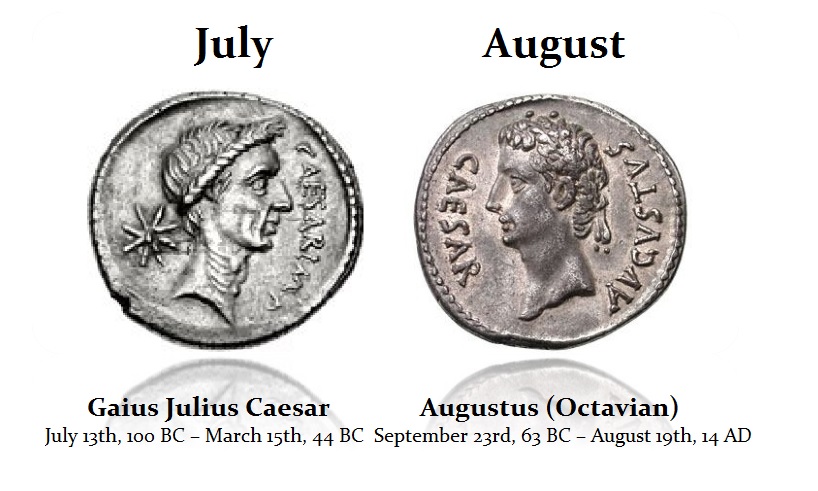
If you look at the calendar, the months that have 31 days are January, March, May, July, August, October, and December. The only two months with 31 days back-to-back are July and August. Why? July was named for Julius Caesar. Augustus, meaning “father of the nation,” died on August 19, 14 AD, and was probably poisoned by his wife. So they named August after him before his death. But of course, August had 30 days and that would be slighting Augustus relative to Julius who had 31 days. So the solution was obvious. They took the extra day from February which was only named for a feast day known as the Februarius or Februa, the feast of purification, and renamed the month with 31 days equal to July.

January was named for the god Janus and March was named for Mars. You certainly didn’t want to make them angry. May was named Maius taken from the Greek Maia, or the goddess of spring. June could not be touched since that was named after the goddess Juno, the queen of the gods. July’s original name was quintilis or the fifth month in the early Roman calendar, so renaming that for Julius Caesar did not offend anyone. August was originally named sextilis or the sixth month in the early Roman calendar. September was the seventh month in the early Roman calendar and October was the eighth. November was named the ninth month and December (decimal) the tenth month.

Therefore, February was an easy month to take days from since it was named after a feast and nobody had to offend the gods

It’s Time to Turn Out the Lights in Illinois


Illinois Road Tax

The roads in Illinois are in decay. This may be the first state to go bankrupt. The question is not if, but when. State unions are so greedy that they are destroying the very state. This is exactly how Rome fell — government employees against the people.

Seven states have constitutional provisions that state employee pensions must come BEFORE everything, including debt payments. Since the legislature in New Jersey was Democrat, they fought Governor Christie on pension reform. Their solution? On the ballot in November, there will be a provision to amend the state Constitution to put employee pensions before everything else. The people are generally kept ignorant of what that means to property taxes and the future of the state. Therefore, the average person will say, “Sure, I should get my pension, so they should also.”

Turn out Lights

Illinois should declare bankruptcy. It is simply inevitable. There is absolutely no hope for Illinois whatsoever. Every year they will have to pay more and more. If the state who manages the pension money loses, well, the taxpayers have to cover those losses as well. The governor tried to stop the downgrade of expectations for earnings in the pension fund from 7.5% to 7%, which means they have to raise taxes and/or cut service by almost a half-billion.

It’s time to just turnout the lights in Illinois. Welcome to the Sovereign Debt Crisis. This is the contagion you will finally start to hear about, but only after the elections. Why spoil the party?

Heads They Win, Tails You Lose


Coin-toss-r

Money Market

QUESTION: Sir,

You mentioned in your blog post that money market funds now have to be in government bonds as per SEC ruling. You have said we are going through a sovereign debt crisis which means government bonds are at risk. If I’m trading and my money is now parked as “cash” before I make another trade in a money market fund, does this mean outside of a trade, my money is now at risk when government bonds crash?

Thanks for all you are doing

DK

ANSWER: Yes. There are two types of funds. One is marked-to-market, so there will be no guarantee you get back 100%. The other will be fully invested in government bonds. There, you will be told you lost nothing, but in reality, you may not be able to sell. When the crisis comes, the only buyer will be the central banks and if they stop buying, look out below.

Personally, if I were in the business I would create a corporate bond fund only that prohibits all government paper. That may not be “politically correct” but neither are politicians.

Hoardng Cash – Prelude to the Crash & Burn


Swiss 1000-CHF

We are monitoring confidence in the banking system as reflected by cash withdrawals. The sale of home safes has exploded in many countries. I previously reported that one in ten currency notes in Switzerland being printed is now the 1000 franc note. In fact, there is some 41.6 billion in Swiss francs now in circulation in 1000 CHF notes exclusively. The ECB is truly brain-dead for they thought by moving with negative interest rates, people would spend their money and that would rekindle inflation. They are correct that people would not want to pay negative interest rates. However, they totally never guessed that they would withdraw their money and hoard it rather than spend it. The trend toward hoarding cash really became in 2011. It started to make the news in 2012. Now the German savers are buying home safes as well and pulling out cash. Of course, they attribute this primarily to negative rates. However, the concerns that Deutsche Bank may be in serious trouble is also helping matters.

Crash-BurnWe are witnessing this trend around the world throughout Asia as well. Japan has been printing 10,000 yen notes like crazy. The Japanese are also withdrawing cash and keeping it at home. Even Americans began hoarding cash also back in 2011, which began to make news by 2014. In fact, 43% of Americans keep their savings in cash these days for interest pays nothing. Yet, an amazing 53% of those cash-hoarders “plan to hide bills in a secret location at home.”

Everything is going as our model has projected. The peak in trusting banks and government is in place. From here on out, all we have is the collapse in public confidence and the 2016 elections bring that home.

All we are waiting for now is simply the Crash & Burn. This will be a serious topic for this year’s WEC in Orlando.

US Debt: Who is Really Selling & Who is Buying?


USBonds

QUESTION: Marty; Since you wrote that central banks have been net sellers of US Treasuries for the first six months to support their currencies, others are jumping on board and are claiming nobody wants them so buy gold. Would you care to elaborate on this subject? It seems another desperate attempt by the hyperinflationists.

Thank you

PG

ANSWER:The central banks, AT THE REQUEST OF THE USA, are trying to support their own currencies and engaging in the very same action as they did following the Plaza Accord in 1985. The US position is that it needs a weaker dollar to prevent a recession. This will not prevent what is coming. Furthermore, what has been taking place is the 10-year is the new 30-year. Demand for 30-year paper has collapsed because nobody knows what will happen two years out, no less 30 years. The main buyers have been pension funds in the States who are desperate for higher yields.

As far as this being the sign to buy gold or a signal that hyperinflation is around the corner — of course it is not, lol. The people who make these claims are like horses with blinders. They only see the United States and everything they talk about is only in the USA. They cannot get it through their heads that things are far worse outside the USA. Even China has sold Treasuries to support their currency. Everyone has agreed to ban together to try to prevent the dollar rally and keep the capital where it is in a desperate attempt to stimulate their economies in hopes they reverse. They will fail.

A rise in the dollar is the key to the Sovereign Debt Crisis. Now, even the Bank of International Settlements is starting to warn that there are so many loans in dollars outside of the USA, which were originally to save on interest way back when, that a rise in the value of the dollar will cause a cascade failure in sovereign debt, especially among emerging markets. There may be the skeptics out there who think we are just making a lot of noise, but those in high places pay attention to our models no matter what the critics think. A strong dollar is the lynchpin that unravels everything. This is not about gold or hyperinflation. Clearly, those people lack any comprehension of what is unfolding on a global scale.

Central bankers are trying to keep the dollar from rising. This is what has been going on. They are fighting tooth and nail against the trend, but our computer says they will lose. The ECB’s insane policy of negative rates is tearing Europe apart and we can look at the raw capital flows to see how the peripheral economies within the Eurozone are moving to hedge the failure of the euro. The European banking crisis is beyond contemplation. The main central banks are selling Treasuries while the peripherals are buying. Just open your eyes and forget the propaganda.

Corp-Treas%

Capital is also moving shorter-term for the declining trend in public confidence. I attended a meeting of a very large pension fund who has followed our advice. They too SOLD TREASURIES and moved to corporate debt to get the yield. The rating agency came in and exclaimed that they were taking on more risk. They responded by saying they did their due diligence on our advice and confirmed that the top of the crop of corporate debt does not default, but governments do. The premium of corporate yields over Treasuries is declining. Our smartest clients are jumping on board. You cannot forecast the future without known the past.

Here is the breakdown of holdings per country for the past year. The actual holdings rose overall. However, note the countries who have been increasing their holdings like Poland, Spain, and Italy. Turkey has been a major seller but this is political. There are peripheral countries increasing Treasuries as a hedge against the euro. The main G5 have been net sellers in an effort to support their currencies such as China, Japan, France, Belgium, and Australia. Germany increased its holdings since it has been the target of European capital inflows. The Swiss have been buyers of Treasuries to hedge against the euro. Here is the full breakdown (Source central banks):

US Debt Holding June 2016

New SEC Money Market Rule Will Send Cash into Treasuries


Money Market


The new SEC rule on money market funds takes effect October 17, 2016. There is never a crisis that simply passes. Such events always lead to more regulation even when those creating the rules are clueless about what they are regulating. The 2007-2009 crisis did more that wipe out Lehman Brothers and Bear Stearns than anything else. The impact of the crisis led to a panic in money market funds. It was assumed that all money market funds were safe and that you would never get less than what you invested. That proved to be false in the midst of the Lehman failure.

The Reserve Primary Fund, which was the oldest US money market fund, fell during the crisis to 97 cents. You might say it was due to negative interest rates. However, it was perceived as a risk and not safety. True, the fund had some Lehman paper, but that was only a very small portion of the Reserve Fund’s assets. The collapse in confidence was the key. People feared banks and bank paper. When the market began shorting Goldman Sachs shares, its former CEO came to the rescue and banned the short selling of banks. Investors essentially stampeded out of the Reserve Fund in mass, for if Paulson was banning short selling on Goldman, then a collapse of the banking system was not so far-fetched. This triggered a run on money market funds, and when the oldest went, the contagion spread and threatened the liquidity of the entire financial system.

PE Ratio 2007-2016

Big, smart money ran to equities. Many individuals ran into gold. The PE ratio on the S&P exceeded 100; at the peak of the dot.com bubble, it only reached 50:1. Money market funds became vulnerable for they invest short-term debt securities like commercial paper. Indeed, banks and big corporations rely on those funds for liquidity to fund immediate operations. Lehman failed for it could not redeem its overnight paper it borrowed against in the overnight repo market. They had just 24 hours to pay or fail, and they did the latter. This is why the government had to step in with bailouts to make sure the whole system didn’t collapse. It was liquidity that evaporated.

The critical factor is always liquidity. Liquidity is the lifeblood of the financial system. When confidence is lost, people hoard money and do not invest or deposit in banks or money market funds. The SEC assumed that the run on money markets was simply because the Reserve Primary Fund fell below par value. They are not looking at the market as a whole.

The October SEC rule will change the valuation of money market funds by eliminating this presumption that what you put in is always there. The funds will be marked-to-market and the SEC thinks this will prevent another run during a crisis. The rule, of course, exempts funds who invest ONLY in government paper. So everything else is perceived to be “risky” so it must be marked-to-market for transparency, but if it is a pure government fund, hey, the rules do not apply.

Already, the weak minded are moving to government-only funds that will just be like the Japanese funds were who hid any losses. The accounting will assume you have lost nothing as long as it is government paper. Investors are being told already that their money market funds restricted to government paper are 100% safe and will always return their money. The floating NAV values for all other funds are risky.

Fed Excess Reserves

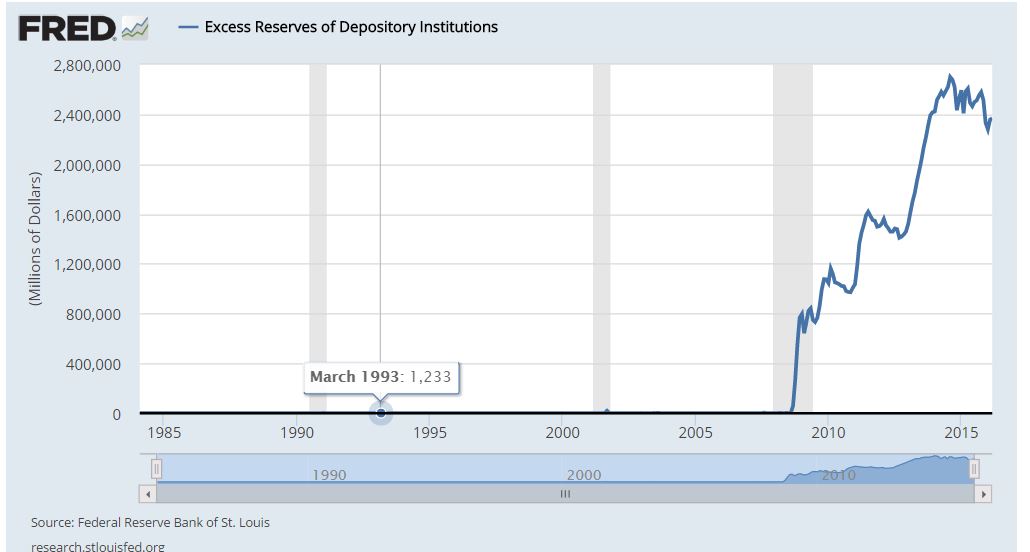
What is happening is very clear, almost $500 billion has moved from money market funds into government funds. Total assets in money market funds have now dropped below $1 trillion for the first time in 17 years. This is very bad for it will enhance the economic decline when banks are already not supporting the economy and hoarding cash deposited at the Fed in its Excess Reserves facility.

Despite the hoopla that sales of US Treasuries are signaling that the end is near, to the contrary, the landscape is changing already and the new rule has not yet gone into effect.

As always, you have to pick up the rug to see the real trend. Analyzing just the surface never reveals the truth. You have to pay closer attention.