Comprehending The Capabilities of AI


QUESTION: Mr. Armstrong – Neural nets and deep-learning algos are not all that new. However, with the advent of quantum computing power and huge cloud data stores recording every flinch people make, the business world is abuzz that this is the portent for AI to now transform business, business management, and our lives. Of course, trading systems are now being ‘trained’ on datasets. However, regardless the algo, it’s learning capacity is still limited by the extent of the data that it is presented. Since you have spent so much exhaustive work amassing such a long-term financial (and governmental, etc.) database, using even such things as coinage records for your forensics, I have to wonder if these other systems will still have a long run to go before their forecasting power can match that of your models. Do you expect this to provide Socrates an advantage over the new wave of AI market/trading forecasters that will last for some time yet?

SC

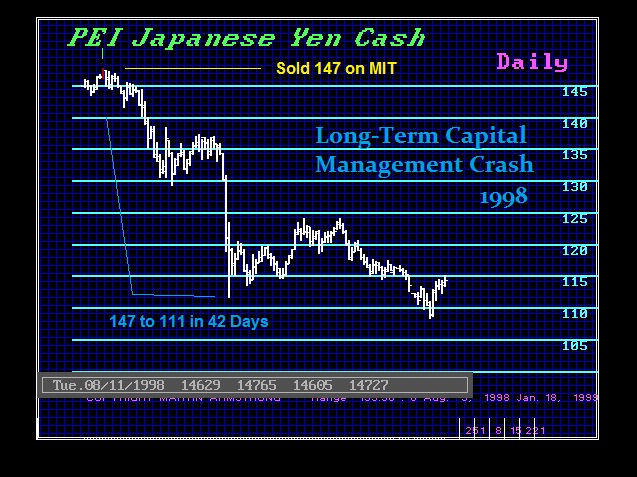
ANSWER: The long-term database is essential. That cost more than $100 million to assemble and quite frankly, nobody seems to be willing to spend that much. This is why all prior models have collapsed creating economic catastrophes such as Long-Term Capital Management debacle. They collapsed again in 2007. Nevertheless, then you have the problem of Neutral Nets are just incapable of handling the vast array of variables. The attempts to create trading models are all flat-model based. Our system has made so many accurate forecasts for so long on so many markets around the globe that I do not even comment on. It is far too much for me to even write about. That is the whole purpose of Socrates.

I had to design a completely different programming technique to work out the complexity. Just image calculating every market in the world in 35 different currencies. The number of variables is beyond comprehension. If we are talking about a limited number of variables for normal business operations, Neural Nets are fine. When it comes to market forecasting, they can develop a Deep Learning system on a single market, but without correlating this with all other markets, you will NEVER see the contagion coming. When everything crashed in 1998 because of the collapse in the Russian debt markets, the illiquidity caused funds to sell other assets to raise cash to cover losses elsewhere. The Russian bond collapse caused a massive sell-off in Japanese yen/dollar rate that had absolutely NOTHING to do with the fundamentals in Japan. Contagions always emerge externally so you can create a model and it will work for a while and then you lose everything.

The Federal Reserve Un-Discussed Structure


COMMENT: Your 4-2-18 FEDERAL RESERVE VS CONGRESS Blog should be framed & sent to every talk show host and politician in the country. It really puts everything in perspective.
SC

REPLY: What I find most astonishing is that to write that article, all you have to do is a little investigation. Nobody bothers to question anything. That is the most shocking thing I have encountered. So often I get responses like how come I am the only one saying this? Some people think this is just sophistry or made up. I cannot explain why investigative journalists never dare to actually investigate. All I can assume is that some have tried, but their editors will not allow such articles to be published. It is truly mind-numbing.

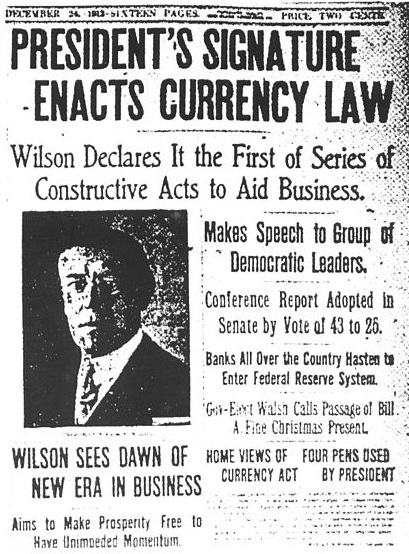
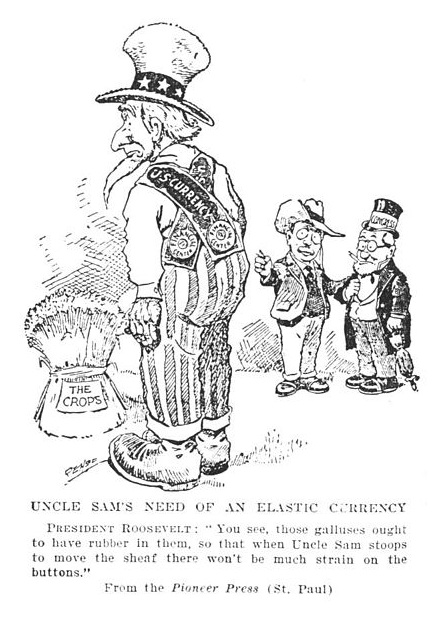
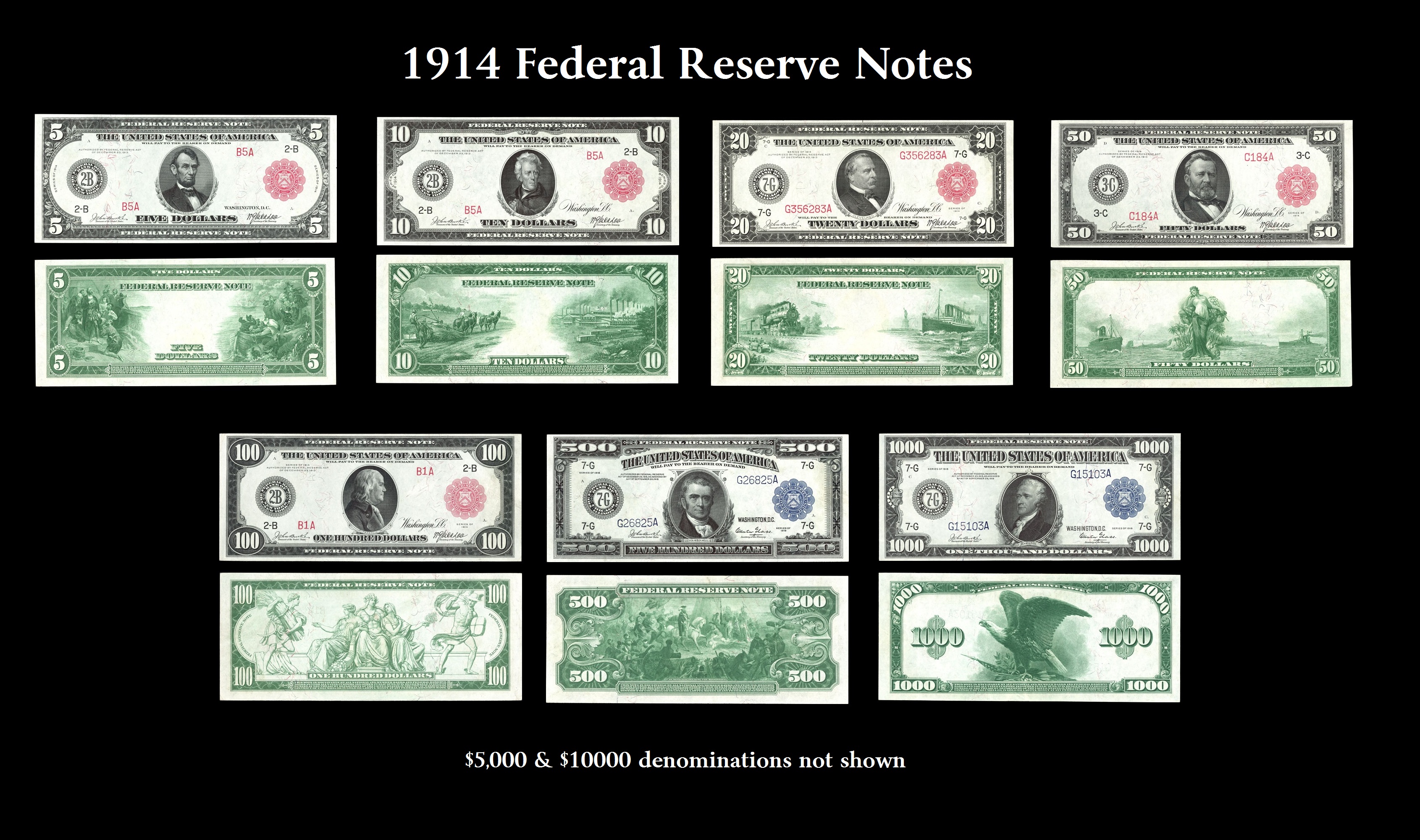
Contemporary journalism back in 1913 called it a monetary change from a national currency system to a national credit system. There were cartoons and well as criticism of the new central bank. The entire theory of elastic money was talked about. Today, the vast majority remain ignorant of the entire debate of that era.

It is no wonder why people just read the Creature from Jekyll Island and assumed evil lurks behind the scenes. They focus on the Fed is “owned” by the banks and merge that with elastic money and have no idea that the ownership was because the taxpayer was not going to fund a bank bailout so the banks had to put up their own money to create the Fed and pay into it to support the system. The elastic money supply was in use since the 1850s and the Fed would buy ONLY corporate paper when banks were not lending to preserve the economy and prevent corporations from laying off workers. The corporate paper is secured and is retired.  The structure was changed with World War I when Congress instructed the Fed to then buy ONLY government paper. Temporary solutions always become permanent and thus the Fed today is nothing close to the original design.

Individual v Institutional Portfolio


QUESTION: Martin, in today’s answer re: Asset Allocation you had mentioned of helping a couple of large funds prepare for what is to come.Was wondering if we regular folks will also be privy to this info at some point and also will we get a heads up when things are getting closer to the Big Event.In an earlier blog you had mentioned something about 2022, will that be a critical time for our savings/economy?

Thank you always for your work.

W

ANSWER: The difficulty in turning around major portfolios is substantially different from a private individual. Often these major portfolios are dominated by real estate and government bond positions in the hundreds of billions of dollars. How to strategically shift such portfolios is highly complicated and it cannot be done on a single phone call. The complexity is significant and the general advice on here is not opposite of recommendations to institutions. How to execute such shifts and when is critical timing.

I have stated many times that you can turn a speedboat on a dime. That is not the case with an aircraft carrier. This is the same difference between a private portfolio and a major institution. They just cannot pick up the phone and yell sell everything at the market! This is substantially a different position altogether.

The advice we provide for a major portfolio shift has to be tailored to the asset allocation mix. We must run timing models on each and every component for selling one aspect can have an adverse impact on other assets classes. It is by no means a simple project.

New York Real Estate


QUESTION: Mr. Armstrong; I listened to you perhaps a bit too late. Put my condo on the market here in New York City and nothing for six months. The realtor said they have never seen buyers disappear so fast. Is there still hope for those of us trapped in the Big Apple?

GB

ANSWER: Real estate in New York has collapsed 25% basis the number of sales by the end of the first quarter. Sorry, but you may have to just lower your price until you find a sucker. Keep in mind that as interest rates rise, banks will tend to run away from mortgages very fast. The last crisis was real estate. They will be more reluctant with real estate than any other sector going forward. If funding for mortgages dries up, prices crash.


Asset Allocation


QUESTION:  Hi Martin,
First of all I enjoyed your 2018 Share Market Report and I am looking forward to your video updates. I am one of those retired investors with a typical 50% equities and 50% bonds portfolio. In your recent blog you stated, “The biggest losers have been the asset allocation followers. They assume they cannot forecast the future so they spread their assets hoping that the traditional 60% equities will make up for the losses on the 40% bonds.” Since both equities and bonds prices have rallied since 2009. Is this the time to change our portfolio mix to raise our equities percentages over bonds (my bonds are one year US treasuries). If so what should our portfolio mix be going forward?
Thank you for your guidance!
KC

ANSWER: I really cannot wait to launch Socrates. Answering these questions depends entirely upon (1) your currency base, and (2) the country in reference. There will be a great divide between US government debt and that of Europe. The dividing line appears to arrive in 2019. For now, US debt will be the best performing and the short-term debt will have the least risk of a Forced Loan Conversion, which has taken place in Europe before post-World War II. A “Forced Loan Conversion” is a phrase I coined to identify what happens when a government cannot repay its debt. Italy simply decreed that short-term paper such as 90-day bills were converted to 10-year paper. There is no risk of short-term US debt going through a Forced Loan Conversion.

The Italian government engaged in a Forced Loan Conversion which was a mandatory debt conversion, known as “conversione forzosa” during 1926, which they would again impose during 1934. They forced debt holders to extend their debt by lengthening the maturity. This seriously impacted the full faith and trust in the Italian government. During the post-1926 years and then again after 1934, the mandatory conversione forzosa effectively was seen as a partial default by the government, which made it extremely difficult and costly to borrow on a short-term basis thereafter.

Governments are concerned about appearance. They will mere engage in Forced Loan Conversions to be able to say with a straight face that they are not defaulting. Therefore, the shorter paper will have the greater risk in Europe from 2019 onward. Additionally, interest rates will be on the rise as pension funds fail and smart money continues to migrate from Public to Private debt.

Any asset allocation to bonds MUST be private!!!!!!! A government can default or suspend debt and will never be prosecuted. Private companies do not have that luxury. The traditional asset allocation models will all blow up. We are in the process of helping some very huge portfolios to shift in preparation of what is to come.

Dollar Hegemony – Real or Sophistry?


QUESTION: Mr. Armstrong; I really wish I found you sooner. A friend of mine has been telling me to listen. He bought the Dow at 17,000 and sold it 26,000 on your advice. He paid off his house and has told me – see, I told you so. I get these emails from the gold community who seem to never give up on every day will be the start of a new rally. This latest one also paints the United States as “dollar hegemony” and they claim that the US expanded greatly following the fall of the Soviet Union. They say China has woken up making money on trade with America. They now say the dollar will collapse and China will be the new world order so buy gold and sell the dollar.

These people seem to have no morals. They sleep perfectly fine raking in the money from people like me robbing us of our savings and preventing us from participating in the real economy as we should. Is there any real dollar hegemony or is this also just hot air?

WH

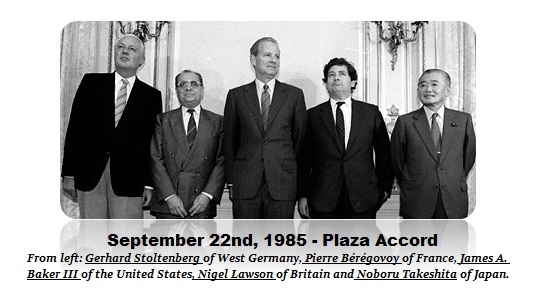
ANSWER: No, it is total nonsense and you are correct – it is designed to rob people of their life savings. There is no “dollar hegemony” for that assumes that the USA is somehow imposing the dollar upon the entire world by sheer will. History shows that the USA has pursued a policy of lowering the value of the dollar for trade purposes. Even the Plaza Accord in 1985 was a deliberate attempt to lower the dollar and it was at that meeting when the USA argued that Europe needed to create a single currency to compete with the dollar.

There is no competition with the dollar and that is the problem. The Fed wanted to raise interest rates back in 2014 but was lobbied by everyone not to. The Fed has lost control of the local economy because the domestic policy has been suppressed by international policy. The IMF, Europe, and emerging markets all pleaded with the Fed NOT to raise interest rates regardless of the domestic policy objectives.

This is complete sophistry and the arguments of people who really have no clue about how the global economy functions. I have been in meetings in Washington where I have been asked how to PREVENT the dollar from being the reserve currency. The answer is simple. There is no law that the USA can pass to bring about such a result.

It is coming. That will be the Monetary Crisis. But every such crisis has resulted in the dollar rising. That will bring the new monetary system. Not a lower dollar

Is There a Cycle to Religion?


QUESTION:

Mr. Armstrong,

 With the rise and fall of civilizations comes the rise and fall of religion. Are we due for a new religion to be born, or to have a rapid growth of popularity? Christianity grew rapidly during the fall of the Roman empire, and with the persecution of believers, where are we today in this cycle?

Thank you for your education. I’ve read your blog since I was in high school and realize how life is governed by cycles. Some weeks are rough, some are fantastic, but it all regresses to the mean eventfully.

CO’C

ANSWER: Oh yes. There is a Cycle of Religion that prevails throughout all cultures. It is clearly tied to economics and the business cycle. I am sure some people will naturally disagree with that one, but it cannot be removed from the business cycle itself. Religion has so often inspired war with some even called Holy Wars. The dominance of a given religion has turned with the economy. The rise and fall of civilizations have been clearly linked to religion. Even if we go back to the Stone Age, we find graves with goods place in there with the deceased with obvious demonstrations of love as well as a belief in an after-life.  Burial rites characterize religion and extend back into the Middle Paleolithic, as early as 300,000 years ago, coinciding with the first appearance human communities.
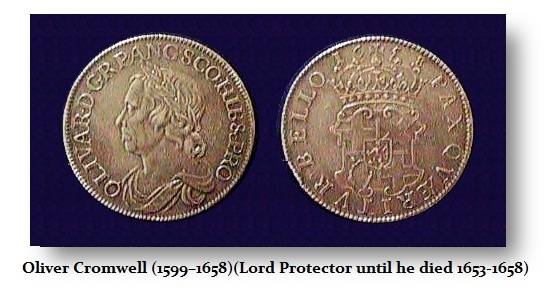
Religion is an integral part of the entire human society. But keep in mind that this goes beyond the simple shifts from Paganism to Christianity and the rise of Islam. There are cycles within each as there are cycles in Asian cultures and religions all tied to the business cycle. The English Civil War was the Protestants against the Catholics which ended up beheading the King. The Puritans seized power under Oliver Cromwell who placed his own portrait on coins wearing a wreath as if he were a Roman Emperor. The Puritans outlawed kissing your wife in public, plays, all sports, and celebrating Christmas. They were so strict that the Protestants rebelled and overthrew the Puritans. It was the Puritans who infected the United States for they were the Pilgrims. This illustrates that there were subcycles within the same religion and the cycle does not always involve Christianity against Islam or Pagans.
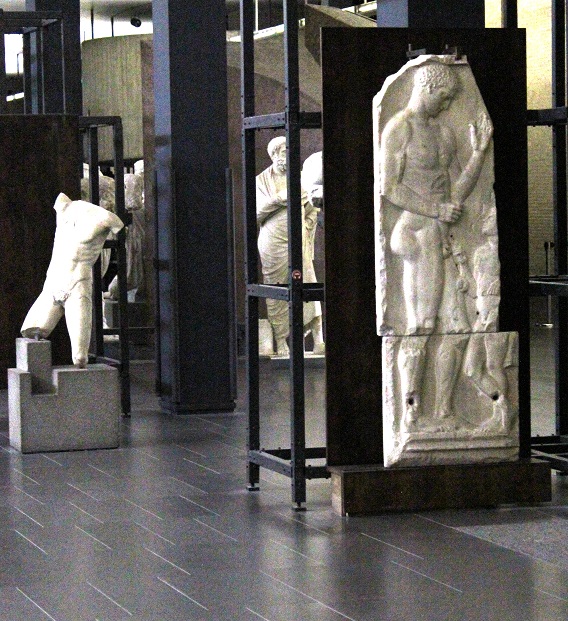
During the 3rd Century, as the Roman Empire was economically imploding and the barbarians were at their gates, this is when the persecutions of the Christians became common. The Pagans believed Rome was being punished because the Christians were not worshiping the gods. When the Christians became the majority inspired by the economic collapse of Rome, then they turned against the Pagans and persecuted them. We see collections of ancient sculptures many are beheaded and defaced. This was the Christians assuming and sculpture was a god.
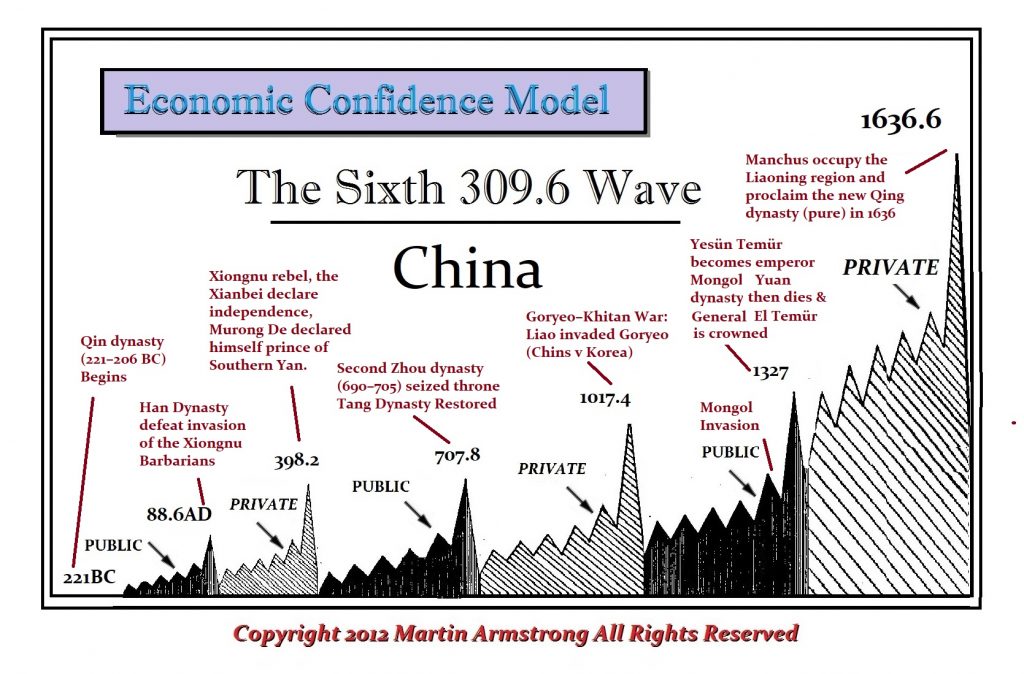
 

If we look at China, we can see quite easily how religion and the business cycle were interlinked even in Asia. The Chinese emperor was seen as being handed the Mandate of Heaven (天, Tian). The Chinese economic, political, and religious doctrine that supported the rule of the Emperor of China was a belief that heaven embodied the natural order and will of the universe. Therefore, it was this natural order that gave the mandate to the ruler of China for he was the “Heavenly Son” of above. In order to maintain that philosophy, if the emperor was overthrown, this was interpreted that the ruler was unworthy, offended the universe, and had therefore lost the mandate. They also believed that natural disasters from earthquakes, famine to floods were all signs from Heaven that the emperor wronged the Heavens and such disaster would often justify revolts of the people.

We see how this belief system interpreted the fall of China to the Mongolian invasion. Genghis Khan began the conquest of China with just raids in 1205 and 1207 across the border. However, by 1279, Kublai Khan had established the Yuan dynasty in China crushing all resistance, which was the first time in history that China came under the rule of a foreign or non-native power.

Most people in the West know little about the history of China. They saw the movie the Last Emperor and assumed that the Emperor ruled until the Communist Revolution in 1946. In reality, following the outbreak of the Wuchang Uprising against Qing Dynasty rule in 1911, the revolutionaries elected Sun Yat-sen as the “provisional president” of the transitional government, with the Republic of China officially established on January 1, 1912. More like the UK, the Chinese Emperor was not eliminated, just the political-economic power. It was against this republican form of government that the Chinese Communist Revolution was launched in 1946 following the beliefs of Karl Marx. Finally, on October 1st, 1949, Mao Zedong proclaimed the establishment of the People’s Republic of China ending the Emperor forever.


There is nothing that is exempt from cycles be it the economy, seasons or even religions. The Hindus believed their religion and gods are invincible not much different from the Romans. Hindus were prosperous, powerful, and became economically very rich and therefore known as was Rome or the United States. They believed that would last forever as every society does. They believed they are special, which is also a common theme. They believed that their gods were in charge of the world as well as the universe. Their culture and community also experienced a very difficult time adjusting to the reality of their collapse. Like the Romans, the Hindus also believed that their gods would bring all good things back and restore them to their former glory. Some resorted to extreme devotion and concluded the same as the Pagans of Rome that their fall was because there was not enough devotion.

In the United States, Rev Jerry Falwell and Pat Robertson came out and said that God was angry and punishing New York allowing the terrorists to succeed on 911. They said God allowed the attack because of “abortion, homosexuality, secular schools and courts, and the American civil liberties union.” (see Guardian). This is the standard reaction when fortune shifts. Many will blame some group that God is punishing the entire community because of these people. This human response was the same in the Hindus as it was among the ancient Romans and Greeks.

Socrates was sentenced to death for corrupting the youth and offending the gods. It is not clear whether he believed in just one God or many. The Greek word Plato used in the original text is “θεός” (theos) which is translated to “God” or “the deity”. Nevertheless, “θεοί” is the plural form of “θεός” and Plato also used this in sections of his Phaedo. Plato does indeed use both the singular and plural forms in the text.


Christianity went through dark periods of the cycle of religion. Because Roman bathhouses were communal and were places one went to even for prostitutes, when Roman fell, bathing was then connected with sin. Mathematics also became associated with the Devil. The entire idea that the Earth was flat and the center of the universe emerged from the idea of heaven and hell and there had to be an up and down. Bruno was burned alive for saying the Earth revolved again the Sun. The Church jailed Galileo (1564-1642) for believing the same concept. The knowledge that came from the fall of Constantinople in 1453 introducing schools brought the West out of the Dark Ages. But this took time. Christopher Columbus had maps that came from the East and set sail to discover America in 1492, about 40 years following the fall of Constantinople.

Every religion undergoes a cycle of change. It does not matter which religion we are talking about. Nonetheless, this is tied to the business cycle. When economic decline hits, we see rising civil unrest as one group blames the other for their ways and non-devotion.

Islam and Christianity preached a level of equality, which provided a flat social structure as distinguished from a class system. This was the foundation of capitalism for people were allowed to change their professions at will and new converts to their religions were welcome. Hinduism, on the other hand, has a rather strict ordered and hierarchical structure of society. This structure was flexible at the beginning and the ancient texts contain examples of people changing their castes. Over time, this flexibility was lost and the caste began to be decided at birth.
Islam regarded stealing severely where Christianity was more forgiving, but the government and Christain Fundamentalism turned to the unforgiving policies that have led the United States to have almost 25% of the total world prison population when it has only 4.4% of the world’s population. People are imprisoned for any offense whatsoever. If you drive on federal property and do not have your drivers license on you, you MUST go to jail and will be given typically a sentence of 30 days. When John Ashcroft was Attorney General under Bush, Jr., he imposed his unforgiving religious belief system upon the nation. Prosecutors would not get credit for a mere conviction. The defendant MUST do some jail time. It was Ashcroft who has turned the United States into the most anti-Liberty nation on the face of the Earth. Nobody imprisons people for every offense no matter how minor than the US Federal Government.

Islam and Christianity both demand absolute faith in their own version of God. Hindus are much more tolerant of what you should believe, but conversion to Hinduism is more difficult than that to Islam/Christianity. In polytheist Hindu system, if you want to bring in your god, then it is just one more idol in the already crowded temple of Gods. Hinduism offers a rich variety of texts and encourages debate as well as the pursuit of knowledge. Hinduism and most other Eastern religions, tend to believe that humans are part of the environment and that animals and plants should all be respected. Western religions, including Islam and Christianity, tend to accept the principle that humans are created in the image of God and are therefore a superior species on the planet which was created for humans.

So there are differences in philosophy between East and West. In the East, they tend to believe in cycles as part of nature where in the West the core starting point was linear. That said, there are cycles in the belief system but there are also cycles within each religion.

Conservative v Trader


QUESTION: Mr. Armstrong; I know my friend sent an email to you and is finally listening only after racking up losses. I explained how I followed you since 2015 and bought the Dow back at the end of 2015. I made almost 10,000 points and paid off my house. My family toasts you every Thanksgiving around the table. I know you warned that April could make a new low in the Dow and the first half of this year would be a period of consolidation. The rally into March made new highs in the Nasdaq but the Dow failed. You have taught me to just follow the numbers and I appreciate your comments trying to explain events as they unfold. The Global Market Watch was fantastic. On the yearly level it said potential major high in January and then it flipped back and now says new highs remain possible. To watch how that sifts on the yearly level has been a tremendous indicator in itself. That gave me the confidence to sell the close of January. My question is simple. Do you see this as a major buying opportunity? How long should I keep the powder dry?

Thank you

SJ

ANSWER: This is a consolidation period and it will be difficult to guess where the market will go from one day to the next. Yes, the Global Market Watch has been fluctuating on the yearly level on the Dow and that is a reflection each day what the future would look like assuming that was the end of the year. It did by itself state potential major high and that confirmed the correction into February. Now it is saying new highs are possible which is reflecting that we are indeed in a consolidation mode.

This will provide a major buying opportunity. We needed this pause in trend to shift the majority back to bears. When the market rallies and breaks out again, they will fight it as they have all the way up. The biggest losers have been the asset allocation followers. They assume they cannot forecast the future so they spread their assets hoping that the traditional 60% equities will make up for the losses on the 40% bonds. That will bankrupt most people on this next move. It has failed to save pension funds.

Just remember. You MUST be disciplined. The hardest part of successful investing is to remove your emotions as much as possible from the decision process. This is why the decision must be on the NUMBERS and not even what I have to say. Nobody can forecast a market from a gut perspective. If they are looking for someone to be a guru, then kiss your portfolio goodbye right now.

I will be doing video updates for those who purchased the 2018 Share Market Report. We will be holding a WEC in Singapore in June. We will be opening up both Singapore and Orlando for general ticket sales shortly. Prior attendees get first dibs. We will be covering all of Asia in Singapore and the world in general. Orlando will be focused on Europe and North America with also a general overview of the world. That will be held after the 2018 US elections.

So follow the Reversals and the Timing. They will tell us when to ac

Wheat & the Drought Cycle


QUESTION: Interesting that $1.3T US spending bill was enacted on March 23, 2018, exactly 31.459 years after passage of US Tax Reform Act of 1986:

Also, the 86 year cycle in drought conditions in the midwest US seems to approach – is this why Marty thinks wheat will bottom this year?

The below Wikipedia link mentions a “short drought” in 1890 in the US Great Plains, and then a dust storm on November 11, 1933, in South Dakota (43 years later). Wikipedia also mentions that the US Great Plains entered an unusually dry era in the summer of 1930 (a little more than 86 years ago), with droughts coming in 1934, 1936 and 1939-1940.

Kansas is having drought conditions currently:

Poor winter wheat condition worrying Kansas farmers

I wonder if this is the year to go long wheat, especially since Marty forecast a bottom for this year?

Best,
J

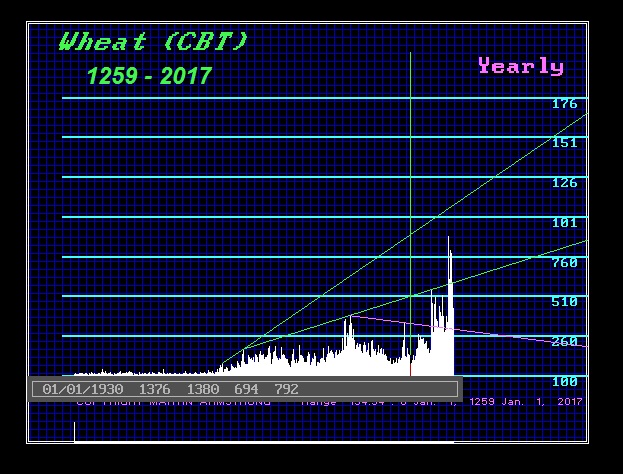
ANSWER: Here is a chart of Wheat from 1259 to 2017 with the currency converted to dollars from British pounds using the conversion rate at the beginning of the US dollar extending it back in time. Here we can see the overall trend. Yes, there is an influence with respect to weather. However, the Dust Bowl was a local event.

What our computer is warning about begins next year with a Directional Change in Wheat. This cycle appears to be impacted by (1) significant climate change, and (2) the War Cycle. The combination of both is pointing to a bull market in nominal dollar terms.

Monetary Policy is a Complete Failure? Will Shutting Down the Fed Solve All the Problems?


I recently did an interview and was asked about the Federal Reserve. There is so much absolute nonsense sophistry that circulates where people think that ending the central bank will somehow cure everything. I really just laid it out plain and simple. The Fed’s balance sheet is a tiny fraction of the economy or the real money supply. Everyone blames the Fed for everything and they NEVER bother to look at (1) the fiscal policy of Congress, and (2) the banking system as a whole.

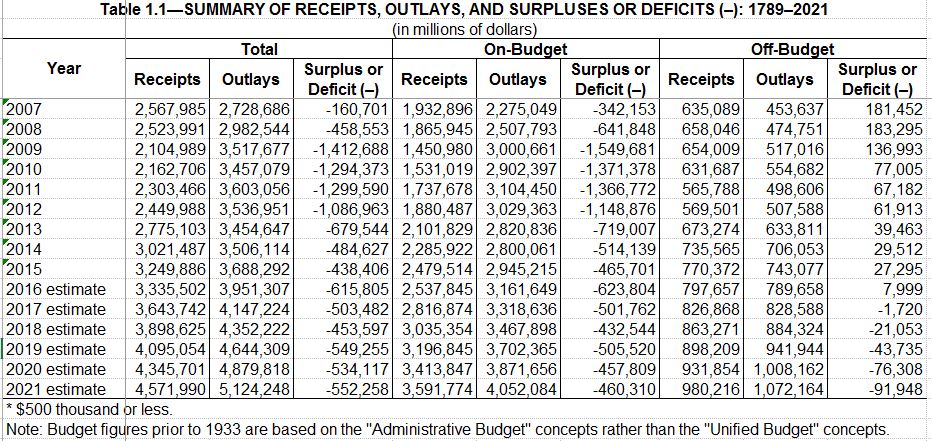
Even if you want to scream from the top of every hill that $4 trillion worth of Fed’s Quantitative Easing was pure evil and should have created hyperinflation (which it did not), the deficits created by Obama topped $1 trillion per year and those never die whereas the Fed’s QE evaporates as they do let the debt they bought mature and expire without rebuying it again, whereas Draghi and the ECB have conceded they will reinvest their holdings. Look at 2009-2012. Obama created $5.4 trillion that will never expire but will be rolled until there are no more buyers.

So let’s do the math. The entire Federal Reserve QE program was equal to 1/5th of the national debt. The ECB bought 40% of all public debt and the Bank of Japan bought 75% of new debt coming to the market. Yet all we get is dollar bashing and people actually have called the yen the safe-haven play. I really do not know if I am arguing is drunks, people with dementia, or just con-artists. All these people pushing the end of central banks because they are clueless about how the real world functions.

I have been trying to explain to the world that monetary policy using interest rates to impact the balance of payments is really voodo economics. The Australian even wrote an article back in 1989 about the advice I was given to governments. No matter how long I have been at this, trying to overcoming manipulating interest rates to try to control the economy is just totally insane. It reminds me of the skit in Blazing Saddles where the Black guy puts a gun to his own head and say if anybody moves, the black guy gets it. How can a central bank raise interest rates to fight inflation when the government is the biggest borrower in the system? The government deficits will rise because their interest expenditure will rise perpetually because they continuously roll their national debts and never pay anything off. The central banks have lost all control and the press is just too stupid to even understand the problem.

The Australian wrote about our recommendation: “He firmly believes the worldwide obsession with monetary policy, namely the use of interest rates to regulate inflation and demand, is misguided, and in a recent circular to clients described it as “voodoo” economics.”


We are hopelessly lost and the idiots who bash the Fed are doing so much harm to society it is not even funny. The bulk of the real world money supply is created by lending on a leveraged basis. It is not money created by the Fed and it goes well beyond that even created by the Congress.

AT the end of 2017, total household debt exceeded $13 trillion. Total non-financial business debt stood at $6.1 trillion at the end of 2017. The Fed’s balance sheet was $4.4 trillion of which $2.4 is US Treasuries. The national debt stood at $20.5 trillion at the end of 2017. If we look at this perspective, that means the money supply is $41.6 trillion just using the debt. If we then add M2 (all accounts _ money market accounts) which stood at $13.8 trillion at the end of 2017, this brings us to a liquid money supply of $55.4 trillion. The Fed’s balance sheet does not even reach 10% of that figure. Now let us add the stock market, which is liquid. That reached $30 trillion by the end of 2017. Therefore, the liquid assets/cash position stood at $85.4 trillion at the end of 2017. Now let us add total personal real estate (homes) in the United States which stood at $31.8 trillion. If we include illiquid real estate, now we are up to  $117.2 trillion. So how will shutting down the Fed and theoretically eliminate $4.4 trillion solve all the problems?