
There are only two possible legal basis which are one a UN detraction of war or two the US congress voting on and approving a declaration of war. If that is not done then it becomes an invasion and if Russia takes offense to bombing his client state it is not good.t
Tag Archives: IMF world bank
Ukraine hosts military drills led by US and joined by NATO
A day late and a dollar short and not much more than a token but better than nothing.
Fast food protesters to be hit with massive job losses when Obama grants amnesty in November
As most any competent economist will tell you minimum wages do nothing for the beginning or low end workers. If yo raise the $8 worker to $15 then all those between $8 and $15 will demand increases and those from $15 to where every (especially with union contracts) will also what a raise. The bottom line is within a few years the purchasing power of $15 will be the same as it was before at $8 so there is no gain. Also with cheaper and cheaper tech the cost benefit from automation gets better and better The current order takers only push buttons and make change. Flip the terminals around and let the customers enter there own orders. How many stores today have self checkout lanes so the concept is not new and at some pay level that is what will happen.
De-Dollarization Continues: China-Argentina Agree Currency Swap, Will Trade In Yuan
Re-Posted from ZEROHEDGE

Submitted by Tyler Durden on 09/07/2014 17:58 -0400
It appears there is another nation on planet Earth that is becoming isolated. One by one, Russia and China appear to be finding allies willing to ‘de-dollarize’; and the latest to join this trend is serial-defaulter Argentina. As Reuters reports, China and Argentina’s central banks have agreed a multi-billion dollar currency swap operation “to bolster Argentina’s foreign reserves” or “pay for Chinese imports with Yuan,” as Argentina’s USD reserves dwindle. In addition, Argentina claims China supports the nation’s plans in the defaulted bondholder dispute.
Having met ‘on the sidelines’ in Basel, Switzerland in July, Argentine and Chinese central banks agreed to a currency swap equivalent to $11b that Cabinet Chief Jorge Capitanich said could be used to stabilize reserves.. (as Reuters reports)
Argentina, which defaulted on its debt in July, will receive the first tranche of a multi-billion dollar currency swap operation with China’s central bank before the end of this year, the South American country’s La Nacion newspaper reported on Sunday.The swap will allow Argentina to bolster its foreign reserves or pay for Chinese imports with the yuan currency at a time weak export revenues and an ailing currency have put the Latin American nation’s foreign reserves under intense pressure.
La Nacion said Argentina would receive yuan worth $1 billion by the end of 2014, the first payment of a loan worth a total $11 billion signed by Argentina’s President Cristina Fernandez and her Chinese counterpart in July.
In addition, Bloomberg reports
People’s Bank of China Governor Zhou Xiaochuan expressed his support for Argentina in its legal fight against holdout bondholders
Worker Witnesses To Mike Brown Shooting ?
The case becomes more complicated …
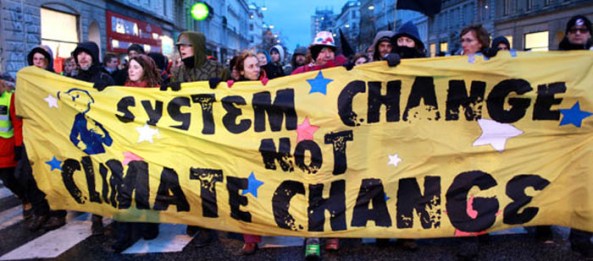
The Australian Government Broadcaster asks if we should ditch Democracy to ensure a climate change response
Their goal is Very Strong Central Governments such as exist in China and Russia controlled by one party that is little different then a medieval kingdom, and we know how good that was!
Ukraine Crisis Sends NATO Back to the Cold War
Re-Post from WHO WHAT WHY By Alex Stevenson on Sep 4, 2014

NATO, a military alliance forged in the Cold War, is showing signs of reverting to type—with Russia assuming its familiar role as the “heavy.”
This is a development that should trouble us all, not least because the arguments advanced to justify NATO’s newly aggressive stance are so hard to resist.
Nobody can deny that NATO is preparing to flex its military muscles, with Europe engulfed in the biggest period of instability in decades. Yet, as some 67 heads of state meet at its latest summit in Wales this week, few are talking about the alliance’s legacy of expansionism—which many feel has contributed to the current tensions with Russia. Instead all the talk is of the 28-nation alliance seeking a new purpose as the drawdown of troops from Afghanistan steadily continues.
In responding to Russian President Vladimir Putin’s aggression in Ukraine, NATO looks to have found it.
***
“We will send an unmistakable message,” NATO’s secretary-general Anders Fogh Rasmussen said in an op-ed co-authored with General Philip M. Breedlove, NATO’s supreme allied commander for Europe. “We must make the right choices for NATO: to ensure that the alliance remains ready, willing and able to defend our almost one billion citizens.”
In response to Russia’s land grab in Crimea—the first territorial aggrandizement in Europe since the Second World War—the alliance founded in 1949 to combat the Soviet Union is once again preparing to stand up to Moscow. The bellicose talk comes even as Putin is talking of a ceasefire with Ukraine.
The United States has joined the aggressive chorus, too. Pentagon spokesman Rear Admiral John Kirby this week said Russia’s actions have “galvanized the alliance and … and brought into sharp relief the need for all NATO partners and allies to continue sufficient and adequate defense spending.”
Expensive Posturing
A strong move by NATO in response to increased tensions will not come cheap. Right now, only four of NATO’s members spend more than 2 percent of their gross domestic product on defense. Indeed, the alliance’s governments have cut total defense spending by a fifth over the last five years. Yet Russia’s has jumped up by 50% over the same period.
In the UK, officials are overseeing the diplomacy that they hope will precede a sweeping agreement to advance troops much closer to Russia’s border. The expectation is that, rather than permanently basing NATO troops in former Warsaw Pact countries like the Baltic states and Poland, a rapid reinforcement capability will be established that will, in essence, send Eastern Europe back to a Cold War footing.
Agreement has already been reached on the movement of a NATO headquarters to a “forward” position – probably at the alliance’s existing base in Szczecin, Poland. Vital equipment and supplies will be placed in waiting near the Russian border, a senior British Foreign Office official said on condition of anonymity, at a recent briefing in London attended by WhoWhatWhy. When a crisis develops, troops will be rushed into any border area NATO feels is threatened by Russia, grabbing their weapons along the way. A new set of military exercises will be set up to prepare troops for combat scenarios, the official said.

Besides all this, a number of countries will soon be offered what are euphemistically called “defense capacity building missions.” These programs are played down by NATO-allied officials, who characterize them as a way for countries to benefit from the alliance’s “expertise.” Georgia, which Russia invaded in 2008, is on the shortlist—an inclusion likely to anger Moscow.
***
For years after the fall of the Berlin Wall, defense experts say, NATO bent over backwards to keep Russia happy. “It created a number of serious dialogues. But Russia expressed deep discomfort about a further deepening of ties,” says Kathleen McInnis, a former Department of Defense strategist who now works for the Chatham House think-tank in London. “It’s actually been Russia that’s given NATO the cold shoulder.”
One manifestation of NATO’s attempts to appease Russia was its hesitancy to garrison troops in Eastern Europe for 20 years, according to Jonathan Eyal, international studies director at the London-based Royal United Services Institute think-tank. NATO exhibited a “marked reluctance to get troops into Eastern Europe because it would be seen as a hostile move,” he said.
Yet at the same time that the West enjoyed the “peace dividend” of reduced defense spending, NATO continued to push its borders east in what amounted to a diplomatic offensive. In 1999, Poland, Hungary and the Czech Republic joined the alliance in 1999, followed five years later by the Baltic States, Romania, Slovakia and Bulgaria.
A “Finger in the Eye”
This took place despite warnings from some quarters, including British Colonel Bob Stewart, who was the chief of policy at Supreme Headquarters Allied Powers Europe two decades ago. Back then, he argued that pushing NATO further east “would be like sticking a finger in the eye of the Russians – that if we expand we’ve got to be very careful we don’t irritate the hell out of the Russians. I warned about that and I was overruled.”
Now that the Russian bear is clearly aroused, Stewart has become an avid proponent of confrontation. “Yes, the Russians will protest like hell,” he says, about NATO expanding its fighting capabilities in Eastern Europe. “But let’s face it, we don’t like what the Russians have done. So tough shit.”
Gisela Stuart, a Labour colleague on the committee, makes the same point in less provocative language. She remembers travelling around the Baltic during the build-up to the 2004 NATO expansion—a time when the Baltic countries were also hoping to join the European Union. “To them, NATO membership was more important than EU membership,” she recalls. “For countries that got the Cold War in the neck, the physical security was much more important than anything else.”
Politicians, military figures and defense experts may disagree on whether NATO should have been more circumspect in pushing into what has been Russia’s traditional sphere of influence in Eastern Europe. But for a surprising number of defense analysts in Britain, the time has come to vigorously counter what they see as Putin’s belligerence.

“If there is one person responsible for this it is Mr. Putin, who has created a scenario whereby it is seen as a sign of weakness for NATO to avoid a deployment,” Jonathan Eyal says. “If the summit concludes with no demonstrable moves to provide more equipment for NATO troops, this will be interpreted by the Russians as a sign of weakness, that the allies are divided.”
***
It’s no coincidence that President Obama stopped over in Estonia before to the summit. In a speech, he said the Baltic states will be defended to the hilt from Russian aggression. U.S. aircraft are already patrolling their skies and more ships are being sent to the Black and Baltic seas. “Our alliance should extend these defensive measures for as long as necessary, because the defense of Tallinn and Riga and Vilnius is just as important as the defense of Berlin and Paris and London,” Obama said.
Yet it was precisely NATO’s aggressive expansion into areas like the Baltic States—after Russia dismantled the Warsaw Pact at the end of the Cold War—that created the conditions for Moscow’s intervention in Ukraine, according to David Gibbs, a professor of history and government at the University of Arizona who has written extensively about NATO. So history may be repeating itself.
The recent discussions about admitting Ukraine and Georgia as members have only exacerbated Russia’s frustrations. “Russia views its interventions in the Ukraine as defensive actions, against NATO threats to its border security. NATO expansion must be viewed as a short-sighted action, one that was bound to provoke the Russians, and it laid the groundwork for the Ukraine’s civil war.”
Putin’s Game
In Britain—which spends more than 2 percent of its GDP on defense—influential voices are calling for new ways to respond to Russia. Air Chief Marshal Sir Michael Graydon, former chief of Britain’s Royal Air Force, wants an acknowledgement that the old policies have failed. “We’ve taken the risk that nothing will happen, but there’s been a wake-up call,” he says. “Politicians have chosen other priorities—they have to be elected, after all. But these are a series of crises. And at the moment, NATO doesn’t look serious.”
Britain is optimistic that it will secure allies’ commitment to at least halt the fall in defense spending, the Foreign Office official told WhoWhatWhy. “That will mark the start of a sea-change in attitudes.”
In the meantime, the nature of warfare itself seems to be changing: Russia is firing artillery into Ukraine, a move that in previous years would be unequivocally viewed as an act of war. Moscow has largely denied allegations that its soldiers are being deployed against the Ukrainians but in unmarked uniforms or using humanitarian aid as a cover. It did, however, admit the capture of 10 Russian paratroopers in Ukraine, while saying they’d crossed the border accidentally.

“Putin, as an ex-KGB colonel, knows what he’s doing. He’s playing this game,” Air Commodore Andrew Lambert, a Royal Air Force strategist, says. “That’s why he hasn’t driven three divisions across the border.” According to Lambert, the Russian president’s tactics need to be understood by Western leaders, and a new way of dealing with that type of warfare has to be developed.
There’s little chance that NATO will undertake such a radical re-invention any time soon. Its focus, as leaders gather at Celtic Manor in Wales, is on securing agreement to send its troops back to a Cold War footing. That will be combined with pressure on more reticent allies to increase defense spending.
Some analysts argue that the Cold War is the wrong lens through which to view what’s happening in Eastern Europe. McInnis of Chatham House thinks the better analogy is to the uneasy balance between European powers that existed during the run-up to the First World War.
And she warns: “[I]t’s a somewhat unstable system.” Her view is that the last 25 years of security and stability in Europe are a historical aberration: “We, the U.S. and Europe, are not very interested in war because we’ve become unaccustomed to it. But just because we’re not interested in war doesn’t mean war isn’t interested in us.”
WhoWhatWhy plans to continue doing this kind of groundbreaking original reporting. You can count on us. Can we count on you? What we do is only possible with your support.
– See more at: http://whowhatwhy.com/2014/09/04/ukraine-sends-nato-back-to-the-cold-war/#sthash.jcz7DoNl.dpuf
Labor Participation Rate Drops To Lowest Since 1978; People Not In Labor Force Rise To Record 92.3 Million
Re-Post from ZEROHEDGE
Submitted by Tyler Durden on 09/05/2014 09:03 -0400
It is almost as if the Fed warned us this would happen. In a note released yesterday, a Fed working paper titled “Labor Force Participation: Recent Developments and Future Prospects“, looked at the US labor force and concluded that “while we see some of the current low level of the participation rate as indicative of labor market slack, we do not expect the participation rate to show a substantial increase from current levels as labor market conditions continue to improve.” But don’t blame it on the greatest recession/depression since 1929: “our overall assessment is that much – but not all – of the decline in the labor force participation rate since 2007 is structural in nature.”
Well that’s very odd, because it was only two months ago that the Census wrote the following: “Many older workers managed to stay employed during the recession; in fact, the population in age groups 65 and over were the only ones not to see a decline in the employment share from 2005 to 2010 (Figure 3-25)… Remaining employed and delaying retirement was one way of lessening the impact of the stock market decline and subsequent loss in retirement savings.”

So yeah… sounds like most of the decline in the participation rate is not structural in nature and is merely a response to what everyone but the 1% sees as the biggest – and ongoing – economic devastation perhaps in history, papered over conveniently for the 1% with trillions in liquidity injections.
In any event, no matter how you spin it, today’s data was bad: because not only did the headline data disappoint, the labor force participation rate dropped once again to 62.8% from 62.9%, matching the lowest since 1978, as a result of the people not in labor force rising once again, and hitting a new all time high record of 92,269,000, up 268,000 from the prior month. In fact, in August the number of people not in the labor force increased by nearly double the number of people who found jobs, which as we reported previously, was only 142K.

Putting it another way, since the start of the depression in December 2007, the number of people not in the labor force has increased by 13.0 million. The number of jobs added: 768,000.

Average:
Russian General Demands Preemptive Nuclear Strike Doctrine Against NATO
This is getting out of hand Obama had better put the clubs away and come up with something and quickly.
NATO Membership For Ukraine – Another Move On The Grand Chessboard
Very interesting the game being played here is very deep and layered Chess with nuclear weapons and we are the pawns. Unfortunately in this game putin is a grand Master and Obama is still playing checkers.

