
I do hate to disagree with Walter E. Williams but there is a problem with this argument which is since everything can be made cheaper in sweat shops overseas then it must follow that everything must be made overseas. The extension of that is that all work will be done somewhere else and all consumption will be done here; obviously that can not work; for there is no one working and and therefore there is no money to buy anything and the system collapse.
Tag Archives: Monetary Policy
Larry Summers – Who Admits He Cannot Forecast – Forecasts Trump
Armstrong Economics Blog/Armstrong Economics 101
Re-Posted Jan 8, 2017 by Martin Armstrong
QUESTION: Marty; Did you see Larry Summer’s comments on Trump. Is this guy completely insane? He says Trump is proposing things off the planet. Wasn’t it Summers who came up with the negative interest rates and supported repealing Glass Steagal?
ANSWER: Larry Summers is a classic example of how a PHD means absolutely nothing compared to real life experience. He had the audacity to say, “The vast majority of the companies who have large overseas cash also have substantial amounts of domestic cash.” Obviously, Summers has never advised a real company. If Trump makes it a 10% tax, any company who does not bring their cash home would be a short. EBay had two companies it wanted to buy domestically. It backed out of the deal because it would have to bring in cash from overseas and pay too much tax to make it worthwhile. That’s how much Larry Summers knows about the world.
Summers went further, “The reality is that cash that is brought home will be used to pay dividends, to buy back shares, to engage in mergers and acquisitions, to rearrange the financial chessboard, not to invest in large amounts of new capital. It is a chimera to suppose that there will be large increases in capital investment as a consequence of that repatriation.”
First of all, paying dividends and buying back shares will put money DIRECTLY into the hands of investors who will redistribute the funds. Summers tries to “stimulate” by handing banks billions with no strings attached in hopes that they will lend the money to people who want to borrow. Then he wants to impose negative interest rates to punish people for not spending or investing.
Larry Summers has publicly admitted he is incapable of forecasting the economy, so where does he get off saying this nonsense? Quite frankly, those who are watching their pension funds go bankrupt should sue this guy for his non-conventional idea of negative interest rates to “stimulate” the economy. He gave us the 2007-2009 crisis by repealing Glass-Steagall and supporting the bankers, and he set the pension crisis in motion with negative interest rates. Thank God Hillary lost because this clown would be in charge of screwing up the economy even more.
Norway Insane Property Boom or Capital Flight from Eurozone?
Armstrong Economics Blog/European Union
Re-Posted Feb 22, 2017 by Martin Armstrong

QUESTION: Hello Martin, I was wondering if you could write a piece on the Norwegian real estate market? The market has gone complete mad the last couple of years with salaries declining, and housing prices booming. Over 40% of Oslo is now owned by people not leaving there. A lot of apartments are empty because people don’t care to rent them out, it is just for speculation. Will this continue or will the Sovereign debt crises drag the market down with it? Love your blog, and hope you can spare some time for little Norway!
HG
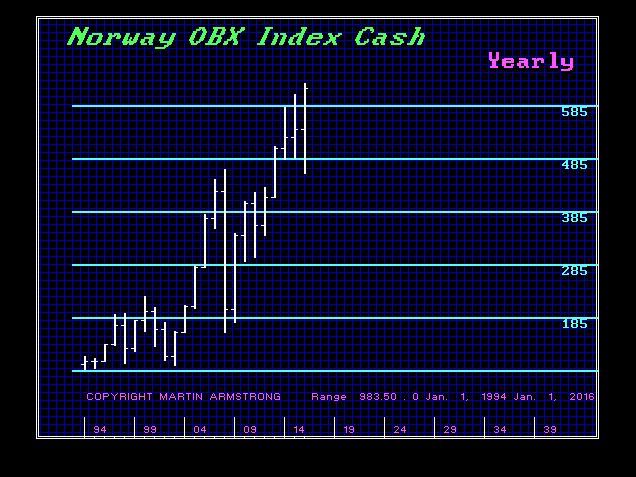
ANSWER: Actually, I will be speaking there in Norway in a few weeks. Most of this “speculation” is really parking money. They are not trying to actually make a profit, which is why they are not renting these properties out. This is about parking money outside of the Eurozone. This has been a bet against Brussels and the collapse of the Euro. When we look at the share market, we see an outside reversal to the upside in 2016 as our model warmed with a Panic Cycle. This too is money trying to get off the grid.

The is a picture of the Krone expressed in US dollars since 1927. Here also, the dollar is positioned to rally against the Krone and we should see a new high above that of 1985, but at the very least a rally to retest that level for the third time.

In the case against the Euro, the Yearly Bullish Reversal stood at 87125 and we closed 2016 at 86450 after reaching intraday for the year 89940. To have exceeded the Yearly Bullish for the Euro intraday yet failed to close above it warns that the rally in the Euro against the Krone is most likely coming to an end.
The Total Lack of Common Sense
Armstrong Economics Blog/Pension Crisis
Re-Posted Feb 20, 2017 by Martin Armstrong

QUESTION: Martin – Given your compelling elucidation of the business cycle (which remains ineluctable even with central bank and regulatory distortion of money and markets), the avg annual return targets set by pension and retirement plans seems absurd. CalPERS had an annual bogey of 8% to meet via its active management. Even in a rapidly-growing economy whose markets were free from distortions, it seems that any fixed number could only rationally be set as a target if the investment horizon spanned several business cycles. This would allow at least some averaging over bull and bear phases to enable a fixed average return target like this to have any meaning.
This is not exotic – it seems commons sense. Do professional asset managers (or central bankers for that matter) make up nice-sounding goals that they know they cannot meet, or do they just not know what they are doing?
ANSWER: The fund managers are not really very professional. The majority of pension funds based their returns upon the standard 8% yield of long-term 30 year bonds. They have never actually adjusted their return expectations and thus the majority remain under-funded.
Do not apply this to all pension funds. We have helped many make the transition to the real world. When you have CALPERS where the decisions come often from the board, which is not professional, but political, therein lies the problem. The Social Security system is likewise a disaster. I tried to convert it into a wealth fund almost 20 years ago. The Democrats blocked it for anything to do with the free markets to them was risky. Thus, they stuff it with their own debt and then lowered interest rates. The fund is broke and you will see demands to raise taxes to cover the losses the politicians have created, yet they will of course blame someone other than themselves.
Someone who has simply managed a pension fund for the government is typically not qualified to be a private fund manager. If they were hired from the private sector to then clean up a public pension fund, then we have a different type of person. It will depend at that point on the board of directors and if they will allow the fund manager to make market decisions or will they still be overridden by politics.
Keep in mind that I often appear to be the lone analyst on many issues. This is ONLY because those with experience must sign confidentiality agreements to work for a fund or bank. They are not allowed to make comments for whatever they say would be attributed to their employer. I get tons of emails cheering often what I say because they are silenced. You really have to peek behind the curtain to comprehend what goes on because it really does defeat COMMON SENSE! It is like everything else. Nobody would have sat down and designed a financial or political system as we have today. This whole mess is just total insanity. It does not take a conspiracy, it takes stupidity. These people attribute such knowledge to people that is not justified. Some of these decisions do not make even the basic common sense tes
“Seriously Delinquent” Auto Loans Surge
We never learn do we … so sad!
Trade v Banking – The Real Issue
Armstrong Economics Blog/Banking Crisis
Re-Posted Feb 18, 2017 by Martin Armstrong

While CNN and ABC news have turned really vicious against Trump, they are failing to report the real impact of world events that can undo everything. As we head into April/May, we are looking at a real crisis emerging that is beyond contemplation. The prospect of the breakup of the European Union because Brussels refuses to consider that their dream of ruling all of Europe is coming to an end. Yes, Juncker has said he will stand down while Draghi tries to threaten member states, saying they have to pay up in order to leave.
Last September, the International Monetary Fund (IMF) has warned at the G20 summit in Hangzhou, China, that in the face of crises, the refusal to reform how things are functioning will lead to economic weakness in the global economy. “The latest data shows subdued activity, less growth in trade, and a very low inflation, suggesting an even weaker global economic growth this year,” the IMF told G20 leaders.
The real crisis behind the curtain remains not TRADE, but BANKING. The EU hired over 20,000 people to regulate the European banking system. They have been installing bail-ins after that worked in Cyprus. They have been moving toward instant banking transfers by September 2017 with the design of eliminating cash. All of this becomes a major risk and the European Central Bank holds 40% of all government debt in the Eurozone. The cracks in the foundation of the EU are tremendous and the ramifications will ripple through the entire global economy. The seriousness of this crisis is being ignored by mainstream media because they are too busy trying to undermine Trump because their own ratings have collapsed. Newspapers are for the 50+ generation. The youth go to the internet and really do not watch the news of mainstream media. They are rapidly becoming sidelined and they hate Trump’s tweets because he is going directly to the people much as FDR did with his fireside chats.
Norway Central Banker Warns Of Massive 50% Drop In Wealth Fund Assets To Cover Budget Deficits

by Tyler Durden
Back in August, we noted that, for the first time since it’s creation in 1996, the Norwegian government had started raiding its sovereign wealth fund in 2016 to cover government deficits. Then in October the Nordic country revealed plans to massively increase withdrawals by over 25% in 2017, to $15 billion, to cover a budget hole that was expected to be roughly 8% of GDP.
That said, Norway’s ultimate GDP potential, and therefore budget deficits, are heavily dependent on oil prices so any further weakening of crude could result in even more withdrawals. Moreover, given the substantial YoY increase, it’s important to recall that there are fiscal limits imposed on fund withdrawals equal to 4% of assets, or roughly $36 billion, which could come into play at some point in the future if oil prices remain “lower for longer.”

Of course the withdrawals accelerated just as the heavily oil-dependent economy of Norway started to absorb the impact of lower oil prices.

And what do you do when you depend on portfolio returns to fund everyday living expenses but are faced with extremely low returns courtesy of artificially depressed international bond yields? Well, you just buy more equities, of course. Which, as we noted back in December, was exactly the motivation behind a decision to increase the fund’s equity allocation from 60%, to a staggering 75%, all while funneling another $130 billion to the global equity bubble.
The central bank’s board, which oversees the fund, on Thursday recommended an increase in the equity share to 75 percent from 60 percent. That will raise the expected average annual real return to 2.5 percent over 10 years and to 3.5 percent over 30 years, compared with 2.1 percent and 2.6 percent, respectively, under the current setup
The world’s largest sovereign wealth fund said that it expects an annual return of only 0.25 percent on bonds over the next decade and that the expected “equity risk premium,” or return on stocks over government bonds, will be just 3 percentage points in a cautious estimate.
“In our analyses, this is clearly evident in global data: internationally, growth in firms’ cash flows and equity returns are correlated with growth in the global economy,” Deputy Governor Egil Matsen said in a speech Thursday in Oslo. “Global economic growth in the coming years is expected to be below its historical level. This ‘pessimism’ is partly related to the driving forces behind the low level of the real interest rate.”
But despite their best efforts to protect the principle balance of Norway’s sovereign wealth fund through statutory spending caps and buying more and more equities, Norway’s central bank governor Oystein Olsen warned earlier today that increasing reliance on the fund to cover budget deficits could result in a “sharp reduction” in the fund’s capital over the next 10 years. Per Bloomberg:
Governor Oystein Olsen said that the continued rise in oil cash spending, which now accounts for about 20 percent of the budget and 8 percent of gross domestic product, must now be halted to protect the $900 billion fund, the world’s largest sovereign pool of cash.
“With a high level of oil revenue spending, there’s a risk of a sharp reduction in the fund’s capital,” Olsen said in the traditional Annual Address in Oslo Thursday. “This could, for example, happen if a global recession triggers both a decline in oil revenue and low or negative returns on the fund’s capital.”
In fact, in some of the more dire scenarios, Olsen warned that 50% of the fund’s $900 billion in assets could be wiped out over the next 10 years in the event of a global recession that kept oil prices low while also driving equity valuations down.
While the fund, which is overseen by the central bank, so far has said it’s more than able to handle outflows without selling assets, Olsen’s speech did lift the lid to reveal some of the worst case scenarios being calculated by the investor.
For example, it sees a 1 percent chance of a 50 percent decline over 10 years if spending is kept at the current level of about 3 percent of the fund. If spending is raised to 4 percent that probability rises to about 5 percent. If the fund’s allocation to stocks is boosted to 75 percent from 60 percent, which is currently being discussed, the probabilities rise even further to about 2 percent and 6 percent, respectively.
“This shows what you may risk if you increase oil spending from today’s level,” Olsen said in a separate interview. “This helps us to strengthen the message.”
“It must be recognized, however, that the longer-term challenges facing the the Norwegian economy can’t be resolved by spending more oil revenue and keeping interest rates low,” he said in the speech, arguing the Norwegian economy needs more legs to stand on.
That said, we wouldn’t be too worried because equity prices never go down, right? Silly Central Banker…
Some Good News For Active Managers: First Weekly Mutual Fund Inflow In 12 Months
by Tyler Durden
Finally some good news for active managers. After one year of consecutive outflows, last week saw the first inflows into long-only equity mutual funds going back to last February, as according to BofA there finally was a $0.5 billion cash inflow, “a sign of rising investor confidence & broadening participation in equity rally.” However, to put this number in context, at the same time inflows to ETFs amounted to $17.2 billion, some 35 time more.

BofA’s Michael Hartnett summarizes the latest fund flows in two words: “Risk-on.”
The details: largest equity inflows in 9 weeks ($17.7bn), 8th consecutive week of bond inflows ($6.7bn), precious metals inflows in 4 of past 5 weeks ($1.2bn), largest EM equity fund inflows in 6 months ($2.7bn); largest financials inflows in 3 months ($2.3bn); 14 straight weeks of inflows to bank loan funds; inflows in 11 of past 12 weeks to HY bond funds. However, European equity fund flows remain lackluster.
Looking at credit, BofA notes “IG dissonance” with chunky $37bn IG bond fund inflows past 4 months even though US IG bonds are down 3% over that period. Harnett warns that further IG underperformance
could lead to bout of IG bond redemptions

According to BofA’s proprietary fund flow indicator, private clients are also in reflation mode with the past 4 weeks have seen big buyers of credit (HY, bank loans, IG, EM debt) and inflation-plays (financials, materials, precious metals) at the expense of defensives (low-vol, staples, utilities) and yield-plays (dividend-income, REITs, munis)

Going back to Hartnett’s favorite topic, the so-called “Icarus Trade” profiled previously, he says “we remain long risk until Positioning turns dangerously bullish. Our Bull & Bear Indicator of investor sentiment now up to 6.8 (most bullish since Jul’14)…”sell” when indicator reaches euphoric territory of >8.0. Sustained inflows to EM equity, EM debt & HY bond funds and FMS cash falling toward 4.0% over next 6-8 weeks would trigger contrarian “sell” signal.”
Finally, some more fund flow details broken down by asset class:
Asset Class Flows
- Equities: 7 straight weeks of inflows (big $17.7bn) ($17.2bn ETF inflows and $0.5bn mutual fund inflows) (first weekly mutual fund inflows in 12 months!)
- Bonds: 8 straight weeks of inflows ($6.7bn)
- Precious metals: $1.2bn inflows (inflows in 4 of past 5 weeks)
- Money-markets: $11.2 outflows
Fixed Income Flows
- Inflows to HY bond funds in 11 of past 12 weeks ($1.0bn)
- Inflows to EM debt funds in 6 of past 7 weeks ($1.3bn)
- 8 straight weeks of IG bond inflows ($4.1bn)
- 14 straight weeks of inflows to bank loan funds ($1.0bn)
- 10 straight weeks of inflows to TIPS funds ($0.5bn)
- $1.2bn outflows from govt/tsy funds (largest in 8 weeks)
Equity Flows
- EM: largest EM equity fund inflows in 6 months ($2.7bn) (mostly via Global EM funds)
- Japan: 6 straight weeks of inflows ($0.9bn)
- Europe: tiny $73mn inflows (4 straight weeks)
- US: $8.6bn inflows (largest in 9 weeks)
- By sector: strong $2.3bn inflows to financial funds (largest in 13 weeks); largest inflows to consumer funds in 2 years ($1.1bn); inflows to materials in 14 of past 15 weeks ($0.8bn); inflows to energy in 10 of past 11 weeks ($0.5bn)
Source: BofA
S&P Futures, Global Stocks Slide As European Political Fears Return; Gold Jumps
by Tyler Durden
S&P equity futures followed Asian and European stocks lower, driven by weakness in Franch and Italian markets, as French political concerns returned; the pound tumbled after UK monthly retail sales unexpectedly dropped pushing the dollar higher and Euro lower.
About an hour after the European open, major indices experienced softness despite no fundamental catalyst to see Euro Stoxx 50 lower by 0.5%. The euro weakened and French bonds declined after the French Socialist Party’s presidential candidate, Benoit Hamon, said he’s in talks with far-left candidate Jean-Luc Melenchon about a single candidacy that would increase the likelihood of a stand -off with far-right front runner Marine le Pen, sending 10y OAT yields up 5bps and 6bps wider against Germany. Gold rebounded 0.2% as a quiet push into safe assets continued.
Global equity markets are set to end the week on a softer footing on Friday, after setting record highs in the previous two sessions, as investors looked for clarity on U.S. President Donald Trump’s policies on tax and trade. Confusion over US fiscal and monetary policy has grown as traders have gone back and forth assessing the prospects for President Donald Trump’s economics plans and the timing of U.S. interest-rate increases. Financial conditions have continued to tighten as March rate hike odds jumped after Yellen’s congressional testimony: the renewed uptick in 3M OIS and LIbor have yet to impact broader asset classes.

Trump’s plans last week to unveil a “phenomenal” tax policy spurred a rally in stocks, the dollar and emerging-market assets. In Congressional testimony this week, Yellen warned against waiting too long to tighten policy and said a healthier economy may warrant higher interest rates.
Speaking to Bloomberg, Naeem Aslam, chief market analyst at Think Markets said “many do believe that the market is getting ahead of itself and there is just too much optimism about how far Trump can go with his fiscal and tax plans as he still needs full approval from congress,” said “The chances of that are not that great and this is what makes some investors a little pessimistic.”
Much of the action was again in currencies, with the USDJPY sliding most of the overnight session, dragging global risk sentiment lower. Although the dollar was 0.3 percent firmer on the day, it was hovering near a one-week low against a basket of currencies .DXY and headed for its sixth week of losses in the last eight, as investors awaited substantive market-friendly news from President Donald Trump on tax reform. The greenback hit a one-month high on Wednesday after U.S. Federal Reserve Chair Janet Yellen supported a near-term rate hike due to signs of robust economic growth. Junichi Ishikawa, senior forex strategist at IG Securities in Tokyo said the dollar’s recent bounce lacked conviction.
“This shows that the market is still trying to work out the implication of President Trump’s policies, of which his approach to trade may not be supportive for the dollar,” he said.
The pound fell half a percent to $1.2427 after data showing retail sales in Britain fell shaprly 0.3% month-on-month last month, on expectations for a 0.9% rise.
The MSCI All-Country World index was headed for its fourth straight week of gains after hitting a record high on Thursday, but Asian and European markets eased as investors cashed in recent gains.
The MSCI’s index of Asia-Pacific shares outside Japan pulled back 0.2%, Tokyo stocks closed down 0.6 percent and the pan-European STOXX 600 index was 0.5 percent lower, although it remained near its highest level in 13 months.
Equities in Europe fell, paring a second weekly advance, led by commodity producers as prices of industrial metals were dragged down by further signs of tightening liquidity in China.
“It’s too soon to tell what divergent monetary policy will do to equity markets, but higher rates in the U.S. may help financials do better,” said Ramakrishnan.
In commodities, gold was set for its third week of gains as political uncertainty spurred demand for the safe haven precious metal. Spot gold was up 0.2% on the day. Brent crude futures were down 0.8%, paring back earlier gains. OPEC sources told Reuters the producers’ club could extend its output cut in order to rein in global oversupply. Copper was set to end the week lower as profit-taking pared back the price of the three-month copper contract, though concerns over supply from Chilean and Indonesian mines remained.
Bond yields slipped pretty much across the board. Yields on 10Y Treasuries hovered at 2.43% having crept higher during the week on U.S. rate hike speculation, while yields on Europe’s benchmark, German Bunds, were down 3 basis points at 0.32%. There has been a noticeable divide this week, with safe-haven Bunds and other core countries like France and Austria have seeing yields rise, while Spain and Italy have seen theirs fall for the first week in five, helped by some soothing noises from the European Central Bank. The ECB’s minutes on Thursday indicated little appetite for curbing stimulus, setting the scene for a divergence in central bank policy between the U.S. and Europe.
Market Snapshot
- S&P 500 futures down 0.3% to 2,339.00
- STOXX Europe 600 down 0.5% to 368.27
- German 10Y yield fell 3.0 bps to 0.319%
- Euro down 0.2% to 1.0650 per US$
- Brent Futures down 0.1% to $55.57/bbl
- Italian 10Y yield fell 8.6 bps to 2.156%
- Spanish 10Y yield rose 0.7 bps to 1.61%
- MXAP down 0.2% to 144.97
- MXAPJ down 0.3% to 466.19
- Nikkei down 0.6% to 19,234.62
- Topix down 0.4% to 1,544.54
- Hang Seng Index down 0.3% to 24,033.74
- Shanghai Composite down 0.9% to 3,202.08
- Sensex up 0.6% to 28,470.70
- Australia S&P/ASX 200 down 0.2% to 5,805.82
- Kospi down 0.06% to 2,080.58
- Brent Futures down 0.1% to $55.57/bbl
- Gold spot up 0.2% to $1,241.35
- U.S. Dollar Index up 0.2% to 100.67
Top Overnight News from BBG
- Mnuchin Warned by Japan, Germany as G-20 Sees New Economic Order
- Sage CEO Says Biotech Firm Has Received Takeover Interest
- U.S. House Steps Up Effort to Derail Exxon Climate Probe
- UnitedHealth Accused of Overcharging Medicare by Billions
- Trump’s Second Pick for Labor Differs More in Style Than Policy
- Boeing, SpaceX Safety Risks May Delay U.S. Astronaut Travel
- Macau Casino Stocks Flash Warnings That Preceded 2014 Crash
- U.K. Retail Sales Unexpectedly Decline as Inflation Bites
- Calpers, Others to Push Banks on Dakota Access Pipeline: FT
* * *
Asia equity markets traded negative following the subdued lead from the US, where the Nasdaq and S&P 500 ended their string of records, although the DJIA still edged a fresh all-time closing high with minimal gains of 0.04%. ASX 200 (-0.2%) was lower amid a lack of drivers with the index weighed down by the healthcare sector, whilst Nikkei 225 (-0.6%) was the laggard as exporters suffered from the recent JPY strength. China markets were also weak with the Shanghai Comp. (-0.9%) and Hang Seng (-0.4%) dampened after the PBoC’s liquidity operations amounted to a consecutive net weekly drain. 10yr JGBs were higher following advances in T-notes and amid the risk averse sentiment in Japan, while the curve was mixed with mild outperformance in the long-end. PBoC injected CNY 50bIn 7-day reverse repos, CNY 50bIn in 14-day reverse repos and CNY 50bIn in 28-day reverse repos for a net weekly drain of CNY 150bIn vs. Prev. CNY 625bn drain last week.
Top Asian News
- UOB Profit Declines as Bank Boosts Energy Loan Provisions
- Singapore’s Economy Expands at Fastest Pace in More Than 5 Years
- PBOC’s Cash Moves Act to Lower Banks’ Reserve Ratios, Data Show
- Coal-Loving Indonesian Investor Doubles Down After 39% Gain
- China’s H Shares Pare Weekly Advance as Banking Rally Stumbles
- Singapore, Hong Kong Restart Dual-Class Push to Snag IPOs
- China Futures Volume Surges as Brokers Climb on Looser Curbs
European stocks are also lower, with the Stoxx 600 down 0.5%, as this morning has seen a typically quiet Friday in terms of newsflow, however with price action garnering some attention. Around an hour into equity trade, major indices experiences softness amid no new fundamental catalyst to see Euro Stoxx 50 lower by 0.5%. In terms of a sector specific basis, energy is among the worst performers, while healthcare outperforms after Shire’s earnings yesterday and with AstraZeneca’s Lynparza met its primary endpoint. Elsewhere, the most notable earnings from the past 24 hours has come from Allianz, with an impressive beat and a share buyback program seeing Co. shares soar. In tandem with the downside seen in equities by mid-morning, fixed income markets pushed higher as Bunds retake the 164 level and retrace all the softness seen throughout the week. The US 10Y yield is also approaching pre-Yellen levels at around 2.64.
Top European News
- ECB Shows Readiness to Flex Rules If Inflation Goal’s at Stake
- Allianz Plans $3.2 Billion Share Buyback as Profit Climbs (3)
- U.K.’s Clark Meets PSA Chiefs to Make Case for Vauxhall
- Sprint by Turkish Stocks Leaves Fund Managers in Starting Blocks
- Swedish Muzak Startup Ditches Spotify in World Expansion Bid
In currencies, UK retail sales data was the only top tier release for the day, and came in far weaker than expected despite some correction expected due to the drop seen in the previous month. The Jan data missed on all counts, with headline M/M falling 0.3% vs a +0.9% rise expected. GBP was falling ahead of the release, with Cable trade above 1.2500 all too brief and followed up by a move through the 1.2400’s to retest the lows around 1.2385 seen earlier in the week. EUR/GBP raced up towards 0.8600 after a temporary dip towards 0.8500, but it looks as though heavy GBP/JPY sales provided just as much of the impetus as pre 142.00 trade earlier in the day led to an eventual drop below 140.00. The flow may well have been encouraged by the weakness in USD/JPY, which has now dropped below 113.00 putting the support from 112.50 back under threat as UST yields continue to struggle despite this week’s events/data.
In commodities, the Bloomberg Commodity Index fell 0.4 percent, heading for its fourth weekly drop in five. Oil declined 0.2 percent to $53.28 a barrel. Crude is heading for its first weekly decline in five weeks as expanding U.S. crude stockpiles countered output cuts from OPEC and other producing nations. Gold nudged 0.2 percent higher to $1,241.56 an ounce and is and is set for its seventh weekly gain in eight weeks. Front and centre at present is the rise in Gold, and despite the obvious negative correlation with the USD, the risk tone has turned a little to cause some wobbles on Wall Street. The Dow may have eked out some fresh record highs, but not after a confused start exacerbated by the rise in Treasuries. Base metals across the board have eased back off better levels on the week due to risk sentiment also, but minor outperformance seen in Platinum. USD weakness will also underpin Oil prices, but with the growth in inventories dismissed due to the future impact of the OPEC agreed productions, support in WTI looks well established and comfortably ahead of USD50.00, though little to prompt a move on USD55.00+ for now. Support in Brent comes in ahead of USD55.00.
Looking at the day ahead it looks set to be a fairly quiet end to the week. In Europe this morning the only data came from the UK where the January retail sales figures disappointed (-0.3%, Exp. 0.9%, last -1.9%) while in the US this we’ve got the Conference Board’s leading indicator for January. Earnings wise Allianz headlines a small list.
US Event Calendar
- 10am: Leading Index, est. 0.5%, prior 0.5%
- * * *
DB’s Jim Reid concludes the overnight wrap
On a relatively dull day markets wise the ECB minutes brought a little excitement to European bonds at least. The minutes said that implementing the planned QE programme would “inevitably” require “limited and temporary deviations” from the ECB’s capital key. Although ‘limited’ and ‘temporary’ don’t indicate anything substantial this was still enough to help peripherals rally strongly. Indeed 10y yields in Italy, Spain and Portugal finished -10.3bps, -8.9bps and -10.4bps lower respectively and so tightening their spreads to Bunds which ended -2.5bps on the day. 10y Treasury yields (-4.8bps to 2.445%) also finished lower for the first time since February 8th. Not even a bumper Philly Fed manufacturing index reading which saw the index surge nearly 20pts to 43.3 in February and the highest since 1984 could halt the reversal. The jump in the data was in fact the single biggest in a month since 2009 and came hot on the heels of a decent NY Fed manufacturing survey on Wednesday.
For the most part the reversal for bonds was also the case for risk assets. Despite staging a typical late bounce-back into the close the S&P 500 (-0.09%) finally snapped a run of 7 consecutive daily gains and finished lower for the first time since February 6th. The Dow (+0.04%) did manage to just eke out a small gain and extend the record high for another day although the runs did come to an end for the Nasdaq (-0.08%) and Russell 2000 (-0.36%) indices too. The overall tone in Europe had been relatively soft too (Stoxx 600 -0.37%) with Banks and Energy sectors under pressure. Oil was particularly volatile in the afternoon as we saw WTI touch as high at $53.59/bbl, before tumbling to $52.68/bbl, and then reverse again into the close to actually finish up +0.60% at around $53.36/bbl. A combination of growing US inventories following the latest EIA data and a Reuters report suggesting that OPEC could look to extend the six-month production cut both seemed to play their part.
Elsewhere there was a bit of excitement in the spike up in the VIX (+7.40%) to 12.86 in the early evening which saw it reach a new high for the month, only for the index to completely retrace into the close and end more or less flat. Currencies were a bit more one-way however with the Dollar index (-0.73%) down for the second day in a row following ten successive daily gains. The Yen (+0.81%) was a big beneficiary against that and we’re seeing that weigh on Japanese equities this morning with the Nikkei currently -0.55%. The Hang Seng (-0.15%), ASX (-0.14%) and Kospi (-0.17%) are also down while bourses in China were initially up helped by the news of the China futures exchange relaxing curbs on stock index futures trading, but are now down a similar amount.
Moving on. While there was some focus on the President Trump press conference yesterday, more so for its typical entertainment than any material updates for markets, House Speaker Ryan did emphasise separately that a tax reform “has to happen” and that following the President’s Day break on Monday, the House intends to “introduce legislation and repeal and replace Obamacare”. Ryan also said that a much anticipated border adjustment tax is needed to spur US manufacturing and that currency adjustment would occur with tax law harmonization.
Closer to home, time is ticking down now to the Eurogroup meeting on Monday and it seems that there is growing scepticism out there that a Greek deal will be struck in time. Germany parliamentary members stressed the need to have IMF participation yesterday which they also said is precisely the position taken by euro area finance ministers. The FT also ran an article downplaying hope of an agreement by next week, suggesting instead that a deal may be months away now. While Greece is likely able to stand on its own two feet until July (when heavy bond maturities are due) its looking like any progress will go on the backburner until the Dutch and first round of French elections are out of the way over the next couple of months.
Before we wrap up, the only other data yesterday in the US came in the housing sector where housing starts revealed a suspiring -2.6% mom decline in January (vs. 0.0% expected) but permits jumped a better than expected +4.6% mom (vs. +0.2% expected). Initial jobless claims rose 5k last week to 239k but remain at low levels still. Elsewhere, Fed Vice-Chair Fischer also spoke but didn’t give much away in terms of timing for the next rate hike while also declining to say whether or not he expects two or three moves this year.
While we’re on the Fed, it’s worth drawing your attention to our economists’ latest Global Economic Perspectives piece where they have taken a look at the looming leadership shake-up. They note that President Trump will have considerable scope to reshape the Fed. By April, there will now be at least three vacancies on the seven-seat Board of Governors (following Governor Tarullo’s resignation), whilst Fed Chair Janet Yellen’s term as Chair will end in January next year. They note that at this point there is substantial uncertainty about who could replace Chair Yellen – there has been little indication from the Trump administration about possible candidates. Our team discuss several of the candidates that have been mentioned (these include current Governor Jerome Powell, past Governor Kevin Warsh, and academic John Taylor). Based on Trump’s past comments, the makeup of his economic advisors and appointments, and the political leanings of Congressional Republicans, they argue that it would seem that Trump may prefer a candidate that: (1) has significant experience in markets and/or business (i.e., a market practitioner rather than an academic economist), (2) does not have strong hawkish leanings that would work against Trump’s growth agenda, and (3) does not forcefully reject greater Congressional oversight of the Fed. They write that who occupies the Chair’s seat would be critical for markets in any environment. But Yellen’s replacement could be even more important, as he or she may well preside over an economy that is near full employment and that is given a large dose of fiscal stimulus. This raises the risk that the Fed could fall behind the curve.
Looking at the day ahead it looks set to be a fairly quiet end to the week. In Europe this morning the only data comes from the UK where we’ll get the January retail sales figures (where a rebound is expected) while in the US this afternoon we’ve got the Conference Board’s leading indicator for January. Earnings wise Allianz headlines a small list.
When Sovereign Defaults Create a Depression
Armstrong Economics Blog/America’s Economic History
Re-Posted Feb 17, 2017 by Martin Armstrong

The 1840 Presidential Election took place in the midst of a great depression that was set in motion by State Sovereign Defaults after Andrew Jackson shut down the Bank of the United States, which acted as the central bank. There, the incumbent Democrat, President Martin Van Buren suffered a devastating loss to the new unified Whig candidate William H. Harrison who won 234 electoral votes compared to Van Buren’s 60 votes. They were trying to create the image that the economy was recovering and called it the Harrisonian rally. This poster showed a vignette of the log cabin, the barrel of hard cider, and of William H. Harrison behind the plow.
Clearly, the United States presidential election of 1840 demonstrated how much economics plays into the result of an election. President Martin Van Buren did not create the depression. That was set in motion by Andrew Jackson who create the Panic of 1837. Van Buren fought for re-election against an economic depression and State Sovereign Defaults that wiped out the bond markets. The Whig Party unified for the first time behind war hero William Henry Harrison and came back to throw out the Democratic administration. Their slogan has remained famous “Tippecanoe and Tyler, too.”
This election was unique in that electors cast votes for four men who had been or would become President of the United States. President Martin Van Buren, President-elect William Henry Harrison, Vice-President-elect John Tyler, who would succeed Harrison upon his death, and then James K. Polk, who received one electoral vote for Vice President who also became President late on.

The economy peaked in 1835 with the stock market and declined for 7 years into 1842. Therefore, the 1840 elect of the Whigs did not reverse the trend. It was on September 10th, 1833 when President Andrew Jackson announced that the government would no longer use the Second Bank of the United States, the country’s national bank. He then used his executive power to remove all federal funds from the bank, in the final salvo of what is referred to as the “Bank War.” The market first crashed into 1934, then recovered with a slingshot into 1835, and then the depression was unleashed as the wildcat banks Jackson encouraged went bust and States then issued bonds trying to support the banks. Many states then defaulted on their bonds permanently and we can see that this was the first major sustain correction the United States had ever encountered
 Centinel2012