Civil War at the Fed?


Do Lower Interest Rates Promote Deflation?


Gorilla-Thinking

QUESTION: Mr. Armstrong; You have said that the only way to reverse the deflation is to raise interest rates not lower them. I understand that the low rates only reduce the cost of funds for banks, but it hallows-out savings and pensions. Has anyone listened to you and tried the opposite trend to raise interest rates? It seems the Fed is listening to you but the IMF and others plead to the Fed not to raise rates. Can you point to any hope in this regard?

Thank you for you do. Truly you make us think.

KS

ANSWER: Actually, all you have to do is look at Iceland. Not only did they throw the bankers in prison instead of giving them bonuses, but they also raised interest rates unlike everyone else in the Western world. In an attempt to stimulate their economies, Western central banks lowered rates and the European Central Bank (ECB) moved to negative rates after implementing a very unconventional monetary policy suggested by Larry Summers. Meanwhile, the Central Bank of Iceland (CBI) did precisely the opposite by raising interest rates and reducing the size of its balance sheet. This stands in direct contrast to the ECB, the Bank of England (BOE), Japan, and the United States.

Just step back and look objectively at the evidence. Back in July 2011, the CBI’s benchmark rate of 4.25% was significantly higher than the ECB’s benchmark rate of 1.50%, and it was substantially higher than the BOE’s benchmark rate of 0.50%. Since that point in time, the CBI’s benchmark rate increased relative to both the ECB and BOE.

Iceland now has the strongest economy in all of Europe where its GDP has risen more than 100%, doubling since 2009. This stands in amazing contrast to the ECB where European growth since 2009 has been just 14%, and in Britain, the total GDP growth since 2009 has been 27%. This is clear evidence that this policy of low interest rates is nonsense. The rate of interest reflects inflation and future opportunities. If rates are at zero, it demonstrates that there is zero confidence in the future of Europe. I think even an ape could figure out that this is not working.

Analysts v News Chasers


bank-run-1931

QUESTION: I am beginning to see the light. It seems as though when gold rallies strong, the sentiment is reflected in these gold promoters. Then gold drops and they preach the same thing again. This leads them to buy every high and in fact they are merely cheering the news and are not analysts at all. They are not objective in any way. So are they just news chasers?

Thank you for the light to bring

KJ

ANSWER: Yes, of course. They act more like the most novice investor just starting out. Their forecasts are based solely on emotions, and they try to look for fundamentals to fit their predetermined conclusion. We are all human and that means we are subject to the same human frailties as everyone else. So, when these people see a strong price move, it is their emotion that takes over and the forecast is not connected to reality. They are convinced about a single theory. They are incapable of learning because advancing in knowledge requires admitting mistakes.

These type of people claiming to be analysts give the field a bad name because they are by no means analysts, but simply news followers. They think something has to have a reason behind every move. This is where they are dead wrong. Markets move in ANTICIPATION of future events. This is why professionals say, “Buy the rumor and sell the news.” It really does not matter if the event is real or not. If people THINK it may happen, they will act accordingly in ANTICIPATION. Deutsche Banks shares crashed because people ANTICIPATED it would collapse. They did not wait for a formal announcement, as it would have been too late to act. So they act, expecting something might happen. In the case of bank runs, that fear can lead to actual bank failure even the rumor was false.

Elizabeth Warren Calls for the Dismissal of the Head of SEC Who Refuses to Comply with Law


Elizabeth-Warren

white-mary-joElizabeth Warren wrote to Obama demanding Mary Jo White, the head of the SEC, be fired. She wrote: “I do not make this request lightly.”  Warren has sought that the SEC require corporations to reveal their political donations. “I have tried both publicly and privately to persuade Chair White to direct the agency’s resources toward pressing matters of compelling interest to investors and the public, and toward completing those rules that Congress has required it to implement. But after years of fruitless efforts, it is clear that Chair White is set on her course. The only way to return the SEC to its intended purpose is to change its leadership.”

I know Mary Jo White and I can say, while I do not agree with Warren on much of her economic ideas, nonetheless, she is right on point here with the performance of the SEC. Mary Jo White was the head of the Justice Department in New York City when my case began. I did not know who she was. At my first bail hearing, my lawyer got the government to admit that they never bothered to call a single client. Instead, they repeated whatever the bankers alleged, and the judge in Trenton, New Jersey, was shocked.

tr-9-13-1999-bail-hearing


After I won that hearing, the government never bothered to call any clients to verify anything the bank told them. Mary Jo White came up to me and was literally snarling and showing her teeth to the point where I looked at her and asked what the hell was her problem. I did not know who she was. All I knew was that she looked like she was about to bite me like some animal. My lawyer then told me who she was. It was totally unprofessional to say the least.

She did not understand anything about the transactions. In the end when they had to plead guilty and return all the funds, they were exempt from prison. It was exactly like the ending in “The Big Short.” New York bankers never go to jail.

Mary Jo White has ALWAYS protected the establishment. That is what she is there for.

Brussels Contemplates Outlawing Short Selling on European Bank Stocks


EU Parliament

The European banks are in much worse shape than their US competition. The reason being argued in Europe is that the US government imposed a ban on speculation after the financial crisis. However, that was imposed on September 19, 2008, and it ended on October 9, 2008. But some Europeans claim that is why US banks survived and want to outlaw short selling on banks stocks in Europe. The problem with this proposal running around behind the curtain is that Brussels would lead, not to short selling, but wholesale liquidation. They would have to suspend all trading, period. The problem is that it would not last for more than one month, as was the case in the United States. This would only destroy confidence in Europe altogether.

Why are we Stuck with Under 2% growth?


world-economic-growth

QUESTION: Mr. Armstrong; I have a very basic question. With all the trillions of dollars of stimulus in Europe, USA, and Japan, we are in the age of deflation as you have pointed out. The Federal Reserve itself predicts less than 2% economic growth so that is probably optimistic yet the best in the western world. This all seems to defy logic and you explained it is confidence and not the empirical level of money. The various explanations running around focus the cause on being the 2008 crisis as the main culprit. That appears to be bit shallow. Could you put your two cents into this nonsense?

I respect the fact that whilst you were one of the billionaire hedge fund managers and even won hedge fund manager of the year and are clearly not with the bankers. Your public track record showed you had the lowest draw down of anyone in the management field. What they did to you proves you are not one of them. It is becoming terribly obvious that it takes a global perspective to comprehend this mess. There are too few real big international hedge fund managers left these days and they seem to be in league with the bankers donating to Hillary and not very trustworthy.

I appreciate you speak with experience and distinguish opinion from fact. You are truly alone when others remain silent or just buy government.

Thank you; See you in Orlando

PM

steinway-piano

ANSWER: The crisis of deflation has very loose ties to the 2007-2009 crisis, but its tentacles spread far and wide. It is also a direct factor of the decline and fall of western society — our moment with destiny. The entire structure of government social programs is predicated upon a Ponzi scheme that uses Marxism to justify robbing one generation for the previous one. Stir in Keynesianism, and you have a lethal cocktail we cannot survive.

To start, the leveraging of housing was far more significant than just real estate. For example, people would often take home equity loans for various purchases in many categories that were expensive like a piano. To this day, pianos are anywhere from 25% to 50% below 2007 price levels. There was a bubble in this market as well because people could get easy home equity loans with no problem. Those days are gone. Many high-end things of this nature are off considerably since the ability to borrow easy money on your home came to an end.

Consequently, the 2007-2009 crash in real estate impacted other markets beyond just housing. We have seen a contraction in many areas that relied on home equity loans for financing. So the days of easy money came to a terrible end. The collapse in that leverage is not fully appreciated.

The shift to Asia can be also demonstrated with pianos. The top name is Steinway and Weber. Both were German. They are now mostly manufactured in Asia. Japan began to make pianos, and eventually the Japanese improved quality. Now the top names in pianos are Yamaha and Kawai. Pearl River may be the biggest manufacturer in the world. They are in China and they manufacture for other brands. So first product manufacturing migrated for the better price, but that manufacturing improved and actually became a top brand. This is the path all products follow.


ubcbt-y-noted-decline-in-rates

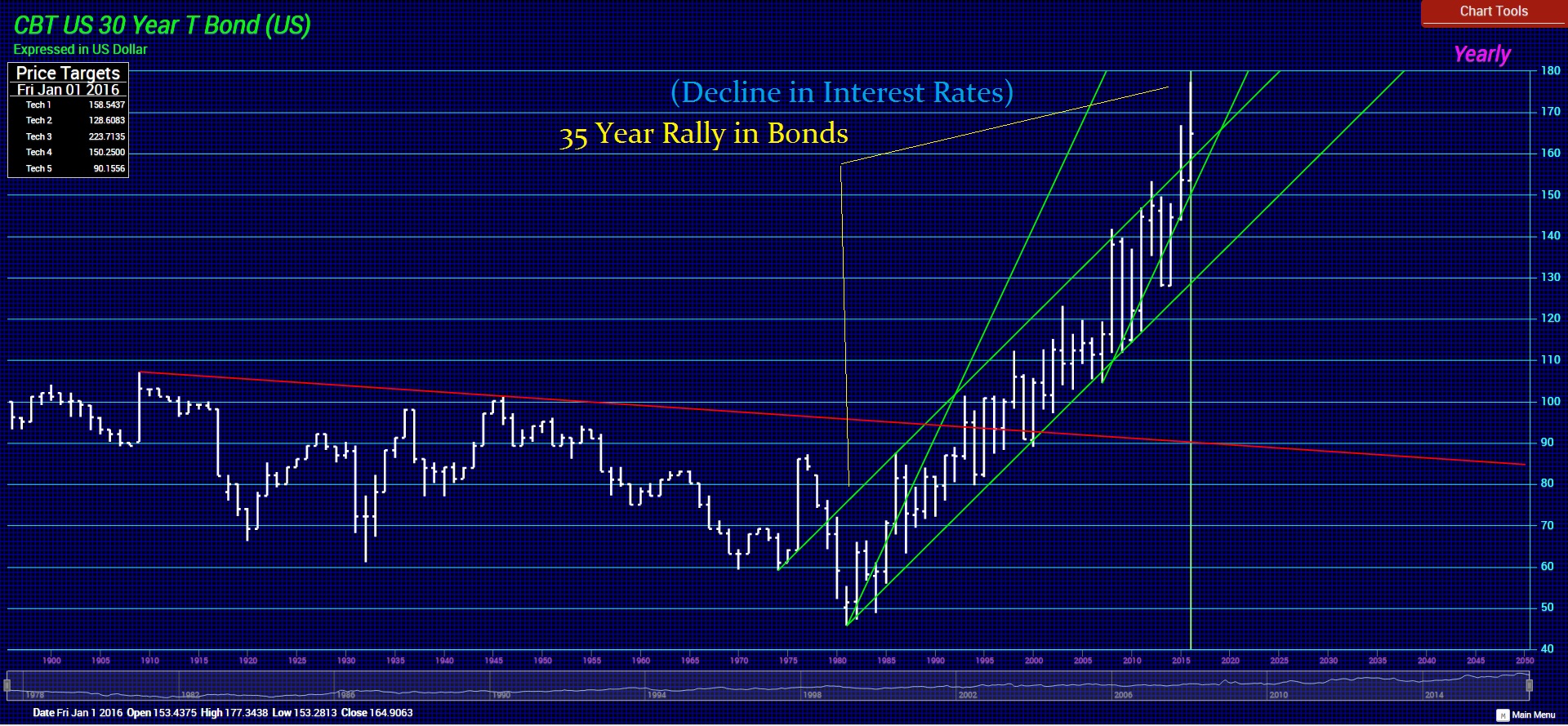
Then there is the crisis in pensions mixed with the crisis in demographics. All the pension systems were based upon a Ponzi scheme whereby the assumed population would always increase, so the young would pay for the old. Obamacare was constructed on the same fatal flaw. Note that the trend in lower interest rates did not begin with the 2007-2009 financial crisis. Pension funds WRONGLY assumed that government debt was safe, and as a result, many pension funds simply bought 30-year bonds in an effort to match maturity dates for pensions. That led to a strong bull market and the break-even was 8%. They kept bidding to try to lock in rates for pension payment in the future and their lack of management skills led to this 35-year bull market. Rather than picking stocks, they just believe government is the best thing since sliced bread. Now, they can no longer survive with rates this low, which is why the Fed keeps saying we must “normalize interest rates” for we will see a massive wholesale collapse in pensions. Yes, the 2007-2009 crisis helped create the final Phase Transition into a major long-term high in bonds (5,000 low in rates), but it obviously is not responsible for the 35-year bull market in bonds (decline in rates).
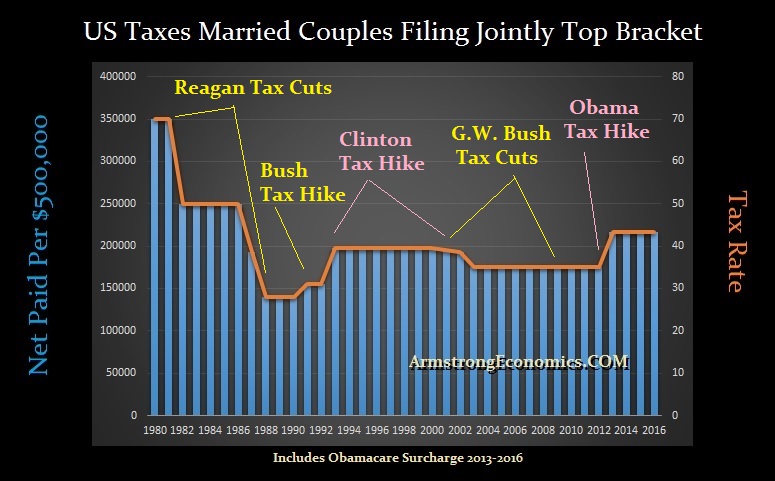
us-top-tax-policy-1980-2016
Taxes have risen sharply. Back in 1980, the tax rate was 70.0% on $600,177 for married couples filing jointly. What Clinton calls “trickle-down economics” actually worked. The top tax bracket under Reagan dropped to 50.0% on $203,661 in 1982, and it fell to 38.5% on $181,189 in 1987 for married couples filing jointly. In 1988, in response to the 1987 Crash, the rate was cut again to 28.0% on just $57,738. It then began to rise in 1991, reaching 31.0% on $138,481. Then in 1993 when the Clintons came to power, they raised the tax rate to 39.6% on $397,221. It fell back in 2001 to 39.1% on $385,487, and in 2002, it fell to 38.6% on $391,867 followed by 35.0% in 2003 on $389,249. It was raised again in 2013 to 39.6% on $440,876.

us-gdp-growth-1980-2016

When we look at the annual growth rate in the economy using GDP, nothing even came close to the surge in economic growth during Reagan’s administration. If you look to buy a car and one dealer wants full sticker and another gives you a 5% discount just 5 miles away, I think you would drive the 5 miles. Lowering the tax rate from 70% to 28% by 1987 produced the biggest surge in modern history. Yet all we hear is that trickle-down economics failed.

us-natl-debt-growth

The growth in the national debt was steadily declining, demonstrating that trickle-down worked. The debt soared during Cheney’s war. This clearly shows that it is a fallacy that war is good for the economy. True, it worked with World War II only because 40% of the workforce had been farmers displaced by the combustion engine and the Dust Bowl.

us-interest-expenditures

The other fallacy being totally overlooked is that under Obama, the interest expenditures have soared despite the fact that interest rates have declined. Under Reagan, the national debt was $1.029 trillion, and under Obama, as of September 2016, it stands at $19.528 trillion. If interest rates today were 8% as they were under Reagan, the interest expenditures along for the year would be $1.6 trillion.
Hillary will raise taxes again. Every Democrat has done that except Kennedy, who also cut taxes like Reagan. Government is growing and it is consuming all the productive forces within the economy, and regulation like FATCA is destroying international trade. There is nowhere to go but down. This was not set in motion by 2007-2009. That was simply the catalyst, but not the total cause.

World Capital Flows


russia-capital-flows-10-13-2016

QUESTION: Marty, can you say what the actual capital flow number was per month?

ANSWER: The net foreign private inflows were $113.0 billion, and net foreign official outflows were $39.3 billion for August on securities. That is cash, minus trade. So this is the amount of money running into money instruments.

Dow Looking Forward for Week of 10/17/2016


djind-w-10-16-2016

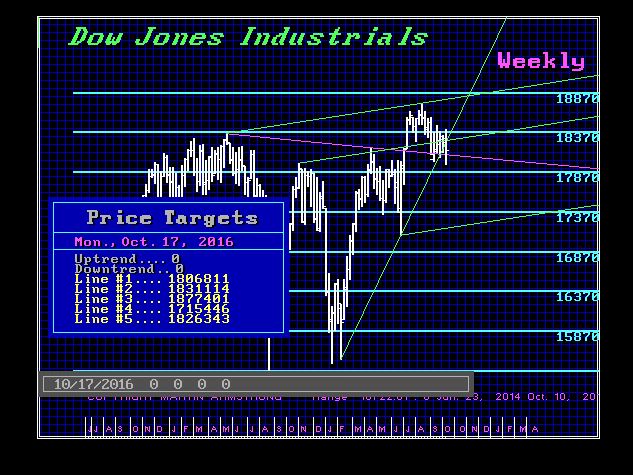
Apparently, there are a lot of people calling for a crash in the stock market as usual claiming it looks just like 1987. Sorry, there is nothing of that magnitude showing up at this time. We did elect one Weekly Bearish Reversal back at 18368. However, the main bank of support lies at 17710 followed by 17330. Only a weekly closing below 17330 would hint of a more serious correction. We did rally back and closed above technical support at 18068 last Friday. Now we need to pay attention to this area for a breach of 18050 should mean PAY ATTENTION. A break of 17990 will be more of a warning and this means last week’s low of 17959.95 comes into play. This would warn of a possible drop to 17710.

djind-for-w-10-16-2016

Note this this coming week is a Directional Change as well as a turning point. Note that we have turning points every other week right now so the pattern looks to be choppy. The key week appears to be the week just after our conference, November 14th. The two primary targets remains November and January.

A weekly closing back above 18370 will signal a rally ahead. Until then, we are retesting support.

Red alert: Prepare for severe stock market crash, warns HSBC


Lets hope that is wrong!

The Relocation of the Financial Capitol of the United States


1st-bankofus

QUESTION:  Hi Marty,
I have a question for you on the movement of the financial capital. Is there a reason it moved to NY (as apposed to VA, MA, or MD) in 1914? Also is it possible to predict what region in china it will move to, or can we just assume it will move to Beijing.
Thanks for all your hard work. I read your blog for breakfast.
-AM

2nd-bank-of-usa-c

ANSWER: Philadelphia was the financial capitol of the United States. That is where the Bank of the United States began, and to this day, you can go to dinner on Chestnut and Walnut Streets at many fine restaurants that were once banks. That was banker’s row until the state sovereign debt crisis of the 1840s, thanks to Andrew Jackson. The Second Bank of the United States is now a museum. This was the bank that Jackson attacked.

cooke-jayJay Cooke was the first “Primary Dealer” to sell government debt for the Civil War, and he was the real financier of the Civil War. He is considered to be the first major investment banker in the United States. Cooke embraced technology by adopting the telegraph and thereby establishing the first wirehouse firm. He used the railroads to distribute bonds to people around the nation. This is why Lincoln went to Cooke to sell debt. The Panic of 1873 ended Jay Cooke & Company.

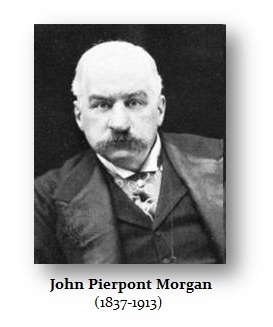
morgan-jpWith the collapse of Jay Cooke & Company, the field opened. The next man to fill that role was none other than J.P. Morgan, who also began in Philadelphia. J.P. Morgan moved the financial capitol of the United States to New York City. It was from there that he organized the gold loan for the United States during the Panic of 1896. That is why New York is New York. It was not Wall Street and the stock market, it was the banking center and insurance center that was given life by J.P. Morgan.

There has always been a rival against New York for it sees itself as the real capitol of the United States since that is where Washington was sworn in. The capitol moved south after Alexander Hamilton struck a deal with Thomas Jefferson to allow a national debt. Jefferson demanded the capitol move to his state, Virginia.