Gold to be or Not to Be


gold-bugs

QUESTION: Marty; I won a bet against a goldbug. He bet gold would soar and the dollar would crash October 1st because of the SDR and said you would be exposed as a fraud. I won the $100 bet. I tried to bet an ounce of gold, but he would do that.

I too studied Latin. Remember Julius Caesar your favorite: Fere libenter homines, id quod volunt, credunt – People almost always willingly believe what you want (De Bello Gallico, III, 18). That is their whole problem. They want something so bad they are blind to everything around them. You can lead a horse to water, but you cannot make him drink.

With gold down at 1275, when is your next video update?

CB

ANSWER: Yes I admired Caesar. But he forgave his enemies and they killed him for his generosity.

You cannot enlighten certain people because they have too much invested in their beliefs. There are people who will vote for Hillary no matter what as there are people who will vote Republican no matter what. There is always those who just believe and never question.

I will update a video soon. The timing is not right for gold to break out. It failed to elect the Monthly Bullish and then failed to elect the Quarterly Bullish Reversal despite the fact it was much lower. Gold rallied right to that reversal and bounced off. That was the kiss of death.

People are still uncertain about the future. They have no idea which way to go with this year from Political Hell. Will do a Private Blog Update for tomorrow.

Gold – Dollar – Bonds


businessman_juggle_dollar_symbols_150_clr_18746

QUESTION: Hi,
I have two questions:
a) do you believe US dollar has been kept artificially lower than it should be (or at least in long range trading range) by at least two central banks lately? if so how long you think it would last, years?
b) you remind many times gold does not yield so investors should avoid it at any cost – as the most investors have done. benefits of stocks are clear but why many investors still buy / have bought bonds even with negative interests or buy fiat currencies with very low interest levels.
BR, J

ANSWER: Yes. The central banks have been trying to keep the dollar down because a rising dollar will undermine Europe exposing the ECB total failure, and then there is the risk of major sovereign defaults among emerging markets who issued their debt in dollars. The IMF has lobbied hard with the Fed pleading not to raise rates for this fear of capital pouring into the dollar. They do not appear to be able to sustain this policy beyond January.

Gold is not something to avoid. True, institutions cannot buy gold for they earn no income. Gold is really for the individual and it will eventually be the hedge against government and the change in the monetary system which could come as early as 2018 but by 2020 if on schedule.

Gold-Fluctuated

Institutions buy bond because they simply go by the book. Then pension funds often have restraints requiring various portions MUST be in government debt to varying degrees. Social Security is only in US debt. Fiat money is currency that a government has declared to be legal tender, but it is not backed by a physical commodity according to most people. The value of fiat money is supposed to be derived from the relationship between supply and demand rather than the value of the material that the money is made of. But throughout history, ALL money has always been fiat. Bretton Woods collapsed because they continued to print money and the claimed backing was not there. So even the pretend gold standard was fiat. When money was gold coins during the 19th century, it was legal tender, not backed but anything else, and yet it still rose and fell in purchasing power. There is no such period in monetary history of such a Utopia or money remaining steady and a constant purchasing power. It has never existed.

OPEC & Manipulating Oil Prices


oil-middle-east

Electric CarsThe Organization of Petroleum Exporting Countries’ (OPEC) agreement to cut production is supposed to end Saudi Arabia’s policy of the last to years to pump-at-will. This has sent Middle Eastern economies into a tail-spin and the glut of oil has meant rising taxes and selling bonds to raise capital. With this new claimed reversal of that pump-at-will policy, there are of course the optimists who say oil should now soar, yet they overlook some very critical points. OPEC deals have routinely failed, and there is a real glut of oil in inventories, not to mention the reduction in oil demand rising from electric cars.

The EU first introduced mandatory 2015 CO2 standards for new passenger cars way back in 2009. Mandatory targets for light-commercial vehicles come into play in 2017, which was passed back in 2011. Then by the end of 2013, the EU reached an agreement that will implement mandatory 2020 CO2 emission targets for new passenger cars and light-commercial vehicles. Europe is applying these standards for 95% of vehicles in 2020 with 100% compliance in 2021 and the light-commercial vehicle standards are are required for 2020. Electric cars are becoming commonplace in Europe. Charging stations are seen just about everywhere including in London. This is not the case in the United States. Clearly, demand will decline for oil moving forward.

The optimists also overlook the reality of the oil production countries. OPEC cannot control the 60% of world production outside its membership. The United States is the largest oil producer. In the top five oil producing countries, only Saudi Arabia makes that list as number two. Of the top 10 producing countries, only four are OPEC members. The bottom line; OPEC can not manipulate oil prices any more.
2014 Country Production (bbl/day)

1 United States 11,973,000
2 Saudi Arabia (OPEC) 11,624,000
3 Russia 10,853,000
4 China, People’s Republic of 4,572,000
5 Canada 4,383,000
6 United Arab Emirates (OPEC) 3,471,000
7 Iran (OPEC) 3,375,000
8 Iraq (OPEC) 3,371,000
9 Brazil 2,950,000
10 Mexico 2,812,000
11 Kuwait (OPEC) 2,767,000
12 Venezuela (OPEC) 2,689,000
13 Nigeria (OPEC) 2,427,000
14 Qatar (OPEC) 2,055,000
15 Norway 1,904,000
16 Angola (OPEC) 1,756,000
17 Algeria (OPEC) 1,721,000
18 Kazakhstan 1,719,000
19 Colombia 1,016,000
20 India 978,000
21 Oman 951,000
22 Indonesia (OPEC) 911,000
23 United Kingdom 906,000
24 Azerbaijan 856,000
25 Argentina 715,000
26 Malaysia 697,000
27 Egypt 667,000
29 Libya (OPEC) 516,000
30 Australia 478,000
31 Thailand 422,000
32 Vietnam 316,000
33 Turkmenistan 276,000
34 Equatorial Guinea 269,000
35 Sudan and South Sudan 262,000
36 Congo, Republic of the 259,000
37 Gabon 240,000
38 Peru 180,000
39 Denmark 171,000
40 Italy 169,000
41 Germany 160,000
41 South Africa, Republic of 160,000
43 Japan 137,000
44 Yemen 127,000
45 Brunei 124,000
46 Trinidad and Tobago 116,000
47 Ghana 106,000
48 Romania 104,000
49 Chad 103,000
50 Pakistan 98,000
51 Uzbekistan 85,000
52 Cameroon 81,000
53 South Korea 79,000
54 Timor-Leste 76,000
55 Bolivia 67,000
56 Ukraine 66,000
57 Bahrain 64,000
57 Netherlands 64,000
59 France 61,000
59 Turkey 61,000
61 Tunisia 59,000
62 New Zealand 50,000
63 Cuba 49,000
64 Spain 40,000
65 Poland 39,000
66 Ivory Coast 37,000
67 Papua New Guinea 34,000
68 Syria 33,000
69 Belarus 32,000
70 Austria 27,000
71 Philippines 26,000
72 Hungary 25,000
73 Taiwan 22,000
74 Albania 21,000
74 Myanmar 21,000
78 Congo, Democratic Republic of the 20,000
78 Niger 20,000
78 Singapore 20,000
81 Croatia 18,000
82 Chile 15,000
82 Virgin Islands, U.S. 15,000
84 Guatemala 14,000
84 Suriname 14,000
86 Belgium 13,000
86 Estonia 13,000
88 Sweden 12,000
89 Czech Republic 11,000
90 Finland 10,000
91 Lithuania 9,100
91 Slovakia 9,100
93 Greece 8,700
94 Portugal 7,100
95 Mauritania 6,000
96 Palestine 5,800
97 Morocco 5,100
98 Bangladesh 4,800
99 Switzerland 3,900
100 Bulgaria 3,400
101 Aruba 2,800
102 Jamaica 2,100
103 Paraguay 2,000
104 Belize 1,800
105 Netherlands Antilles 1,500
106 Uruguay 1,200
107 Barbados 1,000
107 Georgia 1,000
107 Latvia 1,000
110 Ireland, Republic of 900
111 Puerto Rico 700
112 Costa Rica 300
112 Slovenia 300
114 Jordan 200
114 Malawi 200
114 Tajikistan 200
114 Zambia 200
118 Ethiopia 100
118 Hong Kong 100
118 Zimbabwe 100

Understanding Deutsche Bank’s Possible Bail-in


Deutsche_Bank_Frankfurt

Chancellor Merkel cannot afford to bailout Deutsche Bank from the point of view of foreign policy perspective within the EU since she has taken such and intolerable hard line in the Italian bank rescue not to mention Greece. On the other hand, Deutsche Bank is different since it is the primary clearing bank in Europe. Any bail-in is more likely to take place by wiping out its bonds called CoCos which have no maturity date. Indeed, investors may never get their money back. Under the terms, the bank can redeem them, usually after five years if it wants to. The annual coupon payments are contingent on the bank’s ability to keep its capital above certain critical threshold levels. If the bank’s capital falls below that threshold, the bank won’t make the coupon payment. Investors cannot call a default on these bonds, and that sets them up for a bail-in. Investors are simply sitting on bonds that they bought because they had a 6% coupon. However, there is not maturity and no guarantee of redemption and if capital falls below the threshold they plunged in value and pay no coupon. Consequently, if regulators deem that the bank is failing, then these CoCos will be bailed-in by either being converted into declining values in shares or could be just canceled.

These 6% CoCo notes have traded as high as 104 cents on the euro in early 2014 shortly after they’d been issued, and plunged to about 70 cents and are trading in the 77 level in this latest crisis. Therefore, the CoCos are a good indication of public confidence for if investors believe those thresholds are approaching, the bank will not pay the coupon and the risk of being converted to shares rises. Of course, converting to shares at any value could be a blessing in disguise since shares can be sold.

de-y

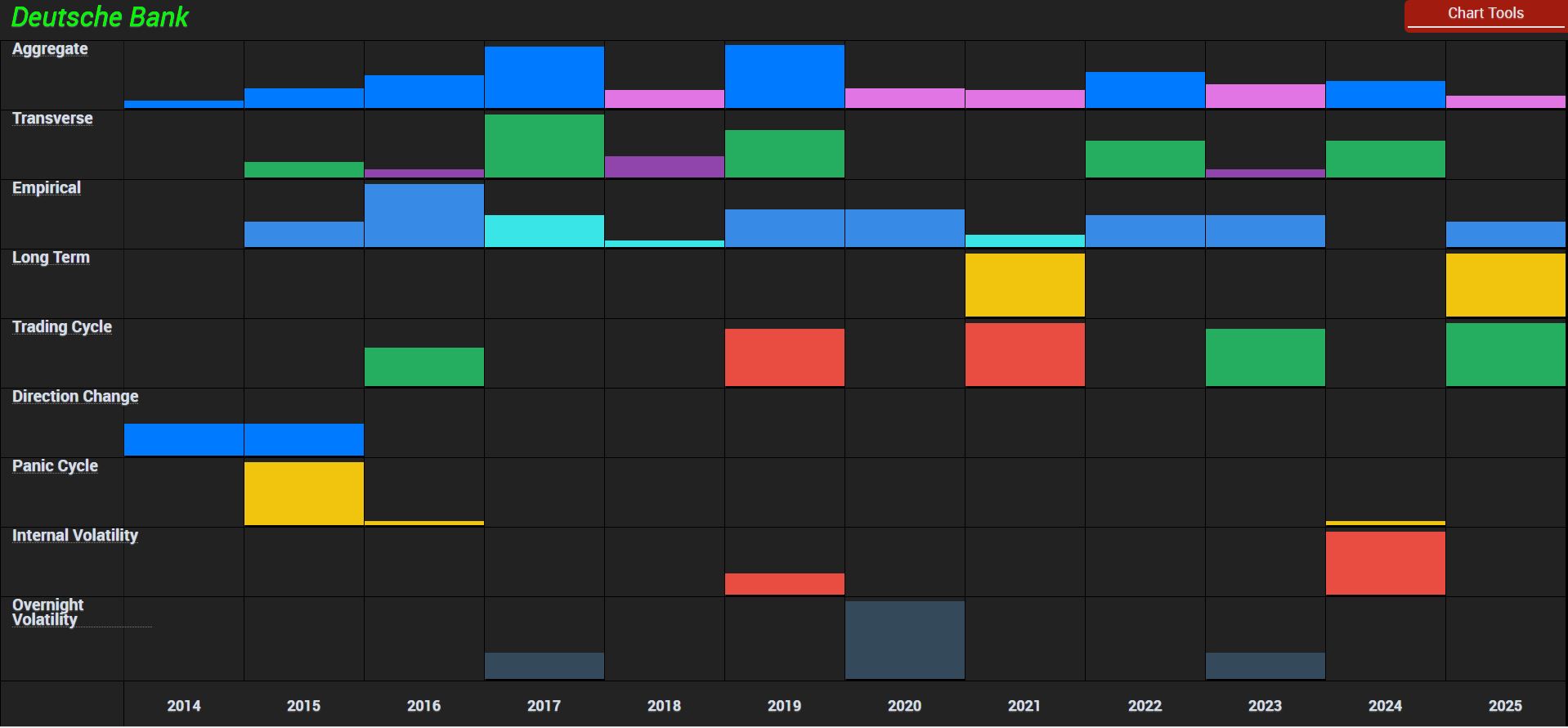
When we look at Deutsche Bank, we elected a Yearly Bearish Reversal at the close of 2015. Support lies at 8.55 and this is really important. We have reach 11.19 so far and resistance overhead will stand at 15.50. The primary target for a major turning point still appears to be 2017 whereas 2016 could produce the lowest yearly closing.

de-for-y-10-2-2016

Whatever we get in 2017, should be followed by the opposite direction into 2019. This means a rally into 2017 without making a new low under 2016 levels, would most likely result in a Knee Jerk reaction high (one time unit). This becomes possible only if we exceed the 15.50 level. Even that is minor for the Monthly Bullish Reversal really cap this stock standing at 17.90 warning it is not over just yet.

defor-m-10-2-2016

The timing Array in Deutsche Bank has been targeting September all along. There are back to bank Directional Changes for September October and the next main target for a turning point is November. The Panic Cycle play out well for September as well. This all warns that is last week’s low holds, a bounce into November becomes possible.

Romans Landed in America and Sent Ambassadors to China


urma-okinawa-runins

roman-coin-discovered-in-japanHistory is being rewritten all the time for the timeline of the past is far from definitive. Ancient Roman Coins issued under Constantine I the Great have been excavated from the ruins of a castle in Uruma, located in Okinawa Prefecture., This is the first such discovery made in Japan of Roman coins. Four copper coins were discovered in the ruins of Katsuren Castle. This location was actually only in existence from the 12th to 15th centuries where the coins were from the 4th century.

We do know that Okinawa traded both with China and Southeast Asia. These coins are curious since this is from the dark period of Japan when the only coins used were all foreign. Yet the history of Rome that claimed to rule the world (orbis terrarum) stood at the opposite end of the world from the strikingly similar Han Dynasty (206BC-220AD) in China, which also claimed to have ruled the world (tianxia). There is the History Book for Tang-Dynasty in China covering the period 618-907AD. Yet the text mentions 17 times what appears to be the Roman Empire. It also describes an envoy that was sent by the Roman Emperor to China. The Roman Emperor was recorded to have been “Anton“. The account of such an envoy who visited the older Han Dynasty predates the Venetian traveler Marco Polo (1254-1325) by more than 1,000 years. This envoy has been attributed to 166AD during the reign of Marcus Aurelius Antoninus (121-180AD). It is the death of Marcus Aurelius, that has marked the peak in the Roman Empire and the turning point that begins the Decline and Fall of the Roman Empire where its monetary system collapses just 72 years thereafter. This envoy established diplomatic contact at the peak in the Roman Empire from which a disastrous decline begins. Any political-economic aspirations to further such a relationship would then die with Marcus Aurelius. Yet also, both empires would suffer the same fate of barbarian invasions. The Han Dynasty falls in 220AD from which emerges the chaotic period known as the Three Kingdoms (220-280AD) – the division of the once unified Chinese Empire.

roman-swordRoman artifacts have been discovered also in Canada. This clearly establishes that the ancient Roman sailed across the Atlantic long before Columbus or the Vikings. This discovery in Canada has created a storm for it rewrites history. The unquestionable discovery of a Roman sword in Canada is rather stark evidence that history is different from what academics believed.


These discoveries are significant for they confirm world travel and trade. This is up there with the discovery of the Cocaine Mummies from Egypt confirming trade between Africa and South America.

Sears – What Comes Next?


sears-logo

sears-catalogueSears, Roebuck & Co. is an American department store that was founded by Richard Warren Sears and Alvah Curtis Roebuck back in 1886. It was based originally in Chicago and it gave birth to the mail order industry. It was the Amazon of the 19th century. Sears issued catalogs that were distributed throughout the country by the railroads. You could order products from Sears and everything would be delivered by railroad.

Sears began opening retail locations in 1925. The company was eventually taken over by the American Kmart chain in 2005, which had just emerged from bankruptcy itself, and they renamed the company Sears Holdings. Sears was the largest retailer in the United States and peaked with the Economic Confidence Model 1989.95. It was in 1989 when Walmart surpassed Sears. Sears was still the 5th larges by sales in 2013.

Nonetheless, there is speculation that Sears will be bankrupt by 2020. The name-brand belongs to an older generation. Nevertheless, 2015 represents five 8.6-year cycles and it is curious that ever since it has hit that timing mark, the speculation of bankruptcy began. Sears spun off a real estate investment trust (REIT) Seritage Growth Properties (SRG) in 2015 to raise about $2.7 billion in cash. While its shares are up 28%, there could be a serious cash-flow problem if Sears goes bankrupt since the property it now rents could be in real trouble.

A “Lehman Moment on Steroids”


This is a very real problem!

Financial Capitol of the World & Its Migration


WorldEconomy

QUESTION:

I am a great admirer of your Socrates model, but there’s one thing in your personal pronouncements that seem to contain a contradiction. On the one hand you are predicting a decline of the U.S.A. and other western economies, mainly caused by excessive government interference in the economy. However, on the other hand you are predicting a rise in the prominence of China occurring simultaneously with the decline in the Western economies, yet the Chinese economy is still dominated by State-owned enterprises (SOEs) and that is unlikely to change anytime soon. Can you please explain this apparent contradiction?

Also, you (perhaps justifiably) continually put the boot into Western governments for their excessive involvement in their economies and yet you rarely, if ever, criticise the Chinese government’s heavy involvement in the Chinese economy. Why the double standard? Is Socrates is actually predicting a near-term decline in Chinese government involvement in their economy? And is there an allied Socrates prediction for increased democracy in China in the near-term?

Thanks for your great service,

Andrew.

ANSWER: You are missing the timing and overlap. It is true that the Chinese government is still trying to manage its transition to a free economy. Ultimately, that will happen. However, the difference between the former communist regions such as Europe, Russia, and China, in comparison to Western Europe, such as North America, Australia, New Zealand, and Japan, is significant whereas the former region has people who do not depend on government and the latter still expects government to be there to take care of us until we die. A collapse in government in the former communist regions will not be as devastating to the common people and it would be in the Western developed world. China and Russia learned that Marxism failed. It is simply our turn in the West to experience the same as they did with the collapse of socialism.

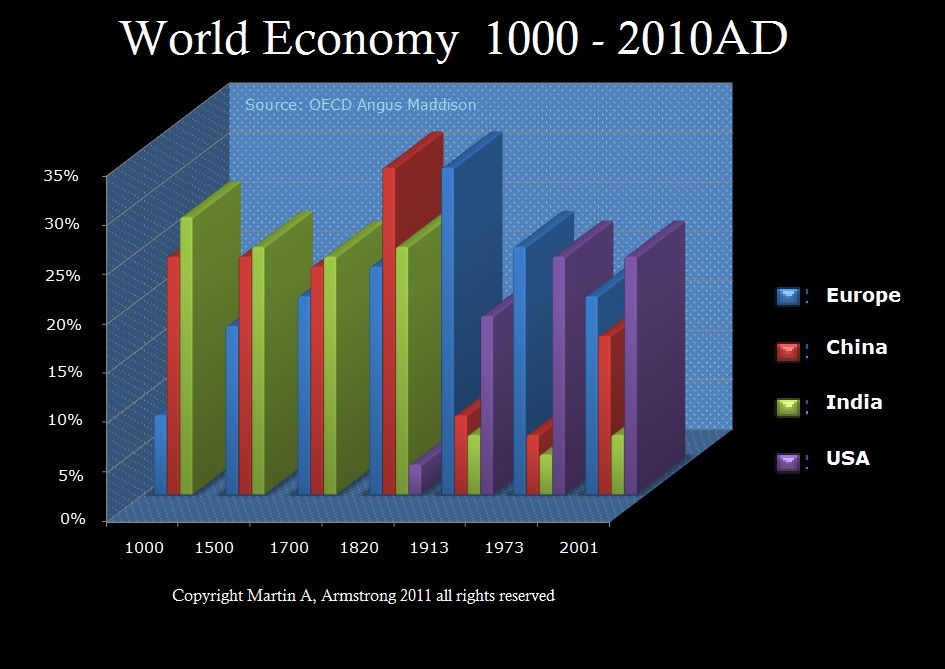
After 2032, the financial capital of the world will simply migrate to China. It always migrates. You are assuming that the government of China will survive in its current form. They too will change and alter. In the West, governments are not interested in reform. They are only interested in holding on to power. This is simply how empires, nations, and city-states have always historically failed.

China is moving through its reform stage that began in 1989.95. We should see the first political shake up by 2021/2022. That is simply how long it will take from the beginning in 1989.95. They are simply at a different point in their own cyclical history.


The Fish Bowl Economy & Academics


fish-bowl-economy

QUESTION: Hi Marty, I hope you’re doing well. Having been a follower of yours for some time now, and been enlightened from that, I am ever in your debt for what you have shared and (hopefully!) will continue to share. I am an economic history student studying at the University of Edinburgh, and I have to say the professors are consistently bamboozled when I bring anything up that I read on your blog! I am going into my second year now and am in particular very much interested in population flows. I am trying to set up my own ‘database’ to store all of this information and subsequently start creating my own analyses in a similar image of our dear friend Mr. Socrates. To get to my point, I am wondering how you went about initially setting up Socrates, what sort of coding or programs you were using and if there were any big potholes to try and avoid when setting up something like this? I am in absolute awe of Socrates and yourself, but I am enticed by the challenge of doing something I can call my own. Any help at all is very much appreciated I hope to hear from you soon!

Kind regards,

C

ANSWER: Yes, you will find traditional economics fall short of reality. They rest upon supply and demand, yet assume they can stimulate demand with Keynesian economics to raise or lower interest rates. They are clueless with regard to international trends because that would mean that they could not manipulate any economy, for there are always external factors they have no control over. Consequently, all theories are based upon what I call the “Fish Bowl Economy” that assumes everything is self contained and nothing external will enter their perfect world.

From a programming standpoint, there are no off-the-shelf programs to do what is necessary. Languages are really much the same. VB and C are the main languages, but then there are specialties like Prologue, etc. I was always into artificial intelligence from the start. The pitfall to avoid is to NEVER presume anything. Just let the data reveal the truth. As soon as you make an assumption, you will fail. Migration has always contributed to dictating the rise and fall of nations. Let the data show you the way. That is the exciting path to discovery.

World Trade Collapsing On Schedule


world-trade-2

The World Trade Organization (WTO) has warned that there is a “dramatic slowing of trade growth” unfolding. The WTO has revised downward its projections, saying trade is now on track this year to grow at the slowest pace since 2009.

The hunt for taxes is destroying the world economy and on January 1, 2017, all governments will begin sharing info on foreigners. The assumption is that anyone doing anything outside the USA is hiding money from taxes. With this attitude, world trade will continue to collapse into 2020.