
Armstrong Economics Blog/Ancient Economies
Re-Posted Jan 7, 2017 by Martin Armstrong


QUESTION: Hi Martin!
I have been enjoying readings in your rich (in knowledge) website and writings in my vacations here in Southern South America. Between one coffee and another I printing articles and writings in order to “connect de dots” as you use to say. That is being a pleasure.
My question is on your article from 9th November in 2013. That’s outstanding, by the way, I really liked that. It makes me happy once you make connections throughout history of human civilization. I do appreciate that.
The name of the article is “Deflation – The Great Equalizer – Now Greece? Was There a Different TESTED Response in History? YES!”
Was astonishing to me the initiatives form the Emperor Tiberius (14-37 AD) and the fact that it worked as you said!
Therefore, I am wondering on the following points:
a) Where can I find (book references) more about these initiatives to fix the economy made from Emperor Tiberius? Which book you would recommend on Roman Empire focusing in this economics view?
b) Where can I find some source with regard “call money rate” of the countries around the world or at least from some of them?
Thank you very much for your attention and hard work!!
All the best!
Warm regards,
RS
ANSWER: There is no single source from which I can draw everything. “The Decline and Fall of the Roman Empire” by Edward Gibbons is probably the best single source, but this does not focus upon the economics. I put together the Panic of 33 AD from various sources using Tacitus as well as the coins themselves. You will find some of the the digital versions on this site under “books.” I prefer contemporary historians to modern ones who interject their interpretations. I also recommend “Historia Augusta.” You can also see how I have brought together all the key sources from ancient times by recording the economic crisis of the first Roman Civil War.
Plutarch (c. 46–120), recorded the personal lives of important Greeks and Romans
Gaius Cornelius Tacitus (c. 56 –c. 120), early Roman Empire
Suetonius (75–160), Roman emperors up to Flavian dynasty
Appian (c. 95–c. 165), Roman history
Arrian (c. 92–175), Greek history
Lucius Ampelius (3rd century AD?), Roman history
Dio Cassius (c. 160–after 229), Roman history
Herodian (c. 170–c. 240), Roman history







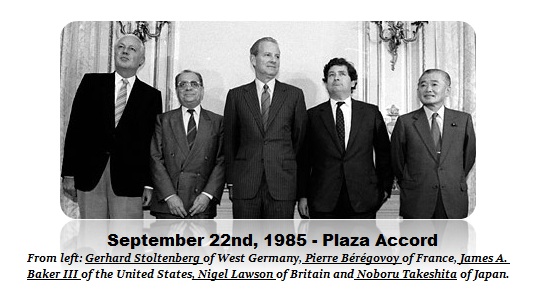


 I was advising the equivalent of about 50% of the value of the US National Debt at that time. The Japanese to ease trade restrictions, had been buying US debt and owned bout 33% of the US national debt at that time. I warned the Treasury that to lower the value of the dollar by 40% as the Plaza Accord said that was their goal, the would set off a crash and higher volatility because foreign investors will be forced to sell and exit the dollar. Yes, the value of exports would look good to foreign consumers, but US assets would also look like a sell. Capital will move to the most advantageous location globally because we are all connected.
 On May 28th, 1997, again I wrote to then Robert Rubin who was Secretary of the Treasury. Rubin was doing the same thing and trying to talk the dollar down criticizing the Japanese. Our models were warning of another crash and indeed it hit within just a few weeks of my letter and became known as the Asian Currency Crisis. The Asian financial crisis was a period of financial crisis that gripped much of East Asia beginning in July 1997 and raised fears of a worldwide economic meltdown due to financial contagion. Indonesia, South Korea and Thailand were the countries most affected by the crisis.
 Centinel2012