As Lyft, the ride-sharing company, prepares to go public, it announces its intention to kill personal car ownership, boasting that some 300,000 people have already kicked the car habit thanks to Lyft. What does America gain and lose in the transportation as a service economy? Bill Whittle Now is a production of the Members at http://BillWhittle.com
Captain Marvel star Brie Larson seems committed to alienating white males — the Marvel Comic Universe base. While on a promotional tour for the new movie, talks smack to attack the very people who form the lifeblood of her potential box office. Right Angle is a production of the Members at http://BillWhittle.com
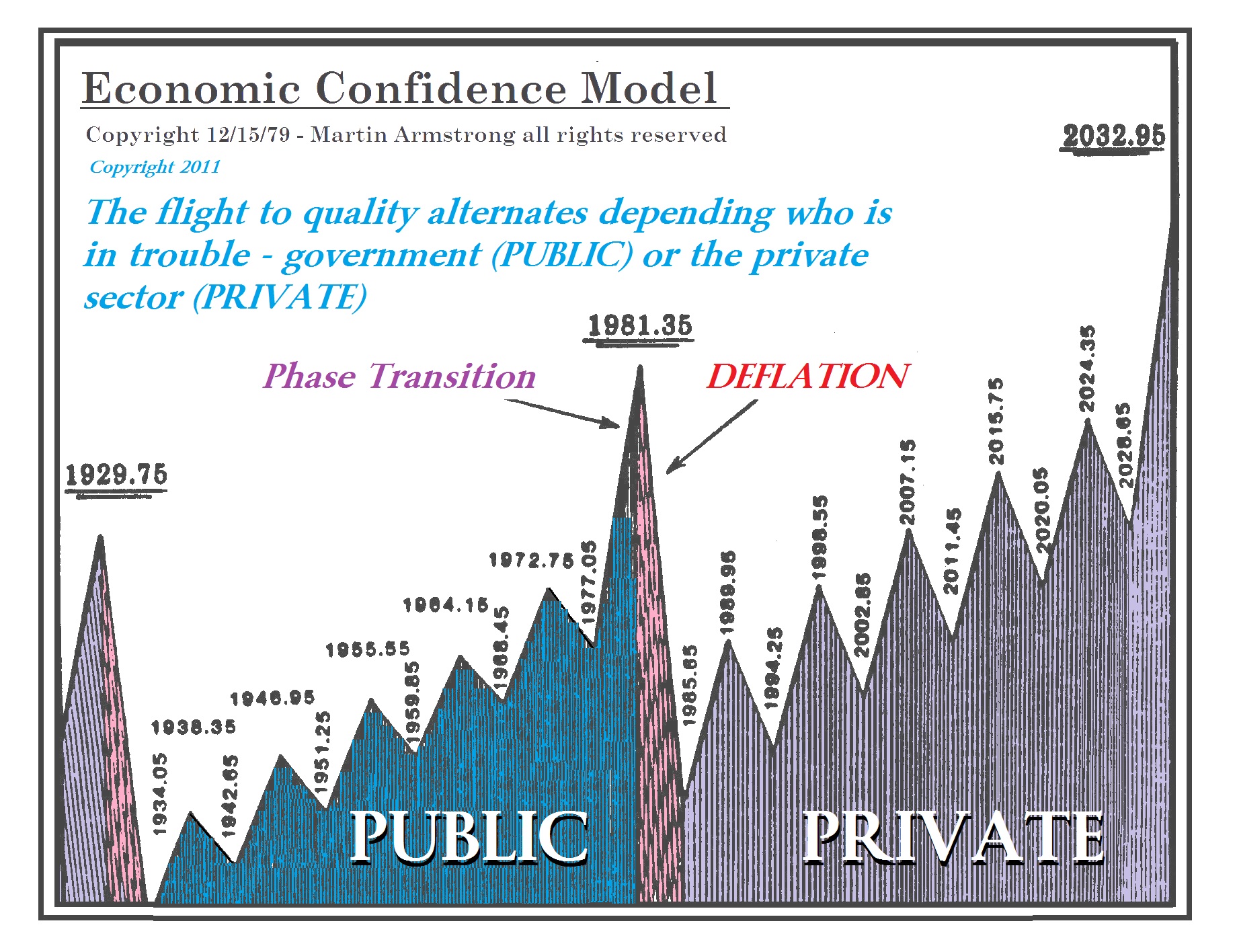
The results of my life research, reading every newspaper story going into the bull market of the Roaring ’20s and the Great Depression revealed that before the high in 1929, when interest rates were rising, people interpreted it as BULLISH for it demonstrated that there was STILL a demand for money. Indeed, interest rates decline when people are not interested in borrowing, and as such, stock markets historically decline. It was this correlation that revealed the shift in confidence between the PUBLIC sector and the PRIVATEsector.
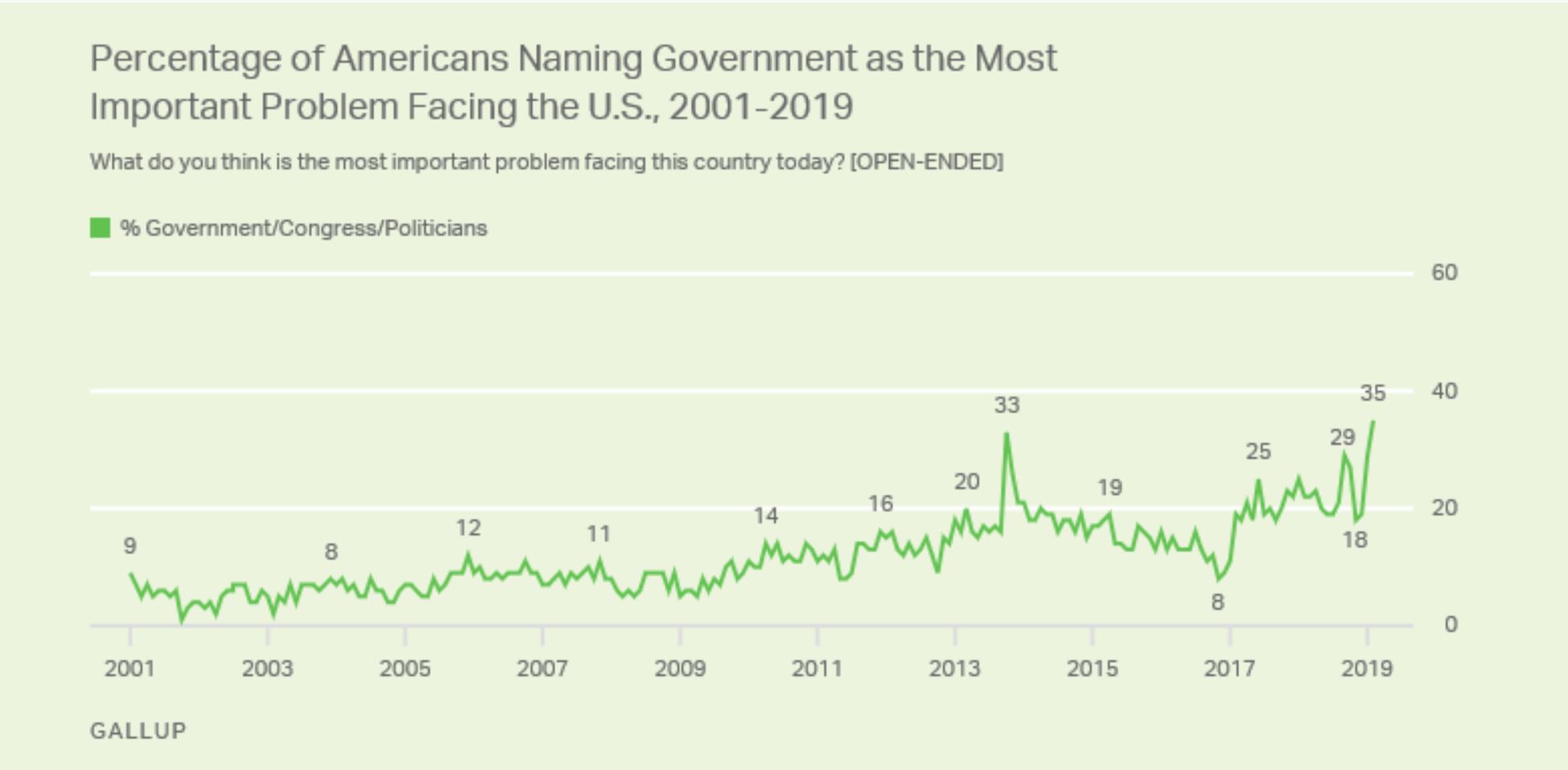
Following the Great Depression, the confidence shifted to government with FDR’s New Deal. That is when the bond market outperforms stocks as the confidence shifts. In the current wave, the confidence has shifted back to thePRIVATE sector and this is what the Gallup Poll is showing — 35% of American believe that the government is the NUMBER ONE PROBLEM.
Indeed, 42% of Americanshave identified themselves as independents in 2017, up from 39% in 2016. Everything that the model has been forecasting has been spot on.
A November Gallup poll found that 54% of Democrats were actually Democratic-leaning independents who wanted the party to become “more moderate,” while only 41% wanted it to be more left. That contrasted with the Republicans and their allies, 57% of whom wanted a more conservative party with less government and lower taxes. Meanwhile, the most startling Gallup Poll to date, taken on Feb 18th, 2019, after the midterm elections, reported that 35% of Americans now believe that government/leadership is the top problem facing the country. Only 11% cited Donald Trump while 18% cited gridlock.
In politics, as of February 2019, the Gallup Poll shows it is a dead heat between people who identify themselves as Democrat (30%) or Republican (31%). However, those who identify themselves as independentcame in at 37%. Now there are more people joining the ranks of independent than there are party members on either side. Fox News has replaced CNN as the #1 news station and Fox was ranked the “most trusted”American TV news brand in the United States. It came in second just behind only the British-based BBC. Yet in Britain itself, only one in six people trust the BBC.
At almost the exact same time Speaker Nancy Pelosi brings an anti-bigotry resolution to the floor for a vote, representative Alexandria Ocasio-Cortez sends out a campaign email proclaiming the Jews are out to get her.
Too funny… Here’s both stories. First the vote:
(Via AP) – 5:35 p.m. -The House has passed a resolution condemning anti-Semitism, discrimination against Muslims and other bigotry against minorities.
The 407-23 vote Thursday was a bid to end dissension among Democrats over congresswoman Ilhan Omar’s latest remarks on Israel. Omar said the Jewish state’s allies pressure lawmakers to pledge “allegiance” to a foreign country. (more)
Now, here’s the corresponding campaign email from Alexandria Ocasio-Cortez:
President Donald Trump and First Lady Melania Trump welcome Czech Prime Minister Andrej Babis and Madame Monika Babisova to the White House in advance of a bilateral meeting between the two leaders. [Video and Transcript]
.
[Transcript] Oval Office – 1:55 P.M. EST – PRESIDENT TRUMP: Well, thank you very much. It’s a great honor to have the Prime Minister of the Czech Republic. Prime Minister Babiš and Mrs. Babiš, thank you very much for being here. It’s a great honor. Great country.
It’s — Czech Republic doing very, very well economically and all other respects. A very safe country. Has always been a very safe country. A strong military. Strong people. And we have a very good relationship with the Czech Republic in the United States. We do a lot of trade and a lot of — just about everything you could imagine.
But I just want to say, Mr. Prime Minister, it’s a great honor to have you. Thank you very much.
PRIME MINISTER BABIŠ: Thank you.
PRESIDENT TRUMP: Thank you. Please.
PRIME MINISTER BABIŠ: So, Mr. President, Mrs. Trump, thank you very much for your warm welcome to the White House. It’s a great pleasure for me and my wife to be here.
Our countries have been allies since the United States helped establish our first republic 100 years ago. And it’s a very symbolic day today, Mr. President, because today is the birthday of our first president, Tomáš Garrigue Masaryk. And he, by the way, was happily married to an American.
PRESIDENT TRUMP: Ahh —
PRIME MINISTER BABIŠ: So we are allies in NATO. We commemorate our joining 20 years ago. We will — we will — it is on next week, on 12 March. And our soldiers are fighting alongside these U.S. soldiers —
PRESIDENT TRUMP: That’s right.
PRIME MINISTER BABIŠ: — against the international terrorists.
PRESIDENT TRUMP: That’s right.
PRIME MINISTER BABIŠ: Czech Republic is a great country. A small country but very beautiful, and the sixth safest in the world. And this year, we celebrate 30 years since the Velvet Revolution, when the Czech people finally gained democracy and freedom.
So, Czech people are creative, innovative, great people. You said in Brussels.
PRESIDENT TRUMP: Yes.
PRIME MINISTER BABIŠ: Yeah.
PRESIDENT TRUMP: That’s true. That’s true.
PRIME MINISTER BABIŠ: And with unlimited potentials. And our bilateral business relations are growing.
PRESIDENT TRUMP: Right.
PRIME MINISTER BABIŠ: Our investors are investing in the U.S. and already created thousands of jobs.
Mr. President, I watched your 2019 State of the Union Address, and I perfectly understand your plan: how to make America great again. I have a similar plan to make the Czech Republic great again.
So I look forward for our discussion about international trade, energy, safety, and threats like cyberattacks and —
PRESIDENT TRUMP: Yeah.
PRIME MINISTER BABIŠ: — illegal immigration and, of course, the international terrorists.
So thank you again for — to receive us here.
PRESIDENT TRUMP: Well, thank you very much.
PRIME MINISTER BABIŠ: Thank you. Thank you.
PRESIDENT TRUMP: It really is an honor and it’s a great country, and it is a very creative country. We’re working on cyber and many other things together, and working very well.
So I just want to thank you both for being with us and on behalf of the First Lady. And you did a great job this morning, I understand, at the State Department. Melania was very well received this morning by a lot of people. So thank you very much. Great.
Thank you, everybody. Thank you very much.
Q Mr. President, is there talk of pardons between your representatives, your lawyers, and Michael Cohen’s legal team?
PRESIDENT TRUMP: Thank you all very much. Thank you all very much.
Q Mr. President, trade between Czech Republic and the United States it’s growing just right now. Very good —
PRESIDENT TRUMP: Say it?
Q — very high numbers. But the potential tariffs on the cars could be very harmful to the Czech economy.
PRESIDENT TRUMP: I don’t — I don’t understand.
Thank you.
Q Are you disappointed in Kim Jong Un? Are you disappointed about Kim Jong Un and the nuclear activity in North Korea?
PRESIDENT TRUMP: A little disappointed. A little bit.
Q (Inaudible.)
PRESIDENT TRUMP: We’ll see. We’ll let you know in about a year.
There was a little funny moment as the Czech couple first arrived to the White House and the President and Prime Minister headed inside without the customary front door picture. First Lady Melania Trump and Mrs. Monika Babisova shrugged and laughed it off.
Economic analysis can get weedy…. so a simple way to look at productivity is to think about baking bread in your kitchen.
If you were going to bake 4 loaves of bread it might take you 2 hrs start to finish. However, if you were going to bake 8 loaves of bread it would not take you twice as long because most of the tasks can be accomplished with simple increases in batch size, and only minor increases in labor time. Your productivity measured in the last four loaves is higher.
Economic Productivity is measured much the same way, within what’s called a production probability equation. Additionally, if two hours of your time are worth $40, each of four loaves of bread costs $10; but if you make 8 loaves in the same amount of time the labor cost is only $5/per loaf.
From 2007 through 2017 the average rate of productivity increase was 1.3%. In the fourth quarter of 2018 productivity was 1.9%. That means total business output increased as more product was demanded from within the business operation. Throughout the economy people just wanted more stuff. However, the most important numbers for MAGAnomics (Main Street USA) center around manufacturing and durable goods.
Improved gains in efficiency/productivity (more bread needed) supports faster economic growth without generating higher inflation; no need to raise prices because your cost to make each loaf of bread decreases the more you make. Higher sales and lower per unit cost means more profit for the bread-maker. No need to raise prices. Without inflation, there’s no motive for the Fed to raise interest-rates.
Increases in productivity generally means the economy is generating more stuff. The more stuff generated the higher the value of all economic activity; this increases GDP growth.
When we see higher productivity in direct alignment with GDP increases, the increased production indicates sustainable GDP growth.
BLS Report: “Manufacturing sector labor productivity increased 2.0 percent in the fourth quarter of 2018, as output increased 2.7 percent and hours worked rose 0.8 percent. Productivity increased 3.3 percent in the durable manufacturing sector” (link)
In durable goods we made 6.1 percent more stuff, and only worked 2.7 percent longer. The net is a 3.3 percent productivity increase. This sector is critical because most large capital investment surrounds manufacturing. There is a lag between investment, getting the manufacturing machines and buildings in place, and then actually starting the operation.
As we can see overall real wage growth continues to outpace inflation by about 1 percent. That means more money in workers pockets, and more actual disposable income. [Keep in mind this are national averages; there are regional averages much, much, higher.]
Durable good productivity increases (3.3%) are a key sign the economy is continuing to expand. People are in need of more stuff; businesses are producing that stuff to meet the consumer demand. Increased hiring; more overtime; longer work shifts; longer production runs; more operational time on the equipment; less down time; all of this indicates the U.S. Main Street economy is expanding at a strong and steady rate.
Detractors will point to productivity gains from 1987 through 2004 as being stronger. However, that’s a false comparative metric. That historic period included the massive rise of computers and mobile technology which over-inflated the traditional baseline for strong structural productivity increase.
Back to the bread analogy…. Think of ’87 – ’04 like a period where you went from having to mix and kneed bread dough my hand, to a period where you have a new fangledelectronic mixer to do the work. Obviously you cannot duplicate that initial technological jump in bread dough productivity. So comparisons to this historic period are false metrics.
Right now companies are hiring, real wages are growing, productivity is growing, and outputs are increasing as a result of continued, strong consumer demand; and keep in mind…. all of the new trade deals have yet to come into play. The outcome of the trade reset will mean even more investment inside the U.S. The future is bright…
Main Street is strong !
Bloomberg
✔@business
For years employers have complained about labor shortages. Since then they have managed to hire another 18 million people https://bloom.bg/2EJlmvQ
America’s Job Market Is Defying Employer Labor Shortage Reports
Interpreting job market anecdotes in the Federal Reserve’s Beige Book survey of regional businesses is more art than science — and it’s the kind of art that demands a skeptical eye.
A hot US job market is coaxing people in from the sidelines
WASHINGTON (AP) — A surprisingly strong burst of job growth over the past year has led many economists to wonder: Where are all the workers coming from? As recently as last spring, analysts…
Bill Whittle and Scott Ott, both active in the early days of the Tea Party movement, reflect on its 10th anniversary. What did it mean at the start? What did it accomplish? Where do we go from here? And would Donald Trump be President of the United States without the Tea Party? Bill Whittle Now is a production of the Members of http://BillWhittle.com
Earlier today President Donald Trump participated in a meeting of the American Workforce Policy Advisory Board at the White House. [Video and Transcript below]
.
[Transcript] – State Dining Room – 4:17 P.M. EST – MS. TRUMP: Mr. President, Mr. Vice President, on behalf of my co-chair, Secretary Ross, and the entire American Workforce Policy Advisory Board, it’s an honor to have here for today’s inaugural board meeting. We have spent the last several hours in excellent discussion with the objective of advancing a national workforce strategy.
Our collective aim is to ensure that all Americans can benefit from the nation’s historic economic boom and record low unemployment rates. This board of industry, education, government, and non-profit leaders are deeply passionate about bringing more Americans off the sidelines and into the workforce. We are seeking to increase the country’s workforce participation rates by connecting workers with good-paying jobs.
We must also focus on helping those most vulnerable to having their jobs displaced due to the rapid pace of technological change, and work together to assist them in learning a new skill so they can continue to provide for themselves and for their families.
Today, we discussed in detail the four goals that are the mandate of this specific council. First is to develop a robust campaign to promote multiple pathways to good-paying jobs, dispelling the myth that there is only one path to a successful career.
Second, improving the availability of high-quality, transparent, and timely data to better inform students and educators, as well as match American workers to American jobs.
Third, modernizing candidate recruitment and training practices to expand the pool of job applicants employers are looking to hire.
And finally, measuring and encouraging employer-led training and investments. We are championing and seeking to further private-sector leadership and investment in workforce development.
As we look to the future, this Board will also influence our legislative agenda to mobilize our higher education system and help us be more responsive to today’s students and job creators. And this is something that we’re optimistic can be done in this Congress.
I’d like to thank you, Mr. President, for being here, and for your steadfast commitment to a pro-growth economic agenda that is creating tremendous opportunity for all Americans. Just this past quarter, a remarkable 73 percent of people who started out work had been out of the workforce the previous month, rather than being unemployed. That’s the highest share of people entering the labor force from the sidelines since we started tracking this metric decades ago.
With record low unemployment rates across all demographics, we will continue to focus on fostering inclusive growth that lifts up all of our citizens. We have an extraordinary opportunity, and this extraordinary group around the table — titans of industry, education innovators, and pillars of our community — will help us make a difference in the lives of millions of our fellow citizens.
We are taking advantage of this incredible moment to ensure America retains its leadership role.
And, now, Mr. President, I turn the floor over to you.
THE PRESIDENT: She’s so formal. (Laughter.)
A special person. And she’s worked so hard, as you all know. And I want to thank you, Ivanka, for your devotion to the America workers — our great workers. And nobody has workers like we do. So I just want to thank you, honey, because — great job. Really great job. (Applause.)
She works very hard on this, I will say. And she’s created a lot of happy families. Because you’re going to be up to close to 7 million people pretty soon that you are very responsible, along with many of the people at this table.
And I’m going to ask, I think, for you — maybe before I even speak — to go around the table, because this is such a distinguished group, and just introduce yourself. We have a few of the media back there, and just a small group.
You know, Tim, sometimes you have to see some of these groups. It’s pretty amazing what they do. They break down the walls and the windows and everything else in order to get in. But we have great representative media back.
And I thought you should really take some of the credit for what you’ve done. And I’d maybe like to start with Tim Cook who has done such an incredible job at Apple. He’s become a friend of mine. And he’s a friend because he does a great job. I mean, we want to get things done. Employs so many people. Brought a lot of money back into our country because of the new tax law, and he’s spending that money very wisely. And just done an incredible job.
So, Tim, maybe you could just start. Please.
MR. COOK: Sure. Thank you, Mr. President. It’s an honor to serve on this council. I’ve always thought that America is so special in so many ways, but at the heart of all of it is people. And that, to me, is what this group is about.
For — our company, as you know, was founded by a college drop-out.
THE PRESIDENT: Right.
MR. COOK: So we’ve never really thought that a college degree was the thing that you had to have to do well. We’ve always tried to expand our horizons.
And so that degree — about half of our U.S. employment last year were people that did not have a four-year degree. And we’re very proud of that, but we want to go further.
And so to that end, as we’ve looked at the — sort of, the mismatch between the skills that are coming out of colleges and what the skills are that we believe we need in the future, and many other businesses do, we’ve identified coding as a very key one.
And we believe strongly that it should be a requirement in the United States for every kid to have coding before they graduate from K-12, and become somewhat proficient at it.
And so we’ve provided a — we’ve done a curriculum now and provided it to all schools in the United States. Four thousand have picked it up. Now, we have a lot further to go because there’s a lot more than 4,000 schools in America, but that is a start.
We’ve also done that with 80 community colleges. And we’re really proud of that, particularly with the work that we’re doing in Austin, and providing coding education there.
There’s an enormous deficit in the number of jobs versus the number of candidates. And so we’re — we are proud to take part and to help to get this alignment much better between education and private sector. We realize that in something this large, it takes government, private sector, and education all kind of oaring in the same direction, and we’re very proud to be a part of it.
THE PRESIDENT: Well, thank you, Tim. Great job you’re doing.
MR. COOK: Thank you. Thank you.
THE PRESIDENT: Thank you very much. Kim?
GOVERNOR REYNOLDS: Well, I too want to echo my appreciation for having the opportunity to serve on this Board. I’m excited about what’s happening across this country. Iowa has the lowest unemployment rate the nation at 2.4 percent. Our economy is growing. We’ve had four straight quarters of wage growth in Iowa. We are no different than other states. We have jobs looking for people.
So I’m anxious to work. And public-private partnership is the answer. That is how it’s going to work. We have an initiative, Future Ready Iowa, that has a goal of having 70 percent of Iowans in the workforce to have education or training beyond high school by the year 2025. And we’re at about 58 percent right now, but set the goals high, right? —
THE PRESIDENT: Right.
GOVERNOR REYNOLDS: — and work hard to get it.
And we’re doing that through registered apprenticeship programs. And we just — we’ll be launching an initiative, Computer Science is Elementary, that will launch six computer-science elementaries in the state that will target high-poverty, high-needs areas so we can help produce a capable, ready workforce.
Most importantly, though — and then I’ll pass it — is to make sure that our students and that Iowans know that there are multiple paths to great careers and those careers exist in Iowa. Thank you.
THE PRESIDENT: Well, thank you. And, Kim, just had a great victory — Governor of Iowa. She just defeated somebody who spent unlimited money. It was unlimited. And it’s called “talent.” You’ve done a great job. Thank you very much, Kim. Great job.
MAYOR LYLES: Mr. President, thank you for the opportunity to be here today. I’m Vi Lyles, from the city of Charlotte. And what I’d like to say is that we’re a city where we want everyone to have the ability to participate in the economic opportunity. And we are the second largest banking center now in the country. That may be good or bad. But nonetheless, when we look at that, we also have to weigh it against those that haven’t had a chance.
And this opportunity, I think, will provide us pathways, innovations, collaborations to accomplish that, so that people left out can get in a great home, a place — safe place to live, and a job that they can be proud of.
THE PRESIDENT: Thank you very much. And we have our big convention in your city, as you know.
MAYOR LYLES: That’s true. We’re getting ready for it.
THE PRESIDENT: And you worked very hard. And a lot of people wanted it and you got it. So congratulations, and I’ll see you soon. Thank you.
MR. MCGARVEY: Mr. President, Sean McGarvey with North America’s Building and Trades Unions. And I too want to thank you for the opportunity to work with terrific co-chairs and colleagues around this table on issues that are really important to the building trades.
And I want to let you know that we made a commitment to you last year of 250,000 new apprentices over the next five years, and 56,000 of those last year were registered with the Department of Labor. So we’re following through on our commitment. Thank you.
THE PRESIDENT: Thank you very much.
MR. BOX: Mr. President, Jay Box from the great state — the great commonwealth of Kentucky, representing 4.3 million people, and more particularly, representing the 16 comprehensive community colleges and our 73 campuses around the state.
And in Kentucky, we are committed to speeding the time to a degree and a credential because we know the workforce needs us to turn out our workers faster.
And so, we like to say: Instead of a career pathway, a career freeway, with many onramps and exit ramps so that students can come into our institutions at any time and exit once they get a credential and right into the workforce. And later on they can come right back in for further skill training.
THE PRESIDENT: Great job. Thank you very much.
MR. BOX: Thank you.
MR. DONOHUE: Mr. President, nice to see you. I’m very pleased to be here. This project addresses itself to the two fundamental challenges we face in the business community and in our society. That is people without jobs and massive numbers of jobs without people. And I believe the work that will take place here immediately, just with people working with one another, will add to the solution of both of those challenges.
Thank you very much.
THE PRESIDENT: Thank you very much.
MR. SANDERS: Thank you Mr. President. Scott Sanders, National Association of State Workforce Agencies. It’s been great to be around this table with employers, educators, and others. We’ve already started talking with Tom about how we can help across all the states — help pull those together that are unemployed, under-skilled, and they’re out of the workforce — and how do we get them back in and help fill those 7.3 million jobs.
So, honored to be here. Thank you.
THE PRESIDENT: Thank you very much. Thank you.
MS. UTASH: Mr. President, Sheree Utash, President of Wichita State University Applied Sciences and Technology in Wichita, Kansas, “The Air Capital of the World.”
THE PRESIDENT: Right.
MS. UTASH: And very happy to be here. Very honored to be serving on this. And wonderful that we have this issue to deal with and to find solutions for. So thank you for all your efforts towards that.
You know, we say, at our college, “Hope has a face,” and it’s face of our students. And we know from education — from higher education — that we have to be innovative and disruptive in order to be in line and aligned with business and industry.
And so we’re doing a lot of that and hope to continue to do that. And I can assure you, from the two-year sector, along with Dr. Bumphus, we’re doing everything we can to create the workforce for the future.
THE PRESIDENT: Thank you very much. Thank you.
MS. WANAMAKER: Mr. President, I’m Marianne Wanamaker. I’m a labor economist at the University of Tennessee. I think, really, the administration should be applauded for putting a spotlight on our — using federal data to solve some of our biggest challenges. And this is one of those places where we really have a lot of assets at our disposal. I’m excited to help the board think through those issues.
THE PRESIDENT: Thank you very much.
DR. BUMPHUS: Good afternoon, Mr. President. Good to see you again. It was about a year ago, I think, when we were here with the Expanding Apprenticeships Task Force. And I join my colleague here in saying the administration should be applauded and commended for the focus and spotlight you put on this very, very important issue.
And I would be remiss, as I think all of my colleagues would agree, if we didn’t also commend Ivanka and Secretary Ross for the leadership they provided too. I think there’s going to be some outstanding work we’re going to do together.
So again, thank you for your leadership, sir.
THE PRESIDENT: Thank you very much.
Governor?
GOVERNOR HOLCOMB: Mr. President, let me pile on the praise for your administration’s — and the entire administration, for that matter — just a laser focus on this topic. It is going to — whether we like it around this table or not, it’s going to define our nation. It’s going to define our states, our organizations, our companies, and the legacy that we leave behind us when we get this right. And you are.
So I just want to express another debt of gratitude for trusting us. Last year, your administration, the Department of Labor, granted us a waiver that enabled us to cut our workforce council in the state of Indiana about in half. And it allowed us to operate at the speed of this table and the businesses that are around it. And that has made all the difference in the world.
So as you continue to trust us, the states, to own it and to prove it, we will show America what works and what doesn’t. And that will take us to the next level. Thank you, sir.
THE PRESIDENT: That’s great. Thank you, Eric. Great.
MS. HEWSON: Mr. President, Marillyn Hewson, Lockheed Martin. I just, again, wanted to tell you how honored I am to serve on this advisory board but also to commend you and your administration for your focus on getting American workers prepared for the future and advanced economy that we’re in.
It’s not just about today’s mismatch and things we might work on today, but it’s getting us prepared for continued economic growth. What you’ve done to enable us with tax reform, with regulatory reform has helped us to reinvest in our businesses, to reinvest in our workforce. And we thank you for that and commend you for that. Thank you.
THE PRESIDENT: Thank you, Marillyn. How is the F-35 doing?
MS. HEWSON: It’s doing great, sir. (Laughter.)
THE PRESIDENT: Because I spoke to some of your competitor countries, and they say, “We have a problem with it. You can’t see it.” I say, “How do you do with your plane compared to this one?” They say, “Well, this one you can’t see.” So I would say they have a pretty big — our pilots have a pretty big advantage with the F-35. So that’s great. Great job you’ve done.
MS. HEWSON: Thank you.
THE PRESIDENT: And it’s a great plane. Everybody loves it.
Wilbur?
SECRETARY ROSS: Thank you, Mr. President, for making the American workforce one of your top priorities as President. Thank you also for putting in place the economic policies that are dedicated to the preposition that American workers form the backbone of our economy.
Thank you, too, to the members of the new Workforce Advisory Board for such an insightful and high-energy discussion. Now the real work begins.
In the next 12 months, between now and, actually, July of 2020, this Advisory Board will develop recommendations under the four major points that we discussed this afternoon. And those recommendations will go the National Council for the American Worker, which Ivanka and I co-chair with Secretary Acosta and Domestic Policy Council Director, Joe Grogan.
So we’re looking forward to the implementation phase, which, as you know, execution is the key to everything.
THE PRESIDENT: Thank you, Wilbur.
Mike? Mike Pence.
THE VICE PRESIDENT: Mr. President, I would just — I want to commend Ivanka and the Secretary for implementing your vision of workforce innovation in this country. And I want to thank Governor Reynolds, Governor Holcomb, and Tim and Marillyn, and Ginni and Al. It’s an extraordinary group of industry leaders —
THE PRESIDENT: It’s true.
THE VICE PRESIDENT: — that you brought together. And I just want to assure you — one of the very first conversations the President and I had when he was considering me for this positon, back in the campaign of 2016, was about workforce; about his passion for what we call “vocational and technical education.”
And I just want to assure you, as you’ll hear firsthand again from the President today, that this is an enormously high priority for this administration. We’re very grateful to each and every one of you for engaging and bringing best practices and best ideas forward.
THE PRESIDENT: Thanks, Mike.
MR. KELLY: Mr. President and Mr. Vice President, Ivanka started the meeting today — actually, twice — (laughter) — talking about the strength of the economy. And I think that I applaud any organization — in this particular case, the U.S. government and your administration — for actually planning for the future when things are actually strong. And I think that’s a really, really smart thing and very, very good leadership. And so we’re excited about doing everything we can to be part of it. So thank you.
THE PRESIDENT: Thank you very much, Al. Great job you’re doing. Thank you.
MS. HUMPTON: Mr. President, Barbara Humpton, CEO of Siemens USA. And it’s such an honor to be included with this brilliant group.
Siemens comes to the table just with open to sharing and open to learning from our colleagues. And I’ve got a special focus on this fourth objective: the idea that what gets measured gets done, and the idea that we can use our measurements and track progress to encourage others to get engaged in these initiatives.
Thank you.
THE PRESIDENT: Well, thank you. And really a great job. In fact, specifically, Ivanka wanted me to point you out and say, “Dad” — I’ll tell you, she said, “Dad, she’s done a great job.” I appreciate it. Thank you, Barbara. Great job.
MS. HUMPTON: Thank you so much. And thank you, Ivanka.
MS. TRUMP: Thank you.
MR. CLARK: Good. Jim Clark, the President of Boys & Girls Clubs of America. And thank you for hosting our Youth of the Year — five of them — this morning at your office, with the Vice President. They enjoyed the opportunity to interact with you.
Thank you for including Boys & Girls Clubs in this important endeavor. Out-of-school time matters. Kids spend more time out of school than in school. And our focus is on that pathway to success and a great future instilling essential skills as well as critical job-readiness skills, like STEM education and other important factors.
So thank you for including Boys & Girls Club.
THE PRESIDENT: Thanks, Jim.
MR. PIWOWAR: Mr. President, Mike Piwowar from the Milken Institute. And I know you know the work of the institute very well. But for others, we are a non-partisan, non-profit think tank dedicated to building meaningful lives. I’m the Executive Director of the Center for Financial Markets, and our mission is to use the power of financial markets to improve access to capital, job creation, and improved health.
I’m so excited to be part of this effort to — what I think of is building a virtuous cycle of investing in the American Dream by investing in each other. So thank you.
THE PRESIDENT: Thank you very much.
MS. GOETTL: Mr. President, Elizabeth Goettl, Cristo Rey Network. Thirty-five private schools exclusively serving low-income students through a special agreement with the United States Department of Labor. Every single student works day a week in an entry-level professional job: law firms, engineering firms, the technology industry, and the like. And in so doing, developing these transferable soft skills that will take them into any job in the workforce: persistence, communication, and a strong work ethic.
Thanks for the opportunity to be here.
THE PRESIDENT: Thank you very much. Thank you.
MR. TIMMONS: Mr. President, Jay Timmons with the National Association of Manufacturers. I had the great fortune yesterday of being able to announce the results of our first quarter 2019 Survey of Manufacturers with the Vice President present at our Board of Directors meeting. And as you know, that survey has been going on for 20 years. I was able to announce that we have had nine consecutive quarters of record optimism —
THE PRESIDENT: Great.
MR. TIMMONS: — for manufacturers. 91.8 percent. And that’s no accident. That is because of the tools we’ve been given to invest, to hire, to raise wages on benefits through tax reform, through regulatory certainty. And that’s created a bit of a challenge for us because now we have 428,000 jobs open in manufacturing. Our Manufacturing Institute predicts that that number will increase to 2.4 million in the next 10 years.
So this Board, this Advisory Board, it’s perfect timing. Thank you for taking this on. Thank you to Ivanka for your passion on this issue. It really is going to matter for America’s future. It’s going to matter for our success in the global economy.
THE PRESIDENT: Thank you, Jay. And if you remember from past years, others said that manufacturing was not going to happen; those jobs were never coming back. And they are coming back. We have 600,000 —
MR. TIMMONS: Well, they’re coming roaring back.
THE PRESIDENT: Right, they’re roaring back. We have 600,000, and it’ll be a lot higher than that when the next report comes out. And it’s really been something, the manufacturing jobs. We’re going to be up to — getting close to record numbers. Nobody thought they were coming back. And I said, “How does that not happen?” Right? If manufacturing jobs come back, does the country come back? And we’re doing really well.
And I think you’re also, in your numbers, it was the biggest increase in the history of your chart. And that’s something that made me very happy. Your initial jump. Not you last jump, but your initial jump.
MR. TIMMONS: Yeah, it went from 56 percent, I believe, to 93 percent.
THE PRESIDENT: Yeah.
MR. TIMMONS: It was a huge jump.
THE PRESIDENT: That’s right. That’s what I had heard. I had to bring that up because, to me, that was — that was the initial one. The last one was a nice jump, but, you know, we were competing against ourselves. But the intial, yeah, it went from like 56 to 93.
MR. TIMMONS: That’s right.
THE PRESIDENT: So that was a pretty big jump. That shows optimism, which is a big part of what we’re doing.
Thank you very much, Jay. Great job.
MR. TIMMONS: Thank you for your leadership.
THE PRESIDENT: Thank you. Keep it up.
MR. LIDDELL: Mr. President, thank you for your focus on this area. I have the benefit of spending a lot of time with you, and I know your passion for the area. So thank you for the leadership.
We have an extraordinary group around the table, and we’re coming up with some really practical and implemental action. So, thank you.
THE PRESIDENT: Thanks, Chris. Thanks. Great job.
MR. PULSIPHER: Mr. President, Mr. Vice President, Scott Pulsipher. I’m the President of Western Governors University. Ivanka, Secretary Ross, thank you for the honor and the opportunity to be here.
WGU was founded very simply on the premise and the purpose to change the lives of individuals and families. And we believe education is the single biggest catalyst to do so. We believe it’s the surest path to opportunity in the form of a great job and a prominent life. We surely have a mission to expand access to high-quality education with great outcomes. We need more accessible, more affordable, more aligned pathways in education that lead to the workforce of the future.
And so it’s a great opportunity to be here and work together with these colleagues.
THE PRESIDENT: Thank you, Scott.
MR. PULSIPHER: Thank you.
THE PRESIDENT: Very nice. Thank you.
MS. DUGGAN: Mr. President, Juanita Duggan, NFIB, the National Federation of Independent Business. And we’ve been representing hundreds of thousands of small businesses across America for 75 years.
And thanks to you and the last Congress, you gave us the largest tax cut in history for America’s small business, and the small-business economy has been on fire.
You also broke records for optimism in small business over the last two years. And for years, taxes and regulations were the biggest problems facing small business. The Vice President knows this as well. And now those are not the problems, but finding qualified labor is the biggest problem for small business.
Record numbers of small-business owners declared that they can’t find any applicants for their open jobs. So this is becoming a crisis. And as good as the economy is for small business, it’s not sustainable if we can’t fix this serious labor shortage.
THE PRESIDENT: Right. I agree.
MS. DUGGAN: So thank you very much. It’s an honor to serve on this committee. And thank you also for the whole administration’s focus on small business over the last two years.
THE PRESIDENT: Thank you very much.
MS. DUGGAN: It’s been extraordinary. Thank you, Mr. President.
THE PRESIDENT: And I agree with what you just said. Thank you very much, Juanita.
MR. MENEAR: Mr. President, Mr. Vice President, Craig Menear from the Home Depot. It is a privilege to serve the American workers here with the esteemed colleagues around this table. So I thank you for the opportunity.
We’re passionate at Home Depot about helping our associates grow their careers. And to run a retailer the scale of Home Depot, you need everything from engineering, to data science, to folks who have outstanding people skills and a passion for customer service.
And we’re privileged to serve on this committee to help drive this forward and continue to grow this economy. Thank you.
THE PRESIDENT: Thank you very much. Great job you’re doing.
MS. ROMETTY: Mr. President and Mr. Vice President, I, like everyone, am very honored to be on this committee. And I have to add just two other comments to those already made.
So to both Secretary Ross and Ivanka, I would add the word “unwavering” leadership. Because for as long as you’ve been in office, I can remember this has been a top issue. And it has been unwavering, through thick and thin, their support on this, and yours.
And I also am very optimistic about this in that I think we have a chance to not only say this is a very strong economy; it will be an inclusive economy. Because I think as a result of all this work, we have a chance to employ so many more people, and not always with a college degree. Less than a four-year degree will get a very good-paying job in the new economy.
And so, to me, that would be just a really wonderful contribution — both a strong and an inclusive economy. So thank you for the opportunity.
THE PRESIDENT: Thank you very much, Ginni.
MR. TAYLOR: Mr. President, Johnny Taylor from the Society for Human Resource Management, SHRM. Three-hundred thousand members across the globe. And I got to tell you, we share something, a common passion, and that’s for workforce.
When I hear the Vice President say that — I know Ivanka is living it — it means a lot to our profession. You’ve created a different problem for us, though. We often — now businesses are telling us they don’t have a problem accessing financial capital; they have a problem accessing human capital. That’s a high-class problem. The human resources profession is committed to resolving it. But thank you for that opportunity.
THE PRESIDENT: Well, thank you very much, Johnny. And we’re going to be opening up the labor forces, because we have to. We have so many companies coming. People like Tim, you’re expanding all over and doing things that I really wanted you to right from the beginning. I used to say, “Tim, you got to start doing it over here.” And you really have. I mean, you’ve really put a big investment in our country. We appreciate it very much, Tim — Apple.
But we’re opening it up. We have to bring people in. We want them to be people based on merit, and we want them to come in legally.
You see what’s going on at the border. And we’re doing a great job, whether it’s Border Patrol, ICE, law enforcement, generally. We’re all working together. We have our military sent to the border. We have 8,000 military personnel right now at the border. We are doing an amazing job considering it’s really an onslaught very much. I call it “invasion.” They always get upset when I say “an invasion.” But it really is somewhat of an invasion.
And we’re stopping drugs at a record level, but a record number of drugs are pouring up and coming up. And we’re getting it done. Human trafficking is a disaster. Nobody knew too much about it until recently. It’s been going on for a million years, actually. It’s been going on for a long time. But we’ve seen it. We’ve spotted it. It’s being slowed down, but we can’t slow it down unless we have a very strong and powerful separation between us and whoever it is it may be. And in this case, it happens to be Mexico. And Mexico has helped us, but Mexico has a record number of murders this year — a number that’s so large, it’s actually hard to believe.
And we’re working very hard on doing — actually having one of the safest we’ve ever been. We have some of the best numbers we’ve ever had, from the standpoint of crime, murders, killings included. One of our best years ever was last year. And we’re down 6 percent from last year, so that’s very important.
But we want to have a very strong border, but we’re going to have a lot of people coming in. A lot of people don’t understand that. They think we’re shutting it out. We’re not shutting it out. We want people to come in, but they have to come in through a process. So we have a process that’s really moving along rapidly. Last year, we took in a large number of highly qualified, wonderful people. And they’re — for the most part, they’re working already in your companies.
But we also have a lot of companies coming in. I was with Prime Minister Abe the other day, and he said — we spoke the other day. And he said that Japan is going to be sending about seven — at least seven more big factories into this country. And it’s got to do more than that; we have too big a deficit with Japan. We have for a long time.
But they’re going to — you saw a couple of openings — big openings in Michigan. Chrysler Fiat just announced that they’re going to spend $4.5 billion in Michigan around the Detroit area. We have a tremendous number of not only car companies coming in; we have a lot of car companies coming in. They’re coming in, they’re building new, but they’re also expanding. And they’re going to Pennsylvania. They’re going to Ohio. Very heavy in Michigan. South Carolina, North Carolina — all over.
We have — we have companies coming into this country at a record pace, and really at a pace that nobody thought possible because nobody thought you’d ever see these particular companies again. Many of them are coming back. They want to be where the action is. They’re coming back. They left years ago — I used to talk about it as a civilian. But they left years ago, and now they’re coming back, and they’re coming back in numbers that nobody believes.
So we’re going to let a lot of people come in because we need workers. We have to have workers. Unemployment at 3.7, 3.6, probably. These are low numbers. And, in one way, I love it. But, in another way, I don’t want to make it hard for you to get those companies rolling with really great people. Because without the great people, it doesn’t work. All of these wonderful things we talk about are nice, but you need the great — as you discussed, Juanita, you need the people and you need really good people. And we have great people. And we have the best in the world, in my opinion. And we are having other people come into our country that you’re going to be very proud of and the job they do.
One of the things that has happened — and people don’t talk about it — but because of the great economy, we have a prison population that, for the first time ever, is getting a shot at working. When they got out of prison, they had a stigma, and it was a tough stigma. And, in many cases, there was not much they could do; they couldn’t get a job. They couldn’t — no matter what, they couldn’t get a job. And now they’re getting jobs because our economy is so strong because you want workers.
And I’ve spoken to at least six big employers, and they are loving what they see. They cannot even believe how good some of these people are. Not in all cases, I guess, but you can say that about everybody — but how great they have been. And it’s very nice to hear. First time ever. The first time that’s ever happened. And to a large extent, it’s because we take some credit because of the economy.
But it’s an incredible thing what’s happening with respect to the prison population. They’re getting out, they’re getting jobs, and they’re doing a fantastic job. And it’s really beautiful to see.
I just want to — and many of you are friends — I just want to thank you all for what you’ve done. I also want to thank Doug McMillon, the CEO of WalMart. They have been fantastic, Ivanka, I know that — because they’ve just hired tremendous amounts of people. And William McDermott of SAP. They have really stood out. And they — they’re very special people. And I just want to thank them, in addition to the folks around the table.
And again, thank you all for being here. Thanks for the incredible job you’ve done. We appreciate it very much. And, Tim, thank you very much.
MR. COOK: Thank you, Mr. President.
THE PRESIDENT: And thank you very much, everybody. Thank you. Thank you. Press, thank you. Appreciate it.
Q Mr. President, how much more immigration would you like to see in this (inaudible)?
THE PRESIDENT: Well, we’re going to have a lot of people coming into the country. We want a lot of people coming in. And we need it. It’s not a question of do we want it. These folks are going to have to, sort of, not expand too much. And if you tell them — these are very ambitious people around this table. They don’t like the concept of not expanding. Would you say that’s right, Barbara? Barbara is not into non-expansion.
So we want to have the companies grow. And the only way they’re going to grow is if we give them the workers. And the only way we’re going to have the workers is to do exactly what we’re doing.
Thank you all very much. Appreciate it. Thank you. Please.
Q Can you comment on the T-Mobile-Sprint merger, sir?
DNC President Tom Perez announced today that Fox News will not host, nor will they be even allowed to broadcast, a Democrat primary debate for the 2020 presidential race.
The DNC is anticipating more than a dozen debates and they will not allow Fox News to broadcast any of them.
In response, President Trump announced he is considering applying the same standard to the left-wing media for the general election:
Speaker of the House Nancy Pelosi is scheduling an Ilhan Omar resolution for Wednesday (full pdf of resolution below) in an attempt to protect her party and cover ongoing, bigoted and sustained antisemitic comments from Muslim freshman representative Ilhan Omar. However, Pelosi’s attempt to hide the inherent strain of anti-Jewish sentiment throughout her party is likely to fail.
Quite simply, Speaker Pelosi and her House leadership are once again putting their fingers in the cracks of a crumbling wall holding back the far-left hatred for Jews growing amid their base each year.
To further Pelosi’s anxiety, Ms. Omar has full-throated support from fellow freshman Rep. Rashida Tlaib (MI), the first Palestinian-American congresswoman, and the celeb progressive Alexandria Ocasio-Cortez (N.Y) who compares Omar’s attacks against Jewish people to the demands made by “civil rights icons” of years past.
There’s an ideological baseline here that cannot be overcome simply by putting political resolutions on the floor while Omar, Tlaib and AOC express their underlying desire for their preferred ‘final solution‘, to see the nation state of Israel destroyed. Apparently they too have a dream…
Donald J. Trump
✔@realDonaldTrump
It is shameful that House Democrats won’t take a stronger stand against Anti-Semitism in their conference. Anti-Semitism has fueled atrocities throughout history and it’s inconceivable they will not act to condemn it!
WASHINGTON DC – […] If the House moves ahead with the vote on Wednesday as planned, it would be an unprecedented public rebuke of Omar, who was sworn into office just over 60 days ago. Omar’s office declined to comment about the Democratic resolution on Monday. (read more)
I have created this site to help people have fun in the kitchen. I write about enjoying life both in and out of my kitchen. Life is short! Make the most of it and enjoy!
This is a library of News Events not reported by the Main Stream Media documenting & connecting the dots on How the Obama Marxist Liberal agenda is destroying America


 The results of my life research, reading every newspaper story going into the bull market of the Roaring ’20s and the Great Depression revealed that before the high in 1929, when interest rates were rising, people interpreted it as BULLISH for it demonstrated that there was STILL a demand for money. Indeed, interest rates decline when people are not interested in borrowing, and as such, stock markets historically decline. It was this correlation that revealed the shift in confidence between the PUBLIC sector and the PRIVATEsector.