Why the Dollar is Really the Reserve Currency


Posted originally on Mar 27, 2026 by Martin Armstrong |  

Eurodollar Liquidation 1980 1985

COMMENT: Mr. Armstrong, I just had to say that your 1985 clip explaining how the dollar rose because they thought the US would default on its eurodollar obligations was fascinating. You are the only real analyst with genuine experience and sources. The latest stats show that foreign holdings of US debt have risen, while holdings of metals have declined. So much for the constant dollar haters, as you call them. They are always wrong.

Thank you so much for your view of the world. Experience counts.

GP
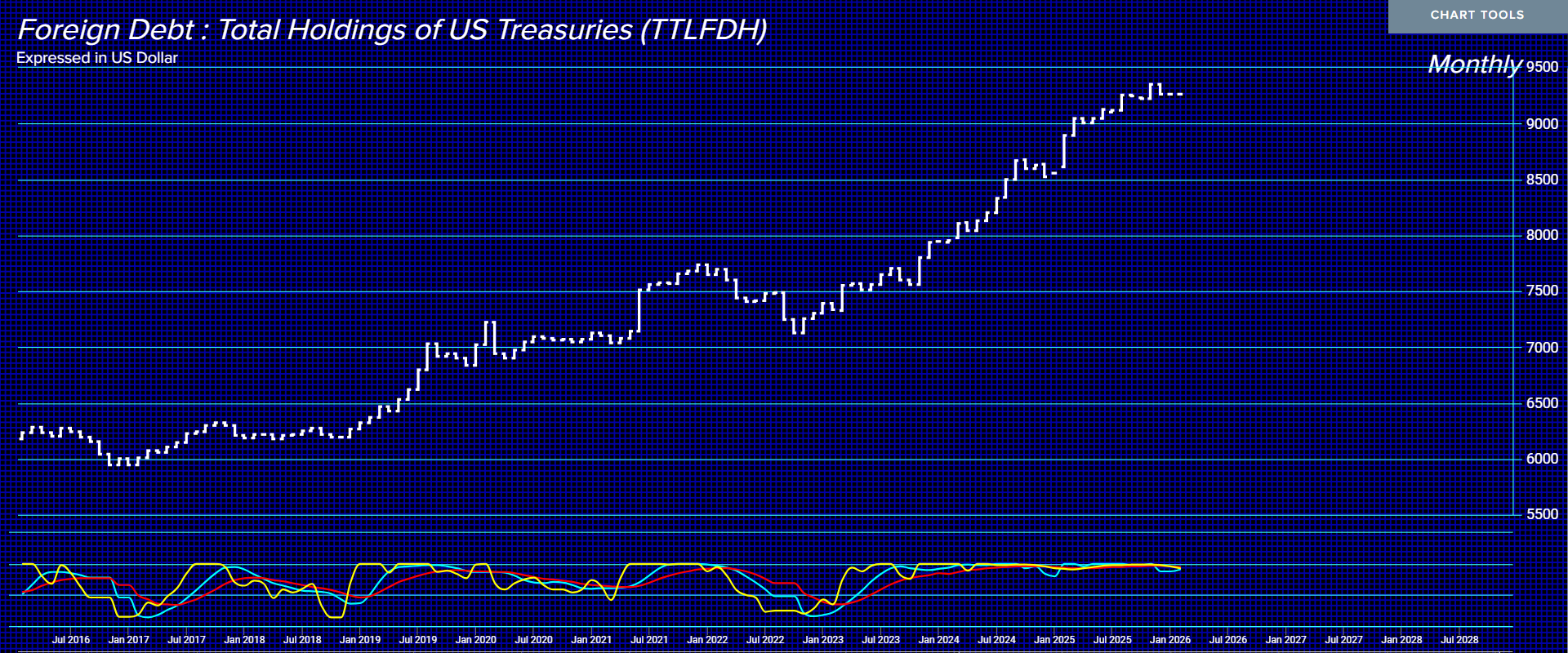
US Debt Holdings M Tech 3 26 26
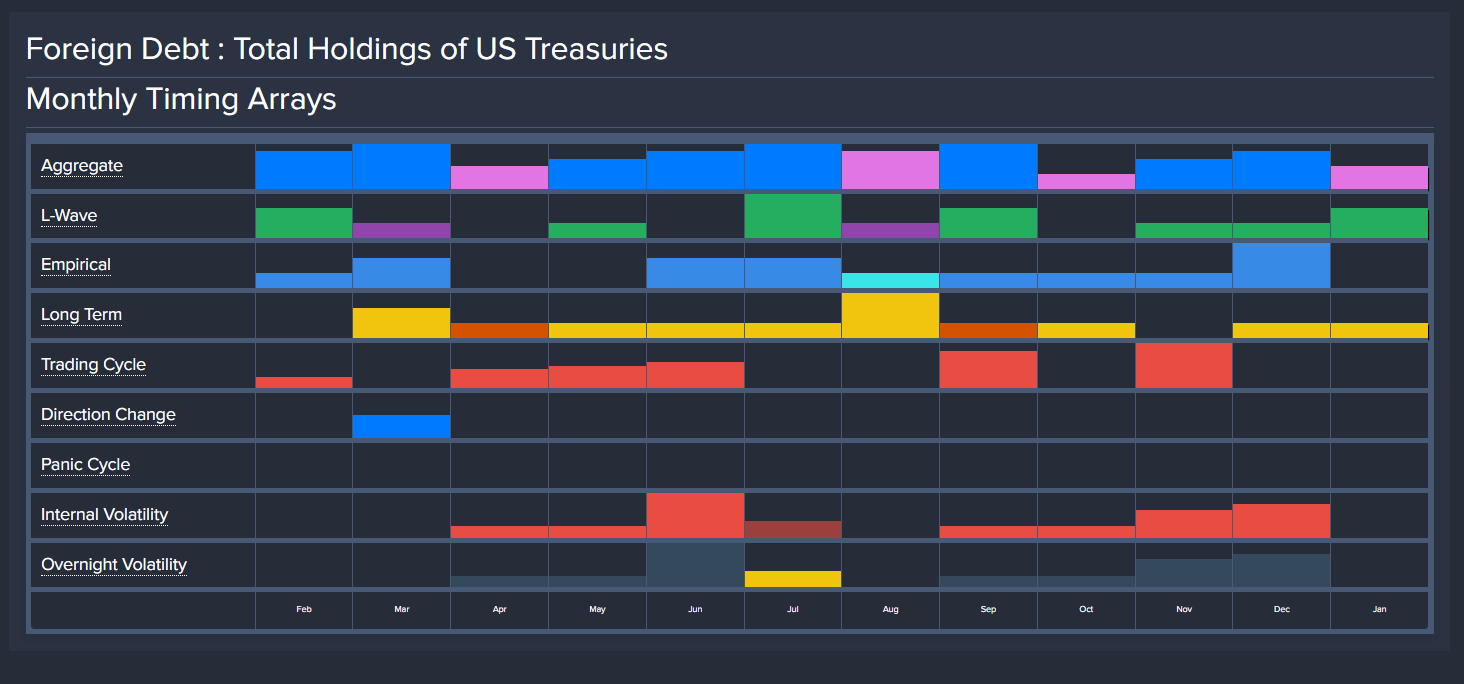
US Debt Holdings M Array 3 26 26

REPLY: Those perpetual dollar haters have been singing the same song since the 1970s. It gets frustrating for me to see the same old claims regurgitated constantly with no reflection or original analysis ever and certainly no historical investigation. As Julius Caesar once said, people believe what they want to believe, not the facts or truth.

Socrates is showing that March could be a low and we have a Directional Change and the volatility rises sharply in June. We have Panic Cycles in July even in our War Index. It is suggesting that capital flows will shift into the USA with escalating war in Europe and the Middle East. These dollar haters are generally the fiat currency crowd who have been insisting on a commodity backed currency for decades when they do not understand the first thing about the economy and how it functions globally.
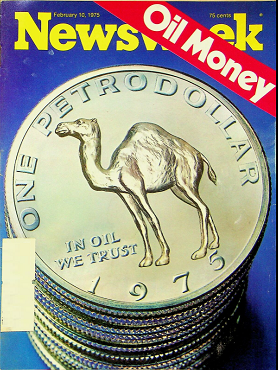
Newsweek_Feb_10_1975_Petrodollar r

The Petrodollar was a their desperate attempt to explain why the dollar did not crash after the collapse of the Bretton Woods in 1971. When the dollar did not collapse after the end of the gold standard, they had to cover-their-ass because they were WRONG.  So, to save face, they claimed that the dollar was now backed by oil rather than gold because oil was priced in dollars. They sold that BS to the press and it was pure sophistry. To this day, we still hear the conspiracy theory about the Petrodollar.

The percentage of world trade attributed to oil and petroleum products is approximately 8-10% based on the 2022 data. Merchandise Trade in 2022 globally totaled around $25 trillion (WTO data). Of that, crude oil and refined petroleum product exports worldwide were estimated to be between $2.2 and 2.5 trillion (depending on price fluctuations and trade volumes). This includes contributions from OPEC, which are only 40% of crude exports, and non-OPEC exporters like the U.S., Russia, and Canada.

The whole Petrodollar theory was absolute nonsense and it diverts people from understanding the importance of the financial capital movements. The USA has the largest consumer-based economy and everyone has to sell their products in dollars to American consumers. Comparing Per Capita Spending internationally, the US consumer spends $32,700,  European comes in at $18,000 – $22,000 (varies by country), and Japan comes in at $8,800, despite the fact that Japan is the second largest consumer-based economy.
Athens Owl 449 413BC Egyptian Imitation

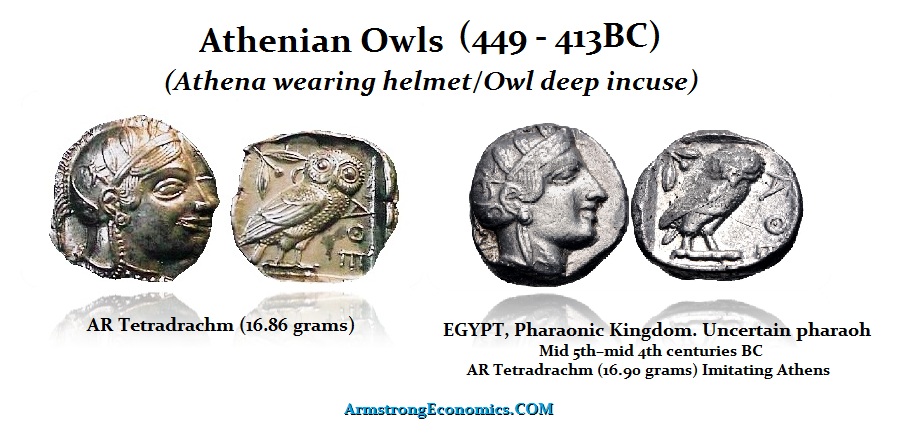
The backing of ANY currency is the productivity of the nation – it’s people. Russia is the largest country with $75 trillion in natural resources, but they are still in the ground. If a currency is would only some commodity, then Russia should be #1 and if oil backs a currency then why is Venezuela or Saudi Arabia not the reserve currency? Part of what makes a reserve currency is also military power. When Athens defeated the Persian invasion, they rose in stature. The Athenian Owl became the dominant currency in the ancient world to the point that Egypt, which never issued coinage, struck imitation Athenian Owls for international trade. The US dollar is also the reserve currency in part because of the military power.
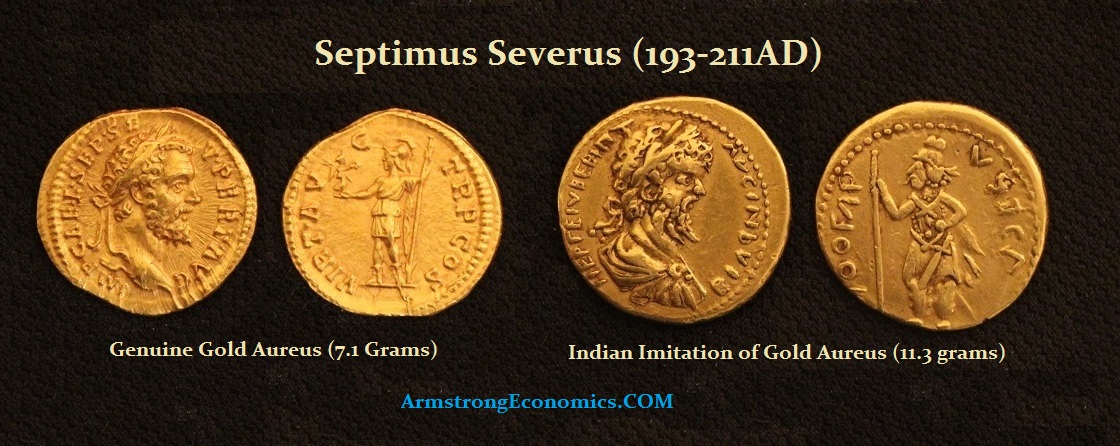
SeptimusSeverus India Imitation gold aureus R2

The Roman Empire was the first society to develop a massive, market-driven urban consumer culture on a scale never seen before. This is why you see imitation of Roman coinage produced in India for the Roman coinage carried a premium over and above the metal content. This example shows that the imitation contained more gold then original. Ancient Rome (particularly the city itself) was a consumer city—a term historians use to describe cities that consumed far more than they produced locally. Rome’s population of about one million people was sustained by:

  1. State-distributed grain (annona) paid for by taxes from the provinces
  2. Elite wealth extracted from conquered territories
  3. A vast network of imports (wine, olive oil, metals, pottery) from across the Mediterranean
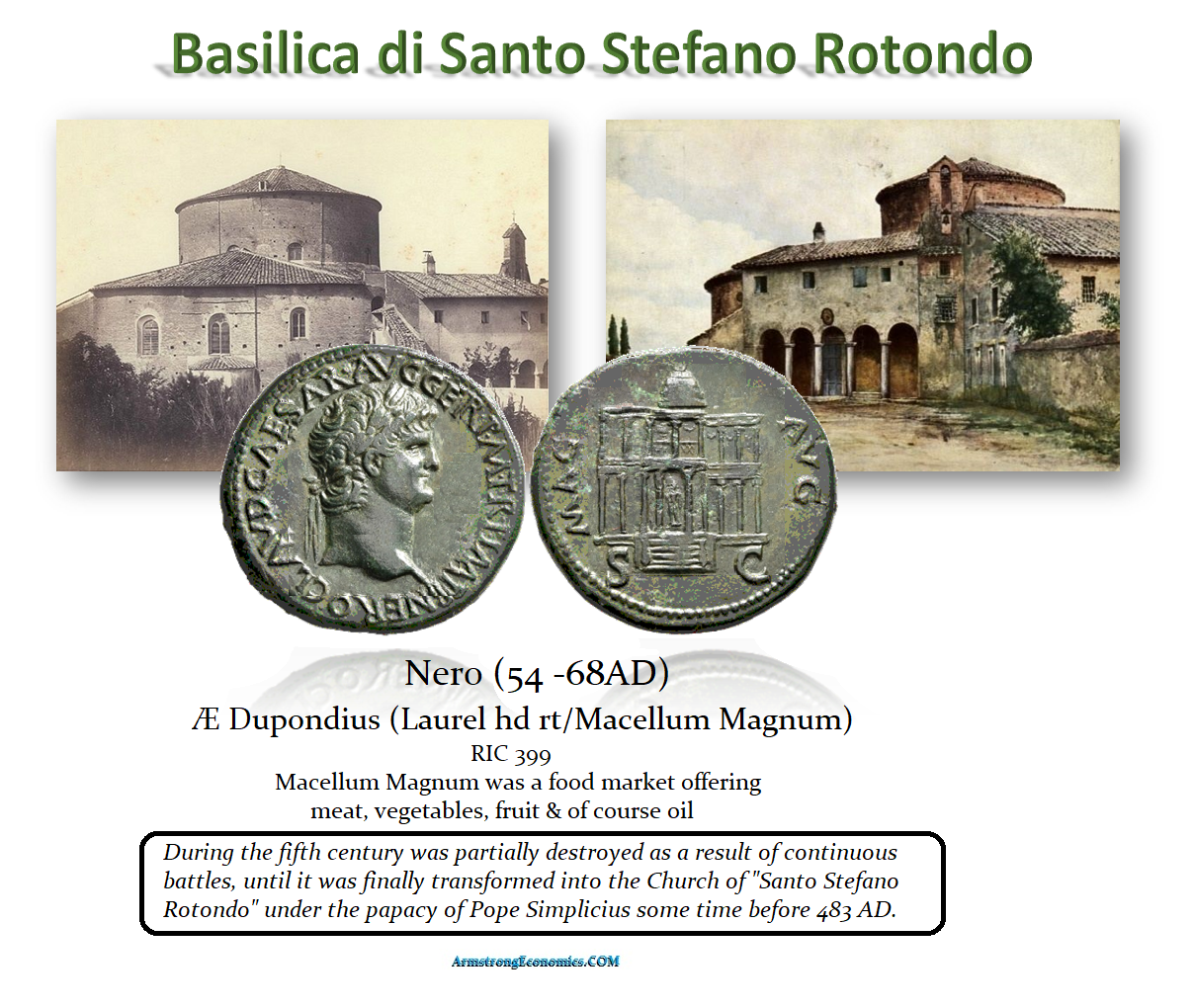
Nero AE Dupondius Macellum Magnum

This created an unprecedented concentration of demand. In Rome you found sophisticated retail shops (tabernae), competitive markets, standardized coinage, and even early forms of branding (e.g., wine amphorae stamped with producers’ names). Here is a coin of Nero announcing the construction of essentially a food mall, Macellum Magnum. This coin is a fascinating artifact because it serves both as a piece of imperial propaganda and a unique historical record of Roman urban life.
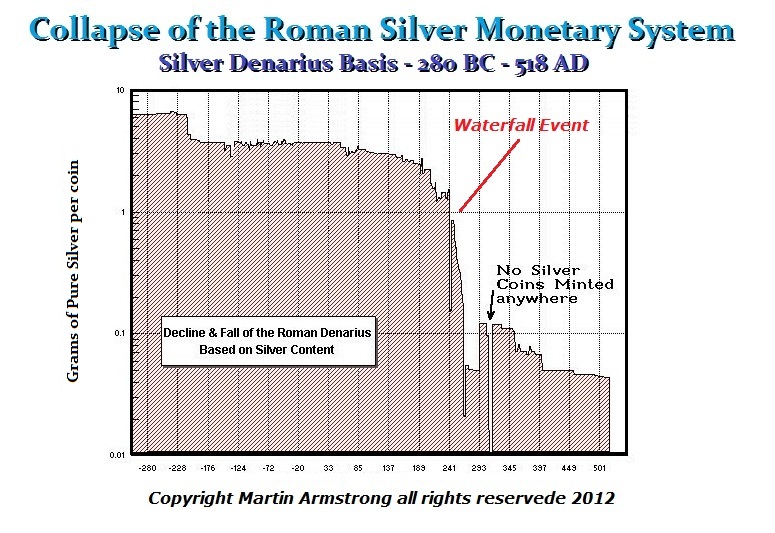
Roman decline silver content monetary system Armstrong Waterfall effect

I have explained that once Emperor Valerian I was captured by the Persians in batte during 260AD, that sent a shockwave  throughout the empire and encouraged the barbarian of the North to invade smelling Rome was weak. Thie became the crisis of the Third Century; silver denarius collapsed within just 8.6 years and provincial coinages began to come to an end. The severe debasement destroyed confidence.
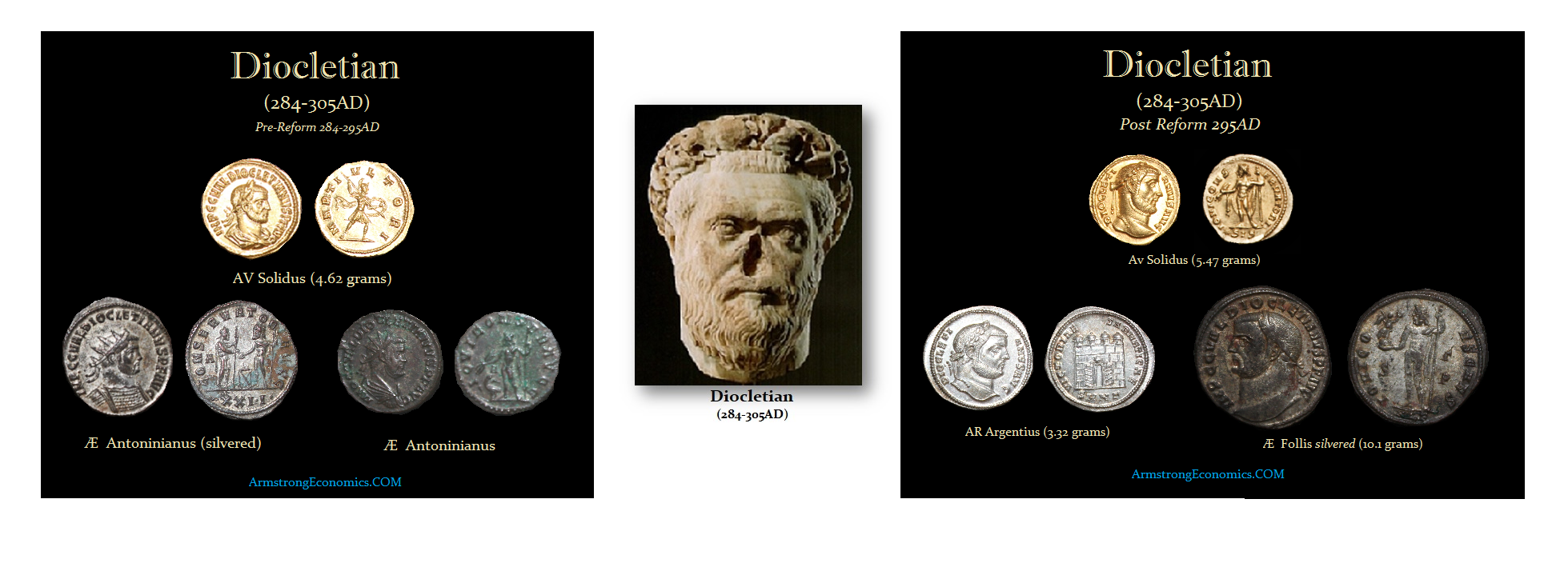
Diocletian Pre Post Reform

Emperor Diocletian (284-305AD) sought to reestablish that confidence reforming the currency. He introduced the gold solidus and new silver/bronze coinage in an attempt to revive the economy. Yet, only the gold remained stable as the silver coinage began to decline and vanish.
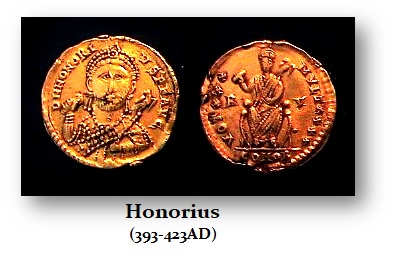
Honorius 393 423AD AU Facing

Britain was a special case of total collapse. Unlike Gaul or Italy, where some continuity was maintained, coinage in Britain came to a complete halt after the Roman departure. By about 435 AD, coins had ceased to be used as a medium of exchange. The island would not see a new, native coinage until the late 7th century. The Romans exited Britain primarily in 410 AD, when Emperor  told the cities of Britain to “look to their own defenses,” effectively ending central Roman rule. However, this was not a single event but a process over several decades, with key troop withdrawals starting as early as 383 AD.
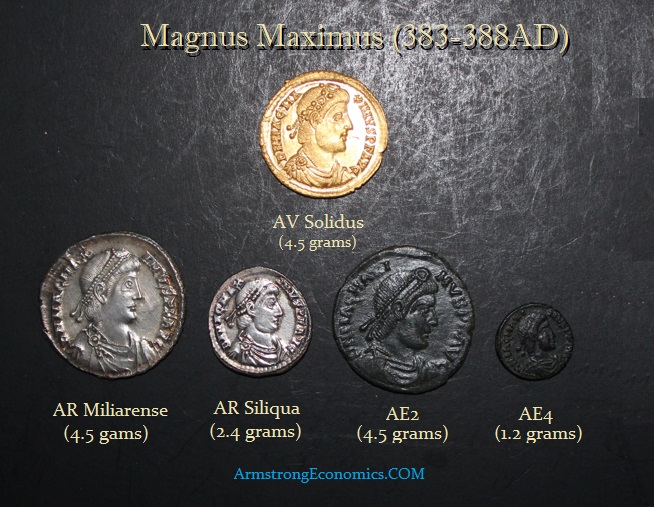
Magnus Maximus Denaminations Solidus Miliarense Siliqua AE2 AE 4

The formal break in 410 AD was the culmination of a long period of decline and withdrawal. The first major troop withdrawal came in 383AD when General Magnus Maximus took a large portion of Britain’s garrison to Gaul to launch a successful (but temporary) bid for the Roman throne. He never returned the troops, leaving local leaders in charge of defense in northern and western Britain.
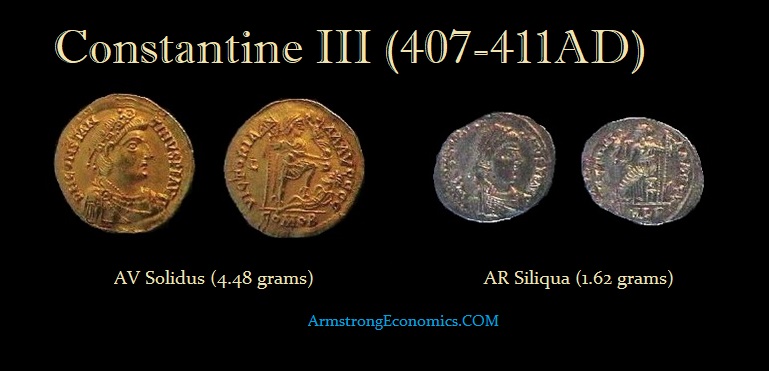
Constantine III denominations Solidus Siliqua

The usurper Constantine III stripped the remaining mobile Roman soldiers from Britain in 407AD, crossing to Gaul in another attempt to become emperor. These forces also never came back. The Formal Break (409-410 AD) came with no army for protection, facing increasing raids, and paying taxes to a distant emperor who could no longer help, the Romano-British elites expelled Roman officials around 409 D. The following year, Emperor Honorius sent his famous rescript telling the British cities to arrange their own defense, officially acknowledging the end of Roman authority.
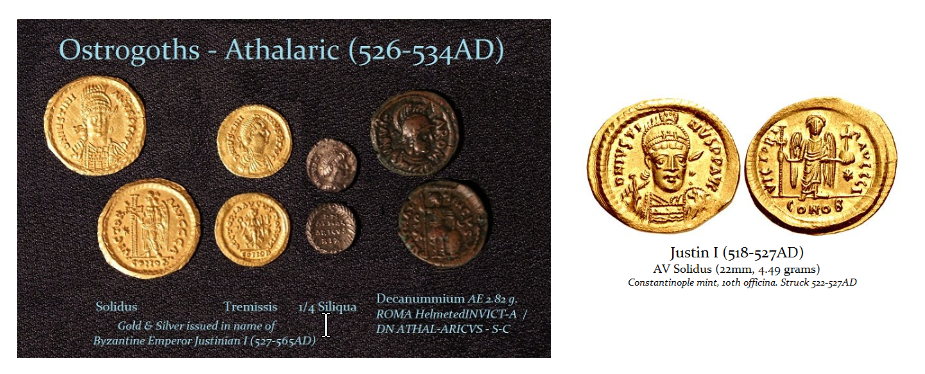
Ostrogoth Imitation


By the late 5th century, it was over for the West. Following the final loss of Roman political control, the various barbarian kingdoms (like the Franks, Visigoths, and Ostrogoths) took over the existing Roman mints. They continued to strike coins, often in the names of the remaining Roman emperors for a time, but this was the beginning of a new, post-Roman monetary system.

Crumbling Dollars

The idea that the dollar will collapse because it is fiat and is not backed by gold is just laughable. German and Japan rose to the strongest economies in their respective regions without gold. They did so by productivity.

Seasonal Hires Reach 16-Year Low


Posted originally on Sep 29, 2025 by Martin Armstrong |  

Online Shopping

Seasonal retail hiring may plummet to the lowest level since 2009. Job placement firm Challenger, Gray & Christmas expects retailers to add under 500,000 temporary positions in the final three months of the year, an 8% annual decline, and the smallest gain in 16 years. Retail depends on holiday Q4 sales for a bulk of annual revenue and the hiring trend is a glaring sign of a declining economy.

Certain retailers, like Target, stated that they plan to offer overtime hours to existing employees. Yet another sign of the times as people are eager for additional income and companies are not keen to take on additional employees.

A PwC survey from September 2025 indicates that the average person plans to spend 5% less this holiday season, down from $1,638 in 2024 to $1,552 per person. The survey has not indicated a drop in holiday sales since 2020. PwC’s figure translates to ~$413B–$460B total if scaled to ~266M adult consumers. Gen Z notably plans to spend 23% less this year as the cost of living has caused most young adults to live paycheck to paycheck, whereas boomers with sufficient savings plan to spend 5% more.

The National Retail Federation (NRF), however, predicts US retail sales will rise between 2.7% and 3.7% over 2024, reaching between $5.42 trillion and $5.48 trillion for the year. As for holiday spending, the NRF predicts a rise between 2.5% and 3.5% reaching a total between $979.5 billion and $989 billion.

Hiring trends in retail indicate that companies are less than optimistic about overall foot traffic this holiday season. Americans are spending more on less. Discretionary spending has been on the decline as inflation never meaningly waned.

Gold – Dow & People Pretending to be Me.


Posted originally on Sep 25, 2025 by Martin Armstrong |  

Gold and IBM Share Certificate

COMMENT: Mr. Armstrong, I just wanted to thank you for your ground-breaking analysis. I was a gold-only bug, and you opened my eyes to capital flows, explaining that gold rises not due to inflation, but geopolitical tensions. You have been forewarned that when Europe is flirting with war, the capital will flee, and it will be on every boat to the USA. We have gold making new highs, and the Dow is also reaching new highs. Something the gold crowd always said the opposite. You said gold could test the $5,000 level due to war as soon as 2026, I believe. At the same time, others continue to claim that the stock market will crash and revise their forecasts with every new high.

I just wanted to say you are honestly making a difference. I know people steal your work and claim it as their own. I discovered some people created channels and pretend to be you on Telegram and elsewhere. I do not understand their game. You do not solicit money. I’m not sure if they are trying to ruin your reputation. I reported what I encountered to your staff.

I know you have more money than God because you don’t raise your prices, you don’t solicit money, and you don’t sell advertising.

Please do not get discouraged.

Cheers

FDS

REPLY: Thank you for bringing that to our attention. I am not sure what is going on with people pretending to be me. I DO NOT RECOMMEND ANY STOCK INDIVIDUALLY, AND I DO NOT MANAGE MONEY. If you want to know about an individual share that is on Socrates. Some funds trade based on Socrates, but sorry, – been there, done that. I am far too busy to manage money. I am honestly working seven days a week, from 7 AM to midnight, and I still can’t get ahead of the workload. Anyone pretending to be me, telling you to buy a specific stock or promising to manage your money, is a fraud. Let our staff know.

As far as the market is concerned, I will do a Private Post this week. There can be a brief correction in the share market after this week. But it still does not appear to be a major long-term bear market or crash. As far as gold is concerned, the key resistance is really $4500 for next year. Gold has to pass that, and then it would test the $5,000 level. Exceeding that level, the expectations will then jump to $10,000. It gets dicey after $5,000.

If I had more money than God, I suppose that means people wouldn’t contribute to any church.

When Monetary and Fiscal Policies Blur


Posted originally on Sep 24, 2025 by Martin Armstrong |  

fiscal_cliff_10937_h264_19201 ezgif.com video to gif converter

The Federal Reserve should operate independently of Washington. It does not. Stephan Miran was appointed to the Federal Reserve Board of Governors by Donald Trump. Miran, who served as a top economic adviser to Trump and served as the chairman of the White House Council of Economic Advisers, switched from controlling fiscal to monetary policy and now the lines between Washington and the Fed are completely blurred.

Miran believes interest rates should eventually be cut in half. He mistakenly believes the old Keynesian theories that lower rates will result in higher employment. “The Federal Reserve has been entrusted with the important goal of promoting price stability for the good of all American households and businesses, and I am committed to bringing inflation sustainably back to 2 percent,” he said. “However, leaving policy restrictive by such a large degree brings significant risks for the Fed’s employment mandate.”

“The upshot is that monetary policy is well into restrictive territory,” he said. “Leaving short-term interest rates roughly 2 percentage points too tight risks unnecessary layoffs and higher unemployment.”

I’ve explained numerous times why this line of thinking is flawed. Businesses are not eager to take on additional debt, albeit at a lower rate, if they do not see a decent ROI in the future. Not a single client has suggested that they were waiting for rates to drop to expand their business. Look what happened in Japan when they artificially lowered rates to zero for decades. The economy stagnated because confidence was lost.

The reason politicians love low rates is not to help the people but to help government. With the US national debt now spiraling out of control, every uptick in rates increases the cost of debt service. Trump knows this. Biden knew it too. Every administration eventually leans on the Fed to keep rates down because the alternative is insolvency.

Trump appointed Miran for a reason. Powell was unwilling to play into politics, but Miran, a voting member of the FOMC, is an installed loyalist who will ensure the government’s ability to borrow continues.

Interview: Europe’s Economic Turmoil, Political Uprisings, & Global Tensions


Posted originally on Sep 21, 2025 by Martin Armstrong |  

Interview: Gold, Stocks, Geopolitical & Dollar Surge


Posted originally on Sep 20, 2025 by Martin Armstrong |  

Coffee Prices on the Rise


Posted originally on Sep 19, 2025 by Martin Armstrong |  

Coffee

Coffee prices are the latest grocery item troubling American consumers. The United States is the world’s largest importer of coffee, but produces less than 0.1% of all coffee for domestic consumption, importing over $8.2 billion (1.6 metric tons) of coffee last year alone. The average retail price of coffee spiked 21% in the past year, marking the sharpest rise since the late 1990s.

Tariffs are certainly part of the problem. Brazil produces around 37% of the world’s coffee, but now faces a 50% tariff on coffee beans. The average price of Brazilian coffee now sits around $6 per pound. Brazil also experienced a depleted harvest in 2024-25 due to drought and unfavorable weather conditions. The harvest was 9% beneath traditional levels. Global production rose by 4.3 million bags, but was offset by lower stocks, and prices remained high. The US spent $1.41 billion last year on Brazilian coffee alone, and a 50% tariff in addition to increased prices is causing grocers and retailers to raise prices.

Brazil and Colombia primarily focus on Arabica beans, with Colombia being America’s second-highest importer. In far contrast to Brazil, Colombia’s tariff sits at 10%. Still, the US purchased $1.4 billion in coffee beans from Colombia last year and any levy will be felt by consumers. Colombia’s 2024-25 coffee harvest was extremely robust at 13.2 million bags, a 23% increase from the previous year. Farmers believe production will fall by 5.3% in the coming harvest due to weakening La Nina conditions and heavy rain.

Vietnam supplies 17% of the world’s coffee, but the US mainly relies on South America for imports. Vietnam’s tariff sits at 20% and many roasters have complained that this is affecting their bottom line. Same with Indonesia, which has a 19-32% levy.

Brazilian coffee exports to the US have fallen by nearly 46% since tariffs were imposed. While the US consumed 15% of Brazilian coffee exports, Germany was close behind at 14% and has surpassed the US to become the top buyer. It is undeniable that tariffs on Brazil have caused a spike in US coffee prices, which has been exacerbated by a weak harvest.

Fed Cuts 25BPS


Posted originally on Sep 17, 2025 by Martin Armstrong |  

Federal Reserve Bank

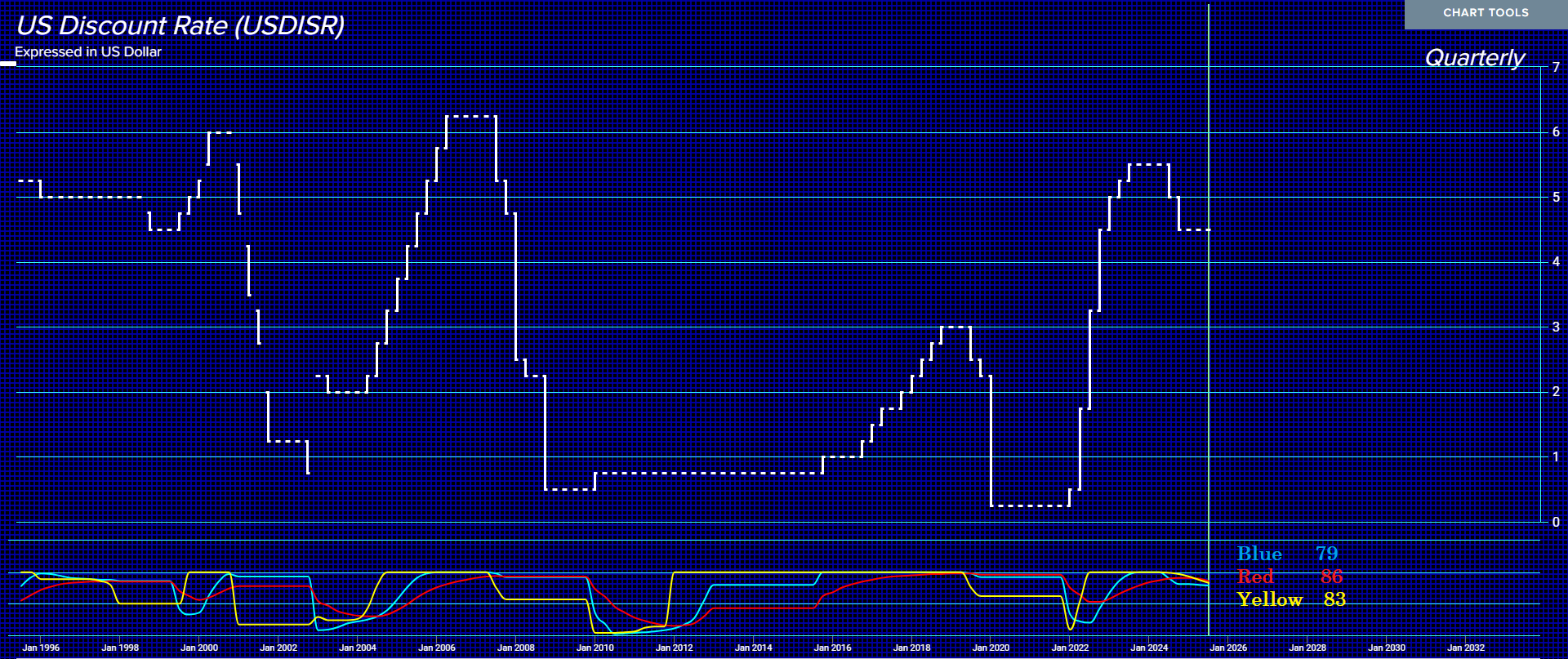
Members of the Federal Open Market Committee (FOMC) voted to reduce the benchmark federal funds rate by 25 basis points, setting the new target range at 4 percent to 4.25 percent. The Fed statement was clear, with one dissenter, Stephen Miran, who recently joined.

“Recent indicators suggest that the growth of economic activity moderated in the first half of the year. Job gains have slowed, and the unemployment rate has edged up but remains low. Inflation has moved up and remains somewhat elevated,” the FOMC said in a statement.

The market was widely expecting a 25 basis point cut in rates, as our computer has been forecasting for months that any cut would be in September, not before. However, there were the typical groups of questionable analysts touting that a 50 basis point cut could lead to a more significant market rally.

With the prospect of war on the horizon and a sovereign debt crisis brewing in the EU, there are realistic expectations for a continued decline. The risk is that Trump will interfere in the Fed, leading to a loss of confidence worldwide, which would result in unrealistic interest policy into early 2026. There remains the risk of another cut during the next quarter.

Fed Discoint CBDR Q 9 17 25

Quarterly vs Semi-Annual Earnings Reports


Posted originally on Sep 16, 2025 by Martin Armstrong |  

Balance Sheet

President Donald Trump believes that companies should cease reporting on a quarterly basis and switch to semiannual reports instead. Trump said that the concept is “subject to SEC approval” and would “save money, and allow managers to focus on properly running their companies.”

JPMorgan Chase CEO Jamie Dimon and Warren Buffett also once voiced support for semiannual reporting. “In our experience, quarterly earnings guidance often leads to an unhealthy focus on short-term profits at the expense of long-term strategy, growth and sustainability,” the pair wrote in an op-ed piece for the Wall Street Journal in 2018.

The SEC currently has a 3-1 Republican voting majority, but why does this seem to be a bipartisan issue? The issue is global, in fact, as Norway’s sovereign wealth fund recently proposed switching to semiannual reporting, and the UK and Europe do not currently require quarterly reports. Providing the consumer and investor with less, infrequent information alludes to bad news. Companies would willingly share praise of quarterly earnings with the public if they were bullish on their future, but in the current stagflationary trend, companies are cautious. Those at the top are losing confidence in their company’s ability to meet or exceed expectations.

Dimon and Buffett argued that the public’s attention should be on the long-term results. That aligns with Buffett’s buy and hold strategy but does not work for most portfolios that require investment strategy changes based on incoming data. In Trump’s personal predicament, the price adjustments due to tariffs are a reason to halt quarterly reporting.

Still, lowering transparency raises market risk, and the markets do not respond well to volatility. Columbia Law School published an article that looked at the 2017 regulatory adjustment on the Tel-Aviv Exchange (TASE) when small-cap firms switched from mandatory quarterly reports to semi-annual updates. “The  stocks of firms that chose that option dropped an average of 2 percent in price in a window of (-5,+5) days,” the analysis found. “Conversely, the stock of firms that chose to continue quarterly reporting rose an average of 2.5 percent over an immediate window of (-5,+5) days.”

The study also noted that while compliance costs dropped by 19.8% by eliminating two annual reports, the firms that chose to maintain four annual reports did not see a significant change in audit fees. There was a clear trade-off between cost reduction and maintaining investor confidence, the study noted.

The US markets cannot be compared to the TASE, and that 2% reduction in investment would likely rise for US firms, as consumer confidence is absolutely paramount. The proposition of semi-annual reports stems from the belief that companies will be unable to provide optimistic earnings reports. Reducing reporting fees is not the concern, and the repercussions are vast as massive portfolio shifts would ensue as investors and money managers need to reduce risks and would be less likely to take short-term risks if the data is unavailable to them. Reducing transparency would shake up confidence in the markets overall, and as mentioned, capital does not like volatility.

Ep 3723a – Is Gold Telegraphing What Is Happening? Trump Is Resetting The World Economy


Posted originally on Rumble By X 22 Report on: September 4, 2025