President Trump Delivers Remarks on Hurricane Dorian Recovery – (Video and Transcript)…


While traveling aboard Air-Force-One, President Trump held a briefing with officials on the aftermath of Hurricane Dorian, and allowed the traveling press pool to participate. [Video and Transcript Below]

.

[Transcript] THE PRESIDENT: So we were going to take a helicopter to Emerald Isle in North Carolina, which was hit very, very hard. Atlantic Beach was hit very hard. Certain areas were really hit. The Governor is with me. Roy, thank you very much for being here.

GOVERNOR COOPER: Sure, Mr. President.

THE PRESIDENT: The Governor was standing in the rain for a long time, along with a lot of talented people that have really helped us a lot. Lindsey, I’m glad you’re here with us, and we appreciate it very much. And Kevin is here someplace.

ACTING SECRETARY MCALEENAN: I’m behind you.

THE PRESIDENT: Where’s — hello, Kevin. Thank you. Thank you for being here.

We have a big rally tonight for Dan Bishop. I was going to go from Emerald Isle right back into the rally, but now we’ll be very early for our rally. That’s the one thing. But it was, I guess, Roy, they say very dangerous flying conditions. I said, “Let’s do it anyway.” They said, “Sir, we’d rather not.” So, I said, “Okay, I’ll take your word for it.” The greatest pilots in the world.

We will be spending a little time. We’re going to be given a presentation as to what’s happening in North Carolina and a little bit about a couple of the other places. I just spoke to Governor Henry McMaster, and they’re in great shape in South Carolina. They’ve done a really good job.

Roy, maybe I could ask you to say a few words —

GOVERNOR COOPER: Yes, sir.

THE PRESIDENT: — and what you need from the federal government.

GOVERNOR COOPER: Yes, sir. First, Mr. President, thank you for coming to North Carolina. We’ve enjoyed our working relationship probably too much. With FEMA, we’re glad to have Mr. Gaynor here with us. And, of course, we’ve had the FEMA team embedded with us at our Emergency Operations Center in Raleigh.

This is the third hurricane that has crossed the coast of North Carolina in less than three years. So this is something that we take very seriously. The widespread damage of Dorian did not approach the damage that we had from Florence and Matthew, but it was still significant in some parts.

We’ve had three deaths in North Carolina related to the storm. Two of them were people who fell off ladders while they were trying to get their house boarded up for the storm. And the other death happened post-storm, with a chainsaw accident with cleanup. We still have about 3,500 people without power, but we had a couple of hundred thousand at one point.

THE PRESIDENT: Right. They’ve done a great job.

GOVERNOR COOPER: One of the hard-hit areas is Ocracoke Island, which they said it’s the worst that they had ever seen. I talked to a man who had a house built in the 1870s, and they had never seen it that bad.

The power is still out there. We’re providing food, resources, working with all of our federal and local partners to provide help there.

The place that you were going to go, Emerald Isle, as the storm approached, it had an EF2 tornado hit an RV park. I toured it on Saturday. The damage was significant. Many homes absolutely destroyed. We had issued an evacuation order, and therefore, most of the people were gone. The few people who were there survived and are lucky that they are alive. And they — I’m sure they appreciated the fact that you had planned to go and see. And I know we have local government officials here who were ready.

We have a nuclear power plant at Brunswick which had to be powered down as the storm him. Today it’s powered back up, and we think everything is okay with that. We still have about 20 road closures. We don’t have anything approaching the last two storms, but we still have some there. We’ve got 125 National Guard activated now, down from 577.

What we would request, Mr. President, is an expedited disaster declaration for both debris removal and for emergency protective measures. And we’ve got joint preliminary damage assessments going on right now with state, FEMA, local, trying to determine the extent of the damage.

And the other thing that I’d like to mention is that Hurricane Florence hit this state badly, and you were here for that, but —

THE PRESIDENT: That’s right.

GOVERNOR COOPER: — less than a year ago. And we have a number of people who were — are not in their homes yet that were affected by Dorian. So any help that you can give us with HUD publishing the Federal Register for the CDBG-DR money for Hurricane Florence —

THE PRESIDENT: Right. We will do that.

GOVERNOR COOPER: — we would appreciate. We’ve had a good relationship with Secretary Carson, but there’s a couple of things that would be helpful, I think, long term with CDBG-DR money, which would, one, be a universal application for all disaster survivors that would work with FEMA, would work with SBA, that would work with HUD. I think that would slim things down and make it a lot easier.

THE PRESIDENT: We’ll look into that.

GOVERNOR COOPER: And also, maybe codifying the CDBG-DR money instead of the Federal Register. And I know there’s legislation in both the House and the Senate for that.

I have with me my Secretary of Public Safety Erik Hooks, who is behind you there. We’re grateful for his work and our local partners we have here too, Mr. President.

THE PRESIDENT: Good. We’ll you’ve done a great job. Thank you very much, Roy.

GOVERNOR COOPER: Thank you, sir.

THE PRESIDENT: Erik, would you like to say something?

MR. HOOKS: Yes, sir, Mr. President. From my aspect, I’d like to emphasize the partnerships that we have all throughout the Department of Homeland of Security, the Coast Guard, FEMA. They’re always at the table. And they’re at the table when things are relatively peaceful.

So when a tragedy in our all-hazards approach hits us, we’re ready and we’re partnered, and those relationships are strong.

THE PRESIDENT: Thank you very much.

GOVERNOR COOPER: Mr. President, if I could add one more thing. The Admiral is here and we were in communication throughout the storm. But the Coast Guard did amazing work, both during Florence and during Dorian. They helped us rescue a man from Ocracoke Island and helped to bring him off, and worked closely with our National Guard. We’re grateful for our Coast Guard and our relationship with them.

THE PRESIDENT: They’ve been so incredible. I’ve always said, for the last three or four years, there’s no brand that has gone up more than the United States Coast Guard. In Texas, they saved thousands and thousands of lives. They’ve done a job like I’ve never seen. Then you went to Florida. Then you went to Puerto Rico. Then you went back here. And the job you’ve done in the Bahamas has been incredible. So please extend my wishes to everybody, Admiral.

Would you like to say something?

ADMIRAL SMITH: No — Mr. President and Governor Cooper, I just — the Coast Guard was just glad to be part of the team. We have a great relationship with the state, with our federal partners, local partners, and we were happy to be part of the team.

As you know, as this storm came up, we flowed in resources —

THE PRESIDENT: Yeah.

ADMIRAL SMITH: — and were ready to respond. And then the focus was providing response when needed, and then opening the ports as quickly as possible. We did that, and I think it went about as well could be expected, sir.

THE PRESIDENT: You’ve done a fantastic job. How are the new Coast Guard cutters?

ADMIRAL SMITH: They’re doing great, sir. We had to flow them out of the region, but we flowed them back in. And they were the first to get offshore to provide response.

THE PRESIDENT: But they’re great. They’re both great.

ADMIRAL SMITH: They’re outstanding. Yes, sir. They’re outstanding.

THE PRESIDENT: It’s what you needed, right?

ADMIRAL SMITH: Absolutely, sir.

THE PRESIDENT: We got them. We got them. They were getting very old. Now you have brand new beauties, right?

ADMIRAL SMITH: Yes, sir, Mr. President.

THE PRESIDENT: That’s very good.

ADMIRAL SMITH: We’re in good shape, sir.

THE PRESIDENT: Kevin, would you guys like to say something?

ACTING SECRETARY MCALEENAN: Absolutely. Thank you, Mr. President. As you know, we’re here in support of our state partners. And Governor Cooper and his team, Commissioner Hook, have been outstanding throughout the effort.

I’d like Administrator — Acting Administrator Pete Gaynor to give you a little bit of sense of the preparations that we had in place in the initial response, and, of course, we’re doing the joint naval assessments now.

THE PRESIDENT: Good. Pete?

ACTING ADMINISTRATOR GAYNOR: Yes, sir. As soon as we realized that Dorian bypassed U.S. Virgin Islands and Puerto Rico and was not going to touch land again, (inaudible) and the NRCC, the National Response Coordination Center, which you visited the other day, was big storm, big response. And we had staff, material, equipment from Miami to Fort A.P. Hill, Virginia, making sure that we could provide all the governors, to include Governor Cooper, whatever they needed from not only FEMA but from the federal family.

And, again, it takes partnerships to make it all happen. And when it works well, it’s a great thing to see. So I thank everyone here that is part of the federal team.

THE PRESIDENT: And I have to say, Ron DeSantis and Brian Kemp and — Henry has been fantastic in South Carolina. Henry McMaster and yourself. The governors have really done a fantastic job. They’ve worked. Whether it’s Republican, Democrat, doesn’t matter. In this case, we’re talking about one that’s on the other side, and the relationship was perfect, right? We have a really good relationship.

And we’re working to get it all together. I want to say that FEMA, first responders, law enforcement has been incredible. Really on the ball. And they were ready in Puerto Rico. Everybody thought it was going to hit Puerto Rico, and we were all set. And, fortunately, it missed Puerto Rico. What it did to the Bahamas is incredible. And the government of the Bahamas has asked us to help. And we have a lot of assets over there, right now, trying to help. That’s really a life-saving mission, when you get right down to it. But the Coast Guard and FEMA and all of you have done a fantastic job.

Would you like to say anything in front of the camera?

ACTING SECRETARY MCALEENAN: No, sir.

THE PRESIDENT: Okay. Lindsey Graham, please?

SENATOR GRAHAM: Well, I want to thank you for calling Henry. To my friends in North Carolina, I used to be a reservist at Seymour Johnson. You all have been hit really hard. And, unfortunately, our delegations in South Carolina and North Carolina are getting pretty good at turning the funds around. And Kevin and Nancy work well together.

So we got to fund the government entirely by the end of the month. But I promise you, we’ll do everything we can to get the money flowing. And being your neighbor, I’m really sorry. I know it’s been really hard up here.

So, thank you, Mr. President.

THE PRESIDENT: Well, thanks. You’ve done a great job. Thank you, Lindsey, very much.

And, Leader, what do you think? You’re working, I know, with the Democrats, and we’re getting things approved rapidly. How’s it going?

HOUSE MINORITY LEADER MCCARTHY: Yeah. I think it’s working well. The only thing, I do want to credit and thank all of you for how well everybody has worked together. The coordination, knowing how this storm would change course, the modeling continuing to go, and just the preparation. I know you saved a lot of lives by the preparation you do.

Our responsibility, Lindsey and others, is making sure the resources are there. And there was — as we talked to FEMA ahead of time, there was enough money. And if there’s more needed, we’ll continue to work towards it.

THE PRESIDENT: Thank you very much, Kevin. And, Admiral, thank you for keeping me in touch. He was with me all the way. No matter where I went, the Admiral was right there. And you let us know. And we were able to do a lot of good by being there. So, thank you.

Would you have anything to say, Admiral?

ADMIRAL SCHULTZ: Just, with regard to the Bahamas — because much of the attention has shifted there now, Mr. President — USAID, the Agency for International Development, their Office of Foreign Disaster Assistance, has been the coordinating lead working directly with the government of the Bahamas, responding to their request for the most acute humanitarian needs of the Bahamian people.

And as you’ve talked about, it’s a very concentrated area of the Bahamas that was affected. The rest of the Bahamas, almost the size of the state of California, is unaffected and open for business. So, Bahamians are helping Bahamians, evacuating people to other sections of the Bahamas that have not been affected. And not only the United States, but foreign governments and non-governmental organizations are all also there in force, providing the humanitarian aid that’s needed.

THE PRESIDENT: So, people are unaware of the fact, for the most part, that the Bahamas is a much bigger place than people would understand, than most people would understand. So you’re actually moving large numbers of people into safer areas and areas that weren’t affected in the Bahamas by the hurricane.

ADMIRAL SCHULTZ: Right, sir. The government of the Bahamas is actually doing that, assisted by others, moving people from the most affected islands, generally the Abaco island which was really damaged —

THE PRESIDENT: Right.

ADMIRAL SCHULTZ: — toward Nassau, which is an area of the Bahamas that was relatively undamaged that has the resources to help those folks out.

THE PRESIDENT: That’s great. They’ve really done a great job. Thank you very much.

So, we have now people standing on line, trying to get into the arena. And I will tell you that they are soaking wet, because Roy and everybody just walked under the plane, and you folks were wet. It is bad weather out there. But we have a tremendous crowd, and we’re going to be there in a little while. We’re going over a little bit earlier than anticipated.

So, I hope you’re going to be able to join us, and we’ll have some fun. It’s going to be a good rally.

Yes.

SENATOR GRAHAM: Mr. President, I forgot to mention one thing. The budget agreement that you helped negotiate with the House and the Senate — no agreement is perfect, but if we had not done the budget deal, we’d go back into sequestration. You would not be having new ships.

THE PRESIDENT: It’s true.

SENATOR GRAHAM: The biggest winners were the DHS and the military as a whole. So in times like this, I appreciate what you did on the budget because sequestration would have been devastating.

THE PRESIDENT: And I think it’s really important to say, Mexico has passed it, Canada has passed it. The USMCA is vital for our country, the economics of our country. You have two countries that have gone through the process fully. And we’re waiting for an approval from the House. I think the Senate will approve it rapidly. So we hope they can get that moving. It’s a great thing for us.

The farmers — even the unions are really liking it a lot. And we’re going to make certain little changes. But Bob Lighthizer is dealing with Nancy Pelosi. I think they’re getting along very well. Steve Mnuchin is involved. And hopefully they can get a vote on that very quickly — the USMCA. Very important. Thank you.

Okay. Thank you, folks. Thank you all very much. Thank you.
END 5:14 P.M. EDT

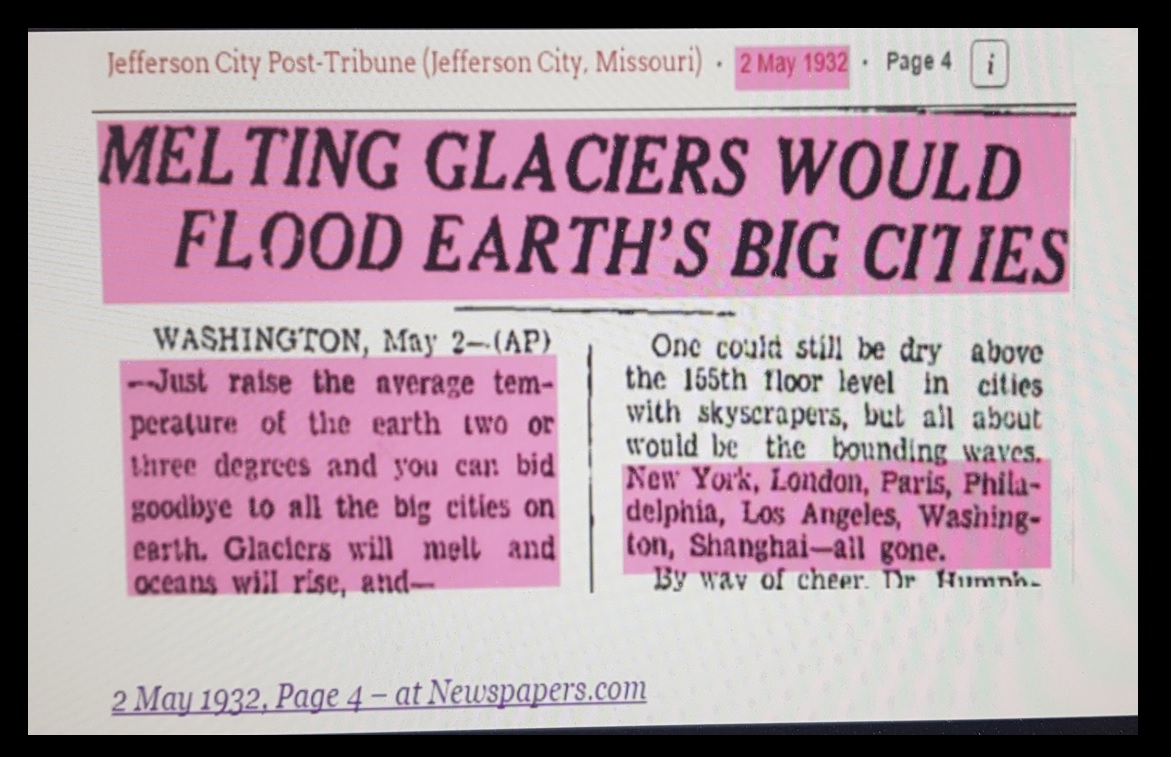
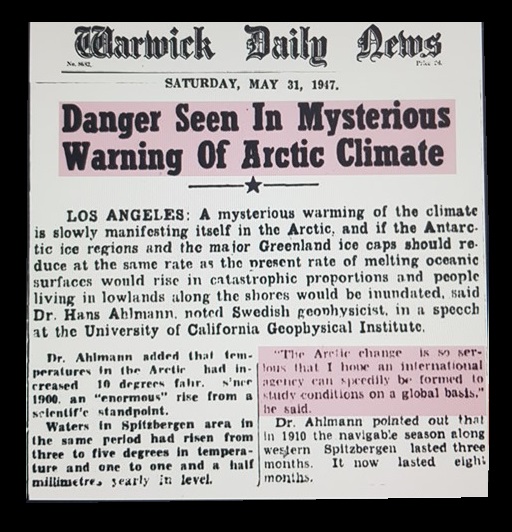
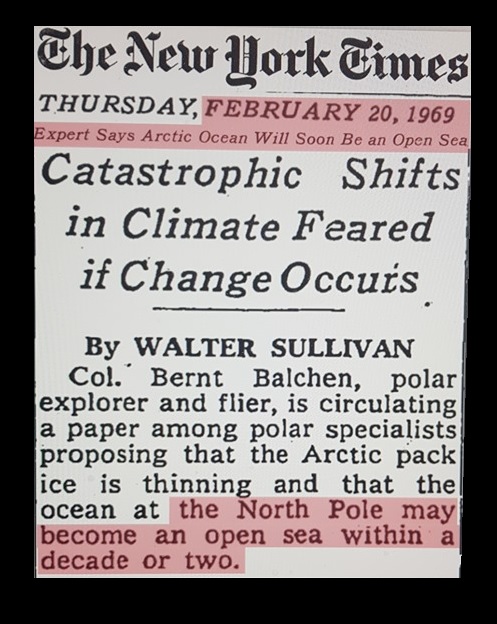
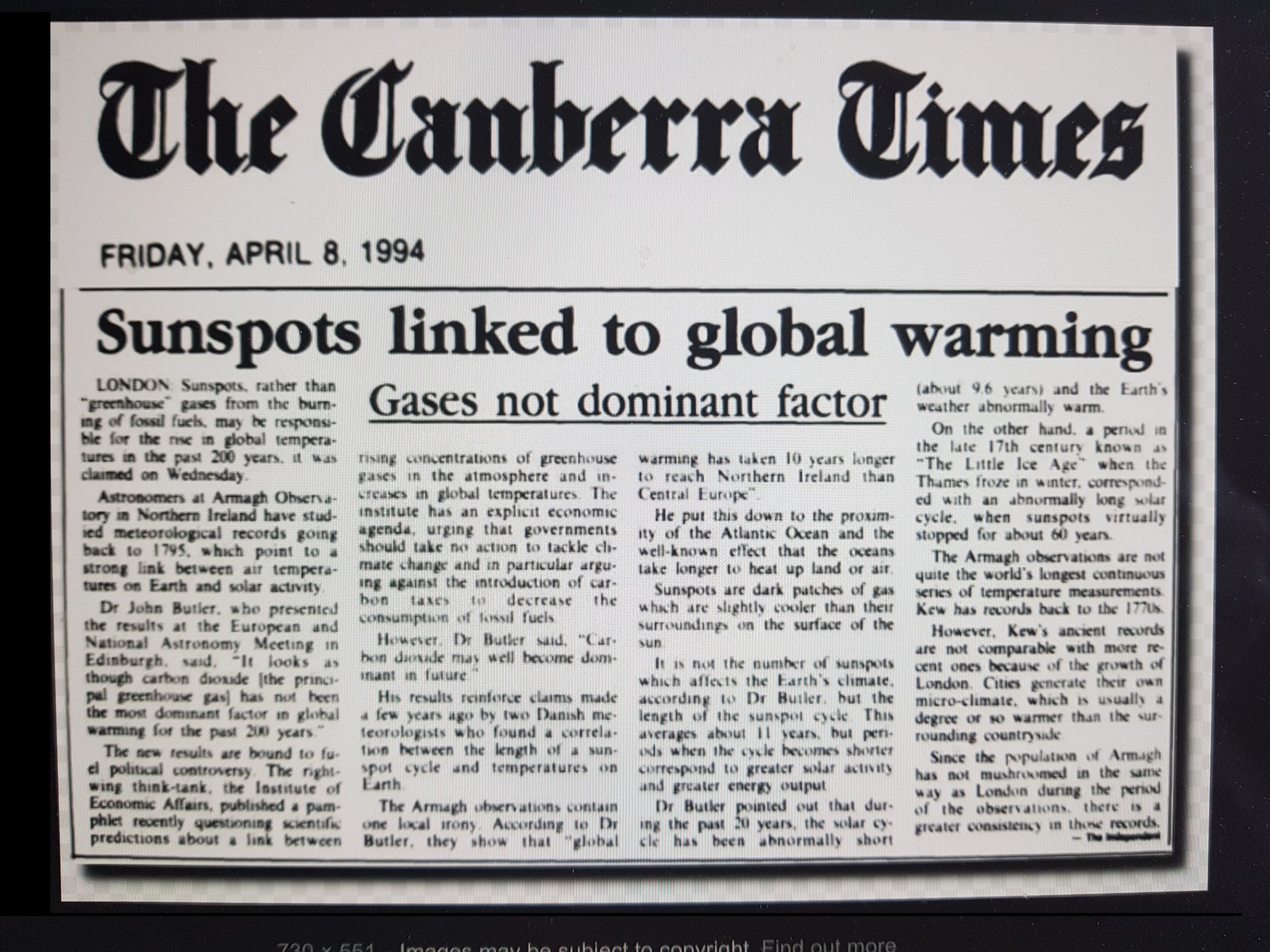
Climate Change Has been a Routine Scare Tactic Since the 1930s


QUESTION: Is there a pattern?

C

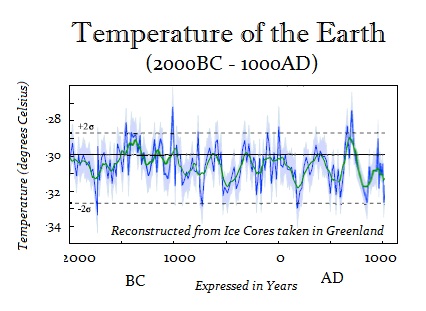
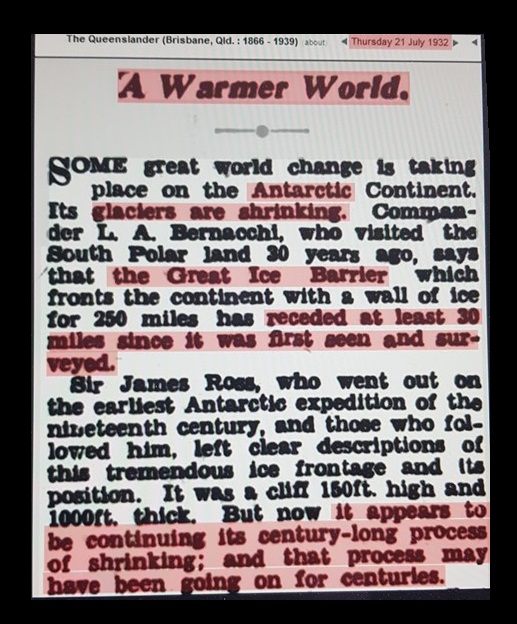
ANSWER: For whatever reason, these people have been promoting that the cities will all sink and we are the cause of it all. They have been touting this scenario since the 1930s when there was the Dust Bowl. It resurfaced after World War II when they were trying to stop rebuilding industry and the housing market which had been destroyed. The same argument appeared again in the 1960s when there was a great expansion in housing.

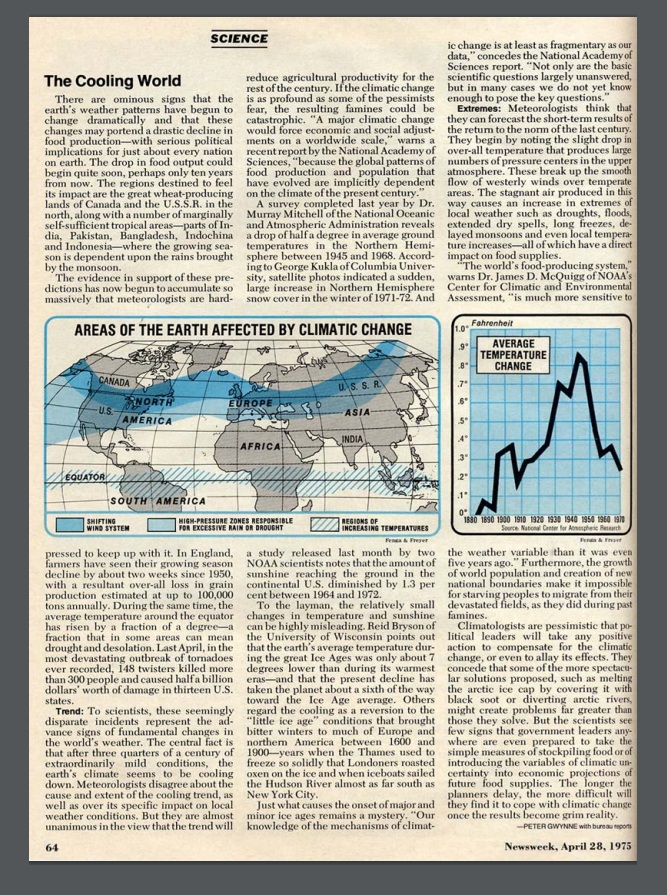
However, during the 1970s when things got colder, everything flipped upside down and then it was global cooling that would destroy civilization. On April 28, 1975, Newsweek magazine published an article in which they sounded the alarm bell and proposed solutions to deliberately melt the ice caps:

“Climatologists are pessimistic that political leaders will take any positive action to compensate for the climatic change, or even to allay its effects. They concede that some of the more spectacular solutions proposed, such as melting the arctic ice cap by covering it with black soot or diverting arctic rivers, might create problems far greater than those they solve. But the scientists see few signs that government leaders anywhere are even prepared to take the simple measures of stockpiling food or of introducing variables of climate uncertainty into economic projections of future food supplies.”

Then TIME magazine’s January 31, 1977 edition had the cover story featuring “The Big Freeze.” They reported that scientists were predicting that Earth’s average temperature could drop by 20 degrees fahrenheit. Their cited cause was, of course, that humans created global cooling. It just seems that humans are so powerful we can alter the universe but cannot manage to create corrupt-free governments.
The difference this time is they have been able to get governments interested on the basis that they can stop it by raising taxes. Canada imposed a $1,000 tax per home to stop global warming. Perhaps the theory is if the politicians get more money they will speak less and reduce the hot air they spout out by yelling the end is near.

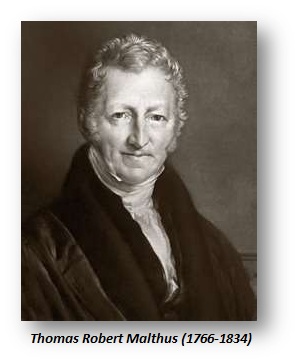
I see this as a derivative of the Populationists theory which was instituted by Thomas Robert Malthus (1766-1834). It was Malthus who first published his “Essay on the Principle of Population as it Affects the Future Improvement of Society” in 1798. He published it anonymously, afraid to put his name on it, but he was soon discovered to be the author. Malthus argued that the resources of production would be exceeded by the population leading to real misery.

Malthus’ theory proved to be completely wrong because he too failed to comprehend that there are cycles to everything. He never considered the cycle in technology and how farming has improved from ancient times up to his own time during the 18th century. Of course, food production has more than kept pace with population growth and even the population goes through cycles. Currently, birth rates have been declining. Then there are diseases and plagues that visit our societies, not to mention war, which all combines to thin the herd so to speak.

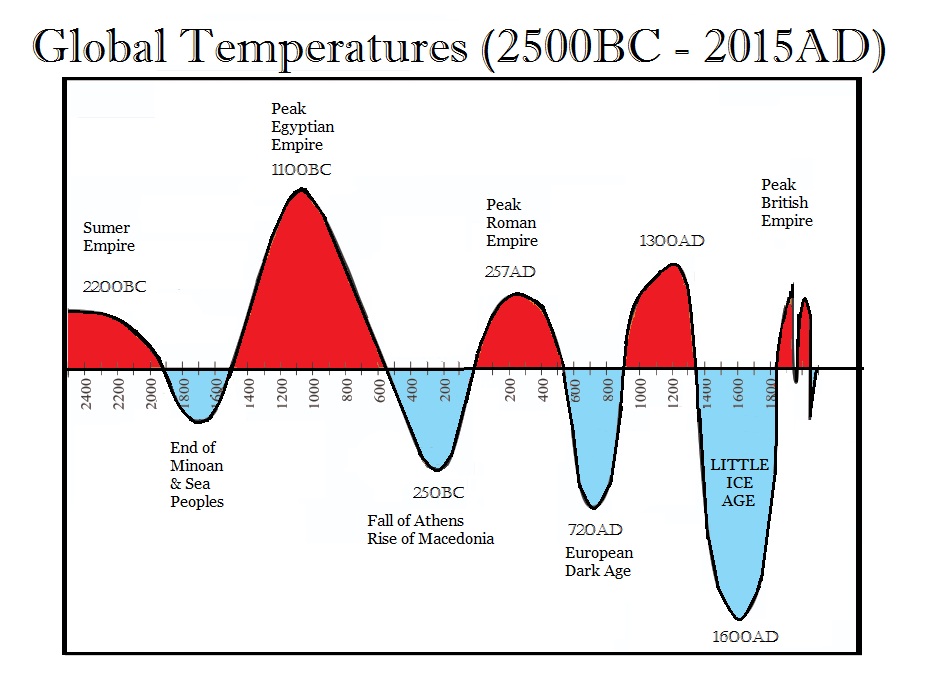
The climate has ALWAYS moved cyclically. Anyone who dares to argue that climate change is NOTcaused by humans is ridiculed because this is a political issue being used to raise taxes and to regulate human activity by removing ever-greater proportions of our human rights and freedom. Those who attack anyone who denies human-induced climate change are either brainwashed or have a self-interest in the entire scam

Erasing America’s Hot Past


Real Climate Science Erasing Americas Hot past

http://www.realclimatescience.com/erasing-americas-hot-past/

The US used to have many very hot summers, with the worst being 1936. Watch this presentation on Real Climate Science and learn what the government is doing with the data. I have personalty review the same data that was used here and I agree 100% with the conclusions. The planet has gotten warmer which is not surprise as if you live long enough you will experience cool periods and warm periods and we are in the end of a warm period. It will coon be getting cooler and the planet will not melt.

Green Tyranny: Exposing the Totalitarian Roots of the Climate Industrial Complex


Climate change was political long before Al Gore first started talking about it. In Green Tyranny, Rupert Darwall traces the alarming origins of the green agenda, revealing how environmental scares have been deployed by our global rivals as a political instrument to contest American power around the world

Horrific Reports From Bahamas in Dorian Aftermath – A Topography Changed Event…


Steve Harrigan reports from Abaco Island in the Bahamas as search and rescue efforts continue.  The scale of the devastation is incredible; everything is gone, and worse yet the topography has changed removing the ability of deep water ports to be used in/around most of the northern Bahama islands.  The anticipated death toll is expected to be dramatic. [Disturbing Content]

.

The duration of Hurricane Dorian has changed the underwater topography making access to the Island communities even more difficult, if not impossible. The Bahamian National Emergency Management Agency and the Royal Bahamian Defense Force have warned all ocean vessels to stay clear of the Northern Bahama islands.

The equipment needed, and the fuel to make the equipment operational, is not able to reach the Islands because the underwater topography has changed. Deep water channels and port routes need to be remapped.  Most previous ports in/around the Northern Bahamas are no longer feasible for use.  What used to be deep water is now shallow water.

Air crews from the U.S. Coast Guard and U.S. Military are working under the authority granted by the Bahamian National Emergency Management Agency and the Royal Bahamian Defense Force to reach as many island residents as possible.  However, the mass delivery of tonnage is severely limited by the inability to open the airports and use fixed wing carriers.

Large ships cannot port, and hovercrafts are needed to avoid the issues with topography changes. All coastal maps are essentially useless around Abacos and Grand Bahama Island. Near shore navigation is currently impossible for large vessels.

This recovery effort is going to be complex and long duration.

As of Friday at 9 a.m.:

Coast Guard crews have rescued 205 people in the Bahamas since Hurricane Dorian began.

The Coast Guard is conducting air operations based out of Andros Island, Bahamas. Seven MH-60 Jayhawk helicopters and five MH-65 Dolphin helicopters are conducting search and rescue missions, area assessments and providing logistical support.

Port Condition Zulu is in effect for the Port of Savannah and Brunswick, Georgia.

Port Condition Zulu is in effect for the Port of Charleston, South Carolina.

Eight Coast Guard cutters are staged near the Bahamas ready to engage in Hurricane Dorian response efforts.

For their safety, the Coast Guard advises mariners to not attempt voyages into the Northern Bahamas until further notice due to the devastating effects of Hurricane Dorian.

The Government of the Bahamas is currently assessing its northern ports and harbors to determine if they are safe to enter. There is a high risk of debris in the water, sunken vessels, and destroyed or missing aids to navigation and pier facilities. There is also a risk of chemical spills and changes to the topography/hydrology in ports and marinas from the prolonged winds and storm surge of the Category 5 hurricane.

The Coast Guard is supporting the Bahamian National Emergency Management Agency and the Royal Bahamian Defense Force, who are leading search and rescue efforts in the Bahamas.

If you are in a life-threatening situation and need assistance, call 911 or 919 in the Bahamas, or call the Bahamian National Emergency Management Agency at 242-325-9983 or the Bahamian Emergency Operations Center at 242-362-3895 or 242-362-3896.

During Port Condition Zulu, no vessels may enter or transit within ports without permission of the COTP. All vessel movements are prohibited, and all ship-to-shore operations must cease. (link)

Global Warming is Undermined by New Discoveries


Nobody wants to listen to the evidence against Global Warming because the government doesn’t hand out money for research that fails to justify new taxes. Real scientists have just discovered a massive previously unknown source of nitrogen that could turn the Global Warming nonsense on its head. My bet is that it will be ignored. There is too much money on the table to just walk away.

This new discovery may dramatically change those dire global warming forecasts that are now a religion. The findings were published in the prestigious Journal Science, whereby the previous eco-science assumed the only source of nitrogen was the atmosphere. Scientists recently discovered that the planet holds vast storehouses of nitrogen, which is essential for plant life, in its bedrock.

This new discovery alters the entire theory behind Global Warming caused by humans. The University of California at Davis environmental scientist and co-author of the study, Ben Houlton, said, “This runs counter the centuries-long paradigm that has laid the foundation for the environmental sciences.”

Now, pay very close attention to the word “paradigm” which he is using. Clearly, if Houlton’s discovery of a vast storehouse of nitrogen is correct, then it would have an enormous impact on global warming predictions. Why?

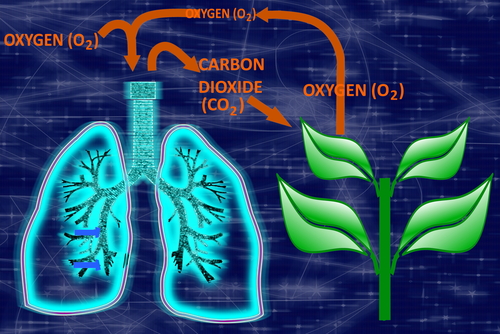
Climate scientists have long known that plants offset some of the effects of climate change by absorbing and storing CO2. But climate scientists assumed that the ability for plants to perform this function was limited because the availability of nitrogen in the atmosphere was limited.

A 2003 study published in the same science journal stated, “There will not be enough nitrogen available to sustain the high carbon uptake scenarios.” You see scientists who have NOT been on the payroll for Global Warming understand this is all nonsense. Ronald Amundson, a soil biogeochemist at the University of California at Berkeley, publicly told Chemical and Engineering News that “If there is more nitrogen there than expected, then the constraints on plant growth in a high-CO2 world may not be as great as we think.”

Remember high school science class? Remember that with more nitrogen available, then plant life will still grow? And guess what, they absorb more CO2 than climate scientists have been estimating. That means the dire forecasts that we have 12 years to live being championed by AOC and the Democrats are completely inaccurate. The planet won’t warm as much with plant life absorbing the CO2 mankind pumps into the atmosphere.

Nevertheless, because this field of research is not under global warming grants, we should not expect this information to ever make it to the mainstream media

Finally Moving – 5:00pm Update Hurricane Dorian – Storm Weakens, Expands, Begins Northward Movement…


Hurricane Dorian has begun moving north, finally starting to lessen the impact on Grand Bahama Island.  The strongest winds have diminished to 110 mph, but the wind field has expanded and now covers 60 miles from center.  The storm surge along the U.S. Southeast is anticipated to be very significant through all tide cycles.

At 500 PM EDT (2100 UTC), the center of Hurricane Dorian was located near latitude 27.7 North, longitude 78.7 West. Dorian is moving toward the northwest near 6 mph (9 km/h), and a slightly faster motion toward the northwest or north-northwest is expected tonight. A turn toward the north is forecast by Wednesday evening, followed by a turn toward the north-northeast Thursday morning.

On this track, the core of Hurricane Dorian will move dangerously close to the Florida east coast and the Georgia coast tonight through Wednesday night. The center of Dorian is forecast to move near or over the coast of South Carolina and North Carolina Thursday through Friday morning.

Maximum sustained winds are near 110 mph (175 km/h) with higher gusts. Dorian is expected to remain a powerful hurricane during the next couple of days.

Dorian has become a larger hurricane. Hurricane-force winds extend outward up to 60 miles (95 km) from the center and tropical-storm-force winds extend outward up to 175 miles (280 km). (more)

If you are near the southeastern coast of the United States please pay attention to the instructions from local officials.  If you are in the mid-Atlantic region, your preparation should be rushed to completion. Anyone asked to evacuate please follow the advice your local officials.  No-one likes to leave their home; but safety must be the number one priority.

In the next several days recovery crews will begin reaching Grand Bahama Island.  Our thoughts and prayers are with those residents who survived two days of sustained hurricane ferocity; and our appreciation for those who now head into the aftermath as they attempt to rescue and recover.


Do We Face Global Cooling or an Ice Age?


QUESTION #1: You expect global cooling due to the decrease in solar energy. Why do glaciers melt?

MG

QUESTION #2: Now that the Greenland Glacier is growing, is this part of the shift back toward global cooling? Do you think we are headed to an ice age?

FH

ANSWER: There appears to be a 20-year cycle in the Arctic to begin with. The mere fact that at times the Northwest Passage has been ice-free and ice blocked proves there is a cycle to absolutely everything. The Arctic has not always been frozen. There are documented accounts from 1817 when the ice melted. The point is nature functions in a cyclical manner — hello, remember four seasons?

I do NOT believe we are heading into an “Ice Age” of such a dramatic duration. All the data clearly shows that we are in a declining trend with each warming peak being less than the former. Anyone who thinks humans have caused this last warming period just listens to propaganda and ignores all the historical evidence. There is ABSOLUTELY no period in history absent of a cycle — NONE!!!!

From an objective and unbiased view, yes, we will see a cooling period. However, this will most likely be just a retest of the last low of the Little Ice Age. I would not speculate on an Ice Age coming, just a swing downward in temperature enough to cause us a lot of inconveniences.

The Greenland Glacier is growing again at the edges because the water is colder. That seems to be in line with the downturn in the energy output of the sun since 2015. The global cooling puts food production at risk. Sure, there are those who just refuse to believe this since global warming has become a religion. The herd may be thinned for their propaganda will ensure they are unprepared for food shortages.

Constantly there are stories about how the data has been manipulated and outright forged. Now China’s scientists have come out and warned of global cooling, not warming. These scientists are not reliant on Western government grants and do not need to fix the data to support the global warming agenda.

The problem with the people who refuse to listen is a similar qualification for being the worst investor in history. You can claim you are right all you want, but when the market goes against you and you refuse the look at your assumptions, you end up dead broke. Perhaps literally after jumping from a window. That is the downside to bias. Always consider both sides.

5:00pm Hurricane Dorian, Category 4, Stationary Over Grand Bahama Island – FL, GA, SC, NC Monitoring…


It’s impossible to find words to describe what the people in Grand Bahama island must be going through.  More than 24 hours inside a 90-mile wide buzzsaw of sustained  cat-5/cat-4 winds, stationary over a populated island, is beyond comprehension.

Two, perhaps three, complete tide cycles; plus 20 feet of storm surge, plus the catastrophic wind must be completely overwhelming the land mass of the island… A topography changing event.  We pray for those who still have hours left amid this storm.

At 500 PM EDT (2100 UTC), the eye of Hurricane Dorian was located near latitude 26.8 North, longitude 78.4 West. Dorian has become nearly stationary this afternoon. A slow westward to west-northwestward motion is expected to resume overnight and continue into early Tuesday. A turn toward the northwest is forecast by late Tuesday, with a northeastward motion forecast to begin by Wednesday night.

On this track, the core of extremely dangerous Hurricane Dorian will continue to pound Grand Bahama Island into Tuesday morning. The hurricane will then move dangerously close to the Florida east coast late Tuesday through Wednesday evening and then move dangerously close to the Georgia and South Carolina coasts on Wednesday night and Thursday.

An Air Force Reserve Hurricane Hunter aircraft has found that maximum sustained winds are near 145 mph (230 km/h) with higher gusts. Dorian is a category 4 hurricane on the Saffir-Simpson Hurricane Wind Scale. Although gradual weakening is forecast,
Dorian is expected to remain a powerful hurricane during the next couple of days.

Hurricane-force winds extend outward up to 45 miles (75 km) from the center and tropical-storm-force winds extend outward up to 150 miles (240 km). (more)

Hurricane Dorian 11:00pm Update – Expanded Warnings and Watches on FL East Coast, A Few Miles Can Make a Big Difference…


Major category-5 hurricane Dorian continues to pummel the Bahamas as it slowly tracks west toward the Florida coast.  The storm is anticipated to turn North, but the timing of that right turn will make all the difference.  A few miles further West could mean full hurricane force winds against the Florida east coast. [Planning/Info Resource Here]

All residents in the watch and warning areas should heed the evacuation notices of local officials.  With winds of 180+ MPH Dorian is a very serious threat.

[Hurricane Center] At 1100 PM EDT (0300 UTC), the center of Hurricane Dorian was located near latitude 26.6 North, longitude 77.9 West. Dorian is moving toward the west near 6 mph (9 km/h). A slower westward to west-northwestward motion is forecast during the next day or so, followed by a gradual turn toward the northwest.

On this track, the core of extremely dangerous Hurricane Dorian will continue to pound Great Abaco and Grand Bahama islands overnight and through much of Monday. The hurricane will move dangerously close to the Florida east coast late Monday through Tuesday night.

Maximum sustained winds are near 180 mph (285 km/h) with higher gusts. Dorian is a category 5 hurricane on the Saffir-Simpson  Hurricane Wind Scale. Slow weakening is forecast, but fluctuations in intensity could occur couple of days. Regardless, Dorian is expected to remain a powerful hurricane during the next few days.

Hurricane-force winds extend outward up to 45 miles (75 km) from the center and tropical-storm-force winds extend outward up to 140 miles (220 km). (read more)

Florida Disaster Information including evacuation orders Here.

FL Division of Emergency Management

@FLSERT

View image on Twitter

FL Division of Emergency Management

@FLSERT

FL Division of Emergency Management

@FLSERT

60 people are talking about this